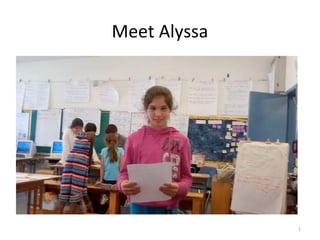
Meet Alyssa
1
Close Reading
Anchor Standard 1:
Read closely to determine what the text says explicitly
and to make logical inferences from it; cite specific
text evidence when writing or speaking to support
conclusions drawn from the text.
What is your definition of close reading?
What do you do when you chose to read closely?
What motivates you to read closely?
2
How do you see
your students as readers?
How do they read?
How much support do they need?
When and what are they reading?
3
Reflect On Instructional Practices
Name three ways you teach
students to understand the text they are reading.
4
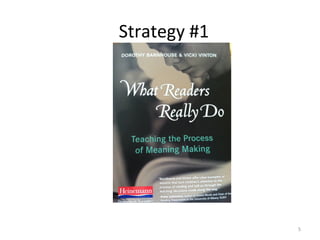
Strategy #1
5
What do proficient readers do?
Understand text structure
Tolerate confusion
Expect clarity as they read on
Hold on to questions
Make and connect inferences to establish context
Develop hunches
Gather evidence to prove
Draft an understanding
Revise hunches when answers are revealed
6
Strategy 1: KNOW/WONDER
Simple – Transferable
Makes thinking visible
Students are successful
Promotes independence
7
The Tiger Rising
That morning, after he discovered the tiger, Rob
went and stood under the Kentucky Star Motel
sign and waited for the school bus just like it was
any other day.
What We Know What We Wonder
8
The Kentucky Star sign was composed of a yellow neon
star that rose and fell over a piece of blue neon in
the shape of the state of Kentucky.
What We Know What We
Wonder
9
Rob liked the sign; he harbored a dim but
abiding notion that it would bring him good
luck.
What We Know What We
Wonder
10
Know / Wonder Strategy
What strikes you about this strategy?
… as a reader
… for your students
11
Know / Wonder
Students grounded in text
Ideas are changed based on text evidence
Structure creates visible thinking while reading
Allows for independent work that can be built on
12
Tips to Introduce Know / Wonder
Teacher charts/Teacher models
Students try at places teacher stops
Students revise wonders when prompted,
teacher charts
Gradual release 1. Students do more charting
2. Whole Group k/w
3. Student k/w and chart
13
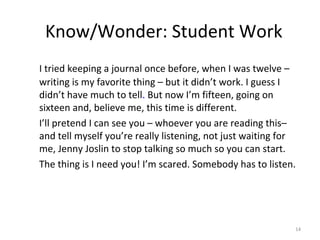
Know/Wonder: Student Work
I tried keeping a journal once before, when I was twelve –
writing is my favorite thing – but it didn’t work. I guess I
didn’t have much to tell. But now I’m fifteen, going on
sixteen and, believe me, this time is different.
I’ll pretend I can see you – whoever you are reading this–
and tell myself you’re really listening, not just waiting for
me, Jenny Joslin to stop talking so much so you can start.
The thing is I need you! I’m scared. Somebody has to listen.
14
Analyze Student Work
What did the student do well?
Did they identify the character,
what the character wants, problems?
Did their wonderings grow out of the text?
What did they miss? Why?
verbs, pronouns, vocabulary, words that convey emotion,
text structure…..
How well did they use the know/wonder strategy?
Next steps for this student?
15
Where my students had trouble
K/W great for beginning,
but as story progresses students
needed a less tasking strategy
16
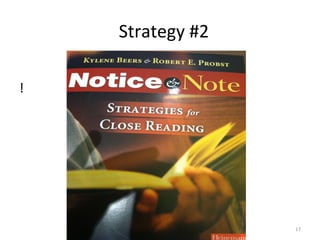
Strategy #2
!
17
Development of the Strategy
• Authors were middle school/university instructors
• Noticed students plowing through text with minimal
reflection; dependent on teachers for thought
• Considered the Common Core’s emphasis
• Read 25 most commonly taught books grades 4-8
• Found common elements (signposts) in text
• Developed lessons for and questions connected to the
“signposts”
• Lessons were tested with teachers and students
throughout the country
18
Six Signposts
*1. Contrasts and Contradictions-- When a character does
something that contradicts expected behavior
*2. Aha Moment-- When a character realizes, understands or figures
out something
3. Tough Questions-- When a character asks herself a very difficult
question
4. Words of the Wiser-- When a character (probably an older or
wiser character) takes the main character aside and offers advice
5. Again and Again-- When you notice a word or phrase or situation
mentioned over and over
6. Memory Moment-- When the author interrupts the action to tell
you about a memory
19
Contrasts and Contradictions
When a character acts in a way that is
different than you would expect.
Anchor Question:
Why would the character act this way?
Your answer may lead to a prediction or an
inference about plot or conflict
20
AHA Moment
When a character realizes something that
changes his actions or his understanding of
himself, others or the world around him.
Anchor question:
How might this change things?
Your answer may lead to understanding the
conflict or the lesson learned.
21
You Try It!
Find the Signposts in the short story
“Spaghetti”
from Every Living Thing
by Cynthia Rylant
Densely packed literature
Connected thematically
22
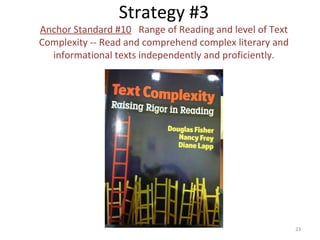
Strategy #3
Anchor Standard #10 Range of Reading and level of Text
Complexity -- Read and comprehend complex literary and
informational texts independently and proficiently.
23
Text Complexity
Consider Quantitative Measures
Levels of meaning, complexity of ideas
Structure or design of narrative/exposition
Language, vocabulary, sentence structure
Knowledge demands
24
Text Complexity
Consider Qualitative Measures
Reader interest
Student background
Student attitudes/maturity
25
Strategy #3:
Reading Multiple Times with Purpose
1. First read: Students Read Independently
2. First discussion: Partner talk to check
meaning
3. Second discussion: Assessing
understanding
4. Second reading: Teacher-led shared
reading and think aloud
5. Third reading: Text dependent questions
26
27
1. First Reading
Students read independently with a pencil
Circle/underline confusing parts
Note what they know/learned/wonder
28
2. First Discussion
Students discuss what they
learned/know/wonder with a partner
Teacher listen in noting where troubles lie
29
3. Second Discussion
Have students share their thinking
with whole group
30
4. Shared Reading
Teacher reads text
Students read along with copies of text
Teacher incorporates think aloud covering areas
students struggled with
31
5. Third Discussion:
Text Dependent Questions
Teacher designed text dependent questions
Purpose of question is to encourage re reading and
looking for text evidence
Two questions with “right there” evidence
Two questions that require inference or synthesis
32
“Right There” or Literal Questions
for the Beyonce Article
1. Celebrities appear in a lot of advertising.
How much is a lot?
2. You try it: Create a “right there” question.
33
Text Dependent Questions
Requring Synthesis or Inference
3. How do you think Beyonce justifies selling
soda?
4. You try it: Create a question that would
require synthesis or inference
34
Next Steps: Debate
• Teacher re reads the text with the purpose of
students developing a point of view
• Students have the copy of the text
• Students mark evidence to prove their position
• After reading have students take a position then face
an opponent for debate
• Provide time for each side to prove their point with
evidence from the text
• Students rebut arguments by conferring with like
minded students
• Journal or essay writing
35
Resources
Storyworks – Grades 3-5
Scope- Grades 6-7
Bi Monthly
Short Story, Poetry, Plays
Non Fiction, Opinion
High Interest, Lexiled Articles
36
Resources
Weekly News Magazines:
Scholastic News
News Articles
Text Features
Supplement Non Fiction Work
High Interest
37
Resources: Short Story Collections
Every Living Thing. by Cynthia Rylant
All Together at One Time, by E.L. Konigsburg
What Do Fish Have to Do With Anything, by Avi
Friends: Stories about Old Friends, New Friends and Unexpectedly True
Friends, Edited by Ann M. Martin
Tripping Over the Lunch Lady, Edited by Nancy E. Mercado
Be Careful What You Wish for, Edited by Lois Metzger
Hey World Here I Am!, by Jean Little
The Year We Missed My Birthday, Edited by Lois Metzger
Dog to the Rescue, by Jeannette Sanderson (non fiction)
Sports Shorts, by Joseph Bruchac, David Lubar and 6 others
Girls Got Game, Edited by Sue Macy
38
Resources: Short Story Collections
Baseball in April, by Gary Soto
Throwing Shadows, by E.L. Konigsburg
Twelve Impossible Things Before Breakfast, by Jane Yolen (fantasy)
Strange Happenings, by Avi (fantasy)
Unicorn Treasury, by Bruce Coville ( fantasy)
Americas Streets, A Multicultural Anthology, Edited by Anne Mazer
House on Mango Street by Sandra Cisneros*
13, Thirteen stories that capture the agony and ecstasy
of being thirteen, Edited by James Howe*
Dear Bully, Edited by Megan Kelly Hall*
Shelf Life, Stories by the Book, by Gary Paulsen*
* Middle School content
39

Close reading2

  • 1.
  • 2.
    Close Reading Anchor Standard1: Read closely to determine what the text says explicitly and to make logical inferences from it; cite specific text evidence when writing or speaking to support conclusions drawn from the text. What is your definition of close reading? What do you do when you chose to read closely? What motivates you to read closely? 2
  • 3.
    How do yousee your students as readers? How do they read? How much support do they need? When and what are they reading? 3
  • 4.
    Reflect On InstructionalPractices Name three ways you teach students to understand the text they are reading. 4
  • 5.
  • 6.
    What do proficientreaders do? Understand text structure Tolerate confusion Expect clarity as they read on Hold on to questions Make and connect inferences to establish context Develop hunches Gather evidence to prove Draft an understanding Revise hunches when answers are revealed 6
  • 7.
    Strategy 1: KNOW/WONDER Simple– Transferable Makes thinking visible Students are successful Promotes independence 7
  • 8.
    The Tiger Rising Thatmorning, after he discovered the tiger, Rob went and stood under the Kentucky Star Motel sign and waited for the school bus just like it was any other day. What We Know What We Wonder 8
  • 9.
    The Kentucky Starsign was composed of a yellow neon star that rose and fell over a piece of blue neon in the shape of the state of Kentucky. What We Know What We Wonder 9
  • 10.
    Rob liked thesign; he harbored a dim but abiding notion that it would bring him good luck. What We Know What We Wonder 10
  • 11.
    Know / WonderStrategy What strikes you about this strategy? … as a reader … for your students 11
  • 12.
    Know / Wonder Studentsgrounded in text Ideas are changed based on text evidence Structure creates visible thinking while reading Allows for independent work that can be built on 12
  • 13.
    Tips to IntroduceKnow / Wonder Teacher charts/Teacher models Students try at places teacher stops Students revise wonders when prompted, teacher charts Gradual release 1. Students do more charting 2. Whole Group k/w 3. Student k/w and chart 13
  • 14.
    Know/Wonder: Student Work Itried keeping a journal once before, when I was twelve – writing is my favorite thing – but it didn’t work. I guess I didn’t have much to tell. But now I’m fifteen, going on sixteen and, believe me, this time is different. I’ll pretend I can see you – whoever you are reading this– and tell myself you’re really listening, not just waiting for me, Jenny Joslin to stop talking so much so you can start. The thing is I need you! I’m scared. Somebody has to listen. 14
  • 15.
    Analyze Student Work Whatdid the student do well? Did they identify the character, what the character wants, problems? Did their wonderings grow out of the text? What did they miss? Why? verbs, pronouns, vocabulary, words that convey emotion, text structure….. How well did they use the know/wonder strategy? Next steps for this student? 15
  • 16.
    Where my studentshad trouble K/W great for beginning, but as story progresses students needed a less tasking strategy 16
  • 17.
  • 18.
    Development of theStrategy • Authors were middle school/university instructors • Noticed students plowing through text with minimal reflection; dependent on teachers for thought • Considered the Common Core’s emphasis • Read 25 most commonly taught books grades 4-8 • Found common elements (signposts) in text • Developed lessons for and questions connected to the “signposts” • Lessons were tested with teachers and students throughout the country 18
  • 19.
    Six Signposts *1. Contrastsand Contradictions-- When a character does something that contradicts expected behavior *2. Aha Moment-- When a character realizes, understands or figures out something 3. Tough Questions-- When a character asks herself a very difficult question 4. Words of the Wiser-- When a character (probably an older or wiser character) takes the main character aside and offers advice 5. Again and Again-- When you notice a word or phrase or situation mentioned over and over 6. Memory Moment-- When the author interrupts the action to tell you about a memory 19
  • 20.
    Contrasts and Contradictions Whena character acts in a way that is different than you would expect. Anchor Question: Why would the character act this way? Your answer may lead to a prediction or an inference about plot or conflict 20
  • 21.
    AHA Moment When acharacter realizes something that changes his actions or his understanding of himself, others or the world around him. Anchor question: How might this change things? Your answer may lead to understanding the conflict or the lesson learned. 21
  • 22.
    You Try It! Findthe Signposts in the short story “Spaghetti” from Every Living Thing by Cynthia Rylant Densely packed literature Connected thematically 22
  • 23.
    Strategy #3 Anchor Standard#10 Range of Reading and level of Text Complexity -- Read and comprehend complex literary and informational texts independently and proficiently. 23
  • 24.
    Text Complexity Consider QuantitativeMeasures Levels of meaning, complexity of ideas Structure or design of narrative/exposition Language, vocabulary, sentence structure Knowledge demands 24
  • 25.
    Text Complexity Consider QualitativeMeasures Reader interest Student background Student attitudes/maturity 25
  • 26.
    Strategy #3: Reading MultipleTimes with Purpose 1. First read: Students Read Independently 2. First discussion: Partner talk to check meaning 3. Second discussion: Assessing understanding 4. Second reading: Teacher-led shared reading and think aloud 5. Third reading: Text dependent questions 26
  • 27.
  • 28.
    1. First Reading Studentsread independently with a pencil Circle/underline confusing parts Note what they know/learned/wonder 28
  • 29.
    2. First Discussion Studentsdiscuss what they learned/know/wonder with a partner Teacher listen in noting where troubles lie 29
  • 30.
    3. Second Discussion Havestudents share their thinking with whole group 30
  • 31.
    4. Shared Reading Teacherreads text Students read along with copies of text Teacher incorporates think aloud covering areas students struggled with 31
  • 32.
    5. Third Discussion: TextDependent Questions Teacher designed text dependent questions Purpose of question is to encourage re reading and looking for text evidence Two questions with “right there” evidence Two questions that require inference or synthesis 32
  • 33.
    “Right There” orLiteral Questions for the Beyonce Article 1. Celebrities appear in a lot of advertising. How much is a lot? 2. You try it: Create a “right there” question. 33
  • 34.
    Text Dependent Questions RequringSynthesis or Inference 3. How do you think Beyonce justifies selling soda? 4. You try it: Create a question that would require synthesis or inference 34
  • 35.
    Next Steps: Debate •Teacher re reads the text with the purpose of students developing a point of view • Students have the copy of the text • Students mark evidence to prove their position • After reading have students take a position then face an opponent for debate • Provide time for each side to prove their point with evidence from the text • Students rebut arguments by conferring with like minded students • Journal or essay writing 35
  • 36.
    Resources Storyworks – Grades3-5 Scope- Grades 6-7 Bi Monthly Short Story, Poetry, Plays Non Fiction, Opinion High Interest, Lexiled Articles 36
  • 37.
    Resources Weekly News Magazines: ScholasticNews News Articles Text Features Supplement Non Fiction Work High Interest 37
  • 38.
    Resources: Short StoryCollections Every Living Thing. by Cynthia Rylant All Together at One Time, by E.L. Konigsburg What Do Fish Have to Do With Anything, by Avi Friends: Stories about Old Friends, New Friends and Unexpectedly True Friends, Edited by Ann M. Martin Tripping Over the Lunch Lady, Edited by Nancy E. Mercado Be Careful What You Wish for, Edited by Lois Metzger Hey World Here I Am!, by Jean Little The Year We Missed My Birthday, Edited by Lois Metzger Dog to the Rescue, by Jeannette Sanderson (non fiction) Sports Shorts, by Joseph Bruchac, David Lubar and 6 others Girls Got Game, Edited by Sue Macy 38
  • 39.
    Resources: Short StoryCollections Baseball in April, by Gary Soto Throwing Shadows, by E.L. Konigsburg Twelve Impossible Things Before Breakfast, by Jane Yolen (fantasy) Strange Happenings, by Avi (fantasy) Unicorn Treasury, by Bruce Coville ( fantasy) Americas Streets, A Multicultural Anthology, Edited by Anne Mazer House on Mango Street by Sandra Cisneros* 13, Thirteen stories that capture the agony and ecstasy of being thirteen, Edited by James Howe* Dear Bully, Edited by Megan Kelly Hall* Shelf Life, Stories by the Book, by Gary Paulsen* * Middle School content 39

Editor's Notes

  • #2 Park Western/Magnet 50% students strugglers: they have a history of failure, they feel they are at the bottom, yet they are hard workers! My mission: get students to success with strategies that they use independently so that they believe in themselves and that the hard work is worth it. They will make it.
  • #4 My Students Your Students 79% Hispanic 67% Spanish language at home 14% African American 7% White 24% Learning Disabled ADD/ADHD Visual/Audio Processing Deficits 100% Title 1