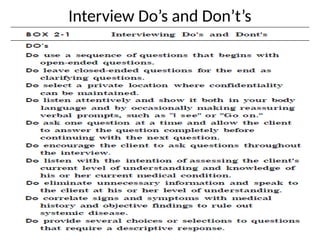
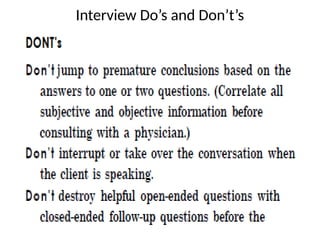
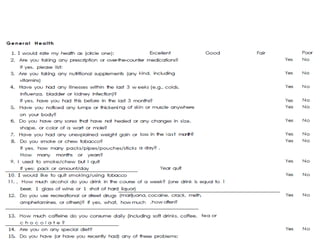
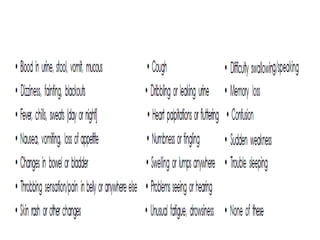
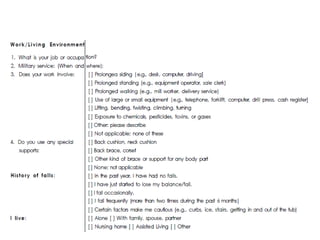
• Interviewing isan important skill for the clinician to
learn.
• Questioning the client may also assist the therapist in
determining whether an injury is in:
– Acute
– Sub acute
– Chronic stage
3.
• Medical practitionersbegin the interview by
determining the client's chief complaint.
• The chief complaint is usually a symptomatic
description by the client.
• Information from the interview guides the
clinician in addressing the underlying pathology.
4.
• The interviewformat provides detailed information
regarding chief complain:
– Frequency
– Duration
– Intensity
– Length
– Breadth
– Depth
– Anatomic location
5.
• The physicaltherapist will later correlate this
information with objective findings from the
examination to rule out possible systemic
origin of symptoms.
6.
Concepts in Communication
•Interviewing is a skill that requires careful
nurturing and refinement over time.
• Telescoping:
– Forget, underreport, or combine separate health
events into a single memory.
7.
Compassion and Caring
•Compassion:
– The desire to identify with or sense something of
another's experience.
– A precursor of caring.
• Caring
– The concern, empathy, and consideration for the needs
and values of others.
8.
• Aware ofyour own body language.
• Sit down when obtaining the history and keep an
appropriate social distance from the client.
• Silence is also a key feature in the communication and
interviewing process.
• Silent attentiveness gives the client time to think or
organize his or her thoughts.
• Silence can give the therapist time to observe the client
and plan the next question or step.
9.
Communication Styles
• Relyingon one interviewing style may not be
adequate for all situations.
– Gender-based styles
– Temperament/ personality-based styles.
• There is a wide range of ethnic identifications,
religions, socioeconomic differences, beliefs, and
behaviors for both the therapist and the client.
10.
• Interactive Style:
–Body language
– Tone of voice
– Eye contact
– Personal space
– Sense of time
– Facial expression