

CLINICAL DECISION MAKING
IN PHYSIOTHERAPY PRACTICE
Aashish Gho Shrestha
KUSMS
01/18/2025 2
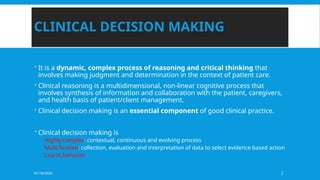
CLINICAL DECISION MAKING
 It is a dynamic, complex process of reasoning and critical thinking that
involves making judgment and determination in the context of patient care.
 Clinical reasoning is a multidimensional, non-linear cognitive process that
involves synthesis of information and collaboration with the patient, caregivers,
and health basis of patient/client management.
 Clinical decision making is an essential component of good clinical practice.
 Clinical decision making is
Highly complex: contextual, continuous and evolving process
Multi faceted: collection, evaluation and interpretation of data to select evidence based action
Learnt behavior
01/18/2025 3
CLINICAL PRACTICE ENVIRONMENTAL
TERMINOLOGY
 Prevention
 Primary
 Secondary
 Tertiary
 Primary care
 Secondary care
 Tertiary care
 Acute care
 Rehabilitation
 Chronic care
 Health promotion
 Wellness
01/18/2025 4
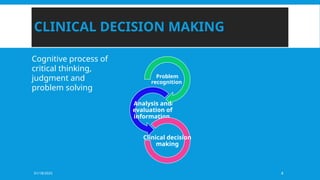
CLINICAL DECISION MAKING
Problem
recognition
Analysis and
evaluation of
information
Clinical decision
making
Cognitive process of
critical thinking,
judgment and
problem solving
01/18/2025 5
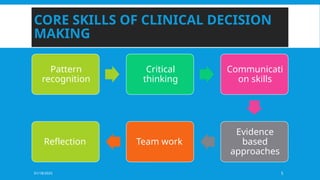
CORE SKILLS OF CLINICAL DECISION
MAKING
Pattern
recognition
Critical
thinking
Communicati
on skills
Evidence
based
approaches
Team work
Reflection
01/18/2025 6
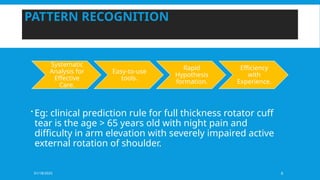
PATTERN RECOGNITION
 Eg: clinical prediction rule for full thickness rotator cuff
tear is the age > 65 years old with night pain and
difficulty in arm elevation with severely impaired active
external rotation of shoulder.
Systematic
Analysis for
Effective
Care.
Easy-to-use
tools.
Rapid
Hypothesis
formation.
Efficiency
with
Experience.
01/18/2025 7
CRITICAL THINKING
Critical thinking in physiotherapy.
Purposeful, self-regulatory judgment employing
cognitive tools.
Assessment and management of patient scenarios.
Analyze, evaluate and apply evidence based practice.
requires physiotherapists to question assumptions,
consider alternative perspectives, and utilize problem-
solving skills to optimize patient outcomes.
01/18/2025 8
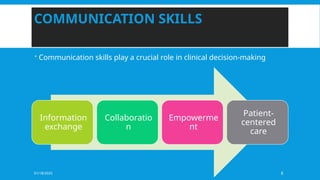
COMMUNICATION SKILLS
 Communication skills play a crucial role in clinical decision-making
Information
exchange
Collaboratio
n
Empowerme
nt
Patient-
centered
care
01/18/2025 9
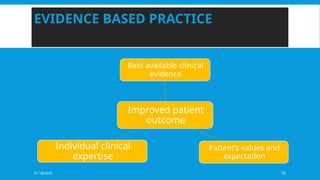
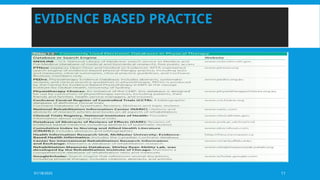
EVIDENCE BASED PRACTICE
 The conscientious, explicit and judicious use of current best evidence in
making decision about the care of individual patient.
 It promotes collection, interpretation and application of valid evidence in
clinical decision making.
 Imagine you have a headache and go to see Dr. Sharma. Instead of just giving
you the same medicine she always gives for headaches, Dr. Sharma checks
the latest research. She finds a new study that shows a different medicine
works better for your type of headache. She explains this to you and suggests
trying the new medicine.
01/18/2025 10
EVIDENCE BASED PRACTICE
Improved patient
outcome
Best available clinical
evidence
Patient’s values and
expectation
Individual clinical
expertise
01/18/2025 11
EVIDENCE BASED PRACTICE
01/18/2025 12
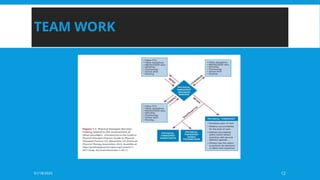
TEAM WORK
01/18/2025 13
CLINICAL DECISION MAKING REQUIRES THE
INTEGRATION OF CORE COMPONENT
 Imagine Dr. Shrestha, a doctor who is treating a patient, Mr. Singh, who has a persistent cough.
 Understanding the Problem: Dr. Shrestha knows that Mr. Singh has a cough.
 Collecting Data: Dr. Shrestha asks Mr. Singh questions about his symptoms, medical history, and performs a
physical examination.
 Efficient Information Handling: Dr. Shrestha uses a checklist to ensure all important information is gathered.
 Experience: Dr. Shrestha has treated many patients with similar symptoms before.
 Recalling Information: Dr. Shrestha remembers that a persistent cough can be a sign of several conditions,
like asthma or an infection.
 Integrating Knowledge: Dr. Shrestha combines the new information from Mr. Singh’s case with what she
already knows about coughs.
 Recognizing Patterns: Dr. Shrestha notices that Mr. Singh’s symptoms match those of a respiratory infection.
 Forming Hypotheses: Dr. Shrestha thinks that Mr. Singh might have bronchitis and considers possible
treatments.
 Reflective Thinking: After prescribing treatment, Dr. Shrestha reflects on the case to see if there’s anything
she could have done better and makes notes for future reference.
01/18/2025 14
HOW IS CLINICAL DECISIONS
COMMONLY MADE?
 Clinicians employ two framework while making clinical decision
1. Fast and frugal heuristics
2. Dual system theory
01/18/2025 15
FAST AND FRUGAL HEURISTICS (FFH)
 In this type of framework of decision making, decisions are made
 Fast: quick decisions (eg, triaging in an emergency department)
 Frugal: simple cognitive exercise, often intuitive, resource/ information frugal
 Heuristic: mental shortcut developed by clinician over a period of time that include
pattern recognition of disease, case experience, intuitive decision based on past
 Often used by experienced physiotherapist in clinical decision making
 Often used in case of emergency where rapid decisions needs to be made
 Associated with bias
01/18/2025 16
01/18/2025 17
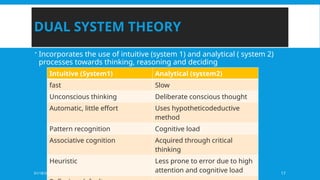
DUAL SYSTEM THEORY
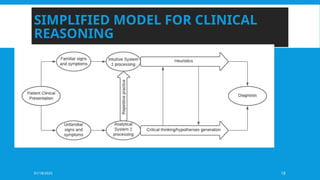
 Incorporates the use of intuitive (system 1) and analytical ( system 2)
processes towards thinking, reasoning and deciding
Intuitive (System1) Analytical (system2)
fast Slow
Unconscious thinking Deliberate conscious thought
Automatic, little effort Uses hypotheticodeductive
method
Pattern recognition Cognitive load
Associative cognition Acquired through critical
thinking
Heuristic Less prone to error due to high
attention and cognitive load
01/18/2025 18
SIMPLIFIED MODEL FOR CLINICAL
REASONING
01/18/2025 19
SUMMARY OF THE FRAMEWORKS
01/18/2025 20
TOOLS FOR CLINICAL DECISION
MAKING
Numbers of conceptual frameworks available to redirect clinical decision
making in physiotherapy practice:
1. International classification of functioning disability and health
(ICF)
2. Patient management model
01/18/2025 21
INTERNATIONAL CLASSIFICATION OF
FUNCTIONING , DISABILITY AND HEALTH
(ICF)
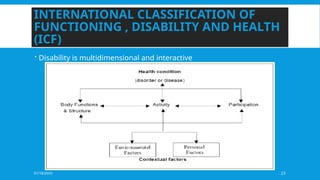
 Provides a framework for comprehensively describing a person’s
individually functioning profile, that in tern helps to better understand
the person’s specific need.
 ICF is the WHO framework for measuring health and disability at both
individual and population levels.
 The ICF conceptualizes a person's level of functioning as a dynamic
interaction between her or his health conditions, environmental factors,
and personal factors.
01/18/2025 22
INTERNATIONAL CLASSIFICATION OF
FUNCTIONING , DISABILITY AND HEALTH
(ICF)
In the ICF, functioning and disability are multi-dimensional concepts,
relating to:
 The body functions and structures of people, and impairments
thereof (functioning at the level of the body);
 The activities of people (functioning at the level of the individual) and
the activity limitations they experience;
 The participation or involvement of people in all areas of life, and the
participation restrictions they experience (functioning of a person as a
member of society); and
 The environmental factors which affect these experiences (and
whether these factors are facilitators or barriers).
01/18/2025 23
INTERNATIONAL CLASSIFICATION OF
FUNCTIONING , DISABILITY AND HEALTH
(ICF)
 Disability is multidimensional and interactive
01/18/2025 24
INTERNATIONAL CLASSIFICATION OF
FUNCTIONING , DISABILITY AND HEALTH
(ICF)
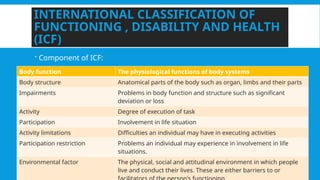
 Component of ICF:
Body function The physiological functions of body systems
Body structure Anatomical parts of the body such as organ, limbs and their parts
Impairments Problems in body function and structure such as significant
deviation or loss
Activity Degree of execution of task
Participation Involvement in life situation
Activity limitations Difficulties an individual may have in executing activities
Participation restriction Problems an individual may experience in involvement in life
situations.
Environmental factor The physical, social and attitudinal environment in which people
live and conduct their lives. These are either barriers to or
01/18/2025 25
PATIENT MANAGEMENT MODEL
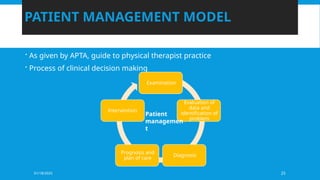
 As given by APTA, guide to physical therapist practice
 Process of clinical decision making
Examination
Evaluation of
data and
identification of
problem
Diagnosis
Prognosis and
plan of care
Intervention
Patient
managemen
t
01/18/2025 26
PATIENT MANAGEMENT MODEL
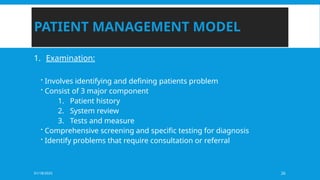
1. Examination:
 Involves identifying and defining patients problem
 Consist of 3 major component
1. Patient history
2. System review
3. Tests and measure
 Comprehensive screening and specific testing for diagnosis
 Identify problems that require consultation or referral
01/18/2025 27
PATIENT MANAGEMENT MODEL
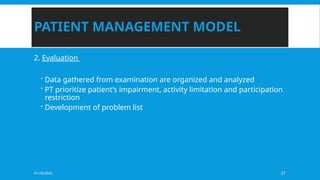
2. Evaluation
 Data gathered from examination are organized and analyzed
 PT prioritize patient’s impairment, activity limitation and participation
restriction
 Development of problem list
01/18/2025 28
PATIENT MANAGEMENT MODEL
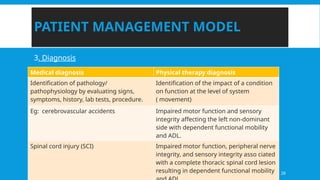
3. Diagnosis
Medical diagnosis Physical therapy diagnosis
Identification of pathology/
pathophysiology by evaluating signs,
symptoms, history, lab tests, procedure.
Identification of the impact of a condition
on function at the level of system
( movement)
Eg: cerebrovascular accidents Impaired motor function and sensory
integrity affecting the left non-dominant
side with dependent functional mobility
and ADL.
Spinal cord injury (SCI) Impaired motor function, peripheral nerve
integrity, and sensory integrity asso ciated
with a complete thoracic spinal cord lesion
resulting in dependent functional mobility
01/18/2025 29
PATIENT MANAGEMENT MODEL
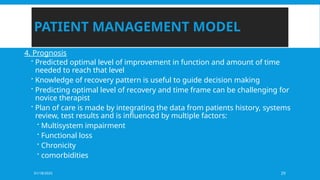
4. Prognosis
 Predicted optimal level of improvement in function and amount of time
needed to reach that level
 Knowledge of recovery pattern is useful to guide decision making
 Predicting optimal level of recovery and time frame can be challenging for
novice therapist
 Plan of care is made by integrating the data from patients history, systems
review, test results and is influenced by multiple factors:
 Multisystem impairment
 Functional loss
 Chronicity
 comorbidities
01/18/2025 30
PATIENT MANAGEMENT MODEL
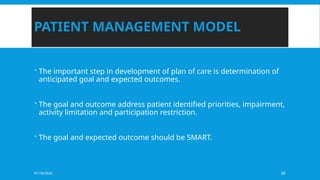
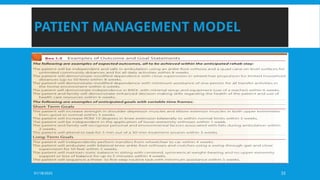
 The important step in development of plan of care is determination of
anticipated goal and expected outcomes.
 The goal and outcome address patient identified priorities, impairment,
activity limitation and participation restriction.
 The goal and expected outcome should be SMART.
01/18/2025 31
PATIENT MANAGEMENT MODEL
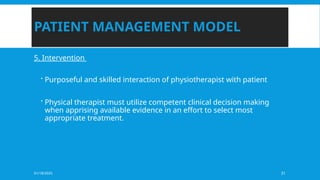
5. Intervention
 Purposeful and skilled interaction of physiotherapist with patient
 Physical therapist must utilize competent clinical decision making
when apprising available evidence in an effort to select most
appropriate treatment.
01/18/2025 32
PATIENT MANAGEMENT MODEL
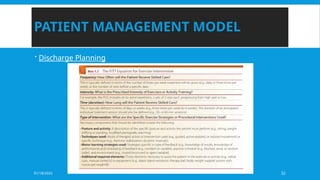
 Discharge Planning
01/18/2025 33
PATIENT MANAGEMENT MODEL
01/18/2025 34
CASE DESCRIPTION
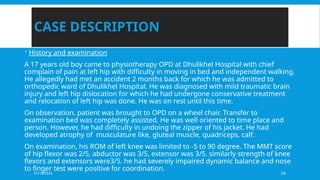
 History and examination
A 17 years old boy came to physiotherapy OPD at Dhulikhel Hospital with chief
complain of pain at left hip with difficulty in moving in bed and independent walking.
He allegedly had met an accident 2 months back for which he was admitted to
orthopedic ward of Dhulikhel Hospital. He was diagnosed with mild traumatic brain
injury and left hip dislocation for which he had undergone conservative treatment
and relocation of left hip was done. He was on rest until this time.
On observation, patient was brought to OPD on a wheel chair. Transfer to
examination bed was completely assisted. He was well oriented to time place and
person. However, he had difficulty in undoing the zipper of his jacket. He had
developed atrophy of musculature like, gluteal muscle, quadriceps, calf.
On examination, his ROM of left knee was limited to -5 to 90 degree. The MMT score
of hip flexor was 2/5, abductor was 3/5, extensor was 3/5. similarly strength of knee
flexors and extensors were3/5. he had severely impaired dynamic balance and nose
to finger test were positive for coordination.
01/18/2025 35
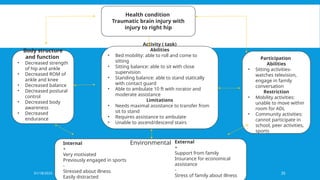
Body structure
and function
• Decreased strength
of hip and ankle
• Decreased ROM of
ankle and knee
• Decreased balance
• Decreased postural
control
• Decreased body
awareness
• Decreased
endurance
Activity ( task)
Abilities
• Bed mobility: able to roll and come to
sitting
• Sitting balance: able to sit with close
supervision
• Standing balance: able to stand statically
with contact guard
• Able to ambulate 10 ft with rorator and
moderate assistance
Limitations
• Needs maximal assistance to transfer from
sit to stand
• Requires assistance to ambulate
• Unable to ascend/descend stairs
Participation
Abilities
• Sitting activities-
watches television,
engage in family
conversation
Restriction
• Mobility activities:
unable to move within
room for ADL
• Community activities:
cannot participate in
school, peer activities,
sports
Environmental
Health condition
Traumatic brain injury with
injury to right hip
Internal
+
Very motivated
Previously engaged in sports
-
Stressed about illness
Easily distracted
External
+
Support from family
Insurance for economical
assistance
-
Stress of family about illness
01/18/2025 36
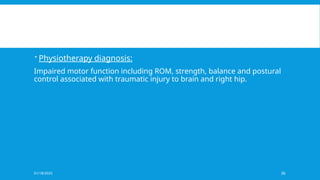
 Physiotherapy diagnosis:
Impaired motor function including ROM, strength, balance and postural
control associated with traumatic injury to brain and right hip.
01/18/2025 37
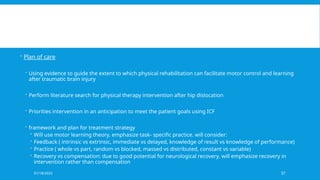
 Plan of care
 Using evidence to guide the extent to which physical rehabilitation can facilitate motor control and learning
after traumatic brain injury
 Perform literature search for physical therapy intervention after hip dislocation
 Priorities intervention in an anticipation to meet the patient goals using ICF
 framework and plan for treatment strategy
 Will use motor learning theory, emphasize task- specific practice. will consider:
 Feedback ( intrinsic vs extrinsic, immediate vs delayed, knowledge of result vs knowledge of performance)
 Practice ( whole vs part, random vs blocked, massed vs distributed, constant vs variable)
 Recovery vs compensation: due to good potential for neurological recovery, will emphasize recovery in
intervention rather than compensation
01/18/2025 38
Intervention
 Prioritize specific procedural interventions
 Task specific practice
 Transfer training, bed mobility, ambulation
 Massed practice
 Increase number of steps by using body weight support for locomotor training
 Blocked practice in a constant environment gradually progressing to random
practice in varying environment
 Strength training
 Progressive resistive exercise and proprioceptive neuromuscular facilitation
training
 Use of neuromuscular electric stimulation on hip abductors and extensor to
increase recruitment during activities like standing, walking
01/18/2025 39
Intervention
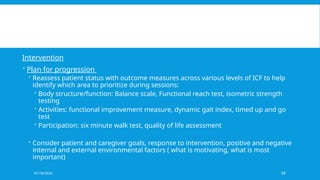
 Plan for progression
 Reassess patient status with outcome measures across various levels of ICF to help
identify which area to prioritize during sessions:
 Body structure/function: Balance scale, Functional reach test, isometric strength
testing
 Activities: functional improvement measure, dynamic gait index, timed up and go
test
 Participation: six minute walk test, quality of life assessment
 Consider patient and caregiver goals, response to intervention, positive and negative
internal and external environmental factors ( what is motivating, what is most
important)
01/18/2025 40
REFERENCES
 Rivas SF, Saiz C, Ossa C. Metacognitive Strategies and Development of Critical
Thinking in Higher Education. Front Psychol. 2022 Jun 15;13:913219. doi:
10.3389/fpsyg.2022.913219. PMID: 35783800; PMCID: PMC9242397.
 Banning, M. (2007). A review of clinical decision making: models and current
research. J. Clinical Nursing, 2007 Feb 28
 Asgari S, Scalzo F, Kasprowicz M. Pattern Recognition in Medical Decision
Support. Biomed Res Int. 2019 Jun 13;2019:6048748. doi:
10.1155/2019/6048748. PMID: 31312659; PMCID: PMC6595383.
 Yazdani S, Hosseinzadeh M, Hosseini F. Models of clinical reasoning with a
focus on general practice: A critical review. J Adv Med Educ Prof. 2017
Oct;5(4):177-184. PMID: 28979912; PMCID: PMC5611427.
 Susan O’ Sullivan, Schmitz. Physical Rehabilitation. 7th
Edition.
01/18/2025 41

Clinical Decision Making in physiotherapy practice.pptx

  • 1.
    CLINICAL DECISION MAKING INPHYSIOTHERAPY PRACTICE Aashish Gho Shrestha KUSMS
  • 2.
    01/18/2025 2 CLINICAL DECISIONMAKING  It is a dynamic, complex process of reasoning and critical thinking that involves making judgment and determination in the context of patient care.  Clinical reasoning is a multidimensional, non-linear cognitive process that involves synthesis of information and collaboration with the patient, caregivers, and health basis of patient/client management.  Clinical decision making is an essential component of good clinical practice.  Clinical decision making is Highly complex: contextual, continuous and evolving process Multi faceted: collection, evaluation and interpretation of data to select evidence based action Learnt behavior
  • 3.
    01/18/2025 3 CLINICAL PRACTICEENVIRONMENTAL TERMINOLOGY  Prevention  Primary  Secondary  Tertiary  Primary care  Secondary care  Tertiary care  Acute care  Rehabilitation  Chronic care  Health promotion  Wellness
  • 4.
    01/18/2025 4 CLINICAL DECISIONMAKING Problem recognition Analysis and evaluation of information Clinical decision making Cognitive process of critical thinking, judgment and problem solving
  • 5.
    01/18/2025 5 CORE SKILLSOF CLINICAL DECISION MAKING Pattern recognition Critical thinking Communicati on skills Evidence based approaches Team work Reflection
  • 6.
    01/18/2025 6 PATTERN RECOGNITION Eg: clinical prediction rule for full thickness rotator cuff tear is the age > 65 years old with night pain and difficulty in arm elevation with severely impaired active external rotation of shoulder. Systematic Analysis for Effective Care. Easy-to-use tools. Rapid Hypothesis formation. Efficiency with Experience.
  • 7.
    01/18/2025 7 CRITICAL THINKING Criticalthinking in physiotherapy. Purposeful, self-regulatory judgment employing cognitive tools. Assessment and management of patient scenarios. Analyze, evaluate and apply evidence based practice. requires physiotherapists to question assumptions, consider alternative perspectives, and utilize problem- solving skills to optimize patient outcomes.
  • 8.
    01/18/2025 8 COMMUNICATION SKILLS Communication skills play a crucial role in clinical decision-making Information exchange Collaboratio n Empowerme nt Patient- centered care
  • 9.
    01/18/2025 9 EVIDENCE BASEDPRACTICE  The conscientious, explicit and judicious use of current best evidence in making decision about the care of individual patient.  It promotes collection, interpretation and application of valid evidence in clinical decision making.  Imagine you have a headache and go to see Dr. Sharma. Instead of just giving you the same medicine she always gives for headaches, Dr. Sharma checks the latest research. She finds a new study that shows a different medicine works better for your type of headache. She explains this to you and suggests trying the new medicine.
  • 10.
    01/18/2025 10 EVIDENCE BASEDPRACTICE Improved patient outcome Best available clinical evidence Patient’s values and expectation Individual clinical expertise
  • 11.
  • 12.
  • 13.
    01/18/2025 13 CLINICAL DECISIONMAKING REQUIRES THE INTEGRATION OF CORE COMPONENT  Imagine Dr. Shrestha, a doctor who is treating a patient, Mr. Singh, who has a persistent cough.  Understanding the Problem: Dr. Shrestha knows that Mr. Singh has a cough.  Collecting Data: Dr. Shrestha asks Mr. Singh questions about his symptoms, medical history, and performs a physical examination.  Efficient Information Handling: Dr. Shrestha uses a checklist to ensure all important information is gathered.  Experience: Dr. Shrestha has treated many patients with similar symptoms before.  Recalling Information: Dr. Shrestha remembers that a persistent cough can be a sign of several conditions, like asthma or an infection.  Integrating Knowledge: Dr. Shrestha combines the new information from Mr. Singh’s case with what she already knows about coughs.  Recognizing Patterns: Dr. Shrestha notices that Mr. Singh’s symptoms match those of a respiratory infection.  Forming Hypotheses: Dr. Shrestha thinks that Mr. Singh might have bronchitis and considers possible treatments.  Reflective Thinking: After prescribing treatment, Dr. Shrestha reflects on the case to see if there’s anything she could have done better and makes notes for future reference.
  • 14.
    01/18/2025 14 HOW ISCLINICAL DECISIONS COMMONLY MADE?  Clinicians employ two framework while making clinical decision 1. Fast and frugal heuristics 2. Dual system theory
  • 15.
    01/18/2025 15 FAST ANDFRUGAL HEURISTICS (FFH)  In this type of framework of decision making, decisions are made  Fast: quick decisions (eg, triaging in an emergency department)  Frugal: simple cognitive exercise, often intuitive, resource/ information frugal  Heuristic: mental shortcut developed by clinician over a period of time that include pattern recognition of disease, case experience, intuitive decision based on past  Often used by experienced physiotherapist in clinical decision making  Often used in case of emergency where rapid decisions needs to be made  Associated with bias
  • 16.
  • 17.
    01/18/2025 17 DUAL SYSTEMTHEORY  Incorporates the use of intuitive (system 1) and analytical ( system 2) processes towards thinking, reasoning and deciding Intuitive (System1) Analytical (system2) fast Slow Unconscious thinking Deliberate conscious thought Automatic, little effort Uses hypotheticodeductive method Pattern recognition Cognitive load Associative cognition Acquired through critical thinking Heuristic Less prone to error due to high attention and cognitive load
  • 18.
    01/18/2025 18 SIMPLIFIED MODELFOR CLINICAL REASONING
  • 19.
  • 20.
    01/18/2025 20 TOOLS FORCLINICAL DECISION MAKING Numbers of conceptual frameworks available to redirect clinical decision making in physiotherapy practice: 1. International classification of functioning disability and health (ICF) 2. Patient management model
  • 21.
    01/18/2025 21 INTERNATIONAL CLASSIFICATIONOF FUNCTIONING , DISABILITY AND HEALTH (ICF)  Provides a framework for comprehensively describing a person’s individually functioning profile, that in tern helps to better understand the person’s specific need.  ICF is the WHO framework for measuring health and disability at both individual and population levels.  The ICF conceptualizes a person's level of functioning as a dynamic interaction between her or his health conditions, environmental factors, and personal factors.
  • 22.
    01/18/2025 22 INTERNATIONAL CLASSIFICATIONOF FUNCTIONING , DISABILITY AND HEALTH (ICF) In the ICF, functioning and disability are multi-dimensional concepts, relating to:  The body functions and structures of people, and impairments thereof (functioning at the level of the body);  The activities of people (functioning at the level of the individual) and the activity limitations they experience;  The participation or involvement of people in all areas of life, and the participation restrictions they experience (functioning of a person as a member of society); and  The environmental factors which affect these experiences (and whether these factors are facilitators or barriers).
  • 23.
    01/18/2025 23 INTERNATIONAL CLASSIFICATIONOF FUNCTIONING , DISABILITY AND HEALTH (ICF)  Disability is multidimensional and interactive
  • 24.
    01/18/2025 24 INTERNATIONAL CLASSIFICATIONOF FUNCTIONING , DISABILITY AND HEALTH (ICF)  Component of ICF: Body function The physiological functions of body systems Body structure Anatomical parts of the body such as organ, limbs and their parts Impairments Problems in body function and structure such as significant deviation or loss Activity Degree of execution of task Participation Involvement in life situation Activity limitations Difficulties an individual may have in executing activities Participation restriction Problems an individual may experience in involvement in life situations. Environmental factor The physical, social and attitudinal environment in which people live and conduct their lives. These are either barriers to or
  • 25.
    01/18/2025 25 PATIENT MANAGEMENTMODEL  As given by APTA, guide to physical therapist practice  Process of clinical decision making Examination Evaluation of data and identification of problem Diagnosis Prognosis and plan of care Intervention Patient managemen t
  • 26.
    01/18/2025 26 PATIENT MANAGEMENTMODEL 1. Examination:  Involves identifying and defining patients problem  Consist of 3 major component 1. Patient history 2. System review 3. Tests and measure  Comprehensive screening and specific testing for diagnosis  Identify problems that require consultation or referral
  • 27.
    01/18/2025 27 PATIENT MANAGEMENTMODEL 2. Evaluation  Data gathered from examination are organized and analyzed  PT prioritize patient’s impairment, activity limitation and participation restriction  Development of problem list
  • 28.
    01/18/2025 28 PATIENT MANAGEMENTMODEL 3. Diagnosis Medical diagnosis Physical therapy diagnosis Identification of pathology/ pathophysiology by evaluating signs, symptoms, history, lab tests, procedure. Identification of the impact of a condition on function at the level of system ( movement) Eg: cerebrovascular accidents Impaired motor function and sensory integrity affecting the left non-dominant side with dependent functional mobility and ADL. Spinal cord injury (SCI) Impaired motor function, peripheral nerve integrity, and sensory integrity asso ciated with a complete thoracic spinal cord lesion resulting in dependent functional mobility
  • 29.
    01/18/2025 29 PATIENT MANAGEMENTMODEL 4. Prognosis  Predicted optimal level of improvement in function and amount of time needed to reach that level  Knowledge of recovery pattern is useful to guide decision making  Predicting optimal level of recovery and time frame can be challenging for novice therapist  Plan of care is made by integrating the data from patients history, systems review, test results and is influenced by multiple factors:  Multisystem impairment  Functional loss  Chronicity  comorbidities
  • 30.
    01/18/2025 30 PATIENT MANAGEMENTMODEL  The important step in development of plan of care is determination of anticipated goal and expected outcomes.  The goal and outcome address patient identified priorities, impairment, activity limitation and participation restriction.  The goal and expected outcome should be SMART.
  • 31.
    01/18/2025 31 PATIENT MANAGEMENTMODEL 5. Intervention  Purposeful and skilled interaction of physiotherapist with patient  Physical therapist must utilize competent clinical decision making when apprising available evidence in an effort to select most appropriate treatment.
  • 32.
    01/18/2025 32 PATIENT MANAGEMENTMODEL  Discharge Planning
  • 33.
  • 34.
    01/18/2025 34 CASE DESCRIPTION History and examination A 17 years old boy came to physiotherapy OPD at Dhulikhel Hospital with chief complain of pain at left hip with difficulty in moving in bed and independent walking. He allegedly had met an accident 2 months back for which he was admitted to orthopedic ward of Dhulikhel Hospital. He was diagnosed with mild traumatic brain injury and left hip dislocation for which he had undergone conservative treatment and relocation of left hip was done. He was on rest until this time. On observation, patient was brought to OPD on a wheel chair. Transfer to examination bed was completely assisted. He was well oriented to time place and person. However, he had difficulty in undoing the zipper of his jacket. He had developed atrophy of musculature like, gluteal muscle, quadriceps, calf. On examination, his ROM of left knee was limited to -5 to 90 degree. The MMT score of hip flexor was 2/5, abductor was 3/5, extensor was 3/5. similarly strength of knee flexors and extensors were3/5. he had severely impaired dynamic balance and nose to finger test were positive for coordination.
  • 35.
    01/18/2025 35 Body structure andfunction • Decreased strength of hip and ankle • Decreased ROM of ankle and knee • Decreased balance • Decreased postural control • Decreased body awareness • Decreased endurance Activity ( task) Abilities • Bed mobility: able to roll and come to sitting • Sitting balance: able to sit with close supervision • Standing balance: able to stand statically with contact guard • Able to ambulate 10 ft with rorator and moderate assistance Limitations • Needs maximal assistance to transfer from sit to stand • Requires assistance to ambulate • Unable to ascend/descend stairs Participation Abilities • Sitting activities- watches television, engage in family conversation Restriction • Mobility activities: unable to move within room for ADL • Community activities: cannot participate in school, peer activities, sports Environmental Health condition Traumatic brain injury with injury to right hip Internal + Very motivated Previously engaged in sports - Stressed about illness Easily distracted External + Support from family Insurance for economical assistance - Stress of family about illness
  • 36.
    01/18/2025 36  Physiotherapydiagnosis: Impaired motor function including ROM, strength, balance and postural control associated with traumatic injury to brain and right hip.
  • 37.
    01/18/2025 37  Planof care  Using evidence to guide the extent to which physical rehabilitation can facilitate motor control and learning after traumatic brain injury  Perform literature search for physical therapy intervention after hip dislocation  Priorities intervention in an anticipation to meet the patient goals using ICF  framework and plan for treatment strategy  Will use motor learning theory, emphasize task- specific practice. will consider:  Feedback ( intrinsic vs extrinsic, immediate vs delayed, knowledge of result vs knowledge of performance)  Practice ( whole vs part, random vs blocked, massed vs distributed, constant vs variable)  Recovery vs compensation: due to good potential for neurological recovery, will emphasize recovery in intervention rather than compensation
  • 38.
    01/18/2025 38 Intervention  Prioritizespecific procedural interventions  Task specific practice  Transfer training, bed mobility, ambulation  Massed practice  Increase number of steps by using body weight support for locomotor training  Blocked practice in a constant environment gradually progressing to random practice in varying environment  Strength training  Progressive resistive exercise and proprioceptive neuromuscular facilitation training  Use of neuromuscular electric stimulation on hip abductors and extensor to increase recruitment during activities like standing, walking
  • 39.
    01/18/2025 39 Intervention  Planfor progression  Reassess patient status with outcome measures across various levels of ICF to help identify which area to prioritize during sessions:  Body structure/function: Balance scale, Functional reach test, isometric strength testing  Activities: functional improvement measure, dynamic gait index, timed up and go test  Participation: six minute walk test, quality of life assessment  Consider patient and caregiver goals, response to intervention, positive and negative internal and external environmental factors ( what is motivating, what is most important)
  • 40.
    01/18/2025 40 REFERENCES  RivasSF, Saiz C, Ossa C. Metacognitive Strategies and Development of Critical Thinking in Higher Education. Front Psychol. 2022 Jun 15;13:913219. doi: 10.3389/fpsyg.2022.913219. PMID: 35783800; PMCID: PMC9242397.  Banning, M. (2007). A review of clinical decision making: models and current research. J. Clinical Nursing, 2007 Feb 28  Asgari S, Scalzo F, Kasprowicz M. Pattern Recognition in Medical Decision Support. Biomed Res Int. 2019 Jun 13;2019:6048748. doi: 10.1155/2019/6048748. PMID: 31312659; PMCID: PMC6595383.  Yazdani S, Hosseinzadeh M, Hosseini F. Models of clinical reasoning with a focus on general practice: A critical review. J Adv Med Educ Prof. 2017 Oct;5(4):177-184. PMID: 28979912; PMCID: PMC5611427.  Susan O’ Sullivan, Schmitz. Physical Rehabilitation. 7th Edition.
  • 41.

Editor's Notes

  • #2 It is a dynamic, complex process of reasoning and critical thinking that involves making judgement and determination in the context of patient care.
  • #3 It is a dynamic, complex process of reasoning and critical thinking that involves making judgement and determination in the context of patient care.
  • #8 Gathering Information regarding their medical history, symptoms, and concerns leading to proper assessment and accurate diagnosis, building rapport to foster trust and cooperation betn healthcare provider, clarifying information,addressing concerns
  • #9 Conscientious: based on principle, explicit: open, clear, unambiguous, judicious: sensible, thoughtful
  • #10 Conscientious: based on principle, explicit: open, clear, unambiguous, judicious: sensible, thoughtful
  • #11 Conscientious: based on principle, explicit: open, clear, unambiguous, judicious: sensible, thoughtful
  • #15 fast: quick, frugal: simply, without much cognitive exercise, or resource frugal, heuristics: mental shortcuts developed by clinicians overtime that include recognizing pattern of disease, case experience, intuitive judgement Automatically and uncounciously employed Used when the decisions are to be made quickly and in limited information Fast Automatic Intuitive Unconscious Heavily reliant on the experience of the clinician making decision
  • #20 Patient centered model: endorsed by APTA, as guide to physical therapist practice
  • #21 Universally applicable framework
  • #23 All component of disability are important and one may interact with one another.
  • #26 History: general demographc, social history. System review, test and measure; objective data to accurately determine the degree of specific function and dysfunction.
  • #27 Clinician synthesize qualitative and quantitative information, considers all the factors described by the ICF framework to guide diagnosis, prognosis and plan of care Priortizing patient problem and linking them to ICF is essential in determining how PT can benefit patient. Important to recognize those clinical problems associated with primary disorder and those associated with comorbid condition. Also important to recognize facilitators and barriers in the environment .