The Nuts & Bolts
of Critical
Thinking and
Decision-making
in Clinical
Medicine
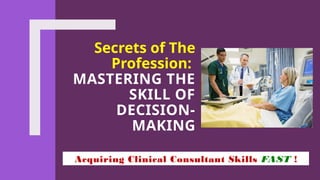
Secrets of The
Profession:
MASTERING THE
SKILL OF
DECISION-
MAKING
Acquiring Clinical Consultant Skills FAST !
Secrets of The
Profession:
DIAGNOSTIC &
THERAPEUTIC
EXCELLENCE
Acquiring Clinical Consultant Skills FAST !
Dr. Imad Salah Ahmed Hassan
MD (UK) FACP FRCPI MSc (UK)
MBBS (U of K)
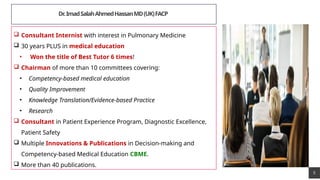
Dr.ImadSalahAhmedHassanMD(UK)FACP
5
 Consultant Internist with interest in Pulmonary Medicine
 30 years PLUS in medical education
• Won the title of Best Tutor 6 times!
 Chairman of more than 10 committees covering:
• Competency-based medical education
• Quality Improvement
• Knowledge Translation/Evidence-based Practice
• Research
 Consultant in Patient Experience Program, Diagnostic Excellence,
Patient Safety
 Multiple Innovations & Publications in Decision-making and
Competency-based Medical Education CBME.
 More than 40 publications.
6
The presentation in short:
A Competence by Design Approach
for Mastery in Critical Thinking and
Decision-making in Medicine using a
Case Scenario.
Competence
by Design
7
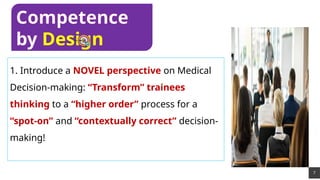
1. Introduce a NOVEL perspective on Medical
Decision-making: “Transform” trainees
thinking to a “higher order” process for a
“spot-on” and “contextually correct” decision-
making!
Competence
by Design
8
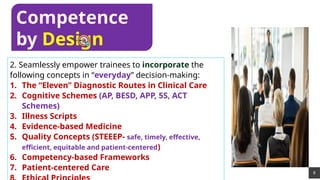
2. Seamlessly empower trainees to incorporate the
following concepts in “everyday” decision-making:
1. The “Eleven” Diagnostic Routes in Clinical Care
2. Cognitive Schemes (AP, BESD, APP, 5S, ACT
Schemes)
3. Illness Scripts
4. Evidence-based Medicine
5. Quality Concepts (STEEEP- safe, timely, effective,
efficient, equitable and patient-centered)
6. Competency-based Frameworks
7. Patient-centered Care
Competence
by Design
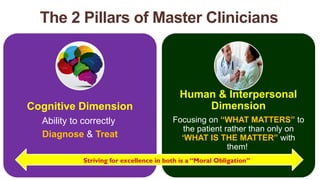
The 2 Pillars of Master Clinicians
Cognitive Dimension
Ability to correctly
Diagnose & Treat
Human & Interpersonal
Dimension
Focusing on “WHAT MATTERS” to
the patient rather than only on
‘WHAT IS THE MATTER” with
them!
Striving for excellence in both is a “Moral Obligation”
10
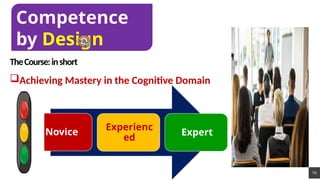
TheCourse:inshort
Achieving Mastery in the Cognitive Domain
Competence
by Design
Novice
Experienc
ed
Expert
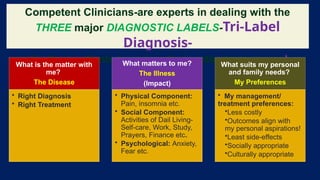
Competent Clinicians-are experts in dealing with the
THREE major DIAGNOSTIC LABELS-Tri-Label
Diagnosis-
for their patients based on their patients concerns!
What is the matter with
me?
The Disease
• Right Diagnosis
• Right Treatment
What matters to me?
The Illness
(Impact)
• Physical Component:
Pain, insomnia etc.
• Social Component:
Activities of Dail Living-
Self-care, Work, Study,
Prayers, Finance etc.
• Psychological: Anxiety,
Fear etc.
What suits my personal
and family needs?
My Preferences
• My management/
treatment preferences:
•Less costly
•Outcomes align with
my personal aspirations!
•Least side-effects
•Socially appropriate
•Culturally appropriate
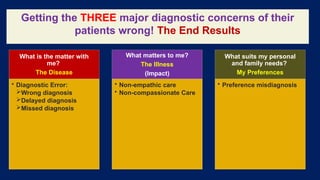
Getting the THREE major diagnostic concerns of their
patients wrong! The End Results
What is the matter with
me?
The Disease
• Diagnostic Error:
Wrong diagnosis
Delayed diagnosis
Missed diagnosis
What matters to me?
The Illness
(Impact)
• Non-empathic care
• Non-compassionate Care
What suits my personal
and family needs?
My Preferences
• Preference misdiagnosis
13
What is Medical Decision-
making?
The Roadmap
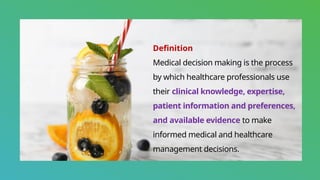
Definition
Medical decision making is the process
by which healthcare professionals use
their clinical knowledge, expertise,
patient information and preferences,
and available evidence to make
informed medical and healthcare
management decisions.
Medical decision-making
is an ART!
The “SKILL” of creating beautiful
and attractive “thoughts and
actions” that your customers
truly rejoice and appreciate!
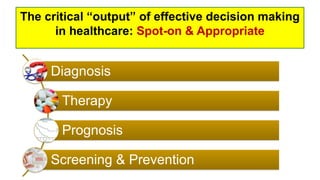
The critical “output” of effective decision making
in healthcare: Spot-on & Appropriate
Diagnosis
Therapy
Prognosis
Screening & Prevention
Why is decision-making so critical?
17
?
18
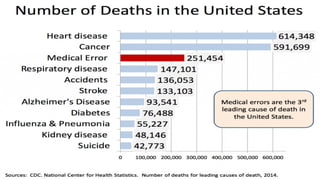
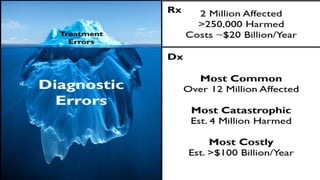
The cost of poor decision-
making.
The Roadmap
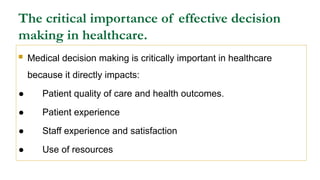
The critical importance of effective decision
making in healthcare.
 Medical decision making is critically important in healthcare
because it directly impacts:
● Patient quality of care and health outcomes.
● Patient experience
● Staff experience and satisfaction
● Use of resources
22
Wrong decisions: why?
The Roadmap
Causes of Poor Clinical Reasoning/Decision-making Errors
 Inadequate knowledge
 Faulty data gathering/acquisition
 Faulty data processing
 Faulty metacognition (Cognitive Biases)
24
Novice and Expert Decision-
making: the differences?
The Roadmap
Clinical Reasoning
• Unlike novices, clinical experts tend to utilize “mental
schemes or scripts” for problem-solving, clinical
reasoning and rational decision making.
Mandin H, Jones A, Woloschuk W, Harasym P. Helping students to think like experts when solving clinical
problems. Acad Med 1997;72:173-9.
Facts on Clinical Decision-making
Knowledge without “tools” for knowledge
retrieval and knowledge application is
inadequate for an error-free and effective
decision-making in clinical medicine.
Clinical Reasoning
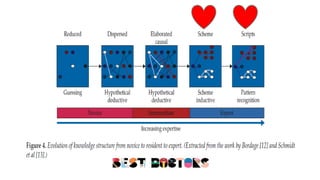
Cognitive schemes and Scripts are
effective tools for knowledge-
retrieval, critical thinking,
problem-solving, and decision-
making.
Peran D, et al. ABCDE cognitive aid tool in patient assessment - development and validation in a multicenter pilot simulation study. BMC Emerg Med. 2020;20(1):95.
Dresler M, et al. Mnemonic Training Reshapes Brain Networks to Support Superior Memory. Neuron. 2017;93(5):1227-1235.
Marshall S. The use of cognitive aids during emergencies in anesthesia: a review of the literature. Anesth Analg. 2013;117(5):1162-71.
29
Important Concepts: Scripts,
Semantic Qualifiers, Schemes.
The Roadmap
Clinical Reasoning
A “Cognitive Scheme” is a
cognitive memory aid that
contains an organized “action”
map or plan by “CLUSTERING”
similar concepts together.
Clinical Reasoning
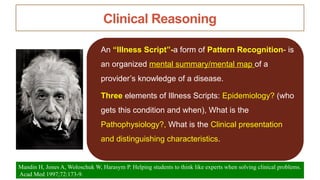
An “Illness Script”-a form of Pattern Recognition- is
an organized mental summary/mental map of a
provider’s knowledge of a disease.
Three elements of Illness Scripts: Epidemiology? (who
gets this condition and when), What is the
Pathophysiology?, What is the Clinical presentation
and distinguishing characteristics.
Mandin H, Jones A, Woloschuk W, Harasym P. Helping students to think like experts when solving clinical problems.
Acad Med 1997;72:173-9.
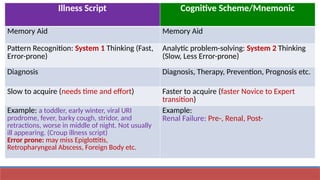
Illness Script Cognitive Scheme/Mnemonic
Memory Aid Memory Aid
Pattern Recognition: System 1 Thinking (Fast,
Error-prone)
Analytic problem-solving: System 2 Thinking
(Slow, Less Error-prone)
Diagnosis Diagnosis, Therapy, Prevention, Prognosis etc.
Slow to acquire (needs time and effort) Faster to acquire (faster Novice to Expert
transition)
Example: a toddler, early winter, viral URI
prodrome, fever, barky cough, stridor, and
retractions, worse in middle of night. Not usually
ill appearing. (Croup illness script)
Error prone: may miss Epiglottitis,
Retropharyngeal Abscess, Foreign Body etc.
Example:
Renal Failure: Pre-, Renal, Post-
Critical Tips
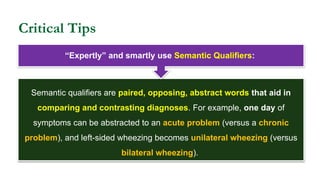
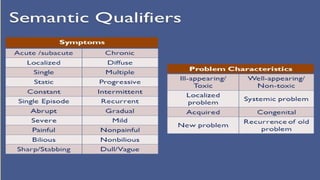
Semantic qualifiers are paired, opposing, abstract words that aid in
comparing and contrasting diagnoses. For example, one day of
symptoms can be abstracted to an acute problem (versus a chronic
problem), and left-sided wheezing becomes unilateral wheezing (versus
bilateral wheezing).
“Expertly” and smartly use Semantic Qualifiers:
Critical Tips
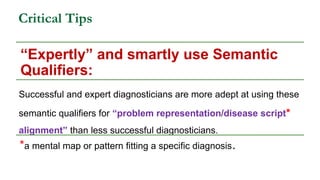
“Expertly” and smartly use Semantic
Qualifiers:
Successful and expert diagnosticians are more adept at using these
semantic qualifiers for “problem representation/disease script*
alignment” than less successful diagnosticians.
*a mental map or pattern fitting a specific diagnosis.
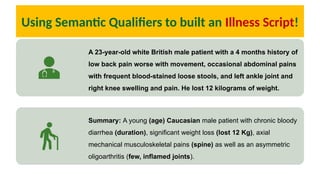
Using Semantic Qualifiers to built an Illness Script!
A 23-year-old white British male patient with a 4 months history of
low back pain worse with movement, occasional abdominal pains
with frequent blood-stained loose stools, and left ankle joint and
right knee swelling and pain. He lost 12 kilograms of weight.
Summary: A young (age) Caucasian male patient with chronic bloody
diarrhea (duration), significant weight loss (lost 12 Kg), axial
mechanical musculoskeletal pains (spine) as well as an asymmetric
oligoarthritis (few, inflamed joints).
37
A case Scenario: a universal
roadmap for care provision.
The Roadmap
38
History:
Sarah, is an obese BMI 36, 24-year-old female who was recently
discharged from hospital. She has been discharged from hospital
after a 14 days admission with an exacerbation of Bronchial
Asthma. This is the third time she has attended ER since discharge
as she is still very symptomatic with cough, wheeze and
breathlessness. Additionally, she developed a right sided chest pain
that is worse with breathing and a red-tinged sputum and
appeared drowsy.
The Case
39
Questions:
1. Why is she still having active asthma symptoms?
2. Does she need to be readmitted?
3. Does she need another course of systemic steroids?
4. Does she need another course of antibiotics?
5. Etc.
The Case
40
Progress:
Re-admitted to hospital two days later with worsening
breathlessness and reduced level of consciousness.
Intubated!
The Case
How to Achieve Excellence?
Learning
Objectives
Articulate a
comprehensive
management input for
any acute medical case
using Cognitive Schemes.
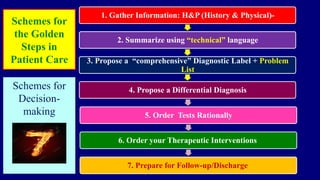
1. Gather Information: H&P (History & Physical)-
2. Summarize using “technical” language
3. Propose a “comprehensive” Diagnostic Label + Problem
List
4. Propose a Differential Diagnosis
5. Order Tests Rationally
6. Order your Therapeutic Interventions
7. Prepare for Follow-up/Discharge
Schemes for
the Golden
Steps in
Patient Care
Schemes for
Decision-
making
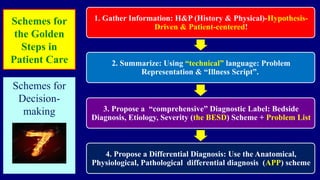
1. Gather Information: H&P (History & Physical)-Hypothesis-
Driven & Patient-centered!
2. Summarize: Using “technical” language: Problem
Representation & “Illness Script”.
3. Propose a “comprehensive” Diagnostic Label: Bedside
Diagnosis, Etiology, Severity (the BESD) Scheme + Problem List
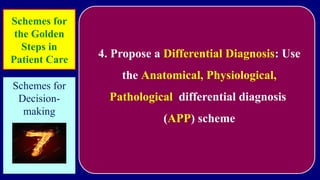
4. Propose a Differential Diagnosis: Use the Anatomical,
Physiological, Pathological differential diagnosis (APP) scheme
Schemes for
the Golden
Steps in
Patient Care
Schemes for
Decision-
making
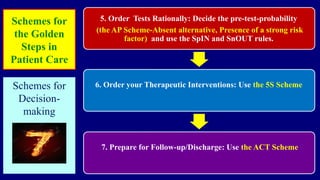
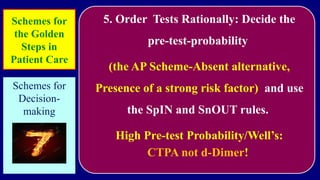
5. Order Tests Rationally: Decide the pre-test-probability
(the AP Scheme-Absent alternative, Presence of a strong risk
factor) and use the SpIN and SnOUT rules.
6. Order your Therapeutic Interventions: Use the 5S Scheme
7. Prepare for Follow-up/Discharge: Use the ACT Scheme
Schemes for
the Golden
Steps in
Patient Care
Schemes for
Decision-
making
1. Gather Information: H&P (History & Physical)-Hypothesis-
Driven and Patient-centered!
Suspected Pulmonary embolism: leg swelling and pain, signs
of right heart strain, pleural rub etc.
Psychosocial impact: activities of daily living, job absenteeism,
financial etc.
Preferences: regarding diagnostic tests and treatments!
Schemes for
the Golden
Steps in
Patient Care
Schemes for
Decision-
making
2. Summarize: Using “technical”
language: Problem Representation &
“Illness Script”.
Sarah, is an obese, 24-year-old female, attending ER
for the third time, recent discharge from hospital with
a prolonged stay, unresolving asthma symptoms with
cough, dyspnoea, right-sided pleurisy, hemoptysis and
reduced level of consciousness GCS ….
Schemes for
the Golden
Steps in
Patient Care
Schemes for
Decision-
making
3. Propose a “comprehensive” Diagnostic
Label (3 critical components): Bedside
Diagnosis, Etiology, Severity (the BESD)
Scheme + Problem List
B: Poorly-resolving asthma exacerbation
E: Likely Pulmonary Embolism
S: Life-threatening/Severe
Problem List:
Obesity etc.
Schemes for
the Golden
Steps in
Patient Care
Schemes for
Decision-
making
Eitiology in a patient
presenting with Asthma
Exacerbation
“An important and well-
recognized cause of
diagnostic errors is
failing to consider
the etiology or
alternative diagnoses”
My Etiological Diagnoses are…….
My Diagnosis is Bronchial Asthma
Exacerbation:
Infections:
Viral: Covid-19, Influenza etc.
Bacterial: Pneumococcus, Mycoplasma,
Legionella, Chlamydia etc.
Poor inhaler Technique
Aggravators: GERD, Sinusitis/PND etc.
Exposure to Precipitanats: smoke,
inhalants, drugs etc.
Psychosocial etc.
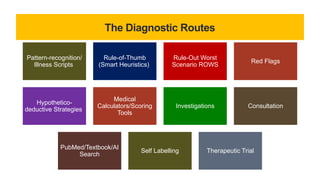
The Diagnostic Routes
Pattern-recognition/
Illness Scripts
Rule-of-Thumb
(Smart Heuristics)
Rule-Out Worst
Scenario ROWS
Red Flags
Hypothetico-
deductive Strategies
Medical
Calculators/Scoring
Tools
Investigations Consultation
PubMed/Textbook/AI
Search
Self Labelling Therapeutic Trial
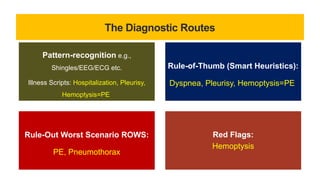
The Diagnostic Routes
Pattern-recognition e.g.,
Shingles/EEG/ECG etc.
Illness Scripts: Hospitalization, Pleurisy,
Hemoptysis=PE
Rule-of-Thumb (Smart Heuristics):
Dyspnea, Pleurisy, Hemoptysis=PE
Rule-Out Worst Scenario ROWS:
PE, Pneumothorax
Red Flags:
Hemoptysis
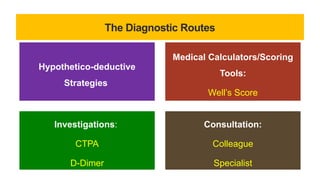
The Diagnostic Routes
Hypothetico-deductive
Strategies
Medical Calculators/Scoring
Tools:
Well’s Score
Investigations:
CTPA
D-Dimer
Consultation:
Colleague
Specialist
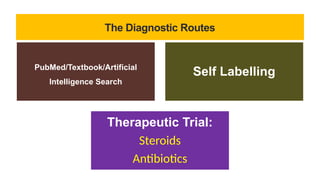
The Diagnostic Routes
PubMed/Textbook/Artificial
Intelligence Search
Self Labelling
Therapeutic Trial:
Steroids
Antibiotics
4. Propose a Differential Diagnosis: Use
the Anatomical, Physiological,
Pathological differential diagnosis
(APP) scheme
Schemes for
the Golden
Steps in
Patient Care
Schemes for
Decision-
making
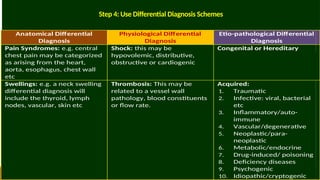
Step 4: Use Differential Diagnosis Schemes
Anatomical Differential
Diagnosis
Physiological Differential
Diagnosis
Etio-pathological Differential
Diagnosis
Pain Syndromes: e.g. central
chest pain may be categorized
as arising from the heart,
aorta, esophagus, chest wall
etc
Shock: this may be
hypovolemic, distributive,
obstructive or cardiogenic
Congenital or Hereditary
Swellings: e.g. a neck swelling
differential diagnosis will
include the thyroid, lymph
nodes, vascular, skin etc
Thrombosis: This may be
related to a vessel wall
pathology, blood constituents
or flow rate.
Acquired:
1. Traumatic
2. Infective: viral, bacterial
etc
3. Inflammatory/auto-
immune
4. Vascular/degenerative
5. Neoplastic/para-
neoplastic
6. Metabolic/endocrine
7. Drug-induced/ poisoning
8. Deficiency diseases
9. Psychogenic
10. Idiopathic/cryptogenic
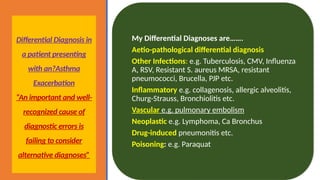
Differential Diagnosis in
a patient presenting
with an?Asthma
Exacerbation
“An important and well-
recognized cause of
diagnostic errors is
failing to consider
alternative diagnoses”
My Differential Diagnoses are…….
Aetio-pathological differential diagnosis
Other Infections: e.g. Tuberculosis, CMV, Influenza
A, RSV, Resistant S. aureus MRSA, resistant
pneumococci, Brucella, PJP etc.
Inflammatory e.g. collagenosis, allergic alveolitis,
Churg-Strauss, Bronchiolitis etc.
Vascular e.g. pulmonary embolism
Neoplastic e.g. Lymphoma, Ca Bronchus
Drug-induced pneumonitis etc.
Poisoning: e.g. Paraquat
5. Order Tests Rationally: Decide the
pre-test-probability
(the AP Scheme-Absent alternative,
Presence of a strong risk factor) and use
the SpIN and SnOUT rules.
High Pre-test Probability/Well’s:
CTPA not d-Dimer!
Schemes for
the Golden
Steps in
Patient Care
Schemes for
Decision-
making
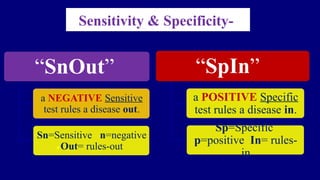
Sensitivity & Specificity-
• –
“SnOut”
a NEGATIVE Sensitive
test rules a disease out.
Sn=Sensitive n=negative
Out= rules-out
“SpIn”
a POSITIVE Specific
test rules a disease in.
Sp=Specific
p=positive In= rules-
in
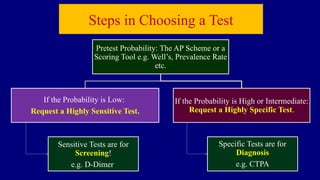
Steps in Choosing a Test
Pretest Probability: The AP Scheme or a
Scoring Tool e.g. Well’s, Prevalence Rate
etc.
If the Probability is Low:
Request a Highly Sensitive Test.
Sensitive Tests are for
Screening!
e.g. D-Dimer
If the Probability is High or Intermediate:
Request a Highly Specific Test.
Specific Tests are for
Diagnosis
e.g. CTPA
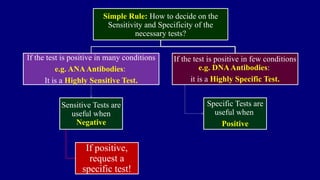
Simple Rule: How to decide on the
Sensitivity and Specificity of the
necessary tests?
If the test is positive in many conditions
e.g. ANAAntibodies:
It is a Highly Sensitive Test.
Sensitive Tests are
useful when
Negative
If positive,
request a
specific test!
If the test is positive in few conditions
e.g. DNAAntibodies:
it is a Highly Specific Test.
Specific Tests are
useful when
Positive
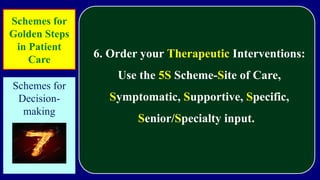
6. Order your Therapeutic Interventions:
Use the 5S Scheme-Site of Care,
Symptomatic, Supportive, Specific,
Senior/Specialty input.
Schemes for
Golden Steps
in Patient
Care
Schemes for
Decision-
making
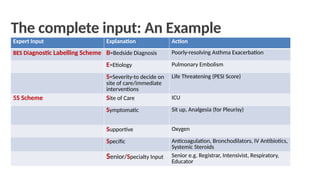
The complete input: An Example
Expert Input Explanation Action
BES Diagnostic Labelling Scheme B=Bedside Diagnosis Poorly-resolving Asthma Exacerbation
E=Etiology Pulmonary Embolism
S=Severity-to decide on
site of care/immediate
interventions
Life Threatening (PESI Score)
5S Scheme Site of Care ICU
Symptomatic Sit up, Analgesia (for Pleurisy)
Supportive Oxygen
Specific Anticoagulation, Bronchodilators, IV Antibiotics,
Systemic Steroids
Senior/Specialty Input Senior e.g. Registrar, Intensivist, Respiratory,
Educator
7. Prepare for Follow-up/Discharge: Use
the ACT Scheme
Schemes for
Golden Steps
in Patient
Care
Schemes for
Decision-
making
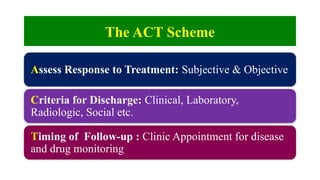
The ACT Scheme
Assess Response to Treatment: Subjective & Objective
Criteria for Discharge: Clinical, Laboratory,
Radiologic, Social etc.
Timing of Follow-up : Clinic Appointment for disease
and drug monitoring
COMPETENCY-
BASED
DECISION-
MAKING
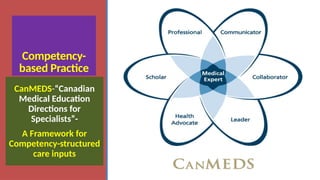
Competency-
based Practice
CanMEDS-“Canadian
Medical Education
Directions for
Specialists”-
A Framework for
Competency-structured
care inputs
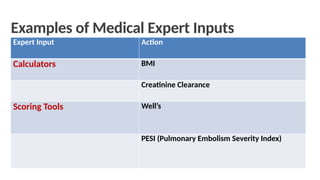
Examples of Medical Expert Inputs
Expert Input Action
Calculators BMI
Creatinine Clearance
Scoring Tools Well’s
PESI (Pulmonary Embolism Severity Index)
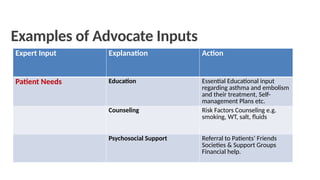
Examples of Advocate Inputs
Expert Input Explanation Action
Patient Needs Education Essential Educational input
regarding asthma and embolism
and their treatment, Self-
management Plans etc.
Counseling Risk Factors Counseling e.g.
smoking, WT, salt, fluids
Psychosocial Support Referral to Patients’ Friends
Societies & Support Groups
Financial help.
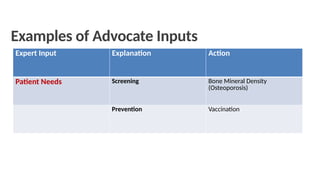
Examples of Advocate Inputs
Expert Input Explanation Action
Patient Needs Screening Bone Mineral Density
(Osteoporosis)
Prevention Vaccination
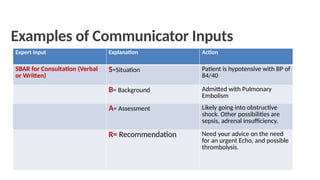
Examples of Communicator Inputs
Expert Input Explanation Action
SBAR for Consultation (Verbal
or Written)
S=Situation Patient is hypotensive with BP of
84/40
B= Background Admitted with Pulmonary
Embolism
A= Assessment Likely going into obstructive
shock. Other possibilities are
sepsis, adrenal insufficiency.
R= Recommendation Need your advice on the need
for an urgent Echo, and possible
thrombolysis.
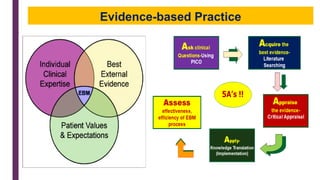
EVIDENCE-BASED
DECISION-
MAKING
Evidence-based Practice
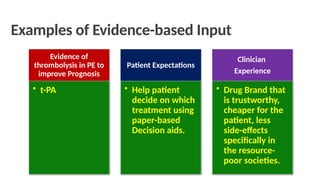
Examples of Evidence-based Input
Evidence of
thrombolysis in PE to
improve Prognosis
• t-PA
Patient Expectations
• Help patient
decide on which
treatment using
paper-based
Decision aids.
Clinician
Experience
• Drug Brand that
is trustworthy,
cheaper for the
patient, less
side-effects
specifically in
the resource-
poor societies.
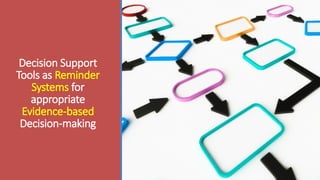
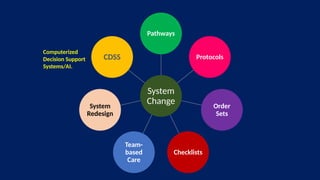
Decision Support
Tools as Reminder
Systems for
appropriate
Evidence-based
Decision-making
System
Change
Pathways
Protocols
Order
Sets
Checklists
Team-
based
Care
System
Redesign
CDSS
Computerized
Decision Support
Systems/AI.
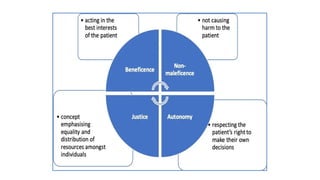
Ethical &
Cultural-based
Decision-making
Two Important Ethical Guides in Decision-
making
Bioethics
Principlism
(Western
Philosophy)
ِ‫ة‬َ‫ع‬‫ي‬ِ‫ر‬ َّ‫الش‬ ُ‫د‬ِ‫ص‬‫َا‬‫ق‬َ‫م‬
Islamic
Jurisprudence’ (Fiqh)
Summary and
examples of the
main purposes
of the Islamic
laws (Sharia)
Patient & Family
Centered
Decision-making
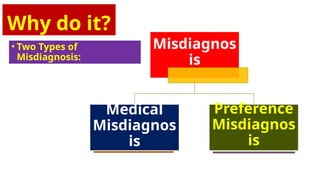
Why do it?
• Two Types of
Misdiagnosis:
Misdiagnos
is
Medical
Misdiagnos
is
Preference
Misdiagnos
is
Patient-Centered Shared Decision Making
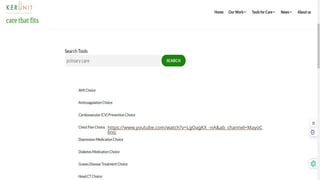
•Mayo Clinic: https://carethatfits.org/tools/
•http://shareddecisions.mayoclinic.org/
•Diabetes:
https://carethatfits.org/diabetes-medication-choice/
•Patient Decision Aids http://decisionaid.ohri.ca/AZlist.html
84 12/21/2024 Add a footer
https://www.youtube.com/watch?v=LgOagKX_-nA&ab_channel=MayoC
linic
Causes of Poor Clinical Reasoning/Decision-making Errors
 Inadequate knowledge
 Faulty data gathering/acquisition
 Faulty data processing
 Faulty metacognition (Cognitive Biases)
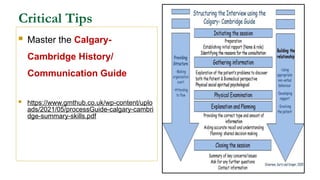
Critical Tips
 Master the Calgary-
Cambridge History/
Communication Guide
 https://www.gmthub.co.uk/wp-content/uplo
ads/2021/05/processGuide-calgary-cambri
dge-summary-skills.pdf
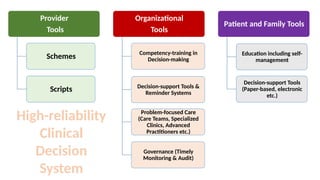
Provider
Tools
Schemes
Scripts
Organizational
Tools
Competency-training in
Decision-making
Decision-support Tools &
Reminder Systems
Problem-focused Care
(Care Teams, Specialized
Clinics, Advanced
Practitioners etc.)
Governance (Timely
Monitoring & Audit)
Patient and Family Tools
Education including self-
management
Decision-support Tools
(Paper-based, electronic
etc.)
High-reliability
Clinical
Decision
System
89
1.Introduce a NOVEL perspective on Medical
Decision-making: “Transform” trainees
thinking to a “higher order” process for a
“spot-on” and “contextually correct”
decision-making!
Competence
by Design
90
2. Seamlessly empower trainees to incorporate the
following concepts in “everyday” decision-making:
1. The “Eleven” Diagnostic Routes in Clinical Care
2. Cognitive Schemes (AP, BESD, APP, 5S, ACT
Schemes)
3. Illness Scripts
4. Evidence-based Medicine
5. Quality Concepts (STEEEP- safe, timely, effective,
efficient, equitable and patient-centered)
6. Competency-based Frameworks
7. Patient-centered Care
Competence
by Design
Become a "top-class" decision-maker in
medicine:
https://drive.google.com/drive/folders/1cIsf
v-DS_2VncjtbVKL-jAEwth4fZCyT?usp=drive_li
nk
https://tababamedics.com/
Critical Thinking Decision Making N1.pptx

Critical Thinking Decision Making N1.pptx

  • 1.
    The Nuts &Bolts of Critical Thinking and Decision-making in Clinical Medicine
  • 2.
    Secrets of The Profession: MASTERINGTHE SKILL OF DECISION- MAKING Acquiring Clinical Consultant Skills FAST !
  • 3.
    Secrets of The Profession: DIAGNOSTIC& THERAPEUTIC EXCELLENCE Acquiring Clinical Consultant Skills FAST !
  • 4.
    Dr. Imad SalahAhmed Hassan MD (UK) FACP FRCPI MSc (UK) MBBS (U of K)
  • 5.
    Dr.ImadSalahAhmedHassanMD(UK)FACP 5  Consultant Internistwith interest in Pulmonary Medicine  30 years PLUS in medical education • Won the title of Best Tutor 6 times!  Chairman of more than 10 committees covering: • Competency-based medical education • Quality Improvement • Knowledge Translation/Evidence-based Practice • Research  Consultant in Patient Experience Program, Diagnostic Excellence, Patient Safety  Multiple Innovations & Publications in Decision-making and Competency-based Medical Education CBME.  More than 40 publications.
  • 6.
    6 The presentation inshort: A Competence by Design Approach for Mastery in Critical Thinking and Decision-making in Medicine using a Case Scenario. Competence by Design
  • 7.
    7 1. Introduce aNOVEL perspective on Medical Decision-making: “Transform” trainees thinking to a “higher order” process for a “spot-on” and “contextually correct” decision- making! Competence by Design
  • 8.
    8 2. Seamlessly empowertrainees to incorporate the following concepts in “everyday” decision-making: 1. The “Eleven” Diagnostic Routes in Clinical Care 2. Cognitive Schemes (AP, BESD, APP, 5S, ACT Schemes) 3. Illness Scripts 4. Evidence-based Medicine 5. Quality Concepts (STEEEP- safe, timely, effective, efficient, equitable and patient-centered) 6. Competency-based Frameworks 7. Patient-centered Care Competence by Design
  • 9.
    The 2 Pillarsof Master Clinicians Cognitive Dimension Ability to correctly Diagnose & Treat Human & Interpersonal Dimension Focusing on “WHAT MATTERS” to the patient rather than only on ‘WHAT IS THE MATTER” with them! Striving for excellence in both is a “Moral Obligation”
  • 10.
    10 TheCourse:inshort Achieving Mastery inthe Cognitive Domain Competence by Design Novice Experienc ed Expert
  • 11.
    Competent Clinicians-are expertsin dealing with the THREE major DIAGNOSTIC LABELS-Tri-Label Diagnosis- for their patients based on their patients concerns! What is the matter with me? The Disease • Right Diagnosis • Right Treatment What matters to me? The Illness (Impact) • Physical Component: Pain, insomnia etc. • Social Component: Activities of Dail Living- Self-care, Work, Study, Prayers, Finance etc. • Psychological: Anxiety, Fear etc. What suits my personal and family needs? My Preferences • My management/ treatment preferences: •Less costly •Outcomes align with my personal aspirations! •Least side-effects •Socially appropriate •Culturally appropriate
  • 12.
    Getting the THREEmajor diagnostic concerns of their patients wrong! The End Results What is the matter with me? The Disease • Diagnostic Error: Wrong diagnosis Delayed diagnosis Missed diagnosis What matters to me? The Illness (Impact) • Non-empathic care • Non-compassionate Care What suits my personal and family needs? My Preferences • Preference misdiagnosis
  • 13.
    13 What is MedicalDecision- making? The Roadmap
  • 14.
    Definition Medical decision makingis the process by which healthcare professionals use their clinical knowledge, expertise, patient information and preferences, and available evidence to make informed medical and healthcare management decisions.
  • 15.
    Medical decision-making is anART! The “SKILL” of creating beautiful and attractive “thoughts and actions” that your customers truly rejoice and appreciate!
  • 16.
    The critical “output”of effective decision making in healthcare: Spot-on & Appropriate Diagnosis Therapy Prognosis Screening & Prevention
  • 17.
    Why is decision-makingso critical? 17 ?
  • 18.
    18 The cost ofpoor decision- making. The Roadmap
  • 19.
    The critical importanceof effective decision making in healthcare.  Medical decision making is critically important in healthcare because it directly impacts: ● Patient quality of care and health outcomes. ● Patient experience ● Staff experience and satisfaction ● Use of resources
  • 22.
  • 23.
    Causes of PoorClinical Reasoning/Decision-making Errors  Inadequate knowledge  Faulty data gathering/acquisition  Faulty data processing  Faulty metacognition (Cognitive Biases)
  • 24.
    24 Novice and ExpertDecision- making: the differences? The Roadmap
  • 25.
    Clinical Reasoning • Unlikenovices, clinical experts tend to utilize “mental schemes or scripts” for problem-solving, clinical reasoning and rational decision making. Mandin H, Jones A, Woloschuk W, Harasym P. Helping students to think like experts when solving clinical problems. Acad Med 1997;72:173-9.
  • 27.
    Facts on ClinicalDecision-making Knowledge without “tools” for knowledge retrieval and knowledge application is inadequate for an error-free and effective decision-making in clinical medicine.
  • 28.
    Clinical Reasoning Cognitive schemesand Scripts are effective tools for knowledge- retrieval, critical thinking, problem-solving, and decision- making. Peran D, et al. ABCDE cognitive aid tool in patient assessment - development and validation in a multicenter pilot simulation study. BMC Emerg Med. 2020;20(1):95. Dresler M, et al. Mnemonic Training Reshapes Brain Networks to Support Superior Memory. Neuron. 2017;93(5):1227-1235. Marshall S. The use of cognitive aids during emergencies in anesthesia: a review of the literature. Anesth Analg. 2013;117(5):1162-71.
  • 29.
    29 Important Concepts: Scripts, SemanticQualifiers, Schemes. The Roadmap
  • 30.
    Clinical Reasoning A “CognitiveScheme” is a cognitive memory aid that contains an organized “action” map or plan by “CLUSTERING” similar concepts together.
  • 31.
    Clinical Reasoning An “IllnessScript”-a form of Pattern Recognition- is an organized mental summary/mental map of a provider’s knowledge of a disease. Three elements of Illness Scripts: Epidemiology? (who gets this condition and when), What is the Pathophysiology?, What is the Clinical presentation and distinguishing characteristics. Mandin H, Jones A, Woloschuk W, Harasym P. Helping students to think like experts when solving clinical problems. Acad Med 1997;72:173-9.
  • 32.
    Illness Script CognitiveScheme/Mnemonic Memory Aid Memory Aid Pattern Recognition: System 1 Thinking (Fast, Error-prone) Analytic problem-solving: System 2 Thinking (Slow, Less Error-prone) Diagnosis Diagnosis, Therapy, Prevention, Prognosis etc. Slow to acquire (needs time and effort) Faster to acquire (faster Novice to Expert transition) Example: a toddler, early winter, viral URI prodrome, fever, barky cough, stridor, and retractions, worse in middle of night. Not usually ill appearing. (Croup illness script) Error prone: may miss Epiglottitis, Retropharyngeal Abscess, Foreign Body etc. Example: Renal Failure: Pre-, Renal, Post-
  • 33.
    Critical Tips Semantic qualifiersare paired, opposing, abstract words that aid in comparing and contrasting diagnoses. For example, one day of symptoms can be abstracted to an acute problem (versus a chronic problem), and left-sided wheezing becomes unilateral wheezing (versus bilateral wheezing). “Expertly” and smartly use Semantic Qualifiers:
  • 34.
    Critical Tips “Expertly” andsmartly use Semantic Qualifiers: Successful and expert diagnosticians are more adept at using these semantic qualifiers for “problem representation/disease script* alignment” than less successful diagnosticians. *a mental map or pattern fitting a specific diagnosis.
  • 36.
    Using Semantic Qualifiersto built an Illness Script! A 23-year-old white British male patient with a 4 months history of low back pain worse with movement, occasional abdominal pains with frequent blood-stained loose stools, and left ankle joint and right knee swelling and pain. He lost 12 kilograms of weight. Summary: A young (age) Caucasian male patient with chronic bloody diarrhea (duration), significant weight loss (lost 12 Kg), axial mechanical musculoskeletal pains (spine) as well as an asymmetric oligoarthritis (few, inflamed joints).
  • 37.
    37 A case Scenario:a universal roadmap for care provision. The Roadmap
  • 38.
    38 History: Sarah, is anobese BMI 36, 24-year-old female who was recently discharged from hospital. She has been discharged from hospital after a 14 days admission with an exacerbation of Bronchial Asthma. This is the third time she has attended ER since discharge as she is still very symptomatic with cough, wheeze and breathlessness. Additionally, she developed a right sided chest pain that is worse with breathing and a red-tinged sputum and appeared drowsy. The Case
  • 39.
    39 Questions: 1. Why isshe still having active asthma symptoms? 2. Does she need to be readmitted? 3. Does she need another course of systemic steroids? 4. Does she need another course of antibiotics? 5. Etc. The Case
  • 40.
    40 Progress: Re-admitted to hospitaltwo days later with worsening breathlessness and reduced level of consciousness. Intubated! The Case
  • 41.
    How to AchieveExcellence?
  • 42.
    Learning Objectives Articulate a comprehensive management inputfor any acute medical case using Cognitive Schemes.
  • 43.
    1. Gather Information:H&P (History & Physical)- 2. Summarize using “technical” language 3. Propose a “comprehensive” Diagnostic Label + Problem List 4. Propose a Differential Diagnosis 5. Order Tests Rationally 6. Order your Therapeutic Interventions 7. Prepare for Follow-up/Discharge Schemes for the Golden Steps in Patient Care Schemes for Decision- making
  • 44.
    1. Gather Information:H&P (History & Physical)-Hypothesis- Driven & Patient-centered! 2. Summarize: Using “technical” language: Problem Representation & “Illness Script”. 3. Propose a “comprehensive” Diagnostic Label: Bedside Diagnosis, Etiology, Severity (the BESD) Scheme + Problem List 4. Propose a Differential Diagnosis: Use the Anatomical, Physiological, Pathological differential diagnosis (APP) scheme Schemes for the Golden Steps in Patient Care Schemes for Decision- making
  • 45.
    5. Order TestsRationally: Decide the pre-test-probability (the AP Scheme-Absent alternative, Presence of a strong risk factor) and use the SpIN and SnOUT rules. 6. Order your Therapeutic Interventions: Use the 5S Scheme 7. Prepare for Follow-up/Discharge: Use the ACT Scheme Schemes for the Golden Steps in Patient Care Schemes for Decision- making
  • 46.
    1. Gather Information:H&P (History & Physical)-Hypothesis- Driven and Patient-centered! Suspected Pulmonary embolism: leg swelling and pain, signs of right heart strain, pleural rub etc. Psychosocial impact: activities of daily living, job absenteeism, financial etc. Preferences: regarding diagnostic tests and treatments! Schemes for the Golden Steps in Patient Care Schemes for Decision- making
  • 47.
    2. Summarize: Using“technical” language: Problem Representation & “Illness Script”. Sarah, is an obese, 24-year-old female, attending ER for the third time, recent discharge from hospital with a prolonged stay, unresolving asthma symptoms with cough, dyspnoea, right-sided pleurisy, hemoptysis and reduced level of consciousness GCS …. Schemes for the Golden Steps in Patient Care Schemes for Decision- making
  • 48.
    3. Propose a“comprehensive” Diagnostic Label (3 critical components): Bedside Diagnosis, Etiology, Severity (the BESD) Scheme + Problem List B: Poorly-resolving asthma exacerbation E: Likely Pulmonary Embolism S: Life-threatening/Severe Problem List: Obesity etc. Schemes for the Golden Steps in Patient Care Schemes for Decision- making
  • 49.
    Eitiology in apatient presenting with Asthma Exacerbation “An important and well- recognized cause of diagnostic errors is failing to consider the etiology or alternative diagnoses” My Etiological Diagnoses are……. My Diagnosis is Bronchial Asthma Exacerbation: Infections: Viral: Covid-19, Influenza etc. Bacterial: Pneumococcus, Mycoplasma, Legionella, Chlamydia etc. Poor inhaler Technique Aggravators: GERD, Sinusitis/PND etc. Exposure to Precipitanats: smoke, inhalants, drugs etc. Psychosocial etc.
  • 50.
    The Diagnostic Routes Pattern-recognition/ IllnessScripts Rule-of-Thumb (Smart Heuristics) Rule-Out Worst Scenario ROWS Red Flags Hypothetico- deductive Strategies Medical Calculators/Scoring Tools Investigations Consultation PubMed/Textbook/AI Search Self Labelling Therapeutic Trial
  • 51.
    The Diagnostic Routes Pattern-recognitione.g., Shingles/EEG/ECG etc. Illness Scripts: Hospitalization, Pleurisy, Hemoptysis=PE Rule-of-Thumb (Smart Heuristics): Dyspnea, Pleurisy, Hemoptysis=PE Rule-Out Worst Scenario ROWS: PE, Pneumothorax Red Flags: Hemoptysis
  • 52.
    The Diagnostic Routes Hypothetico-deductive Strategies MedicalCalculators/Scoring Tools: Well’s Score Investigations: CTPA D-Dimer Consultation: Colleague Specialist
  • 53.
    The Diagnostic Routes PubMed/Textbook/Artificial IntelligenceSearch Self Labelling Therapeutic Trial: Steroids Antibiotics
  • 54.
    4. Propose aDifferential Diagnosis: Use the Anatomical, Physiological, Pathological differential diagnosis (APP) scheme Schemes for the Golden Steps in Patient Care Schemes for Decision- making
  • 55.
    Step 4: UseDifferential Diagnosis Schemes Anatomical Differential Diagnosis Physiological Differential Diagnosis Etio-pathological Differential Diagnosis Pain Syndromes: e.g. central chest pain may be categorized as arising from the heart, aorta, esophagus, chest wall etc Shock: this may be hypovolemic, distributive, obstructive or cardiogenic Congenital or Hereditary Swellings: e.g. a neck swelling differential diagnosis will include the thyroid, lymph nodes, vascular, skin etc Thrombosis: This may be related to a vessel wall pathology, blood constituents or flow rate. Acquired: 1. Traumatic 2. Infective: viral, bacterial etc 3. Inflammatory/auto- immune 4. Vascular/degenerative 5. Neoplastic/para- neoplastic 6. Metabolic/endocrine 7. Drug-induced/ poisoning 8. Deficiency diseases 9. Psychogenic 10. Idiopathic/cryptogenic
  • 56.
    Differential Diagnosis in apatient presenting with an?Asthma Exacerbation “An important and well- recognized cause of diagnostic errors is failing to consider alternative diagnoses” My Differential Diagnoses are……. Aetio-pathological differential diagnosis Other Infections: e.g. Tuberculosis, CMV, Influenza A, RSV, Resistant S. aureus MRSA, resistant pneumococci, Brucella, PJP etc. Inflammatory e.g. collagenosis, allergic alveolitis, Churg-Strauss, Bronchiolitis etc. Vascular e.g. pulmonary embolism Neoplastic e.g. Lymphoma, Ca Bronchus Drug-induced pneumonitis etc. Poisoning: e.g. Paraquat
  • 57.
    5. Order TestsRationally: Decide the pre-test-probability (the AP Scheme-Absent alternative, Presence of a strong risk factor) and use the SpIN and SnOUT rules. High Pre-test Probability/Well’s: CTPA not d-Dimer! Schemes for the Golden Steps in Patient Care Schemes for Decision- making
  • 58.
    Sensitivity & Specificity- •– “SnOut” a NEGATIVE Sensitive test rules a disease out. Sn=Sensitive n=negative Out= rules-out “SpIn” a POSITIVE Specific test rules a disease in. Sp=Specific p=positive In= rules- in
  • 59.
    Steps in Choosinga Test Pretest Probability: The AP Scheme or a Scoring Tool e.g. Well’s, Prevalence Rate etc. If the Probability is Low: Request a Highly Sensitive Test. Sensitive Tests are for Screening! e.g. D-Dimer If the Probability is High or Intermediate: Request a Highly Specific Test. Specific Tests are for Diagnosis e.g. CTPA
  • 60.
    Simple Rule: Howto decide on the Sensitivity and Specificity of the necessary tests? If the test is positive in many conditions e.g. ANAAntibodies: It is a Highly Sensitive Test. Sensitive Tests are useful when Negative If positive, request a specific test! If the test is positive in few conditions e.g. DNAAntibodies: it is a Highly Specific Test. Specific Tests are useful when Positive
  • 61.
    6. Order yourTherapeutic Interventions: Use the 5S Scheme-Site of Care, Symptomatic, Supportive, Specific, Senior/Specialty input. Schemes for Golden Steps in Patient Care Schemes for Decision- making
  • 62.
    The complete input:An Example Expert Input Explanation Action BES Diagnostic Labelling Scheme B=Bedside Diagnosis Poorly-resolving Asthma Exacerbation E=Etiology Pulmonary Embolism S=Severity-to decide on site of care/immediate interventions Life Threatening (PESI Score) 5S Scheme Site of Care ICU Symptomatic Sit up, Analgesia (for Pleurisy) Supportive Oxygen Specific Anticoagulation, Bronchodilators, IV Antibiotics, Systemic Steroids Senior/Specialty Input Senior e.g. Registrar, Intensivist, Respiratory, Educator
  • 63.
    7. Prepare forFollow-up/Discharge: Use the ACT Scheme Schemes for Golden Steps in Patient Care Schemes for Decision- making
  • 64.
    The ACT Scheme AssessResponse to Treatment: Subjective & Objective Criteria for Discharge: Clinical, Laboratory, Radiologic, Social etc. Timing of Follow-up : Clinic Appointment for disease and drug monitoring
  • 65.
  • 66.
    Competency- based Practice CanMEDS-“Canadian Medical Education Directionsfor Specialists”- A Framework for Competency-structured care inputs
  • 67.
    Examples of MedicalExpert Inputs Expert Input Action Calculators BMI Creatinine Clearance Scoring Tools Well’s PESI (Pulmonary Embolism Severity Index)
  • 68.
    Examples of AdvocateInputs Expert Input Explanation Action Patient Needs Education Essential Educational input regarding asthma and embolism and their treatment, Self- management Plans etc. Counseling Risk Factors Counseling e.g. smoking, WT, salt, fluids Psychosocial Support Referral to Patients’ Friends Societies & Support Groups Financial help.
  • 69.
    Examples of AdvocateInputs Expert Input Explanation Action Patient Needs Screening Bone Mineral Density (Osteoporosis) Prevention Vaccination
  • 70.
    Examples of CommunicatorInputs Expert Input Explanation Action SBAR for Consultation (Verbal or Written) S=Situation Patient is hypotensive with BP of 84/40 B= Background Admitted with Pulmonary Embolism A= Assessment Likely going into obstructive shock. Other possibilities are sepsis, adrenal insufficiency. R= Recommendation Need your advice on the need for an urgent Echo, and possible thrombolysis.
  • 71.
  • 72.
  • 73.
    Examples of Evidence-basedInput Evidence of thrombolysis in PE to improve Prognosis • t-PA Patient Expectations • Help patient decide on which treatment using paper-based Decision aids. Clinician Experience • Drug Brand that is trustworthy, cheaper for the patient, less side-effects specifically in the resource- poor societies.
  • 74.
    Decision Support Tools asReminder Systems for appropriate Evidence-based Decision-making
  • 75.
  • 76.
  • 77.
    Two Important EthicalGuides in Decision- making Bioethics Principlism (Western Philosophy) ِ‫ة‬َ‫ع‬‫ي‬ِ‫ر‬ َّ‫الش‬ ُ‫د‬ِ‫ص‬‫َا‬‫ق‬َ‫م‬ Islamic Jurisprudence’ (Fiqh)
  • 79.
    Summary and examples ofthe main purposes of the Islamic laws (Sharia)
  • 80.
  • 82.
    Why do it? •Two Types of Misdiagnosis: Misdiagnos is Medical Misdiagnos is Preference Misdiagnos is
  • 83.
    Patient-Centered Shared DecisionMaking •Mayo Clinic: https://carethatfits.org/tools/ •http://shareddecisions.mayoclinic.org/ •Diabetes: https://carethatfits.org/diabetes-medication-choice/ •Patient Decision Aids http://decisionaid.ohri.ca/AZlist.html
  • 84.
    84 12/21/2024 Adda footer https://www.youtube.com/watch?v=LgOagKX_-nA&ab_channel=MayoC linic
  • 86.
    Causes of PoorClinical Reasoning/Decision-making Errors  Inadequate knowledge  Faulty data gathering/acquisition  Faulty data processing  Faulty metacognition (Cognitive Biases)
  • 87.
    Critical Tips  Masterthe Calgary- Cambridge History/ Communication Guide  https://www.gmthub.co.uk/wp-content/uplo ads/2021/05/processGuide-calgary-cambri dge-summary-skills.pdf
  • 88.
    Provider Tools Schemes Scripts Organizational Tools Competency-training in Decision-making Decision-support Tools& Reminder Systems Problem-focused Care (Care Teams, Specialized Clinics, Advanced Practitioners etc.) Governance (Timely Monitoring & Audit) Patient and Family Tools Education including self- management Decision-support Tools (Paper-based, electronic etc.) High-reliability Clinical Decision System
  • 89.
    89 1.Introduce a NOVELperspective on Medical Decision-making: “Transform” trainees thinking to a “higher order” process for a “spot-on” and “contextually correct” decision-making! Competence by Design
  • 90.
    90 2. Seamlessly empowertrainees to incorporate the following concepts in “everyday” decision-making: 1. The “Eleven” Diagnostic Routes in Clinical Care 2. Cognitive Schemes (AP, BESD, APP, 5S, ACT Schemes) 3. Illness Scripts 4. Evidence-based Medicine 5. Quality Concepts (STEEEP- safe, timely, effective, efficient, equitable and patient-centered) 6. Competency-based Frameworks 7. Patient-centered Care Competence by Design
  • 91.
    Become a "top-class"decision-maker in medicine: https://drive.google.com/drive/folders/1cIsf v-DS_2VncjtbVKL-jAEwth4fZCyT?usp=drive_li nk https://tababamedics.com/