International Classification of Functioning,
disease and health
Historical perspective
 Disability models ( charity- medical-social-bio
psycho social)
 ICD-10 for coding
 ICF is a companion module with a whole new
perspective eon disability
Universal Model vs. Minority
Model
Everyone may have disability
Continuum
Multi-dimensional
Certain impairment groups
Categorical
Uni-dimensional
Medical versus Social
Model
 PERSONAL problem vs SOCIAL problem
 medical care vs social integration
 individual treatment vs social action
 professional help vs individual & collective
responsibility
 personal vs environmental
adjustment manipulation
 behaviour vs attitude
 care vs human rights
 health care policy vs politics
 individual adaptation vs social change
Sequence of Concepts
ICIDH 1980
Impairments
Disease
or
disorder
Disabilities Handicaps
Foundations of ICF
Human Functioning - not merely disability
Universal Model - not a minority model
Integrative Model - not merely medical or
social
Interactive Model - not linear progressive
Parity - not etiological
causality
Context - inclusive - not person alone
Foundations of ICF
Cultural applicability - not western concepts
Operational - not theory driven
alone
Life span coverage - not adult driven
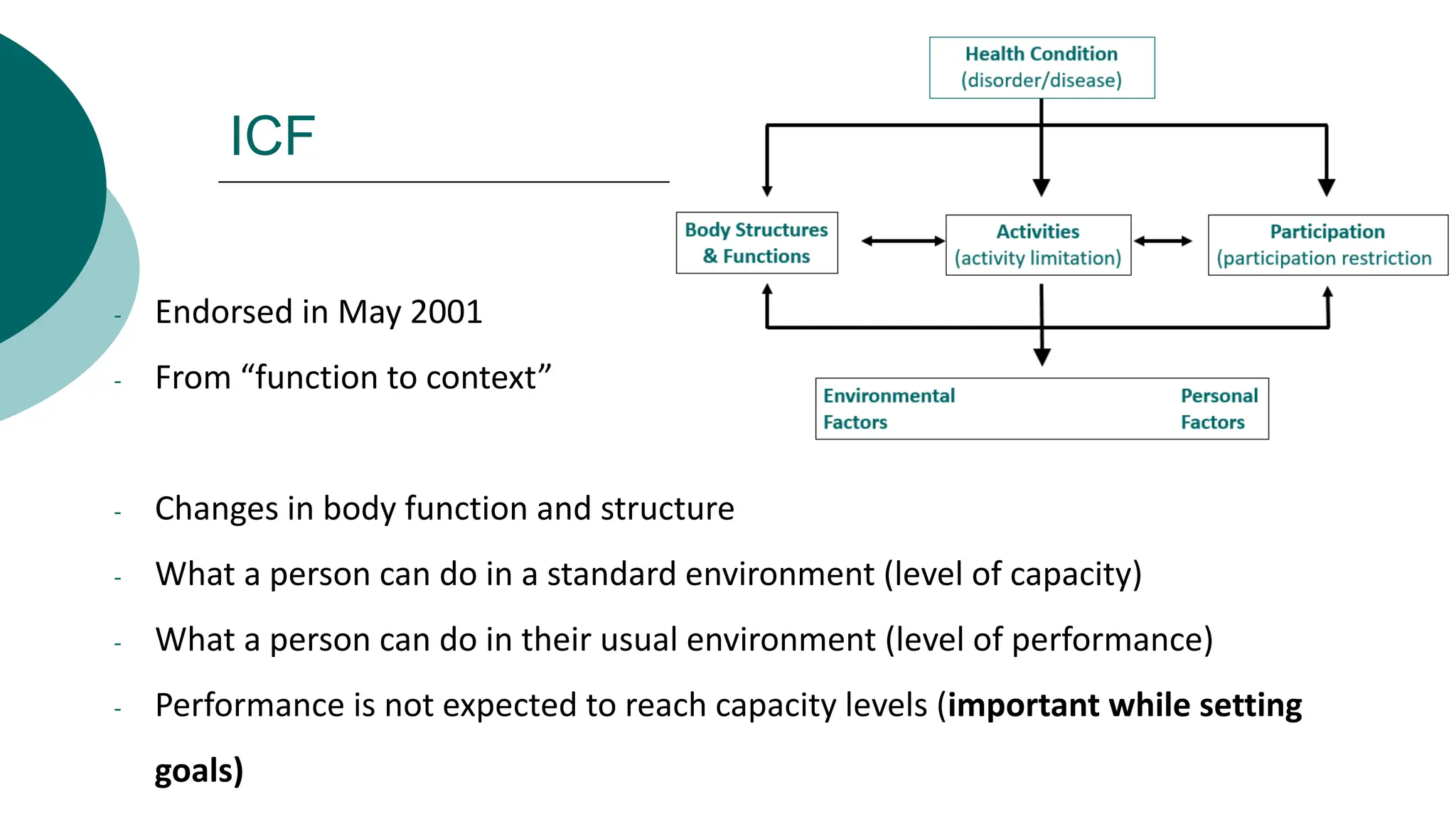
Health Condition
(disorder/disease
)
Interaction of Concepts
ICF 2001
Environmental
Factors
Personal
Factors
Body
function&structure
(Impairment)
Activities
(Limitation)
Participation
(Restriction)
ICF Organisation
 Chapters dealing with each domain
 Interactive bi directional
Clinical Reasoning for Therapy -
ICF Framework
Clinical reasoning for therapy
 Hypothesis generation – diagnosis
 Deficit identification
 Selection of outcome measure
 Management strategies
 Changes in management options
 Follow up plan
 Educational strategies
 Inter-disciplinary documentation
Whole person approach rather than diagnosis
 All of our targets may be influenced by various factors and not just the
diagnosis
 Hence the ICF framework works well
Deformity, ADL Participation
Societal Barriers Employment
ICF
- Endorsed in May 2001
- From “function to context”
- Changes in body function and structure
- What a person can do in a standard environment (level of capacity)
- What a person can do in their usual environment (level of performance)
- Performance is not expected to reach capacity levels (important while setting
goals)
Outcome measures for therapy
 An outcome measure is the result of a test that is used to objectively
determine the baseline function of a patient at the beginning of treatment
 The instrument should also be convenient to apply for the therapist and
comfortable for the patient
Outcomes and ICF
- The domains of ICF describe the three parts of therapy typically documented:
- The therapy goal based on the hypothesis and outcomes chosen
- The intervention strategy or strategies used to accomplish the goal
- The expected outcome of the intervention (+ CF)
Darrah, 2008
Outcomes and ICF
ICF component of body function
Therapist’s goal Intervention Expected outcome
ICF domain
Ability to straighten
knee against gravity
Specific resisted
exercises
Increased quadriceps
strength
Outcomes and ICF
Body function
Therapist’s goal Intervention Expected outcome
ICF domain
Strengthen a child’s
quadriceps muscle
with a qualifier
(MMT of 4+)
Specific resisted
exercises
Improvement in
functional stair
climbing
ICF component Activity
Outcomes and ICF
- By identifying the components represented, we can be more aware of the
assumptions we are making and realize the need to systematically evaluate the
relationship of these assumptions
- Improvement in muscle strength leads
to improvement in stair climbing – is
there a possibility for muscle strength
to improve? Should we consider a
compensatory strategy?
Outcomes and ICF
- By identifying the components represented, we can be more aware of the
assumptions we are making and realize the need to systematically evaluate the
relationship of these assumptions
- Clinical evaluation of the interactive
relationship across the components of
the ICF – is there a direct and simple
relationship or are there complexities
associated with CF?
Relationship between the focus of their interventions
and their expected outcomes
Expected relationship between ICF components Clinical examples
Intervention at component of body function and
structure to achieve improvement at component of
body function and structure
Passive stretching to increase joint range
of motion. Tone reduction to improve
grasp
Intervention at component of body function and
structure to achieve improvement at component of
activity
Passive stretching to improve a child’s
sitting abilities
Intervention at component of activity to achieve
improvement at component of body function and
structure
Increase walking practice to improve
muscle strength
Intervention at component of participation to achieve
improvement at component of participation
Initiate a buddy system at school so that
child can keep up with peers and
socialize
Influence of context on outcomes
 Therapists must acknowledge that a person’s functional motor abilities are
influenced by context
 For example,
A child may be able to improve his or her ability to climb the stationary stairs in the
physiotherapy department, but he or she may not be able to extrapolate this
improvement to the stairs in school due to have a different rise and the skills
required to navigate among other students crowding the stairs
Intervention
 A similar matrix may also be very useful in clinical practice to assist therapists to reflect
on the assumptions being made in clinical practice about what kind of intervention they
are using and what the expected outcome will be
 If outcomes are not as expected, identification of the reasons also becomes simpler.
 E.g. A child is discharged form active therapy with a clear home programme for
maintenance of function. The child returns after 3 months with 80% loss of skills gained
in therapy prior to discharge. It might become necessary to adopt a strategy of
continuous therapy at intervals to avoid such an outcome
Using matrix system
 ICF as a ‘‘guiding system’’ - ICF provides an opportunity for therapists to
consider many intervention ‘‘points of entry’’ when making therapy plans
 ICF when used with CBR matrix gives a long term view of goal setting needs
Using matrix system
 Outcome measures are used to find out whether the therapy gains are meaningful to
patients. Eg. We might notice an improvement in ROM of 15 degrees in shoulder
abduction
 The patient’s goal was not Body Function but activity of doing her hair
 If this aspect is not evaluated using an outcome measure, management may appear to
be unsatisfactory
 Choice of outcome measure must consider which domain is important to the patient
Mapping outcomes
 ICF has been used in rehabilitation is as a tool to categorize outcome
measures
Body structure and function Activity Participation
Range of motion (Goniometry ) GMFM CHIEF
Muscle strength (Dynamometer) PEDI Life H
Endurance (functional testing) EVGS
Pain FMS
Changes in management strategies
 ICF helps to modify strategies based on patient’s evolving needs
 Walk being the same construct has different meanings and requirements in the
3 domains
Construct Domain
E.g. A child with CP- initial expectation is to walk Body Functions
Once achieved walk to the bathroom Activity
Once achieved walk in school Participation
Gait training would have started with a walker in the gym - (10ft) Body functions
Walking endurance to cover 5 m Activity
Walking with crutches on different surfaces for school 50m Participation
ICF core sets
 Specific set of functions for specific disorders
 Comprehensive and brief
 A useful tool for assessment and goal setting
ICF Core sets
 Comprehensive ICF Core Set –includes spectrum of typical problems that
persons with specific health condition may face; allows thorough and
interdisciplinary assessment.
 Brief ICF Core Set –is derived from Comprehensive Core set, used when
brief assessment of functioning is necessary; for describing functioning
and disability in clinical and epidemiological studies.
 Generic Core Set –important for health statistics and public health, can be
part of patient`s medical history.
ICF Core sets
 Core Sets assists in evaluation of the condition
 Support the interdisciplinary, comprehensive assessment of functioning
 Core-sets developed for various health conditions
ICF Core sets
Follow up plan
 Most people coming to PT will have needs even after discharge
 ICF core sets can act as a guiding framework to plan surveillance
programs, follow up etc
 Core sets for CP list pain. This is normally not a focus of PT but something
to be considered during surveillance programs
Educational strategies
 Patient and caregiver education programs can be made more focussed
using ICF domains and core sets
 ICF can be used to develop and structure a patient education program
targeting to enhance patients perceived self-efficacy in relation to their
functioning
Brunani, 2015
Checklist
 Who needs treatment and why?
 What are the expected outcomes of intervention?
 How should outcomes be measured and documented?
 What intervention, instructions, services, and number of visits are necessary to meet
these outcomes?
 How should the patient and caregivers be included in the decision making process?
 How should the success of the intervention and cost-effectiveness be evaluated?
 Are referrals needed for other health care services and screenings?
 When should we stop therapy?
Forward reasoning, or pattern recognition,
often is used when identifying salient
qualitative information
Steiner, 2002
How does ICF fit in clinical reasoning
 Knowledge and psychomotor ability, including observational analysis and
interviewing skills , are important in the development of higher-level skill
demonstrative of expert practice
 Clinical matrix based on ICF helps in forward reasoning, deductive or backward
reasoning, concept mapping, evidence appraisal, and interactive collaboration with
the patient and family are important strategies for clinical decision making
How does ICF fit in clinical reasoning
Frew, 2008
How does ICF fit in clinical reasoning
 Scientific reasoning and the Body Structures and Functions Dynamic
 Narrative Reasoning and the Activities, Participation and Contextual Factors Dynamic
 Pragmatic and Ethical Reasoning and the Contextual Factors Dynamic
How does ICF fit in clinical reasoning
Frew, 2008
How does ICF fit in clinical reasoning
Frew, 2008
How does ICF fit in clinical reasoning
Frew, 2008
How does ICF fit in clinical reasoning
Frew, 2008
How does ICF compare to traditional methods
Method Value Limitations
ICF Greater emphasis on
functioning and therefore
easier to set goals for
activities & participation
and acknowledge CF
Emphasis on AT and
interdisciplinary care
May not hone skills of
pattern recognition
Function is the focus and
hence certain methods
aimed at acquisition of lost
skills may be missed
Traditional diff.dx Puts emphasis on pattern
recognition and is very
useful for cold
orthopaedics
Emphasises the medical
model and hence may be
easier to identify red flags
Limited use when diagnosis
is known and focus is
activity/ function
May waste time in attempts
to regain lost function and
may approach rehabilitation
in a hierarchical manner
Documentation through sources
Defining the purpose
of assessment with
reference
Forms of assessment for obtaining
evidence
Quantification
and coding with the
universal qualifier
How does the child with
CP’s mind and body
function?
Standardized and criterion referenced
measures of cognition, perception,
attention, sensation
- Tests of vision and audition
- Physical measurement
- Laboratory measures
Standard scores
- Percentile scores and ranks
- Descriptive terms
- Ratings based on clinical
judgment
 ICF guides assessments of functioning in primary environments (e.g., home, school,
and community)
Documentation through sources
Defining the purpose
of assessment with
reference
Forms of assessment for obtaining
evidence
Quantification
and coding with the
universal qualifier
What barriers /
facilitators impact
functioning in the child’s
primary
environments?
Normative and criterion referenced
Measures of physical, social, and
attitudinal environments - Self-,
teacher-, parent-report of environment
- Observation of person/environment
interaction
- Photographic, audio, & video
Documentation
Standard scores
- Percentile scores and ranks
- Descriptive terms
- Ratings based on clinical
judgment
 ICF guides assessments of functioning in primary environments (e.g., home, school,
and community)
Documentation – interdisciplinary
Summary
 Therapy aims at addressing issues important to the patient/ client
 This calls for strong scientific knowledge to set meaningful and achievable
goals and plan evidence based interventions
 Requires a strong engagement with the patient and her/his personal
characteristics in order to reach a clinical hypothesis, confirm the hypothesis,
choose sensitive and meaningful measures, plan and execute care
 We mostly work backwards from activity to BS&F. Hence strong skills of
observation and “hearing” are required.
 ICF framework is a good method to organise the processes.
And….
 ICF tells you what to measure NOT how to
measure
 ICF itself is a useful evaluation tool for programs
and populations- limited used clinically
 Complete following e learning module and submit
evidence to me
 https://www.icf-elearning.com/
Core sets
 https://www.icf-research-branch.org/icf-core-
sets
International classification of functioning  and clinical reasoning.pptx

International classification of functioning and clinical reasoning.pptx

  • 1.
    International Classification ofFunctioning, disease and health
  • 2.
    Historical perspective  Disabilitymodels ( charity- medical-social-bio psycho social)  ICD-10 for coding  ICF is a companion module with a whole new perspective eon disability
  • 3.
    Universal Model vs.Minority Model Everyone may have disability Continuum Multi-dimensional Certain impairment groups Categorical Uni-dimensional
  • 4.
    Medical versus Social Model PERSONAL problem vs SOCIAL problem  medical care vs social integration  individual treatment vs social action  professional help vs individual & collective responsibility  personal vs environmental adjustment manipulation  behaviour vs attitude  care vs human rights  health care policy vs politics  individual adaptation vs social change
  • 5.
    Sequence of Concepts ICIDH1980 Impairments Disease or disorder Disabilities Handicaps
  • 6.
    Foundations of ICF HumanFunctioning - not merely disability Universal Model - not a minority model Integrative Model - not merely medical or social Interactive Model - not linear progressive Parity - not etiological causality Context - inclusive - not person alone
  • 7.
    Foundations of ICF Culturalapplicability - not western concepts Operational - not theory driven alone Life span coverage - not adult driven
  • 8.
    Health Condition (disorder/disease ) Interaction ofConcepts ICF 2001 Environmental Factors Personal Factors Body function&structure (Impairment) Activities (Limitation) Participation (Restriction)
  • 9.
    ICF Organisation  Chaptersdealing with each domain  Interactive bi directional
  • 10.
    Clinical Reasoning forTherapy - ICF Framework
  • 11.
    Clinical reasoning fortherapy  Hypothesis generation – diagnosis  Deficit identification  Selection of outcome measure  Management strategies  Changes in management options  Follow up plan  Educational strategies  Inter-disciplinary documentation
  • 12.
    Whole person approachrather than diagnosis  All of our targets may be influenced by various factors and not just the diagnosis  Hence the ICF framework works well Deformity, ADL Participation Societal Barriers Employment
  • 13.
    ICF - Endorsed inMay 2001 - From “function to context” - Changes in body function and structure - What a person can do in a standard environment (level of capacity) - What a person can do in their usual environment (level of performance) - Performance is not expected to reach capacity levels (important while setting goals)
  • 14.
    Outcome measures fortherapy  An outcome measure is the result of a test that is used to objectively determine the baseline function of a patient at the beginning of treatment  The instrument should also be convenient to apply for the therapist and comfortable for the patient
  • 15.
    Outcomes and ICF -The domains of ICF describe the three parts of therapy typically documented: - The therapy goal based on the hypothesis and outcomes chosen - The intervention strategy or strategies used to accomplish the goal - The expected outcome of the intervention (+ CF) Darrah, 2008
  • 16.
    Outcomes and ICF ICFcomponent of body function Therapist’s goal Intervention Expected outcome ICF domain Ability to straighten knee against gravity Specific resisted exercises Increased quadriceps strength
  • 17.
    Outcomes and ICF Bodyfunction Therapist’s goal Intervention Expected outcome ICF domain Strengthen a child’s quadriceps muscle with a qualifier (MMT of 4+) Specific resisted exercises Improvement in functional stair climbing ICF component Activity
  • 18.
    Outcomes and ICF -By identifying the components represented, we can be more aware of the assumptions we are making and realize the need to systematically evaluate the relationship of these assumptions - Improvement in muscle strength leads to improvement in stair climbing – is there a possibility for muscle strength to improve? Should we consider a compensatory strategy?
  • 19.
    Outcomes and ICF -By identifying the components represented, we can be more aware of the assumptions we are making and realize the need to systematically evaluate the relationship of these assumptions - Clinical evaluation of the interactive relationship across the components of the ICF – is there a direct and simple relationship or are there complexities associated with CF?
  • 20.
    Relationship between thefocus of their interventions and their expected outcomes Expected relationship between ICF components Clinical examples Intervention at component of body function and structure to achieve improvement at component of body function and structure Passive stretching to increase joint range of motion. Tone reduction to improve grasp Intervention at component of body function and structure to achieve improvement at component of activity Passive stretching to improve a child’s sitting abilities Intervention at component of activity to achieve improvement at component of body function and structure Increase walking practice to improve muscle strength Intervention at component of participation to achieve improvement at component of participation Initiate a buddy system at school so that child can keep up with peers and socialize
  • 21.
    Influence of contexton outcomes  Therapists must acknowledge that a person’s functional motor abilities are influenced by context  For example, A child may be able to improve his or her ability to climb the stationary stairs in the physiotherapy department, but he or she may not be able to extrapolate this improvement to the stairs in school due to have a different rise and the skills required to navigate among other students crowding the stairs
  • 22.
    Intervention  A similarmatrix may also be very useful in clinical practice to assist therapists to reflect on the assumptions being made in clinical practice about what kind of intervention they are using and what the expected outcome will be  If outcomes are not as expected, identification of the reasons also becomes simpler.  E.g. A child is discharged form active therapy with a clear home programme for maintenance of function. The child returns after 3 months with 80% loss of skills gained in therapy prior to discharge. It might become necessary to adopt a strategy of continuous therapy at intervals to avoid such an outcome
  • 23.
    Using matrix system ICF as a ‘‘guiding system’’ - ICF provides an opportunity for therapists to consider many intervention ‘‘points of entry’’ when making therapy plans  ICF when used with CBR matrix gives a long term view of goal setting needs
  • 24.
    Using matrix system Outcome measures are used to find out whether the therapy gains are meaningful to patients. Eg. We might notice an improvement in ROM of 15 degrees in shoulder abduction  The patient’s goal was not Body Function but activity of doing her hair  If this aspect is not evaluated using an outcome measure, management may appear to be unsatisfactory  Choice of outcome measure must consider which domain is important to the patient
  • 25.
    Mapping outcomes  ICFhas been used in rehabilitation is as a tool to categorize outcome measures Body structure and function Activity Participation Range of motion (Goniometry ) GMFM CHIEF Muscle strength (Dynamometer) PEDI Life H Endurance (functional testing) EVGS Pain FMS
  • 26.
    Changes in managementstrategies  ICF helps to modify strategies based on patient’s evolving needs  Walk being the same construct has different meanings and requirements in the 3 domains Construct Domain E.g. A child with CP- initial expectation is to walk Body Functions Once achieved walk to the bathroom Activity Once achieved walk in school Participation Gait training would have started with a walker in the gym - (10ft) Body functions Walking endurance to cover 5 m Activity Walking with crutches on different surfaces for school 50m Participation
  • 27.
    ICF core sets Specific set of functions for specific disorders  Comprehensive and brief  A useful tool for assessment and goal setting
  • 28.
    ICF Core sets Comprehensive ICF Core Set –includes spectrum of typical problems that persons with specific health condition may face; allows thorough and interdisciplinary assessment.  Brief ICF Core Set –is derived from Comprehensive Core set, used when brief assessment of functioning is necessary; for describing functioning and disability in clinical and epidemiological studies.  Generic Core Set –important for health statistics and public health, can be part of patient`s medical history.
  • 29.
    ICF Core sets Core Sets assists in evaluation of the condition  Support the interdisciplinary, comprehensive assessment of functioning  Core-sets developed for various health conditions
  • 30.
  • 31.
    Follow up plan Most people coming to PT will have needs even after discharge  ICF core sets can act as a guiding framework to plan surveillance programs, follow up etc  Core sets for CP list pain. This is normally not a focus of PT but something to be considered during surveillance programs
  • 32.
    Educational strategies  Patientand caregiver education programs can be made more focussed using ICF domains and core sets  ICF can be used to develop and structure a patient education program targeting to enhance patients perceived self-efficacy in relation to their functioning
  • 33.
  • 34.
    Checklist  Who needstreatment and why?  What are the expected outcomes of intervention?  How should outcomes be measured and documented?  What intervention, instructions, services, and number of visits are necessary to meet these outcomes?  How should the patient and caregivers be included in the decision making process?  How should the success of the intervention and cost-effectiveness be evaluated?  Are referrals needed for other health care services and screenings?  When should we stop therapy?
  • 35.
    Forward reasoning, orpattern recognition, often is used when identifying salient qualitative information Steiner, 2002
  • 36.
    How does ICFfit in clinical reasoning  Knowledge and psychomotor ability, including observational analysis and interviewing skills , are important in the development of higher-level skill demonstrative of expert practice  Clinical matrix based on ICF helps in forward reasoning, deductive or backward reasoning, concept mapping, evidence appraisal, and interactive collaboration with the patient and family are important strategies for clinical decision making
  • 37.
    How does ICFfit in clinical reasoning Frew, 2008
  • 38.
    How does ICFfit in clinical reasoning  Scientific reasoning and the Body Structures and Functions Dynamic  Narrative Reasoning and the Activities, Participation and Contextual Factors Dynamic  Pragmatic and Ethical Reasoning and the Contextual Factors Dynamic
  • 39.
    How does ICFfit in clinical reasoning Frew, 2008
  • 40.
    How does ICFfit in clinical reasoning Frew, 2008
  • 41.
    How does ICFfit in clinical reasoning Frew, 2008
  • 42.
    How does ICFfit in clinical reasoning Frew, 2008
  • 43.
    How does ICFcompare to traditional methods Method Value Limitations ICF Greater emphasis on functioning and therefore easier to set goals for activities & participation and acknowledge CF Emphasis on AT and interdisciplinary care May not hone skills of pattern recognition Function is the focus and hence certain methods aimed at acquisition of lost skills may be missed Traditional diff.dx Puts emphasis on pattern recognition and is very useful for cold orthopaedics Emphasises the medical model and hence may be easier to identify red flags Limited use when diagnosis is known and focus is activity/ function May waste time in attempts to regain lost function and may approach rehabilitation in a hierarchical manner
  • 44.
    Documentation through sources Definingthe purpose of assessment with reference Forms of assessment for obtaining evidence Quantification and coding with the universal qualifier How does the child with CP’s mind and body function? Standardized and criterion referenced measures of cognition, perception, attention, sensation - Tests of vision and audition - Physical measurement - Laboratory measures Standard scores - Percentile scores and ranks - Descriptive terms - Ratings based on clinical judgment  ICF guides assessments of functioning in primary environments (e.g., home, school, and community)
  • 45.
    Documentation through sources Definingthe purpose of assessment with reference Forms of assessment for obtaining evidence Quantification and coding with the universal qualifier What barriers / facilitators impact functioning in the child’s primary environments? Normative and criterion referenced Measures of physical, social, and attitudinal environments - Self-, teacher-, parent-report of environment - Observation of person/environment interaction - Photographic, audio, & video Documentation Standard scores - Percentile scores and ranks - Descriptive terms - Ratings based on clinical judgment  ICF guides assessments of functioning in primary environments (e.g., home, school, and community)
  • 46.
  • 47.
    Summary  Therapy aimsat addressing issues important to the patient/ client  This calls for strong scientific knowledge to set meaningful and achievable goals and plan evidence based interventions  Requires a strong engagement with the patient and her/his personal characteristics in order to reach a clinical hypothesis, confirm the hypothesis, choose sensitive and meaningful measures, plan and execute care  We mostly work backwards from activity to BS&F. Hence strong skills of observation and “hearing” are required.  ICF framework is a good method to organise the processes.
  • 48.
    And….  ICF tellsyou what to measure NOT how to measure  ICF itself is a useful evaluation tool for programs and populations- limited used clinically  Complete following e learning module and submit evidence to me  https://www.icf-elearning.com/
  • 49.