Healthcare Data Warehouse
Models Explained
© 2016 Health Catalyst
Proprietary. Feel free to share but we would appreciate a Health Catalyst citation.
Data Warehouse Models
Building the best enterprise data
warehouse (EDW) for your health system
starts with modeling the data. Why?
Because the data model used to build
your EDW has a significant impact on
both the time-to-value and adaptability of
your system going forward.
This article outlines the strengths and
weaknesses of the two most common
relational data models, and compares
them to the Health Catalyst® Late-
Binding™ approach.
© 2016 Health Catalyst
Proprietary. Feel free to share but we would appreciate a Health Catalyst citation.
Data Warehouse Models
“Binding” data refers to the process of
mapping data aggregated from source
systems to standardized vocabularies
(e.g., SNOMED and RxNorm) and
business rules (e.g., length of stay
definitions and ADT rules) in the EDW.
In other words, it means optimizing data
from all these different sources so it can
be used together for analysis.
Binding data this way is required in any
relational database model.
© 2016 Health Catalyst
Proprietary. Feel free to share but we would appreciate a Health Catalyst citation.
Data Warehouse Models
Each of the models described in this
article bind data at different times in the
design process: some earlier, some later.
Health Catalyst believes that a
methodology of binding data at the right
time is the right approach (sometimes
early, sometimes late, and sometimes
in between).
Adopting a methodology that restricts
your flexibility in binding early or late limits
your ability to be successful with your
analytic efforts.
© 2016 Health Catalyst
Proprietary. Feel free to share but we would appreciate a Health Catalyst citation.
The Enterprise Data Model Approach
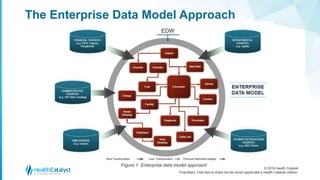
The enterprise data model approach
(Figure 1) to data warehouse design is a
top-down approach that most analytics
vendors advocate for today.
The goal of this approach is modeling
the perfect database from the start—
determining, in advance, everything
you’d like to be able to analyze to
improve outcomes, safety, and patient
satisfaction, and then structuring
the database accordingly.
© 2016 Health Catalyst
Proprietary. Feel free to share but we would appreciate a Health Catalyst citation.
The Enterprise Data Model Approach
In theory, if you’re building a new system in
a vacuum from the ground up, the enterprise
data model approach is the best choice.
In the reality of healthcare, however, you’re
not building a net-new system when you
implement an EDW.
You’re building a secondary system that
receives data from systems that have
already been deployed.
Extracting data from existing systems and
making it all play well together in a net-
new system is like trying to turn an apple
into a banana.
© 2016 Health Catalyst
Proprietary. Feel free to share but we would appreciate a Health Catalyst citation.
The Enterprise Data Model Approach
Figure 1: Enterprise data model approach
© 2016 Health Catalyst
Proprietary. Feel free to share but we would appreciate a Health Catalyst citation.
The Enterprise Data Model Approach
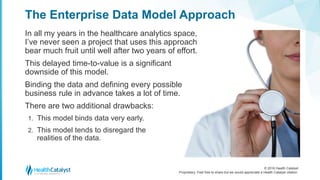
In all my years in the healthcare analytics space,
I’ve never seen a project that uses this approach
bear much fruit until well after two years of effort.
This delayed time-to-value is a significant
downside of this model.
Binding the data and defining every possible
business rule in advance takes a lot of time.
There are two additional drawbacks:
1. This model binds data very early.
2. This model tends to disregard the
realities of the data.
© 2016 Health Catalyst
Proprietary. Feel free to share but we would appreciate a Health Catalyst citation.
The Enterprise Data Model Approach
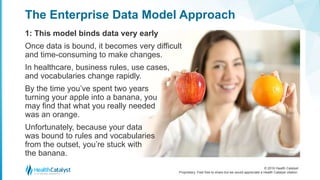
1: This model binds data very early
Once data is bound, it becomes very difficult
and time-consuming to make changes.
In healthcare, business rules, use cases,
and vocabularies change rapidly.
By the time you’ve spent two years
turning your apple into a banana, you
may find that what you really needed
was an orange.
Unfortunately, because your data
was bound to rules and vocabularies
from the outset, you’re stuck with
the banana.
© 2016 Health Catalyst
Proprietary. Feel free to share but we would appreciate a Health Catalyst citation.
The Enterprise Data Model Approach
1: This model tends to disregard the realities of the data
In an ideal world, you may want to measure cost
per case or diabetes care. But do you currently
capture the data that can give you those answers?
The better, more realistic approach is to build your
EDW based on the data you already have,
incrementally moving toward your ideal.
The enterprise data model does not allow for this
incremental approach. Many data warehousing
initiatives based on this approach end up failing.
© 2016 Health Catalyst
Proprietary. Feel free to share but we would appreciate a Health Catalyst citation.
The Independent Data Mart Approach
The independent data mart approach to
data warehouse design is a bottom-up
approach in which you start small, building
individual data marts as you need them.
If you want to analyze revenue cycle or
oncology, you build a separate data mart
for each, bringing in data from the handful
of source systems that apply to that area.
The benefit of this approach is that you can
start implementing and measuring much
quicker—a big difference from the two- to
five-year lifecycle of the enterprise data
model approach.
© 2016 Health Catalyst
Proprietary. Feel free to share but we would appreciate a Health Catalyst citation.
The Independent Data Mart Approach
There are three major drawbacks of the
independent data model:
1. With all these isolated data marts in place,
you don’t have an atomic-level data
warehouse from which to build additional
data marts in the future.
2. This model bombards source systems
repeatedly and unnecessarily. Redundant
feeds must come from each source system.
3. Like the previous model, this approach binds
data quite early in the process. As data is
brought into each independent data mart, it
is mapped into the predefined data model,
inhibiting the adaptability of the solution.
© 2016 Health Catalyst
Proprietary. Feel free to share but we would appreciate a Health Catalyst citation.
The Independent Data Mart Approach
Consider this example which illustrates the
problem with this approach.
Using a grocery shopping analogy, let’s say
you’re baking cookies. The recipe indicates
that you’ll need four eggs, two cups of
shortening, etc.
You go to the store and buy exactly what you
need, pulling four eggs out of the carton,
opening containers of shortening and
measuring it with your measuring cup, etc.
This is efficient now, but later, you need three
cups of flour for a cake and have to return to
the store. You get the idea.
Link to video of Recipe example
© 2016 Health Catalyst
Proprietary. Feel free to share but we would appreciate a Health Catalyst citation.
The Health Catalyst Late-Binding™ Approach
Health Catalyst advocates for a late-binding
approach to data modeling that overcomes the
challenges inherent in the first two models.
The adaptive, pragmatic late-binding approach
is designed to handle the rapidly changing
business rules and vocabularies that
characterize healthcare.
Here is a high-level description of Health
Catalyst’s Late-Binding™ within four zones:
• The Raw Data Zone
• The Trusted Data Zone
• The Refined Data Zone
• The Exploration (Sandbox) Zone
© 2016 Health Catalyst
Proprietary. Feel free to share but we would appreciate a Health Catalyst citation.
The Health Catalyst Late-Binding™ Approach
The Raw Data Zone
In the raw data zone, data is moved in
its native format without transformation
or binding to any business rules.
Typically, the only organization or
structure added in this layer is
outlining what data came from what
source system—Health Catalyst
calls these areas source marts.
© 2016 Health Catalyst
Proprietary. Feel free to share but we would appreciate a Health Catalyst citation.
The Health Catalyst Late-Binding™ Approach
The Raw Data Zone
Although all data starts in the raw data
zone, it’s too vast of a landscape for
less technical users.
Typical users include ETL developers,
data stewards, data analysts, and data
scientists, who are defined by their
ability to derive new knowledge and
insights amid vast amounts of data.
This user base tends to be small and
spends a lot of time sifting through
data, then pushing it into other zones.
© 2016 Health Catalyst
Proprietary. Feel free to share but we would appreciate a Health Catalyst citation.
The Health Catalyst Late-Binding™ Approach
The Trusted Data Zone
Source data is ingested into the EDW, then used to
build shared data marts in the trusted data zone.
Terminology is standardized at this point.
The trusted data zone holds data that serves as
universal truth across the organization. A broader
group has applied extensive governance to this data,
which has more comprehensive definitions that the
entire organization can stand behind.
Trusted data could include building blocks, such as
the number of ED visits in a certain period, inpatient
admission rates from one year to the next, or the
number of members in risk-based contracts.
© 2016 Health Catalyst
Proprietary. Feel free to share but we would appreciate a Health Catalyst citation.
The Health Catalyst Late-Binding™ Approach
The Refined Data Zone
Meaning is applied to raw data so it can be integrated into a common format
and used by specific lines of business. Data in the refined data zone is
grouped into Subject Area Marts (SAMs, often referred to as data marts).
A department manager looking for end-of-month
numbers would query a SAM rather than the
EDW. SAMs become the source of truth for
specific domains.
They take subsets of data from the larger pool
and add value that’s meaningful to a finance,
clinical, operations, supply chain, or other
administrative area.
© 2016 Health Catalyst
Proprietary. Feel free to share but we would appreciate a Health Catalyst citation.
The Health Catalyst Late-Binding™ Approach
The Refined Data Zone
Refined data is used by a broad group of people, but is not yet blessed by
everyone in the organization.
In other words, people beyond specific subject
areas may not be able to derive meaning
from refined data.
A SAM gets promoted to the trusted data
zone when the definitions applied to its
data elements have broadened to a much
larger group of people.
© 2016 Health Catalyst
Proprietary. Feel free to share but we would appreciate a Health Catalyst citation.
The Health Catalyst Late-Binding™ Approach
The Exploration (Sandbox) Zone
Anyone can decide to move data from the
raw, trusted, or refined data zones into the
exploration zone.
Here, data from all these zones can be
morphed for private use. Once information
has been vetted, it is promoted for broader
use in the refined data zone.
© 2016 Health Catalyst
Proprietary. Feel free to share but we would appreciate a Health Catalyst citation.
The Health Catalyst Late-Binding™ Approach
The Exploration (Sandbox) Zone
The late-binding approach is something like
just-in-time data binding.
Rather than trying to perfect a data model up
front, when you can only guess what all the
use cases for the data will be, you bind the
data at the right time in the process to solve
an actual clinical or business problem (or
when there is general agreement on a given
clinical or business concept).
© 2016 Health Catalyst
Proprietary. Feel free to share but we would appreciate a Health Catalyst citation.
The Health Catalyst Late-Binding™ Approach
The Exploration (Sandbox) Zone
You don’t have to make final decisions about
your data model up front because you can’t
see what’s coming down the road in two, three,
or five years.
The late-binding approach gives you maximum
flexibility for using your data to tackle a wide
variety of use cases as the needs arise and
prevents you from wasting resources.
© 2016 Health Catalyst
Proprietary. Feel free to share but we would appreciate a Health Catalyst citation.
Going Beyond an EDW with a
Data Operating System
To be successful, the late-binding approach to
data warehousing requires the right
technology foundation.
Organizations trying to implement a late-
binding data warehouse with traditional ETL
or data processing tools often find them-
selves overwhelmed with the volume of
analytic requests.
Their methodology scales, but their tools
and people do not.
© 2016 Health Catalyst
Proprietary. Feel free to share but we would appreciate a Health Catalyst citation.
Going Beyond an EDW with a
Data Operating System
At the core of the Health Catalyst® Data
Operating System (DOS™) platform is a
metadata-driven data processing engine
and toolset that allows organizations to
scale their analytics efforts.
It enables the building of a late-binding
warehouse with a significantly lower total
cost of ownership than other solutions.
Additionally, DOS allows you to take the
analytic value contained in your data
warehouse and use it in new and
interesting ways to drive clinical and
business improvements throughout
your organization.
© 2016 Health Catalyst
Proprietary. Feel free to share but we would appreciate a Health Catalyst citation.
For more information:
© 2016 Health Catalyst
Proprietary. Feel free to share but we would appreciate a Health Catalyst citation.
More about this topic
Link to original article for a more in-depth discussion.
Healthcare Data Warehouse Models Explained
Early- or Late-binding Approaches to Healthcare Data Warehousing: Which Is Better for You?
Mike Doyle, Sales, VP
Late-Binding Data Warehousing: An Update on the Fastest Growing Trend in Healthcare Analytics
Dale Sanders, President of Technology (Webinar)
5 Reasons Healthcare Data Is Unique and Difficult to Measure
Dan LeSueur, VP of Client and Technical Operations
Late-Binding™ vs. EMR-based Models:A Comparison of Healthcare Data Warehouse Methodologies
Eric Just, Senior VP of Product Development
The Late-Binding™ Data Warehouse: A Detailed Technical Overview
Dale Sanders, President of Technology
© 2016 Health Catalyst
Proprietary. Feel free to share but we would appreciate a Health Catalyst citation.
Other Clinical Quality Improvement Resources
Click to read additional information at www.healthcatalyst.com
Mr. Barlow is a co-founder of Health Catalyst and former CEO of the company. He oversees all
development activities for Health Catalyst's suite of products and services. Mr. Barlow is a
founding member and former chair of the Healthcare Data Warehousing Association. He began
his career in healthcare over 18 years ago at Intermountain Healthcare, and acted as a member
of the team that led Intermountain's nationally recognized improvements in quality of care
delivery and reductions in cost. Mr. Barlow holds a BS from the University of Utah in health education and
promotion.
Steve Barlow
© 2016 Health Catalyst
Proprietary. Feel free to share but we would appreciate a Health Catalyst citation.
Other Clinical Quality Improvement Resources
Click to read additional information at www.healthcatalyst.com
Bryan joined Health Catalyst in February 2012. Prior to joining the Catalyst team, Bryan
spent 6 years with Intel and 4 years with The Church of Jesus Christ of Latter-Day Saints.
While at Intel Bryan was on teams responsible for Intel's factory reporting systems and
equipment maintenance prediction. At the LDS Church he led the .NET Development Center
of Excellence and was responsible for the Application Lifecycle Management (ALM) processes and
tools used for development at the Church. Bryan graduated from Brigham Young University with a
degree in Computer Science.
Bryan Hinton

Healthcare Data Warehouse Models Explained

  • 1.
  • 2.
    © 2016 HealthCatalyst Proprietary. Feel free to share but we would appreciate a Health Catalyst citation. Data Warehouse Models Building the best enterprise data warehouse (EDW) for your health system starts with modeling the data. Why? Because the data model used to build your EDW has a significant impact on both the time-to-value and adaptability of your system going forward. This article outlines the strengths and weaknesses of the two most common relational data models, and compares them to the Health Catalyst® Late- Binding™ approach.
  • 3.
    © 2016 HealthCatalyst Proprietary. Feel free to share but we would appreciate a Health Catalyst citation. Data Warehouse Models “Binding” data refers to the process of mapping data aggregated from source systems to standardized vocabularies (e.g., SNOMED and RxNorm) and business rules (e.g., length of stay definitions and ADT rules) in the EDW. In other words, it means optimizing data from all these different sources so it can be used together for analysis. Binding data this way is required in any relational database model.
  • 4.
    © 2016 HealthCatalyst Proprietary. Feel free to share but we would appreciate a Health Catalyst citation. Data Warehouse Models Each of the models described in this article bind data at different times in the design process: some earlier, some later. Health Catalyst believes that a methodology of binding data at the right time is the right approach (sometimes early, sometimes late, and sometimes in between). Adopting a methodology that restricts your flexibility in binding early or late limits your ability to be successful with your analytic efforts.
  • 5.
    © 2016 HealthCatalyst Proprietary. Feel free to share but we would appreciate a Health Catalyst citation. The Enterprise Data Model Approach The enterprise data model approach (Figure 1) to data warehouse design is a top-down approach that most analytics vendors advocate for today. The goal of this approach is modeling the perfect database from the start— determining, in advance, everything you’d like to be able to analyze to improve outcomes, safety, and patient satisfaction, and then structuring the database accordingly.
  • 6.
    © 2016 HealthCatalyst Proprietary. Feel free to share but we would appreciate a Health Catalyst citation. The Enterprise Data Model Approach In theory, if you’re building a new system in a vacuum from the ground up, the enterprise data model approach is the best choice. In the reality of healthcare, however, you’re not building a net-new system when you implement an EDW. You’re building a secondary system that receives data from systems that have already been deployed. Extracting data from existing systems and making it all play well together in a net- new system is like trying to turn an apple into a banana.
  • 7.
    © 2016 HealthCatalyst Proprietary. Feel free to share but we would appreciate a Health Catalyst citation. The Enterprise Data Model Approach Figure 1: Enterprise data model approach
  • 8.
    © 2016 HealthCatalyst Proprietary. Feel free to share but we would appreciate a Health Catalyst citation. The Enterprise Data Model Approach In all my years in the healthcare analytics space, I’ve never seen a project that uses this approach bear much fruit until well after two years of effort. This delayed time-to-value is a significant downside of this model. Binding the data and defining every possible business rule in advance takes a lot of time. There are two additional drawbacks: 1. This model binds data very early. 2. This model tends to disregard the realities of the data.
  • 9.
    © 2016 HealthCatalyst Proprietary. Feel free to share but we would appreciate a Health Catalyst citation. The Enterprise Data Model Approach 1: This model binds data very early Once data is bound, it becomes very difficult and time-consuming to make changes. In healthcare, business rules, use cases, and vocabularies change rapidly. By the time you’ve spent two years turning your apple into a banana, you may find that what you really needed was an orange. Unfortunately, because your data was bound to rules and vocabularies from the outset, you’re stuck with the banana.
  • 10.
    © 2016 HealthCatalyst Proprietary. Feel free to share but we would appreciate a Health Catalyst citation. The Enterprise Data Model Approach 1: This model tends to disregard the realities of the data In an ideal world, you may want to measure cost per case or diabetes care. But do you currently capture the data that can give you those answers? The better, more realistic approach is to build your EDW based on the data you already have, incrementally moving toward your ideal. The enterprise data model does not allow for this incremental approach. Many data warehousing initiatives based on this approach end up failing.
  • 11.
    © 2016 HealthCatalyst Proprietary. Feel free to share but we would appreciate a Health Catalyst citation. The Independent Data Mart Approach The independent data mart approach to data warehouse design is a bottom-up approach in which you start small, building individual data marts as you need them. If you want to analyze revenue cycle or oncology, you build a separate data mart for each, bringing in data from the handful of source systems that apply to that area. The benefit of this approach is that you can start implementing and measuring much quicker—a big difference from the two- to five-year lifecycle of the enterprise data model approach.
  • 12.
    © 2016 HealthCatalyst Proprietary. Feel free to share but we would appreciate a Health Catalyst citation. The Independent Data Mart Approach There are three major drawbacks of the independent data model: 1. With all these isolated data marts in place, you don’t have an atomic-level data warehouse from which to build additional data marts in the future. 2. This model bombards source systems repeatedly and unnecessarily. Redundant feeds must come from each source system. 3. Like the previous model, this approach binds data quite early in the process. As data is brought into each independent data mart, it is mapped into the predefined data model, inhibiting the adaptability of the solution.
  • 13.
    © 2016 HealthCatalyst Proprietary. Feel free to share but we would appreciate a Health Catalyst citation. The Independent Data Mart Approach Consider this example which illustrates the problem with this approach. Using a grocery shopping analogy, let’s say you’re baking cookies. The recipe indicates that you’ll need four eggs, two cups of shortening, etc. You go to the store and buy exactly what you need, pulling four eggs out of the carton, opening containers of shortening and measuring it with your measuring cup, etc. This is efficient now, but later, you need three cups of flour for a cake and have to return to the store. You get the idea. Link to video of Recipe example
  • 14.
    © 2016 HealthCatalyst Proprietary. Feel free to share but we would appreciate a Health Catalyst citation. The Health Catalyst Late-Binding™ Approach Health Catalyst advocates for a late-binding approach to data modeling that overcomes the challenges inherent in the first two models. The adaptive, pragmatic late-binding approach is designed to handle the rapidly changing business rules and vocabularies that characterize healthcare. Here is a high-level description of Health Catalyst’s Late-Binding™ within four zones: • The Raw Data Zone • The Trusted Data Zone • The Refined Data Zone • The Exploration (Sandbox) Zone
  • 15.
    © 2016 HealthCatalyst Proprietary. Feel free to share but we would appreciate a Health Catalyst citation. The Health Catalyst Late-Binding™ Approach The Raw Data Zone In the raw data zone, data is moved in its native format without transformation or binding to any business rules. Typically, the only organization or structure added in this layer is outlining what data came from what source system—Health Catalyst calls these areas source marts.
  • 16.
    © 2016 HealthCatalyst Proprietary. Feel free to share but we would appreciate a Health Catalyst citation. The Health Catalyst Late-Binding™ Approach The Raw Data Zone Although all data starts in the raw data zone, it’s too vast of a landscape for less technical users. Typical users include ETL developers, data stewards, data analysts, and data scientists, who are defined by their ability to derive new knowledge and insights amid vast amounts of data. This user base tends to be small and spends a lot of time sifting through data, then pushing it into other zones.
  • 17.
    © 2016 HealthCatalyst Proprietary. Feel free to share but we would appreciate a Health Catalyst citation. The Health Catalyst Late-Binding™ Approach The Trusted Data Zone Source data is ingested into the EDW, then used to build shared data marts in the trusted data zone. Terminology is standardized at this point. The trusted data zone holds data that serves as universal truth across the organization. A broader group has applied extensive governance to this data, which has more comprehensive definitions that the entire organization can stand behind. Trusted data could include building blocks, such as the number of ED visits in a certain period, inpatient admission rates from one year to the next, or the number of members in risk-based contracts.
  • 18.
    © 2016 HealthCatalyst Proprietary. Feel free to share but we would appreciate a Health Catalyst citation. The Health Catalyst Late-Binding™ Approach The Refined Data Zone Meaning is applied to raw data so it can be integrated into a common format and used by specific lines of business. Data in the refined data zone is grouped into Subject Area Marts (SAMs, often referred to as data marts). A department manager looking for end-of-month numbers would query a SAM rather than the EDW. SAMs become the source of truth for specific domains. They take subsets of data from the larger pool and add value that’s meaningful to a finance, clinical, operations, supply chain, or other administrative area.
  • 19.
    © 2016 HealthCatalyst Proprietary. Feel free to share but we would appreciate a Health Catalyst citation. The Health Catalyst Late-Binding™ Approach The Refined Data Zone Refined data is used by a broad group of people, but is not yet blessed by everyone in the organization. In other words, people beyond specific subject areas may not be able to derive meaning from refined data. A SAM gets promoted to the trusted data zone when the definitions applied to its data elements have broadened to a much larger group of people.
  • 20.
    © 2016 HealthCatalyst Proprietary. Feel free to share but we would appreciate a Health Catalyst citation. The Health Catalyst Late-Binding™ Approach The Exploration (Sandbox) Zone Anyone can decide to move data from the raw, trusted, or refined data zones into the exploration zone. Here, data from all these zones can be morphed for private use. Once information has been vetted, it is promoted for broader use in the refined data zone.
  • 21.
    © 2016 HealthCatalyst Proprietary. Feel free to share but we would appreciate a Health Catalyst citation. The Health Catalyst Late-Binding™ Approach The Exploration (Sandbox) Zone The late-binding approach is something like just-in-time data binding. Rather than trying to perfect a data model up front, when you can only guess what all the use cases for the data will be, you bind the data at the right time in the process to solve an actual clinical or business problem (or when there is general agreement on a given clinical or business concept).
  • 22.
    © 2016 HealthCatalyst Proprietary. Feel free to share but we would appreciate a Health Catalyst citation. The Health Catalyst Late-Binding™ Approach The Exploration (Sandbox) Zone You don’t have to make final decisions about your data model up front because you can’t see what’s coming down the road in two, three, or five years. The late-binding approach gives you maximum flexibility for using your data to tackle a wide variety of use cases as the needs arise and prevents you from wasting resources.
  • 23.
    © 2016 HealthCatalyst Proprietary. Feel free to share but we would appreciate a Health Catalyst citation. Going Beyond an EDW with a Data Operating System To be successful, the late-binding approach to data warehousing requires the right technology foundation. Organizations trying to implement a late- binding data warehouse with traditional ETL or data processing tools often find them- selves overwhelmed with the volume of analytic requests. Their methodology scales, but their tools and people do not.
  • 24.
    © 2016 HealthCatalyst Proprietary. Feel free to share but we would appreciate a Health Catalyst citation. Going Beyond an EDW with a Data Operating System At the core of the Health Catalyst® Data Operating System (DOS™) platform is a metadata-driven data processing engine and toolset that allows organizations to scale their analytics efforts. It enables the building of a late-binding warehouse with a significantly lower total cost of ownership than other solutions. Additionally, DOS allows you to take the analytic value contained in your data warehouse and use it in new and interesting ways to drive clinical and business improvements throughout your organization.
  • 25.
    © 2016 HealthCatalyst Proprietary. Feel free to share but we would appreciate a Health Catalyst citation. For more information:
  • 26.
    © 2016 HealthCatalyst Proprietary. Feel free to share but we would appreciate a Health Catalyst citation. More about this topic Link to original article for a more in-depth discussion. Healthcare Data Warehouse Models Explained Early- or Late-binding Approaches to Healthcare Data Warehousing: Which Is Better for You? Mike Doyle, Sales, VP Late-Binding Data Warehousing: An Update on the Fastest Growing Trend in Healthcare Analytics Dale Sanders, President of Technology (Webinar) 5 Reasons Healthcare Data Is Unique and Difficult to Measure Dan LeSueur, VP of Client and Technical Operations Late-Binding™ vs. EMR-based Models:A Comparison of Healthcare Data Warehouse Methodologies Eric Just, Senior VP of Product Development The Late-Binding™ Data Warehouse: A Detailed Technical Overview Dale Sanders, President of Technology
  • 27.
    © 2016 HealthCatalyst Proprietary. Feel free to share but we would appreciate a Health Catalyst citation. Other Clinical Quality Improvement Resources Click to read additional information at www.healthcatalyst.com Mr. Barlow is a co-founder of Health Catalyst and former CEO of the company. He oversees all development activities for Health Catalyst's suite of products and services. Mr. Barlow is a founding member and former chair of the Healthcare Data Warehousing Association. He began his career in healthcare over 18 years ago at Intermountain Healthcare, and acted as a member of the team that led Intermountain's nationally recognized improvements in quality of care delivery and reductions in cost. Mr. Barlow holds a BS from the University of Utah in health education and promotion. Steve Barlow
  • 28.
    © 2016 HealthCatalyst Proprietary. Feel free to share but we would appreciate a Health Catalyst citation. Other Clinical Quality Improvement Resources Click to read additional information at www.healthcatalyst.com Bryan joined Health Catalyst in February 2012. Prior to joining the Catalyst team, Bryan spent 6 years with Intel and 4 years with The Church of Jesus Christ of Latter-Day Saints. While at Intel Bryan was on teams responsible for Intel's factory reporting systems and equipment maintenance prediction. At the LDS Church he led the .NET Development Center of Excellence and was responsible for the Application Lifecycle Management (ALM) processes and tools used for development at the Church. Bryan graduated from Brigham Young University with a degree in Computer Science. Bryan Hinton