Late Binding in Data Warehouses:
Designing for Analytic Agility

Dale Sanders, Oct 2013
© 2013 Health Catalyst
www.healthcatalyst.com
© 2013 Health Catalyst
www.healthcatalyst.com
Overview
•

The concept of “binding” in software and data
engineering

•

Examples of data binding in healthcare

•

The two tests for early binding
•

•

The six points of binding in data warehouse design
•

•

Comprehensive & persistent agreement

Data Modeling vs. Late Binding

The importance of binding in analytic progression
•

Eight levels of analytic adoption in healthcare

© 2013 Health Catalyst
www.healthcatalyst.com
Late Binding in Software Engineering
1980s: Object Oriented Programming
●

Alan Kay Universities of Colorado & Utah, Xerox/PARC

●

Small objects of code, reflecting the real world

●

Compiled individually, linked at runtime, only as needed

●

Major agility and adaptability to address new use cases

Steve Jobs
●

NeXT computing

●

Commercial, large-scale adoption of Kay’s concepts

●

Late binding– or as late as practical– becomes the norm

●

Maybe Jobs’ largest contribution to computer science

3
© 2013 Health Catalyst
www.healthcatalyst.com
Late Binding in Data Engineering
Atomic data must be “bound” to business rules about that data and
to vocabularies related to that data in order to create information
Vocabulary binding in healthcare is pretty obvious
●
●
●
●

Unique patient and provider identifiers
Standard facility, department, and revenue center codes
Standard definitions for gender, race, ethnicity
ICD, CPT, SNOMED, LOINC, RxNorm, RADLEX, etc.

Examples of binding data to business rules
●
●
●
●
●
●
●

Length of stay
Patient relationship attribution to a provider
Revenue (or expense) allocation and projections to a department
Revenue (or expense) allocation and projections to a physician
Data definitions of general disease states and patient registries
Patient exclusion criteria from disease/population management
Patient admission/discharge/transfer rules

4
© 2013 Health Catalyst
www.healthcatalyst.com
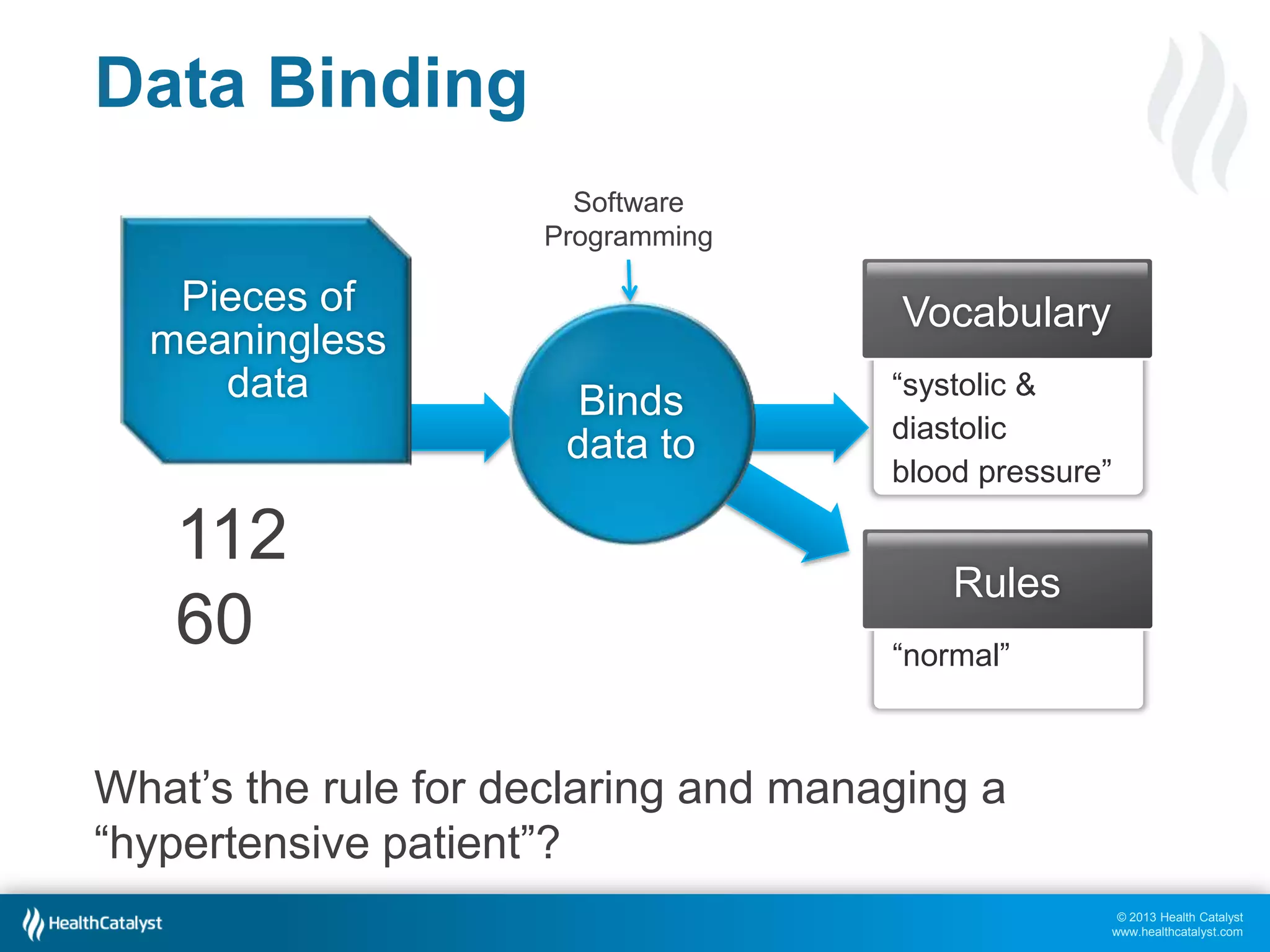
Data Binding
Software
Programming

Pieces of
meaningless
data

112
60

Vocabulary
Binds
data to

“systolic &
diastolic
blood pressure”

Rules
“normal”

What’s the rule for declaring and managing a
“hypertensive patient”?
© 2013 Health Catalyst
www.healthcatalyst.com
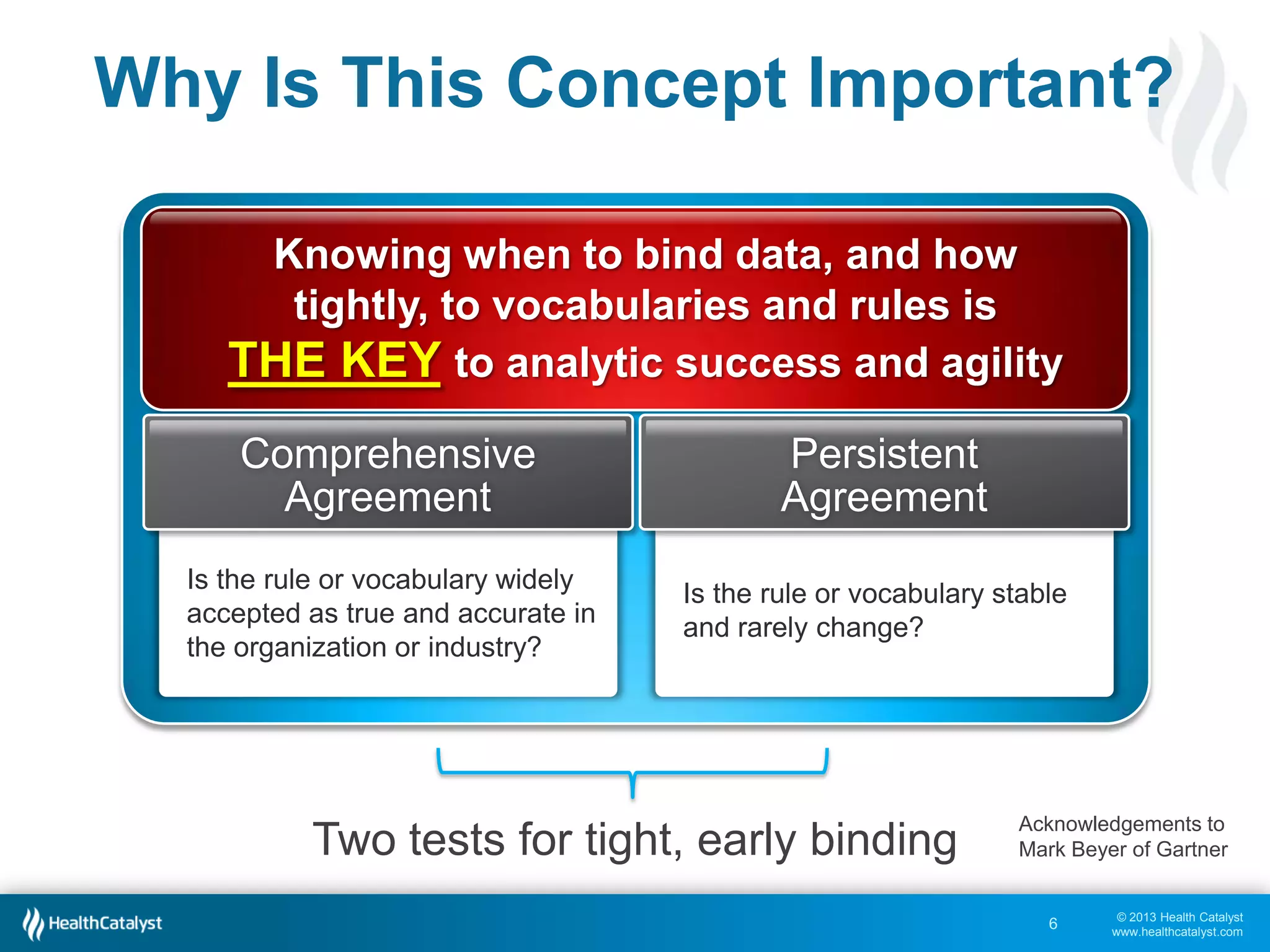
Why Is This Concept Important?
Knowing when to bind data, and how
tightly, to vocabularies and rules is
THE KEY to analytic success and agility
Comprehensive
Agreement
Is the rule or vocabulary widely
accepted as true and accurate in
the organization or industry?

Persistent
Agreement
Is the rule or vocabulary stable
and rarely change?

Two tests for tight, early binding

Acknowledgements to
Mark Beyer of Gartner

6

© 2013 Health Catalyst
www.healthcatalyst.com
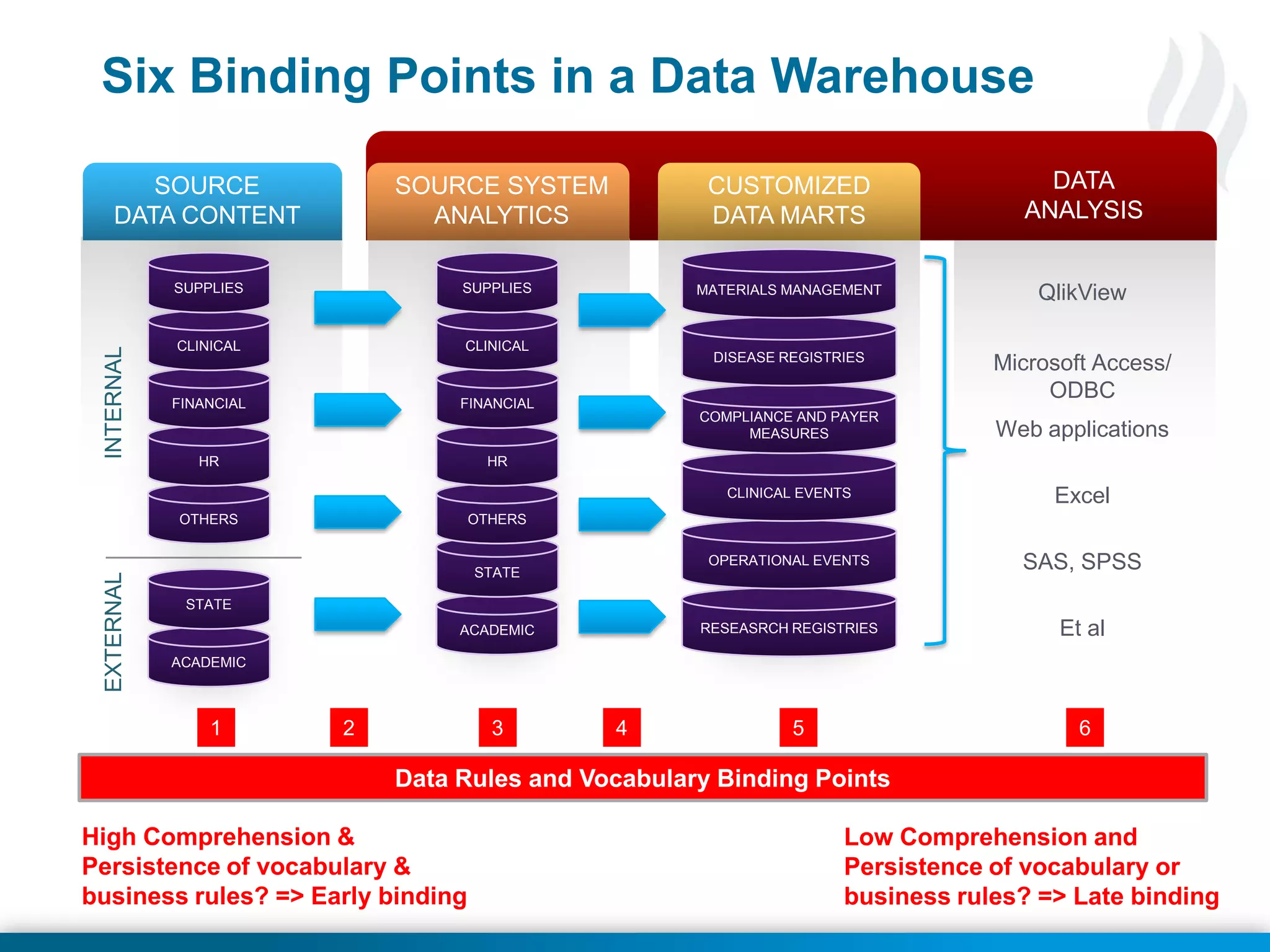
Six Binding Points in a Data Warehouse
SOURCE
DATA CONTENT
SUPPLIES

INTERNAL

CUSTOMIZED
DATA MARTS

CLINICAL

CLINICAL

FINANCIAL

FINANCIAL

QlikView

DISEASE REGISTRIES

SUPPLIES

DATA
ANALYSIS

MATERIALS MANAGEMENT

SOURCE SYSTEM
ANALYTICS

Microsoft Access/
ODBC

Excel

OPERATIONAL EVENTS

SAS, SPSS

RESEASRCH REGISTRIES

Et al

HR

OTHERS

EXTERNAL

Web applications

CLINICAL EVENTS

HR

COMPLIANCE AND PAYER
MEASURES

OTHERS

STATE
STATE
ACADEMIC
ACADEMIC

1

2

3

4

5

6

Data Rules and Vocabulary Binding Points
High Comprehension &
Persistence of vocabulary &
business rules? => Early binding

Low Comprehension and
Persistence of vocabulary or
business rules? => Late binding
© 2013 Health Catalyst
www.healthcatalyst.com
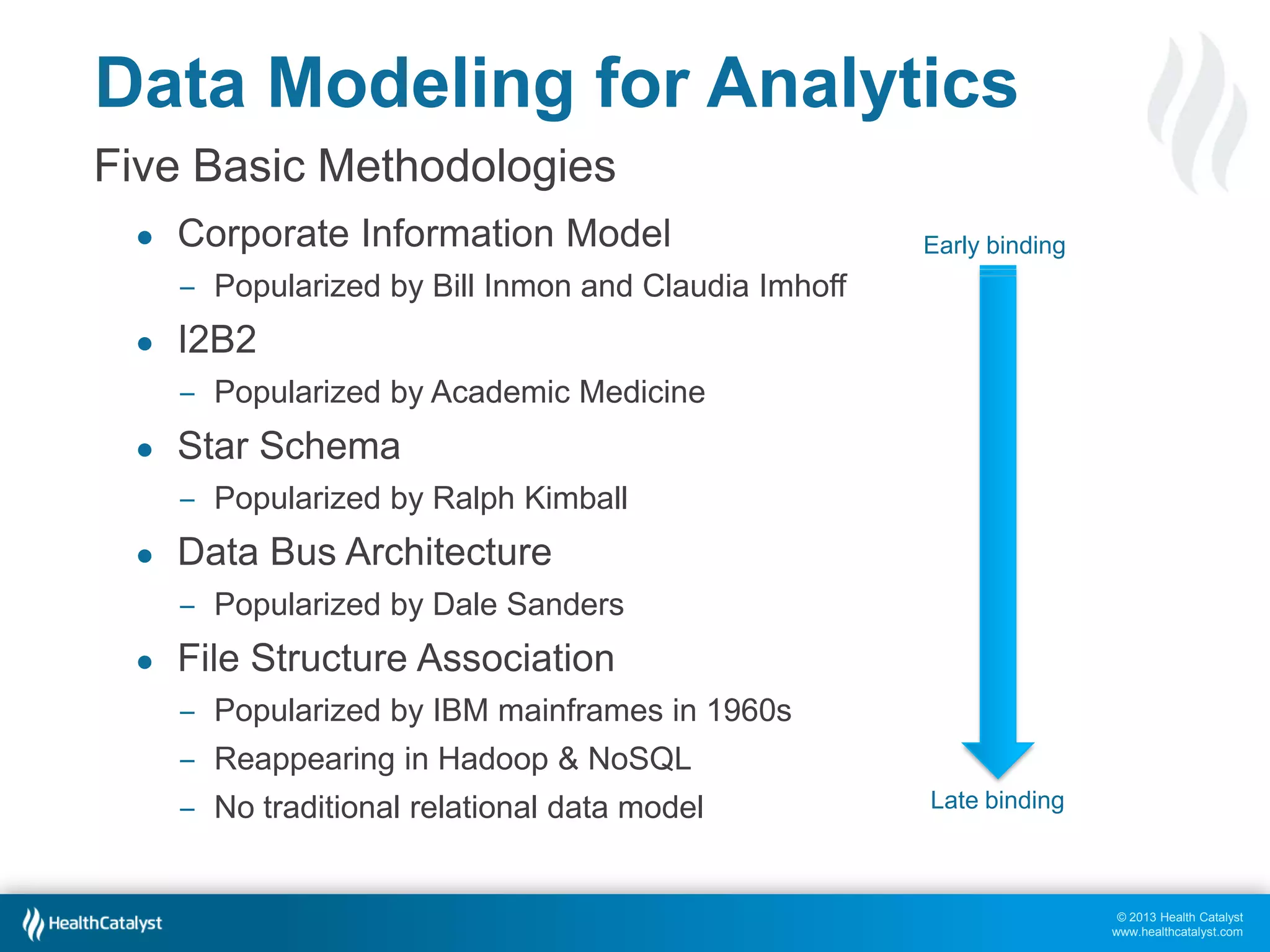
Data Modeling for Analytics
Five Basic Methodologies
●

Corporate Information Model

Early binding

‒ Popularized by Bill Inmon and Claudia Imhoff
●

I2B2
‒ Popularized by Academic Medicine

●

Star Schema
‒ Popularized by Ralph Kimball

●

Data Bus Architecture
‒ Popularized by Dale Sanders

●

File Structure Association
‒ Popularized by IBM mainframes in 1960s
‒ Reappearing in Hadoop & NoSQL
‒ No traditional relational data model

Late binding

© 2013 Health Catalyst
www.healthcatalyst.com
Binding to Analytic Relations
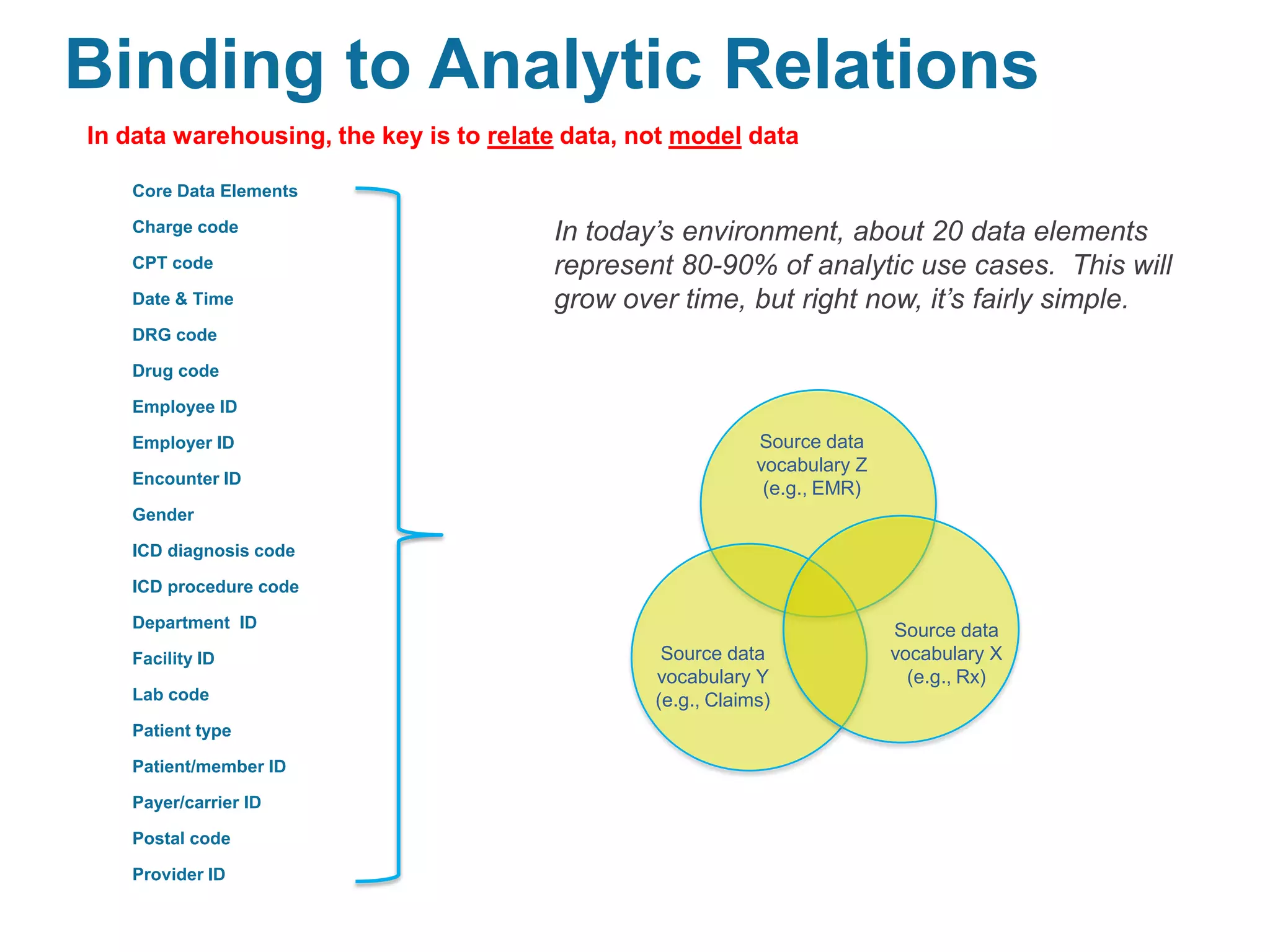
In data warehousing, the key is to relate data, not model data
Core Data Elements
Charge code
CPT code
Date & Time

In today’s environment, about 20 data elements
represent 80-90% of analytic use cases. This will
grow over time, but right now, it’s fairly simple.

DRG code
Drug code
Employee ID
Employer ID
Encounter ID

Source data
vocabulary Z
(e.g., EMR)

Gender
ICD diagnosis code
ICD procedure code
Department ID
Facility ID
Lab code
Patient type
Patient/member ID
Payer/carrier ID
Postal code
Provider ID

Source data
vocabulary Y
(e.g., Claims)

Source data
vocabulary X
(e.g., Rx)
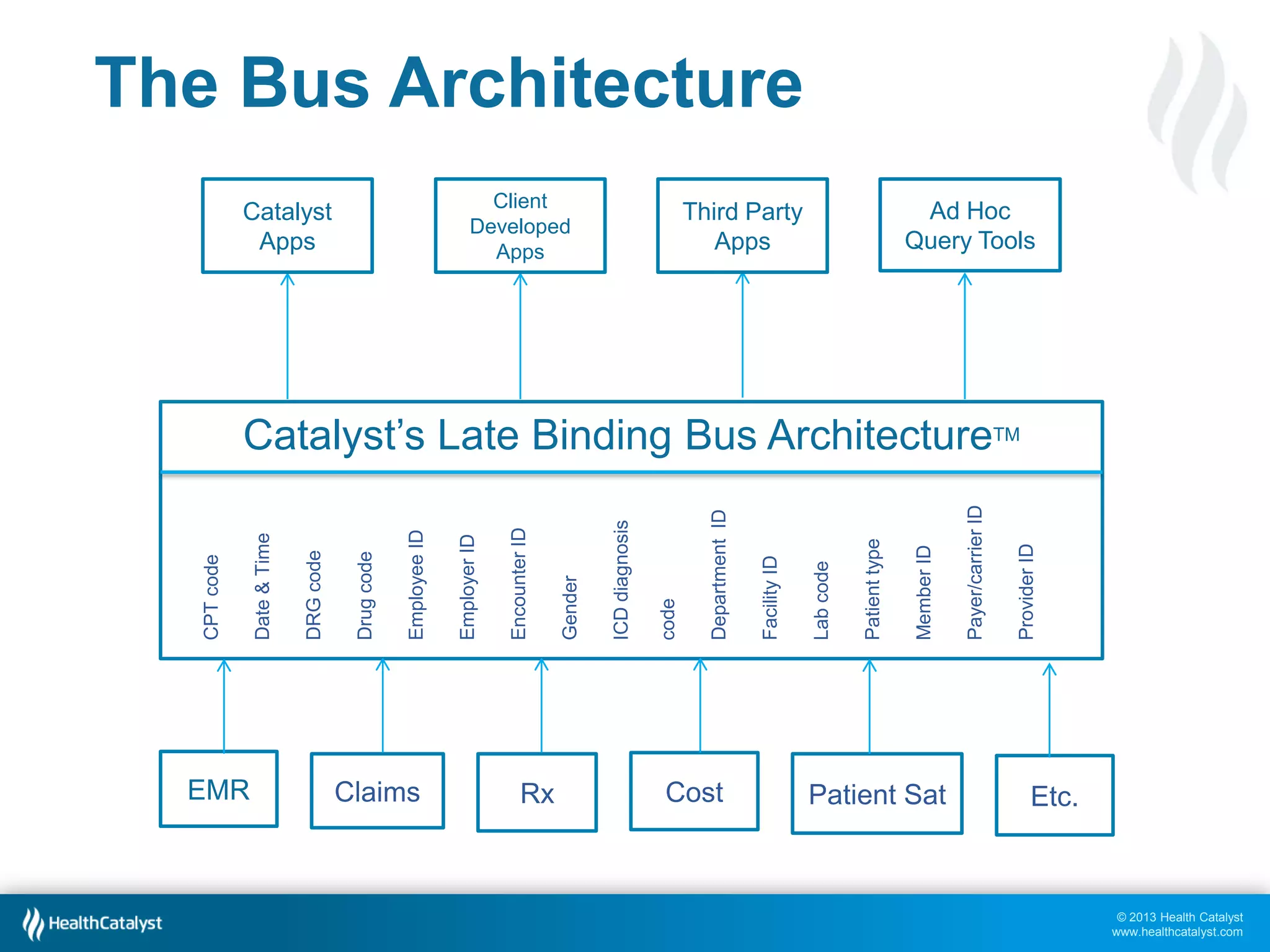
The Bus Architecture
Client
Developed
Apps

Vendor Apps

Ad Hoc
Query Tools

Third Party
Apps

EMR

Claims

Rx

Cost

Patient Sat

Provider ID

Payer/carrier ID

Member ID

Patient type

Lab code

Facility ID

Department ID

ICD diagnosis code

Gender

Encounter ID

Employer ID

Employee ID

Drug code

DRG code

Date & Time

CPT code

Late Binding Bus Architecture

Etc.

© 2013 Health Catalyst
www.healthcatalyst.com
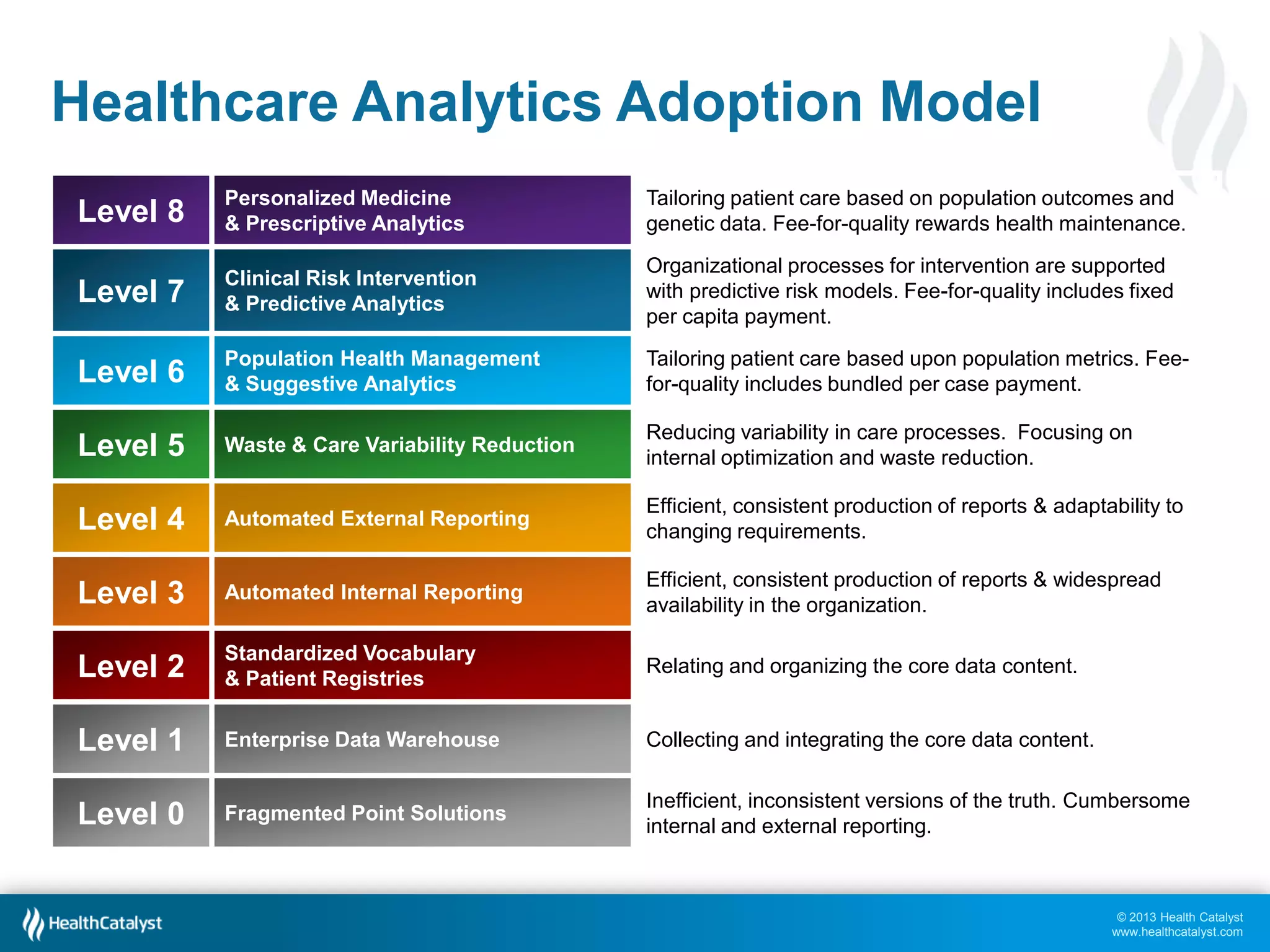
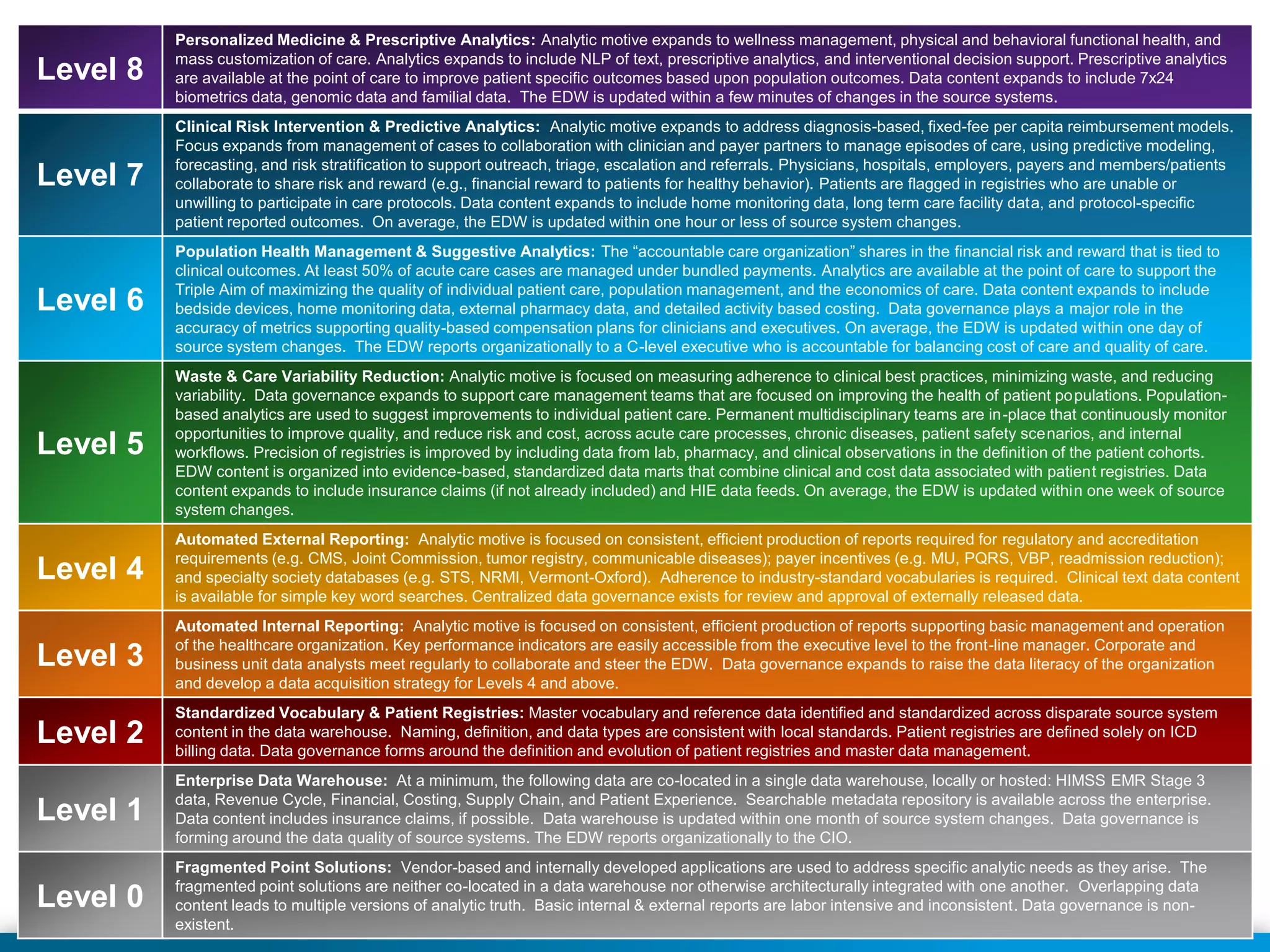
Healthcare Analytics Adoption Model
Level 8

Personalized Medicine
& Prescriptive Analytics

Tailoring patient care based on population outcomes and
genetic data. Fee-for-quality rewards health maintenance.

Level 7

Clinical Risk Intervention
& Predictive Analytics

Organizational processes for intervention are supported
with predictive risk models. Fee-for-quality includes fixed
per capita payment.

Level 6

Population Health Management
& Suggestive Analytics

Tailoring patient care based upon population metrics. Feefor-quality includes bundled per case payment.

Level 5

Waste & Care Variability Reduction

Reducing variability in care processes. Focusing on
internal optimization and waste reduction.

Level 4

Automated External Reporting

Efficient, consistent production of reports & adaptability to
changing requirements.

Level 3

Automated Internal Reporting

Efficient, consistent production of reports & widespread
availability in the organization.

Level 2

Standardized Vocabulary
& Patient Registries

Relating and organizing the core data content.

Level 1

Enterprise Data Warehouse

Collecting and integrating the core data content.

Level 0

Fragmented Point Solutions

Inefficient, inconsistent versions of the truth. Cumbersome
internal and external reporting.

© 2013 Health Catalyst
www.healthcatalyst.com
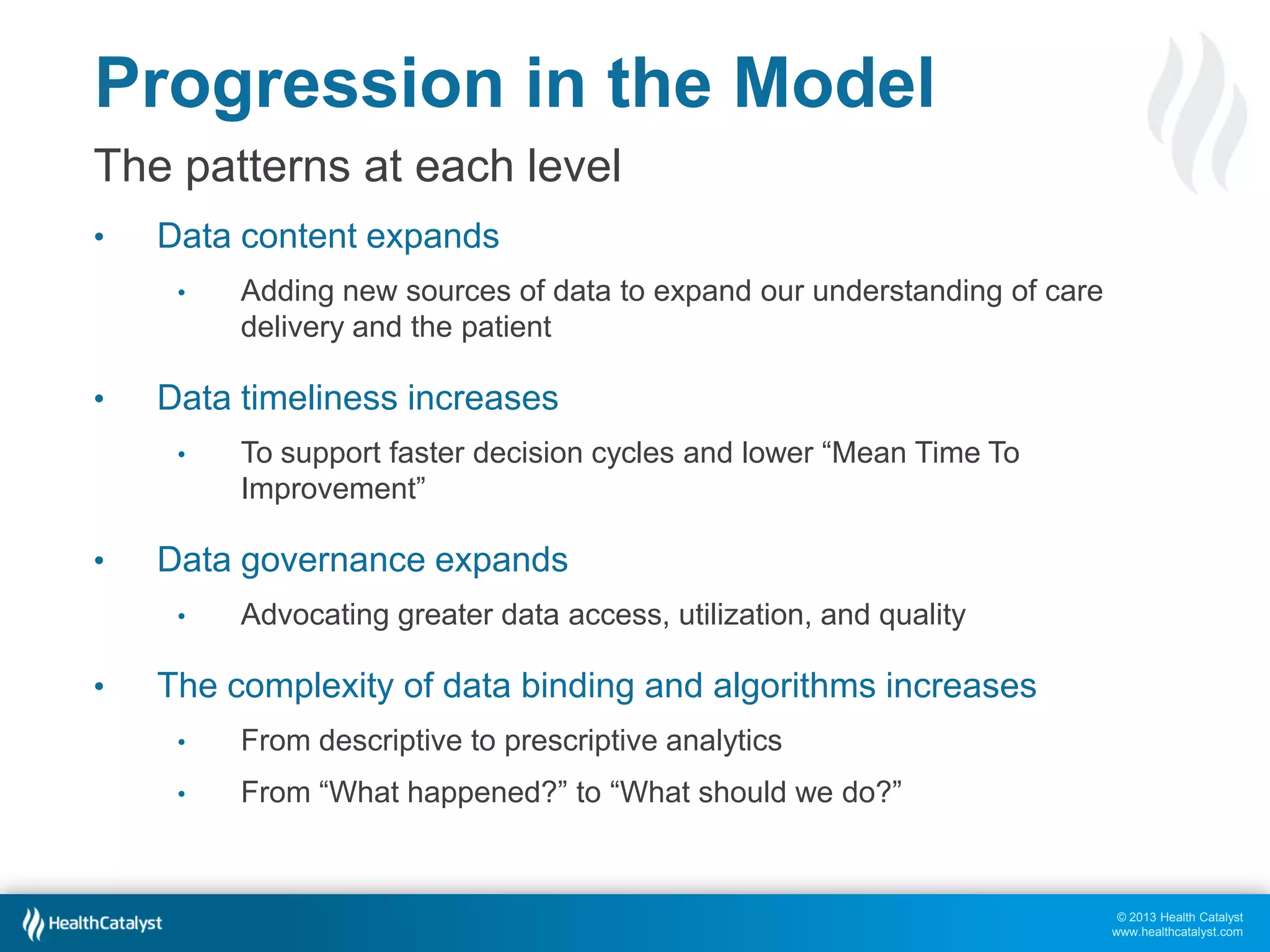
Progression in the Model
The patterns at each level
•

Data content expands
•

•

Data timeliness increases
•

•

To support faster decision cycles and lower “Mean Time To
Improvement”

Data governance expands
•

•

Adding new sources of data to expand our understanding of care
delivery and the patient

Advocating greater data access, utilization, and quality

The complexity of data binding and algorithms increases
•

From descriptive to prescriptive analytics

•

From “What happened?” to “What should we do?”

© 2013 Health Catalyst
www.healthcatalyst.com
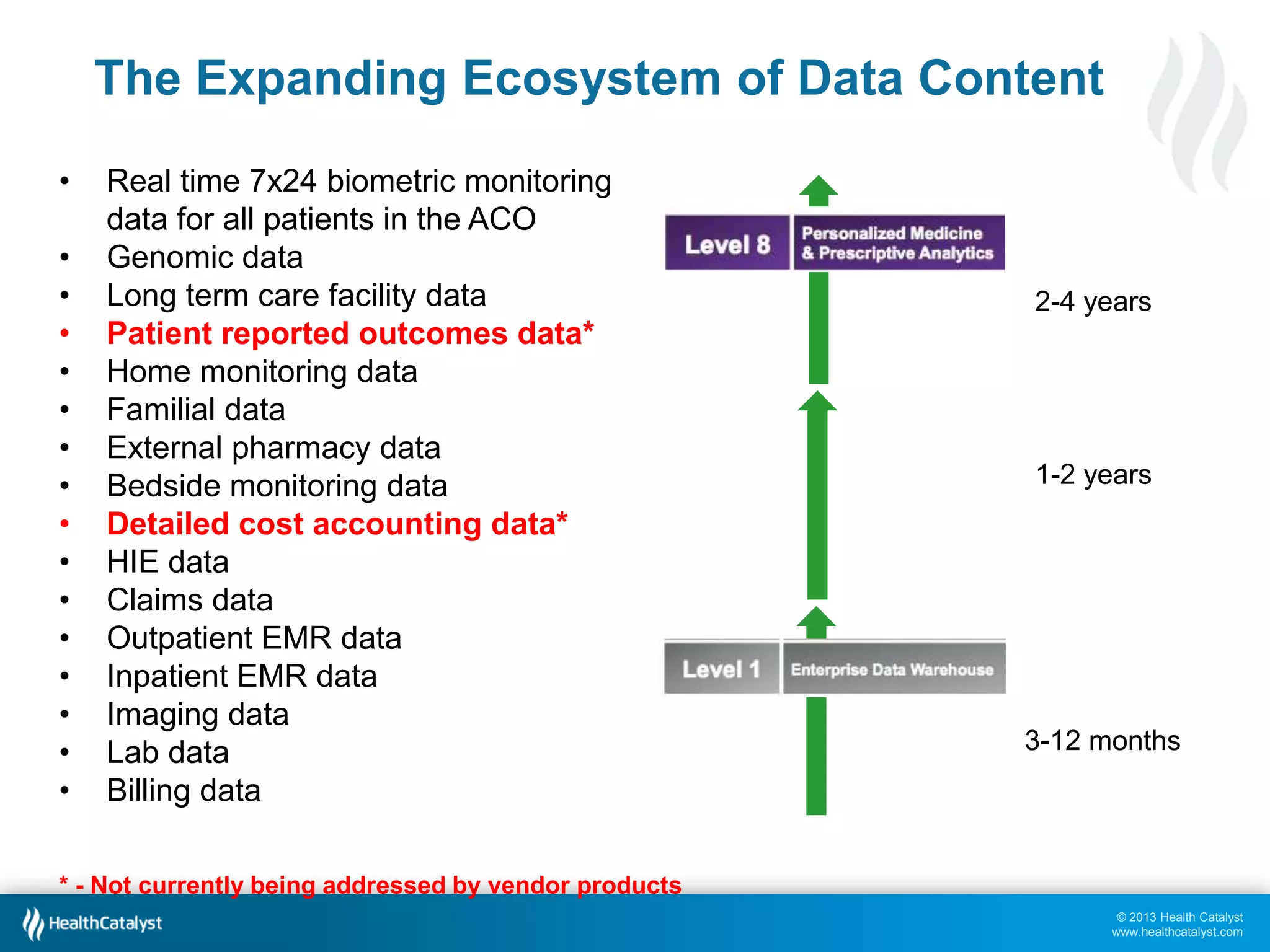
The Expanding Ecosystem of Data Content
•
•
•
•
•
•
•
•
•
•
•
•
•
•
•
•

Real time 7x24 biometric monitoring
data for all patients in the ACO
Genomic data
Long term care facility data
Patient reported outcomes data*
Home monitoring data
Familial data
External pharmacy data
Bedside monitoring data
Detailed cost accounting data*
HIE data
Claims data
Outpatient EMR data
Inpatient EMR data
Imaging data
Lab data
Billing data

2-4 years

1-2 years

3-12 months

* - Not currently being addressed by vendor products
© 2013 Health Catalyst
www.healthcatalyst.com
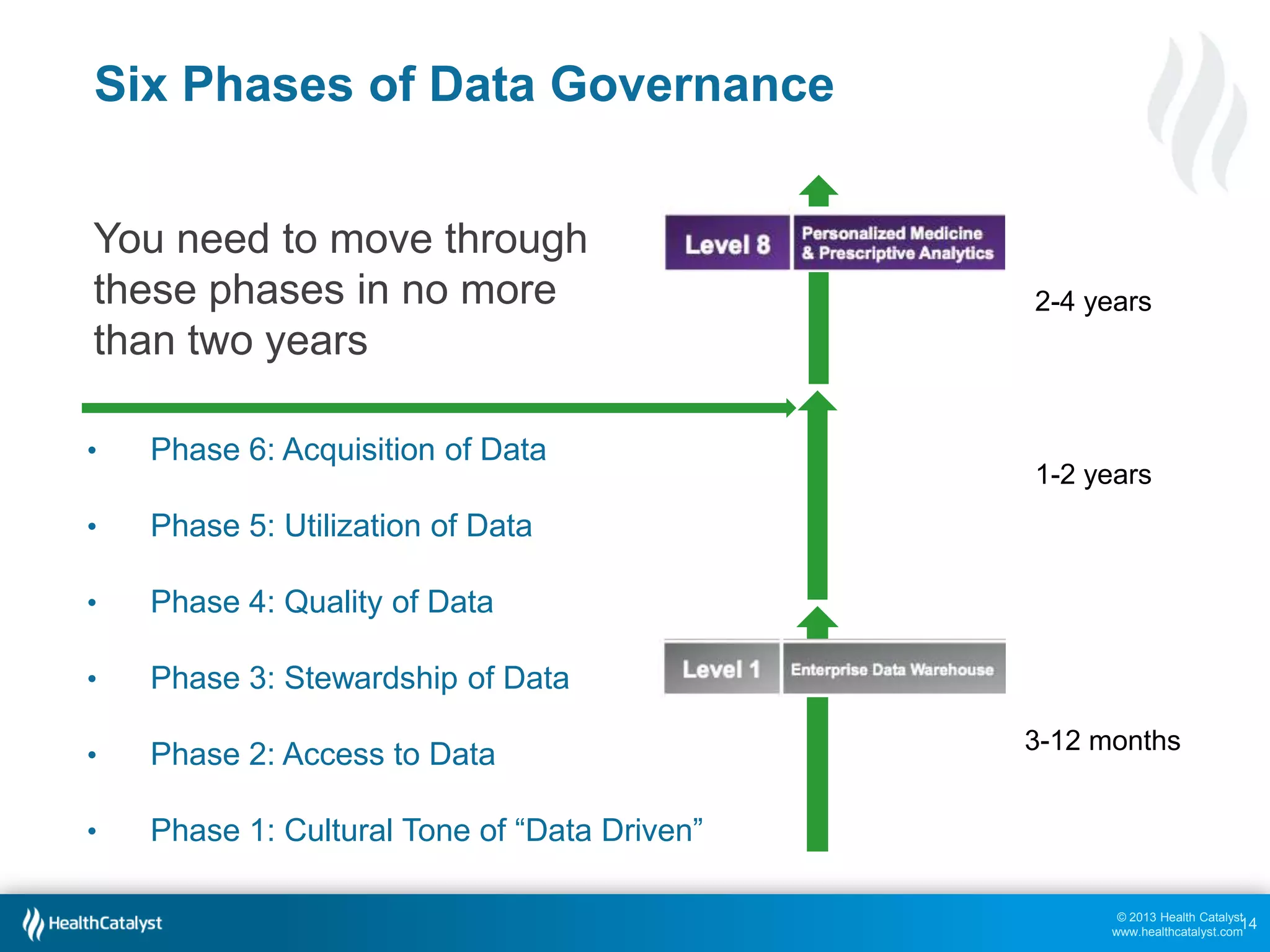
Six Phases of Data Governance
You need to move through
these phases in no more
than two years
•

Phase 6: Acquisition of Data

•

Phase 5: Utilization of Data

•

Phase 4: Quality of Data

•

Phase 3: Stewardship of Data

•

Phase 2: Access to Data

•

2-4 years

Phase 1: Cultural Tone of “Data Driven”

1-2 years

3-12 months

© 2013 Health Catalyst
14
www.healthcatalyst.com
One Page Self Inspection Guide
Principles to Remember
1. Delay binding as long as possible… until a clear analytic

use case requires it
2. Earlier binding is appropriate for business rules or

vocabularies that change infrequently or that the
organization wants to “lock down” for consistent analytics
3. Late binding, in the visualization layer, is appropriate for

“what if” scenario analysis
4. Retain a record of the changes to vocabulary and rules

bindings in the data models of the data warehouse
●

Bake the history of vocabulary and business rules bindings into
the data models so you can retrace your analytic steps if need be

16

© 2013 Health Catalyst
www.healthcatalyst.com
Closing Words of Caution
Healthcare suffers from a low degree of
Comprehensive and Persistent agreement on
many topics that impact analytics

The vast majority of vendors and home grown
data warehouses bind to rules and vocabulary
too early and too tightly, in comprehensive
enterprise data models

Analytic agility and adaptability suffers greatly
• “We’ve been building our EDW for two years.”
• “I asked for that report last month.”

17

© 2013 Health Catalyst
www.healthcatalyst.com

Late Binding in Data Warehouses

  • 1.
    Late Binding inData Warehouses: Designing for Analytic Agility Dale Sanders, Oct 2013 © 2013 Health Catalyst www.healthcatalyst.com © 2013 Health Catalyst www.healthcatalyst.com
  • 2.
    Overview • The concept of“binding” in software and data engineering • Examples of data binding in healthcare • The two tests for early binding • • The six points of binding in data warehouse design • • Comprehensive & persistent agreement Data Modeling vs. Late Binding The importance of binding in analytic progression • Eight levels of analytic adoption in healthcare © 2013 Health Catalyst www.healthcatalyst.com
  • 3.
    Late Binding inSoftware Engineering 1980s: Object Oriented Programming ● Alan Kay Universities of Colorado & Utah, Xerox/PARC ● Small objects of code, reflecting the real world ● Compiled individually, linked at runtime, only as needed ● Major agility and adaptability to address new use cases Steve Jobs ● NeXT computing ● Commercial, large-scale adoption of Kay’s concepts ● Late binding– or as late as practical– becomes the norm ● Maybe Jobs’ largest contribution to computer science 3 © 2013 Health Catalyst www.healthcatalyst.com
  • 4.
    Late Binding inData Engineering Atomic data must be “bound” to business rules about that data and to vocabularies related to that data in order to create information Vocabulary binding in healthcare is pretty obvious ● ● ● ● Unique patient and provider identifiers Standard facility, department, and revenue center codes Standard definitions for gender, race, ethnicity ICD, CPT, SNOMED, LOINC, RxNorm, RADLEX, etc. Examples of binding data to business rules ● ● ● ● ● ● ● Length of stay Patient relationship attribution to a provider Revenue (or expense) allocation and projections to a department Revenue (or expense) allocation and projections to a physician Data definitions of general disease states and patient registries Patient exclusion criteria from disease/population management Patient admission/discharge/transfer rules 4 © 2013 Health Catalyst www.healthcatalyst.com
  • 5.
    Data Binding Software Programming Pieces of meaningless data 112 60 Vocabulary Binds datato “systolic & diastolic blood pressure” Rules “normal” What’s the rule for declaring and managing a “hypertensive patient”? © 2013 Health Catalyst www.healthcatalyst.com
  • 6.
    Why Is ThisConcept Important? Knowing when to bind data, and how tightly, to vocabularies and rules is THE KEY to analytic success and agility Comprehensive Agreement Is the rule or vocabulary widely accepted as true and accurate in the organization or industry? Persistent Agreement Is the rule or vocabulary stable and rarely change? Two tests for tight, early binding Acknowledgements to Mark Beyer of Gartner 6 © 2013 Health Catalyst www.healthcatalyst.com
  • 7.
    Six Binding Pointsin a Data Warehouse SOURCE DATA CONTENT SUPPLIES INTERNAL CUSTOMIZED DATA MARTS CLINICAL CLINICAL FINANCIAL FINANCIAL QlikView DISEASE REGISTRIES SUPPLIES DATA ANALYSIS MATERIALS MANAGEMENT SOURCE SYSTEM ANALYTICS Microsoft Access/ ODBC Excel OPERATIONAL EVENTS SAS, SPSS RESEASRCH REGISTRIES Et al HR OTHERS EXTERNAL Web applications CLINICAL EVENTS HR COMPLIANCE AND PAYER MEASURES OTHERS STATE STATE ACADEMIC ACADEMIC 1 2 3 4 5 6 Data Rules and Vocabulary Binding Points High Comprehension & Persistence of vocabulary & business rules? => Early binding Low Comprehension and Persistence of vocabulary or business rules? => Late binding © 2013 Health Catalyst www.healthcatalyst.com
  • 8.
    Data Modeling forAnalytics Five Basic Methodologies ● Corporate Information Model Early binding ‒ Popularized by Bill Inmon and Claudia Imhoff ● I2B2 ‒ Popularized by Academic Medicine ● Star Schema ‒ Popularized by Ralph Kimball ● Data Bus Architecture ‒ Popularized by Dale Sanders ● File Structure Association ‒ Popularized by IBM mainframes in 1960s ‒ Reappearing in Hadoop & NoSQL ‒ No traditional relational data model Late binding © 2013 Health Catalyst www.healthcatalyst.com
  • 9.
    Binding to AnalyticRelations In data warehousing, the key is to relate data, not model data Core Data Elements Charge code CPT code Date & Time In today’s environment, about 20 data elements represent 80-90% of analytic use cases. This will grow over time, but right now, it’s fairly simple. DRG code Drug code Employee ID Employer ID Encounter ID Source data vocabulary Z (e.g., EMR) Gender ICD diagnosis code ICD procedure code Department ID Facility ID Lab code Patient type Patient/member ID Payer/carrier ID Postal code Provider ID Source data vocabulary Y (e.g., Claims) Source data vocabulary X (e.g., Rx)
  • 10.
    The Bus Architecture Client Developed Apps VendorApps Ad Hoc Query Tools Third Party Apps EMR Claims Rx Cost Patient Sat Provider ID Payer/carrier ID Member ID Patient type Lab code Facility ID Department ID ICD diagnosis code Gender Encounter ID Employer ID Employee ID Drug code DRG code Date & Time CPT code Late Binding Bus Architecture Etc. © 2013 Health Catalyst www.healthcatalyst.com
  • 11.
    Healthcare Analytics AdoptionModel Level 8 Personalized Medicine & Prescriptive Analytics Tailoring patient care based on population outcomes and genetic data. Fee-for-quality rewards health maintenance. Level 7 Clinical Risk Intervention & Predictive Analytics Organizational processes for intervention are supported with predictive risk models. Fee-for-quality includes fixed per capita payment. Level 6 Population Health Management & Suggestive Analytics Tailoring patient care based upon population metrics. Feefor-quality includes bundled per case payment. Level 5 Waste & Care Variability Reduction Reducing variability in care processes. Focusing on internal optimization and waste reduction. Level 4 Automated External Reporting Efficient, consistent production of reports & adaptability to changing requirements. Level 3 Automated Internal Reporting Efficient, consistent production of reports & widespread availability in the organization. Level 2 Standardized Vocabulary & Patient Registries Relating and organizing the core data content. Level 1 Enterprise Data Warehouse Collecting and integrating the core data content. Level 0 Fragmented Point Solutions Inefficient, inconsistent versions of the truth. Cumbersome internal and external reporting. © 2013 Health Catalyst www.healthcatalyst.com
  • 12.
    Progression in theModel The patterns at each level • Data content expands • • Data timeliness increases • • To support faster decision cycles and lower “Mean Time To Improvement” Data governance expands • • Adding new sources of data to expand our understanding of care delivery and the patient Advocating greater data access, utilization, and quality The complexity of data binding and algorithms increases • From descriptive to prescriptive analytics • From “What happened?” to “What should we do?” © 2013 Health Catalyst www.healthcatalyst.com
  • 13.
    The Expanding Ecosystemof Data Content • • • • • • • • • • • • • • • • Real time 7x24 biometric monitoring data for all patients in the ACO Genomic data Long term care facility data Patient reported outcomes data* Home monitoring data Familial data External pharmacy data Bedside monitoring data Detailed cost accounting data* HIE data Claims data Outpatient EMR data Inpatient EMR data Imaging data Lab data Billing data 2-4 years 1-2 years 3-12 months * - Not currently being addressed by vendor products © 2013 Health Catalyst www.healthcatalyst.com
  • 14.
    Six Phases ofData Governance You need to move through these phases in no more than two years • Phase 6: Acquisition of Data • Phase 5: Utilization of Data • Phase 4: Quality of Data • Phase 3: Stewardship of Data • Phase 2: Access to Data • 2-4 years Phase 1: Cultural Tone of “Data Driven” 1-2 years 3-12 months © 2013 Health Catalyst 14 www.healthcatalyst.com
  • 15.
    One Page SelfInspection Guide
  • 16.
    Principles to Remember 1.Delay binding as long as possible… until a clear analytic use case requires it 2. Earlier binding is appropriate for business rules or vocabularies that change infrequently or that the organization wants to “lock down” for consistent analytics 3. Late binding, in the visualization layer, is appropriate for “what if” scenario analysis 4. Retain a record of the changes to vocabulary and rules bindings in the data models of the data warehouse ● Bake the history of vocabulary and business rules bindings into the data models so you can retrace your analytic steps if need be 16 © 2013 Health Catalyst www.healthcatalyst.com
  • 17.
    Closing Words ofCaution Healthcare suffers from a low degree of Comprehensive and Persistent agreement on many topics that impact analytics The vast majority of vendors and home grown data warehouses bind to rules and vocabulary too early and too tightly, in comprehensive enterprise data models Analytic agility and adaptability suffers greatly • “We’ve been building our EDW for two years.” • “I asked for that report last month.” 17 © 2013 Health Catalyst www.healthcatalyst.com