Linking Clinical and Financial Data: The 
Key to Real Quality and Cost Outcomes 
By Bobbi Brown 
© 2014 Health Catalyst 
www.healthcatalyst.com Proprietary. Feel free to share but we would appreciate a Health Catalyst citation. 
© 2014 Health Catalyst 
www.healthcatalyst.com 
Proprietary. Feel free to share but we would appreciate a Health Catalyst citation.
Linking Clinical and Financial Data 
Health systems weren’t concerned with 
achieving high-value care until accountable 
care took the industry by a storm in 2010. 
Health systems had a predictable revenue 
stream from the fee-for-service payment 
model. Patient volumes their revenue. 
© 2014 Health Catalyst 
www.healthcatalyst.com 
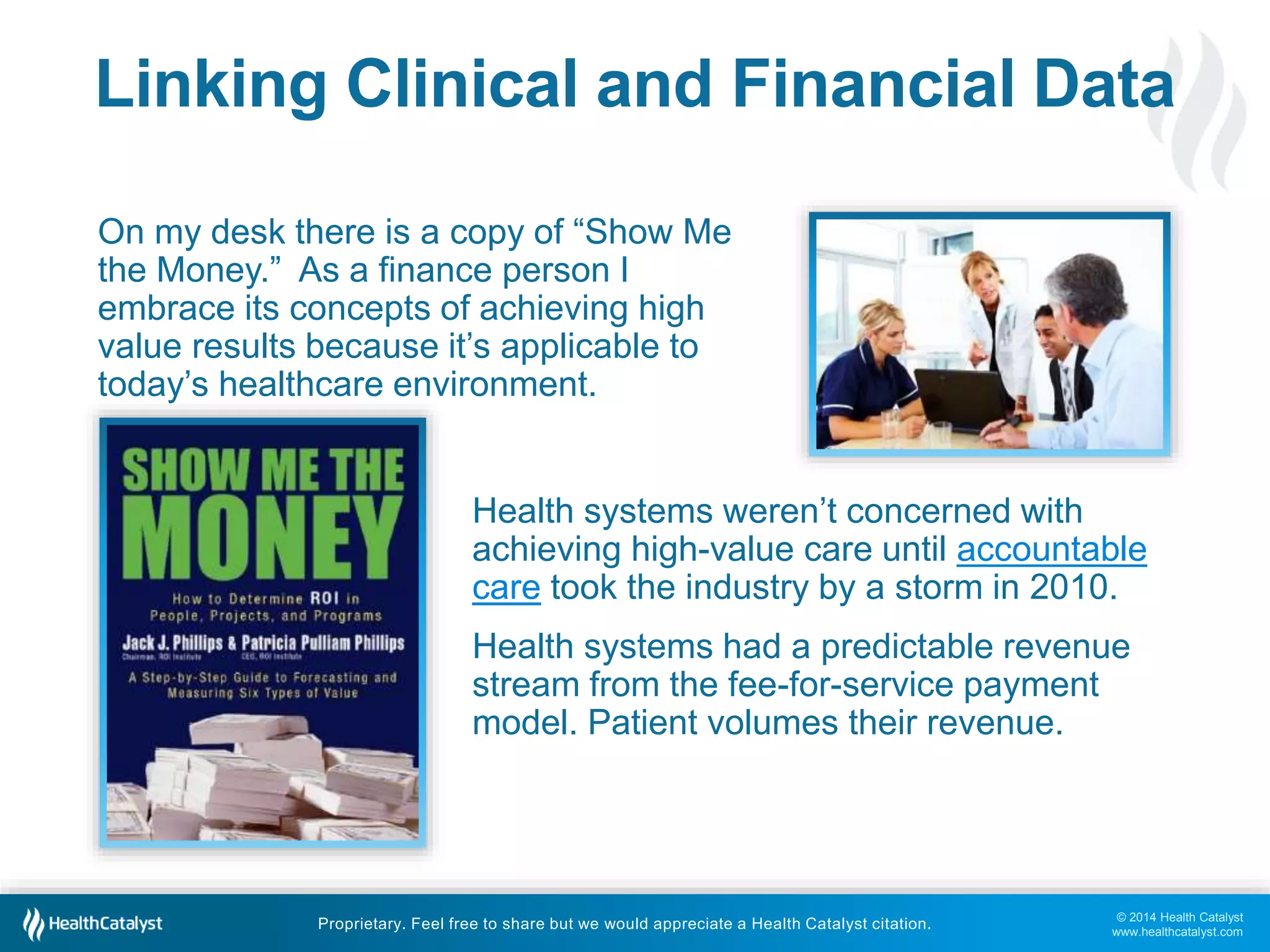
On my desk there is a copy of “Show Me 
the Money.” As a finance person I 
embrace its concepts of achieving high 
value results because it’s applicable to 
today’s healthcare environment. 
Proprietary. Feel free to share but we would appreciate a Health Catalyst citation.
Metrics for Value-based Purchasing 
© 2014 Health Catalyst 
www.healthcatalyst.com 
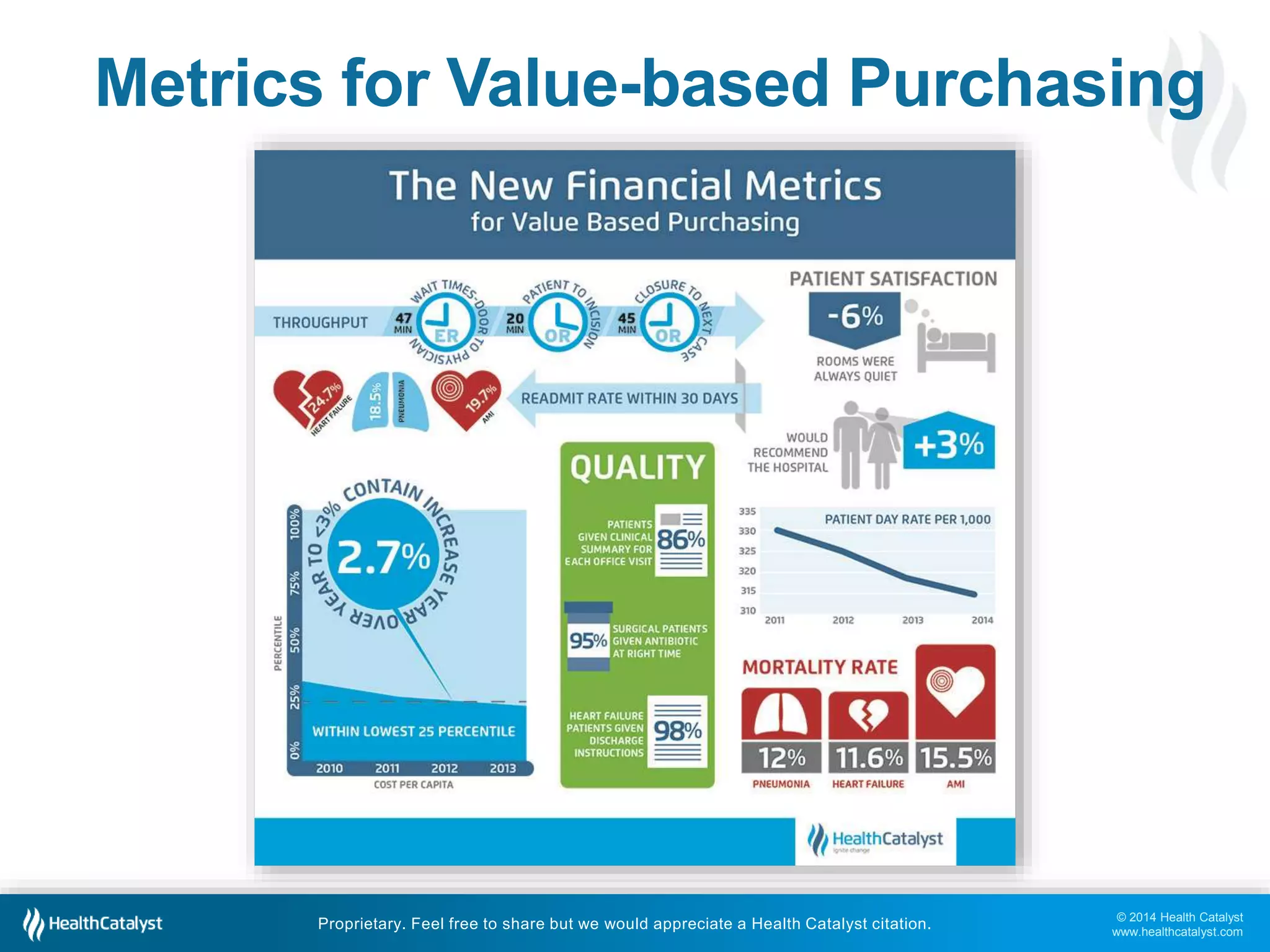
While the switch to value-based 
purchasing will ultimately improve 
both quality and cost outcomes, 
health systems now need the 
capability of tracking and 
analyzing many other metrics 
before they can comply with the 
government’s new mandates. 
These metrics include: 
Throughput Quality Readmissions 
Proprietary. Feel free to share but we would appreciate a Health Catalyst citation. 
Mortality 
rates 
Patient 
Satisfaction 
Cost per 
Episode of Care
Metrics for Value-based Purchasing 
Throughput 
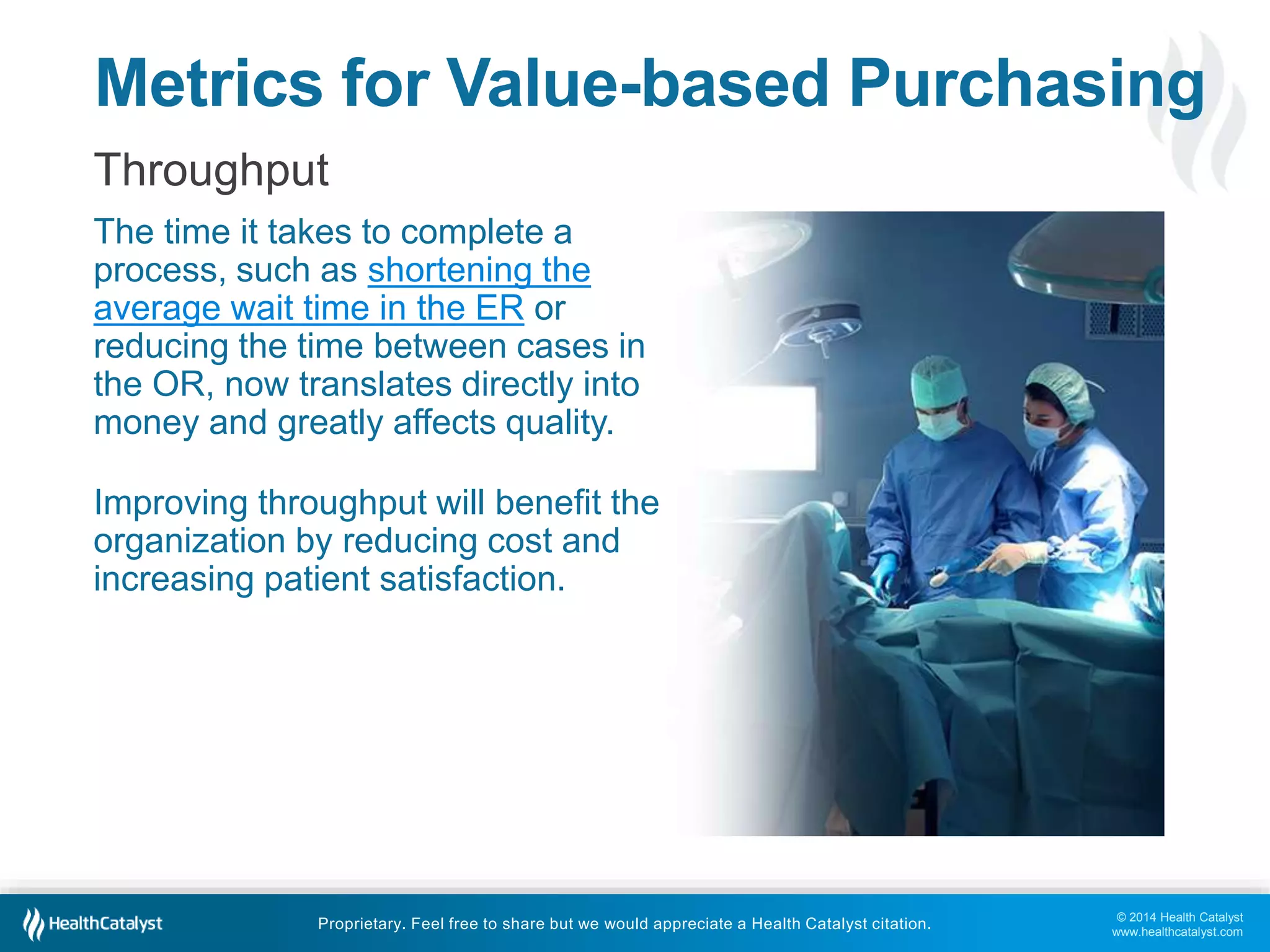
The time it takes to complete a 
process, such as shortening the 
average wait time in the ER or 
reducing the time between cases in 
the OR, now translates directly into 
money and greatly affects quality. 
© 2014 Health Catalyst 
www.healthcatalyst.com 
Improving throughput will benefit the 
organization by reducing cost and 
increasing patient satisfaction. 
Proprietary. Feel free to share but we would appreciate a Health Catalyst citation.
Metrics for Value-based Purchasing 
Quality 
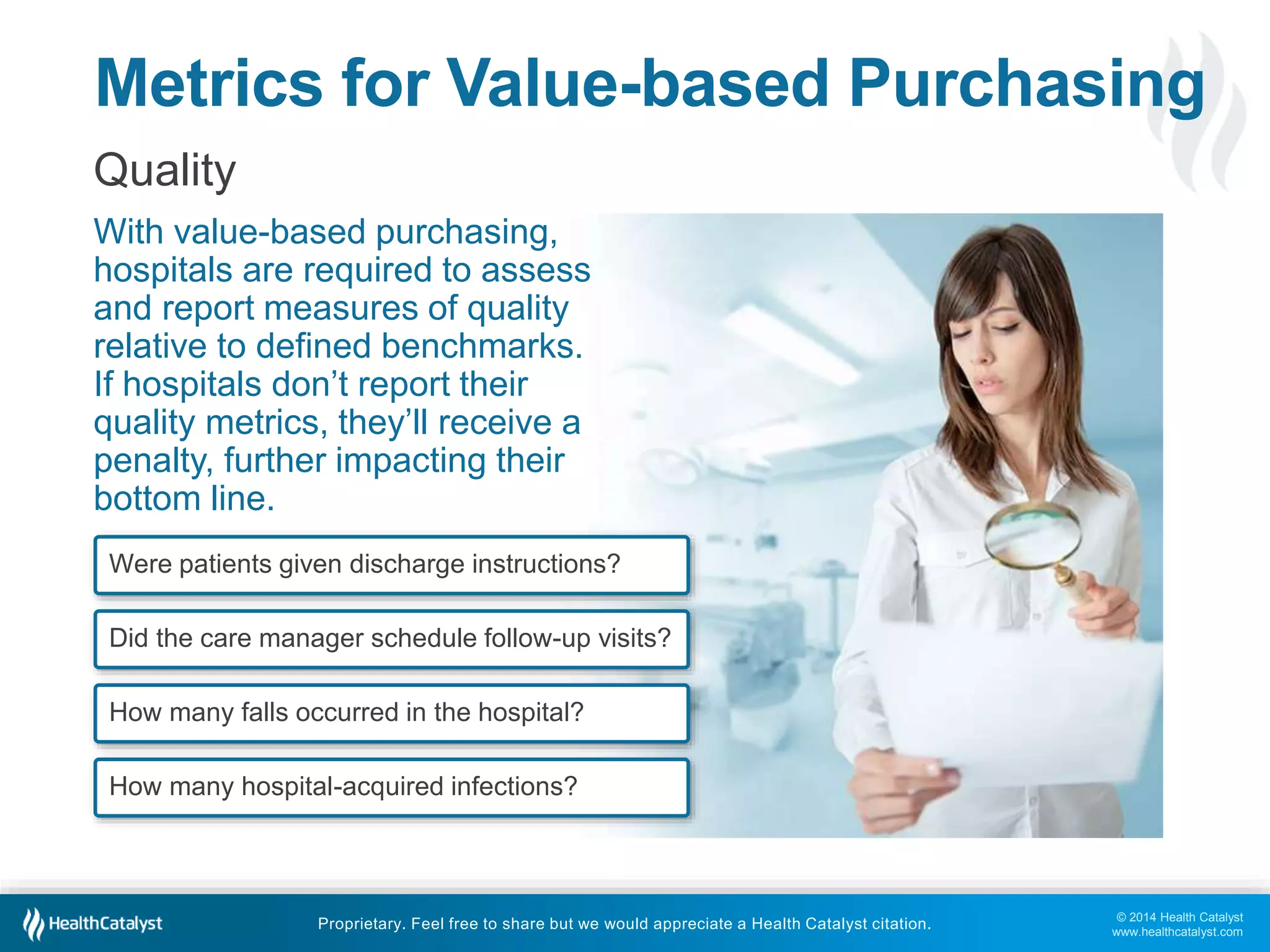
With value-based purchasing, 
hospitals are required to assess 
and report measures of quality 
relative to defined benchmarks. 
If hospitals don’t report their 
quality metrics, they’ll receive a 
penalty, further impacting their 
bottom line. 
© 2014 Health Catalyst 
www.healthcatalyst.com 
Were patients given discharge instructions? 
Did the care manager schedule follow-up visits? 
How many falls occurred in the hospital? 
How many hospital-acquired infections? 
Proprietary. Feel free to share but we would appreciate a Health Catalyst citation.
Metrics for Value-based Purchasing 
Readmissions 
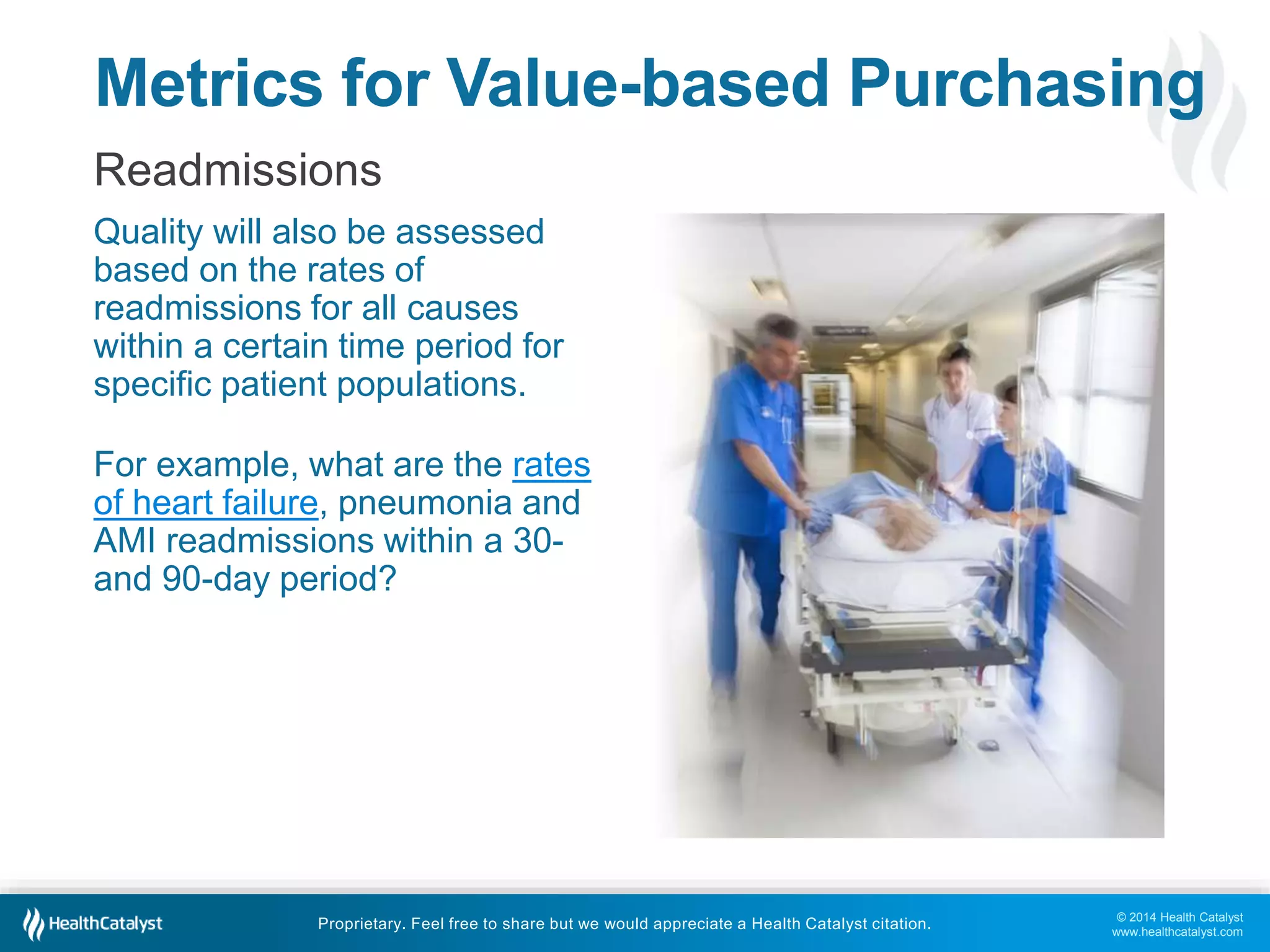
Quality will also be assessed 
based on the rates of 
readmissions for all causes 
within a certain time period for 
specific patient populations. 
© 2014 Health Catalyst 
www.healthcatalyst.com 
For example, what are the rates 
of heart failure, pneumonia and 
AMI readmissions within a 30- 
and 90-day period? 
Proprietary. Feel free to share but we would appreciate a Health Catalyst citation.
Metrics for Value-based Purchasing 
Mortality Rates 
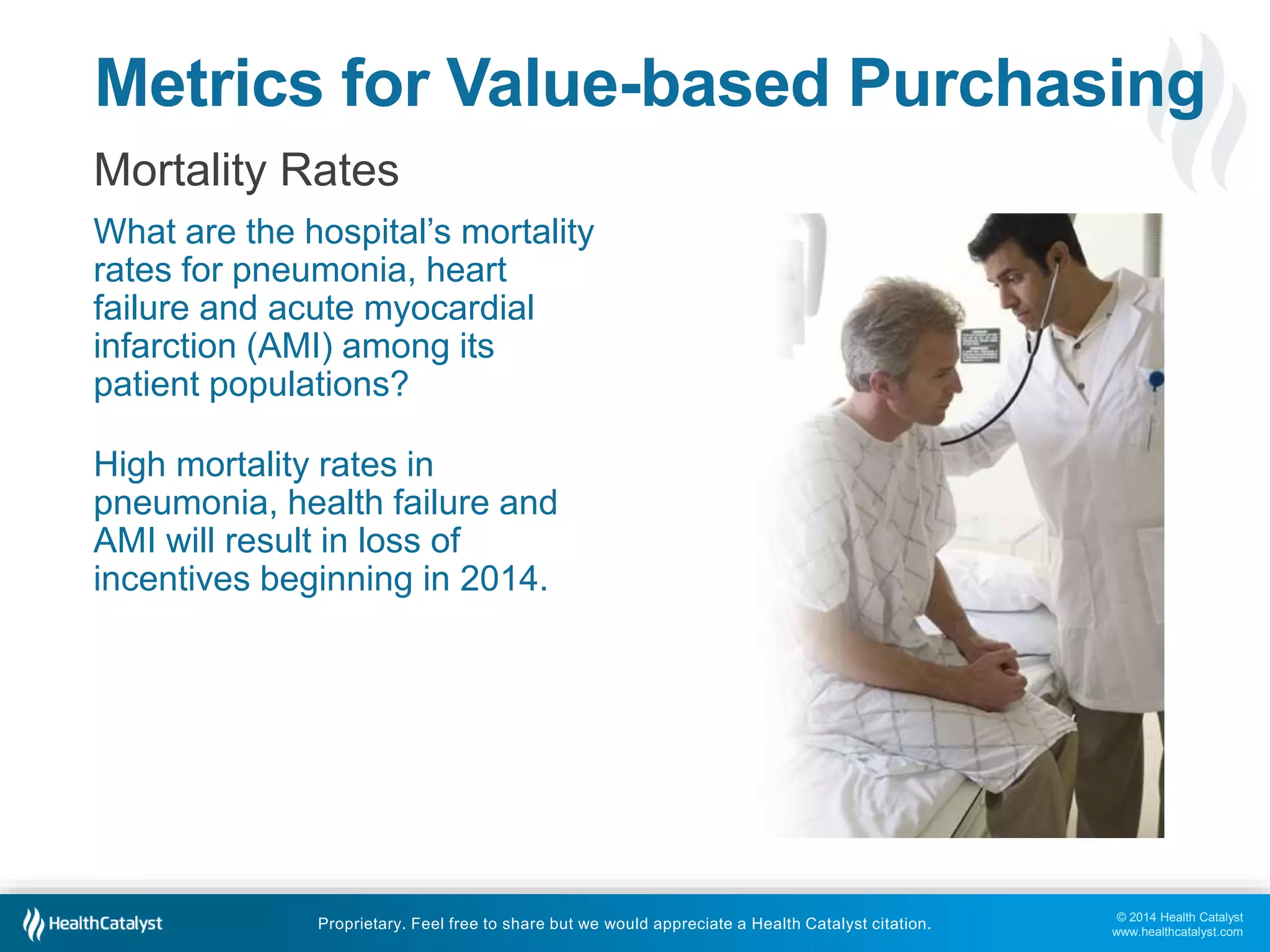
What are the hospital’s mortality 
rates for pneumonia, heart 
failure and acute myocardial 
infarction (AMI) among its 
patient populations? 
© 2014 Health Catalyst 
www.healthcatalyst.com 
High mortality rates in 
pneumonia, health failure and 
AMI will result in loss of 
incentives beginning in 2014. 
Proprietary. Feel free to share but we would appreciate a Health Catalyst citation.
Metrics for Value-based Purchasing 
Patient Satisfaction 
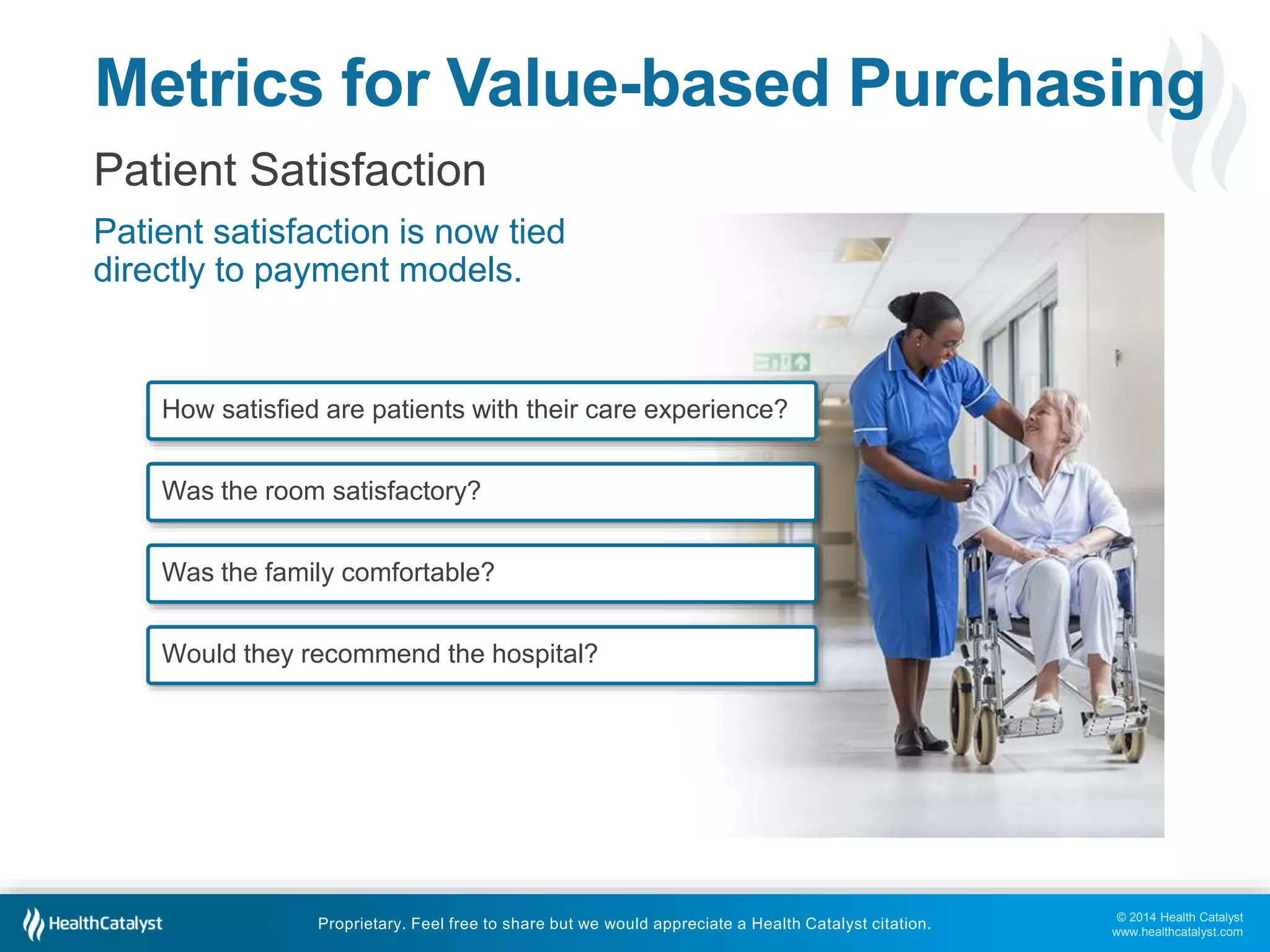
Patient satisfaction is now tied 
directly to payment models. 
© 2014 Health Catalyst 
www.healthcatalyst.com 
How satisfied are patients with their care experience? 
Was the room satisfactory? 
Was the family comfortable? 
Would they recommend the hospital? 
Proprietary. Feel free to share but we would appreciate a Health Catalyst citation.
Metrics for Value-based Purchasing 
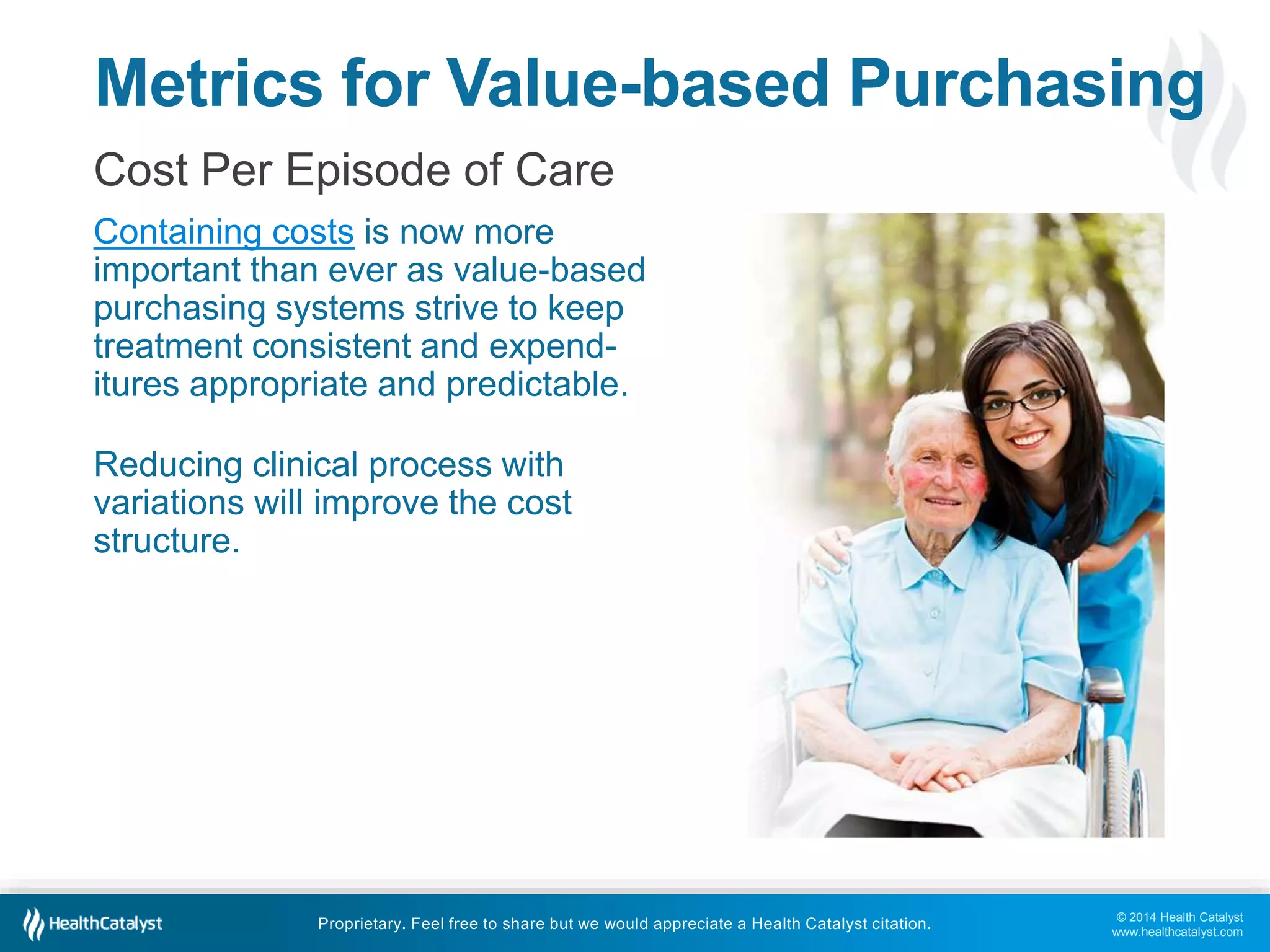
Cost Per Episode of Care 
Containing costs is now more 
important than ever as value-based 
purchasing systems strive to keep 
treatment consistent and expend-itures 
© 2014 Health Catalyst 
www.healthcatalyst.com 
appropriate and predictable. 
Reducing clinical process with 
variations will improve the cost 
structure. 
Proprietary. Feel free to share but we would appreciate a Health Catalyst citation.
Metrics for Value-based Purchasing 
© 2014 Health Catalyst 
www.healthcatalyst.com 
Proprietary. Feel free to share but we would appreciate a Health Catalyst citation.
Clinical & Financial Data Challenges 
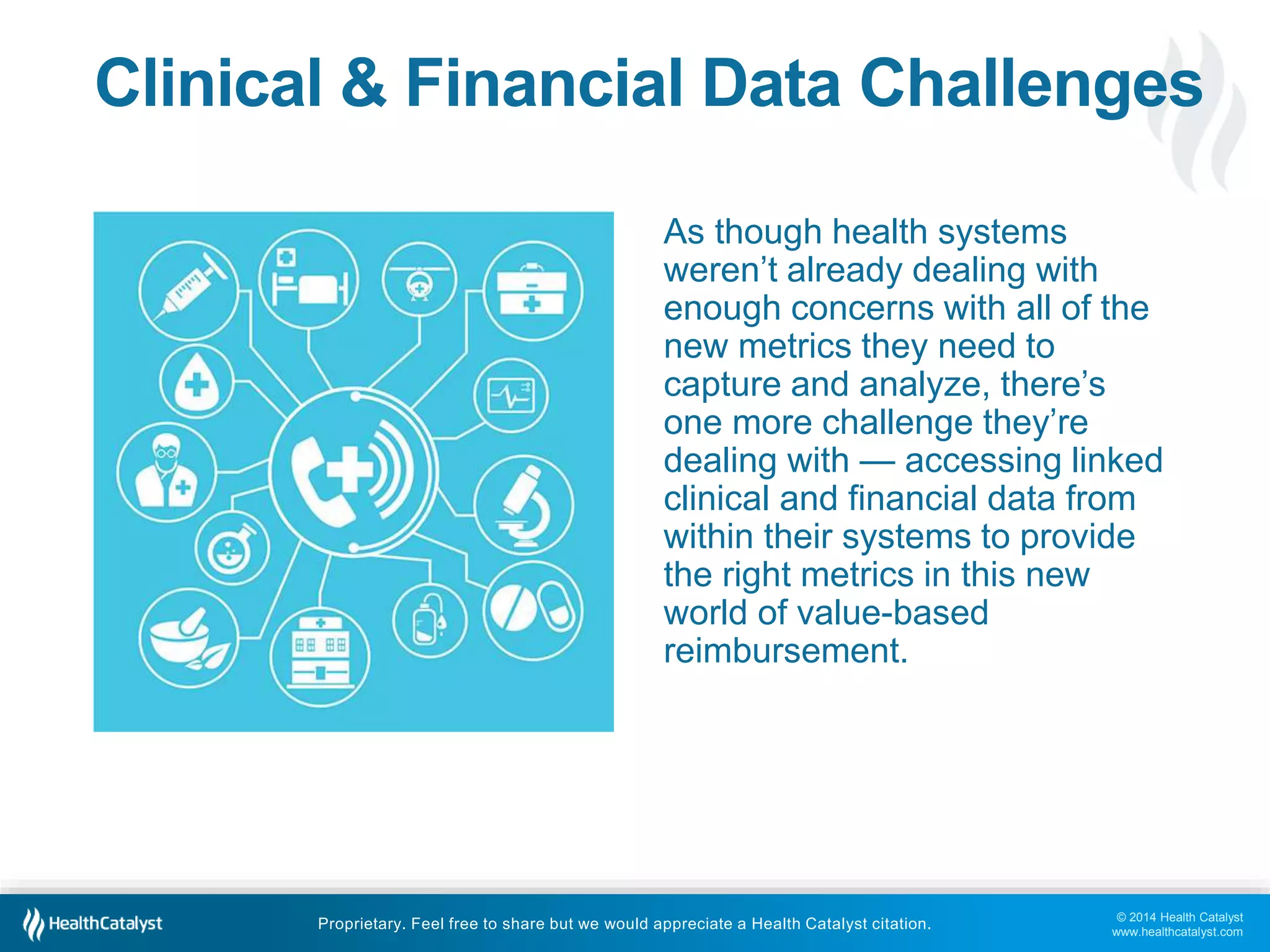
As though health systems 
weren’t already dealing with 
enough concerns with all of the 
new metrics they need to 
capture and analyze, there’s 
one more challenge they’re 
dealing with — accessing linked 
clinical and financial data from 
within their systems to provide 
the right metrics in this new 
world of value-based 
reimbursement. 
© 2014 Health Catalyst 
www.healthcatalyst.com 
Proprietary. Feel free to share but we would appreciate a Health Catalyst citation.
Clinical & Financial Data Challenges 
But the two data systems were 
not integrated because there 
wasn’t a need. 
Today, data from both clinical 
and financial systems can be 
leveraged to drive concrete, 
timely quality improvements 
while also lowering costs. 
© 2014 Health Catalyst 
www.healthcatalyst.com 
Traditionally, health systems 
housed their financial and 
clinical data in separate 
systems. 
Proprietary. Feel free to share but we would appreciate a Health Catalyst citation.
© 2014 Health Catalyst 
www.healthcatalyst.com 
Achieving High Value Results 
Achieving high value results for 
health systems is achievable. 
The organization must 
understand where it is in 
relation to clinical quality 
measures and financial costs 
associated with delivering care. 
The right tools and teams are 
necessary to liberate clinical 
and financial data and link it 
together to provide a full picture 
of trends and opportunities. 
Proprietary. Feel free to share but we would appreciate a Health Catalyst citation.
© 2014 Health Catalyst 
www.healthcatalyst.com 
Achieving High Value Results 
Enterprise data warehouse 
A late-bindingTM enterprise 
data warehouse (EDW) 
provides the ability to 
aggregate data from a wide 
variety of sources allowing a 
sophisticated analytics system 
to leverage the data and drive 
timely quality improvements. 
Late-binding brings the data 
together just-in-time. 
Proprietary. Feel free to share but we would appreciate a Health Catalyst citation.
© 2014 Health Catalyst 
www.healthcatalyst.com 
Achieving High Value Results 
Multi-disciplinary teams 
In addition to the EDW, 
permanent multi-disciplinary 
teams of frontline staff can help 
drive sustainable improvement. 
The team constantly monitors to 
ensure they’re focused on 
sustaining quality and financial 
improvements as well as clinical 
and operational outcomes. 
Once data and best practices 
reveal improvement they work to 
gain buy-in from the clinicians. 
Proprietary. Feel free to share but we would appreciate a Health Catalyst citation.
© 2014 Health Catalyst 
www.healthcatalyst.com 
Achieving High Value Results 
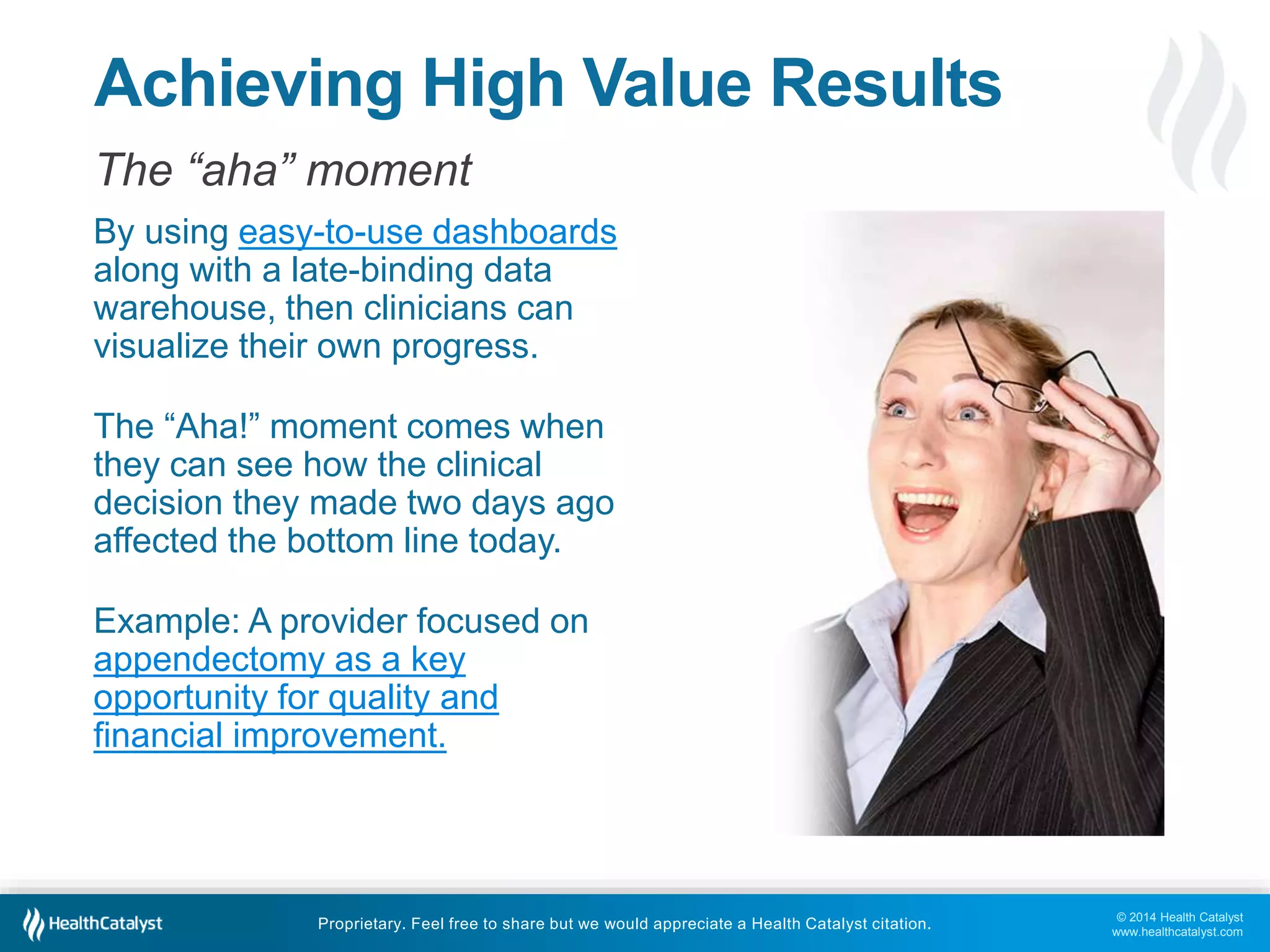
The “aha” moment 
By using easy-to-use dashboards 
along with a late-binding data 
warehouse, then clinicians can 
visualize their own progress. 
The “Aha!” moment comes when 
they can see how the clinical 
decision they made two days ago 
affected the bottom line today. 
Example: A provider focused on 
appendectomy as a key 
opportunity for quality and 
financial improvement. 
Proprietary. Feel free to share but we would appreciate a Health Catalyst citation.
© 2014 Health Catalyst 
www.healthcatalyst.com 
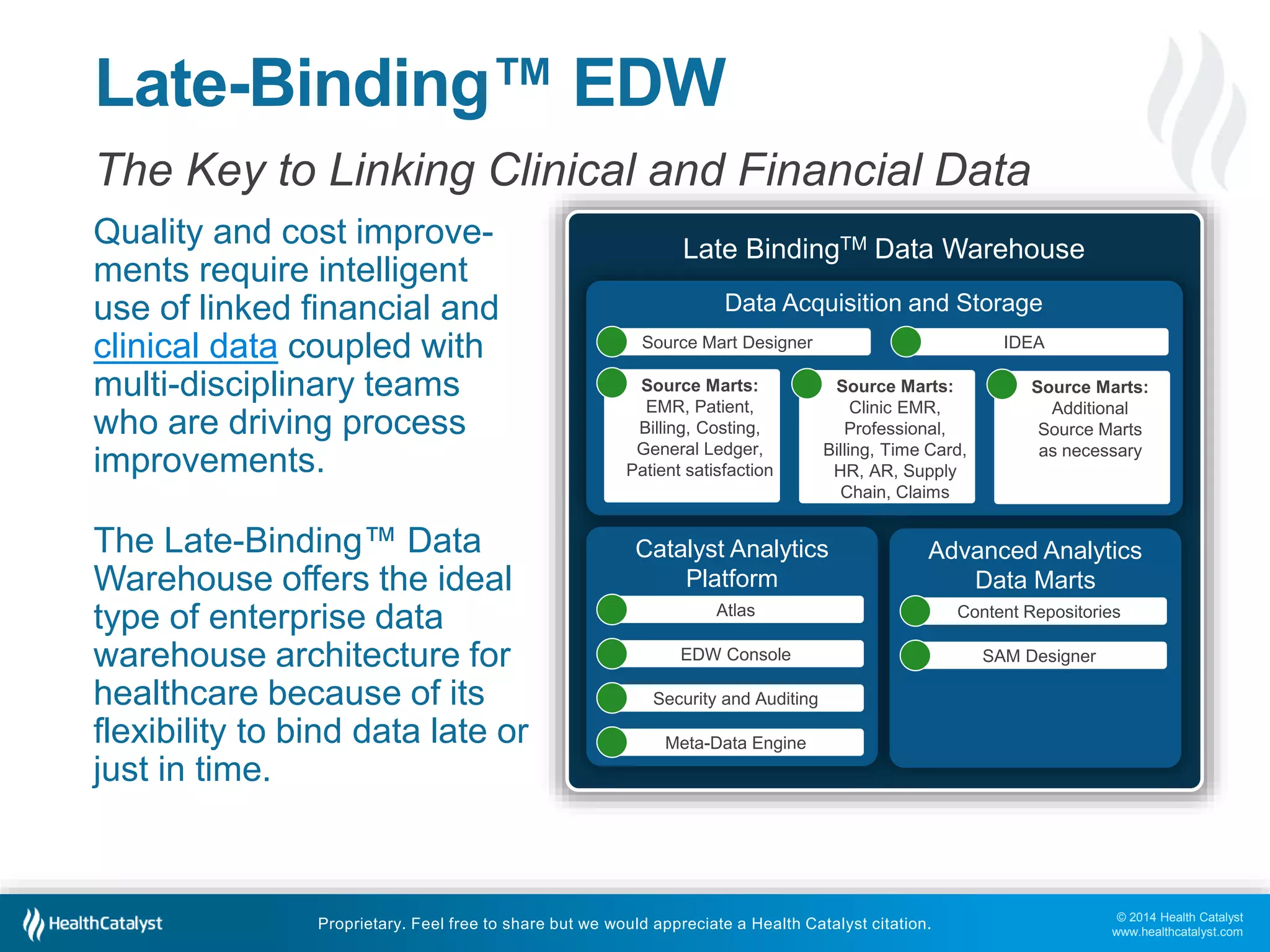
Late-Binding™ EDW 
The Key to Linking Clinical and Financial Data 
Quality and cost improve-ments 
require intelligent 
use of linked financial and 
clinical data coupled with 
multi-disciplinary teams 
who are driving process 
improvements. 
The Late-Binding™ Data 
Warehouse offers the ideal 
type of enterprise data 
warehouse architecture for 
healthcare because of its 
flexibility to bind data late or 
just in time. 
Late BindingTM Data Warehouse 
Data Acquisition and Storage 
Source Mart Designer IDEA 
Source Marts: 
EMR, Patient, 
Billing, Costing, 
General Ledger, 
Patient satisfaction 
Source Marts: 
Clinic EMR, 
Professional, 
Billing, Time Card, 
HR, AR, Supply 
Chain, Claims 
Proprietary. Feel free to share but we would appreciate a Health Catalyst citation. 
Source Marts: 
Additional 
Source Marts 
as necessary 
Catalyst Analytics 
Platform 
Atlas 
EDW Console 
Security and Auditing 
Meta-Data Engine 
Advanced Analytics 
Data Marts 
Content Repositories 
SAM Designer
Surviving Value-Based Purchasing: Connecting Clinical and Financial Data for the 
Best ROI 
Bobbi Brown, VP Financial Engagement 
How to Drive ROI in Your Healthcare Improvement Projects 
(a free, on-demand webinar, transcript, and slides) 
Bobbi Brown, VP Financial Engagement and Leslie Falk, VP Executive Engagement 
© 2014 Health Catalyst 
www.healthcatalyst.com 
More about this topic 
Both Financial and Clinical Data Are Required for Meaningful Population Health 
Management (white paper) 
Bobbi Brown, VP Financial Engagement and Luke Skelley, Vice President 
5 Ways to Improve Hospital Revenue Cycle Management 
Bobbi Brown, VP Financial Engagement 
The Key to Transitioning from Fee-for-Service to Value-Based Reimbursement 
Bobbi Brown, VP Financial Engagement and Jared Crapo, VP 
Proprietary. Feel free to share but we would appreciate a Health Catalyst citation.
© 2014 Health Catalyst 
www.healthcatalyst.com 
For more information: 
Proprietary. Feel free to share but we would appreciate a Health Catalyst citation.
Other Clinical Quality Improvement Resources 
© 2013 Health Catalyst 
www.healthcatalyst.com 
Click to read additional information at www.healthcatalyst.com 
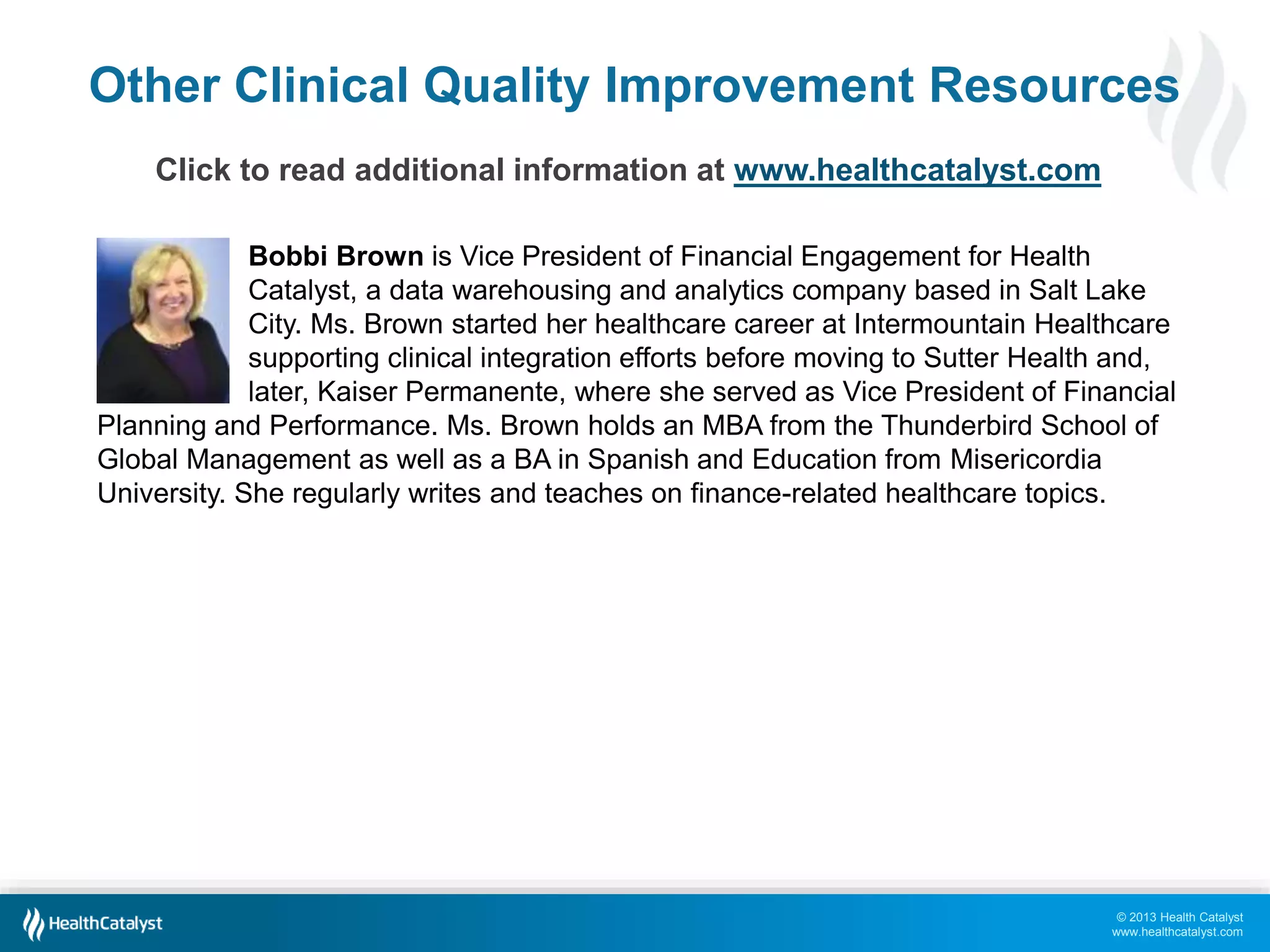
Bobbi Brown is Vice President of Financial Engagement for Health 
Catalyst, a data warehousing and analytics company based in Salt Lake 
City. Ms. Brown started her healthcare career at Intermountain Healthcare 
supporting clinical integration efforts before moving to Sutter Health and, 
later, Kaiser Permanente, where she served as Vice President of Financial 
Planning and Performance. Ms. Brown holds an MBA from the Thunderbird School of 
Global Management as well as a BA in Spanish and Education from Misericordia 
University. She regularly writes and teaches on finance-related healthcare topics.

Linking Clinical And Financial Data: The Key To Real Quality And Cost Out

  • 1.
    Linking Clinical andFinancial Data: The Key to Real Quality and Cost Outcomes By Bobbi Brown © 2014 Health Catalyst www.healthcatalyst.com Proprietary. Feel free to share but we would appreciate a Health Catalyst citation. © 2014 Health Catalyst www.healthcatalyst.com Proprietary. Feel free to share but we would appreciate a Health Catalyst citation.
  • 2.
    Linking Clinical andFinancial Data Health systems weren’t concerned with achieving high-value care until accountable care took the industry by a storm in 2010. Health systems had a predictable revenue stream from the fee-for-service payment model. Patient volumes their revenue. © 2014 Health Catalyst www.healthcatalyst.com On my desk there is a copy of “Show Me the Money.” As a finance person I embrace its concepts of achieving high value results because it’s applicable to today’s healthcare environment. Proprietary. Feel free to share but we would appreciate a Health Catalyst citation.
  • 3.
    Metrics for Value-basedPurchasing © 2014 Health Catalyst www.healthcatalyst.com While the switch to value-based purchasing will ultimately improve both quality and cost outcomes, health systems now need the capability of tracking and analyzing many other metrics before they can comply with the government’s new mandates. These metrics include: Throughput Quality Readmissions Proprietary. Feel free to share but we would appreciate a Health Catalyst citation. Mortality rates Patient Satisfaction Cost per Episode of Care
  • 4.
    Metrics for Value-basedPurchasing Throughput The time it takes to complete a process, such as shortening the average wait time in the ER or reducing the time between cases in the OR, now translates directly into money and greatly affects quality. © 2014 Health Catalyst www.healthcatalyst.com Improving throughput will benefit the organization by reducing cost and increasing patient satisfaction. Proprietary. Feel free to share but we would appreciate a Health Catalyst citation.
  • 5.
    Metrics for Value-basedPurchasing Quality With value-based purchasing, hospitals are required to assess and report measures of quality relative to defined benchmarks. If hospitals don’t report their quality metrics, they’ll receive a penalty, further impacting their bottom line. © 2014 Health Catalyst www.healthcatalyst.com Were patients given discharge instructions? Did the care manager schedule follow-up visits? How many falls occurred in the hospital? How many hospital-acquired infections? Proprietary. Feel free to share but we would appreciate a Health Catalyst citation.
  • 6.
    Metrics for Value-basedPurchasing Readmissions Quality will also be assessed based on the rates of readmissions for all causes within a certain time period for specific patient populations. © 2014 Health Catalyst www.healthcatalyst.com For example, what are the rates of heart failure, pneumonia and AMI readmissions within a 30- and 90-day period? Proprietary. Feel free to share but we would appreciate a Health Catalyst citation.
  • 7.
    Metrics for Value-basedPurchasing Mortality Rates What are the hospital’s mortality rates for pneumonia, heart failure and acute myocardial infarction (AMI) among its patient populations? © 2014 Health Catalyst www.healthcatalyst.com High mortality rates in pneumonia, health failure and AMI will result in loss of incentives beginning in 2014. Proprietary. Feel free to share but we would appreciate a Health Catalyst citation.
  • 8.
    Metrics for Value-basedPurchasing Patient Satisfaction Patient satisfaction is now tied directly to payment models. © 2014 Health Catalyst www.healthcatalyst.com How satisfied are patients with their care experience? Was the room satisfactory? Was the family comfortable? Would they recommend the hospital? Proprietary. Feel free to share but we would appreciate a Health Catalyst citation.
  • 9.
    Metrics for Value-basedPurchasing Cost Per Episode of Care Containing costs is now more important than ever as value-based purchasing systems strive to keep treatment consistent and expend-itures © 2014 Health Catalyst www.healthcatalyst.com appropriate and predictable. Reducing clinical process with variations will improve the cost structure. Proprietary. Feel free to share but we would appreciate a Health Catalyst citation.
  • 10.
    Metrics for Value-basedPurchasing © 2014 Health Catalyst www.healthcatalyst.com Proprietary. Feel free to share but we would appreciate a Health Catalyst citation.
  • 11.
    Clinical & FinancialData Challenges As though health systems weren’t already dealing with enough concerns with all of the new metrics they need to capture and analyze, there’s one more challenge they’re dealing with — accessing linked clinical and financial data from within their systems to provide the right metrics in this new world of value-based reimbursement. © 2014 Health Catalyst www.healthcatalyst.com Proprietary. Feel free to share but we would appreciate a Health Catalyst citation.
  • 12.
    Clinical & FinancialData Challenges But the two data systems were not integrated because there wasn’t a need. Today, data from both clinical and financial systems can be leveraged to drive concrete, timely quality improvements while also lowering costs. © 2014 Health Catalyst www.healthcatalyst.com Traditionally, health systems housed their financial and clinical data in separate systems. Proprietary. Feel free to share but we would appreciate a Health Catalyst citation.
  • 13.
    © 2014 HealthCatalyst www.healthcatalyst.com Achieving High Value Results Achieving high value results for health systems is achievable. The organization must understand where it is in relation to clinical quality measures and financial costs associated with delivering care. The right tools and teams are necessary to liberate clinical and financial data and link it together to provide a full picture of trends and opportunities. Proprietary. Feel free to share but we would appreciate a Health Catalyst citation.
  • 14.
    © 2014 HealthCatalyst www.healthcatalyst.com Achieving High Value Results Enterprise data warehouse A late-bindingTM enterprise data warehouse (EDW) provides the ability to aggregate data from a wide variety of sources allowing a sophisticated analytics system to leverage the data and drive timely quality improvements. Late-binding brings the data together just-in-time. Proprietary. Feel free to share but we would appreciate a Health Catalyst citation.
  • 15.
    © 2014 HealthCatalyst www.healthcatalyst.com Achieving High Value Results Multi-disciplinary teams In addition to the EDW, permanent multi-disciplinary teams of frontline staff can help drive sustainable improvement. The team constantly monitors to ensure they’re focused on sustaining quality and financial improvements as well as clinical and operational outcomes. Once data and best practices reveal improvement they work to gain buy-in from the clinicians. Proprietary. Feel free to share but we would appreciate a Health Catalyst citation.
  • 16.
    © 2014 HealthCatalyst www.healthcatalyst.com Achieving High Value Results The “aha” moment By using easy-to-use dashboards along with a late-binding data warehouse, then clinicians can visualize their own progress. The “Aha!” moment comes when they can see how the clinical decision they made two days ago affected the bottom line today. Example: A provider focused on appendectomy as a key opportunity for quality and financial improvement. Proprietary. Feel free to share but we would appreciate a Health Catalyst citation.
  • 17.
    © 2014 HealthCatalyst www.healthcatalyst.com Late-Binding™ EDW The Key to Linking Clinical and Financial Data Quality and cost improve-ments require intelligent use of linked financial and clinical data coupled with multi-disciplinary teams who are driving process improvements. The Late-Binding™ Data Warehouse offers the ideal type of enterprise data warehouse architecture for healthcare because of its flexibility to bind data late or just in time. Late BindingTM Data Warehouse Data Acquisition and Storage Source Mart Designer IDEA Source Marts: EMR, Patient, Billing, Costing, General Ledger, Patient satisfaction Source Marts: Clinic EMR, Professional, Billing, Time Card, HR, AR, Supply Chain, Claims Proprietary. Feel free to share but we would appreciate a Health Catalyst citation. Source Marts: Additional Source Marts as necessary Catalyst Analytics Platform Atlas EDW Console Security and Auditing Meta-Data Engine Advanced Analytics Data Marts Content Repositories SAM Designer
  • 18.
    Surviving Value-Based Purchasing:Connecting Clinical and Financial Data for the Best ROI Bobbi Brown, VP Financial Engagement How to Drive ROI in Your Healthcare Improvement Projects (a free, on-demand webinar, transcript, and slides) Bobbi Brown, VP Financial Engagement and Leslie Falk, VP Executive Engagement © 2014 Health Catalyst www.healthcatalyst.com More about this topic Both Financial and Clinical Data Are Required for Meaningful Population Health Management (white paper) Bobbi Brown, VP Financial Engagement and Luke Skelley, Vice President 5 Ways to Improve Hospital Revenue Cycle Management Bobbi Brown, VP Financial Engagement The Key to Transitioning from Fee-for-Service to Value-Based Reimbursement Bobbi Brown, VP Financial Engagement and Jared Crapo, VP Proprietary. Feel free to share but we would appreciate a Health Catalyst citation.
  • 19.
    © 2014 HealthCatalyst www.healthcatalyst.com For more information: Proprietary. Feel free to share but we would appreciate a Health Catalyst citation.
  • 20.
    Other Clinical QualityImprovement Resources © 2013 Health Catalyst www.healthcatalyst.com Click to read additional information at www.healthcatalyst.com Bobbi Brown is Vice President of Financial Engagement for Health Catalyst, a data warehousing and analytics company based in Salt Lake City. Ms. Brown started her healthcare career at Intermountain Healthcare supporting clinical integration efforts before moving to Sutter Health and, later, Kaiser Permanente, where she served as Vice President of Financial Planning and Performance. Ms. Brown holds an MBA from the Thunderbird School of Global Management as well as a BA in Spanish and Education from Misericordia University. She regularly writes and teaches on finance-related healthcare topics.