© 2013 HL7 ® International. Licensed under Creative Commons. HL7 & Health Level Seven are registered trademarks of Health Level Seven International. Reg. U.S. TM Office.
Introduction to
FHIR
Grahame Grieve
Aug 19, 2014
© 2014 HL7 ® International. Licensed under Creative Commons. HL7 & Health Level Seven are registered trademarks of Health Level Seven International. Reg. U.S. TM Office.
This presentation
 Is licensed for use under the Creative
Commons, specifically:
 Creative Commons Attribution 3.0 Unported
License
 (Do with it as you wish, so long as you give credit)
© 2014 HL7 ® International. Licensed under Creative Commons. HL7 & Health Level Seven are registered trademarks of Health Level Seven International. Reg. U.S. TM Office.
The “FHIR” Acronym
 F – Fast (to design & to implement)
 H – Health
 I – Interoperable
 R – Resources (Building blocks)
 There is more on Resources to follow
 “Fast” is relative – no technology can make
integration as fast as we’d like
 “FHIR” (pronouced “Fire”) is a fertile source of
puns etc. Feel free to make your own
3
© 2014 HL7 ® International. Licensed under Creative Commons. HL7 & Health Level Seven are registered trademarks of Health Level Seven International. Reg. U.S. TM Office.
What is FHIR?
 A set of modular components called
“Resources”
 Resources refer to each other using URLs
 Build a web to support healthcare process
 Exchange resources between systems
 Using a RESTful API (e.g. web approach)
 As a bundle of resources (messages, documents)
4
© 2014 HL7 ® International. Licensed under Creative Commons. HL7 & Health Level Seven are registered trademarks of Health Level Seven International. Reg. U.S. TM Office.
Genesis of FHIR
 There has been a need to share healthcare
information electronically for a long time
 HL7 v2 is over 25 years old
 Increasing pressure to broaden scope of
sharing
 Across organizations, disciplines, even borders
 Mobile & cloud-based applications
 Faster – integration in days or weeks, not months
or years
5
© 2014 HL7 ® International. Licensed under Creative Commons. HL7 & Health Level Seven are registered trademarks of Health Level Seven International. Reg. U.S. TM Office.
Genesis of FHIR
 HL7 did not have much to offer in this
space?
 V2 Old, and limited by it’s own rules
 V3 too slow and too hard
 CDA has success, but both limited and too hard
 Different contexts of interoperability  different
representations that aren’t compatible
 Nothing suitable for light-weight integration,
or for Health 2.0
 No other Organization so well situated6
© 2014 HL7 ® International. Licensed under Creative Commons. HL7 & Health Level Seven are registered trademarks of Health Level Seven International. Reg. U.S. TM Office.
Genesis of FHIR
 HL7 undertook a “Fresh look”
 What would healthcare exchange look like if we
started from scratch using modern approaches?
 Web search for success markers led to
RESTful based APIs
 An exemplar: Highrise from “37 Signals)
 Drafted a healthcare exchange API based
on this approach
7
© 2014 HL7 ® International. Licensed under Creative Commons. HL7 & Health Level Seven are registered trademarks of Health Level Seven International. Reg. U.S. TM Office.
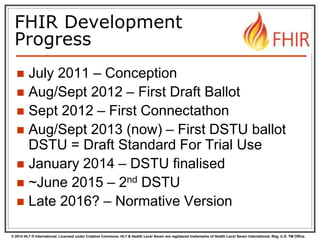
FHIR Development
Progress
 July 2011 – Conception
 Aug/Sept 2012 – First Draft Ballot
 Sept 2012 – First Connectathon
 Aug/Sept 2013 – First DSTU ballot
DSTU = Draft Standard For Trial Use
 January 2014 – DSTU finalised
 ~June 2015 – 2nd DSTU
 Late 2016? – Normative Version
© 2014 HL7 ® International. Licensed under Creative Commons. HL7 & Health Level Seven are registered trademarks of Health Level Seven International. Reg. U.S. TM Office.
FHIR PRINCIPLES
9
© 2014 HL7 ® International. Licensed under Creative Commons. HL7 & Health Level Seven are registered trademarks of Health Level Seven International. Reg. U.S. TM Office.
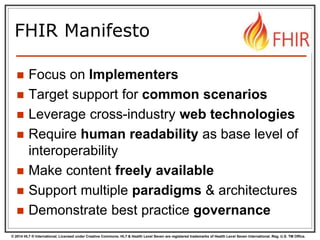
FHIR Manifesto
 Focus on Implementers
 Target support for common scenarios
 Leverage cross-industry web technologies
 Require human readability as base level of
interoperability
 Make content freely available
 Support multiple paradigms & architectures
 Demonstrate best practice governance
© 2014 HL7 ® International. Licensed under Creative Commons. HL7 & Health Level Seven are registered trademarks of Health Level Seven International. Reg. U.S. TM Office.
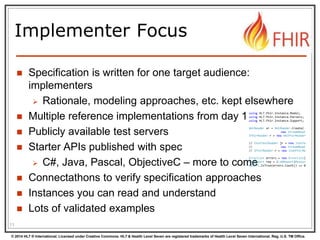
Implementer Focus
 Specification is written for one target audience:
implementers
 Rationale, modeling approaches, etc. kept elsewhere
 Multiple reference implementations from day 1
 Publicly available test servers
 Starter APIs published with spec
 C#, Java, Pascal, ObjectiveC – more to come
 Connectathons to verify specification approaches
 Instances you can read and understand
 Lots of validated examples
11
using HL7.Fhir.Instance.Model;
using HL7.Fhir.Instance.Parsers;
using HL7.Fhir.Instance.Support;
XmlReader xr = XmlReader.Create(
new StreamRead
IFhirReader r = new XmlFhirReader
// JsonTextReader jr = new JsonTe
// new StreamRead
// IFhirReader r = new JsonFhirRe
ErrorList errors = new ErrorList(
LabReport rep = (LabReport)Resour
Assert.IsTrue(errors.Count() == 0
© 2014 HL7 ® International. Licensed under Creative Commons. HL7 & Health Level Seven are registered trademarks of Health Level Seven International. Reg. U.S. TM Office.
Support “Common”
Scenarios
 Focus on scenarios implementers ask for
 Inclusion of content in core specification is
based on core content rule
 “We only include data elements if we are confident
that most normal implementations using that
resource will make use of the element”
 Other content in extensions (more on this later)
 Easy to say, governance challenge to achieve
 Resources are simple and easy to
understand and use12
© 2014 HL7 ® International. Licensed under Creative Commons. HL7 & Health Level Seven are registered trademarks of Health Level Seven International. Reg. U.S. TM Office.
Web technologies
 Instances shared using XML & JSON
 Collections represented using ATOM
 Same technology that gives you your daily news
summary
 Out-of-the-box publish/subscribe
 Web calls work the same way they do for
Facebook & Twitter
 Rely on HTTPS, OAuth, etc. for security
functions
13
© 2014 HL7 ® International. Licensed under Creative Commons. HL7 & Health Level Seven are registered trademarks of Health Level Seven International. Reg. U.S. TM Office.
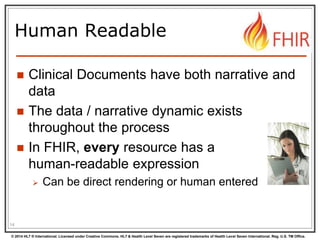
Human Readable
 Clinical Documents have both narrative and
data
 The data / narrative dynamic exists
throughout the process
 In FHIR, every resource has a
human-readable expression
 Can be direct rendering or human entered
14
© 2014 HL7 ® International. Licensed under Creative Commons. HL7 & Health Level Seven are registered trademarks of Health Level Seven International. Reg. U.S. TM Office.
Freely available
 Unencumbered – free for use, no
membership required
 http://hl7.org/fhir
15
© 2014 HL7 ® International. Licensed under Creative Commons. HL7 & Health Level Seven are registered trademarks of Health Level Seven International. Reg. U.S. TM Office.
FHIR is Better
 Easy & Quick to understand & implement
 Code & example servers already exist
 Specification is free for use with no
restrictions
 Based on the Web
 Can be extended and adapted seamlessly
for local usage
16
© 2014 HL7 ® International. Licensed under Creative Commons. HL7 & Health Level Seven are registered trademarks of Health Level Seven International. Reg. U.S. TM Office.
FHIR & Cost of
Integration
 These factors will drive down the cost of
integration and interoperability
 Easier to Develop
 Easier to Troubleshoot
 Easier to Leverage in production
 More people to do the work (less expensive
consultants)
 Competing approaches will have to match the
cost, or disappear – effect is already being felt
© 2014 HL7 ® International. Licensed under Creative Commons. HL7 & Health Level Seven are registered trademarks of Health Level Seven International. Reg. U.S. TM Office.
Future impact of FHIR
 Impact of FHIR on the market:
 Drive interoperability prices down
 Higher Expectations
 Increased spend on integration (N x 2!)
 Overall Market focus
 PHR on the web
 Healthcare repositories (MHD+)
 Device Data management
 Retooling existing connections (will happen slowly)
18
© 2014 HL7 ® International. Licensed under Creative Commons. HL7 & Health Level Seven are registered trademarks of Health Level Seven International. Reg. U.S. TM Office.
ABOUT REST AND
RESOURCES
1
9
© 2014 HL7 ® International. Licensed under Creative Commons. HL7 & Health Level Seven are registered trademarks of Health Level Seven International. Reg. U.S. TM Office.
REST
 “Representational state transfer” – an
architecture for how to connect systems
 Outcomes
 Simple stable interfaces
 High Performance / Scalability
 Visible Process (e.g. can debug)
 Portability
 Reliability (resistance to failure)
2
0
© 2014 HL7 ® International. Licensed under Creative Commons. HL7 & Health Level Seven are registered trademarks of Health Level Seven International. Reg. U.S. TM Office.
REST in practice
 “Resources” with an explicit and stable URI
 The name for what gets exchanged in REST
 Defined behaviour and meaning
 Known identity / location
 Quite an abstract idea
 Formats: XML / JSON (+RDF, coming)
 Exchange using HTTP (Security: SSL / Oauth)
 Often “REST” is followed loosely, hence
“RESTful”
2
1
© 2014 HL7 ® International. Licensed under Creative Commons. HL7 & Health Level Seven are registered trademarks of Health Level Seven International. Reg. U.S. TM Office.
REST Operations
REST is based on CRUD(E):
 Create – create a new instance of data
 Read – get the content (state) of an
instance of data
 Update – change the content of an
instance of data
 Delete – remove the instance of data
 Execute – get the instance of data (?) to do
something for you
2
2
© 2014 HL7 ® International. Licensed under Creative Commons. HL7 & Health Level Seven are registered trademarks of Health Level Seven International. Reg. U.S. TM Office.
RPC vs REST
 RPC (Remote Procedure Call):
 Ask a server to perform some operation
 Hand it a set of parameters
 Server performs some operations
 Returns a set of parameters
 REST:
 Define a URI that represents the state of
something
 Tell the server what the state should be
 Server makes the state change happen2
3
© 2014 HL7 ® International. Licensed under Creative Commons. HL7 & Health Level Seven are registered trademarks of Health Level Seven International. Reg. U.S. TM Office.
RPC vs REST example
 Example:
 A device that monitors a patient %02 Sat
 Raises an alarm on EHR if it’s too low
 EHR can turn the alarm off
 RPC:
 POST http://acme.org/devices/turnOffAlarm
 Parameters: device id, alarm id
 REST:
 POST http://acme.org/devices/[deviceid]/[alarmid]
 Content: data to say “Alarm is off”
2
4
© 2014 HL7 ® International. Licensed under Creative Commons. HL7 & Health Level Seven are registered trademarks of Health Level Seven International. Reg. U.S. TM Office.
RPC vs REST
 Difference is subtle, and depends on
perspective
 Outcome is large difference
 REST is increasingly preferred in practice
 Most systems mix and match
 “mini-operations”
 General issue: REST doesn’t deal well if
server needs context from the client
 e.g. who keeps audit trail for the user’s context?
2
5
© 2014 HL7 ® International. Licensed under Creative Commons. HL7 & Health Level Seven are registered trademarks of Health Level Seven International. Reg. U.S. TM Office.
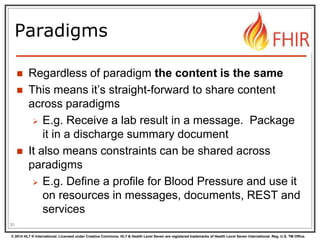
Paradigms
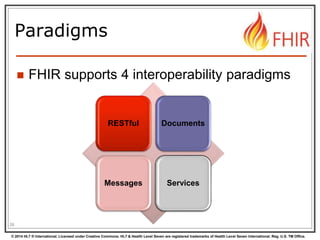
 FHIR supports 4 interoperability paradigms
26
RESTful Documents
Messages Services
© 2014 HL7 ® International. Licensed under Creative Commons. HL7 & Health Level Seven are registered trademarks of Health Level Seven International. Reg. U.S. TM Office.
Documents
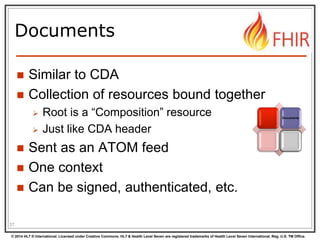
 Similar to CDA
 Collection of resources bound together
 Root is a “Composition” resource
 Just like CDA header
 Sent as an ATOM feed
 One context
 Can be signed, authenticated, etc.
27
Documents
© 2014 HL7 ® International. Licensed under Creative Commons. HL7 & Health Level Seven are registered trademarks of Health Level Seven International. Reg. U.S. TM Office.
Messages
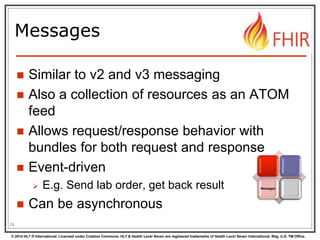
 Similar to v2 and v3 messaging
 Also a collection of resources as an ATOM
feed
 Allows request/response behavior with
bundles for both request and response
 Event-driven
 E.g. Send lab order, get back result
 Can be asynchronous
28
Messages
© 2014 HL7 ® International. Licensed under Creative Commons. HL7 & Health Level Seven are registered trademarks of Health Level Seven International. Reg. U.S. TM Office.
Service Oriented
Architecture (SOA)
 Do whatever you like
 (based on SOA principles)
 Ultra complex workflows
 Ultra simple workflows
 Individual resources or collections (in Atom or
other formats)
 Use HTTP or use something else
 Only constraint is that you’re passing around FHIR
resources in some shape or manner
29
Services
© 2014 HL7 ® International. Licensed under Creative Commons. HL7 & Health Level Seven are registered trademarks of Health Level Seven International. Reg. U.S. TM Office.
Paradigms
 Regardless of paradigm the content is the same
 This means it’s straight-forward to share content
across paradigms
 E.g. Receive a lab result in a message. Package
it in a discharge summary document
 It also means constraints can be shared across
paradigms
 E.g. Define a profile for Blood Pressure and use it
on resources in messages, documents, REST and
services
30
© 2014 HL7 ® International. Licensed under Creative Commons. HL7 & Health Level Seven are registered trademarks of Health Level Seven International. Reg. U.S. TM Office.
FHIR RESOURCES
© 2014 HL7 ® International. Licensed under Creative Commons. HL7 & Health Level Seven are registered trademarks of Health Level Seven International. Reg. U.S. TM Office.
Resources
 “Resources” are:
 Small logically discrete units of exchange
 Defined behaviour and meaning
 Known identity / location
 Smallest unit of transaction
 “of interest” to healthcare
 V2: Sort of like Segments
 V3: Sort of like CMETs
32
© 2014 HL7 ® International. Licensed under Creative Commons. HL7 & Health Level Seven are registered trademarks of Health Level Seven International. Reg. U.S. TM Office.
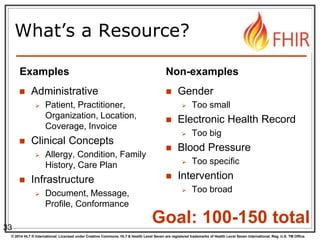
What’s a Resource?
Examples
 Administrative
 Patient, Practitioner,
Organization, Location,
Coverage, Invoice
 Clinical Concepts
 Allergy, Condition, Family
History, Care Plan
 Infrastructure
 Document, Message,
Profile, Conformance
Non-examples
 Gender
 Too small
 Electronic Health Record
 Too big
 Blood Pressure
 Too specific
 Intervention
 Too broad
33
Goal: 100-150 total
© 2014 HL7 ® International. Licensed under Creative Commons. HL7 & Health Level Seven are registered trademarks of Health Level Seven International. Reg. U.S. TM Office.
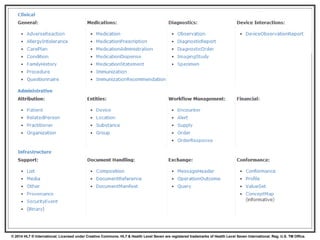
DSTU Resource List
© 2014 HL7 ® International. Licensed under Creative Commons. HL7 & Health Level Seven are registered trademarks of Health Level Seven International. Reg. U.S. TM Office.
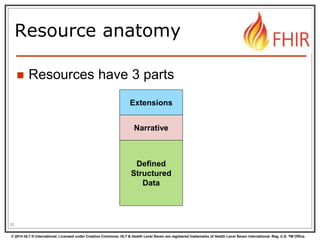
Resource anatomy
 Resources have 3 parts
35
Defined
Structured
Data
Extensions
Narrative
© 2014 HL7 ® International. Licensed under Creative Commons. HL7 & Health Level Seven are registered trademarks of Health Level Seven International. Reg. U.S. TM Office.
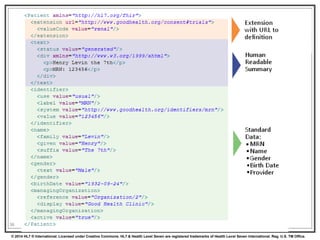
36
© 2014 HL7 ® International. Licensed under Creative Commons. HL7 & Health Level Seven are registered trademarks of Health Level Seven International. Reg. U.S. TM Office.
Resource Documentation
For each Resource, the specification provides:
 Scope and Usage Notes
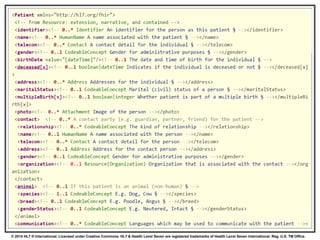
 Resource Content (as UML and XML)
 Terminology Bindings (what codes can you use?
 Constraints (technical rules about usage)
 Discussion of Implementation Issues
 Search Parameters for RESTful interface
 Examples, Profiles, Formal Definitions
 Mappings to RIM, CDA, v2, etc
3
7
© 2014 HL7 ® International. Licensed under Creative Commons. HL7 & Health Level Seven are registered trademarks of Health Level Seven International. Reg. U.S. TM Office.
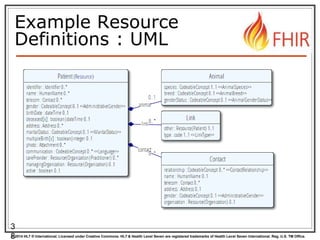
Example Resource
Definitions : UML
3
8
© 2014 HL7 ® International. Licensed under Creative Commons. HL7 & Health Level Seven are registered trademarks of Health Level Seven International. Reg. U.S. TM Office.
39
© 2014 HL7 ® International. Licensed under Creative Commons. HL7 & Health Level Seven are registered trademarks of Health Level Seven International. Reg. U.S. TM Office.
Resource elements
 Resources are defined as an XML structure
based on desired wire syntax
 Hierarchy of elements
 Each element has
 Name
 Either a datatype or nested elements
 Cardinality
• All collections are nested in a containing element
 Definition
 Mappings
 But instances in XML or JSON
© 2014 HL7 ® International. Licensed under Creative Commons. HL7 & Health Level Seven are registered trademarks of Health Level Seven International. Reg. U.S. TM Office.
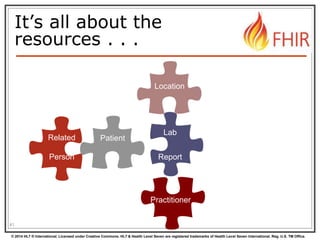
It’s all about the
resources . . .
41
Lab
Report
Related
Person
Patient
Practitioner
Location
© 2014 HL7 ® International. Licensed under Creative Commons. HL7 & Health Level Seven are registered trademarks of Health Level Seven International. Reg. U.S. TM Office.
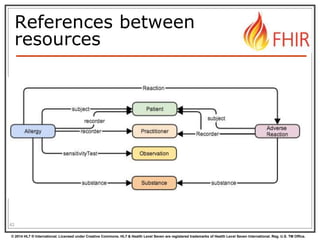
References between
resources
42
© 2014 HL7 ® International. Licensed under Creative Commons. HL7 & Health Level Seven are registered trademarks of Health Level Seven International. Reg. U.S. TM Office.
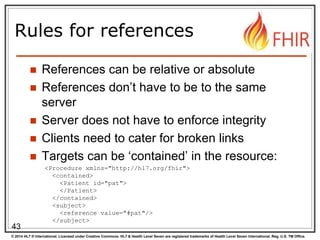
Rules for references
 References can be relative or absolute
 References don’t have to be to the same
server
 Server does not have to enforce integrity
 Clients need to cater for broken links
 Targets can be ‘contained’ in the resource:
43
<Procedure xmlns="http://hl7.org/fhir">
<contained>
<Patient id="pat">
</Patient>
</contained>
<subject>
<reference value="#pat"/>
</subject>
© 2014 HL7 ® International. Licensed under Creative Commons. HL7 & Health Level Seven are registered trademarks of Health Level Seven International. Reg. U.S. TM Office.
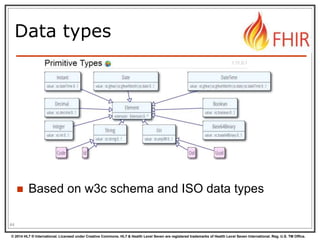
Data types
44
 Based on w3c schema and ISO data types
© 2014 HL7 ® International. Licensed under Creative Commons. HL7 & Health Level Seven are registered trademarks of Health Level Seven International. Reg. U.S. TM Office.
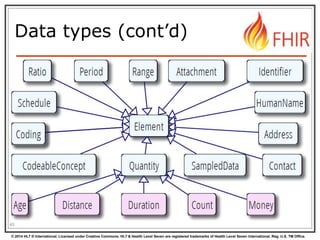
Data types (cont’d)
45
© 2014 HL7 ® International. Licensed under Creative Commons. HL7 & Health Level Seven are registered trademarks of Health Level Seven International. Reg. U.S. TM Office.
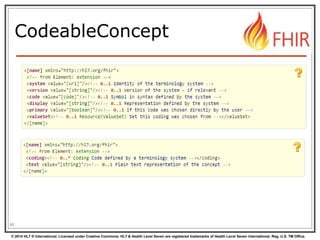
CodeableConcept
46
© 2014 HL7 ® International. Licensed under Creative Commons. HL7 & Health Level Seven are registered trademarks of Health Level Seven International. Reg. U.S. TM Office.
Vocabulary
47
 Support for coded data of varying complexity
 Some codes defined as part of resource,
others referenced from external vocabularies
 LOINC, SNOMED, UCUM, etc.
 Recognition some will differ by
implementation space
 Can use Value Set resource to define more
complex code lists
© 2014 HL7 ® International. Licensed under Creative Commons. HL7 & Health Level Seven are registered trademarks of Health Level Seven International. Reg. U.S. TM Office.
Bundles
 When more than one resource needed
 Query result
 Document
 Message
 Atom ‘feed’
 Widely used on the web for syndicating data
 FHIR defines a JSON representation
48
© 2014 HL7 ® International. Licensed under Creative Commons. HL7 & Health Level Seven are registered trademarks of Health Level Seven International. Reg. U.S. TM Office.
Narrative
 All resources carry an html representation of their
content
 It’s a clinical safety issue
 The receiver has a fall back option if the system is not sure it
fully understands the content
 It is not mandatory, but SHOULD be present
 In a closed eco-system, with extremely tight control and
strong conformance testing, it may not be necessary
 But things often change over time
 So using narrative is highly recommended
 Saves a lot of money downstream from the author
4
9
© 2014 HL7 ® International. Licensed under Creative Commons. HL7 & Health Level Seven are registered trademarks of Health Level Seven International. Reg. U.S. TM Office.
Narrative XHTML
 Narrative is XHTML. Formatting allowed:
 Tables, lists, divs, spans
 Bold, Italics, styles etc
 E.g. all static content
 Features not allowed:
 Objects, scripts, forms – any active content
 Links, Stylesheets, iframes – web context
 Local storage, Microdata (no active content)
 Concerns are security and clinical safety
5
0
© 2014 HL7 ® International. Licensed under Creative Commons. HL7 & Health Level Seven are registered trademarks of Health Level Seven International. Reg. U.S. TM Office.
FHIR EXTENSIONS
51
© 2014 HL7 ® International. Licensed under Creative Commons. HL7 & Health Level Seven are registered trademarks of Health Level Seven International. Reg. U.S. TM Office.
The Case for Extensions
 Extensions are often problematic in existing
HL7 specs
 Z-segments in v2
 What does this mean?
• ZSB|20080117|Q^57|4.30^uL
 Foreign namespaces in CDA/V3
 Break schemas
 Simple choice – design for absolutely
everything or allow extensions
52
© 2014 HL7 ® International. Licensed under Creative Commons. HL7 & Health Level Seven are registered trademarks of Health Level Seven International. Reg. U.S. TM Office.
Extensions
 FHIR has a standard framework for
extensions
 Every FHIR element can be extended
 Every extension has:
 Reference to a computable definition
 Value – from a set of known types
 Every system can read, write, store and
exchange all legal extensions
 All extensions are valid by schema etc5
3
© 2014 HL7 ® International. Licensed under Creative Commons. HL7 & Health Level Seven are registered trademarks of Health Level Seven International. Reg. U.S. TM Office.
Extensions without the
pain…
 Extensions are built into the wire format
 All conformant systems can “handle” any possible
extension - Just a bucket of “other stuff”
 Extensions rendered in human readable portion
54
© 2014 HL7 ® International. Licensed under Creative Commons. HL7 & Health Level Seven are registered trademarks of Health Level Seven International. Reg. U.S. TM Office.
Governing Extensions
 Extensions are not a silver bullet
 FHIR has a sliding scale governance for
extensions
 Local Projects
 Domain standards (e.g Best Practice
Cardiology)
 National Standards (e.g. Standard Finnish
Extensions)
 HL7 published extensions (corner cases with
international scope)
5
5
© 2014 HL7 ® International. Licensed under Creative Commons. HL7 & Health Level Seven are registered trademarks of Health Level Seven International. Reg. U.S. TM Office.
What’s the goal here?
 In most areas of healthcare standards, there is
wide variability
 Between systems, countries, institutions, clinicians
 Choices:
 Specification only supports core – no one can use it
 Specification adds everything – no one understands it
 Specification picks winners – they can use it
 Allow extensions that people can use
 Extensions tame the specification
5
6
© 2014 HL7 ® International. Licensed under Creative Commons. HL7 & Health Level Seven are registered trademarks of Health Level Seven International. Reg. U.S. TM Office.
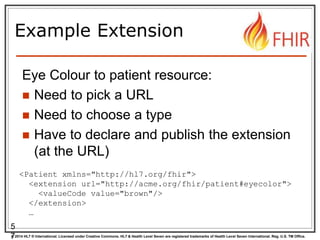
Example Extension
Eye Colour to patient resource:
 Need to pick a URL
 Need to choose a type
 Have to declare and publish the extension
(at the URL)
5
7
<Patient xmlns="http://hl7.org/fhir">
<extension url="http://acme.org/fhir/patient#eyecolor">
<valueCode value="brown"/>
</extension>
…
© 2014 HL7 ® International. Licensed under Creative Commons. HL7 & Health Level Seven are registered trademarks of Health Level Seven International. Reg. U.S. TM Office.
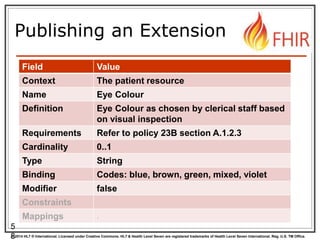
Publishing an Extension
Field Value
Context The patient resource
Name Eye Colour
Definition Eye Colour as chosen by clerical staff based
on visual inspection
Requirements Refer to policy 23B section A.1.2.3
Cardinality 0..1
Type String
Binding Codes: blue, brown, green, mixed, violet
Modifier false
Constraints
Mappings .
5
8
© 2014 HL7 ® International. Licensed under Creative Commons. HL7 & Health Level Seven are registered trademarks of Health Level Seven International. Reg. U.S. TM Office.
FHIR OPERATIONS
59
© 2014 HL7 ® International. Licensed under Creative Commons. HL7 & Health Level Seven are registered trademarks of Health Level Seven International. Reg. U.S. TM Office.
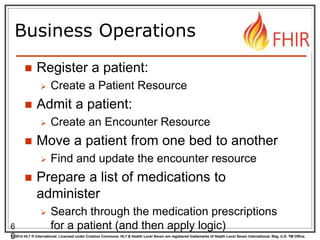
Business Operations
 Register a patient:
 Create a Patient Resource
 Admit a patient:
 Create an Encounter Resource
 Move a patient from one bed to another
 Find and update the encounter resource
 Prepare a list of medications to
administer
 Search through the medication prescriptions
for a patient (and then apply logic)6
0
© 2014 HL7 ® International. Licensed under Creative Commons. HL7 & Health Level Seven are registered trademarks of Health Level Seven International. Reg. U.S. TM Office.
FHIR Resource URLs
Template Description Example
[base] Server URL http://fhir.com
[base]/[type] URL for type
manager
http://fhir.com/Patient
[base]/[type]/[id
]
URL for a resource http://fhir.com/Patient/23
[base]/[type]/[id
]/_history/[vid]
URL for a past
version of a
resource
http://fhir.com/Patient/23/_hist
roy/2
6
1
© 2014 HL7 ® International. Licensed under Creative Commons. HL7 & Health Level Seven are registered trademarks of Health Level Seven International. Reg. U.S. TM Office.
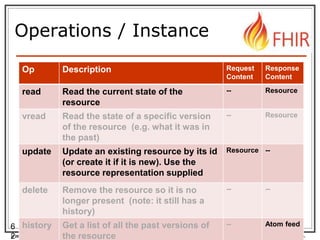
Operations / Instance
Op Description Request
Content
Response
Content
read Read the current state of the
resource
-- Resource
vread Read the state of a specific version
of the resource (e.g. what it was in
the past)
-- Resource
update Update an existing resource by its id
(or create it if it is new). Use the
resource representation supplied
Resource --
delete Remove the resource so it is no
longer present (note: it still has a
history)
-- --
history Get a list of all the past versions of
the resource
-- Atom feed6
2
© 2014 HL7 ® International. Licensed under Creative Commons. HL7 & Health Level Seven are registered trademarks of Health Level Seven International. Reg. U.S. TM Office.
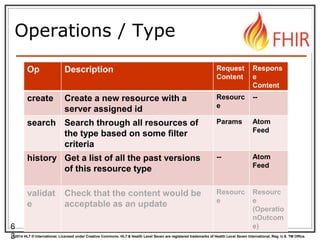
Operations / Type
Op Description Request
Content
Respons
e
Content
create Create a new resource with a
server assigned id
Resourc
e
--
search Search through all resources of
the type based on some filter
criteria
Params Atom
Feed
history Get a list of all the past versions
of this resource type
-- Atom
Feed
validat
e
Check that the content would be
acceptable as an update
Resourc
e
Resourc
e
(Operatio
nOutcom
e)6
3
© 2014 HL7 ® International. Licensed under Creative Commons. HL7 & Health Level Seven are registered trademarks of Health Level Seven International. Reg. U.S. TM Office.
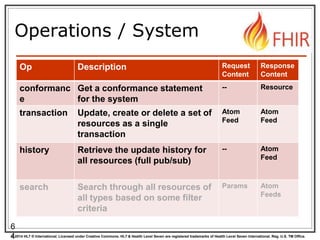
Operations / System
Op Description Request
Content
Response
Content
conformanc
e
Get a conformance statement
for the system
-- Resource
transaction Update, create or delete a set of
resources as a single
transaction
Atom
Feed
Atom
Feed
history Retrieve the update history for
all resources (full pub/sub)
-- Atom
Feed
search Search through all resources of
all types based on some filter
criteria
Params Atom
Feeds
6
4
© 2014 HL7 ® International. Licensed under Creative Commons. HL7 & Health Level Seven are registered trademarks of Health Level Seven International. Reg. U.S. TM Office.
PROFILES &
CONFORMANCE
65
© 2014 HL7 ® International. Licensed under Creative Commons. HL7 & Health Level Seven are registered trademarks of Health Level Seven International. Reg. U.S. TM Office.
Conformance Resources
 Conformance – a state of system capabilities
 Profile – a set of rules about a resource is
used
 Value set – describes a set of codes that can
be used for something
© 2014 HL7 ® International. Licensed under Creative Commons. HL7 & Health Level Seven are registered trademarks of Health Level Seven International. Reg. U.S. TM Office.
Conformance
 A resource for documenting conformance to
FHIR
 Can be used for:
 Stating how a specific system instance behaves
 Defining how a software system is capable of behaving
(including configuration options)
 Identifying a desired set of behavior (e.g. RFP)
 To declare itself “FHIR Conformant”, a server
must publish a Conformance instance
67
© 2014 HL7 ® International. Licensed under Creative Commons. HL7 & Health Level Seven are registered trademarks of Health Level Seven International. Reg. U.S. TM Office.
Profiles
 Document constraints and extensions on
one or more resources
 May also define new extensions search
terms, new messaging events, etc.
 Subsumes: template, implementation profile,
DCM (Detailed Clinical Model), etc.
 Looks an awful lot like the definition of the
resources themselves
 You can download profile XML for all resources68
© 2014 HL7 ® International. Licensed under Creative Commons. HL7 & Health Level Seven are registered trademarks of Health Level Seven International. Reg. U.S. TM Office.
Using Profiles
 You can just go ahead and use a resource
 No need for a profile
 But you can write a profile
 Document your usage in detail for partners
 You can mark a resource with a profile
 It’s just a claim – can test conformance with that
 Denormalization for performance
69
© 2014 HL7 ® International. Licensed under Creative Commons. HL7 & Health Level Seven are registered trademarks of Health Level Seven International. Reg. U.S. TM Office.
IMPLEMENTING FHIR
© 2014 HL7 ® International. Licensed under Creative Commons. HL7 & Health Level Seven are registered trademarks of Health Level Seven International. Reg. U.S. TM Office.
Where can FHIR be
used?
 Classic in-institution interoperability
 Back-end e-business systems (e.g. financial)
 Regional Health Information Organizations
(RHIO)
 National EHR systems
 Social Web (Health)
 Mobile Applications
71
Initial
Focus
© 2014 HL7 ® International. Licensed under Creative Commons. HL7 & Health Level Seven are registered trademarks of Health Level Seven International. Reg. U.S. TM Office.
Architecture Options
 Standalone FHIR Server
 A FHIR Server in front of an existing application (e.g.
SQL)
 FHIR as front end to an XDS server (“MHD”)
 An interface engine that ‘speaks’ FHIR
 A tablet/mobile phone application
 Web portal uses FHIR to access other systems
 A healthcare application that access information from
multiple systems as well as it’s own server
 Smart-On-FHIR – an EHR plug-in framework
7
2
© 2014 HL7 ® International. Licensed under Creative Commons. HL7 & Health Level Seven are registered trademarks of Health Level Seven International. Reg. U.S. TM Office.
Implementation
Assistance
 Reference Implementations – object
models, parsers, serializers, clients,
validators, utilities
 Schema, Schematron, Validation Pack
 1000’s of examples
 Live Servers to test against
 http://wiki.hl7.org/index.php?title=Publicly_Available_FHIR_Servers_for_test
ing
 Connectathons
7
3
© 2014 HL7 ® International. Licensed under Creative Commons. HL7 & Health Level Seven are registered trademarks of Health Level Seven International. Reg. U.S. TM Office.
Servers
 Use the servers to explore how it works
 Write clients that use the test data
 Test that you got your own system right
 Most developers:
 use the servers to learn
 consult the documentation occasionally
 (we do recommend to read the specification at
least a little)
7
4
© 2014 HL7 ® International. Licensed under Creative Commons. HL7 & Health Level Seven are registered trademarks of Health Level Seven International. Reg. U.S. TM Office.
Other Free software
 See
http://wiki.hl7.org/index.php?title=Open_Source_FHIR_implementations
 Coming shortly:
 “Sprinkler” – a conformance test tool for
servers
 “Forge” – an editor for conformance
statements
 A Value set Editor
 Several implementation guide publishers
7
5
© 2014 HL7 ® International. Licensed under Creative Commons. HL7 & Health Level Seven are registered trademarks of Health Level Seven International. Reg. U.S. TM Office.
Connectathons
 Open invitation to any interested party to come
and write software that exchanges FHIR
resources
 Always hold one before HL7 meetings (last
week) + Others by invitation
 Mix of skills
 Newbies (“where is the spec?”)
 Old hands who’ve been to every connectathon
 Experiment with new features
 We have a virtual connectathon all the time…
7
6
© 2014 HL7 ® International. Licensed under Creative Commons. HL7 & Health Level Seven are registered trademarks of Health Level Seven International. Reg. U.S. TM Office.
Implementation
Assistance
 Stack Overflow – ask implementation questions
 Link from front page
 Search for answers first
 Don’t ask for changes to the spec (get deleted!)
 gForge Tracker – ask for changes to the spec
 Link from bottom of every page
 But have discussion somewhere first
 Disqus – on every page of the specification
 Skype – implementers channel – 105 participants
 FHIR Email list, Connectathons, Tutorials
7
7
© 2014 HL7 ® International. Licensed under Creative Commons. HL7 & Health Level Seven are registered trademarks of Health Level Seven International. Reg. U.S. TM Office.
Migration
 No expectation that people will migrate
existing interfaces any time soon.
 Initial adopters are expected to be green-
field, new technology
 FHIR may see use behind the scenes in v2
systems before it sees use over the wire
 Forthcoming policy initiatives may
necessitate revisiting existing interfaces
© 2014 HL7 ® International. Licensed under Creative Commons. HL7 & Health Level Seven are registered trademarks of Health Level Seven International. Reg. U.S. TM Office.
Migration – v2
 Already have an integration engine that
supports translation between v2 and FHIR
 Resources map to segments reasonably well
 As always, the challenge with v2 mapping is
the variability of v2 interfaces
 “Common” mappings can be created, but they
won’t be one size fits all
© 2014 HL7 ® International. Licensed under Creative Commons. HL7 & Health Level Seven are registered trademarks of Health Level Seven International. Reg. U.S. TM Office.
Migration – CDA
 Made more complex by human-readable
nature
 Need to ensure text <-> entry linkages are
retained
 Will best be handled on a template by
template basis
 Likely start with important ones like C-CDA
80
© 2014 HL7 ® International. Licensed under Creative Commons. HL7 & Health Level Seven are registered trademarks of Health Level Seven International. Reg. U.S. TM Office.
FHIR Manifesto
 Focus on Implementers
 Target support for common scenarios
 Leverage cross-industry web technologies
 Require human readability as base level of
interoperability
 Make content freely available
 Support multiple paradigms & architectures
 Demonstrate best practice governance
© 2014 HL7 ® International. Licensed under Creative Commons. HL7 & Health Level Seven are registered trademarks of Health Level Seven International. Reg. U.S. TM Office.
Thank you
 FHIR:
http://hl7.org/fhir
 Development team wiki home:
http://wiki.hl7.org/index.php?title=FHIR
 Twitter:
https://twitter.com/search?q=%23FHIR
 Stack Overflow:
http://stackoverflow.com/questions/tagged/hl7-fhir
82

Introduction to FHIR™

  • 1.
    © 2013 HL7® International. Licensed under Creative Commons. HL7 & Health Level Seven are registered trademarks of Health Level Seven International. Reg. U.S. TM Office. Introduction to FHIR Grahame Grieve Aug 19, 2014
  • 2.
    © 2014 HL7® International. Licensed under Creative Commons. HL7 & Health Level Seven are registered trademarks of Health Level Seven International. Reg. U.S. TM Office. This presentation  Is licensed for use under the Creative Commons, specifically:  Creative Commons Attribution 3.0 Unported License  (Do with it as you wish, so long as you give credit)
  • 3.
    © 2014 HL7® International. Licensed under Creative Commons. HL7 & Health Level Seven are registered trademarks of Health Level Seven International. Reg. U.S. TM Office. The “FHIR” Acronym  F – Fast (to design & to implement)  H – Health  I – Interoperable  R – Resources (Building blocks)  There is more on Resources to follow  “Fast” is relative – no technology can make integration as fast as we’d like  “FHIR” (pronouced “Fire”) is a fertile source of puns etc. Feel free to make your own 3
  • 4.
    © 2014 HL7® International. Licensed under Creative Commons. HL7 & Health Level Seven are registered trademarks of Health Level Seven International. Reg. U.S. TM Office. What is FHIR?  A set of modular components called “Resources”  Resources refer to each other using URLs  Build a web to support healthcare process  Exchange resources between systems  Using a RESTful API (e.g. web approach)  As a bundle of resources (messages, documents) 4
  • 5.
    © 2014 HL7® International. Licensed under Creative Commons. HL7 & Health Level Seven are registered trademarks of Health Level Seven International. Reg. U.S. TM Office. Genesis of FHIR  There has been a need to share healthcare information electronically for a long time  HL7 v2 is over 25 years old  Increasing pressure to broaden scope of sharing  Across organizations, disciplines, even borders  Mobile & cloud-based applications  Faster – integration in days or weeks, not months or years 5
  • 6.
    © 2014 HL7® International. Licensed under Creative Commons. HL7 & Health Level Seven are registered trademarks of Health Level Seven International. Reg. U.S. TM Office. Genesis of FHIR  HL7 did not have much to offer in this space?  V2 Old, and limited by it’s own rules  V3 too slow and too hard  CDA has success, but both limited and too hard  Different contexts of interoperability  different representations that aren’t compatible  Nothing suitable for light-weight integration, or for Health 2.0  No other Organization so well situated6
  • 7.
    © 2014 HL7® International. Licensed under Creative Commons. HL7 & Health Level Seven are registered trademarks of Health Level Seven International. Reg. U.S. TM Office. Genesis of FHIR  HL7 undertook a “Fresh look”  What would healthcare exchange look like if we started from scratch using modern approaches?  Web search for success markers led to RESTful based APIs  An exemplar: Highrise from “37 Signals)  Drafted a healthcare exchange API based on this approach 7
  • 8.
    © 2014 HL7® International. Licensed under Creative Commons. HL7 & Health Level Seven are registered trademarks of Health Level Seven International. Reg. U.S. TM Office. FHIR Development Progress  July 2011 – Conception  Aug/Sept 2012 – First Draft Ballot  Sept 2012 – First Connectathon  Aug/Sept 2013 – First DSTU ballot DSTU = Draft Standard For Trial Use  January 2014 – DSTU finalised  ~June 2015 – 2nd DSTU  Late 2016? – Normative Version
  • 9.
    © 2014 HL7® International. Licensed under Creative Commons. HL7 & Health Level Seven are registered trademarks of Health Level Seven International. Reg. U.S. TM Office. FHIR PRINCIPLES 9
  • 10.
    © 2014 HL7® International. Licensed under Creative Commons. HL7 & Health Level Seven are registered trademarks of Health Level Seven International. Reg. U.S. TM Office. FHIR Manifesto  Focus on Implementers  Target support for common scenarios  Leverage cross-industry web technologies  Require human readability as base level of interoperability  Make content freely available  Support multiple paradigms & architectures  Demonstrate best practice governance
  • 11.
    © 2014 HL7® International. Licensed under Creative Commons. HL7 & Health Level Seven are registered trademarks of Health Level Seven International. Reg. U.S. TM Office. Implementer Focus  Specification is written for one target audience: implementers  Rationale, modeling approaches, etc. kept elsewhere  Multiple reference implementations from day 1  Publicly available test servers  Starter APIs published with spec  C#, Java, Pascal, ObjectiveC – more to come  Connectathons to verify specification approaches  Instances you can read and understand  Lots of validated examples 11 using HL7.Fhir.Instance.Model; using HL7.Fhir.Instance.Parsers; using HL7.Fhir.Instance.Support; XmlReader xr = XmlReader.Create( new StreamRead IFhirReader r = new XmlFhirReader // JsonTextReader jr = new JsonTe // new StreamRead // IFhirReader r = new JsonFhirRe ErrorList errors = new ErrorList( LabReport rep = (LabReport)Resour Assert.IsTrue(errors.Count() == 0
  • 12.
    © 2014 HL7® International. Licensed under Creative Commons. HL7 & Health Level Seven are registered trademarks of Health Level Seven International. Reg. U.S. TM Office. Support “Common” Scenarios  Focus on scenarios implementers ask for  Inclusion of content in core specification is based on core content rule  “We only include data elements if we are confident that most normal implementations using that resource will make use of the element”  Other content in extensions (more on this later)  Easy to say, governance challenge to achieve  Resources are simple and easy to understand and use12
  • 13.
    © 2014 HL7® International. Licensed under Creative Commons. HL7 & Health Level Seven are registered trademarks of Health Level Seven International. Reg. U.S. TM Office. Web technologies  Instances shared using XML & JSON  Collections represented using ATOM  Same technology that gives you your daily news summary  Out-of-the-box publish/subscribe  Web calls work the same way they do for Facebook & Twitter  Rely on HTTPS, OAuth, etc. for security functions 13
  • 14.
    © 2014 HL7® International. Licensed under Creative Commons. HL7 & Health Level Seven are registered trademarks of Health Level Seven International. Reg. U.S. TM Office. Human Readable  Clinical Documents have both narrative and data  The data / narrative dynamic exists throughout the process  In FHIR, every resource has a human-readable expression  Can be direct rendering or human entered 14
  • 15.
    © 2014 HL7® International. Licensed under Creative Commons. HL7 & Health Level Seven are registered trademarks of Health Level Seven International. Reg. U.S. TM Office. Freely available  Unencumbered – free for use, no membership required  http://hl7.org/fhir 15
  • 16.
    © 2014 HL7® International. Licensed under Creative Commons. HL7 & Health Level Seven are registered trademarks of Health Level Seven International. Reg. U.S. TM Office. FHIR is Better  Easy & Quick to understand & implement  Code & example servers already exist  Specification is free for use with no restrictions  Based on the Web  Can be extended and adapted seamlessly for local usage 16
  • 17.
    © 2014 HL7® International. Licensed under Creative Commons. HL7 & Health Level Seven are registered trademarks of Health Level Seven International. Reg. U.S. TM Office. FHIR & Cost of Integration  These factors will drive down the cost of integration and interoperability  Easier to Develop  Easier to Troubleshoot  Easier to Leverage in production  More people to do the work (less expensive consultants)  Competing approaches will have to match the cost, or disappear – effect is already being felt
  • 18.
    © 2014 HL7® International. Licensed under Creative Commons. HL7 & Health Level Seven are registered trademarks of Health Level Seven International. Reg. U.S. TM Office. Future impact of FHIR  Impact of FHIR on the market:  Drive interoperability prices down  Higher Expectations  Increased spend on integration (N x 2!)  Overall Market focus  PHR on the web  Healthcare repositories (MHD+)  Device Data management  Retooling existing connections (will happen slowly) 18
  • 19.
    © 2014 HL7® International. Licensed under Creative Commons. HL7 & Health Level Seven are registered trademarks of Health Level Seven International. Reg. U.S. TM Office. ABOUT REST AND RESOURCES 1 9
  • 20.
    © 2014 HL7® International. Licensed under Creative Commons. HL7 & Health Level Seven are registered trademarks of Health Level Seven International. Reg. U.S. TM Office. REST  “Representational state transfer” – an architecture for how to connect systems  Outcomes  Simple stable interfaces  High Performance / Scalability  Visible Process (e.g. can debug)  Portability  Reliability (resistance to failure) 2 0
  • 21.
    © 2014 HL7® International. Licensed under Creative Commons. HL7 & Health Level Seven are registered trademarks of Health Level Seven International. Reg. U.S. TM Office. REST in practice  “Resources” with an explicit and stable URI  The name for what gets exchanged in REST  Defined behaviour and meaning  Known identity / location  Quite an abstract idea  Formats: XML / JSON (+RDF, coming)  Exchange using HTTP (Security: SSL / Oauth)  Often “REST” is followed loosely, hence “RESTful” 2 1
  • 22.
    © 2014 HL7® International. Licensed under Creative Commons. HL7 & Health Level Seven are registered trademarks of Health Level Seven International. Reg. U.S. TM Office. REST Operations REST is based on CRUD(E):  Create – create a new instance of data  Read – get the content (state) of an instance of data  Update – change the content of an instance of data  Delete – remove the instance of data  Execute – get the instance of data (?) to do something for you 2 2
  • 23.
    © 2014 HL7® International. Licensed under Creative Commons. HL7 & Health Level Seven are registered trademarks of Health Level Seven International. Reg. U.S. TM Office. RPC vs REST  RPC (Remote Procedure Call):  Ask a server to perform some operation  Hand it a set of parameters  Server performs some operations  Returns a set of parameters  REST:  Define a URI that represents the state of something  Tell the server what the state should be  Server makes the state change happen2 3
  • 24.
    © 2014 HL7® International. Licensed under Creative Commons. HL7 & Health Level Seven are registered trademarks of Health Level Seven International. Reg. U.S. TM Office. RPC vs REST example  Example:  A device that monitors a patient %02 Sat  Raises an alarm on EHR if it’s too low  EHR can turn the alarm off  RPC:  POST http://acme.org/devices/turnOffAlarm  Parameters: device id, alarm id  REST:  POST http://acme.org/devices/[deviceid]/[alarmid]  Content: data to say “Alarm is off” 2 4
  • 25.
    © 2014 HL7® International. Licensed under Creative Commons. HL7 & Health Level Seven are registered trademarks of Health Level Seven International. Reg. U.S. TM Office. RPC vs REST  Difference is subtle, and depends on perspective  Outcome is large difference  REST is increasingly preferred in practice  Most systems mix and match  “mini-operations”  General issue: REST doesn’t deal well if server needs context from the client  e.g. who keeps audit trail for the user’s context? 2 5
  • 26.
    © 2014 HL7® International. Licensed under Creative Commons. HL7 & Health Level Seven are registered trademarks of Health Level Seven International. Reg. U.S. TM Office. Paradigms  FHIR supports 4 interoperability paradigms 26 RESTful Documents Messages Services
  • 27.
    © 2014 HL7® International. Licensed under Creative Commons. HL7 & Health Level Seven are registered trademarks of Health Level Seven International. Reg. U.S. TM Office. Documents  Similar to CDA  Collection of resources bound together  Root is a “Composition” resource  Just like CDA header  Sent as an ATOM feed  One context  Can be signed, authenticated, etc. 27 Documents
  • 28.
    © 2014 HL7® International. Licensed under Creative Commons. HL7 & Health Level Seven are registered trademarks of Health Level Seven International. Reg. U.S. TM Office. Messages  Similar to v2 and v3 messaging  Also a collection of resources as an ATOM feed  Allows request/response behavior with bundles for both request and response  Event-driven  E.g. Send lab order, get back result  Can be asynchronous 28 Messages
  • 29.
    © 2014 HL7® International. Licensed under Creative Commons. HL7 & Health Level Seven are registered trademarks of Health Level Seven International. Reg. U.S. TM Office. Service Oriented Architecture (SOA)  Do whatever you like  (based on SOA principles)  Ultra complex workflows  Ultra simple workflows  Individual resources or collections (in Atom or other formats)  Use HTTP or use something else  Only constraint is that you’re passing around FHIR resources in some shape or manner 29 Services
  • 30.
    © 2014 HL7® International. Licensed under Creative Commons. HL7 & Health Level Seven are registered trademarks of Health Level Seven International. Reg. U.S. TM Office. Paradigms  Regardless of paradigm the content is the same  This means it’s straight-forward to share content across paradigms  E.g. Receive a lab result in a message. Package it in a discharge summary document  It also means constraints can be shared across paradigms  E.g. Define a profile for Blood Pressure and use it on resources in messages, documents, REST and services 30
  • 31.
    © 2014 HL7® International. Licensed under Creative Commons. HL7 & Health Level Seven are registered trademarks of Health Level Seven International. Reg. U.S. TM Office. FHIR RESOURCES
  • 32.
    © 2014 HL7® International. Licensed under Creative Commons. HL7 & Health Level Seven are registered trademarks of Health Level Seven International. Reg. U.S. TM Office. Resources  “Resources” are:  Small logically discrete units of exchange  Defined behaviour and meaning  Known identity / location  Smallest unit of transaction  “of interest” to healthcare  V2: Sort of like Segments  V3: Sort of like CMETs 32
  • 33.
    © 2014 HL7® International. Licensed under Creative Commons. HL7 & Health Level Seven are registered trademarks of Health Level Seven International. Reg. U.S. TM Office. What’s a Resource? Examples  Administrative  Patient, Practitioner, Organization, Location, Coverage, Invoice  Clinical Concepts  Allergy, Condition, Family History, Care Plan  Infrastructure  Document, Message, Profile, Conformance Non-examples  Gender  Too small  Electronic Health Record  Too big  Blood Pressure  Too specific  Intervention  Too broad 33 Goal: 100-150 total
  • 34.
    © 2014 HL7® International. Licensed under Creative Commons. HL7 & Health Level Seven are registered trademarks of Health Level Seven International. Reg. U.S. TM Office. DSTU Resource List
  • 35.
    © 2014 HL7® International. Licensed under Creative Commons. HL7 & Health Level Seven are registered trademarks of Health Level Seven International. Reg. U.S. TM Office. Resource anatomy  Resources have 3 parts 35 Defined Structured Data Extensions Narrative
  • 36.
    © 2014 HL7® International. Licensed under Creative Commons. HL7 & Health Level Seven are registered trademarks of Health Level Seven International. Reg. U.S. TM Office. 36
  • 37.
    © 2014 HL7® International. Licensed under Creative Commons. HL7 & Health Level Seven are registered trademarks of Health Level Seven International. Reg. U.S. TM Office. Resource Documentation For each Resource, the specification provides:  Scope and Usage Notes  Resource Content (as UML and XML)  Terminology Bindings (what codes can you use?  Constraints (technical rules about usage)  Discussion of Implementation Issues  Search Parameters for RESTful interface  Examples, Profiles, Formal Definitions  Mappings to RIM, CDA, v2, etc 3 7
  • 38.
    © 2014 HL7® International. Licensed under Creative Commons. HL7 & Health Level Seven are registered trademarks of Health Level Seven International. Reg. U.S. TM Office. Example Resource Definitions : UML 3 8
  • 39.
    © 2014 HL7® International. Licensed under Creative Commons. HL7 & Health Level Seven are registered trademarks of Health Level Seven International. Reg. U.S. TM Office. 39
  • 40.
    © 2014 HL7® International. Licensed under Creative Commons. HL7 & Health Level Seven are registered trademarks of Health Level Seven International. Reg. U.S. TM Office. Resource elements  Resources are defined as an XML structure based on desired wire syntax  Hierarchy of elements  Each element has  Name  Either a datatype or nested elements  Cardinality • All collections are nested in a containing element  Definition  Mappings  But instances in XML or JSON
  • 41.
    © 2014 HL7® International. Licensed under Creative Commons. HL7 & Health Level Seven are registered trademarks of Health Level Seven International. Reg. U.S. TM Office. It’s all about the resources . . . 41 Lab Report Related Person Patient Practitioner Location
  • 42.
    © 2014 HL7® International. Licensed under Creative Commons. HL7 & Health Level Seven are registered trademarks of Health Level Seven International. Reg. U.S. TM Office. References between resources 42
  • 43.
    © 2014 HL7® International. Licensed under Creative Commons. HL7 & Health Level Seven are registered trademarks of Health Level Seven International. Reg. U.S. TM Office. Rules for references  References can be relative or absolute  References don’t have to be to the same server  Server does not have to enforce integrity  Clients need to cater for broken links  Targets can be ‘contained’ in the resource: 43 <Procedure xmlns="http://hl7.org/fhir"> <contained> <Patient id="pat"> </Patient> </contained> <subject> <reference value="#pat"/> </subject>
  • 44.
    © 2014 HL7® International. Licensed under Creative Commons. HL7 & Health Level Seven are registered trademarks of Health Level Seven International. Reg. U.S. TM Office. Data types 44  Based on w3c schema and ISO data types
  • 45.
    © 2014 HL7® International. Licensed under Creative Commons. HL7 & Health Level Seven are registered trademarks of Health Level Seven International. Reg. U.S. TM Office. Data types (cont’d) 45
  • 46.
    © 2014 HL7® International. Licensed under Creative Commons. HL7 & Health Level Seven are registered trademarks of Health Level Seven International. Reg. U.S. TM Office. CodeableConcept 46
  • 47.
    © 2014 HL7® International. Licensed under Creative Commons. HL7 & Health Level Seven are registered trademarks of Health Level Seven International. Reg. U.S. TM Office. Vocabulary 47  Support for coded data of varying complexity  Some codes defined as part of resource, others referenced from external vocabularies  LOINC, SNOMED, UCUM, etc.  Recognition some will differ by implementation space  Can use Value Set resource to define more complex code lists
  • 48.
    © 2014 HL7® International. Licensed under Creative Commons. HL7 & Health Level Seven are registered trademarks of Health Level Seven International. Reg. U.S. TM Office. Bundles  When more than one resource needed  Query result  Document  Message  Atom ‘feed’  Widely used on the web for syndicating data  FHIR defines a JSON representation 48
  • 49.
    © 2014 HL7® International. Licensed under Creative Commons. HL7 & Health Level Seven are registered trademarks of Health Level Seven International. Reg. U.S. TM Office. Narrative  All resources carry an html representation of their content  It’s a clinical safety issue  The receiver has a fall back option if the system is not sure it fully understands the content  It is not mandatory, but SHOULD be present  In a closed eco-system, with extremely tight control and strong conformance testing, it may not be necessary  But things often change over time  So using narrative is highly recommended  Saves a lot of money downstream from the author 4 9
  • 50.
    © 2014 HL7® International. Licensed under Creative Commons. HL7 & Health Level Seven are registered trademarks of Health Level Seven International. Reg. U.S. TM Office. Narrative XHTML  Narrative is XHTML. Formatting allowed:  Tables, lists, divs, spans  Bold, Italics, styles etc  E.g. all static content  Features not allowed:  Objects, scripts, forms – any active content  Links, Stylesheets, iframes – web context  Local storage, Microdata (no active content)  Concerns are security and clinical safety 5 0
  • 51.
    © 2014 HL7® International. Licensed under Creative Commons. HL7 & Health Level Seven are registered trademarks of Health Level Seven International. Reg. U.S. TM Office. FHIR EXTENSIONS 51
  • 52.
    © 2014 HL7® International. Licensed under Creative Commons. HL7 & Health Level Seven are registered trademarks of Health Level Seven International. Reg. U.S. TM Office. The Case for Extensions  Extensions are often problematic in existing HL7 specs  Z-segments in v2  What does this mean? • ZSB|20080117|Q^57|4.30^uL  Foreign namespaces in CDA/V3  Break schemas  Simple choice – design for absolutely everything or allow extensions 52
  • 53.
    © 2014 HL7® International. Licensed under Creative Commons. HL7 & Health Level Seven are registered trademarks of Health Level Seven International. Reg. U.S. TM Office. Extensions  FHIR has a standard framework for extensions  Every FHIR element can be extended  Every extension has:  Reference to a computable definition  Value – from a set of known types  Every system can read, write, store and exchange all legal extensions  All extensions are valid by schema etc5 3
  • 54.
    © 2014 HL7® International. Licensed under Creative Commons. HL7 & Health Level Seven are registered trademarks of Health Level Seven International. Reg. U.S. TM Office. Extensions without the pain…  Extensions are built into the wire format  All conformant systems can “handle” any possible extension - Just a bucket of “other stuff”  Extensions rendered in human readable portion 54
  • 55.
    © 2014 HL7® International. Licensed under Creative Commons. HL7 & Health Level Seven are registered trademarks of Health Level Seven International. Reg. U.S. TM Office. Governing Extensions  Extensions are not a silver bullet  FHIR has a sliding scale governance for extensions  Local Projects  Domain standards (e.g Best Practice Cardiology)  National Standards (e.g. Standard Finnish Extensions)  HL7 published extensions (corner cases with international scope) 5 5
  • 56.
    © 2014 HL7® International. Licensed under Creative Commons. HL7 & Health Level Seven are registered trademarks of Health Level Seven International. Reg. U.S. TM Office. What’s the goal here?  In most areas of healthcare standards, there is wide variability  Between systems, countries, institutions, clinicians  Choices:  Specification only supports core – no one can use it  Specification adds everything – no one understands it  Specification picks winners – they can use it  Allow extensions that people can use  Extensions tame the specification 5 6
  • 57.
    © 2014 HL7® International. Licensed under Creative Commons. HL7 & Health Level Seven are registered trademarks of Health Level Seven International. Reg. U.S. TM Office. Example Extension Eye Colour to patient resource:  Need to pick a URL  Need to choose a type  Have to declare and publish the extension (at the URL) 5 7 <Patient xmlns="http://hl7.org/fhir"> <extension url="http://acme.org/fhir/patient#eyecolor"> <valueCode value="brown"/> </extension> …
  • 58.
    © 2014 HL7® International. Licensed under Creative Commons. HL7 & Health Level Seven are registered trademarks of Health Level Seven International. Reg. U.S. TM Office. Publishing an Extension Field Value Context The patient resource Name Eye Colour Definition Eye Colour as chosen by clerical staff based on visual inspection Requirements Refer to policy 23B section A.1.2.3 Cardinality 0..1 Type String Binding Codes: blue, brown, green, mixed, violet Modifier false Constraints Mappings . 5 8
  • 59.
    © 2014 HL7® International. Licensed under Creative Commons. HL7 & Health Level Seven are registered trademarks of Health Level Seven International. Reg. U.S. TM Office. FHIR OPERATIONS 59
  • 60.
    © 2014 HL7® International. Licensed under Creative Commons. HL7 & Health Level Seven are registered trademarks of Health Level Seven International. Reg. U.S. TM Office. Business Operations  Register a patient:  Create a Patient Resource  Admit a patient:  Create an Encounter Resource  Move a patient from one bed to another  Find and update the encounter resource  Prepare a list of medications to administer  Search through the medication prescriptions for a patient (and then apply logic)6 0
  • 61.
    © 2014 HL7® International. Licensed under Creative Commons. HL7 & Health Level Seven are registered trademarks of Health Level Seven International. Reg. U.S. TM Office. FHIR Resource URLs Template Description Example [base] Server URL http://fhir.com [base]/[type] URL for type manager http://fhir.com/Patient [base]/[type]/[id ] URL for a resource http://fhir.com/Patient/23 [base]/[type]/[id ]/_history/[vid] URL for a past version of a resource http://fhir.com/Patient/23/_hist roy/2 6 1
  • 62.
    © 2014 HL7® International. Licensed under Creative Commons. HL7 & Health Level Seven are registered trademarks of Health Level Seven International. Reg. U.S. TM Office. Operations / Instance Op Description Request Content Response Content read Read the current state of the resource -- Resource vread Read the state of a specific version of the resource (e.g. what it was in the past) -- Resource update Update an existing resource by its id (or create it if it is new). Use the resource representation supplied Resource -- delete Remove the resource so it is no longer present (note: it still has a history) -- -- history Get a list of all the past versions of the resource -- Atom feed6 2
  • 63.
    © 2014 HL7® International. Licensed under Creative Commons. HL7 & Health Level Seven are registered trademarks of Health Level Seven International. Reg. U.S. TM Office. Operations / Type Op Description Request Content Respons e Content create Create a new resource with a server assigned id Resourc e -- search Search through all resources of the type based on some filter criteria Params Atom Feed history Get a list of all the past versions of this resource type -- Atom Feed validat e Check that the content would be acceptable as an update Resourc e Resourc e (Operatio nOutcom e)6 3
  • 64.
    © 2014 HL7® International. Licensed under Creative Commons. HL7 & Health Level Seven are registered trademarks of Health Level Seven International. Reg. U.S. TM Office. Operations / System Op Description Request Content Response Content conformanc e Get a conformance statement for the system -- Resource transaction Update, create or delete a set of resources as a single transaction Atom Feed Atom Feed history Retrieve the update history for all resources (full pub/sub) -- Atom Feed search Search through all resources of all types based on some filter criteria Params Atom Feeds 6 4
  • 65.
    © 2014 HL7® International. Licensed under Creative Commons. HL7 & Health Level Seven are registered trademarks of Health Level Seven International. Reg. U.S. TM Office. PROFILES & CONFORMANCE 65
  • 66.
    © 2014 HL7® International. Licensed under Creative Commons. HL7 & Health Level Seven are registered trademarks of Health Level Seven International. Reg. U.S. TM Office. Conformance Resources  Conformance – a state of system capabilities  Profile – a set of rules about a resource is used  Value set – describes a set of codes that can be used for something
  • 67.
    © 2014 HL7® International. Licensed under Creative Commons. HL7 & Health Level Seven are registered trademarks of Health Level Seven International. Reg. U.S. TM Office. Conformance  A resource for documenting conformance to FHIR  Can be used for:  Stating how a specific system instance behaves  Defining how a software system is capable of behaving (including configuration options)  Identifying a desired set of behavior (e.g. RFP)  To declare itself “FHIR Conformant”, a server must publish a Conformance instance 67
  • 68.
    © 2014 HL7® International. Licensed under Creative Commons. HL7 & Health Level Seven are registered trademarks of Health Level Seven International. Reg. U.S. TM Office. Profiles  Document constraints and extensions on one or more resources  May also define new extensions search terms, new messaging events, etc.  Subsumes: template, implementation profile, DCM (Detailed Clinical Model), etc.  Looks an awful lot like the definition of the resources themselves  You can download profile XML for all resources68
  • 69.
    © 2014 HL7® International. Licensed under Creative Commons. HL7 & Health Level Seven are registered trademarks of Health Level Seven International. Reg. U.S. TM Office. Using Profiles  You can just go ahead and use a resource  No need for a profile  But you can write a profile  Document your usage in detail for partners  You can mark a resource with a profile  It’s just a claim – can test conformance with that  Denormalization for performance 69
  • 70.
    © 2014 HL7® International. Licensed under Creative Commons. HL7 & Health Level Seven are registered trademarks of Health Level Seven International. Reg. U.S. TM Office. IMPLEMENTING FHIR
  • 71.
    © 2014 HL7® International. Licensed under Creative Commons. HL7 & Health Level Seven are registered trademarks of Health Level Seven International. Reg. U.S. TM Office. Where can FHIR be used?  Classic in-institution interoperability  Back-end e-business systems (e.g. financial)  Regional Health Information Organizations (RHIO)  National EHR systems  Social Web (Health)  Mobile Applications 71 Initial Focus
  • 72.
    © 2014 HL7® International. Licensed under Creative Commons. HL7 & Health Level Seven are registered trademarks of Health Level Seven International. Reg. U.S. TM Office. Architecture Options  Standalone FHIR Server  A FHIR Server in front of an existing application (e.g. SQL)  FHIR as front end to an XDS server (“MHD”)  An interface engine that ‘speaks’ FHIR  A tablet/mobile phone application  Web portal uses FHIR to access other systems  A healthcare application that access information from multiple systems as well as it’s own server  Smart-On-FHIR – an EHR plug-in framework 7 2
  • 73.
    © 2014 HL7® International. Licensed under Creative Commons. HL7 & Health Level Seven are registered trademarks of Health Level Seven International. Reg. U.S. TM Office. Implementation Assistance  Reference Implementations – object models, parsers, serializers, clients, validators, utilities  Schema, Schematron, Validation Pack  1000’s of examples  Live Servers to test against  http://wiki.hl7.org/index.php?title=Publicly_Available_FHIR_Servers_for_test ing  Connectathons 7 3
  • 74.
    © 2014 HL7® International. Licensed under Creative Commons. HL7 & Health Level Seven are registered trademarks of Health Level Seven International. Reg. U.S. TM Office. Servers  Use the servers to explore how it works  Write clients that use the test data  Test that you got your own system right  Most developers:  use the servers to learn  consult the documentation occasionally  (we do recommend to read the specification at least a little) 7 4
  • 75.
    © 2014 HL7® International. Licensed under Creative Commons. HL7 & Health Level Seven are registered trademarks of Health Level Seven International. Reg. U.S. TM Office. Other Free software  See http://wiki.hl7.org/index.php?title=Open_Source_FHIR_implementations  Coming shortly:  “Sprinkler” – a conformance test tool for servers  “Forge” – an editor for conformance statements  A Value set Editor  Several implementation guide publishers 7 5
  • 76.
    © 2014 HL7® International. Licensed under Creative Commons. HL7 & Health Level Seven are registered trademarks of Health Level Seven International. Reg. U.S. TM Office. Connectathons  Open invitation to any interested party to come and write software that exchanges FHIR resources  Always hold one before HL7 meetings (last week) + Others by invitation  Mix of skills  Newbies (“where is the spec?”)  Old hands who’ve been to every connectathon  Experiment with new features  We have a virtual connectathon all the time… 7 6
  • 77.
    © 2014 HL7® International. Licensed under Creative Commons. HL7 & Health Level Seven are registered trademarks of Health Level Seven International. Reg. U.S. TM Office. Implementation Assistance  Stack Overflow – ask implementation questions  Link from front page  Search for answers first  Don’t ask for changes to the spec (get deleted!)  gForge Tracker – ask for changes to the spec  Link from bottom of every page  But have discussion somewhere first  Disqus – on every page of the specification  Skype – implementers channel – 105 participants  FHIR Email list, Connectathons, Tutorials 7 7
  • 78.
    © 2014 HL7® International. Licensed under Creative Commons. HL7 & Health Level Seven are registered trademarks of Health Level Seven International. Reg. U.S. TM Office. Migration  No expectation that people will migrate existing interfaces any time soon.  Initial adopters are expected to be green- field, new technology  FHIR may see use behind the scenes in v2 systems before it sees use over the wire  Forthcoming policy initiatives may necessitate revisiting existing interfaces
  • 79.
    © 2014 HL7® International. Licensed under Creative Commons. HL7 & Health Level Seven are registered trademarks of Health Level Seven International. Reg. U.S. TM Office. Migration – v2  Already have an integration engine that supports translation between v2 and FHIR  Resources map to segments reasonably well  As always, the challenge with v2 mapping is the variability of v2 interfaces  “Common” mappings can be created, but they won’t be one size fits all
  • 80.
    © 2014 HL7® International. Licensed under Creative Commons. HL7 & Health Level Seven are registered trademarks of Health Level Seven International. Reg. U.S. TM Office. Migration – CDA  Made more complex by human-readable nature  Need to ensure text <-> entry linkages are retained  Will best be handled on a template by template basis  Likely start with important ones like C-CDA 80
  • 81.
    © 2014 HL7® International. Licensed under Creative Commons. HL7 & Health Level Seven are registered trademarks of Health Level Seven International. Reg. U.S. TM Office. FHIR Manifesto  Focus on Implementers  Target support for common scenarios  Leverage cross-industry web technologies  Require human readability as base level of interoperability  Make content freely available  Support multiple paradigms & architectures  Demonstrate best practice governance
  • 82.
    © 2014 HL7® International. Licensed under Creative Commons. HL7 & Health Level Seven are registered trademarks of Health Level Seven International. Reg. U.S. TM Office. Thank you  FHIR: http://hl7.org/fhir  Development team wiki home: http://wiki.hl7.org/index.php?title=FHIR  Twitter: https://twitter.com/search?q=%23FHIR  Stack Overflow: http://stackoverflow.com/questions/tagged/hl7-fhir 82

Editor's Notes

  • #4 9:25
  • #6 Who
  • #11 We don’t actually have a formal manifesto, but these are the principles we adhere to.
  • #12 Who’s read the v3 spec? – modeler & balloter focused Spec is driven by people who write code Numerous pieces have been changed because of experience with what worked when trying to implement Even have a test workbench for RESTful servers
  • #13 Design by constraint failed – years to develop, what was produced required yet more design to be implementable and after that might not be interoperable How to determine the 80%? Look to existing specs – v2, v3, CDA templates, OpenEHR, jurisdictional projects, what implementations we’ve seen If not sure, err on the side of “not in for now” Note: not 80% of instances, 80% of implementations Challenges with “raising the bar” What happens when there aren’t many/any implementations?
  • #14 We try very hard to *not* invent stuff that exists elsewhere unless it’s really broken or totally unaligned with the FHIR principles.
  • #15 Even when you think your target will understand all the encoded data, reality is data often gets shared beyond the originally intended context Allow for exceptions for things like automated device readings, etc.
  • #16 Was a bigger deal before HL7 decided to open up all IP full legal text towards bottom of FHIR home page
  • #30 Comment about SOA discovery day
  • #32 10:00
  • #34 And few systems will ever see more than 40-50
  • #36 Defined Structured Data The logical, common contents of the resource Mapped to formal definitions/RIM & other formats Extensions “Non-common” requirements, but everyone can use Published and managed Narrative Human readable (fall back)
  • #37 System for gender is wrong . . .
  • #42 Steve ballmer – It’s all about the developers
  • #52 10:15
  • #55 Recipient must be able to know about these in the instance Avoid modifier extensions -
  • #66 10:15
  • #68 Doesn’t have to support XML – is can be json only
  • #69 Extensions and profiles are a big part of spec – Wednesday Q2 for specific session
  • #81 12:15 Text linkages not as important when not human-attested