HEAT BALANCE OF THE
EARTH
Dr. Rekha Vishwakarma
Associate Professor, Department of Geography
M.L.K.(P.G.) College, Balrampur, Uttar Pradesh, India
INTRODUCTION
Essentially all of the Energy the Earth
receives is in radiant energy that originates
from the Sun. The temperature of the Earth is
a balancing act, with greenhouse gases in the
atmosphere contributing to a planet that is
inhabitable.
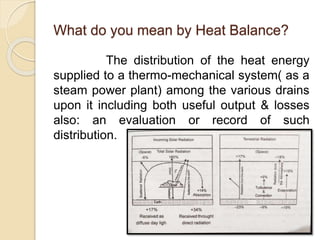
What do you mean by Heat Balance?
The distribution of the heat energy
supplied to a thermo-mechanical system( as a
steam power plant) among the various drains
upon it including both useful output & losses
also: an evaluation or record of such
distribution.
What is the energy balance in
relation to the Sun & Earth?
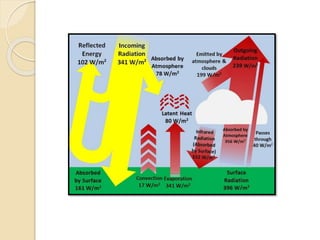
The Energy Balance drives the
weather & life on Earth. Essentially 100% of
the energy that fuels the earth comes from the
Sun. To maintain a constant global average
temperature, all of the sun’s radiation that
enters Earth’s atmosphere must eventually be
sent back to space.
What’s the hottest possible
temperature?
But what about absolute hot? It’s the highest
possible temperature that matter can attain,
according to conventional physics, & well, it’s
been measured to be exactly
1,420,000,000,000,000,000,000,000,000,000
,000 degrees Celsius
(2,556,000,000,000,000,000,000,000,000,00
0,000 degrees Fahrenheit).
What prevents heat escaping from
the Earth?
There are some Gases in the
atmosphere which trap the heat escaping
from the Earth & stop it from travelling back
into the space. These gases are called
Greenhouse Gases. The glass in a green
house has a similar effect on the Sun’s rays &
so it is called the Greenhouse Effect.
Insolation:-
The atmosphere is essential for the
survival of the plant & animal life. They also
require the optimum temperature to keep
themselves warm & grow. In this article, we
are going to discuss in details about some of
the topics like insolation, terrestrial radiation,
heat budget of the earth, albedo, etc.
Insolation or Incoming Solar
Radiation:-
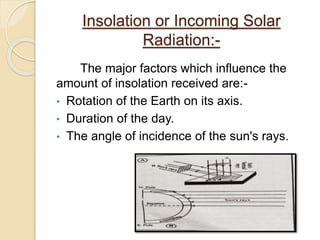
The major factors which influence the
amount of insolation received are:-
• Rotation of the Earth on its axis.
• Duration of the day.
• The angle of incidence of the sun's rays.
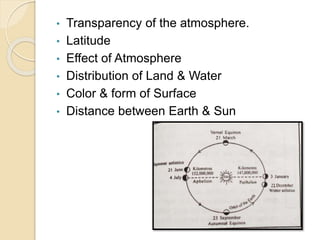
• Transparency of the atmosphere.
• Latitude
• Effect of Atmosphere
• Distribution of Land & Water
• Color & form of Surface
• Distance between Earth & Sun
Heat balance

Heat balance

  • 1.
    HEAT BALANCE OFTHE EARTH Dr. Rekha Vishwakarma Associate Professor, Department of Geography M.L.K.(P.G.) College, Balrampur, Uttar Pradesh, India
  • 3.
    INTRODUCTION Essentially all ofthe Energy the Earth receives is in radiant energy that originates from the Sun. The temperature of the Earth is a balancing act, with greenhouse gases in the atmosphere contributing to a planet that is inhabitable.
  • 4.
    What do youmean by Heat Balance? The distribution of the heat energy supplied to a thermo-mechanical system( as a steam power plant) among the various drains upon it including both useful output & losses also: an evaluation or record of such distribution.
  • 5.
    What is theenergy balance in relation to the Sun & Earth? The Energy Balance drives the weather & life on Earth. Essentially 100% of the energy that fuels the earth comes from the Sun. To maintain a constant global average temperature, all of the sun’s radiation that enters Earth’s atmosphere must eventually be sent back to space.
  • 6.
    What’s the hottestpossible temperature? But what about absolute hot? It’s the highest possible temperature that matter can attain, according to conventional physics, & well, it’s been measured to be exactly 1,420,000,000,000,000,000,000,000,000,000 ,000 degrees Celsius (2,556,000,000,000,000,000,000,000,000,00 0,000 degrees Fahrenheit).
  • 7.
    What prevents heatescaping from the Earth? There are some Gases in the atmosphere which trap the heat escaping from the Earth & stop it from travelling back into the space. These gases are called Greenhouse Gases. The glass in a green house has a similar effect on the Sun’s rays & so it is called the Greenhouse Effect.
  • 8.
    Insolation:- The atmosphere isessential for the survival of the plant & animal life. They also require the optimum temperature to keep themselves warm & grow. In this article, we are going to discuss in details about some of the topics like insolation, terrestrial radiation, heat budget of the earth, albedo, etc.
  • 9.
    Insolation or IncomingSolar Radiation:- The major factors which influence the amount of insolation received are:- • Rotation of the Earth on its axis. • Duration of the day. • The angle of incidence of the sun's rays.
  • 10.
    • Transparency ofthe atmosphere. • Latitude • Effect of Atmosphere • Distribution of Land & Water • Color & form of Surface • Distance between Earth & Sun