Page 1 Registration Number: 150135133
POLICY CONCLUSIONS
As shown in the IPCC report, adaptation
measures to deal with inevitable sea level rise
and mitigation to limit long term rise are
believed to be the most appropriate responses
to global sea level rise.
● Ecosystem based adaptation approaches
could be useful in helping local communities
to adapt to the negative effects of global
climate change (UNEP, 2016).
● The restoration of mangrove forests where
appropriate should be considered as a
strategy for building resilience in the
impacts of sea level rise (Conservation
International, 2016).
● Traditional adaptation measures such as
building groynes and breakwaters should be
continued , however the decision to
implement these should be contextual to
avoid maladaptation (Kostakos, Zhang and
Veening, 2014).
● The most current projections on sea level
rise should be taken into account when
designing all future coastal structures -
(Simpson et al., 2010).
● Diversification of Caribbean economies
away from tourism could prove effective in
building resilience (Kostakos, Zhang and
Veening, 2014).
● Natural disaster insurance programmes can
be developed to assist those affected in
rebuilding (Wong et al., 2014; Simpson et
al., 2010).
‘AGAINST THE RISING TIDE’:
Projected Impacts of Sea Level Rise on Coastal & Low-lying Areas in the Caribbean
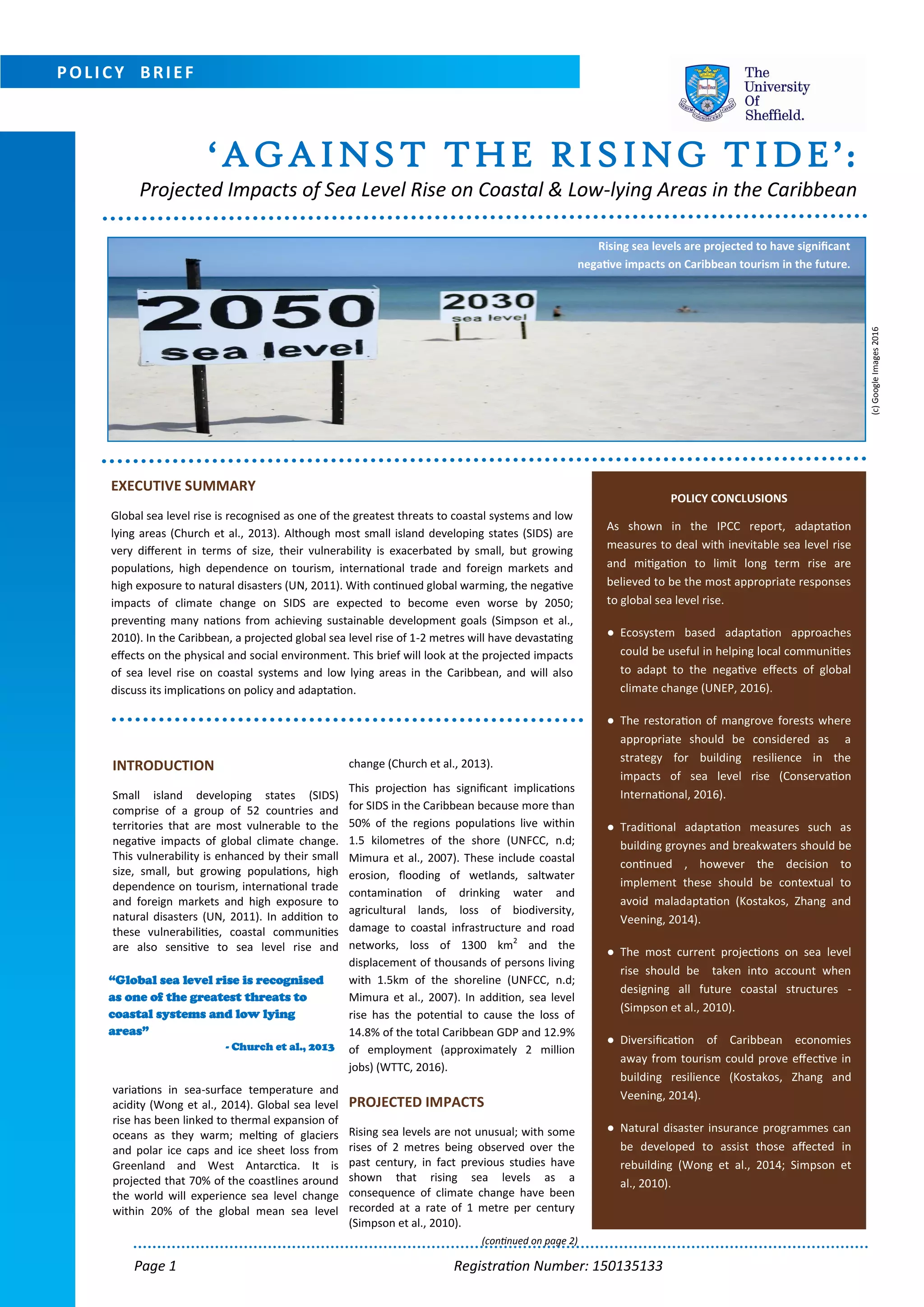
Rising sea levels are projected to have significant
negative impacts on Caribbean tourism in the future.
POLICY BRIEF
EXECUTIVE SUMMARY
Global sea level rise is recognised as one of the greatest threats to coastal systems and low
lying areas (Church et al., 2013). Although most small island developing states (SIDS) are
very different in terms of size, their vulnerability is exacerbated by small, but growing
populations, high dependence on tourism, international trade and foreign markets and
high exposure to natural disasters (UN, 2011). With continued global warming, the negative
impacts of climate change on SIDS are expected to become even worse by 2050;
preventing many nations from achieving sustainable development goals (Simpson et al.,
2010). In the Caribbean, a projected global sea level rise of 1-2 metres will have devastating
effects on the physical and social environment. This brief will look at the projected impacts
of sea level rise on coastal systems and low lying areas in the Caribbean, and will also
discuss its implications on policy and adaptation.
(continued on page 2)
INTRODUCTION
Small island developing states (SIDS)
comprise of a group of 52 countries and
territories that are most vulnerable to the
negative impacts of global climate change.
This vulnerability is enhanced by their small
size, small, but growing populations, high
dependence on tourism, international trade
and foreign markets and high exposure to
natural disasters (UN, 2011). In addition to
these vulnerabilities, coastal communities
are also sensitive to sea level rise and
variations in sea-surface temperature and
acidity (Wong et al., 2014). Global sea level
rise has been linked to thermal expansion of
oceans as they warm; melting of glaciers
and polar ice caps and ice sheet loss from
Greenland and West Antarctica. It is
projected that 70% of the coastlines around
the world will experience sea level change
within 20% of the global mean sea level
change (Church et al., 2013).
This projection has significant implications
for SIDS in the Caribbean because more than
50% of the regions populations live within
1.5 kilometres of the shore (UNFCC, n.d;
Mimura et al., 2007). These include coastal
erosion, flooding of wetlands, saltwater
contamination of drinking water and
agricultural lands, loss of biodiversity,
damage to coastal infrastructure and road
networks, loss of 1300 km2
and the
displacement of thousands of persons living
with 1.5km of the shoreline (UNFCC, n.d;
Mimura et al., 2007). In addition, sea level
rise has the potential to cause the loss of
14.8% of the total Caribbean GDP and 12.9%
of employment (approximately 2 million
jobs) (WTTC, 2016).
PROJECTED IMPACTS
Rising sea levels are not unusual; with some
rises of 2 metres being observed over the
past century, in fact previous studies have
shown that rising sea levels as a
consequence of climate change have been
recorded at a rate of 1 metre per century
(Simpson et al., 2010).
“Global sea level rise is recognised
as one of the greatest threats to
coastal systems and low lying
areas”
- Church et al., 2013
(c)GoogleImages2016
Page 2 Registration Number: 150135133
POLICY BRIEF
1. Conservation International, (2016). Using ecosystem-based adaptation to build resilience in
the Philippines - Conservation International. [online] Conservation International. Available at:
http://www.conservation.org/projects/Pages/Using-ecosystem-based-adaptation-to-build-
resilience-in-the-Philippines.aspx [Accessed 24 Apr. 2016].
2. Kostakos, G., Zhang, T. and Veening, W. (2014). Climate Security and Justice for Small Island
Developing States: An Agenda for Action. Policy Brief 9. The Hague Institute for Global Justice.
3. Simpson, M.C.1,2, Scott, D.2,3, Harrison, M4., Sim, R.3, Silver, N.5, O’Keeffe, E.6, Harrison, S.4,
Taylor, M.7, Lizcano, G.1, Rutty, M.3, Stager, H.2,3, Oldham, J.3, Wilson, M.7, New, M.1,
Clarke, J. 2, Day, O.J.2, Fields, N.2, Georges, J.2, Waithe, R.2, McSharry, P.1 (2010)
Quantification and Magnitude of Losses and Damages Resulting from the Impacts of Climate
Change: Modelling the Transformational Impacts and Costs of Sea Level Rise in the Caribbean
(Full Document). United Nations Development Programme (UNDP), Barbados, West Indies.
Available at: http://dms.caribbeanclimate.bz/php/gateway/eldis.php?id=2961 [Accessed 21
Apr. 2016]
4. UNEP.org. (2016). UNEP - Climate Change - Adaptation - Ecosystem-Based Adaptation.
[online] Available at: http://unep.org/climatechange/adaptation/EcosystemBasedAdaptation/
tabid/29583/Default.aspx [Accessed 21 Apr. 2016].
5. Wong, P .P ., I.J. Losada, J.-P . Gattuso, J. Hinkel, A. Khattabi, K.L. McInnes, Y . Saito, and A.
Sallenger, 2014: Coastal systems and low-lying areas. In: Climate Change 2014: Impacts,
Adaptation, and Vulnerability. Part A: Global and Sectoral Aspects. Contribution of Working
Group II to the Fifth Assessment Report of the Intergovernmental Panel on Climate Change
[Field, C.B., V.R. Barros, D.J. Dokken, K.J. Mach, M.D. Mastrandrea, T.E. Bilir, M. Chatterjee,
K.L. Ebi, Y .O. Estrada, R.C. Genova, B. Girma, E.S. Kissel, A.N. Levy, S. MacCracken, P .R.
Mastrandrea, and L.L. White (eds.)]. Cambridge University Press, Cambridge, United Kingdom
and New York, NY , USA, pp. 361-409.
FURTHER READING
ADAPTATION
Adaptation strategies to address the negative impact of climate
change on coastal communities cover three categories: protection,
accommodation and managed retreat.
Protection
Many recommendations to policymakers call for the construction of
“hard” defences like sea walls in order to protect coastal
infrastructure (Wong et al., 2014) , however these approaches are
extremely costly ; mostly Caribbean nations lack the capital and the
capacity to implement this (Simpson et al., 2010). In addition, these
defences can negatively impact the wider coastal environment if
their placement is not carefully considered (Moser and Boykoff,
2013) .
Accommodation
Changes to human infrastructure, in the form of retro-fitting
buildings and raising low-lying bridges, and policy, in the form of
adjusted land use plans, can assist in building resilience to the effects
of rising sea levels (Wong et al., 2014). Simpson et al. (2010).
However, in the event of even more rapid SLR, these measures may
not be suitable for the long term.
Managed Retreat
This involves moving assets away from the coastline through the use
of setbacks for coastal developments. In the Caribbean, the
implementation of enforced setbacks may be problematic due to the
location of infrastructure and where there is small landmass or
unsuitable topography for development. In cases like this, relocation
of assets in response to SLR should be considered as a last resort
(Wong et al., 2014).
MOVING FORWARD
With sea level rise becoming an inevitable reality, Caribbean nations
will need to adapt in order to survive. Adjustments to land use,
coastal planning and development of insurance schemes may be
useful long term adaptation strategies.
Short term strategies in the form of physical coastal defence
measures, like groynes and sea walls, have traditionally been used in
response to coastal erosion and sea level rise. These approaches are
costly and can lead to maladaptation if policymakers fail to
understand all of the site specific factors. The benefits of ecosystem
based adaptation should be investigated as an alternative because,
while it is not a panacea, it could provide more cost effective means
of defending the shoreline.
PROJECTED IMPACTS CONT’D
Anthropogenic interventions have been noted as the direct cause of the current
global mean rate of sea level rise, according to the 2013 IPCC report; doubling
from 1.7mm per year in the past century to 3.2mm per year in the last twenty
years, but rates may vary from ocean to ocean (Church et al., 2013).
In the Caribbean, the rate of sea level rise is aligned with historical global means,
at approximately 1.8mm per year (Palanisamy et al., 2012), however rise in sea
level make become more pronounced because of the related gravitational forces
near to the Equator (Simpson et al., 2010). The projected consequences of sea
level rise in the Caribbean are discussed in the table below.
Projected Impact Description
Population Displacement  a 1-2 metre SLR would result in nearly 1300km2
of land area being lost (Simpson et al., 2010)
 More than 50% of the Caribbean populations
live within 1.5 kilometres of the coast which
would result in 110, 000 people in Caribbean
community (CARICOM) nations being displaced
Coastal Erosion & Damage
to coastal infrastructure
 Flooding
Over 1 million people at risk to flooding with 1
metre SLR with a 1 in 100 year storm surge
(Simpson et al., 2010).
 Disruption of road networks
cumulative loss of 567 km of coastal roads
 Trade and regional travel via ports of entry
21 airports and the lands surrounding 35 ports
will suffer damages.
Displacement of Mangrove
Forests
 1 metre SLR will cause a complete collapse of
the Port Royal mangrove wetland in Jamaica
(UNFCC, n.d).
 Loss of ecosystem services
 Further coastal erosion
Economic Losses in the
Tourism Sector
 Tourism accounted for 14.8% of the total
Caribbean GDP in 2015 and 12.9% of
employment (approximately 2 million jobs)
(WTTC, 2016).
 Losses much higher in individual countries like
Dominica - 39% of GDP and 35.6% of total
employment in 2015 (WTTC, 2016).
Table 1 - Projected impacts of Sea Level Rise (SLR) in the Caribbean.
Page 3 Registration Number: 150135133
Reference List
1. Barnett, J. and O'Neill, S. (2012). Islands, resettlement and adaptation. Nature Climate Change, [online] 2(1), pp.8-10.
Available at: http://www.nature.com/nclimate/journal/v2/n1/full/nclimate1334.html [Accessed 25 Apr. 2016].
2. Church, J.A., P.U. Clark, A. Cazenave, J.M. Gregory, S. Jevrejeva, A. Levermann, M.A. Merrifield, G.A. Milne, R.S. Nerem,
P.D. Nunn, A.J. Payne, W.T. Pfeffer, D. Stammer and A.S. Unnikrishnan, 2013: Sea Level Change. In: Climate Change
2013: The Physical Science Basis. Contribution of Working Group I to the Fifth Assessment Report of the
Intergovernmental Panel on Climate Change [Stocker, T.F., D. Qin, G.-K. Plattner, M. Tignor, S.K. Allen, J. Boschung, A.
Nauels, Y. Xia, V. Bex and P.M. Midgley (eds.)]. Cambridge University Press, Cambridge, United Kingdom and New York,
NY, USA. Available at http://www.ipcc.ch/pdf/assessment-report/ar5/wg1/WG1AR5_Chapter13_FINAL.pdf [Accessed
21 Apr. 2016]
3. Conservation International, (2016). Using ecosystem-based adaptation to build resilience in the Philippines -
Conservation International. [online] Conservation International. Available at: http://www.conservation.org/projects/
Pages/Using-ecosystem-based-adaptation-to-build-resilience-in-the-Philippines.aspx [Accessed 24 Apr. 2016].
4. IUCN.org. (2016). IUCN - Ecosystem-based Adaptation. [online] Available at: https://www.iucn.org/about/work/
programmes/ecosystem_management/climate_change/eba/ [Accessed 21 Apr. 2016].
5. Kostakos, G., Zhang, T. and Veening, W. (2014). Climate Security and Justice for Small Island Developing States: An
Agenda for Action. Policy Brief 9. The Hague Institute for Global Justice.
6. Massel, S., Furukawa, K. and Brinkman, R. (1999). Surface wave propagation in mangrove forests. Fluid Dynamics
Research, [online] 24(4), pp.219-249. Available at: http://iopscience.iop.org/article/10.1016/S0169-5983(98)00024-0/
meta;jsessionid=DD8CC539234A1FD9F8425473D2108966.c1 [Accessed 24 Apr. 2016].
7. McIvor, A., Spencer, T., Möller, I. and Spalding, M. (2013). The response of mangrove soil surface elevation to sea level
rise. Natural Coastal Protection Series: Report 3. Cambridge Coastal Research Unit Working Paper 42. [online] The
Nature Conservancy and Wetlands International. Available at: http://coastalresilience.org/science/mangroves/surface-
elevation-and-sea-level-rise [Accessed 25 Apr. 2016].
8. McKee, K., Cahoon, D. and Feller, I. (2007). Caribbean mangroves adjust to rising sea level through biotic controls on
change in soil elevation. Global Ecology and Biogeography, [online] 16(5), pp.545-556. Available at: http://
onlinelibrary.wiley.com/doi/10.1111/j.1466-8238.2007.00317.x/full [Accessed 24 Apr. 2016].
9. Mycoo, M. and Chadwick, A. (2012). Adaptation to climate change: the coastal zone of Barbados. Proceedings of the ICE
- Maritime Engineering, [online] 165(4), pp.159-168. Available at: https://www.researchgate.net/
publication/234038862_1_Mycoo_M_and_Chadwick_A_2012_Adaptation_to_Climate_Change_The_Coastal_Zone_of_
Barbados_Maritime_Engineering_UK_Volume_165_Issue_4_159-168 [Accessed 25 Apr. 2016].
10. Nurse, L.A., R.F. McLean, J. Agard, L.P. Briguglio, V. Duvat-Magnan, N. Pelesikoti, E. Tompkins, and A. Webb, 2014: Small
islands. In: Climate Change 2014: Impacts, Adaptation, and Vulnerability. Part B: Regional Aspects. Contribution of
Working Group II to the Fifth Assessment Report of the Intergovernmental Panel on Climate Change [Barros, V.R., C.B.
Field, D.J. Dokken, M.D. Mastrandrea, K.J. Mach, T.E. Bilir, M. Chatterjee, K.L. Ebi, Y.O. Estrada, R.C. Genova, B. Girma,
E.S. Kissel, A.N. Levy, S. MacCracken, P.R. Mastrandrea, and L.L. White (eds.)]. Cambridge University Press, Cambridge,
United Kingdom and New York, NY, USA, pp. 1613-1654.
11. Palanisamy, H., M. Becker, B. Meyssignac, O. Henry, and A. Cazenave, 2012: Regional sea level change and variability in
the Caribbean Sea since 1950. Journal of Geodetic Science, 2(2), 125-133.
12. Rizvi, A.R., Baig, S., Verdone, M. (2015). Ecosystems Based Adaptation: Knowledge Gaps in Making an Economic Case for
Investing in Nature Based Solutions for Climate Change. Gland, Switzerland: IUCN. v + 48 pp. Available at http://
Page 4 Registration Number: 150135133
cmsdata.iucn.org/downloads/the_economic_case_for_eba__en_1.pdf [Accessed 21 Apr. 2016].
13. Simpson, M., Mercer Clarke, C., Clarke, J., Scott, D. and Clarke, A. (2012). Coastal Setbacks in Latin America and the
Caribbean: A Study of Emerging Issues and Trends that Inform Guidelines for Coastal Planning and Development. IDB
TECHNICAL NOTE No. IDB - TN - 476. [online] InterAmerican Development Bank. Available at: https://
publications.iadb.org/bitstream/handle/11319/5567/Coastal%20Setbacks%20in%20Latin%20America%20and%20the%
1. 20Caribbean.pdf?sequence=1 [Accessed 24 Apr. 2016].
14. Simpson, M.C.1,2, Scott, D.2,3, Harrison, M4., Sim, R.3, Silver, N.5, O’Keeffe, E.6, Harrison, S.4, Taylor, M.7, Lizcano, G.1,
Rutty, M.3, Stager, H.2,3, Oldham, J.3, Wilson, M.7, New, M.1, Clarke, J. 2, Day, O.J.2, Fields, N.2, Georges, J.2, Waithe,
R.2, McSharry, P.1 (2010) Quantification and Magnitude of Losses and Damages Resulting from the Impacts of Climate
Change: Modelling the Transformational Impacts and Costs of Sea Level Rise in the Caribbean (Full Document). United
Nations Development Programme (UNDP), Barbados, West Indies. Available at: http://dms.caribbeanclimate.bz/php/
gateway/eldis.php?id=2961 [Accessed 21 Apr. 2016]
15. UN, (2011). SMALL ISLAND DEVELOPING STATES: Small Islands Big(ger) Stakes. [online] New York: UN-OHRLLS. Available
at: http://unohrlls.org/custom-content/uploads/2013/08/SIDS-Small-Islands-Bigger-Stakes.pdf [Accessed 21 Apr. 2016].
16. UNEP.org. (2016). UNEP - Climate Change - Adaptation - Ecosystem-Based Adaptation. [online] Available at: http://
unep.org/climatechange/adaptation/EcosystemBasedAdaptation/tabid/29583/Default.aspx [Accessed 21 Apr. 2016].
17. UNFCC, (n.d.). VULNERABILITY AND ADAPTATION TO CLIMATE CHANGE IN SMALL ISLAND DEVELOPING STATES. 1st ed.
[ebook] Available at: https://unfccc.int/files/adaptation/adverse_effects_and_response_measures_art_48/application/
pdf/200702_sids_adaptation_bg.pdf [Accessed 24 Apr. 2016].
18. Wong, P .P ., I.J. Losada, J.-P . Gattuso, J. Hinkel, A. Khattabi, K.L. McInnes, Y . Saito, and A. Sallenger, 2014: Coastal
systems and low-lying areas. In: Climate Change 2014: Impacts, Adaptation, and Vulnerability. Part A: Global and
Sectoral Aspects. Contribution of Working Group II to the Fifth Assessment Report of the Intergovernmental Panel on
Climate Change [Field, C.B., V.R. Barros, D.J. Dokken, K.J. Mach, M.D. Mastrandrea, T.E. Bilir, M. Chatterjee, K.L. Ebi,
Y .O. Estrada, R.C. Genova, B. Girma, E.S. Kissel, A.N. Levy, S. MacCracken, P .R. Mastrandrea, and L.L. White (eds.)].
Cambridge University Press, Cambridge, United Kingdom and New York, NY , USA, pp. 361-409.
19. WTTC, (2016). Economic Impact 2016 - Dominica. Travel & Tourism. [online] London: World Travel & Tourism Council.
Available at: http://www.wttc.org/-/media/files/reports/economic%20impact%20research/countries%202016/
dominica2016.pdf [Accessed 21 Apr. 2016].
20. WTTC, (2016). Travel & Tourism: Economic Impact 2016. [online] London: World Travel & Tourism Council, pp.2-3.
Available at: http://www.wttc.org/-/media/files/reports/economic%20impact%20research/regions%202016/
caribbean2016.pdf [Accessed 21 Apr. 2016].

150135133_-_Against_the_Rising_Tide1

  • 1.
    Page 1 RegistrationNumber: 150135133 POLICY CONCLUSIONS As shown in the IPCC report, adaptation measures to deal with inevitable sea level rise and mitigation to limit long term rise are believed to be the most appropriate responses to global sea level rise. ● Ecosystem based adaptation approaches could be useful in helping local communities to adapt to the negative effects of global climate change (UNEP, 2016). ● The restoration of mangrove forests where appropriate should be considered as a strategy for building resilience in the impacts of sea level rise (Conservation International, 2016). ● Traditional adaptation measures such as building groynes and breakwaters should be continued , however the decision to implement these should be contextual to avoid maladaptation (Kostakos, Zhang and Veening, 2014). ● The most current projections on sea level rise should be taken into account when designing all future coastal structures - (Simpson et al., 2010). ● Diversification of Caribbean economies away from tourism could prove effective in building resilience (Kostakos, Zhang and Veening, 2014). ● Natural disaster insurance programmes can be developed to assist those affected in rebuilding (Wong et al., 2014; Simpson et al., 2010). ‘AGAINST THE RISING TIDE’: Projected Impacts of Sea Level Rise on Coastal & Low-lying Areas in the Caribbean Rising sea levels are projected to have significant negative impacts on Caribbean tourism in the future. POLICY BRIEF EXECUTIVE SUMMARY Global sea level rise is recognised as one of the greatest threats to coastal systems and low lying areas (Church et al., 2013). Although most small island developing states (SIDS) are very different in terms of size, their vulnerability is exacerbated by small, but growing populations, high dependence on tourism, international trade and foreign markets and high exposure to natural disasters (UN, 2011). With continued global warming, the negative impacts of climate change on SIDS are expected to become even worse by 2050; preventing many nations from achieving sustainable development goals (Simpson et al., 2010). In the Caribbean, a projected global sea level rise of 1-2 metres will have devastating effects on the physical and social environment. This brief will look at the projected impacts of sea level rise on coastal systems and low lying areas in the Caribbean, and will also discuss its implications on policy and adaptation. (continued on page 2) INTRODUCTION Small island developing states (SIDS) comprise of a group of 52 countries and territories that are most vulnerable to the negative impacts of global climate change. This vulnerability is enhanced by their small size, small, but growing populations, high dependence on tourism, international trade and foreign markets and high exposure to natural disasters (UN, 2011). In addition to these vulnerabilities, coastal communities are also sensitive to sea level rise and variations in sea-surface temperature and acidity (Wong et al., 2014). Global sea level rise has been linked to thermal expansion of oceans as they warm; melting of glaciers and polar ice caps and ice sheet loss from Greenland and West Antarctica. It is projected that 70% of the coastlines around the world will experience sea level change within 20% of the global mean sea level change (Church et al., 2013). This projection has significant implications for SIDS in the Caribbean because more than 50% of the regions populations live within 1.5 kilometres of the shore (UNFCC, n.d; Mimura et al., 2007). These include coastal erosion, flooding of wetlands, saltwater contamination of drinking water and agricultural lands, loss of biodiversity, damage to coastal infrastructure and road networks, loss of 1300 km2 and the displacement of thousands of persons living with 1.5km of the shoreline (UNFCC, n.d; Mimura et al., 2007). In addition, sea level rise has the potential to cause the loss of 14.8% of the total Caribbean GDP and 12.9% of employment (approximately 2 million jobs) (WTTC, 2016). PROJECTED IMPACTS Rising sea levels are not unusual; with some rises of 2 metres being observed over the past century, in fact previous studies have shown that rising sea levels as a consequence of climate change have been recorded at a rate of 1 metre per century (Simpson et al., 2010). “Global sea level rise is recognised as one of the greatest threats to coastal systems and low lying areas” - Church et al., 2013 (c)GoogleImages2016
  • 2.
    Page 2 RegistrationNumber: 150135133 POLICY BRIEF 1. Conservation International, (2016). Using ecosystem-based adaptation to build resilience in the Philippines - Conservation International. [online] Conservation International. Available at: http://www.conservation.org/projects/Pages/Using-ecosystem-based-adaptation-to-build- resilience-in-the-Philippines.aspx [Accessed 24 Apr. 2016]. 2. Kostakos, G., Zhang, T. and Veening, W. (2014). Climate Security and Justice for Small Island Developing States: An Agenda for Action. Policy Brief 9. The Hague Institute for Global Justice. 3. Simpson, M.C.1,2, Scott, D.2,3, Harrison, M4., Sim, R.3, Silver, N.5, O’Keeffe, E.6, Harrison, S.4, Taylor, M.7, Lizcano, G.1, Rutty, M.3, Stager, H.2,3, Oldham, J.3, Wilson, M.7, New, M.1, Clarke, J. 2, Day, O.J.2, Fields, N.2, Georges, J.2, Waithe, R.2, McSharry, P.1 (2010) Quantification and Magnitude of Losses and Damages Resulting from the Impacts of Climate Change: Modelling the Transformational Impacts and Costs of Sea Level Rise in the Caribbean (Full Document). United Nations Development Programme (UNDP), Barbados, West Indies. Available at: http://dms.caribbeanclimate.bz/php/gateway/eldis.php?id=2961 [Accessed 21 Apr. 2016] 4. UNEP.org. (2016). UNEP - Climate Change - Adaptation - Ecosystem-Based Adaptation. [online] Available at: http://unep.org/climatechange/adaptation/EcosystemBasedAdaptation/ tabid/29583/Default.aspx [Accessed 21 Apr. 2016]. 5. Wong, P .P ., I.J. Losada, J.-P . Gattuso, J. Hinkel, A. Khattabi, K.L. McInnes, Y . Saito, and A. Sallenger, 2014: Coastal systems and low-lying areas. In: Climate Change 2014: Impacts, Adaptation, and Vulnerability. Part A: Global and Sectoral Aspects. Contribution of Working Group II to the Fifth Assessment Report of the Intergovernmental Panel on Climate Change [Field, C.B., V.R. Barros, D.J. Dokken, K.J. Mach, M.D. Mastrandrea, T.E. Bilir, M. Chatterjee, K.L. Ebi, Y .O. Estrada, R.C. Genova, B. Girma, E.S. Kissel, A.N. Levy, S. MacCracken, P .R. Mastrandrea, and L.L. White (eds.)]. Cambridge University Press, Cambridge, United Kingdom and New York, NY , USA, pp. 361-409. FURTHER READING ADAPTATION Adaptation strategies to address the negative impact of climate change on coastal communities cover three categories: protection, accommodation and managed retreat. Protection Many recommendations to policymakers call for the construction of “hard” defences like sea walls in order to protect coastal infrastructure (Wong et al., 2014) , however these approaches are extremely costly ; mostly Caribbean nations lack the capital and the capacity to implement this (Simpson et al., 2010). In addition, these defences can negatively impact the wider coastal environment if their placement is not carefully considered (Moser and Boykoff, 2013) . Accommodation Changes to human infrastructure, in the form of retro-fitting buildings and raising low-lying bridges, and policy, in the form of adjusted land use plans, can assist in building resilience to the effects of rising sea levels (Wong et al., 2014). Simpson et al. (2010). However, in the event of even more rapid SLR, these measures may not be suitable for the long term. Managed Retreat This involves moving assets away from the coastline through the use of setbacks for coastal developments. In the Caribbean, the implementation of enforced setbacks may be problematic due to the location of infrastructure and where there is small landmass or unsuitable topography for development. In cases like this, relocation of assets in response to SLR should be considered as a last resort (Wong et al., 2014). MOVING FORWARD With sea level rise becoming an inevitable reality, Caribbean nations will need to adapt in order to survive. Adjustments to land use, coastal planning and development of insurance schemes may be useful long term adaptation strategies. Short term strategies in the form of physical coastal defence measures, like groynes and sea walls, have traditionally been used in response to coastal erosion and sea level rise. These approaches are costly and can lead to maladaptation if policymakers fail to understand all of the site specific factors. The benefits of ecosystem based adaptation should be investigated as an alternative because, while it is not a panacea, it could provide more cost effective means of defending the shoreline. PROJECTED IMPACTS CONT’D Anthropogenic interventions have been noted as the direct cause of the current global mean rate of sea level rise, according to the 2013 IPCC report; doubling from 1.7mm per year in the past century to 3.2mm per year in the last twenty years, but rates may vary from ocean to ocean (Church et al., 2013). In the Caribbean, the rate of sea level rise is aligned with historical global means, at approximately 1.8mm per year (Palanisamy et al., 2012), however rise in sea level make become more pronounced because of the related gravitational forces near to the Equator (Simpson et al., 2010). The projected consequences of sea level rise in the Caribbean are discussed in the table below. Projected Impact Description Population Displacement  a 1-2 metre SLR would result in nearly 1300km2 of land area being lost (Simpson et al., 2010)  More than 50% of the Caribbean populations live within 1.5 kilometres of the coast which would result in 110, 000 people in Caribbean community (CARICOM) nations being displaced Coastal Erosion & Damage to coastal infrastructure  Flooding Over 1 million people at risk to flooding with 1 metre SLR with a 1 in 100 year storm surge (Simpson et al., 2010).  Disruption of road networks cumulative loss of 567 km of coastal roads  Trade and regional travel via ports of entry 21 airports and the lands surrounding 35 ports will suffer damages. Displacement of Mangrove Forests  1 metre SLR will cause a complete collapse of the Port Royal mangrove wetland in Jamaica (UNFCC, n.d).  Loss of ecosystem services  Further coastal erosion Economic Losses in the Tourism Sector  Tourism accounted for 14.8% of the total Caribbean GDP in 2015 and 12.9% of employment (approximately 2 million jobs) (WTTC, 2016).  Losses much higher in individual countries like Dominica - 39% of GDP and 35.6% of total employment in 2015 (WTTC, 2016). Table 1 - Projected impacts of Sea Level Rise (SLR) in the Caribbean.
  • 3.
    Page 3 RegistrationNumber: 150135133 Reference List 1. Barnett, J. and O'Neill, S. (2012). Islands, resettlement and adaptation. Nature Climate Change, [online] 2(1), pp.8-10. Available at: http://www.nature.com/nclimate/journal/v2/n1/full/nclimate1334.html [Accessed 25 Apr. 2016]. 2. Church, J.A., P.U. Clark, A. Cazenave, J.M. Gregory, S. Jevrejeva, A. Levermann, M.A. Merrifield, G.A. Milne, R.S. Nerem, P.D. Nunn, A.J. Payne, W.T. Pfeffer, D. Stammer and A.S. Unnikrishnan, 2013: Sea Level Change. In: Climate Change 2013: The Physical Science Basis. Contribution of Working Group I to the Fifth Assessment Report of the Intergovernmental Panel on Climate Change [Stocker, T.F., D. Qin, G.-K. Plattner, M. Tignor, S.K. Allen, J. Boschung, A. Nauels, Y. Xia, V. Bex and P.M. Midgley (eds.)]. Cambridge University Press, Cambridge, United Kingdom and New York, NY, USA. Available at http://www.ipcc.ch/pdf/assessment-report/ar5/wg1/WG1AR5_Chapter13_FINAL.pdf [Accessed 21 Apr. 2016] 3. Conservation International, (2016). Using ecosystem-based adaptation to build resilience in the Philippines - Conservation International. [online] Conservation International. Available at: http://www.conservation.org/projects/ Pages/Using-ecosystem-based-adaptation-to-build-resilience-in-the-Philippines.aspx [Accessed 24 Apr. 2016]. 4. IUCN.org. (2016). IUCN - Ecosystem-based Adaptation. [online] Available at: https://www.iucn.org/about/work/ programmes/ecosystem_management/climate_change/eba/ [Accessed 21 Apr. 2016]. 5. Kostakos, G., Zhang, T. and Veening, W. (2014). Climate Security and Justice for Small Island Developing States: An Agenda for Action. Policy Brief 9. The Hague Institute for Global Justice. 6. Massel, S., Furukawa, K. and Brinkman, R. (1999). Surface wave propagation in mangrove forests. Fluid Dynamics Research, [online] 24(4), pp.219-249. Available at: http://iopscience.iop.org/article/10.1016/S0169-5983(98)00024-0/ meta;jsessionid=DD8CC539234A1FD9F8425473D2108966.c1 [Accessed 24 Apr. 2016]. 7. McIvor, A., Spencer, T., Möller, I. and Spalding, M. (2013). The response of mangrove soil surface elevation to sea level rise. Natural Coastal Protection Series: Report 3. Cambridge Coastal Research Unit Working Paper 42. [online] The Nature Conservancy and Wetlands International. Available at: http://coastalresilience.org/science/mangroves/surface- elevation-and-sea-level-rise [Accessed 25 Apr. 2016]. 8. McKee, K., Cahoon, D. and Feller, I. (2007). Caribbean mangroves adjust to rising sea level through biotic controls on change in soil elevation. Global Ecology and Biogeography, [online] 16(5), pp.545-556. Available at: http:// onlinelibrary.wiley.com/doi/10.1111/j.1466-8238.2007.00317.x/full [Accessed 24 Apr. 2016]. 9. Mycoo, M. and Chadwick, A. (2012). Adaptation to climate change: the coastal zone of Barbados. Proceedings of the ICE - Maritime Engineering, [online] 165(4), pp.159-168. Available at: https://www.researchgate.net/ publication/234038862_1_Mycoo_M_and_Chadwick_A_2012_Adaptation_to_Climate_Change_The_Coastal_Zone_of_ Barbados_Maritime_Engineering_UK_Volume_165_Issue_4_159-168 [Accessed 25 Apr. 2016]. 10. Nurse, L.A., R.F. McLean, J. Agard, L.P. Briguglio, V. Duvat-Magnan, N. Pelesikoti, E. Tompkins, and A. Webb, 2014: Small islands. In: Climate Change 2014: Impacts, Adaptation, and Vulnerability. Part B: Regional Aspects. Contribution of Working Group II to the Fifth Assessment Report of the Intergovernmental Panel on Climate Change [Barros, V.R., C.B. Field, D.J. Dokken, M.D. Mastrandrea, K.J. Mach, T.E. Bilir, M. Chatterjee, K.L. Ebi, Y.O. Estrada, R.C. Genova, B. Girma, E.S. Kissel, A.N. Levy, S. MacCracken, P.R. Mastrandrea, and L.L. White (eds.)]. Cambridge University Press, Cambridge, United Kingdom and New York, NY, USA, pp. 1613-1654. 11. Palanisamy, H., M. Becker, B. Meyssignac, O. Henry, and A. Cazenave, 2012: Regional sea level change and variability in the Caribbean Sea since 1950. Journal of Geodetic Science, 2(2), 125-133. 12. Rizvi, A.R., Baig, S., Verdone, M. (2015). Ecosystems Based Adaptation: Knowledge Gaps in Making an Economic Case for Investing in Nature Based Solutions for Climate Change. Gland, Switzerland: IUCN. v + 48 pp. Available at http://
  • 4.
    Page 4 RegistrationNumber: 150135133 cmsdata.iucn.org/downloads/the_economic_case_for_eba__en_1.pdf [Accessed 21 Apr. 2016]. 13. Simpson, M., Mercer Clarke, C., Clarke, J., Scott, D. and Clarke, A. (2012). Coastal Setbacks in Latin America and the Caribbean: A Study of Emerging Issues and Trends that Inform Guidelines for Coastal Planning and Development. IDB TECHNICAL NOTE No. IDB - TN - 476. [online] InterAmerican Development Bank. Available at: https:// publications.iadb.org/bitstream/handle/11319/5567/Coastal%20Setbacks%20in%20Latin%20America%20and%20the% 1. 20Caribbean.pdf?sequence=1 [Accessed 24 Apr. 2016]. 14. Simpson, M.C.1,2, Scott, D.2,3, Harrison, M4., Sim, R.3, Silver, N.5, O’Keeffe, E.6, Harrison, S.4, Taylor, M.7, Lizcano, G.1, Rutty, M.3, Stager, H.2,3, Oldham, J.3, Wilson, M.7, New, M.1, Clarke, J. 2, Day, O.J.2, Fields, N.2, Georges, J.2, Waithe, R.2, McSharry, P.1 (2010) Quantification and Magnitude of Losses and Damages Resulting from the Impacts of Climate Change: Modelling the Transformational Impacts and Costs of Sea Level Rise in the Caribbean (Full Document). United Nations Development Programme (UNDP), Barbados, West Indies. Available at: http://dms.caribbeanclimate.bz/php/ gateway/eldis.php?id=2961 [Accessed 21 Apr. 2016] 15. UN, (2011). SMALL ISLAND DEVELOPING STATES: Small Islands Big(ger) Stakes. [online] New York: UN-OHRLLS. Available at: http://unohrlls.org/custom-content/uploads/2013/08/SIDS-Small-Islands-Bigger-Stakes.pdf [Accessed 21 Apr. 2016]. 16. UNEP.org. (2016). UNEP - Climate Change - Adaptation - Ecosystem-Based Adaptation. [online] Available at: http:// unep.org/climatechange/adaptation/EcosystemBasedAdaptation/tabid/29583/Default.aspx [Accessed 21 Apr. 2016]. 17. UNFCC, (n.d.). VULNERABILITY AND ADAPTATION TO CLIMATE CHANGE IN SMALL ISLAND DEVELOPING STATES. 1st ed. [ebook] Available at: https://unfccc.int/files/adaptation/adverse_effects_and_response_measures_art_48/application/ pdf/200702_sids_adaptation_bg.pdf [Accessed 24 Apr. 2016]. 18. Wong, P .P ., I.J. Losada, J.-P . Gattuso, J. Hinkel, A. Khattabi, K.L. McInnes, Y . Saito, and A. Sallenger, 2014: Coastal systems and low-lying areas. In: Climate Change 2014: Impacts, Adaptation, and Vulnerability. Part A: Global and Sectoral Aspects. Contribution of Working Group II to the Fifth Assessment Report of the Intergovernmental Panel on Climate Change [Field, C.B., V.R. Barros, D.J. Dokken, K.J. Mach, M.D. Mastrandrea, T.E. Bilir, M. Chatterjee, K.L. Ebi, Y .O. Estrada, R.C. Genova, B. Girma, E.S. Kissel, A.N. Levy, S. MacCracken, P .R. Mastrandrea, and L.L. White (eds.)]. Cambridge University Press, Cambridge, United Kingdom and New York, NY , USA, pp. 361-409. 19. WTTC, (2016). Economic Impact 2016 - Dominica. Travel & Tourism. [online] London: World Travel & Tourism Council. Available at: http://www.wttc.org/-/media/files/reports/economic%20impact%20research/countries%202016/ dominica2016.pdf [Accessed 21 Apr. 2016]. 20. WTTC, (2016). Travel & Tourism: Economic Impact 2016. [online] London: World Travel & Tourism Council, pp.2-3. Available at: http://www.wttc.org/-/media/files/reports/economic%20impact%20research/regions%202016/ caribbean2016.pdf [Accessed 21 Apr. 2016].