X. International Istanbul
Insurance Conference
Climate Change
October 4th 2018
Willis Re
© 2016 Willis Towers Watson. All rights reserved.
AGENDA
2© 2016 Willis Towers Watson. All rights reserved.
• Generalities
• Future effects
• (Re)insurance and Climate Change
• Catastrophe Modelling of Climate Change
Very brief definitions
3© 2016 Willis Towers Watson. All rights reserved.
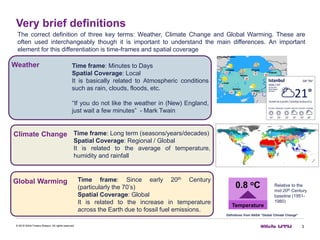
The correct definition of three key terms: Weather, Climate Change and Global Warming. These are
often used interchangeably though it is important to understand the main differences. An important
element for this differentiation is time-frames and spatial coverage
Time frame: Minutes to Days
Spatial Coverage: Local
It is basically related to Atmospheric conditions
such as rain, clouds, floods, etc.
“If you do not like the weather in (New) England,
just wait a few minutes” - Mark Twain
Definitions from NASA “Global Climate Change”
Weather
Climate Change
Global Warming
Time frame: Long term (seasons/years/decades)
Spatial Coverage: Regional / Global
It is related to the average of temperature,
humidity and rainfall
Time frame: Since early 20th Century
(particularly the 70’s)
Spatial Coverage: Global
It is related to the increase in temperature
across the Earth due to fossil fuel emissions.
0.8 oC
Temperature
Relative to the
mid 20th Century
baseline (1951-
1980)
Is Climate Change Normal?
4© 2016 Willis Towers Watson. All rights reserved.
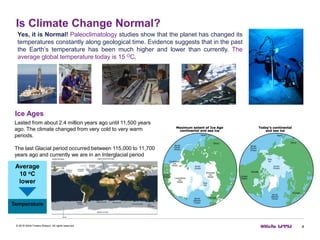
Yes, it is Normal! Paleoclimatology studies show that the planet has changed its
temperatures constantly along geological time. Evidence suggests that in the past
the Earth’s temperature has been much higher and lower than currently. The
average global temperature today is 15 OC.
Ice Ages
Lasted from about 2.4 million years ago until 11,500 years
ago. The climate changed from very cold to very warm
periods.
The last Glacial period occurred between 115,000 to 11,700
years ago and currently we are in an Interglacial period
Average
10 oC
lower
Temperature
Are there more recent examples?
5© 2016 Willis Towers Watson. All rights reserved.
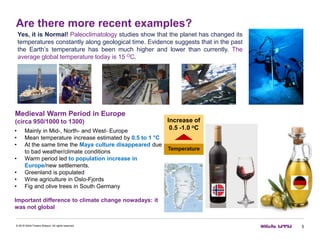
Yes, it is Normal! Paleoclimatology studies show that the planet has changed its
temperatures constantly along geological time. Evidence suggests that in the past
the Earth’s temperature has been much higher and lower than currently. The
average global temperature today is 15 OC.
Medieval Warm Period in Europe
(circa 950/1000 to 1300)
• Mainly in Mid-, North- and West- Europe
• Mean temperature increase estimated by 0.5 to 1 °C
• At the same time the Maya culture disappeared due
to bad weather/climate conditions
• Warm period led to population increase in
Europe/new settlements.
• Greenland is populated
• Wine agriculture in Oslo-Fjords
• Fig and olive trees in South Germany
Important difference to climate change nowadays: it
was not global
Increase of
0.5 -1.0 oC
Temperature
The Little Ice Age
6© 2016 Willis Towers Watson. All rights reserved.
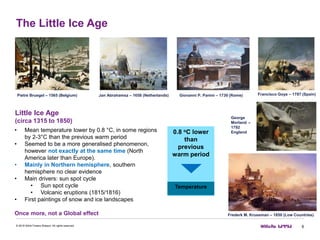
Little Ice Age
(circa 1315 to 1850)
• Mean temperature lower by 0.8 °C, in some regions
by 2-3°C than the previous warm period
• Seemed to be a more generalised phenomenon,
however not exactly at the same time (North
America later than Europe).
• Mainly in Northern hemisphere, southern
hemisphere no clear evidence
• Main drivers: sun spot cycle
• Sun spot cycle
• Volcanic eruptions (1815/1816)
• First paintings of snow and ice landscapes
Once more, not a Global effect
0.8 oC lower
than
previous
warm period
Temperature
Frederk M. Kruseman – 1850 (Low Countries)
Pietre Bruegel – 1565 (Belgium) Jan Abrahamsz – 1658 (Netherlands) Giovanni P. Panini – 1730 (Rome) Francisco Goya – 1787 (Spain)
George
Morland –
1792
England
Is Climate Change Normal?
7© 2016 Willis Towers Watson. All rights reserved.
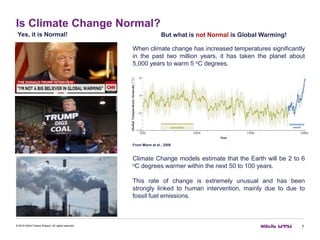
Yes, it is Normal! But what is not Normal is Global Warming!
When climate change has increased temperatures significantly
in the past two million years, it has taken the planet about
5,000 years to warm 5 oC degrees.
From Mann et al., 2008
Climate Change models estimate that the Earth will be 2 to 6
oC degrees warmer within the next 50 to 100 years.
This rate of change is extremely unusual and has been
strongly linked to human intervention, mainly due to due to
fossil fuel emissions.
What Models Tell About the Future
8© 2016 Willis Towers Watson. All rights reserved.
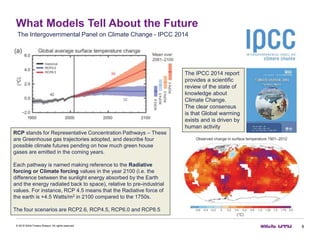
The Intergovernmental Panel on Climate Change - IPCC 2014
The IPCC 2014 report
provides a scientific
review of the state of
knowledge about
Climate Change.
The clear consensus
is that Global warming
exists and is driven by
human activity
RCP stands for Representative Concentration Pathways – These
are Greenhouse gas trajectories adopted, and describe four
possible climate futures pending on how much green house
gases are emitted in the coming years.
Each pathway is named making reference to the Radiative
forcing or Climate forcing values in the year 2100 (i.e. the
difference between the sunlight energy absorbed by the Earth
and the energy radiated back to space), relative to pre-industrial
values. For instance, RCP 4.5 means that the Radiative force of
the earth is +4.5 Watts/m2 in 2100 compared to the 1750s.
The four scenarios are RCP2.6, RCP4.5, RCP6.0 and RCP8.5
What Models Tell About the Future (2)
9© 2016 Willis Towers Watson. All rights reserved.
The Intergovernmental Panel on Climate Change - IPCC 2014
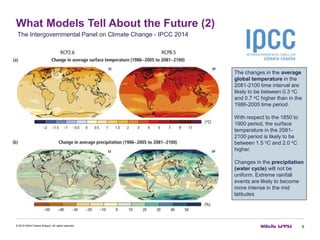
The changes in the average
global temperature in the
2081-2100 time interval are
likely to be between 0.3 oC
and 0.7 oC higher than in the
1986-2005 time period.
With respect to the 1850 to
1900 period, the surface
temperature in the 2081-
2100 period is likely to be
between 1.5 oC and 2.0 oC
higher.
Changes in the precipitation
(water cycle) will not be
uniform. Extreme rainfall
events are likely to become
more intense in the mid
latitudes
Climate Change and (Re)Insurance
10© 2016 Willis Towers Watson. All rights reserved.
The key question in this forum is: Given the complexities of the processes involved in Climate
Change and Global Warming , can the Insurance Industry have any impact (for good) on it?
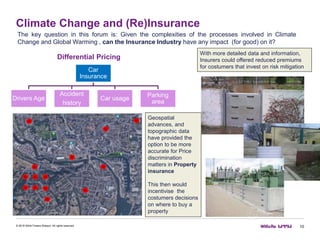
Car
Insurance
Drivers Age
Accident
history
Car usage
Parking
area
Differential Pricing
Geospatial
advances, and
topographic data
have provided the
option to be more
accurate for Price
discrimination
matters in Property
insurance
This then would
incentivise the
costumers decisions
on where to buy a
property
With more detailed data and information,
Insurers could offered reduced premiums
for costumers that invest on risk mitigation
Climate Change and (Re)Insurance - 2
11© 2016 Willis Towers Watson. All rights reserved.
The key question in this forum is: Given the complexities of the processes involved in Climate
Change and Global Warming , can the Insurance Industry have any impact (for good) on it?
ILS (Cat Bonds)
And Governments
A Global Reinsurer proposed
a Cat Bond where rebates or
premiums are partially
returned to
Municipalities/Governments
that invest in Risk mitigation
projects (e.g. Riverine Flood
Defences implementation,
Sewer system upgrades, Sea
Wall defences, etc)
With more detailed data and information,
Insurers could offered reduced premiums
for costumers that invest on risk mitigation
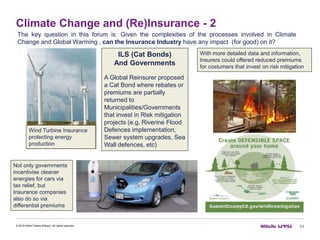
Wind Turbine Insurance
protecting energy
production
Not only governments
incentivise cleaner
energies for cars via
tax relief, but
Insurance companies
also do so via
differential premiums
Is Climate Change Modelled in Catastrophe Models?
12© 2016 Willis Towers Watson. All rights reserved.
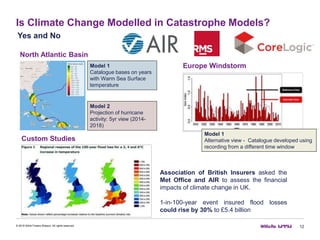
Model 1
Catalogue bases on years
with Warm Sea Surface
temperature
Yes and No
North Atlantic Basin
Model 2
Projection of hurricane
activity: 5yr view (2014-
2018)
Europe Windstorm
Model 1
Alternative view - Catalogue developed using
recording from a different time window
Custom Studies
Association of British Insurers asked the
Met Office and AIR to assess the financial
impacts of climate change in UK.
1-in-100-year event insured flood losses
could rise by 30% to £5.4 billion
X. International Istanbul
Insurance Conference
Climate Change
October 4th 2018
Willis Re
© 2016 Willis Towers Watson. All rights reserved.
Willis Re disclaimers
14
 This analysis has been prepared by Willis Limited and/or Willis Re Inc. and/or the “Willis Towers Watson” entity with whom you are dealing (“Willis Towers Watson” is defined as Willis
Limited, Willis Re Inc., and each of their respective parent companies, sister companies, subsidiaries, affiliates, Willis Towers Watson PLC, and all member companies thereof) on condition
that it shall be treated as strictly confidential and shall not be communicated in whole, in part, or in summary to any third party without written consent from Willis Towers Watson.
 Willis Towers Watson has relied upon data from public and/or other sources when preparing this analysis. No attempt has been made to verify independently the accuracy of this data.
Willis Towers Watson does not represent or otherwise guarantee the accuracy or completeness of such data nor assume responsibility for the result of any error or omission in the data or
other materials gathered from any source in the preparation of this analysis. Willis Towers Watson shall have no liability in connection with any results, including, without limitation, those
arising from based upon or in connection with errors, omissions, inaccuracies, or inadequacies associated with the data or arising from, based upon or in connection with any methodologies
used or applied by Willis Towers Watson in producing this analysis or any results contained herein. Willis Towers Watson expressly disclaims any and all liability arising from, based upon or
in connection with this analysis. Willis Towers Watson assumes no duty in contract, tort or otherwise to any party arising from, based upon or in connection with this analysis, and no party
should expect Willis Towers Watson to owe it any such duty.
 There are many uncertainties inherent in this analysis including, but not limited to, issues such as limitations in the available data, reliance on client data and outside data sources, the
underlying volatility of loss and other random processes, uncertainties that characterize the application of professional judgment in estimates and assumptions, etc. Ultimate losses, liabilities
and claims depend upon future contingent events, including but not limited to unanticipated changes in inflation, laws, and regulations. As a result of these uncertainties, the actual
outcomes could vary significantly from Willis Towers Watson’s estimates in either direction. Willis Towers Watson makes no representation about and does not guarantee the outcome,
results, success, or profitability of any insurance or reinsurance program or venture, whether or not the analyses or conclusions contained herein apply to such program or venture.
 Willis Towers Watson does not recommend making decisions based solely on the information contained in this analysis. Rather, this analysis should be viewed as a supplement to other
information, including specific business practice, claims experience, and financial situation. Independent professional advisors should be consulted with respect to the issues and
conclusions presented herein and their possible application. Willis Towers Watson makes no representation or warranty as to the accuracy or completeness of this document and its
contents.
 This analysis is not intended to be a complete actuarial communication, and as such is not intended to be relied upon. A complete communication can be provided upon request. Willis
Towers Watson actuaries are available to answer questions about this analysis.
 Willis Towers Watson does not provide legal, accounting, or tax advice. This analysis does not constitute, is not intended to provide, and should not be construed as such advice. Qualified
advisers should be consulted in these areas.
 Willis Towers Watson makes no representation, does not guarantee and assumes no liability for the accuracy or completeness of, or any results obtained by application of, this analysis and
conclusions provided herein.
 Where data is supplied by way of CD or other electronic format, Willis Towers Watson accepts no liability for any loss or damage caused to the Recipient directly or indirectly through use of
any such CD or other electronic format, even where caused by negligence. Without limitation, Willis Towers Watson shall not be liable for: loss or corruption of data, damage to any
computer or communications system, indirect or consequential losses. The Recipient should take proper precautions to prevent loss or damage – including the use of a virus checker.
 This limitation of liability does not apply to losses or damage caused by death, personal injury, dishonesty or any other liability which cannot be excluded by law.
 This analysis is not intended to be a complete Financial Analysis communication. A complete communication can be provided upon request. Willis Towers Watson analysts are available to
answer questions about this analysis.
 Willis Towers Watson does not guarantee any specific financial result or outcome, level of profitability, valuation, or rating agency outcome with respect to A.M. Best or any other agency.
Willis Towers Watson specifically disclaims any and all liability for any and all damages of any amount or any type, including without limitation, lost profits, unrealized profits, compensatory
damages based on any legal theory, punitive, multiple or statutory damages or fines of any type, based upon, arising from, in connection with or in any manner related to the services
provided hereunder.
 Acceptance of this document shall be deemed agreement to the above.
© 2016 Willis Towers Watson. All rights reserved.

Climate Change - John Alarcon

  • 1.
    X. International Istanbul InsuranceConference Climate Change October 4th 2018 Willis Re © 2016 Willis Towers Watson. All rights reserved.
  • 2.
    AGENDA 2© 2016 WillisTowers Watson. All rights reserved. • Generalities • Future effects • (Re)insurance and Climate Change • Catastrophe Modelling of Climate Change
  • 3.
    Very brief definitions 3©2016 Willis Towers Watson. All rights reserved. The correct definition of three key terms: Weather, Climate Change and Global Warming. These are often used interchangeably though it is important to understand the main differences. An important element for this differentiation is time-frames and spatial coverage Time frame: Minutes to Days Spatial Coverage: Local It is basically related to Atmospheric conditions such as rain, clouds, floods, etc. “If you do not like the weather in (New) England, just wait a few minutes” - Mark Twain Definitions from NASA “Global Climate Change” Weather Climate Change Global Warming Time frame: Long term (seasons/years/decades) Spatial Coverage: Regional / Global It is related to the average of temperature, humidity and rainfall Time frame: Since early 20th Century (particularly the 70’s) Spatial Coverage: Global It is related to the increase in temperature across the Earth due to fossil fuel emissions. 0.8 oC Temperature Relative to the mid 20th Century baseline (1951- 1980)
  • 4.
    Is Climate ChangeNormal? 4© 2016 Willis Towers Watson. All rights reserved. Yes, it is Normal! Paleoclimatology studies show that the planet has changed its temperatures constantly along geological time. Evidence suggests that in the past the Earth’s temperature has been much higher and lower than currently. The average global temperature today is 15 OC. Ice Ages Lasted from about 2.4 million years ago until 11,500 years ago. The climate changed from very cold to very warm periods. The last Glacial period occurred between 115,000 to 11,700 years ago and currently we are in an Interglacial period Average 10 oC lower Temperature
  • 5.
    Are there morerecent examples? 5© 2016 Willis Towers Watson. All rights reserved. Yes, it is Normal! Paleoclimatology studies show that the planet has changed its temperatures constantly along geological time. Evidence suggests that in the past the Earth’s temperature has been much higher and lower than currently. The average global temperature today is 15 OC. Medieval Warm Period in Europe (circa 950/1000 to 1300) • Mainly in Mid-, North- and West- Europe • Mean temperature increase estimated by 0.5 to 1 °C • At the same time the Maya culture disappeared due to bad weather/climate conditions • Warm period led to population increase in Europe/new settlements. • Greenland is populated • Wine agriculture in Oslo-Fjords • Fig and olive trees in South Germany Important difference to climate change nowadays: it was not global Increase of 0.5 -1.0 oC Temperature
  • 6.
    The Little IceAge 6© 2016 Willis Towers Watson. All rights reserved. Little Ice Age (circa 1315 to 1850) • Mean temperature lower by 0.8 °C, in some regions by 2-3°C than the previous warm period • Seemed to be a more generalised phenomenon, however not exactly at the same time (North America later than Europe). • Mainly in Northern hemisphere, southern hemisphere no clear evidence • Main drivers: sun spot cycle • Sun spot cycle • Volcanic eruptions (1815/1816) • First paintings of snow and ice landscapes Once more, not a Global effect 0.8 oC lower than previous warm period Temperature Frederk M. Kruseman – 1850 (Low Countries) Pietre Bruegel – 1565 (Belgium) Jan Abrahamsz – 1658 (Netherlands) Giovanni P. Panini – 1730 (Rome) Francisco Goya – 1787 (Spain) George Morland – 1792 England
  • 7.
    Is Climate ChangeNormal? 7© 2016 Willis Towers Watson. All rights reserved. Yes, it is Normal! But what is not Normal is Global Warming! When climate change has increased temperatures significantly in the past two million years, it has taken the planet about 5,000 years to warm 5 oC degrees. From Mann et al., 2008 Climate Change models estimate that the Earth will be 2 to 6 oC degrees warmer within the next 50 to 100 years. This rate of change is extremely unusual and has been strongly linked to human intervention, mainly due to due to fossil fuel emissions.
  • 8.
    What Models TellAbout the Future 8© 2016 Willis Towers Watson. All rights reserved. The Intergovernmental Panel on Climate Change - IPCC 2014 The IPCC 2014 report provides a scientific review of the state of knowledge about Climate Change. The clear consensus is that Global warming exists and is driven by human activity RCP stands for Representative Concentration Pathways – These are Greenhouse gas trajectories adopted, and describe four possible climate futures pending on how much green house gases are emitted in the coming years. Each pathway is named making reference to the Radiative forcing or Climate forcing values in the year 2100 (i.e. the difference between the sunlight energy absorbed by the Earth and the energy radiated back to space), relative to pre-industrial values. For instance, RCP 4.5 means that the Radiative force of the earth is +4.5 Watts/m2 in 2100 compared to the 1750s. The four scenarios are RCP2.6, RCP4.5, RCP6.0 and RCP8.5
  • 9.
    What Models TellAbout the Future (2) 9© 2016 Willis Towers Watson. All rights reserved. The Intergovernmental Panel on Climate Change - IPCC 2014 The changes in the average global temperature in the 2081-2100 time interval are likely to be between 0.3 oC and 0.7 oC higher than in the 1986-2005 time period. With respect to the 1850 to 1900 period, the surface temperature in the 2081- 2100 period is likely to be between 1.5 oC and 2.0 oC higher. Changes in the precipitation (water cycle) will not be uniform. Extreme rainfall events are likely to become more intense in the mid latitudes
  • 10.
    Climate Change and(Re)Insurance 10© 2016 Willis Towers Watson. All rights reserved. The key question in this forum is: Given the complexities of the processes involved in Climate Change and Global Warming , can the Insurance Industry have any impact (for good) on it? Car Insurance Drivers Age Accident history Car usage Parking area Differential Pricing Geospatial advances, and topographic data have provided the option to be more accurate for Price discrimination matters in Property insurance This then would incentivise the costumers decisions on where to buy a property With more detailed data and information, Insurers could offered reduced premiums for costumers that invest on risk mitigation
  • 11.
    Climate Change and(Re)Insurance - 2 11© 2016 Willis Towers Watson. All rights reserved. The key question in this forum is: Given the complexities of the processes involved in Climate Change and Global Warming , can the Insurance Industry have any impact (for good) on it? ILS (Cat Bonds) And Governments A Global Reinsurer proposed a Cat Bond where rebates or premiums are partially returned to Municipalities/Governments that invest in Risk mitigation projects (e.g. Riverine Flood Defences implementation, Sewer system upgrades, Sea Wall defences, etc) With more detailed data and information, Insurers could offered reduced premiums for costumers that invest on risk mitigation Wind Turbine Insurance protecting energy production Not only governments incentivise cleaner energies for cars via tax relief, but Insurance companies also do so via differential premiums
  • 12.
    Is Climate ChangeModelled in Catastrophe Models? 12© 2016 Willis Towers Watson. All rights reserved. Model 1 Catalogue bases on years with Warm Sea Surface temperature Yes and No North Atlantic Basin Model 2 Projection of hurricane activity: 5yr view (2014- 2018) Europe Windstorm Model 1 Alternative view - Catalogue developed using recording from a different time window Custom Studies Association of British Insurers asked the Met Office and AIR to assess the financial impacts of climate change in UK. 1-in-100-year event insured flood losses could rise by 30% to £5.4 billion
  • 13.
    X. International Istanbul InsuranceConference Climate Change October 4th 2018 Willis Re © 2016 Willis Towers Watson. All rights reserved.
  • 14.
    Willis Re disclaimers 14 This analysis has been prepared by Willis Limited and/or Willis Re Inc. and/or the “Willis Towers Watson” entity with whom you are dealing (“Willis Towers Watson” is defined as Willis Limited, Willis Re Inc., and each of their respective parent companies, sister companies, subsidiaries, affiliates, Willis Towers Watson PLC, and all member companies thereof) on condition that it shall be treated as strictly confidential and shall not be communicated in whole, in part, or in summary to any third party without written consent from Willis Towers Watson.  Willis Towers Watson has relied upon data from public and/or other sources when preparing this analysis. No attempt has been made to verify independently the accuracy of this data. Willis Towers Watson does not represent or otherwise guarantee the accuracy or completeness of such data nor assume responsibility for the result of any error or omission in the data or other materials gathered from any source in the preparation of this analysis. Willis Towers Watson shall have no liability in connection with any results, including, without limitation, those arising from based upon or in connection with errors, omissions, inaccuracies, or inadequacies associated with the data or arising from, based upon or in connection with any methodologies used or applied by Willis Towers Watson in producing this analysis or any results contained herein. Willis Towers Watson expressly disclaims any and all liability arising from, based upon or in connection with this analysis. Willis Towers Watson assumes no duty in contract, tort or otherwise to any party arising from, based upon or in connection with this analysis, and no party should expect Willis Towers Watson to owe it any such duty.  There are many uncertainties inherent in this analysis including, but not limited to, issues such as limitations in the available data, reliance on client data and outside data sources, the underlying volatility of loss and other random processes, uncertainties that characterize the application of professional judgment in estimates and assumptions, etc. Ultimate losses, liabilities and claims depend upon future contingent events, including but not limited to unanticipated changes in inflation, laws, and regulations. As a result of these uncertainties, the actual outcomes could vary significantly from Willis Towers Watson’s estimates in either direction. Willis Towers Watson makes no representation about and does not guarantee the outcome, results, success, or profitability of any insurance or reinsurance program or venture, whether or not the analyses or conclusions contained herein apply to such program or venture.  Willis Towers Watson does not recommend making decisions based solely on the information contained in this analysis. Rather, this analysis should be viewed as a supplement to other information, including specific business practice, claims experience, and financial situation. Independent professional advisors should be consulted with respect to the issues and conclusions presented herein and their possible application. Willis Towers Watson makes no representation or warranty as to the accuracy or completeness of this document and its contents.  This analysis is not intended to be a complete actuarial communication, and as such is not intended to be relied upon. A complete communication can be provided upon request. Willis Towers Watson actuaries are available to answer questions about this analysis.  Willis Towers Watson does not provide legal, accounting, or tax advice. This analysis does not constitute, is not intended to provide, and should not be construed as such advice. Qualified advisers should be consulted in these areas.  Willis Towers Watson makes no representation, does not guarantee and assumes no liability for the accuracy or completeness of, or any results obtained by application of, this analysis and conclusions provided herein.  Where data is supplied by way of CD or other electronic format, Willis Towers Watson accepts no liability for any loss or damage caused to the Recipient directly or indirectly through use of any such CD or other electronic format, even where caused by negligence. Without limitation, Willis Towers Watson shall not be liable for: loss or corruption of data, damage to any computer or communications system, indirect or consequential losses. The Recipient should take proper precautions to prevent loss or damage – including the use of a virus checker.  This limitation of liability does not apply to losses or damage caused by death, personal injury, dishonesty or any other liability which cannot be excluded by law.  This analysis is not intended to be a complete Financial Analysis communication. A complete communication can be provided upon request. Willis Towers Watson analysts are available to answer questions about this analysis.  Willis Towers Watson does not guarantee any specific financial result or outcome, level of profitability, valuation, or rating agency outcome with respect to A.M. Best or any other agency. Willis Towers Watson specifically disclaims any and all liability for any and all damages of any amount or any type, including without limitation, lost profits, unrealized profits, compensatory damages based on any legal theory, punitive, multiple or statutory damages or fines of any type, based upon, arising from, in connection with or in any manner related to the services provided hereunder.  Acceptance of this document shall be deemed agreement to the above. © 2016 Willis Towers Watson. All rights reserved.