GLOBAL WARMING
Glaciers are melting, sea levels are rising, cloud forests
are dying, and wildlife is scrambling to keep pace. It's
becoming clear that humans have caused most of the past
century's warming by releasing heat-trapping gases as we
power our modern lives. Called greenhouse gases, their levels
are higher now than in the last 650,000 years. We call the
result global warming, but it is causing a set of changes to the
Earth's climate, or long-term weather patterns, that varies from
place to place. As the Earth spins each day, the new heat
swirls with it, picking up moisture over the oceans, rising here,
settling there. It's changing the rhythms of climate that all living
things have come to rely upon. [Watch Polar Bears 101]. What
will we do to slow this warming? How will we cope with the
changes we've already set into motion? While we struggle to
figure it all out, the fate of the Earth as we know it—coasts,
forests, farms, and snow-capped mountains—hangs in the
balance.
Greenhouse effect
The "greenhouse effect" is the warming that happens
when certain gases in Earth's atmosphere trap heat. These
gases let in light but keep heat from escaping, like the glass
walls of a greenhouse. First, sunlight shines onto the Earth's
surface, where it is absorbed and then radiates back into the
atmosphere as heat. In the atmosphere, “greenhouse” gases
trap some of this heat, and the rest escapes into space. The
more greenhouse gases are in the atmosphere, the more heat
gets trapped. Scientists have known about the greenhouse
effect since 1824, when Joseph Fourier calculated that the
Earth would be much colder if it had no atmosphere. This
greenhouse effect is what keeps the Earth's climate livable.
Without it, the Earth's surface would be an average of about 60
degrees Fahrenheit cooler. In 1895, the Swedish chemist
Svante Arrhenius discovered that humans could enhance the
greenhouse effect by making carbon dioxide, a greenhouse
gas. He kicked off 100 years of climate research that has given
us a sophisticated understanding of global warming. Levels of
greenhouse gases (GHGs) have gone up and down over the
Earth's history, but they have been fairly constant for the past
few thousand years. Global average temperatures have stayed
fairly constant over that time as well, until recently. Through the
burning of fossil fuels and other GHG emissions, humans are
enhancing the greenhouse effect and warming Earth.
Globalwarmingwillhappenfasterthanwethink
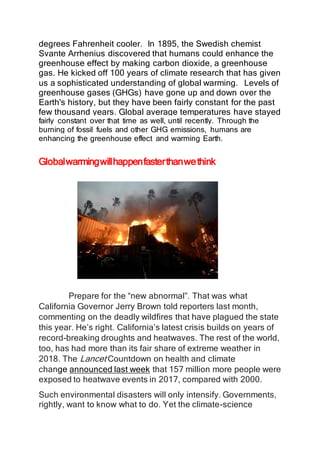
Prepare for the “new abnormal”. That was what
California Governor Jerry Brown told reporters last month,
commenting on the deadly wildfires that have plagued the state
this year. He’s right. California’s latest crisis builds on years of
record-breaking droughts and heatwaves. The rest of the world,
too, has had more than its fair share of extreme weather in
2018. The Lancet Countdown on health and climate
change announced last week that 157 million more people were
exposed to heatwave events in 2017, compared with 2000.
Such environmental disasters will only intensify. Governments,
rightly, want to know what to do. Yet the climate-science
community is struggling to offer useful answers. In October, the
Intergovernmental Panel on Climate Change (IPCC) released a
report setting out why we must stop global warming at 1.5 °C
above pre-industrial levels, and how to do so1. It is grim
reading. If the planet warms by 2 °C — the widely touted
temperature limit in the 2015 Paris climate agreement — twice
as many people will face water scarcity than if warming is
limited to 1.5 °C. That extra warming will also expose more than
1.5 billion people to deadly heat extremes, and hundreds of
millions of individuals to vector-borne diseases such as malaria,
among other harms. But the latest IPCC special report
underplays another alarming fact: global warming is
accelerating. Three trends — rising emissions, declining air
pollution and natural climate cycles — will combine over the next
20 years to make climate change faster and more furious than
anticipated. In our view, there’s a good chance that we could
breach the 1.5 °C level by 2030, not by 2040 as projected in the
special report (see ‘Accelerated warming’). The climate-
modelling community has not grappled enough with the rapid
changes that policymakers care most about, preferring to focus
on longer-term trends and equilibria.
Policymakers have less time to respond than they thought.
Governments need to invest even more urgently in schemes
that protect homes from floods and fires and help people to
manage heat stress (especially older individuals and those
living in poverty). Nations need to make their forests and farms
more resilient to droughts, and prepare coasts for inundation.
Rapid warming will create a greater need for emissions policies
that yield the quickest changes in climate, such as controls on
soot, methane and hydrofluorocarbon (HFC) gases. There
might even be a case for solar geoengineering — cooling the
planet by, for instance, seeding reflective particles in the
stratosphere to act as a sunshade.
Climate scientists must supply the evidence policymakers will
need and provide assessments for the next 25 years. They
should advise policymakers on which climate-warming
pollutants to limit first to gain the most climate benefit. They
should assess which policies can be enacted most swiftly and
successfully in the real world, where political, administrative
and economic constraints often make abstract, ‘ideal’ policies
impractical.
Speeding freight train
Three lines of evidence suggest that global warming will
be faster than projected in the recent IPCC special report.
First, greenhouse-gas emissions are still rising. In 2017,
industrial carbon dioxide emissions are estimated to have
reached about 37 gigatonnes2. This puts them on track with the
highest emissions trajectory the IPCC has modelled so far. This
dark news means that the next 25 years are poised to warm at
a rate of 0.25–0.32 °C per decade3. That is faster than the
0.2 °C per decade that we have experienced since the 2000s,
and which the IPCC used in its special report.
Second, governments are cleaning up air pollution faster than
the IPCC and most climate modellers have assumed. For
example, China reduced sulfur dioxide emissions from its
power plants by 7–14% between 2014 and 2016 (ref. 4).
Mainstream climate models had expected them to rise. Lower
pollution is better for crops and public health5. But aerosols,
including sulfates, nitrates and organic compounds, reflect
sunlight. This shield of aerosols has kept the planet cooler,
possibly by as much as 0.7 °C globally6.
Third, there are signs that the planet might be entering a natural
warm phase that could last for a couple of decades. The Pacific
Ocean seems to be warming up, in accord with a slow climate
cycle known as the Interdecadal Pacific Oscillation7. This cycle
modulates temperatures over the equatorial Pacific and over
North America. Similarly, the mixing of deep and surface waters
in the Atlantic Ocean (the Atlantic meridional overturning
circulation) looks to have weakened since 2004, on the basis of
data from drifting floats that probe the deep ocean8. Without
this mixing, more heat will stay in the atmosphere rather than
going into the deep oceans, as it has in the past.
These three forces reinforce each other. We estimate that rising
greenhouse-gas emissions, along with declines in air pollution,
bring forward the estimated date of 1.5 °C of warming to around
2030, with the 2 °C boundary reached by 2045. These could
happen sooner with quicker shedding of air pollutants. Adding
in natural decadal fluctuations raises the odds of blasting
through 1.5 °C by 2025 to at least 10% (ref. 9). By comparison,
the IPCC assigned probabilities of 17% and 83% for crossing
the 1.5 °C mark by 2030 and 2052, respectively.
Four fronts
Assess science in the near term. Policymakers should
ask the IPCC for another special report, this time on the rates of
climate change over the next 25 years. The panel should also
look beyond the physical science itself and assess the speed at
which political systems can respond, taking into account
pressures to maintain the status quo from interest groups and
bureaucrats. Researchers should improve climate models to
describe the next 25 years in more detail, including the latest
data on the state of the oceans and atmosphere, as well as
natural cycles. They should do more to quantify the odds and
impacts of extreme events. The evidence will be hard to muster,
but it will be more useful in assessing real climate dangers and
responses.
Rethink policy goals. Warming limits, such as the 1.5 °C goal,
should be recognized as broad planning tools. Too often they
are misconstrued as physical thresholds around which to
design policies. The excessive reliance on ‘negative emissions
technologies’ (that take up CO2) in the IPCC special report
shows that it becomes harder to envision realistic policies the
closer the world gets to such limits. It’s easy to bend models on
paper, but much harder to implement real policies that work.
Realistic goals should be set based on political and social
trade-offs, not just on geophysical parameters. They should
come out of analyses of costs, benefits and feasibility.
Assessments of these trade-offs must be embedded in the
Paris climate process, which needs a stronger compass to
guide its evaluations of how realistic policies affect emissions.
Better assessment can motivate action but will also be
politically controversial: it will highlight gaps between what
countries say they will do to control emissions, and what needs
to be achieved collectively to limit warming. Information about
trade-offs must therefore come from outside the formal
intergovernmental process — from national academies of
sciences, subnational partnerships and non-governmental
organizations.
Design strategies for adaptation. The time for rapid adaptation
has arrived. Policymakers need two types of information from
scientists to guide their responses. First, they need to know
what the potential local impacts will be at the scales of counties
to cities. Some of this information could be gleaned by
combining fine-resolution climate impact assessments with
artificial intelligence for ‘big data’ analyses of weather extremes,
health, property damage and other variables. Second,
policymakers need to understand uncertainties in the ranges of
probable climate impacts and responses. Even regions that are
proactive in setting adaptation policies, such as California, lack
information about the ever-changing risks of extreme warming,
fires and rising seas. Research must be integrated across fields
and stakeholders — urban planners, public-health management,
agriculture and ecosystem services. Adaptation strategies
should be adjustable if impacts unfold differently. More planning
and costing is needed around the worst-case outcomes.
Understand options for rapid response. Climate assessments
must evaluate quick ways of lessening climate impacts, such as
through reducing emissions of methane, soot (or black carbon)
and HFCs. Per tonne, these three ‘super pollutants’ have 25 to
thousands of times the impact of CO2. Their atmospheric
lifetimes are short — in the range of weeks (for soot) to about a
decade (for methane and HFCs). Slashing these pollutants
would potentially halve the warming trend over the next 25
years10.
There has been progress on this front. At the Global Climate
Action summit held in September in San Francisco, California,
the United States Climate Alliance — a coalition of state
governors representing 40% of the US population — issued a
road map to reduce emissions of methane, HFCs and soot by
40–50% by 2030. The 2016 Kigali amendment to the Montreal
Protocol, which will go into force by January 2019, is set to
slash HFC emissions by 80% over the next 30 years.
Various climate engineering options should be on the table as
an emergency response. If global conditions really deteriorate,
we might be forced to extract large volumes of excess
CO2 directly from the atmosphere. An even faster emergency
response could be to inject aerosols into the atmosphere to
lower the amount of solar radiation heating the planet, as air
pollution does. This option is hugely controversial, and might
have unintended consequences, such as altering rainfall
patterns that lead to drying of the tropics. So research and
planning are crucial, in case this option is needed. Until there is
investment in testing and technical preparedness — today, there
is almost none — the chances are high that the wrong kinds of
climate-engineering scheme will be deployed by irresponsible
parties who are uninformed by research11.
For decades, scientists and policymakers have framed the
climate-policy debate in a simple way: scientists analyse long-
term goals, and policymakers pretend to honour them. Those
days are over. Serious climate policy must focus more on the
near-term and on feasibility. It must consider the full range of
options, even though some are uncomfortable and freighted
with risk.
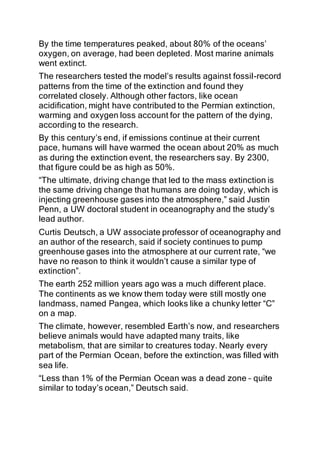
‘Global warming mirrors Earth’s largest extinction event’
largest mass extinction event in Earth’s history.
Researchers have long suspected that volcanic eruptions
triggered “the Great Dying”, as the end of the Permian geologic
period is sometimes called, but exactly how so many creatures
died has been something of a mystery.
Now scientists at the University of Washington (UW) and
Stanford in the United States believe their models reveal how
so many animals were killed, and they see frightening parallels
in the path our planet is on today.
Models of the effects of volcanic greenhouse-gas releases
showed the earth warming dramatically and oxygen
disappearing from its oceans, leaving many marine animals
unable to breathe, according to a study published on Thursday
in the peer-reviewed journal Science.
By the time temperatures peaked, about 80% of the oceans’
oxygen, on average, had been depleted. Most marine animals
went extinct.
The researchers tested the model’s results against fossil-record
patterns from the time of the extinction and found they
correlated closely. Although other factors, like ocean
acidification, might have contributed to the Permian extinction,
warming and oxygen loss account for the pattern of the dying,
according to the research.
By this century’s end, if emissions continue at their current
pace, humans will have warmed the ocean about 20% as much
as during the extinction event, the researchers say. By 2300,
that figure could be as high as 50%.
“The ultimate, driving change that led to the mass extinction is
the same driving change that humans are doing today, which is
injecting greenhouse gases into the atmosphere,” said Justin
Penn, a UW doctoral student in oceanography and the study’s
lead author.
Curtis Deutsch, a UW associate professor of oceanography and
an author of the research, said if society continues to pump
greenhouse gases into the atmosphere at our current rate, “we
have no reason to think it wouldn’t cause a similar type of
extinction”.
The earth 252 million years ago was a much different place.
The continents as we know them today were still mostly one
landmass, named Pangea, which looks like a chunky letter “C”
on a map.
The climate, however, resembled Earth’s now, and researchers
believe animals would have adapted many traits, like
metabolism, that are similar to creatures today. Nearly every
part of the Permian Ocean, before the extinction, was filled with
sea life.
“Less than 1% of the Permian Ocean was a dead zone – quite
similar to today’s ocean,” Deutsch said.
It took a supercomputer more than six months to simulate all
the changes the volcanic eruptions are suspected of causing
during the Permian period. The computer models go into
remarkable detail – simulating things like clouds, ocean currents
and marine plant life – in describing what temperatures and
conditions were like on Earth then.
To measure how rising temperatures and less oxygen would
affect animal species of the Permian period, the researchers
used 61 modern creatures – crustaceans, fish, shellfish, corals
and sharks.
The researchers believe these animals would have similar
temperature and oxygen sensitivities to Permian species
because the animals adapted to live in similar climates.
In their model, the researchers were able to quantify the loss of
habitat as species faced increasingly challenging ocean
conditions. Surface-temperature rise and oxygen loss were
more substantial in areas farther from the equator. Extinction
rates also increased at higher latitudes.
Animals in the tropics were already accustomed to warmer
temperatures and lower oxygen levels before the volcanic
eruptions shifted the climate, according to the research. As the
world warmed, they could move along with their habitat.
Marine creatures that favoured cold waters and high oxygen
levels fared worse: They had nowhere to go.
In modern oceans, warming and oxygen loss have also been
more pronounced near the poles, researchers said, drawing
another analogue between the shift in climate some 252 million
years ago and what’s happening today.
“The study tells us what’s at the end of the road if we let climate
(change) keep going. The further we go, the more species
we’re likely to lose,” Deutsch said.
“That’s frightening. The loss of species is irreversible.” — The
Seattle Times/Tribune News Service
Global Warming and Its Effects
Global warming which is also referred to as climate
change, is the observed rise in the average temperature of
the Earth's climate system the global surface temperature is
likely to rise a further 0.3 to 1.7 °C in the lowest emissions
scenario, and 2.6 to 4.8 °C in the highest emissions scenario
.These readings have been recorded by the “national science
academies of the major industrialized nations”. Future climate
change and impacts will differ from region to region. Expected
effects include increase in global temperatures, rising sea levels,
changing precipitation, and expansion of deserts.
Causes:
Global warming is a serious environmental issues. The
causes are divided into two categories include "natural" and
"human influences" of global warming.
Natural Causes of Global Warming:
 rotation of the sun that changes the intensity of sunlightand
moving closer to the earth
 greenhouse gases
 Volcanic eruption.
Human Influences on Global Warming:
 industrial revolution
 Mining
 Deforestation
Effects:
 heat waves,
 droughts,
 heavy rainfall with floods,
 heavy snowfall ,
 ocean acidification,
 species extinctions due to shifting temperature regimes
solutions:
 To reduce gasoline means we have to choose a hybrid car
that reduce using gasoline. However, petrol prices are
increasing.If a person everyday drives to work they need to
pump petrol after 3 days and causes carbon dioxide. Yet
other way to reduce gasoline is take public transport or
carpool to work. It can help reduce carbon dioxide and save
cost as well.
 Recycle can reduce garbage by reusing plastic bags,
bottles, papers or glass. for an example buy food, and use
our own containers instead of plastic bags. Another
example is after drinking water from bottle; we can reuse
it or use our own bottle. If all this is being reuse,it can help
upto great extend to eradicate global warming
 Finally, human should stop open burning such as burning
dry leafs or burning garbage. It will release carbon dioxide
if its burnt with garbage and plastic.
 Besides, government should
reduce deforestation because the earth temperatures is
increasing. Trees will help to improve the temperature on
earth
 Ozone depletion
 ocean acidification
 species extinctions due to shifting temperature regimes
 Deforestation
 Volcanic eruption
คำศัพท์ แปล
announced last week ประกำศเมื่อสัปดำห์ที่แล้ว
season ฤดูกำล
climate ภูมิอำกำศ
Weather สภำพอำกำศ
Global Wind Patterns กระแสลมโลก
Atmosphere บรรยำกำศ
climate change กำรเปลี่ยนแปลงภูมิอำกำศ
climate system ระบบภูมิอำกำศ
Envelops ห่อหุ้ม
Carbon dioxide ก๊ำซคำร์บอนไดออกไซด์
resulting ส่งผลให้
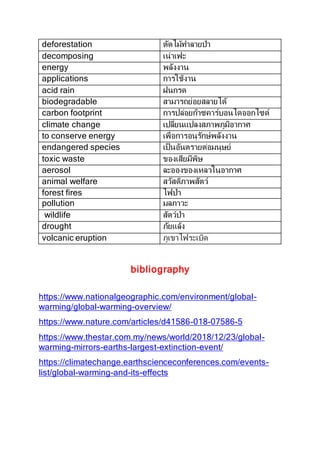
deforestation ตัดไม้ทำลำยป่ำ
decomposing เน่ำเฟะ
energy พลังงำน
applications กำรใช้งำน
acid rain ฝนกรด
biodegradable สำมำรถย่อยสลำยได้
carbon footprint กำรปล่อยก๊ำซคำร์บอนไดออกไซด์
climate change เปลี่ยนแปลงสภำพภูมิอำกำศ
to conserve energy เพื่อกำรอนุรักษ์พลังงำน
endangered species เป็นอันตรำยต่อมนุษย์
toxic waste ของเสียมีพิษ
aerosol ละอองของเหลวในอำกำศ
animal welfare สวัสดิภำพสัตว์
forest fires ไฟป่ำ
pollution มลภำวะ
wildlife สัตว์ป่ำ
drought ภัยแล้ง
volcanic eruption ภูเขำไฟระเบิด
bibliography
https://www.nationalgeographic.com/environment/global-
warming/global-warming-overview/
https://www.nature.com/articles/d41586-018-07586-5
https://www.thestar.com.my/news/world/2018/12/23/global-
warming-mirrors-earths-largest-extinction-event/
https://climatechange.earthscienceconferences.com/events-
list/global-warming-and-its-effects

Global warming

  • 1.
    GLOBAL WARMING Glaciers aremelting, sea levels are rising, cloud forests are dying, and wildlife is scrambling to keep pace. It's becoming clear that humans have caused most of the past century's warming by releasing heat-trapping gases as we power our modern lives. Called greenhouse gases, their levels are higher now than in the last 650,000 years. We call the result global warming, but it is causing a set of changes to the Earth's climate, or long-term weather patterns, that varies from place to place. As the Earth spins each day, the new heat swirls with it, picking up moisture over the oceans, rising here, settling there. It's changing the rhythms of climate that all living things have come to rely upon. [Watch Polar Bears 101]. What will we do to slow this warming? How will we cope with the changes we've already set into motion? While we struggle to figure it all out, the fate of the Earth as we know it—coasts, forests, farms, and snow-capped mountains—hangs in the balance. Greenhouse effect The "greenhouse effect" is the warming that happens when certain gases in Earth's atmosphere trap heat. These gases let in light but keep heat from escaping, like the glass walls of a greenhouse. First, sunlight shines onto the Earth's surface, where it is absorbed and then radiates back into the atmosphere as heat. In the atmosphere, “greenhouse” gases trap some of this heat, and the rest escapes into space. The more greenhouse gases are in the atmosphere, the more heat gets trapped. Scientists have known about the greenhouse effect since 1824, when Joseph Fourier calculated that the Earth would be much colder if it had no atmosphere. This greenhouse effect is what keeps the Earth's climate livable. Without it, the Earth's surface would be an average of about 60
  • 2.
    degrees Fahrenheit cooler.In 1895, the Swedish chemist Svante Arrhenius discovered that humans could enhance the greenhouse effect by making carbon dioxide, a greenhouse gas. He kicked off 100 years of climate research that has given us a sophisticated understanding of global warming. Levels of greenhouse gases (GHGs) have gone up and down over the Earth's history, but they have been fairly constant for the past few thousand years. Global average temperatures have stayed fairly constant over that time as well, until recently. Through the burning of fossil fuels and other GHG emissions, humans are enhancing the greenhouse effect and warming Earth. Globalwarmingwillhappenfasterthanwethink Prepare for the “new abnormal”. That was what California Governor Jerry Brown told reporters last month, commenting on the deadly wildfires that have plagued the state this year. He’s right. California’s latest crisis builds on years of record-breaking droughts and heatwaves. The rest of the world, too, has had more than its fair share of extreme weather in 2018. The Lancet Countdown on health and climate change announced last week that 157 million more people were exposed to heatwave events in 2017, compared with 2000. Such environmental disasters will only intensify. Governments, rightly, want to know what to do. Yet the climate-science
  • 3.
    community is strugglingto offer useful answers. In October, the Intergovernmental Panel on Climate Change (IPCC) released a report setting out why we must stop global warming at 1.5 °C above pre-industrial levels, and how to do so1. It is grim reading. If the planet warms by 2 °C — the widely touted temperature limit in the 2015 Paris climate agreement — twice as many people will face water scarcity than if warming is limited to 1.5 °C. That extra warming will also expose more than 1.5 billion people to deadly heat extremes, and hundreds of millions of individuals to vector-borne diseases such as malaria, among other harms. But the latest IPCC special report underplays another alarming fact: global warming is accelerating. Three trends — rising emissions, declining air pollution and natural climate cycles — will combine over the next 20 years to make climate change faster and more furious than anticipated. In our view, there’s a good chance that we could breach the 1.5 °C level by 2030, not by 2040 as projected in the special report (see ‘Accelerated warming’). The climate- modelling community has not grappled enough with the rapid changes that policymakers care most about, preferring to focus on longer-term trends and equilibria. Policymakers have less time to respond than they thought. Governments need to invest even more urgently in schemes that protect homes from floods and fires and help people to manage heat stress (especially older individuals and those living in poverty). Nations need to make their forests and farms more resilient to droughts, and prepare coasts for inundation. Rapid warming will create a greater need for emissions policies that yield the quickest changes in climate, such as controls on soot, methane and hydrofluorocarbon (HFC) gases. There might even be a case for solar geoengineering — cooling the planet by, for instance, seeding reflective particles in the stratosphere to act as a sunshade.
  • 4.
    Climate scientists mustsupply the evidence policymakers will need and provide assessments for the next 25 years. They should advise policymakers on which climate-warming pollutants to limit first to gain the most climate benefit. They should assess which policies can be enacted most swiftly and successfully in the real world, where political, administrative and economic constraints often make abstract, ‘ideal’ policies impractical. Speeding freight train Three lines of evidence suggest that global warming will be faster than projected in the recent IPCC special report. First, greenhouse-gas emissions are still rising. In 2017, industrial carbon dioxide emissions are estimated to have reached about 37 gigatonnes2. This puts them on track with the highest emissions trajectory the IPCC has modelled so far. This dark news means that the next 25 years are poised to warm at a rate of 0.25–0.32 °C per decade3. That is faster than the 0.2 °C per decade that we have experienced since the 2000s, and which the IPCC used in its special report. Second, governments are cleaning up air pollution faster than the IPCC and most climate modellers have assumed. For example, China reduced sulfur dioxide emissions from its power plants by 7–14% between 2014 and 2016 (ref. 4). Mainstream climate models had expected them to rise. Lower pollution is better for crops and public health5. But aerosols, including sulfates, nitrates and organic compounds, reflect sunlight. This shield of aerosols has kept the planet cooler, possibly by as much as 0.7 °C globally6. Third, there are signs that the planet might be entering a natural warm phase that could last for a couple of decades. The Pacific
  • 5.
    Ocean seems tobe warming up, in accord with a slow climate cycle known as the Interdecadal Pacific Oscillation7. This cycle modulates temperatures over the equatorial Pacific and over North America. Similarly, the mixing of deep and surface waters in the Atlantic Ocean (the Atlantic meridional overturning circulation) looks to have weakened since 2004, on the basis of data from drifting floats that probe the deep ocean8. Without this mixing, more heat will stay in the atmosphere rather than going into the deep oceans, as it has in the past. These three forces reinforce each other. We estimate that rising greenhouse-gas emissions, along with declines in air pollution, bring forward the estimated date of 1.5 °C of warming to around 2030, with the 2 °C boundary reached by 2045. These could happen sooner with quicker shedding of air pollutants. Adding in natural decadal fluctuations raises the odds of blasting through 1.5 °C by 2025 to at least 10% (ref. 9). By comparison, the IPCC assigned probabilities of 17% and 83% for crossing the 1.5 °C mark by 2030 and 2052, respectively. Four fronts Assess science in the near term. Policymakers should ask the IPCC for another special report, this time on the rates of climate change over the next 25 years. The panel should also look beyond the physical science itself and assess the speed at which political systems can respond, taking into account pressures to maintain the status quo from interest groups and bureaucrats. Researchers should improve climate models to describe the next 25 years in more detail, including the latest data on the state of the oceans and atmosphere, as well as natural cycles. They should do more to quantify the odds and impacts of extreme events. The evidence will be hard to muster, but it will be more useful in assessing real climate dangers and responses.
  • 6.
    Rethink policy goals.Warming limits, such as the 1.5 °C goal, should be recognized as broad planning tools. Too often they are misconstrued as physical thresholds around which to design policies. The excessive reliance on ‘negative emissions technologies’ (that take up CO2) in the IPCC special report shows that it becomes harder to envision realistic policies the closer the world gets to such limits. It’s easy to bend models on paper, but much harder to implement real policies that work. Realistic goals should be set based on political and social trade-offs, not just on geophysical parameters. They should come out of analyses of costs, benefits and feasibility. Assessments of these trade-offs must be embedded in the Paris climate process, which needs a stronger compass to guide its evaluations of how realistic policies affect emissions. Better assessment can motivate action but will also be politically controversial: it will highlight gaps between what countries say they will do to control emissions, and what needs to be achieved collectively to limit warming. Information about trade-offs must therefore come from outside the formal intergovernmental process — from national academies of sciences, subnational partnerships and non-governmental organizations. Design strategies for adaptation. The time for rapid adaptation has arrived. Policymakers need two types of information from scientists to guide their responses. First, they need to know what the potential local impacts will be at the scales of counties to cities. Some of this information could be gleaned by combining fine-resolution climate impact assessments with artificial intelligence for ‘big data’ analyses of weather extremes, health, property damage and other variables. Second, policymakers need to understand uncertainties in the ranges of probable climate impacts and responses. Even regions that are proactive in setting adaptation policies, such as California, lack information about the ever-changing risks of extreme warming, fires and rising seas. Research must be integrated across fields and stakeholders — urban planners, public-health management,
  • 7.
    agriculture and ecosystemservices. Adaptation strategies should be adjustable if impacts unfold differently. More planning and costing is needed around the worst-case outcomes. Understand options for rapid response. Climate assessments must evaluate quick ways of lessening climate impacts, such as through reducing emissions of methane, soot (or black carbon) and HFCs. Per tonne, these three ‘super pollutants’ have 25 to thousands of times the impact of CO2. Their atmospheric lifetimes are short — in the range of weeks (for soot) to about a decade (for methane and HFCs). Slashing these pollutants would potentially halve the warming trend over the next 25 years10. There has been progress on this front. At the Global Climate Action summit held in September in San Francisco, California, the United States Climate Alliance — a coalition of state governors representing 40% of the US population — issued a road map to reduce emissions of methane, HFCs and soot by 40–50% by 2030. The 2016 Kigali amendment to the Montreal Protocol, which will go into force by January 2019, is set to slash HFC emissions by 80% over the next 30 years. Various climate engineering options should be on the table as an emergency response. If global conditions really deteriorate, we might be forced to extract large volumes of excess CO2 directly from the atmosphere. An even faster emergency response could be to inject aerosols into the atmosphere to lower the amount of solar radiation heating the planet, as air pollution does. This option is hugely controversial, and might have unintended consequences, such as altering rainfall patterns that lead to drying of the tropics. So research and planning are crucial, in case this option is needed. Until there is investment in testing and technical preparedness — today, there is almost none — the chances are high that the wrong kinds of climate-engineering scheme will be deployed by irresponsible parties who are uninformed by research11.
  • 8.
    For decades, scientistsand policymakers have framed the climate-policy debate in a simple way: scientists analyse long- term goals, and policymakers pretend to honour them. Those days are over. Serious climate policy must focus more on the near-term and on feasibility. It must consider the full range of options, even though some are uncomfortable and freighted with risk. ‘Global warming mirrors Earth’s largest extinction event’ largest mass extinction event in Earth’s history. Researchers have long suspected that volcanic eruptions triggered “the Great Dying”, as the end of the Permian geologic period is sometimes called, but exactly how so many creatures died has been something of a mystery. Now scientists at the University of Washington (UW) and Stanford in the United States believe their models reveal how so many animals were killed, and they see frightening parallels in the path our planet is on today. Models of the effects of volcanic greenhouse-gas releases showed the earth warming dramatically and oxygen disappearing from its oceans, leaving many marine animals unable to breathe, according to a study published on Thursday in the peer-reviewed journal Science.
  • 9.
    By the timetemperatures peaked, about 80% of the oceans’ oxygen, on average, had been depleted. Most marine animals went extinct. The researchers tested the model’s results against fossil-record patterns from the time of the extinction and found they correlated closely. Although other factors, like ocean acidification, might have contributed to the Permian extinction, warming and oxygen loss account for the pattern of the dying, according to the research. By this century’s end, if emissions continue at their current pace, humans will have warmed the ocean about 20% as much as during the extinction event, the researchers say. By 2300, that figure could be as high as 50%. “The ultimate, driving change that led to the mass extinction is the same driving change that humans are doing today, which is injecting greenhouse gases into the atmosphere,” said Justin Penn, a UW doctoral student in oceanography and the study’s lead author. Curtis Deutsch, a UW associate professor of oceanography and an author of the research, said if society continues to pump greenhouse gases into the atmosphere at our current rate, “we have no reason to think it wouldn’t cause a similar type of extinction”. The earth 252 million years ago was a much different place. The continents as we know them today were still mostly one landmass, named Pangea, which looks like a chunky letter “C” on a map. The climate, however, resembled Earth’s now, and researchers believe animals would have adapted many traits, like metabolism, that are similar to creatures today. Nearly every part of the Permian Ocean, before the extinction, was filled with sea life. “Less than 1% of the Permian Ocean was a dead zone – quite similar to today’s ocean,” Deutsch said.
  • 10.
    It took asupercomputer more than six months to simulate all the changes the volcanic eruptions are suspected of causing during the Permian period. The computer models go into remarkable detail – simulating things like clouds, ocean currents and marine plant life – in describing what temperatures and conditions were like on Earth then. To measure how rising temperatures and less oxygen would affect animal species of the Permian period, the researchers used 61 modern creatures – crustaceans, fish, shellfish, corals and sharks. The researchers believe these animals would have similar temperature and oxygen sensitivities to Permian species because the animals adapted to live in similar climates. In their model, the researchers were able to quantify the loss of habitat as species faced increasingly challenging ocean conditions. Surface-temperature rise and oxygen loss were more substantial in areas farther from the equator. Extinction rates also increased at higher latitudes. Animals in the tropics were already accustomed to warmer temperatures and lower oxygen levels before the volcanic eruptions shifted the climate, according to the research. As the world warmed, they could move along with their habitat. Marine creatures that favoured cold waters and high oxygen levels fared worse: They had nowhere to go. In modern oceans, warming and oxygen loss have also been more pronounced near the poles, researchers said, drawing another analogue between the shift in climate some 252 million years ago and what’s happening today. “The study tells us what’s at the end of the road if we let climate (change) keep going. The further we go, the more species we’re likely to lose,” Deutsch said. “That’s frightening. The loss of species is irreversible.” — The Seattle Times/Tribune News Service Global Warming and Its Effects
  • 11.
    Global warming whichis also referred to as climate change, is the observed rise in the average temperature of the Earth's climate system the global surface temperature is likely to rise a further 0.3 to 1.7 °C in the lowest emissions scenario, and 2.6 to 4.8 °C in the highest emissions scenario .These readings have been recorded by the “national science academies of the major industrialized nations”. Future climate change and impacts will differ from region to region. Expected effects include increase in global temperatures, rising sea levels, changing precipitation, and expansion of deserts. Causes: Global warming is a serious environmental issues. The causes are divided into two categories include "natural" and "human influences" of global warming. Natural Causes of Global Warming:  rotation of the sun that changes the intensity of sunlightand moving closer to the earth  greenhouse gases  Volcanic eruption. Human Influences on Global Warming:  industrial revolution  Mining  Deforestation Effects:  heat waves,  droughts,  heavy rainfall with floods,  heavy snowfall ,
  • 12.
     ocean acidification, species extinctions due to shifting temperature regimes solutions:  To reduce gasoline means we have to choose a hybrid car that reduce using gasoline. However, petrol prices are increasing.If a person everyday drives to work they need to pump petrol after 3 days and causes carbon dioxide. Yet other way to reduce gasoline is take public transport or carpool to work. It can help reduce carbon dioxide and save cost as well.  Recycle can reduce garbage by reusing plastic bags, bottles, papers or glass. for an example buy food, and use our own containers instead of plastic bags. Another example is after drinking water from bottle; we can reuse it or use our own bottle. If all this is being reuse,it can help upto great extend to eradicate global warming  Finally, human should stop open burning such as burning dry leafs or burning garbage. It will release carbon dioxide if its burnt with garbage and plastic.  Besides, government should reduce deforestation because the earth temperatures is increasing. Trees will help to improve the temperature on earth  Ozone depletion  ocean acidification  species extinctions due to shifting temperature regimes  Deforestation  Volcanic eruption
  • 13.
    คำศัพท์ แปล announced lastweek ประกำศเมื่อสัปดำห์ที่แล้ว season ฤดูกำล climate ภูมิอำกำศ Weather สภำพอำกำศ Global Wind Patterns กระแสลมโลก Atmosphere บรรยำกำศ climate change กำรเปลี่ยนแปลงภูมิอำกำศ climate system ระบบภูมิอำกำศ Envelops ห่อหุ้ม Carbon dioxide ก๊ำซคำร์บอนไดออกไซด์ resulting ส่งผลให้
  • 14.
    deforestation ตัดไม้ทำลำยป่ำ decomposing เน่ำเฟะ energyพลังงำน applications กำรใช้งำน acid rain ฝนกรด biodegradable สำมำรถย่อยสลำยได้ carbon footprint กำรปล่อยก๊ำซคำร์บอนไดออกไซด์ climate change เปลี่ยนแปลงสภำพภูมิอำกำศ to conserve energy เพื่อกำรอนุรักษ์พลังงำน endangered species เป็นอันตรำยต่อมนุษย์ toxic waste ของเสียมีพิษ aerosol ละอองของเหลวในอำกำศ animal welfare สวัสดิภำพสัตว์ forest fires ไฟป่ำ pollution มลภำวะ wildlife สัตว์ป่ำ drought ภัยแล้ง volcanic eruption ภูเขำไฟระเบิด bibliography https://www.nationalgeographic.com/environment/global- warming/global-warming-overview/ https://www.nature.com/articles/d41586-018-07586-5 https://www.thestar.com.my/news/world/2018/12/23/global- warming-mirrors-earths-largest-extinction-event/ https://climatechange.earthscienceconferences.com/events- list/global-warming-and-its-effects