Submitted By: -- Course: B.Sc Botany(hons)
•Swati Singh-1934127
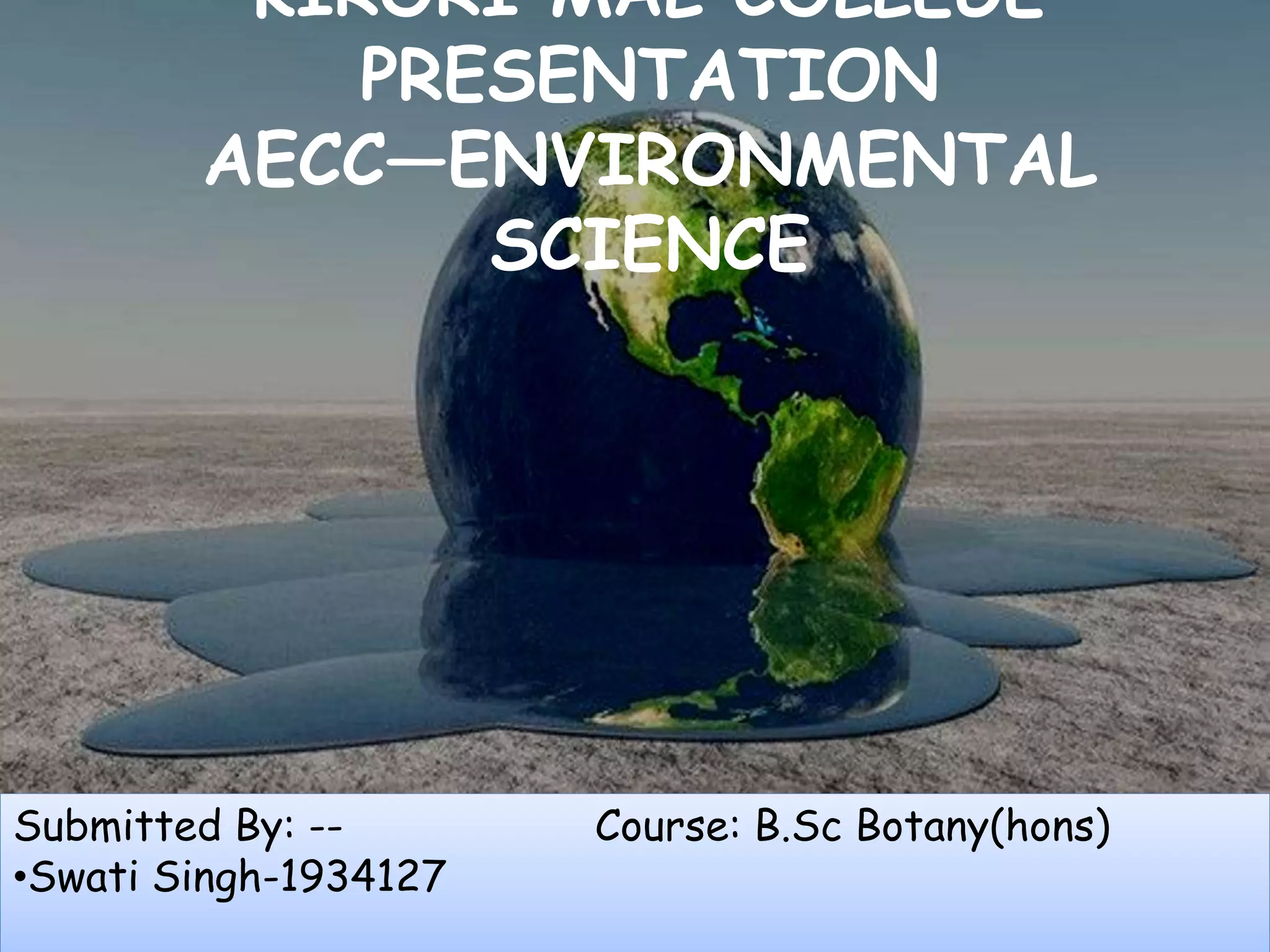
KIRORI MAL COLLEGE
PRESENTATION
AECC—ENVIRONMENTAL
SCIENCE
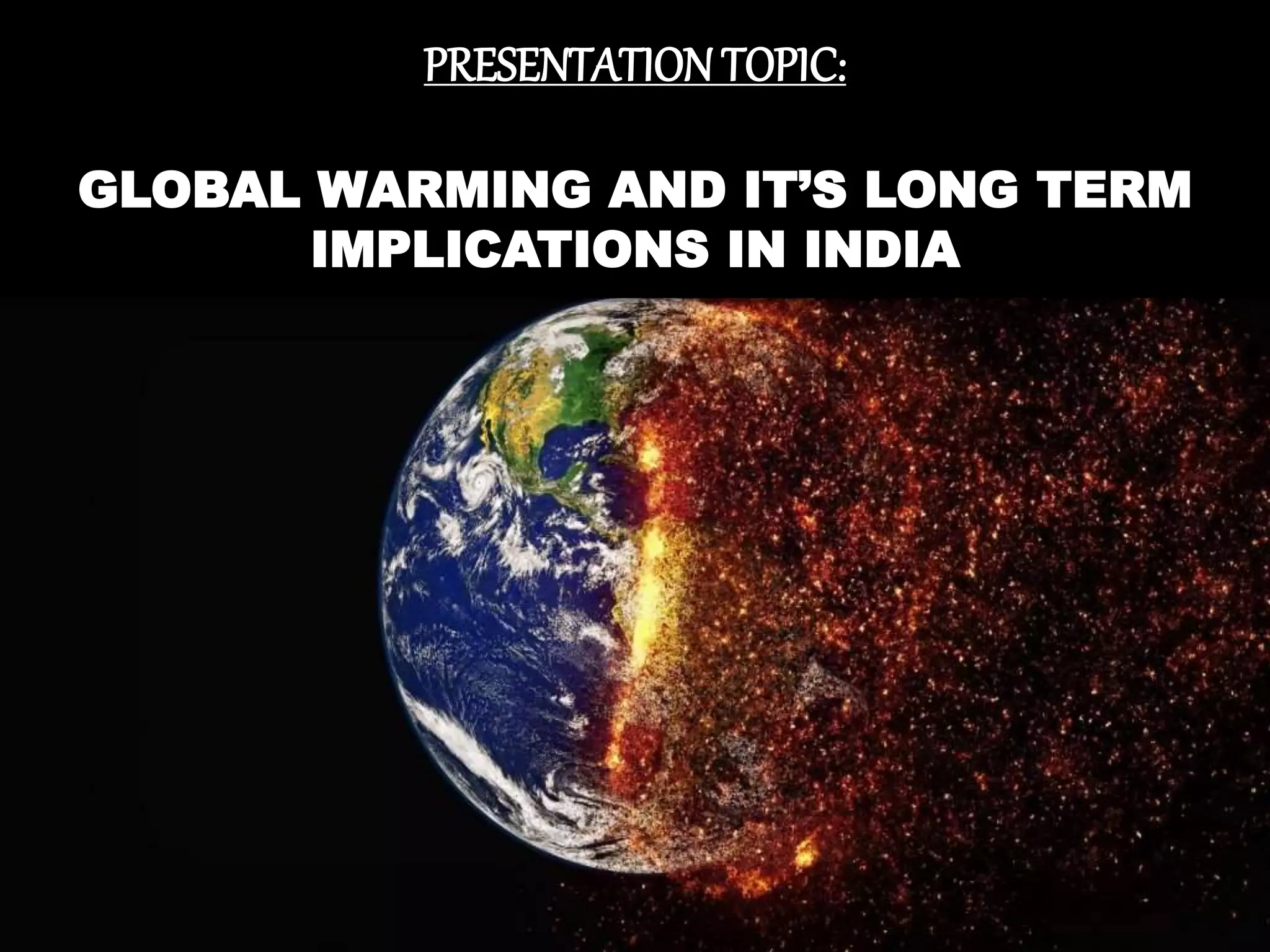
PRESENTATION TOPIC:
GLOBAL WARMING AND IT’S LONG TERM
IMPLICATIONS IN INDIA
TOPICS COVERED:-
What Is Global Warming?
What Are Causes Of Global Warming?
Consequences Of Global Warming
What Are The Other Effects Of Global
Warming?
Long Term Implications In India
Responding To Climate Change
Observed Changes In The Natural And Human
Environment
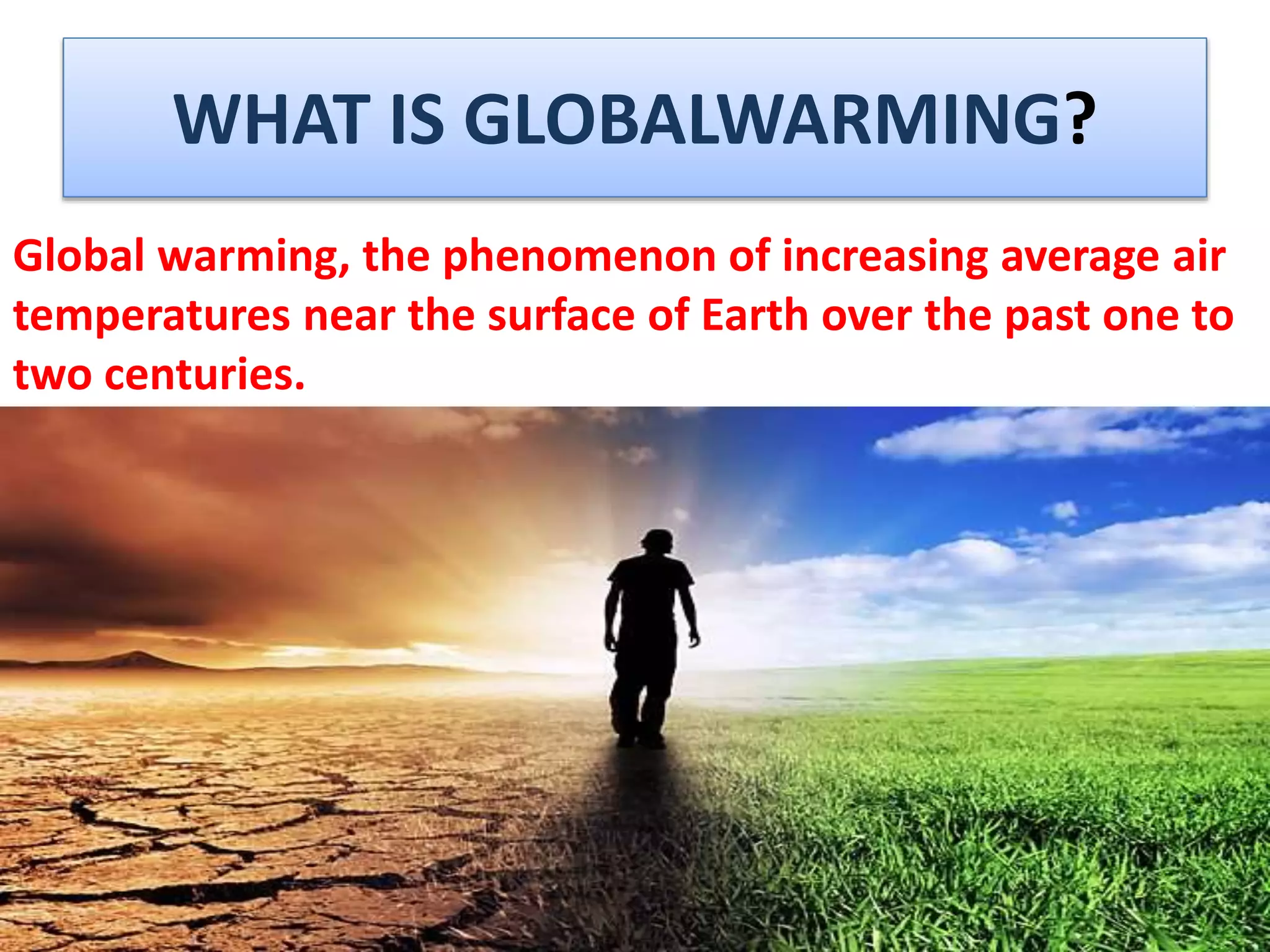
WHAT IS GLOBALWARMING?
Global warming, the phenomenon of increasing average air
temperatures near the surface of Earth over the past one to
two centuries.
How Do Scientist know about Global warming?
Climate scientists have since the mid-20th century gathered detailed
observations of various weather phenomena such as:
 temperatures
 precipitation
 storms
And of related influences on climate such as
 ocean currents
 atmosphere’s chemical composition
These data indicate that Earth’s climate has changed over almost every
conceivable timescale since the beginning of geologic time and that the
influence of human activities since at least the beginning of
the INDUSTRIAL REVOLUTION has been deeply woven into the very
fabric of climate change.
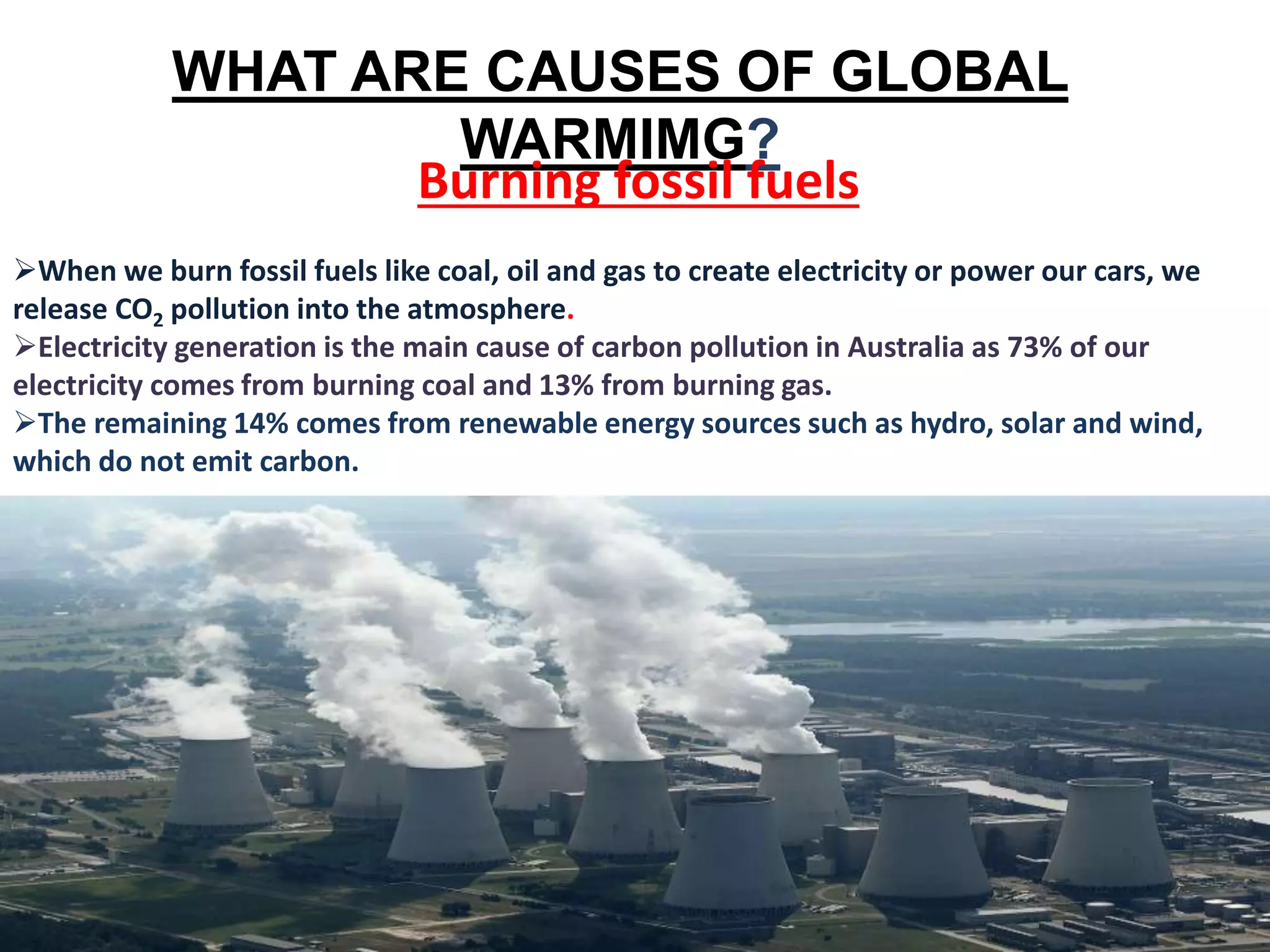
WHAT ARE CAUSES OF GLOBAL
WARMIMG?
Burning fossil fuels
When we burn fossil fuels like coal, oil and gas to create electricity or power our cars, we
release CO2 pollution into the atmosphere.
Electricity generation is the main cause of carbon pollution in Australia as 73% of our
electricity comes from burning coal and 13% from burning gas.
The remaining 14% comes from renewable energy sources such as hydro, solar and wind,
which do not emit carbon.
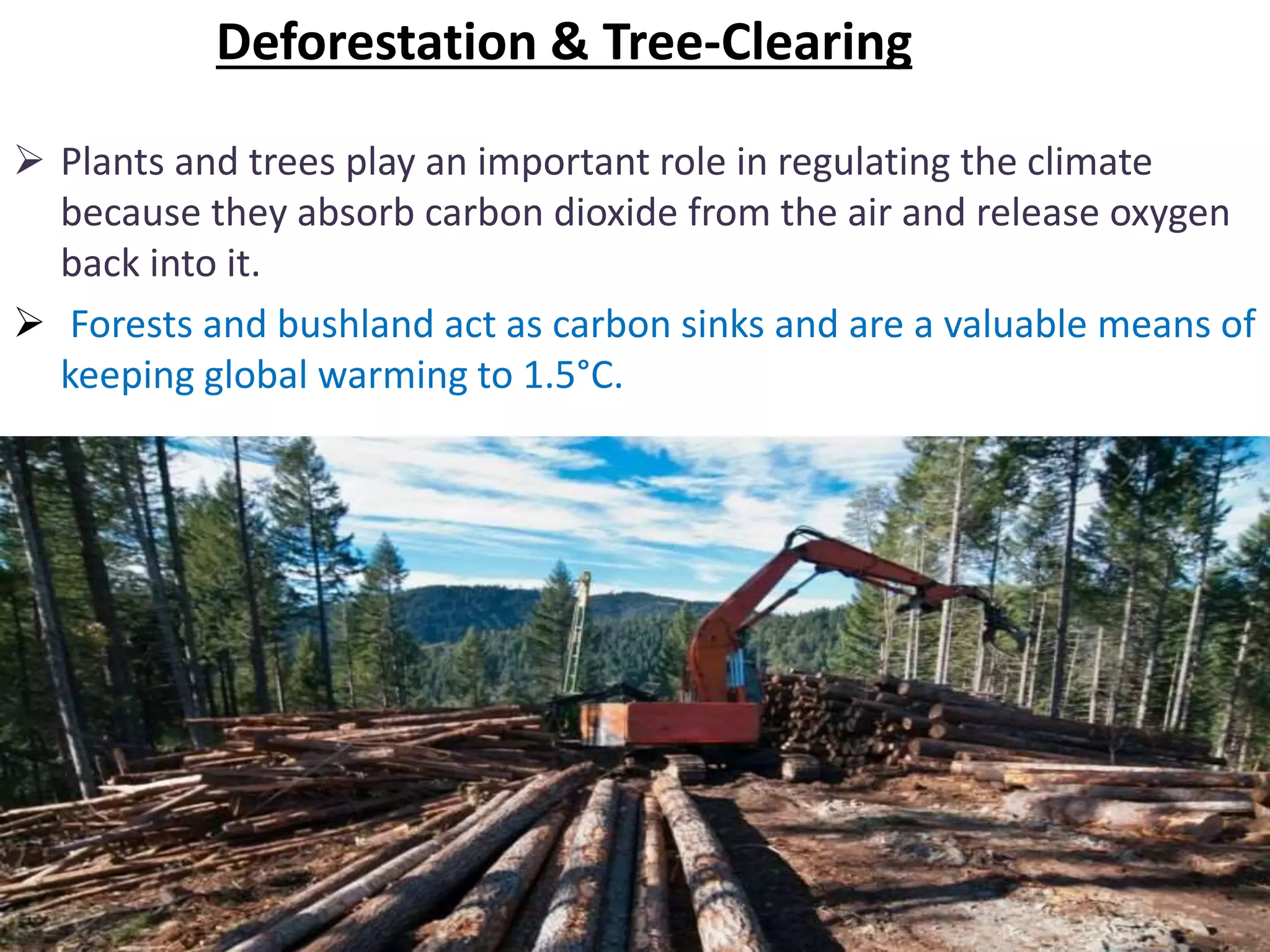
Deforestation & Tree-Clearing
 Plants and trees play an important role in regulating the climate
because they absorb carbon dioxide from the air and release oxygen
back into it.
 Forests and bushland act as carbon sinks and are a valuable means of
keeping global warming to 1.5°C.
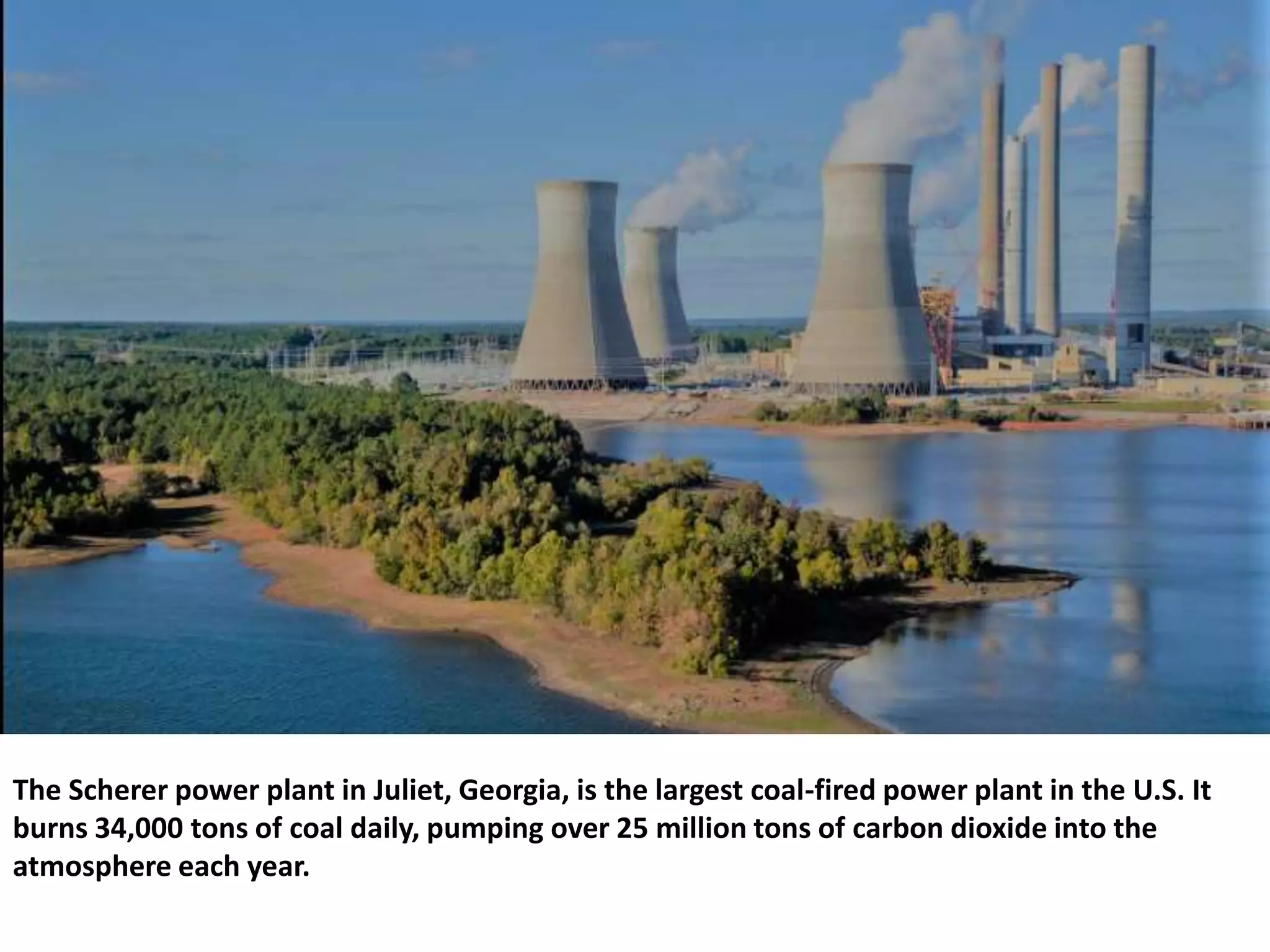
The Scherer power plant in Juliet, Georgia, is the largest coal-fired power plant in the U.S. It
burns 34,000 tons of coal daily, pumping over 25 million tons of carbon dioxide into the
atmosphere each year.
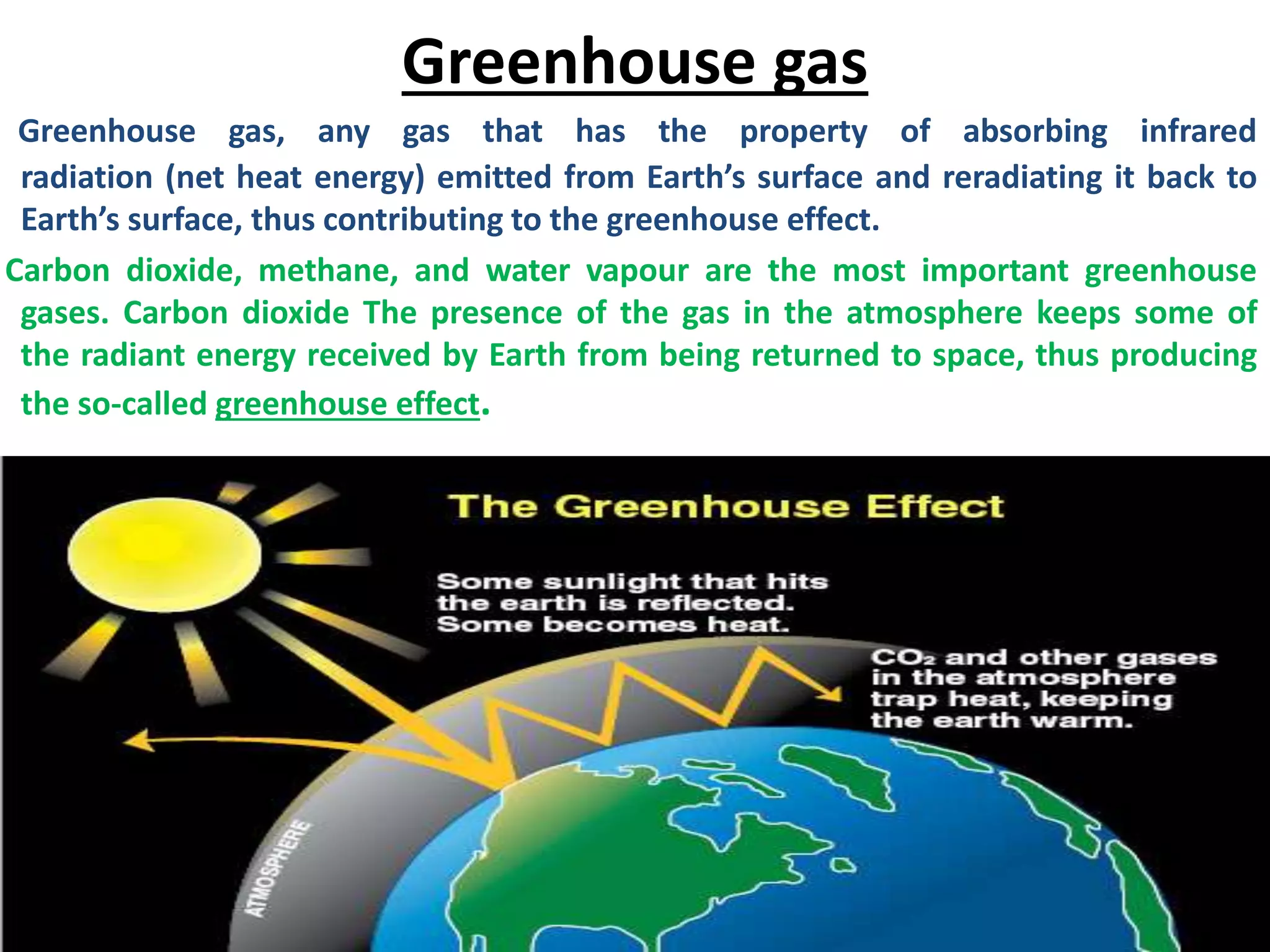
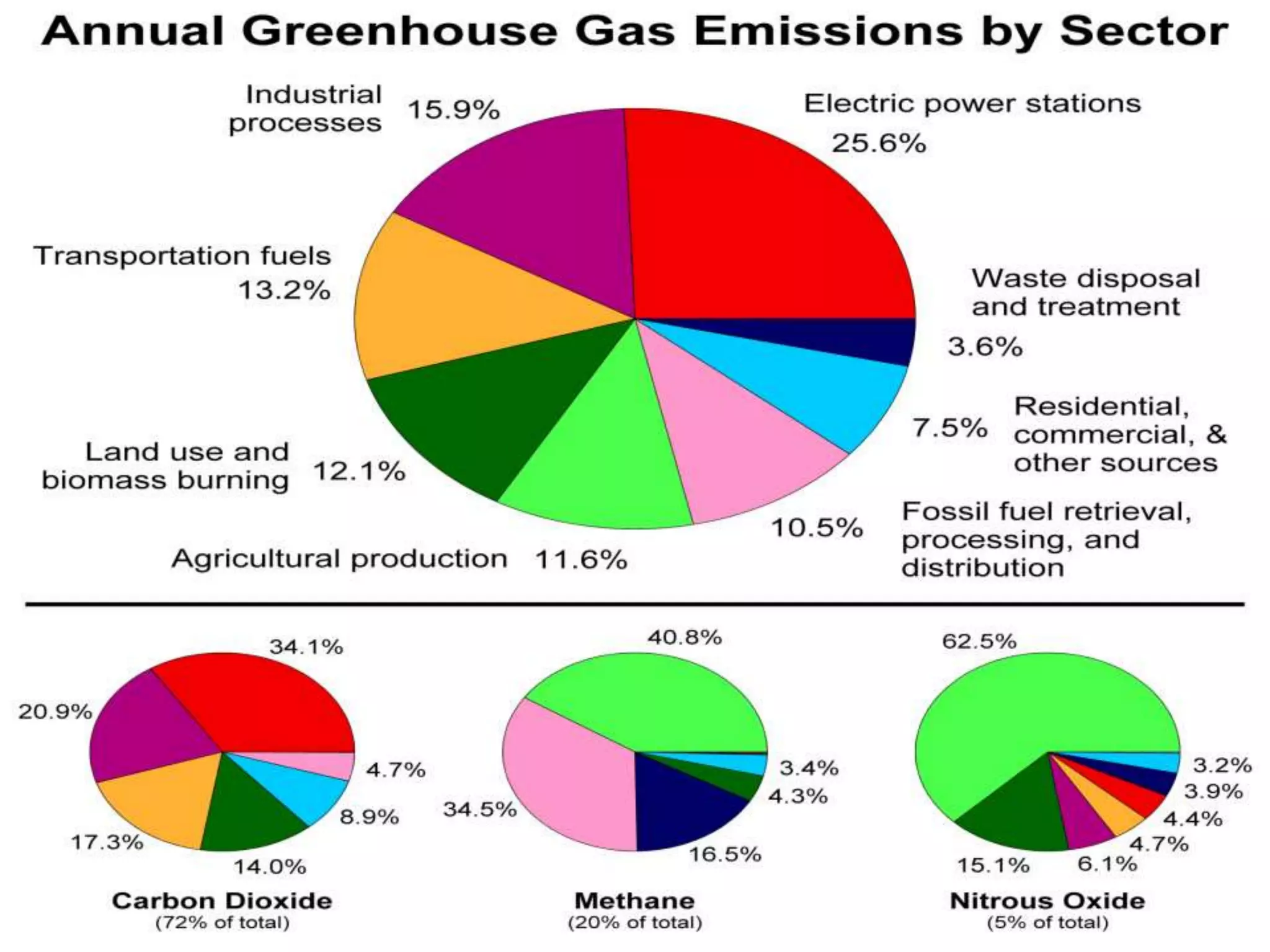
Greenhouse gas
Greenhouse gas, any gas that has the property of absorbing infrared
radiation (net heat energy) emitted from Earth’s surface and reradiating it back to
Earth’s surface, thus contributing to the greenhouse effect.
Carbon dioxide, methane, and water vapour are the most important greenhouse
gases. Carbon dioxide The presence of the gas in the atmosphere keeps some of
the radiant energy received by Earth from being returned to space, thus producing
the so-called greenhouse effect.
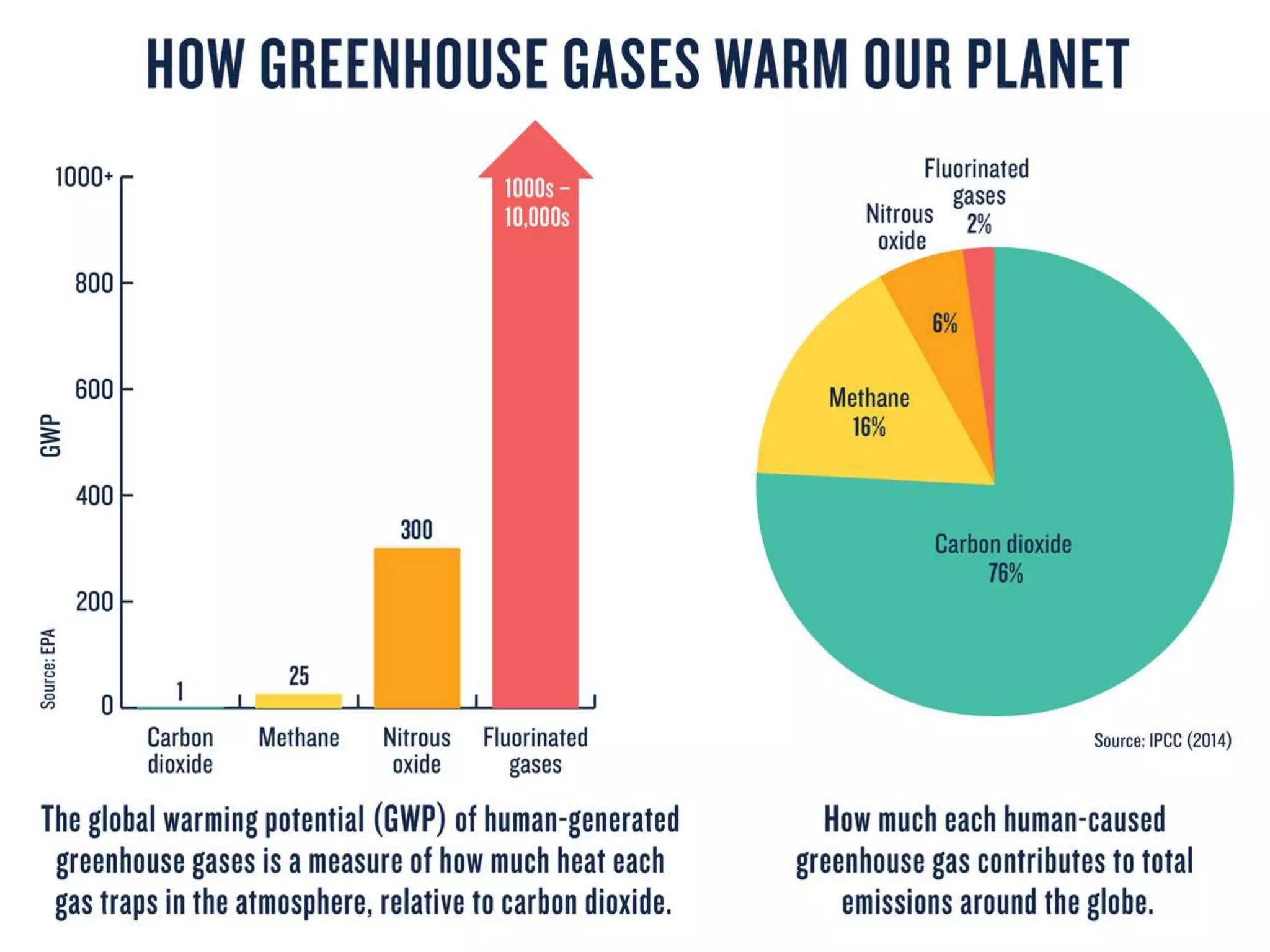
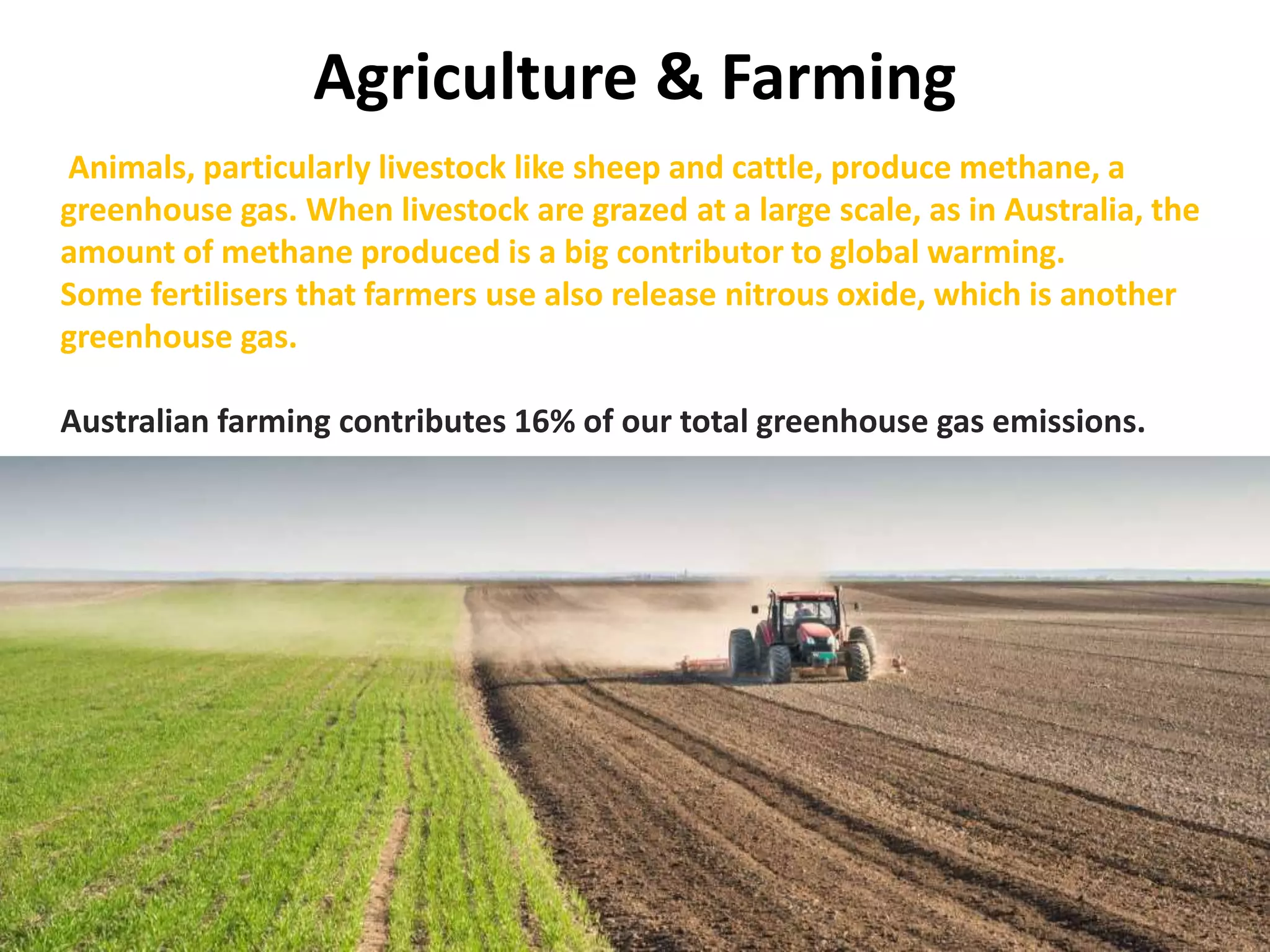
Agriculture & Farming
Animals, particularly livestock like sheep and cattle, produce methane, a
greenhouse gas. When livestock are grazed at a large scale, as in Australia, the
amount of methane produced is a big contributor to global warming.
Some fertilisers that farmers use also release nitrous oxide, which is another
greenhouse gas.
Australian farming contributes 16% of our total greenhouse gas emissions.
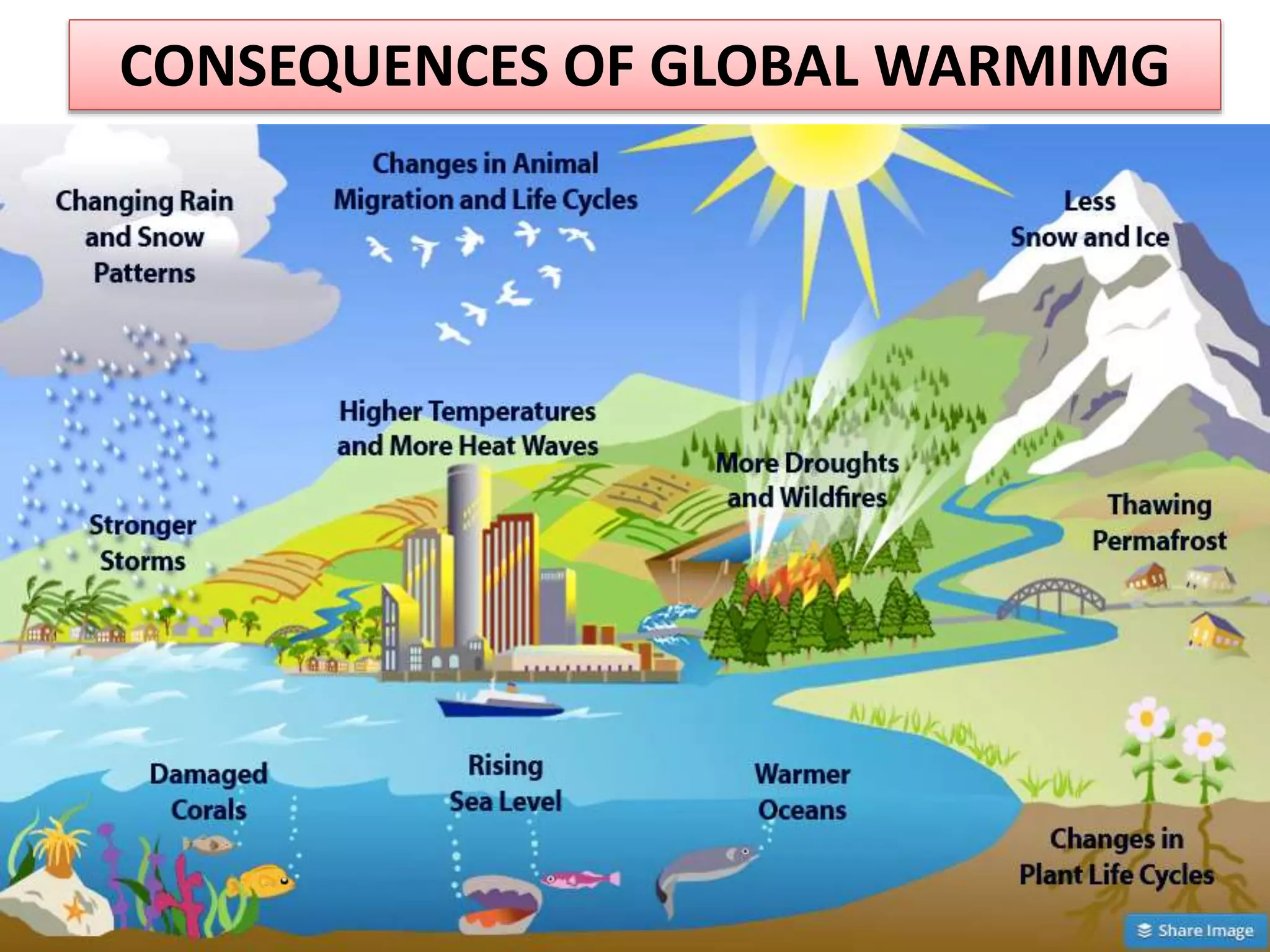
CONSEQUENCES OF GLOBAL WARMIMG
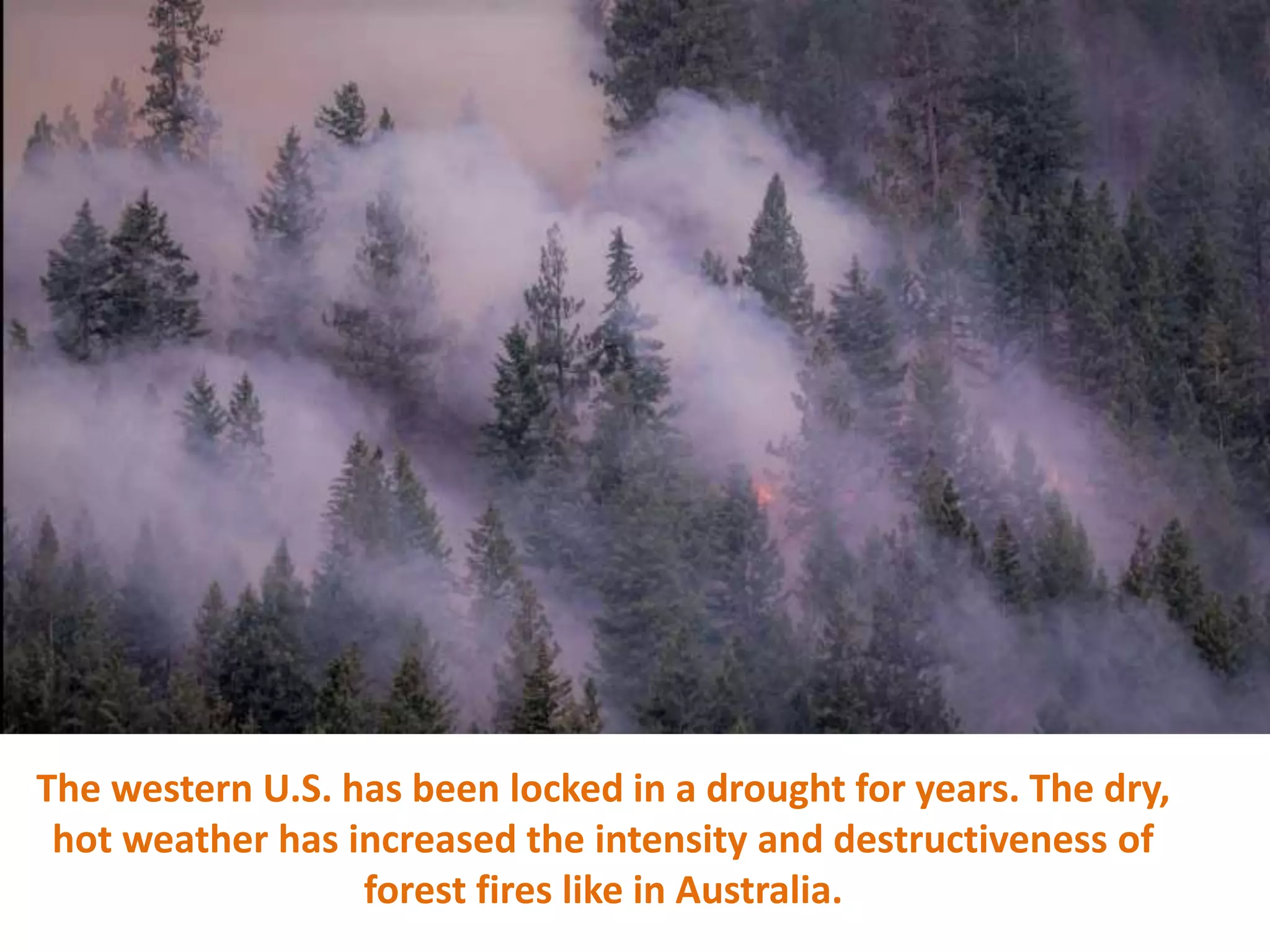
The western U.S. has been locked in a drought for years. The dry,
hot weather has increased the intensity and destructiveness of
forest fires like in Australia.
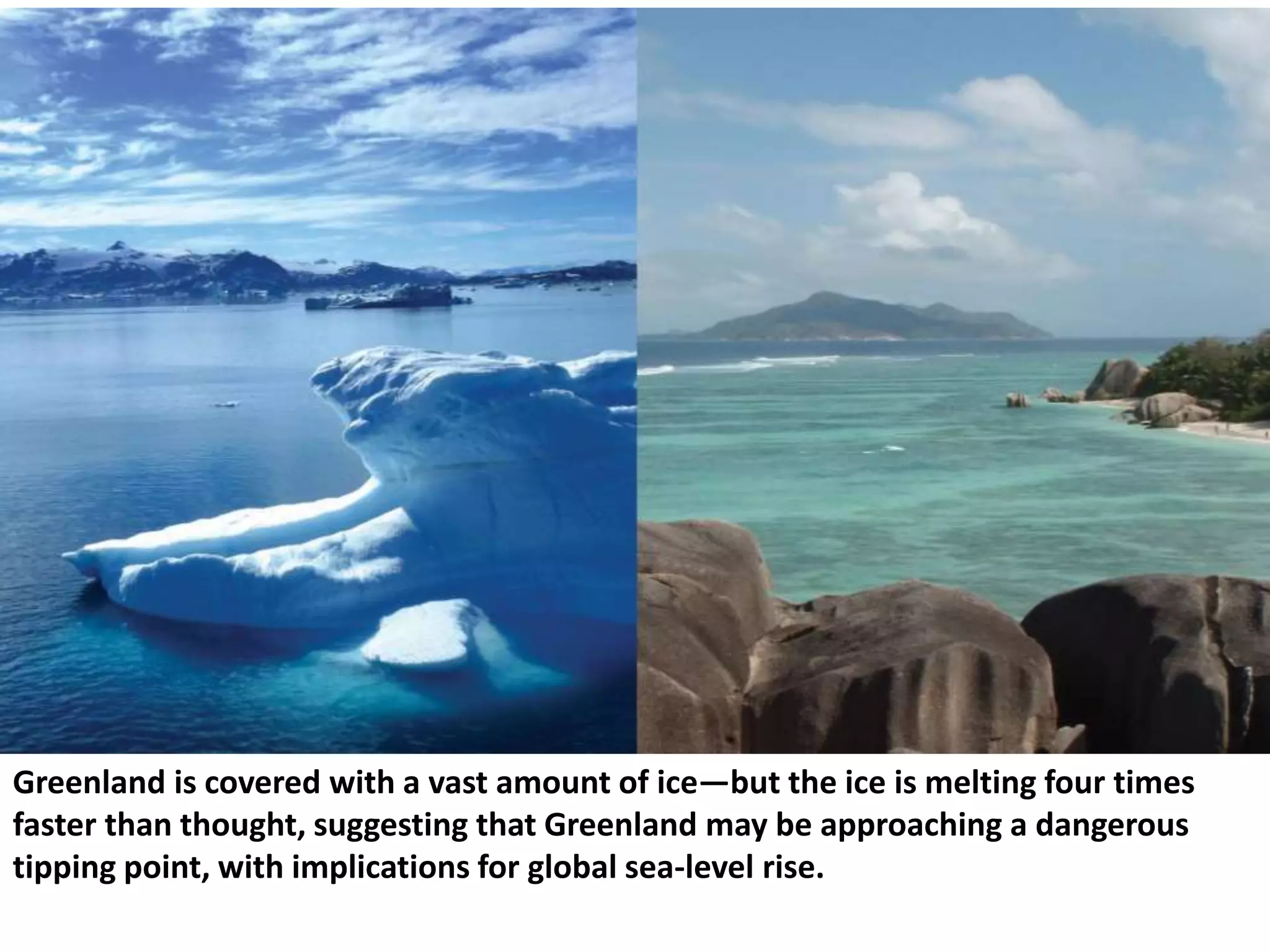
Greenland is covered with a vast amount of ice—but the ice is melting four times
faster than thought, suggesting that Greenland may be approaching a dangerous
tipping point, with implications for global sea-level rise.
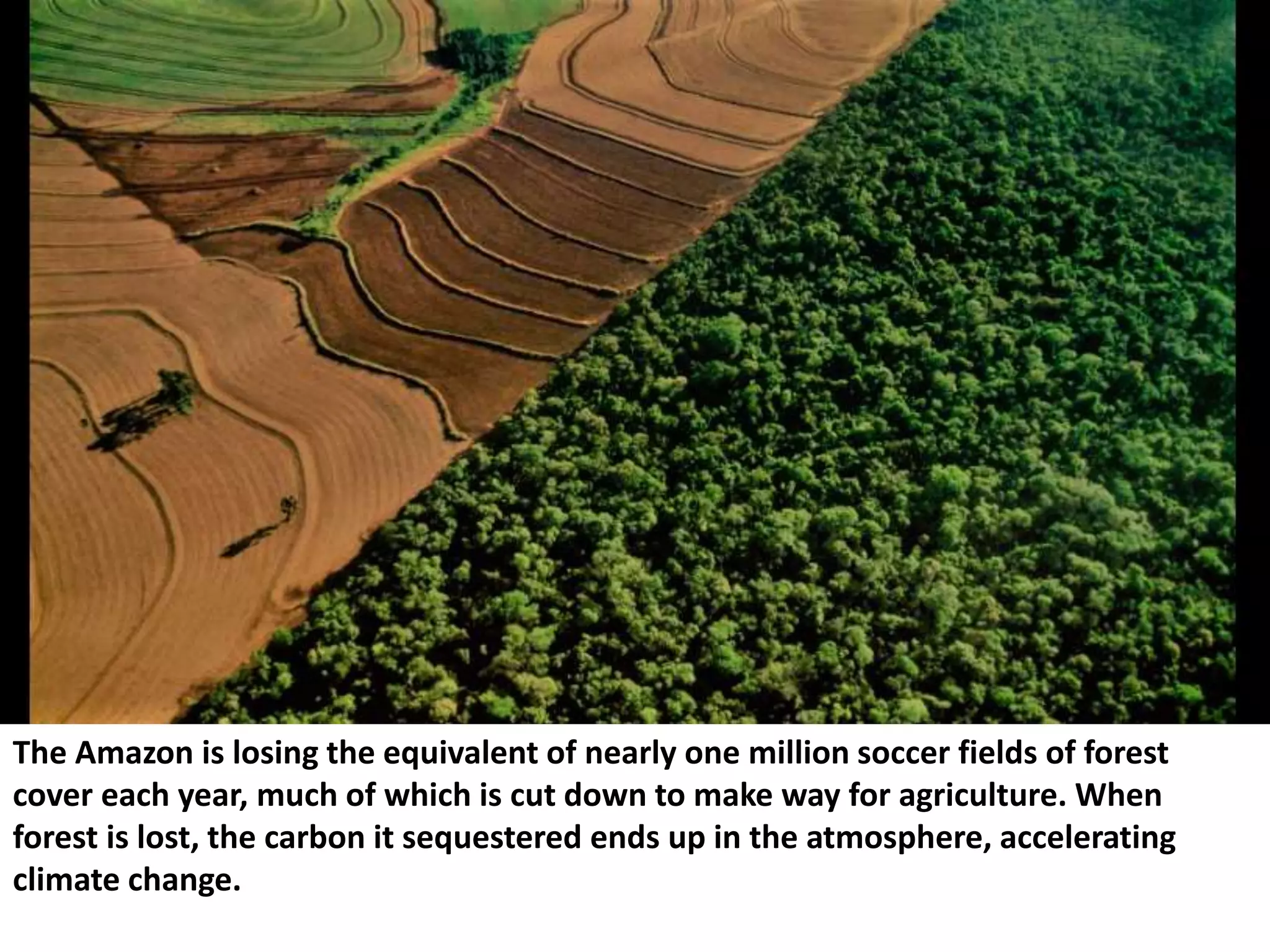
The Amazon is losing the equivalent of nearly one million soccer fields of forest
cover each year, much of which is cut down to make way for agriculture. When
forest is lost, the carbon it sequestered ends up in the atmosphere, accelerating
climate change.
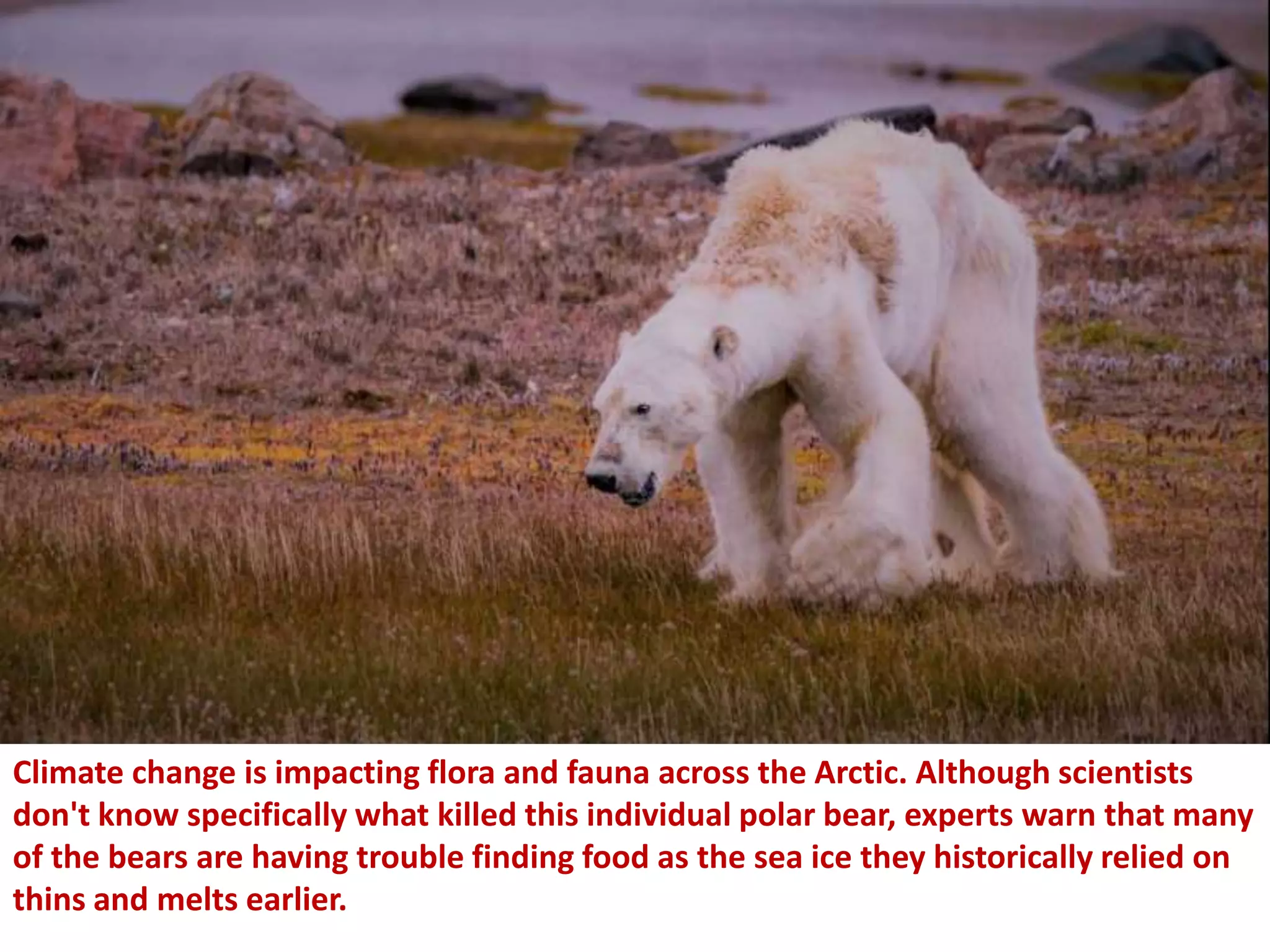
Climate change is impacting flora and fauna across the Arctic. Although scientists
don't know specifically what killed this individual polar bear, experts warn that many
of the bears are having trouble finding food as the sea ice they historically relied on
thins and melts earlier.
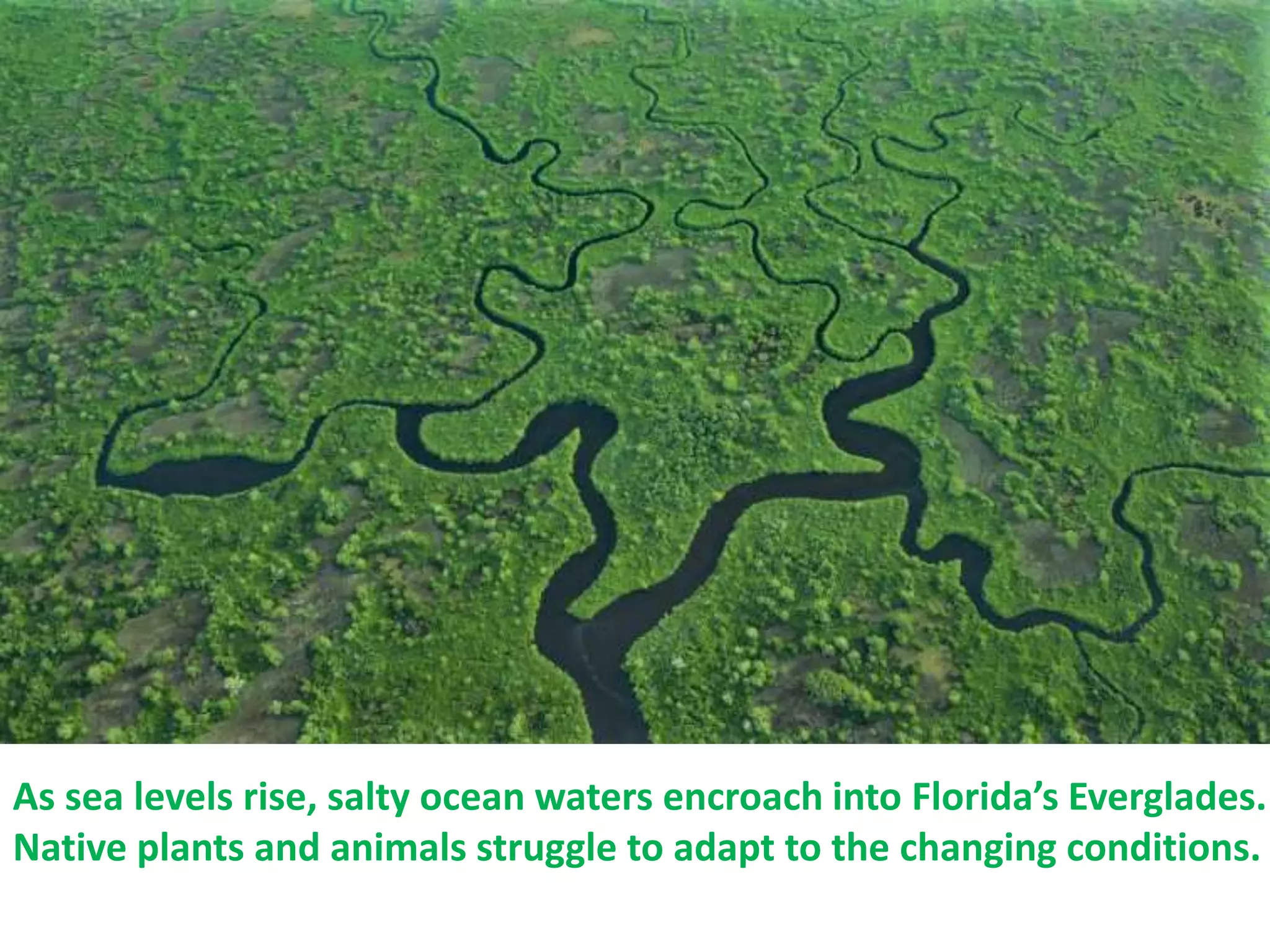
As sea levels rise, salty ocean waters encroach into Florida’s Everglades.
Native plants and animals struggle to adapt to the changing conditions.
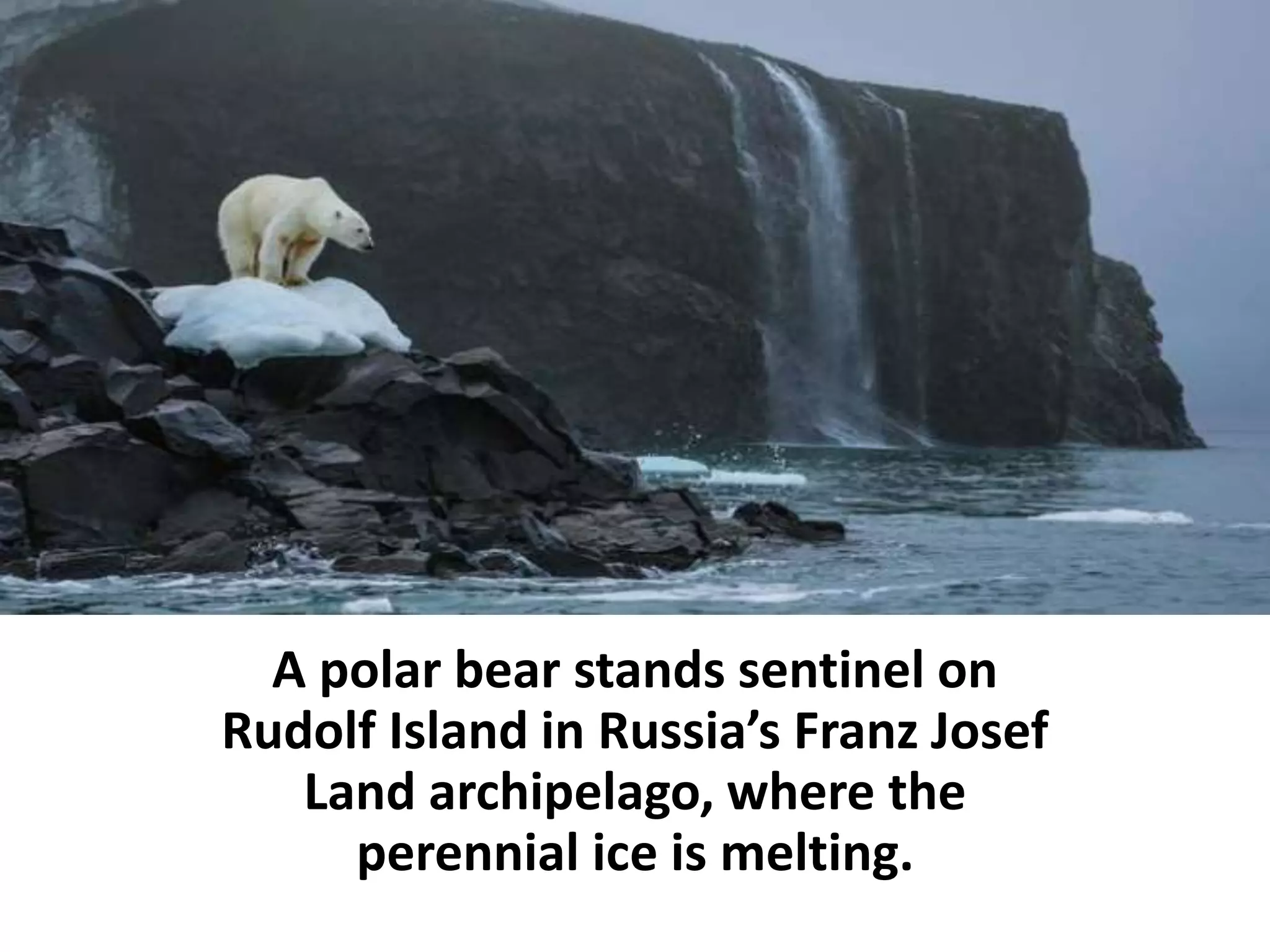
A polar bear stands sentinel on
Rudolf Island in Russia’s Franz Josef
Land archipelago, where the
perennial ice is melting.
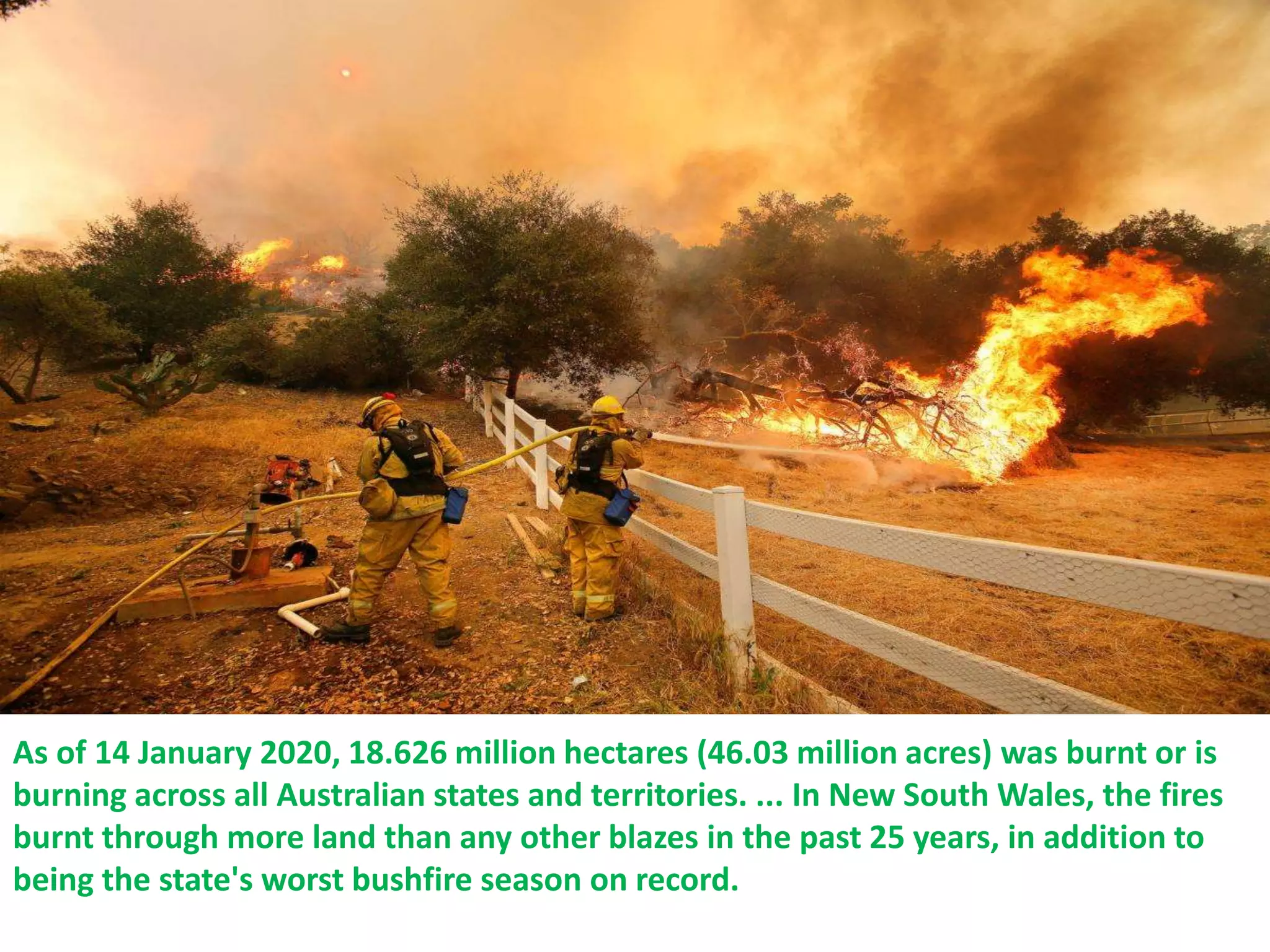
As of 14 January 2020, 18.626 million hectares (46.03 million acres) was burnt or is
burning across all Australian states and territories. ... In New South Wales, the fires
burnt through more land than any other blazes in the past 25 years, in addition to
being the state's worst bushfire season on record.
WHAT ARE THE OTHER EFFECTS OF GLOBAL
WARMING?
• Melting glaciers, early snowmelt, and severe droughts will cause
more dramatic water shortages and increase the risk of wildfires in
the American West.
• Rising sea levels will lead to coastal flooding on the Eastern
Seaboard, especially in Florida, and in other areas such as the Gulf
of Mexico.
• Forests, farms, and cities will face troublesome new pests, heat
waves, heavy downpours, and increased flooding. All those factors
will damage or destroy agriculture and fisheries.
• Disruption of habitats such as coral reefs and Alpine meadows
could drive many plant and animal species to extinction.
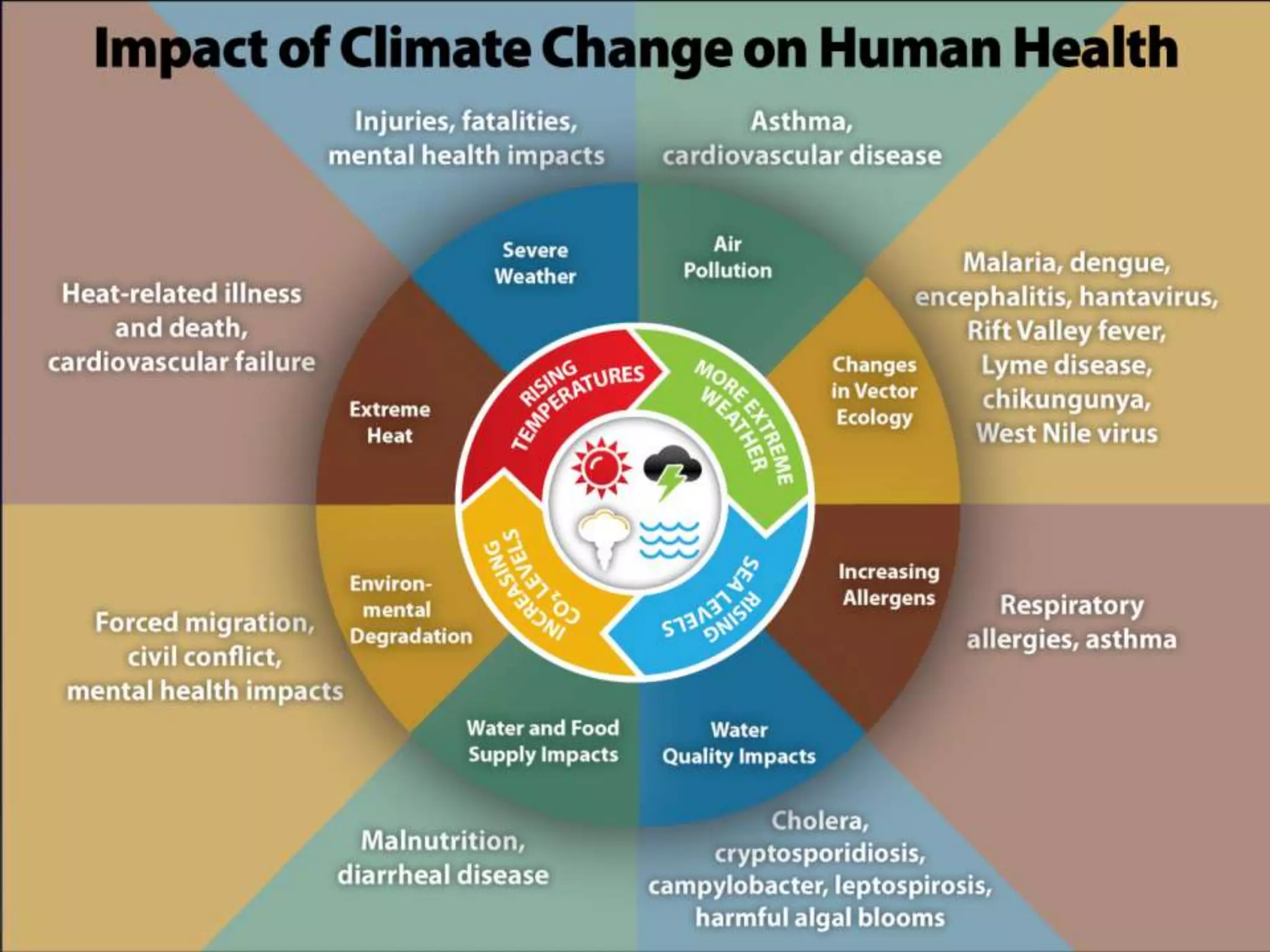
• Allergies, asthma, and infectious disease outbreaks will become
more common due to increased growth of pollen-producing
ragweed, higher levels of air pollution, and the spread of
conditions favourable to pathogens and mosquitoes.
LONG TERM IMPLICATIONS IN INDIA
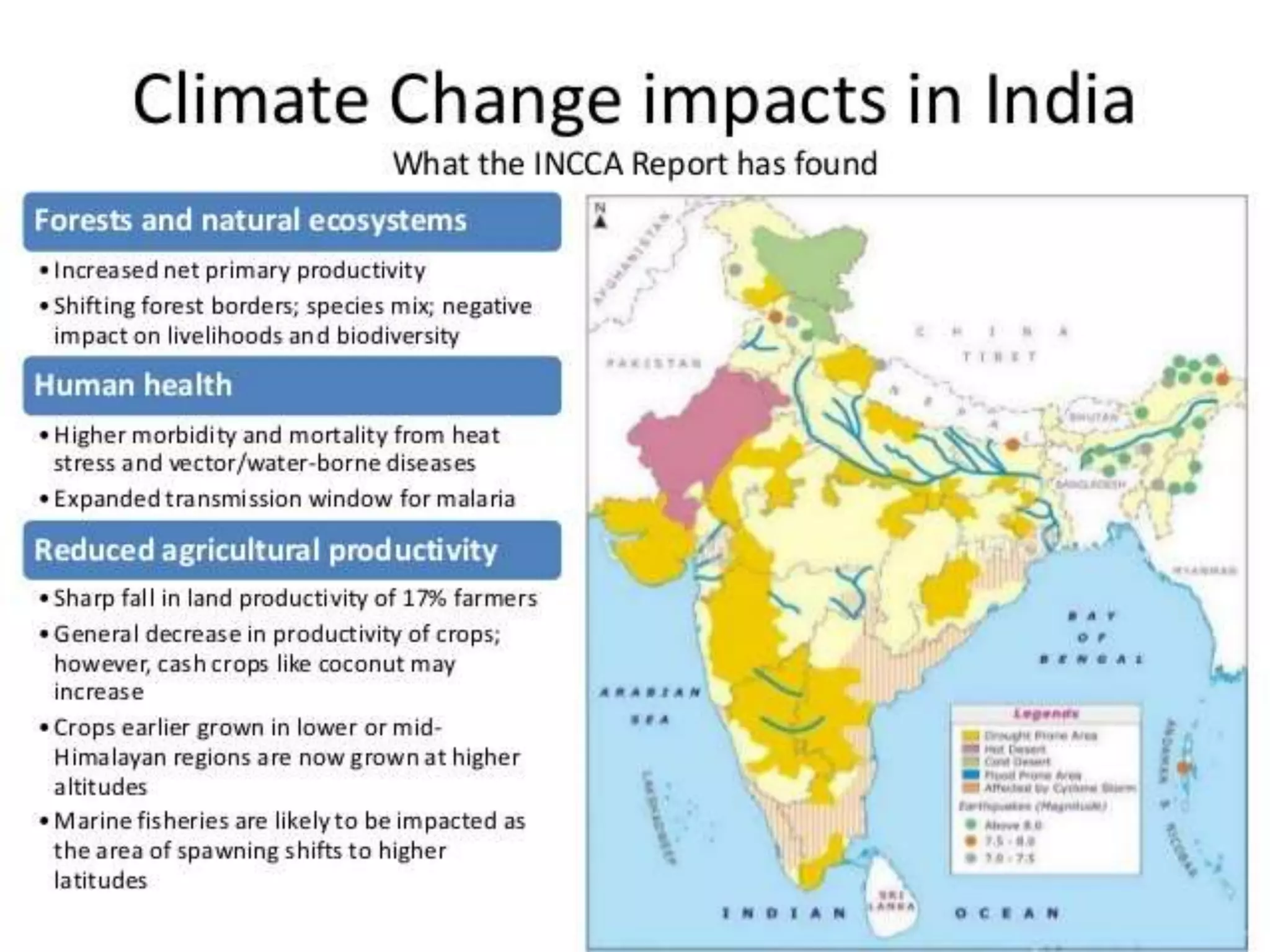
The effects of global warming on INDIA include steady
• sea level rise, increased cyclonic activity,
• and changes in ambient temperature
• and precipitation patterns.
• Increased landslides and flooding are projected to have
an impact upon states such as Assam.
• Ongoing sea level rises have already submerged several
low-lying islands in the Sundarbans, displacing thousands
of people.
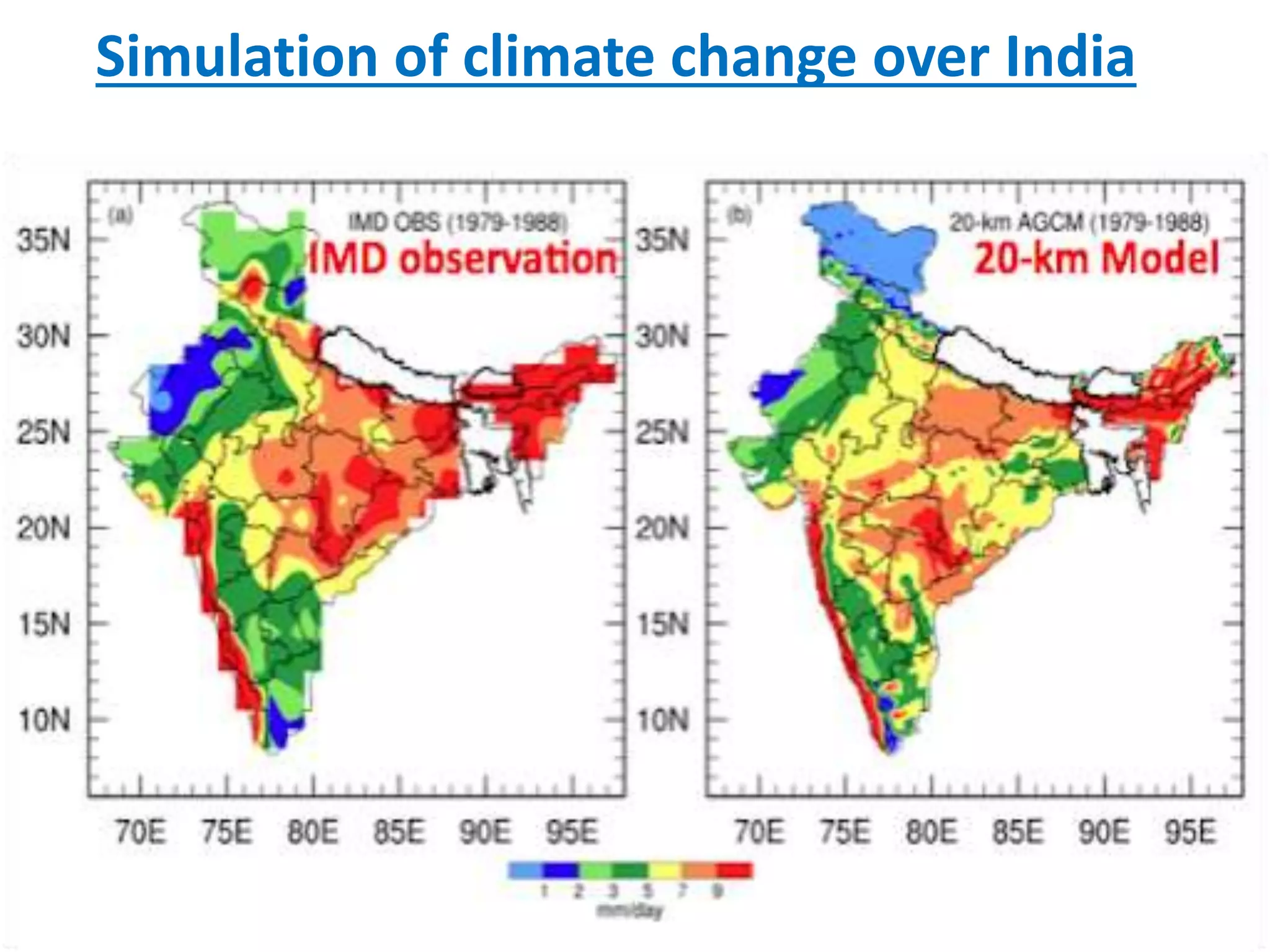
Simulation of climate change over India
Changes in Temperature
There is a reduction in fresh water availability,
disturbance of morphological processes and a higher
intensity of flooding.
• Regarding local temperature rises, the IPCC figure
projected for the mean annual increase in
temperature by the end of the century in South Asia
is 3.3 °C with the min-max range as 2.7 – 4.7 °C.
• The mean value for Tibet would be higher with mean
increase of 3.8 °C and min-max figures of 2.6 and
6.1 °C respectively which implies harsher warming
conditions for the Himalayan watersheds.
Climate of India
• India exhibits a wide diversity of temperatures. The
Himalayas participate in warming by preventing the cold
winds from blowing in, and the Thar desert attracts the
summer monsoon winds, which are responsible for making
the majority of the monsoon season of India. However, the
majority of the regions can be considered climatically
tropical.
• The climate of India is dominated by the monsoon season,
which is the most important season of India, providing 80%
of the annual rainfall. The season extends from June to
September with an average annual rainfall between 750–
1,500 mm across the region. The monsoon of India is
regarded as the most productive wet season on the earth.
OBSERVED CHANGES IN THE NATURAL
AND HUMAN ENVIRONMENT
Social Change
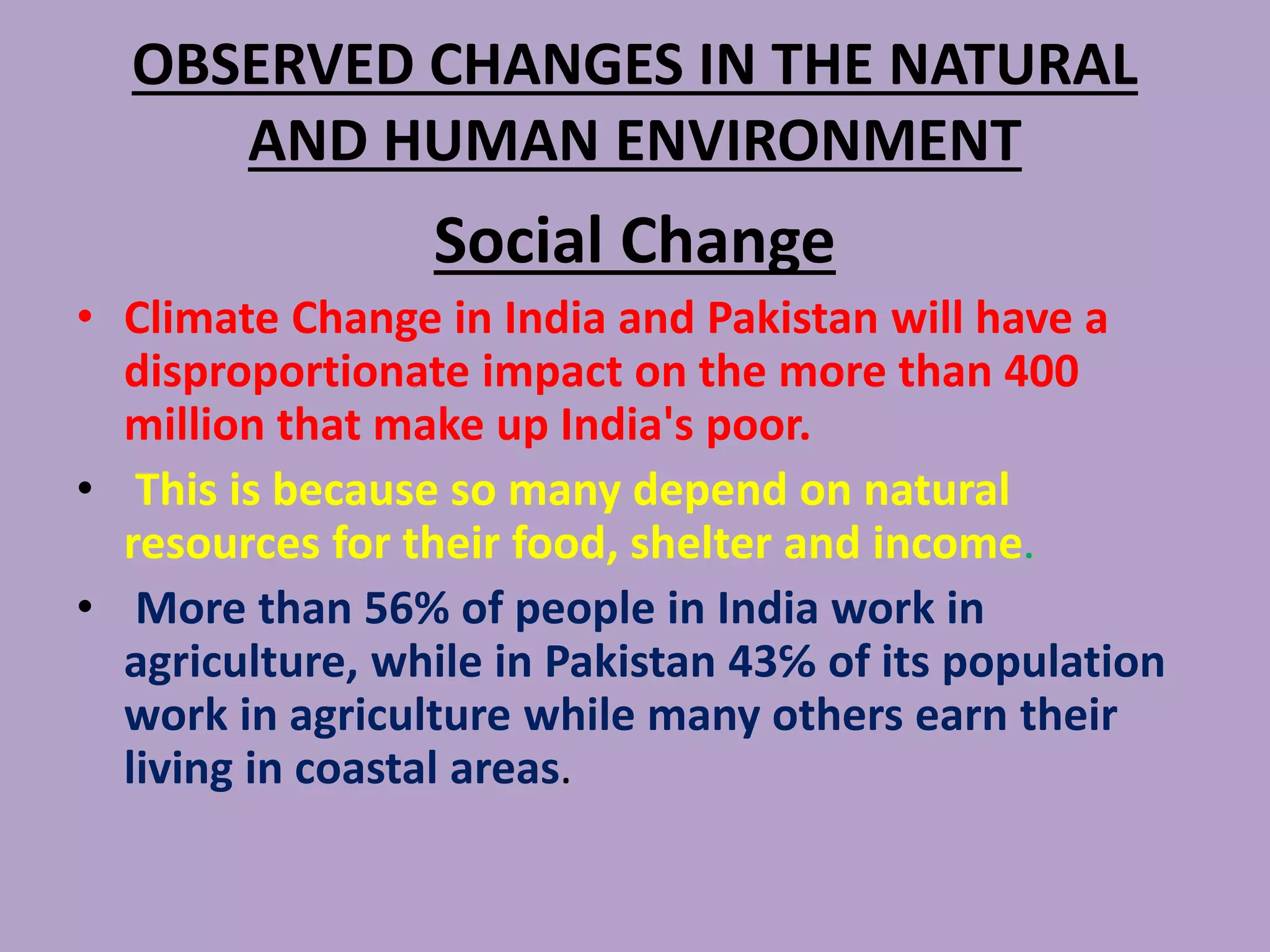
• Climate Change in India and Pakistan will have a
disproportionate impact on the more than 400
million that make up India's poor.
• This is because so many depend on natural
resources for their food, shelter and income.
• More than 56% of people in India work in
agriculture, while in Pakistan 43℅ of its population
work in agriculture while many others earn their
living in coastal areas.
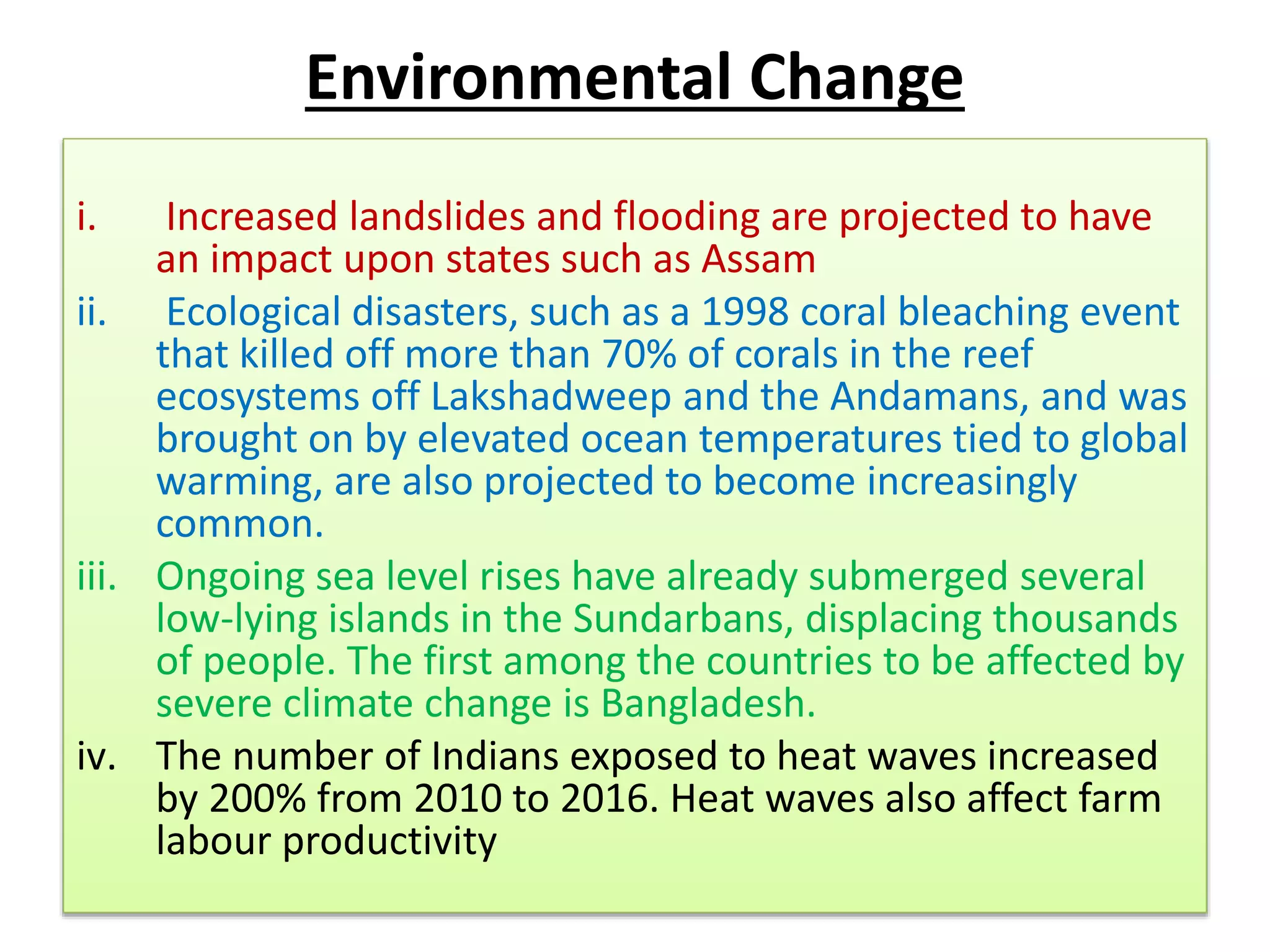
Environmental Change
i. Increased landslides and flooding are projected to have
an impact upon states such as Assam
ii. Ecological disasters, such as a 1998 coral bleaching event
that killed off more than 70% of corals in the reef
ecosystems off Lakshadweep and the Andamans, and was
brought on by elevated ocean temperatures tied to global
warming, are also projected to become increasingly
common.
iii. Ongoing sea level rises have already submerged several
low-lying islands in the Sundarbans, displacing thousands
of people. The first among the countries to be affected by
severe climate change is Bangladesh.
iv. The number of Indians exposed to heat waves increased
by 200% from 2010 to 2016. Heat waves also affect farm
labour productivity
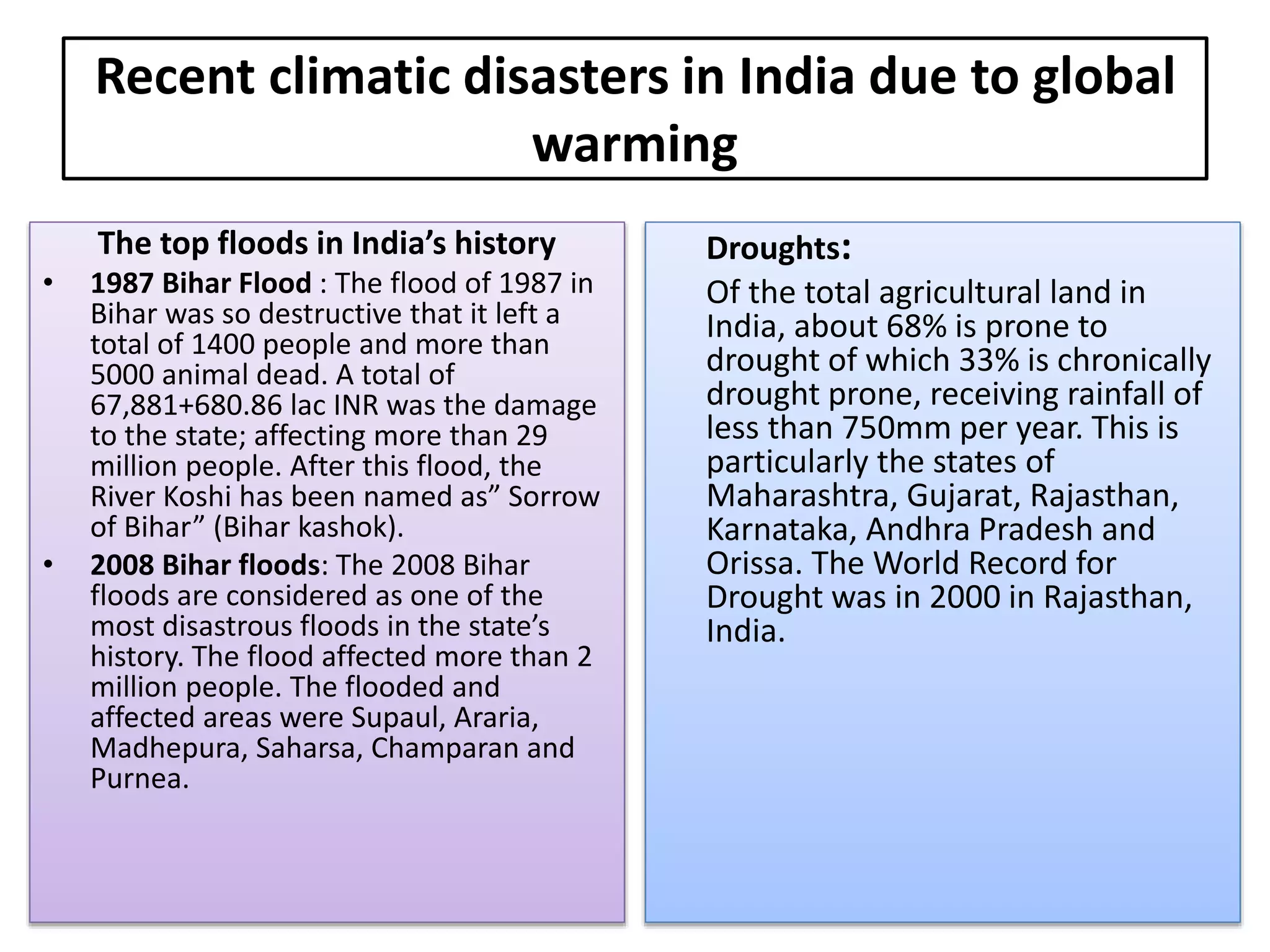
Recent climatic disasters in India due to global
warming
The top floods in India’s history
• 1987 Bihar Flood : The flood of 1987 in
Bihar was so destructive that it left a
total of 1400 people and more than
5000 animal dead. A total of
67,881+680.86 lac INR was the damage
to the state; affecting more than 29
million people. After this flood, the
River Koshi has been named as” Sorrow
of Bihar” (Bihar kashok).
• 2008 Bihar floods: The 2008 Bihar
floods are considered as one of the
most disastrous floods in the state’s
history. The flood affected more than 2
million people. The flooded and
affected areas were Supaul, Araria,
Madhepura, Saharsa, Champaran and
Purnea.
Droughts:
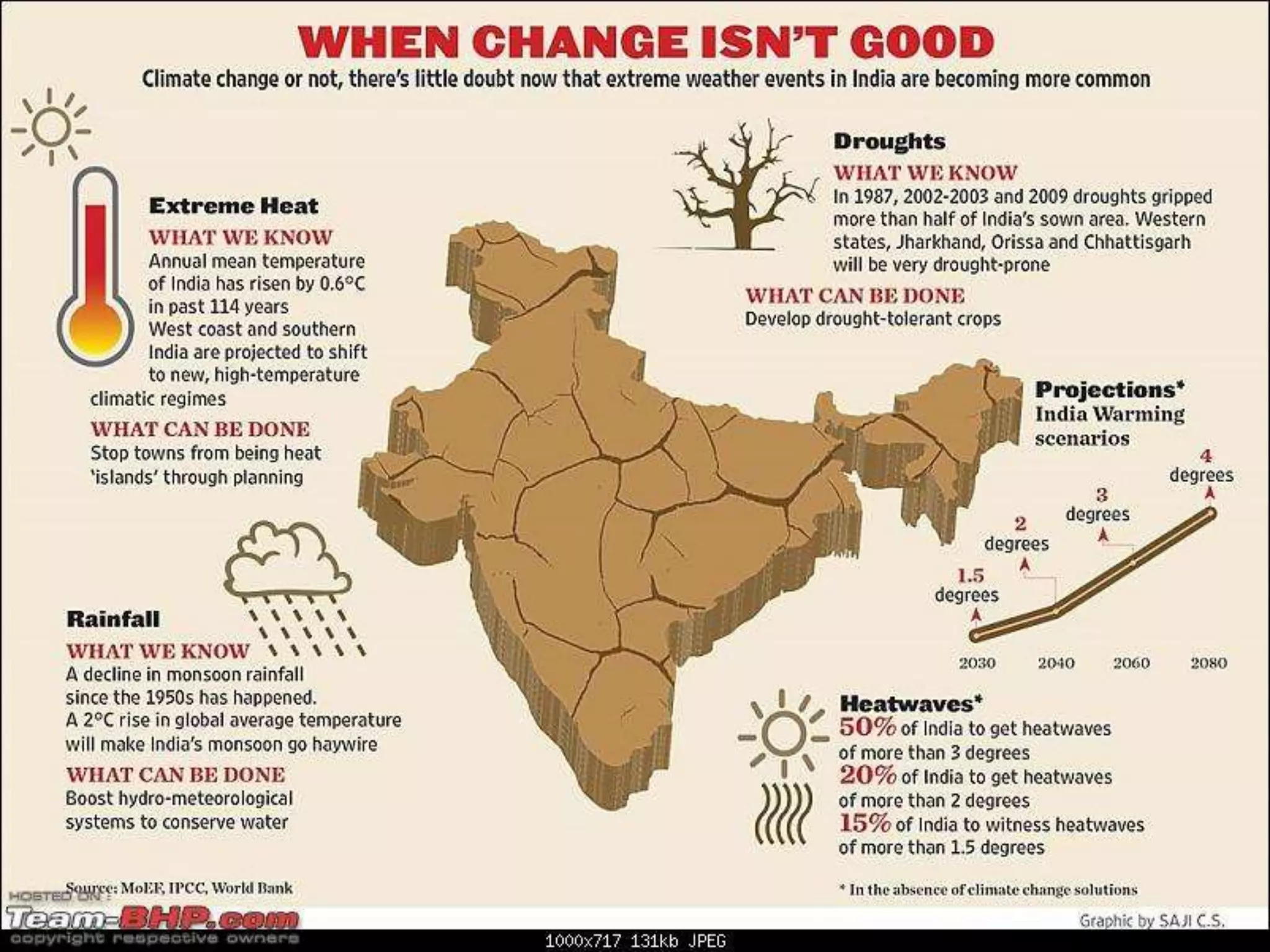
Of the total agricultural land in
India, about 68% is prone to
drought of which 33% is chronically
drought prone, receiving rainfall of
less than 750mm per year. This is
particularly the states of
Maharashtra, Gujarat, Rajasthan,
Karnataka, Andhra Pradesh and
Orissa. The World Record for
Drought was in 2000 in Rajasthan,
India.
Economical Change
• India's GDP could decline by up to 9%, due to shifting
growing seasons for major crops such as rice, production of
which could fall by 40%. Around seven million people are
projected to be displaced due to, among other factors,
submersion of parts of Mumbai and Chennai, if global
temperatures were to rise by a mere 2 °C (3.6 °F)
• India has the world's highest social cost of
carbon. The Indira Gandhi Institute of Development
Research has reported that, if the predictions relating to
global warming made by the Intergovernmental Panel on
Climate Change come to fruition, climate-related factors
could cause India's GDP to decline by up to 9%;
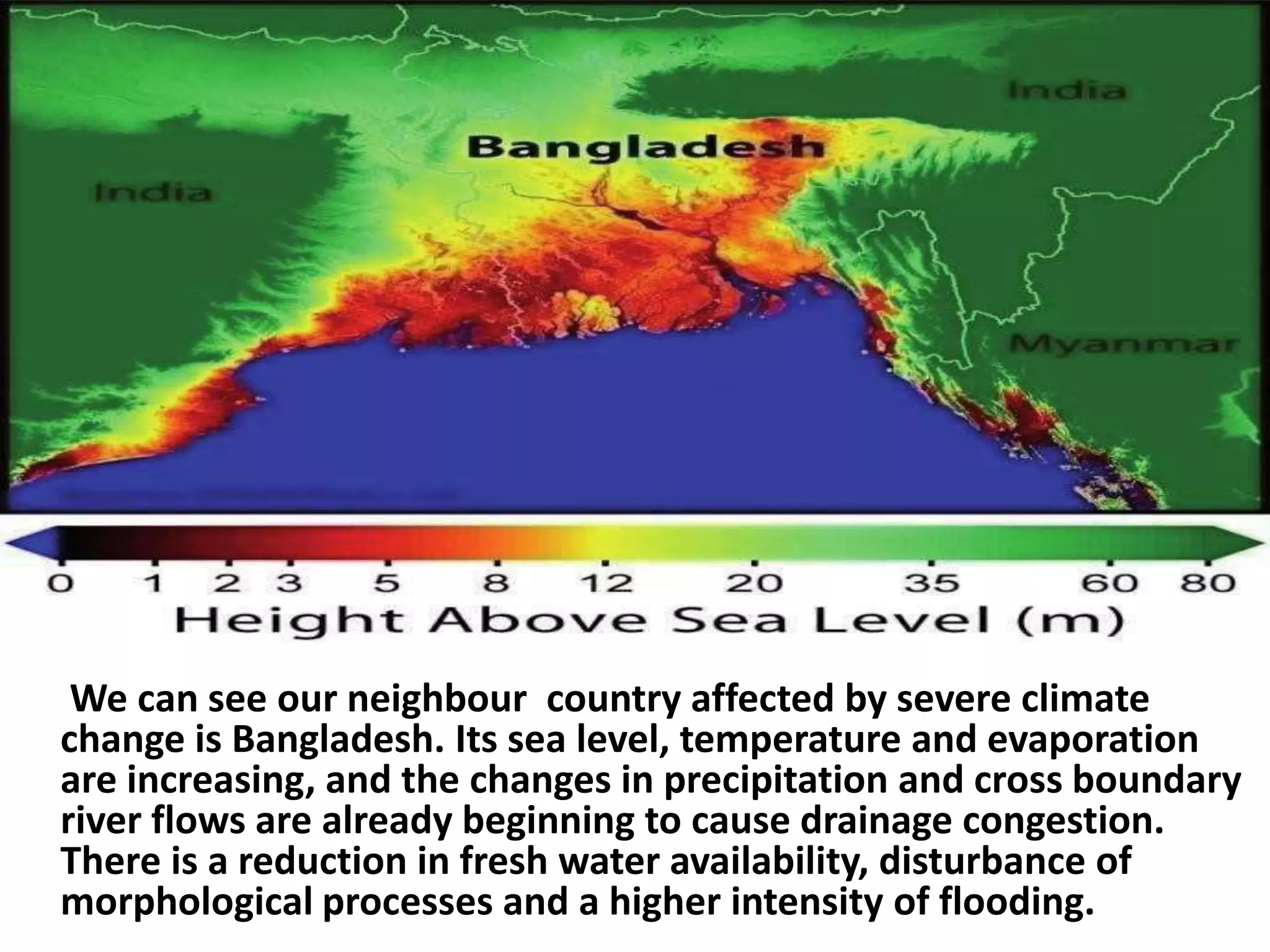
We can see our neighbour country affected by severe climate
change is Bangladesh. Its sea level, temperature and evaporation
are increasing, and the changes in precipitation and cross boundary
river flows are already beginning to cause drainage congestion.
There is a reduction in fresh water availability, disturbance of
morphological processes and a higher intensity of flooding.
RESPONDING TO CLIMATE CHANGE
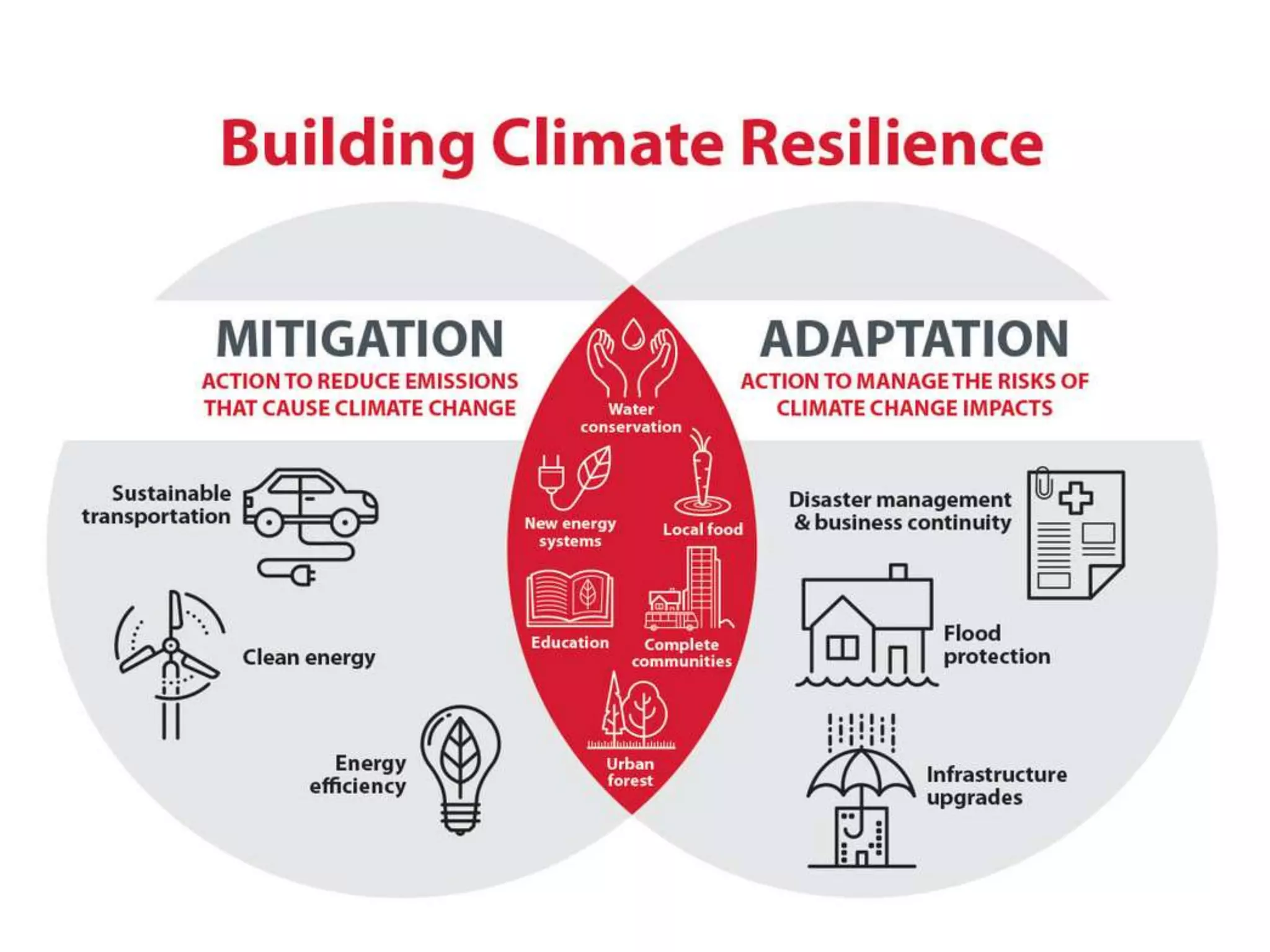
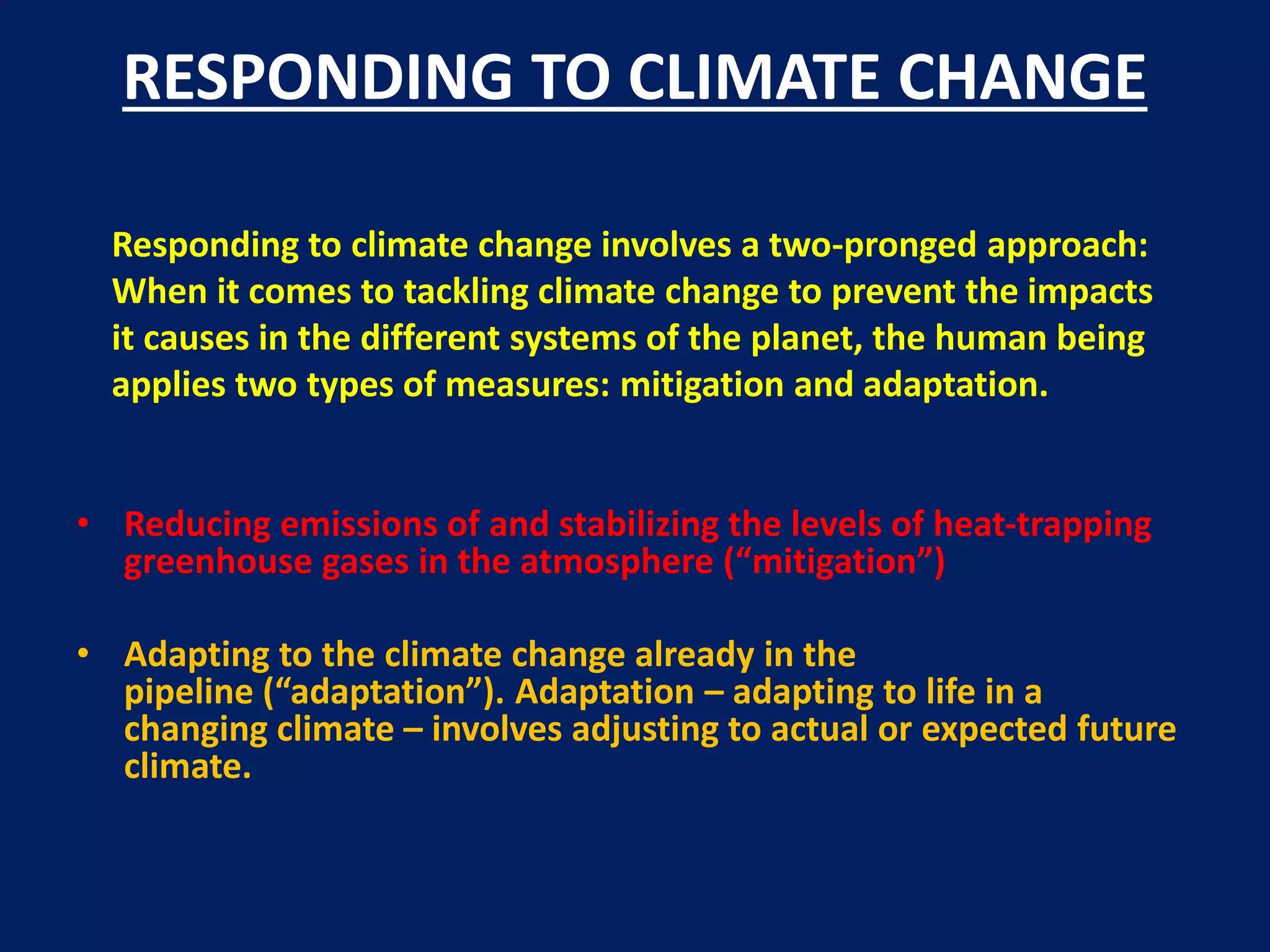
Responding to climate change involves a two-pronged approach:
When it comes to tackling climate change to prevent the impacts
it causes in the different systems of the planet, the human being
applies two types of measures: mitigation and adaptation.
• Reducing emissions of and stabilizing the levels of heat-trapping
greenhouse gases in the atmosphere (“mitigation”)
• Adapting to the climate change already in the
pipeline (“adaptation”). Adaptation – adapting to life in a
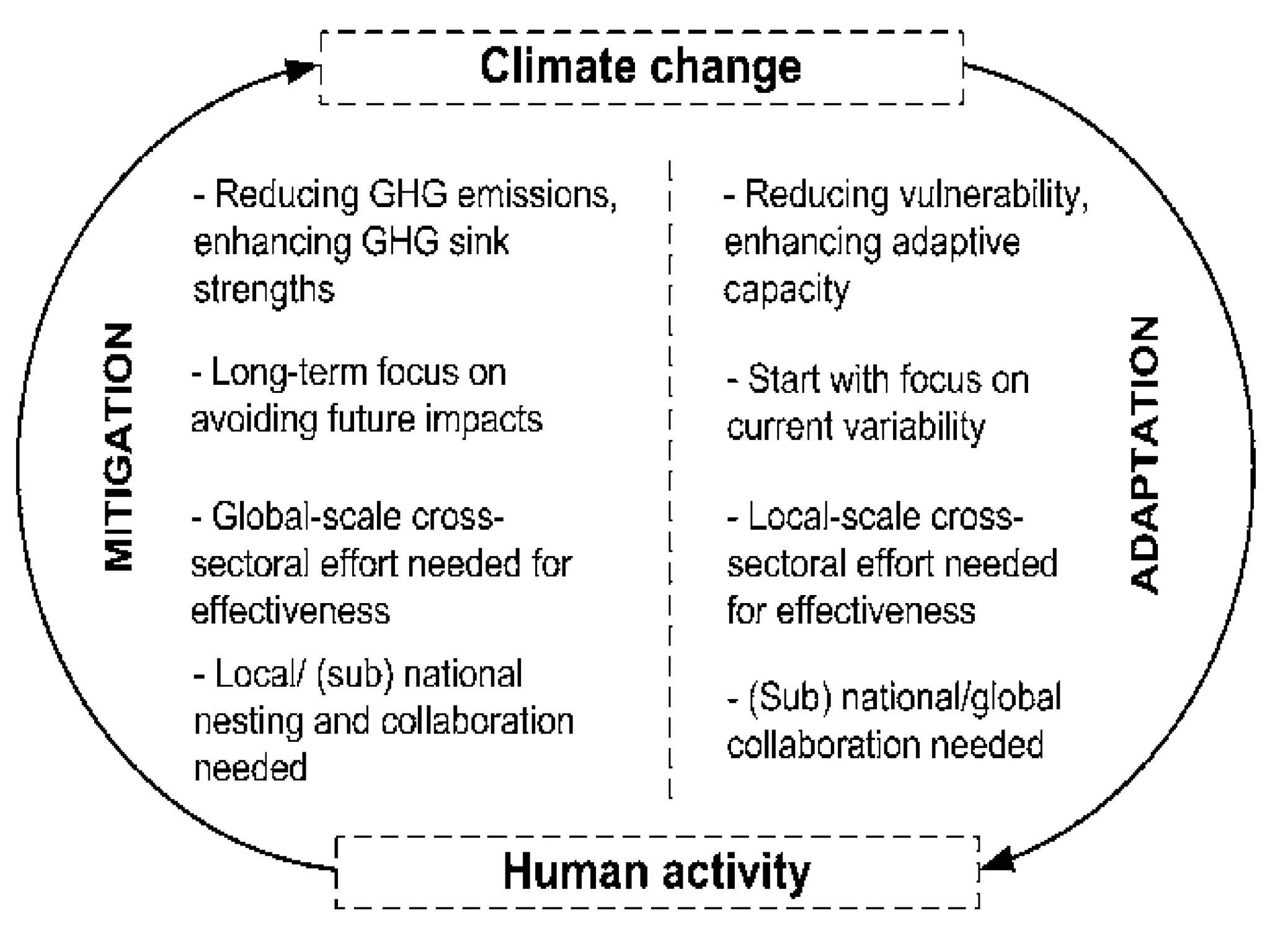
changing climate – involves adjusting to actual or expected future
climate.
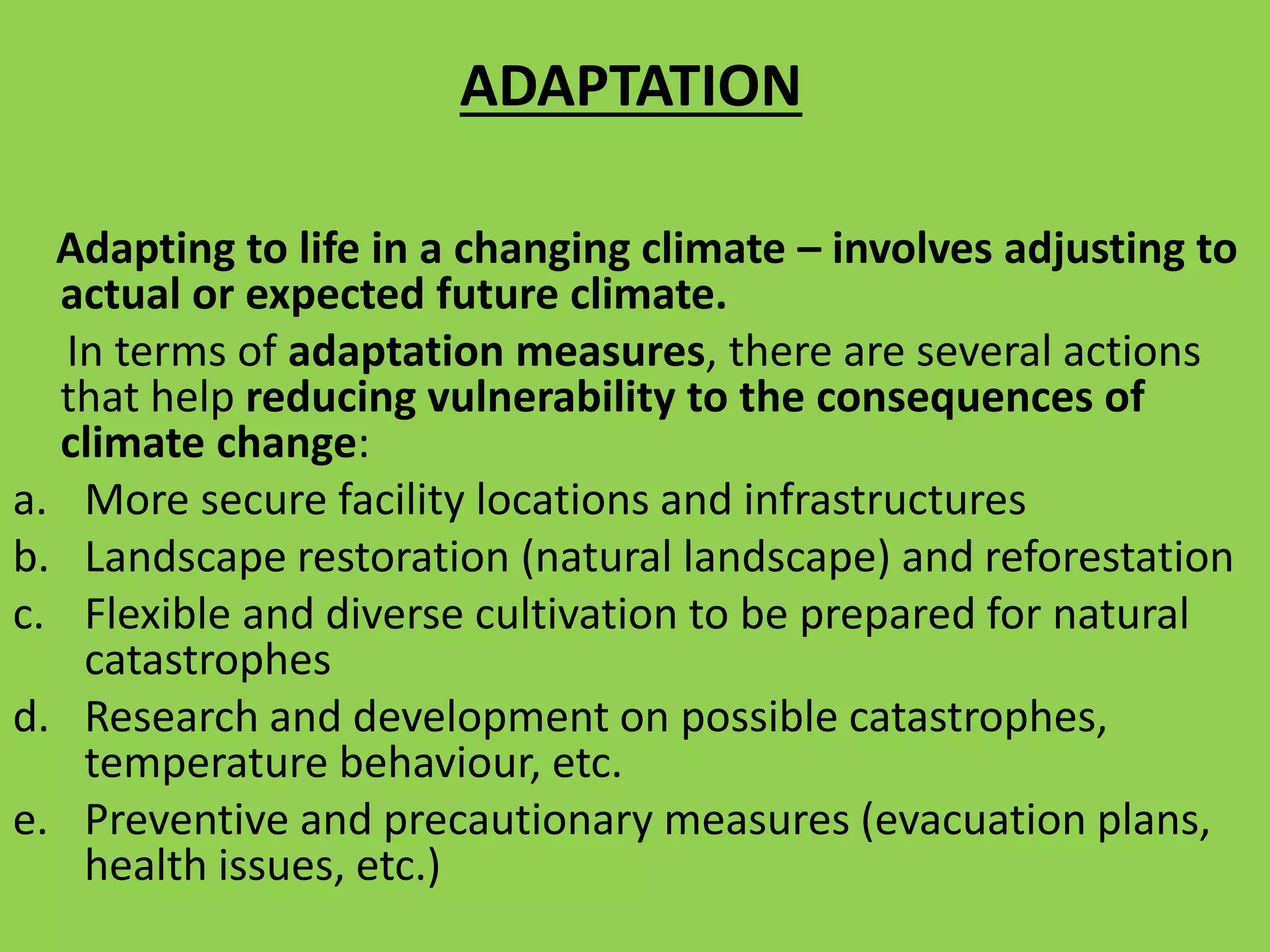
ADAPTATION
Adapting to life in a changing climate – involves adjusting to
actual or expected future climate.
In terms of adaptation measures, there are several actions
that help reducing vulnerability to the consequences of
climate change:
a. More secure facility locations and infrastructures
b. Landscape restoration (natural landscape) and reforestation
c. Flexible and diverse cultivation to be prepared for natural
catastrophes
d. Research and development on possible catastrophes,
temperature behaviour, etc.
e. Preventive and precautionary measures (evacuation plans,
health issues, etc.)
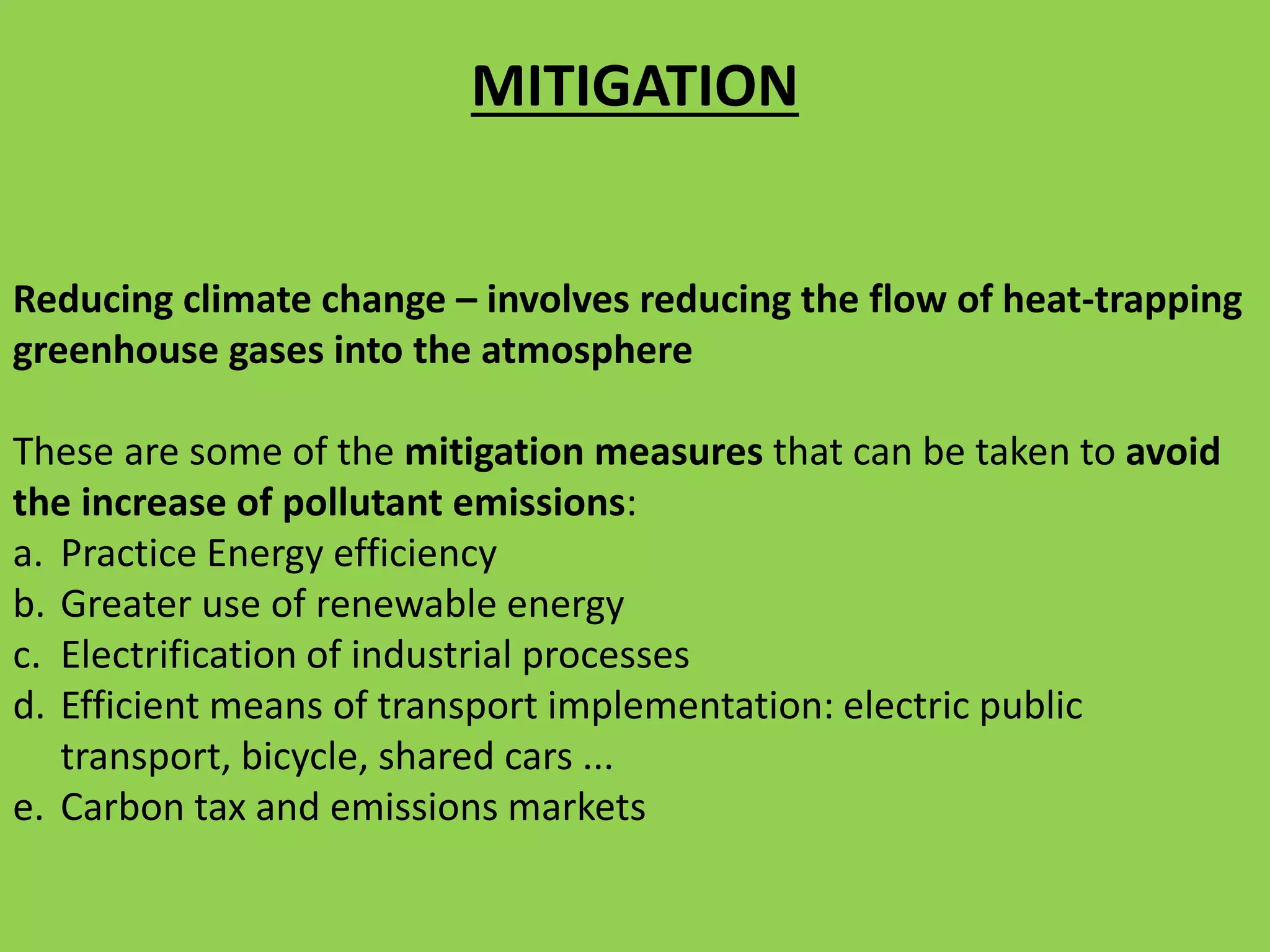
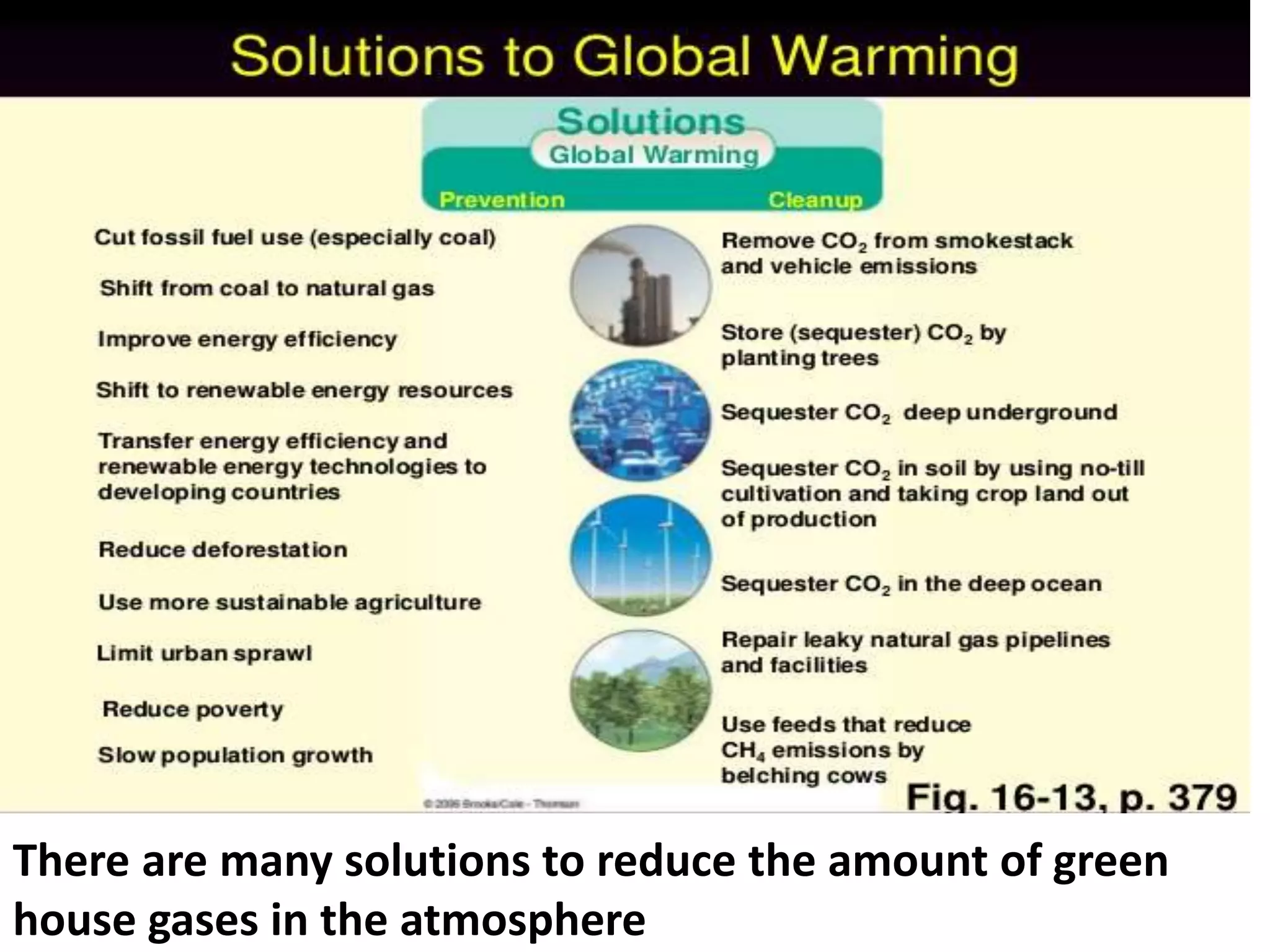
Reducing climate change – involves reducing the flow of heat-trapping
greenhouse gases into the atmosphere
These are some of the mitigation measures that can be taken to avoid
the increase of pollutant emissions:
a. Practice Energy efficiency
b. Greater use of renewable energy
c. Electrification of industrial processes
d. Efficient means of transport implementation: electric public
transport, bicycle, shared cars ...
e. Carbon tax and emissions markets
MITIGATION
There are many solutions to reduce the amount of green
house gases in the atmosphere
WE HAVE TAKEN HELP OF THESE SITES FOR THE PRESENTATION
•https://hykyhemydiro.webkandii.com/solutions-global-warming-essay-28500lr.html
•https://greencleanguide.com/global-warming-and-its-impacts-on-climate-of-india
•https://www.nationalgeographic.com/environment/global-warming/global-warming-
causes/#/07-global-warming-gallery.jpg
•https://www.wwf.org.au/what-we-do/climate/causes-of-global-warming#gs.5fs457
•https://hykyhemydiro.webkandii.com/solutions-global-warming-essay-28500lr.html
•https://en.wikipedia.org/wiki/Effects_of_global_warming_on_South_Asia
REFERENCES

Global warming and its long term implication on India

  • 1.
    Submitted By: --Course: B.Sc Botany(hons) •Swati Singh-1934127 KIRORI MAL COLLEGE PRESENTATION AECC—ENVIRONMENTAL SCIENCE
  • 2.
    PRESENTATION TOPIC: GLOBAL WARMINGAND IT’S LONG TERM IMPLICATIONS IN INDIA
  • 3.
    TOPICS COVERED:- What IsGlobal Warming? What Are Causes Of Global Warming? Consequences Of Global Warming What Are The Other Effects Of Global Warming? Long Term Implications In India Responding To Climate Change Observed Changes In The Natural And Human Environment
  • 4.
    WHAT IS GLOBALWARMING? Globalwarming, the phenomenon of increasing average air temperatures near the surface of Earth over the past one to two centuries.
  • 6.
    How Do Scientistknow about Global warming? Climate scientists have since the mid-20th century gathered detailed observations of various weather phenomena such as:  temperatures  precipitation  storms And of related influences on climate such as  ocean currents  atmosphere’s chemical composition These data indicate that Earth’s climate has changed over almost every conceivable timescale since the beginning of geologic time and that the influence of human activities since at least the beginning of the INDUSTRIAL REVOLUTION has been deeply woven into the very fabric of climate change.
  • 8.
    WHAT ARE CAUSESOF GLOBAL WARMIMG? Burning fossil fuels When we burn fossil fuels like coal, oil and gas to create electricity or power our cars, we release CO2 pollution into the atmosphere. Electricity generation is the main cause of carbon pollution in Australia as 73% of our electricity comes from burning coal and 13% from burning gas. The remaining 14% comes from renewable energy sources such as hydro, solar and wind, which do not emit carbon.
  • 9.
    Deforestation & Tree-Clearing Plants and trees play an important role in regulating the climate because they absorb carbon dioxide from the air and release oxygen back into it.  Forests and bushland act as carbon sinks and are a valuable means of keeping global warming to 1.5°C.
  • 10.
    The Scherer powerplant in Juliet, Georgia, is the largest coal-fired power plant in the U.S. It burns 34,000 tons of coal daily, pumping over 25 million tons of carbon dioxide into the atmosphere each year.
  • 11.
    Greenhouse gas Greenhouse gas,any gas that has the property of absorbing infrared radiation (net heat energy) emitted from Earth’s surface and reradiating it back to Earth’s surface, thus contributing to the greenhouse effect. Carbon dioxide, methane, and water vapour are the most important greenhouse gases. Carbon dioxide The presence of the gas in the atmosphere keeps some of the radiant energy received by Earth from being returned to space, thus producing the so-called greenhouse effect.
  • 14.
    Agriculture & Farming Animals,particularly livestock like sheep and cattle, produce methane, a greenhouse gas. When livestock are grazed at a large scale, as in Australia, the amount of methane produced is a big contributor to global warming. Some fertilisers that farmers use also release nitrous oxide, which is another greenhouse gas. Australian farming contributes 16% of our total greenhouse gas emissions.
  • 15.
  • 16.
    The western U.S.has been locked in a drought for years. The dry, hot weather has increased the intensity and destructiveness of forest fires like in Australia.
  • 17.
    Greenland is coveredwith a vast amount of ice—but the ice is melting four times faster than thought, suggesting that Greenland may be approaching a dangerous tipping point, with implications for global sea-level rise.
  • 18.
    The Amazon islosing the equivalent of nearly one million soccer fields of forest cover each year, much of which is cut down to make way for agriculture. When forest is lost, the carbon it sequestered ends up in the atmosphere, accelerating climate change.
  • 19.
    Climate change isimpacting flora and fauna across the Arctic. Although scientists don't know specifically what killed this individual polar bear, experts warn that many of the bears are having trouble finding food as the sea ice they historically relied on thins and melts earlier.
  • 20.
    As sea levelsrise, salty ocean waters encroach into Florida’s Everglades. Native plants and animals struggle to adapt to the changing conditions.
  • 21.
    A polar bearstands sentinel on Rudolf Island in Russia’s Franz Josef Land archipelago, where the perennial ice is melting.
  • 22.
    As of 14January 2020, 18.626 million hectares (46.03 million acres) was burnt or is burning across all Australian states and territories. ... In New South Wales, the fires burnt through more land than any other blazes in the past 25 years, in addition to being the state's worst bushfire season on record.
  • 23.
    WHAT ARE THEOTHER EFFECTS OF GLOBAL WARMING? • Melting glaciers, early snowmelt, and severe droughts will cause more dramatic water shortages and increase the risk of wildfires in the American West. • Rising sea levels will lead to coastal flooding on the Eastern Seaboard, especially in Florida, and in other areas such as the Gulf of Mexico. • Forests, farms, and cities will face troublesome new pests, heat waves, heavy downpours, and increased flooding. All those factors will damage or destroy agriculture and fisheries. • Disruption of habitats such as coral reefs and Alpine meadows could drive many plant and animal species to extinction. • Allergies, asthma, and infectious disease outbreaks will become more common due to increased growth of pollen-producing ragweed, higher levels of air pollution, and the spread of conditions favourable to pathogens and mosquitoes.
  • 25.
    LONG TERM IMPLICATIONSIN INDIA The effects of global warming on INDIA include steady • sea level rise, increased cyclonic activity, • and changes in ambient temperature • and precipitation patterns. • Increased landslides and flooding are projected to have an impact upon states such as Assam. • Ongoing sea level rises have already submerged several low-lying islands in the Sundarbans, displacing thousands of people.
  • 26.
    Simulation of climatechange over India
  • 27.
    Changes in Temperature Thereis a reduction in fresh water availability, disturbance of morphological processes and a higher intensity of flooding. • Regarding local temperature rises, the IPCC figure projected for the mean annual increase in temperature by the end of the century in South Asia is 3.3 °C with the min-max range as 2.7 – 4.7 °C. • The mean value for Tibet would be higher with mean increase of 3.8 °C and min-max figures of 2.6 and 6.1 °C respectively which implies harsher warming conditions for the Himalayan watersheds.
  • 29.
    Climate of India •India exhibits a wide diversity of temperatures. The Himalayas participate in warming by preventing the cold winds from blowing in, and the Thar desert attracts the summer monsoon winds, which are responsible for making the majority of the monsoon season of India. However, the majority of the regions can be considered climatically tropical. • The climate of India is dominated by the monsoon season, which is the most important season of India, providing 80% of the annual rainfall. The season extends from June to September with an average annual rainfall between 750– 1,500 mm across the region. The monsoon of India is regarded as the most productive wet season on the earth.
  • 31.
    OBSERVED CHANGES INTHE NATURAL AND HUMAN ENVIRONMENT Social Change • Climate Change in India and Pakistan will have a disproportionate impact on the more than 400 million that make up India's poor. • This is because so many depend on natural resources for their food, shelter and income. • More than 56% of people in India work in agriculture, while in Pakistan 43℅ of its population work in agriculture while many others earn their living in coastal areas.
  • 33.
    Environmental Change i. Increasedlandslides and flooding are projected to have an impact upon states such as Assam ii. Ecological disasters, such as a 1998 coral bleaching event that killed off more than 70% of corals in the reef ecosystems off Lakshadweep and the Andamans, and was brought on by elevated ocean temperatures tied to global warming, are also projected to become increasingly common. iii. Ongoing sea level rises have already submerged several low-lying islands in the Sundarbans, displacing thousands of people. The first among the countries to be affected by severe climate change is Bangladesh. iv. The number of Indians exposed to heat waves increased by 200% from 2010 to 2016. Heat waves also affect farm labour productivity
  • 34.
    Recent climatic disastersin India due to global warming The top floods in India’s history • 1987 Bihar Flood : The flood of 1987 in Bihar was so destructive that it left a total of 1400 people and more than 5000 animal dead. A total of 67,881+680.86 lac INR was the damage to the state; affecting more than 29 million people. After this flood, the River Koshi has been named as” Sorrow of Bihar” (Bihar kashok). • 2008 Bihar floods: The 2008 Bihar floods are considered as one of the most disastrous floods in the state’s history. The flood affected more than 2 million people. The flooded and affected areas were Supaul, Araria, Madhepura, Saharsa, Champaran and Purnea. Droughts: Of the total agricultural land in India, about 68% is prone to drought of which 33% is chronically drought prone, receiving rainfall of less than 750mm per year. This is particularly the states of Maharashtra, Gujarat, Rajasthan, Karnataka, Andhra Pradesh and Orissa. The World Record for Drought was in 2000 in Rajasthan, India.
  • 36.
    Economical Change • India'sGDP could decline by up to 9%, due to shifting growing seasons for major crops such as rice, production of which could fall by 40%. Around seven million people are projected to be displaced due to, among other factors, submersion of parts of Mumbai and Chennai, if global temperatures were to rise by a mere 2 °C (3.6 °F) • India has the world's highest social cost of carbon. The Indira Gandhi Institute of Development Research has reported that, if the predictions relating to global warming made by the Intergovernmental Panel on Climate Change come to fruition, climate-related factors could cause India's GDP to decline by up to 9%;
  • 37.
    We can seeour neighbour country affected by severe climate change is Bangladesh. Its sea level, temperature and evaporation are increasing, and the changes in precipitation and cross boundary river flows are already beginning to cause drainage congestion. There is a reduction in fresh water availability, disturbance of morphological processes and a higher intensity of flooding.
  • 38.
    RESPONDING TO CLIMATECHANGE Responding to climate change involves a two-pronged approach: When it comes to tackling climate change to prevent the impacts it causes in the different systems of the planet, the human being applies two types of measures: mitigation and adaptation. • Reducing emissions of and stabilizing the levels of heat-trapping greenhouse gases in the atmosphere (“mitigation”) • Adapting to the climate change already in the pipeline (“adaptation”). Adaptation – adapting to life in a changing climate – involves adjusting to actual or expected future climate.
  • 40.
    ADAPTATION Adapting to lifein a changing climate – involves adjusting to actual or expected future climate. In terms of adaptation measures, there are several actions that help reducing vulnerability to the consequences of climate change: a. More secure facility locations and infrastructures b. Landscape restoration (natural landscape) and reforestation c. Flexible and diverse cultivation to be prepared for natural catastrophes d. Research and development on possible catastrophes, temperature behaviour, etc. e. Preventive and precautionary measures (evacuation plans, health issues, etc.)
  • 41.
    Reducing climate change– involves reducing the flow of heat-trapping greenhouse gases into the atmosphere These are some of the mitigation measures that can be taken to avoid the increase of pollutant emissions: a. Practice Energy efficiency b. Greater use of renewable energy c. Electrification of industrial processes d. Efficient means of transport implementation: electric public transport, bicycle, shared cars ... e. Carbon tax and emissions markets MITIGATION
  • 42.
    There are manysolutions to reduce the amount of green house gases in the atmosphere
  • 45.
    WE HAVE TAKENHELP OF THESE SITES FOR THE PRESENTATION •https://hykyhemydiro.webkandii.com/solutions-global-warming-essay-28500lr.html •https://greencleanguide.com/global-warming-and-its-impacts-on-climate-of-india •https://www.nationalgeographic.com/environment/global-warming/global-warming- causes/#/07-global-warming-gallery.jpg •https://www.wwf.org.au/what-we-do/climate/causes-of-global-warming#gs.5fs457 •https://hykyhemydiro.webkandii.com/solutions-global-warming-essay-28500lr.html •https://en.wikipedia.org/wiki/Effects_of_global_warming_on_South_Asia REFERENCES