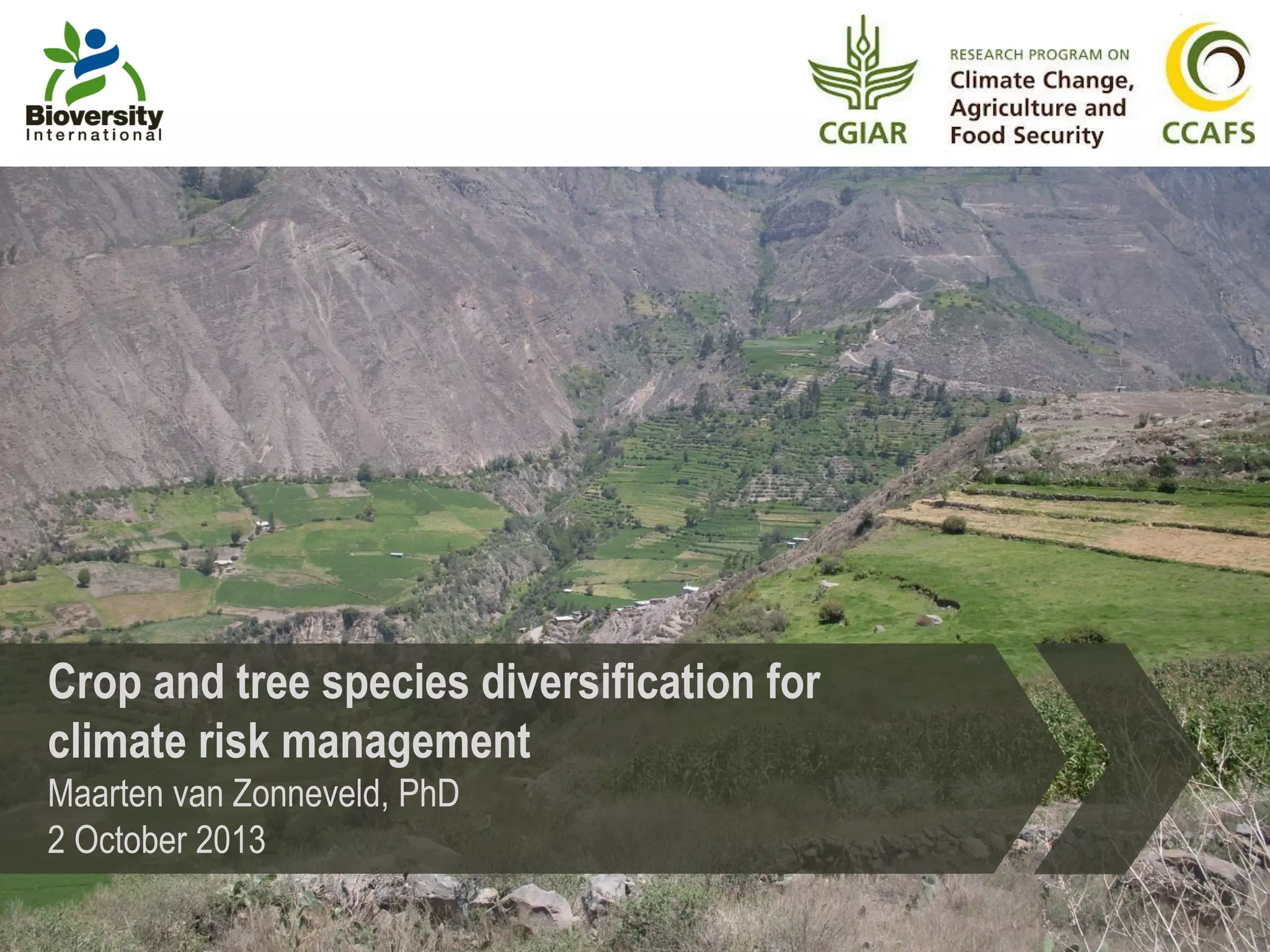
Crop and tree species diversification for
climate risk management
Maarten van Zonneveld, PhD
2 October 2013
Agriculture, food security and climate change
• 100 % increase in food production to feed 9 billion people
in 2050
• Climate change threats agricultural production
• Smallholders are the principal agents of agricultural
production
• Climate change impacts for smallholders are difficult to
predict
• Agriculture is a risky business and becomes more risky
under climate change
Hardaker et al. 2004; Morton 2007; Godfray et al. 2010; Lobell et al. 2011
Crop and tree diversification as climate risk
management strategy
Cultivation of a portfolio of cultivated crops and trees
reduces risk:
• Sum of risks is less than individual crop risks
• Production stabilization and optimization
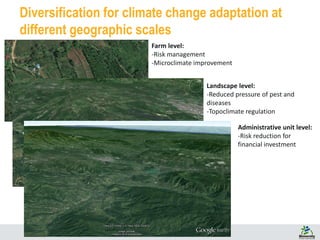
Diversification for climate change adaptation at
different geographic scales
Farm level:
-Risk management
-Microclimate improvement
Landscape level:
-Reduced pressure of pest and
diseases
-Topoclimate regulation
Administrative unit level:
-Risk reduction for
financial investment
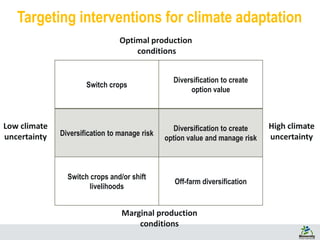
Targeting interventions for climate adaptation
Switch crops
Diversification to create
option value
Diversification to manage risk
Diversification to create
option value and manage risk
Switch crops and/or shift
livelihoods
Off-farm diversification
Optimal production
conditions
Marginal production
conditions
High climate
uncertainty
Low climate
uncertainty
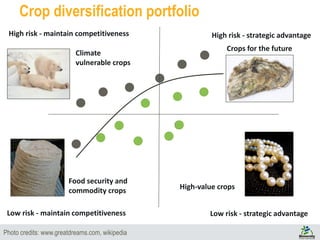
Crop diversification portfolio
Low risk - strategic advantage
High risk - maintain competitiveness
Food security and
commodity crops
Climate
vulnerable crops
Crops for the future
High-value crops
Photo credits: www.greatdreams.com, wikipedia
Low risk - maintain competitiveness
High risk - strategic advantage
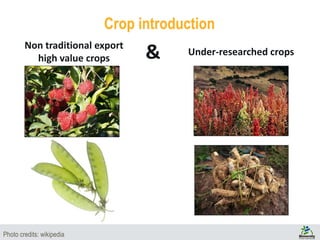
Crop introduction
Non traditional export
high value crops &
Photo credits: wikipedia
Under-researched crops
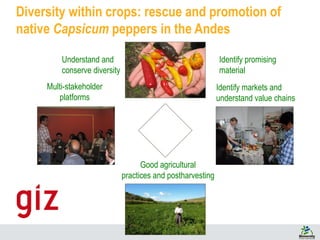
Diversity within crops: rescue and promotion of
native Capsicum peppers in the Andes
Understand and
conserve diversity
Identify promising
material
Identify markets and
understand value chains
Multi-stakeholder
platforms
Good agricultural
practices and postharvesting
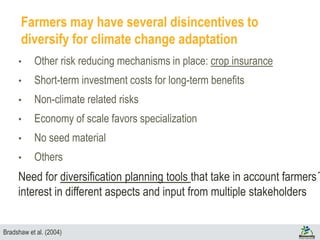
Farmers may have several disincentives to
diversify for climate change adaptation
• Other risk reducing mechanisms in place: crop insurance
• Short-term investment costs for long-term benefits
• Non-climate related risks
• Economy of scale favors specialization
• No seed material
• Others
Need for diversification planning tools that take in account farmers´
interest in different aspects and input from multiple stakeholders
Bradshaw et al. (2004)
Topics of action &
research interest
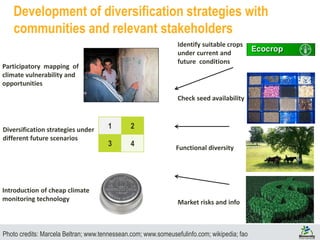
Development of diversification strategies with
communities and relevant stakeholders
Photo credits: Marcela Beltran; www.tennessean.com; www.someusefulinfo.com; wikipedia; fao
Participatory mapping of
climate vulnerability and
opportunities
Identify suitable crops
under current and
future conditions
Diversification strategies under
different future scenarios
Market risks and info
1 2
3 4 Functional diversity
Check seed availability
Introduction of cheap climate
monitoring technology
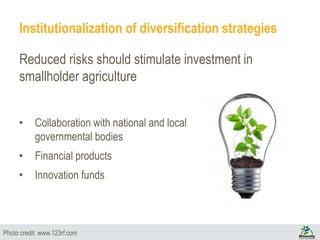
Institutionalization of diversification strategies
Reduced risks should stimulate investment in
smallholder agriculture
• Collaboration with national and local
governmental bodies
• Financial products
• Innovation funds
Photo credit: www.123rf.com
Diversification policies
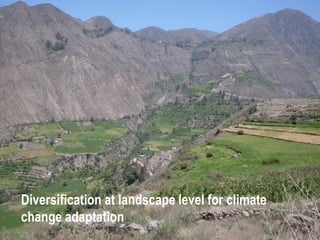
Diversification at landscape level for climate
change adaptation
Diversification at landscape level for climate
change adaptation
What are optimal landscape structures to regulate
topoclimates?
How does diversification at landscape level affect pest
and disease pressure and its biological control?
Summary: principal action and research interest
1. Development of crop and tree species
diversification strategies with communities and
relevant stakeholders
2. Institutionalization of diversification plans
3. Diversification at landscape level
www.bioversityinternational.org
Thank you
m.vanzonneveld@cgiar.org

Crop and tree species diversification for climate risk management

  • 1.
    Crop and treespecies diversification for climate risk management Maarten van Zonneveld, PhD 2 October 2013
  • 2.
    Agriculture, food securityand climate change • 100 % increase in food production to feed 9 billion people in 2050 • Climate change threats agricultural production • Smallholders are the principal agents of agricultural production • Climate change impacts for smallholders are difficult to predict • Agriculture is a risky business and becomes more risky under climate change Hardaker et al. 2004; Morton 2007; Godfray et al. 2010; Lobell et al. 2011
  • 3.
    Crop and treediversification as climate risk management strategy Cultivation of a portfolio of cultivated crops and trees reduces risk: • Sum of risks is less than individual crop risks • Production stabilization and optimization
  • 4.
    Diversification for climatechange adaptation at different geographic scales Farm level: -Risk management -Microclimate improvement Landscape level: -Reduced pressure of pest and diseases -Topoclimate regulation Administrative unit level: -Risk reduction for financial investment
  • 5.
    Targeting interventions forclimate adaptation Switch crops Diversification to create option value Diversification to manage risk Diversification to create option value and manage risk Switch crops and/or shift livelihoods Off-farm diversification Optimal production conditions Marginal production conditions High climate uncertainty Low climate uncertainty
  • 6.
    Crop diversification portfolio Lowrisk - strategic advantage High risk - maintain competitiveness Food security and commodity crops Climate vulnerable crops Crops for the future High-value crops Photo credits: www.greatdreams.com, wikipedia Low risk - maintain competitiveness High risk - strategic advantage
  • 7.
    Crop introduction Non traditionalexport high value crops & Photo credits: wikipedia Under-researched crops
  • 8.
    Diversity within crops:rescue and promotion of native Capsicum peppers in the Andes Understand and conserve diversity Identify promising material Identify markets and understand value chains Multi-stakeholder platforms Good agricultural practices and postharvesting
  • 9.
    Farmers may haveseveral disincentives to diversify for climate change adaptation • Other risk reducing mechanisms in place: crop insurance • Short-term investment costs for long-term benefits • Non-climate related risks • Economy of scale favors specialization • No seed material • Others Need for diversification planning tools that take in account farmers´ interest in different aspects and input from multiple stakeholders Bradshaw et al. (2004)
  • 10.
    Topics of action& research interest
  • 11.
    Development of diversificationstrategies with communities and relevant stakeholders Photo credits: Marcela Beltran; www.tennessean.com; www.someusefulinfo.com; wikipedia; fao Participatory mapping of climate vulnerability and opportunities Identify suitable crops under current and future conditions Diversification strategies under different future scenarios Market risks and info 1 2 3 4 Functional diversity Check seed availability Introduction of cheap climate monitoring technology
  • 12.
    Institutionalization of diversificationstrategies Reduced risks should stimulate investment in smallholder agriculture • Collaboration with national and local governmental bodies • Financial products • Innovation funds Photo credit: www.123rf.com
  • 13.
    Diversification policies Diversification atlandscape level for climate change adaptation
  • 14.
    Diversification at landscapelevel for climate change adaptation What are optimal landscape structures to regulate topoclimates? How does diversification at landscape level affect pest and disease pressure and its biological control?
  • 15.
    Summary: principal actionand research interest 1. Development of crop and tree species diversification strategies with communities and relevant stakeholders 2. Institutionalization of diversification plans 3. Diversification at landscape level
  • 16.