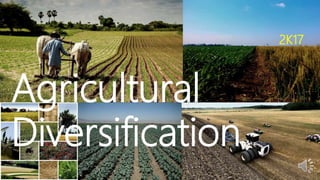
Agricultural
Diversification
2K17
Amar Kumar Mandal
INTRODUCTION
 In the agricultural context, diversification can be regarded as
the re-allocation of some of a farm's productive resources,
such as land, capital, farm equipment and pieces to other
farmers and, particularly in richer countries, non-farming
activities such as restaurants and shops.
 Factors leading to decisions to diversify are many, but include;
reducing risk, responding to changing consumer demands or
changing government policy, responding to external shocks
and, more recently, as a consequence of climate change.
Amar Kumar Mandal
Two approaches to crop diversification in
agriculture: -
Horizontal diversification
 The primary approach to crop
diversification used in production
agriculture. In this approach,
diversification normally takes place
through crop intensification which
means adding new high-value
crops to existing cropping systems
as a way of improving the overall
productivity of a particular farm or
a region's farming economy as a
whole.
Vertical diversification
 It is an approach in which value is
added to the products by farmers
through various methods such as
processing, regional branding,
packaging, merchandising, or other
efforts to enhance the product.
Amar Kumar Mandal
Need of agriculture Diversification
 A substantial portion of Indian farming is dependent on the vagaries of monsoon, making it
is risky affair to rely upon solely.
 Accordingly, the need of diversification is required to enable the farmers to earn from other
alternatives non farm occupation.
 the kharif season opens up ample opportunities for agriculture employment. However,
owing to lack of irrigation facilities, the farmers fails to get gainful employment
opportunities during the Rabi season. Therefore the need of diversification arises during the
Rabi season.
 Agriculture being over crowded cannot further generate employment opportunities.
Therefore, the prospects of the non farm sector should be opened up in the rural area to
provide job opportunities, diverting workforce from the already crowded agriculture sector.
 The non farm sector has several segments that posses dynamic linkages such enhance the
healthy growth of an economy.
Amar Kumar Mandal
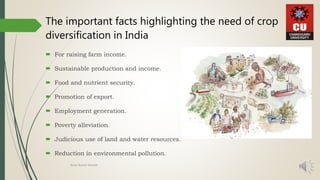
The important facts highlighting the need of crop
diversification in India
 For raising farm income.
 Sustainable production and income.
 Food and nutrient security.
 Promotion of export.
 Employment generation.
 Poverty alleviation.
 Judicious use of land and water resources.
 Reduction in environmental pollution.
Amar Kumar Mandal
Major Driving Forces for Crop Diversification
 Increasing income on small farm holdings.
 Withstanding price fluctuation.
 Mitigating ill-effects of aberrant weather.
 Balancing food demand.
 Improving fodder for livestock animals.
 Conservation of natural resources (soil, water, etc.).
 Minimizing environmental pollution.
 Reducing dependence on off-farm inputs.
 Decreasing insect pests, diseases and weed problems.
 Increasing community Food security
Amar Kumar Mandal
Table: State wise crop diversification in context to
weather
State Weather constraints Traditional crops Proposed crops to be
taken
Tamil Nadu Droughts, high
temperature
Rice, pulses Banana, sugarcane,
onion
Gujarat Droughts,
High temperature
Upland paddy, coarse
cereals,
Cereals
Maize, sesame, castor,
intercropping
sugarcane, soybean,
vegetables, horticultural
crops.
Maharashtra Droughts, high
temperature
Paddy, coarse cereals,
cotton
Oilseeds, soybean,
horticultural crops,
medicinal plants and
flowery culture.
Amar Kumar Mandal
Consequences of changes in cropping pattern:
 The developments have positive effects on land/labor productivity and net farm income, but also
endangered a number of undesirable side effects like reduced farm employment and crop
imbalances and loss of crop diversity at the farm level.
 Although the expansion of commercialized agriculture has fomented new sets of rural non-farm
activities and strengthened the rural-urban growth linkages, but also weakened the traditional inter-
sectoral linkages between the crop and livestock sectors.
 Crop pattern changes lead to serious environmental consequences that take such forms as
groundwater depletion, soil fertility loss and water logging and salinity - which can reduce the
productive capacity and growth potential of agriculture over the long-term.
Amar Kumar Mandal
Table: Suggested Alternate Crops In Place Of Main crops In
Major Growing States.
State Main crop Kharif alternate crop Main crop Rabi alternate crop
Punjab Rice Maize, moong/urad Wheat Mustard, chick pea,
lentil, field peas
Uttar
Pradesh
Rice Arhar (short duration)
moong/urad
Wheat Mustard, chick pea,
lentil, field peas
Bihar Rice Not suggested as most of
the rice area is
waterlogged
Wheat Maize, mustard, lentil.
Amar Kumar Mandal
Crop diversification as a strategy for food and
nutritional security and poverty alleviation
Crop diversification can help the farmers in addressing the important determinants of
poverty such as : -
 lack of income and purchasing power
 lack of productive employment
 the continuous increase in price of food
 inadequacy of social infrastructure, affecting the quality of life of the people and
their employability.
Amar Kumar Mandal
Crop diversification as strategy for issues of
natural resources management:
Water is important natural resource which is facing several challenges and there are
several concerns regarding water resources in the country and the states.
 Judicious use of land and water resources will have to be the central theme for sustainability
of agricultural growth.
 The deterioration in land and water resources has been in the form of land degradation,
water logging and decline in water table.
 There are several possible technologies and alternatives to reduce the use of chemicals in
agriculture. These alternatives are not perfect substitutes to chemicals but adoption of these
can substantially reduce the adverse impact on environment.
 Proper land and water management policies would reduce environmental degradation.
 Community and village level farmer’s institutions have to be encouraged to participate in
protecting natural resources from degradation. Programmes for regeneration of land and
water resources need to be strengthened.
Amar Kumar Mandal
CONSTRAINTS IN CROP DIVERSIFICATION
Lack of suitable land
Lack of water and technologies
Low adoption rate of new varieties
Imports discourage diversification
Existing marketing system discourages diversification
Amar Kumar Mandal
Continued…..
 More than 60 per cent of the cropped area in the country is rain fed and is dependent on rainfall
 Sub-optimal and over-use of resources like land and water resources, causing a negative impact on
the environment and sustainability of agriculture
 Inadequate supply of improved and quality seeds and planting material of improved cultivars
 Fragmentation of land holdings and lack of mechanization of agriculture due investment
constraints and land holding sizes
 Poor basic infrastructure like rural roads, power, transport, communications etc.
 Inadequate post-harvest technologies and inadequate infrastructure for post-harvest handling of
perishable horticultural produce
 Very weak agro-based industry
 Inadequate research - extension - farmer linkages
 Inadequately trained human resources and large scale illiteracy amongst farmers
 Emerging species of diseases and pests affecting most crop plants
 Poor database for horticultural crops and insufficient investments in the agricultural sector.
Amar Kumar Mandal
Research and developmental support for crop
diversification
In order to support the crop diversification sound research and development initiatives are essential.
 Future agriculture will be much more knowledge and skill based rather than the traditional subsistence agriculture.
 In the wake of globalization and opening up of the global market, there will be much more opportunity for
entrepreneurship development in agriculture.
 Development in research and technology and also the transfer of technology for successful crop diversification.
 Needs to address the issues connected with continuance and indulgence in the areas of emerging technologies
but also create a cadre of scientists through the continuous upgrade of skills and human resource development.
 The researchers also need to popularize the technologies, impart knowledge and skills to the extension
functionaries for the transfer of technologies to the farmers.
 This knowledge-based farming will call for much more interaction between the researchers, extension workers and
farmers.
 The fruits of the innovative technologies should reach the farmers at the earliest and also spread in the quickest
possible time.
Amar Kumar Mandal
Institutional and infrastructure developments in
support of crop diversification
To sustain and operationalize crop diversification, institutional support is required-
 Establishment of Natural Research Management Based Institutions and State Agricultural
Universities are jointly addressing the issues connected with the crop diversification.
 Establishments of Crop Directorates for each of the major crops and groups of crops for
development and technology transfer focus on each of these crops and commodities.
 These Directorates act as coordinating agencies between the research and development
activities on the one hand and between the central and state governments for technology
transfer and other promotional activities.
Amar Kumar Mandal
Amar Kumar Mandal
GOVERNMENT POLICIES AND STRATEGIES FOR
CROP DIVERSIFICATION
 Implementing National Agriculture Insurance Scheme.
 Operationalizing Technology Mission on Cotton.
 Provision of Capital Subsidy of 25 percent for Construction / Modernization / Expansion of
Cold Storages and Storages for Horticultural Produce.
 Creation of Watershed Development Fund.
 Strengthening Agricultural Marketing.
 Seed Crop Insurance.
 Seed Bank Scheme.
 Cooperative Sector Reforms.
Amar Kumar Mandal
Conclusion
 Crop diversification is not only a shift from traditional and less remunerative crops to more
remunerative crops but it is a demand driven, need based situation specific and national goal
seeking continuous and dynamic concept and involves spatial, temporal, value addition and
resource complementary approaches.
 The study has observed that the areas under high-value crops have recorded significant growth
(1.99 %) during the past two decades. Consequently, the share of high-value crops in the total
value of agricultural output has remarkably increased.
 The nature of crop diversification is has been mainly from low value coarse cereals to high value
oilseeds and other food grains as well as cattle farming practices such as poultry farming, pig
rearing, goat rearing etc.
Amar Kumar Mandal
References
 http://www.fao.org/docrep/003/x6906e/x6906e06.htm
 https://internationaljournalofresearch.com/2017/01/04/innovative-initiatives-for-
farmers-development-and-issues-of-crop-diversification/#_ftn1
 http://journalofscience.org/index.php/GJSFR
 http://unsdsn.org/
 http://www.icar.org.in/en/%252Fnode/9641
 https://spuvvn.edu/.../R.%20No.%20145%20State%20of%20Rajasthan%20Agricultur
...
 http://www.scholarsresearchlibrary.com
Amar Kumar Mandal
Thank you
Amar Kumar Mandal

Agricultural diversification

  • 1.
  • 2.
    INTRODUCTION  In theagricultural context, diversification can be regarded as the re-allocation of some of a farm's productive resources, such as land, capital, farm equipment and pieces to other farmers and, particularly in richer countries, non-farming activities such as restaurants and shops.  Factors leading to decisions to diversify are many, but include; reducing risk, responding to changing consumer demands or changing government policy, responding to external shocks and, more recently, as a consequence of climate change. Amar Kumar Mandal
  • 3.
    Two approaches tocrop diversification in agriculture: - Horizontal diversification  The primary approach to crop diversification used in production agriculture. In this approach, diversification normally takes place through crop intensification which means adding new high-value crops to existing cropping systems as a way of improving the overall productivity of a particular farm or a region's farming economy as a whole. Vertical diversification  It is an approach in which value is added to the products by farmers through various methods such as processing, regional branding, packaging, merchandising, or other efforts to enhance the product. Amar Kumar Mandal
  • 4.
    Need of agricultureDiversification  A substantial portion of Indian farming is dependent on the vagaries of monsoon, making it is risky affair to rely upon solely.  Accordingly, the need of diversification is required to enable the farmers to earn from other alternatives non farm occupation.  the kharif season opens up ample opportunities for agriculture employment. However, owing to lack of irrigation facilities, the farmers fails to get gainful employment opportunities during the Rabi season. Therefore the need of diversification arises during the Rabi season.  Agriculture being over crowded cannot further generate employment opportunities. Therefore, the prospects of the non farm sector should be opened up in the rural area to provide job opportunities, diverting workforce from the already crowded agriculture sector.  The non farm sector has several segments that posses dynamic linkages such enhance the healthy growth of an economy. Amar Kumar Mandal
  • 5.
    The important factshighlighting the need of crop diversification in India  For raising farm income.  Sustainable production and income.  Food and nutrient security.  Promotion of export.  Employment generation.  Poverty alleviation.  Judicious use of land and water resources.  Reduction in environmental pollution. Amar Kumar Mandal
  • 6.
    Major Driving Forcesfor Crop Diversification  Increasing income on small farm holdings.  Withstanding price fluctuation.  Mitigating ill-effects of aberrant weather.  Balancing food demand.  Improving fodder for livestock animals.  Conservation of natural resources (soil, water, etc.).  Minimizing environmental pollution.  Reducing dependence on off-farm inputs.  Decreasing insect pests, diseases and weed problems.  Increasing community Food security Amar Kumar Mandal
  • 7.
    Table: State wisecrop diversification in context to weather State Weather constraints Traditional crops Proposed crops to be taken Tamil Nadu Droughts, high temperature Rice, pulses Banana, sugarcane, onion Gujarat Droughts, High temperature Upland paddy, coarse cereals, Cereals Maize, sesame, castor, intercropping sugarcane, soybean, vegetables, horticultural crops. Maharashtra Droughts, high temperature Paddy, coarse cereals, cotton Oilseeds, soybean, horticultural crops, medicinal plants and flowery culture. Amar Kumar Mandal
  • 8.
    Consequences of changesin cropping pattern:  The developments have positive effects on land/labor productivity and net farm income, but also endangered a number of undesirable side effects like reduced farm employment and crop imbalances and loss of crop diversity at the farm level.  Although the expansion of commercialized agriculture has fomented new sets of rural non-farm activities and strengthened the rural-urban growth linkages, but also weakened the traditional inter- sectoral linkages between the crop and livestock sectors.  Crop pattern changes lead to serious environmental consequences that take such forms as groundwater depletion, soil fertility loss and water logging and salinity - which can reduce the productive capacity and growth potential of agriculture over the long-term. Amar Kumar Mandal
  • 9.
    Table: Suggested AlternateCrops In Place Of Main crops In Major Growing States. State Main crop Kharif alternate crop Main crop Rabi alternate crop Punjab Rice Maize, moong/urad Wheat Mustard, chick pea, lentil, field peas Uttar Pradesh Rice Arhar (short duration) moong/urad Wheat Mustard, chick pea, lentil, field peas Bihar Rice Not suggested as most of the rice area is waterlogged Wheat Maize, mustard, lentil. Amar Kumar Mandal
  • 10.
    Crop diversification asa strategy for food and nutritional security and poverty alleviation Crop diversification can help the farmers in addressing the important determinants of poverty such as : -  lack of income and purchasing power  lack of productive employment  the continuous increase in price of food  inadequacy of social infrastructure, affecting the quality of life of the people and their employability. Amar Kumar Mandal
  • 11.
    Crop diversification asstrategy for issues of natural resources management: Water is important natural resource which is facing several challenges and there are several concerns regarding water resources in the country and the states.  Judicious use of land and water resources will have to be the central theme for sustainability of agricultural growth.  The deterioration in land and water resources has been in the form of land degradation, water logging and decline in water table.  There are several possible technologies and alternatives to reduce the use of chemicals in agriculture. These alternatives are not perfect substitutes to chemicals but adoption of these can substantially reduce the adverse impact on environment.  Proper land and water management policies would reduce environmental degradation.  Community and village level farmer’s institutions have to be encouraged to participate in protecting natural resources from degradation. Programmes for regeneration of land and water resources need to be strengthened. Amar Kumar Mandal
  • 12.
    CONSTRAINTS IN CROPDIVERSIFICATION Lack of suitable land Lack of water and technologies Low adoption rate of new varieties Imports discourage diversification Existing marketing system discourages diversification Amar Kumar Mandal
  • 13.
    Continued…..  More than60 per cent of the cropped area in the country is rain fed and is dependent on rainfall  Sub-optimal and over-use of resources like land and water resources, causing a negative impact on the environment and sustainability of agriculture  Inadequate supply of improved and quality seeds and planting material of improved cultivars  Fragmentation of land holdings and lack of mechanization of agriculture due investment constraints and land holding sizes  Poor basic infrastructure like rural roads, power, transport, communications etc.  Inadequate post-harvest technologies and inadequate infrastructure for post-harvest handling of perishable horticultural produce  Very weak agro-based industry  Inadequate research - extension - farmer linkages  Inadequately trained human resources and large scale illiteracy amongst farmers  Emerging species of diseases and pests affecting most crop plants  Poor database for horticultural crops and insufficient investments in the agricultural sector. Amar Kumar Mandal
  • 14.
    Research and developmentalsupport for crop diversification In order to support the crop diversification sound research and development initiatives are essential.  Future agriculture will be much more knowledge and skill based rather than the traditional subsistence agriculture.  In the wake of globalization and opening up of the global market, there will be much more opportunity for entrepreneurship development in agriculture.  Development in research and technology and also the transfer of technology for successful crop diversification.  Needs to address the issues connected with continuance and indulgence in the areas of emerging technologies but also create a cadre of scientists through the continuous upgrade of skills and human resource development.  The researchers also need to popularize the technologies, impart knowledge and skills to the extension functionaries for the transfer of technologies to the farmers.  This knowledge-based farming will call for much more interaction between the researchers, extension workers and farmers.  The fruits of the innovative technologies should reach the farmers at the earliest and also spread in the quickest possible time. Amar Kumar Mandal
  • 15.
    Institutional and infrastructuredevelopments in support of crop diversification To sustain and operationalize crop diversification, institutional support is required-  Establishment of Natural Research Management Based Institutions and State Agricultural Universities are jointly addressing the issues connected with the crop diversification.  Establishments of Crop Directorates for each of the major crops and groups of crops for development and technology transfer focus on each of these crops and commodities.  These Directorates act as coordinating agencies between the research and development activities on the one hand and between the central and state governments for technology transfer and other promotional activities. Amar Kumar Mandal
  • 16.
  • 17.
    GOVERNMENT POLICIES ANDSTRATEGIES FOR CROP DIVERSIFICATION  Implementing National Agriculture Insurance Scheme.  Operationalizing Technology Mission on Cotton.  Provision of Capital Subsidy of 25 percent for Construction / Modernization / Expansion of Cold Storages and Storages for Horticultural Produce.  Creation of Watershed Development Fund.  Strengthening Agricultural Marketing.  Seed Crop Insurance.  Seed Bank Scheme.  Cooperative Sector Reforms. Amar Kumar Mandal
  • 18.
    Conclusion  Crop diversificationis not only a shift from traditional and less remunerative crops to more remunerative crops but it is a demand driven, need based situation specific and national goal seeking continuous and dynamic concept and involves spatial, temporal, value addition and resource complementary approaches.  The study has observed that the areas under high-value crops have recorded significant growth (1.99 %) during the past two decades. Consequently, the share of high-value crops in the total value of agricultural output has remarkably increased.  The nature of crop diversification is has been mainly from low value coarse cereals to high value oilseeds and other food grains as well as cattle farming practices such as poultry farming, pig rearing, goat rearing etc. Amar Kumar Mandal
  • 19.
    References  http://www.fao.org/docrep/003/x6906e/x6906e06.htm  https://internationaljournalofresearch.com/2017/01/04/innovative-initiatives-for- farmers-development-and-issues-of-crop-diversification/#_ftn1 http://journalofscience.org/index.php/GJSFR  http://unsdsn.org/  http://www.icar.org.in/en/%252Fnode/9641  https://spuvvn.edu/.../R.%20No.%20145%20State%20of%20Rajasthan%20Agricultur ...  http://www.scholarsresearchlibrary.com Amar Kumar Mandal
  • 20.