CLIL - ICT- HE
Designing CLIL Materials:
Using OER and ICT
@isabel pérez torres
• CLIL Methodology
• CLIL Resources
• IT and Web 2.0 Tools
CLIL is NOT working the same content but
translated into English
Teaching CLIL means changes in..
• The working and planning methodology
• The classroom methodology
Some core features of CLIL
Methodology
• Facilitate learning
Use lot of “scaffolding”
• Visual and graphic support (pictures, charts, diagrams,
tables, etc.)
• Key words
• Repetition, paraphrasing,
• Code switching
• Language frames
• Templates
Some core features of CLIL
Methodology
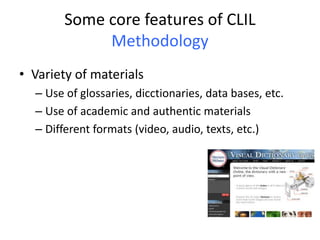
• Variety of materials
– Use of glossaries, dicctionaries, data bases, etc.
– Use of academic and authentic materials
– Different formats (video, audio, texts, etc.)
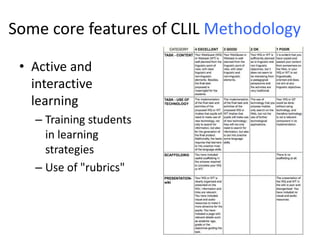
• Active and
interactive
learning
– Training students
in learning
strategies
– Use of "rubrics"
Some core features of CLIL Methodology
• Cooperative learning
– Group work (WebQuests, webtasks, PBL, etc)
– Peer evaluation
Some core features of CLIL
Methodology
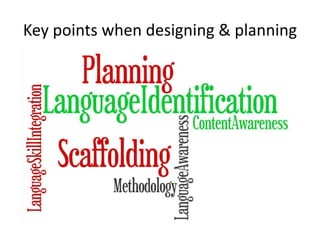
Key points when designing & planning
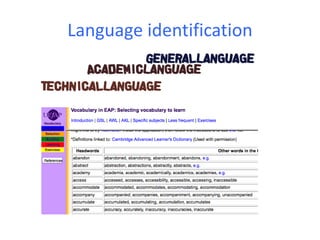
Language identification
Scaffolding
• Reception scaffolding (glossaries, tables, diagrams, etc.)
• Transforming scaffolding
• Production scaffolding (Templates, language frames, etc)
Resources / type
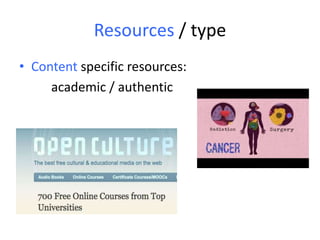
• Content specific resources:
academic / authentic
Resources / type
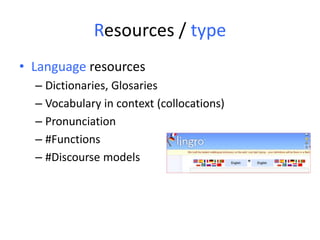
• Language resources
– Dictionaries, Glosaries
– Vocabulary in context (collocations)
– Pronunciation
– #Functions
– #Discourse models
Resources / format
• Continuous and discontinuous texts
• Audios: podcasts
• Videos
• Images
• Animations
• Graphics, mind maps, timelines,
Tools to design materials
• Planning
– Template
Tools to design materials
• Using IT tools
– Podcasts / audacity
– Subtitling videos
– Graphics, mind maps, timelines, others
– Presentations
Tools to design materials
• Sharing and working in collaboration
– Institutional Platforms
– Edu.com
– Wikispaces
– Google drive
– Bookmarks
Physical Education

CLIL - ICT- HE

  • 1.
    CLIL - ICT-HE Designing CLIL Materials: Using OER and ICT @isabel pérez torres
  • 2.
    • CLIL Methodology •CLIL Resources • IT and Web 2.0 Tools
  • 3.
    CLIL is NOTworking the same content but translated into English
  • 4.
    Teaching CLIL meanschanges in.. • The working and planning methodology • The classroom methodology
  • 5.
    Some core featuresof CLIL Methodology • Facilitate learning Use lot of “scaffolding” • Visual and graphic support (pictures, charts, diagrams, tables, etc.) • Key words • Repetition, paraphrasing, • Code switching • Language frames • Templates
  • 6.
    Some core featuresof CLIL Methodology • Variety of materials – Use of glossaries, dicctionaries, data bases, etc. – Use of academic and authentic materials – Different formats (video, audio, texts, etc.)
  • 7.
    • Active and interactive learning –Training students in learning strategies – Use of "rubrics" Some core features of CLIL Methodology
  • 8.
    • Cooperative learning –Group work (WebQuests, webtasks, PBL, etc) – Peer evaluation Some core features of CLIL Methodology
  • 9.
    Key points whendesigning & planning
  • 10.
  • 11.
    Scaffolding • Reception scaffolding(glossaries, tables, diagrams, etc.) • Transforming scaffolding • Production scaffolding (Templates, language frames, etc)
  • 12.
    Resources / type •Content specific resources: academic / authentic
  • 13.
    Resources / type •Language resources – Dictionaries, Glosaries – Vocabulary in context (collocations) – Pronunciation – #Functions – #Discourse models
  • 14.
    Resources / format •Continuous and discontinuous texts • Audios: podcasts • Videos • Images • Animations • Graphics, mind maps, timelines,
  • 15.
    Tools to designmaterials • Planning – Template
  • 16.
    Tools to designmaterials • Using IT tools – Podcasts / audacity – Subtitling videos – Graphics, mind maps, timelines, others – Presentations
  • 17.
    Tools to designmaterials • Sharing and working in collaboration – Institutional Platforms – Edu.com – Wikispaces – Google drive – Bookmarks
  • 18.