CLIENT PROJECT
PRO- FORMA
Sjon Barnes
Mind Maps/Brainstorms
Start by using the first few slides to create mind maps and or brainstorms
for ideas related to your project. Get as many possibilities as you can.
Don’t worry about practicality, suitability or potential at this stage.You will
assess the ideas later.
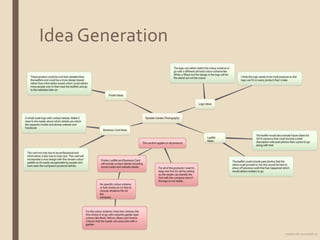
Idea Generation
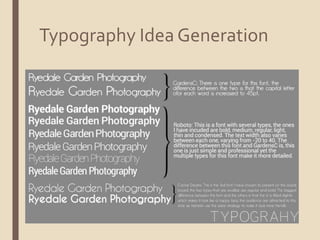
Typography Idea Generation
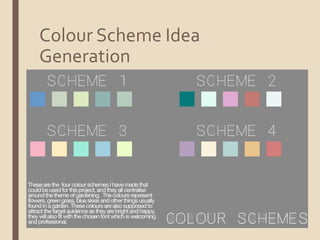
Colour Scheme Idea
Generation
Assessing ideas
Now you have generated lots of potential ideas, it is
time to rationalise those against the requirements of
the brief from your client.
Use the next few slides to consolidate your ideas and
then assess them against the requirements and
constraints of the project.
Finally, select an idea to take forward for further
development.
Idea 1
The first idea will be to include a poster, a business card, a new logo and colour scheme and a leaflet of
events.The poster will be to advertise the latest events happening right now and that will be simple and will
not be detailed, as this is supposed to attract the audience over to the events. However the leaflet will be a
more detailed version of the poster which will include locations, times, equipment needed and other
information that the audience will need for the events.The other products that I will include will be a new
logo and a colour scheme, I have decided to include these because the client has noted that the company
doesn’t exactly have a logo right now and I think having one will be key for this project as I can make the
logo fit with the new poster and leaflet.The last product on this idea is the business card, this will be a small
card that will include basic details about the company including social media, e-mail address, phone
numbers etc., these will be key for the company as you can pass them onto people who will contact the
company for other events.
Evaluation of idea
What do you like about the idea?
This first idea is full of potential to really rebrand the company, and because I’m changing a lot
of the design elements I can really do a different style that won’t be like the last one. Due to me
making a lot of new products this means the products will fit with one another in a style that I
and hopefully the client will like.
Does it match what the client wants?
Yes, this should fit with the brief the client gave me. It includes the core items they want
including the extras that they suggested in the additional information box, this means I should
have more than enough to match what the client wants.
Are you capable of delivering this and on time?
I am more than capable of delivering these ideas, this is because I have dealt with doing
products like this before in past projects.The only problem I’ll have with this idea will be if I
change my mind last minute then it could take longer than usual to complete it.
Do you have the resources available to do this?
The resources I’ll need for this idea will be at college so I’m completely fine with this idea for
resources as all I’ll need will be the Mac with Photoshop.
Idea 2
The second idea for this project is very similar to the first idea just without the added extras, this idea is
meant to work for scheduling rather than doing loads of products in a small amount of time.The products
that I will include in this will be a business card, a logo and colour scheme, and a leaflet.The card will include
basic contact details including phone numbers, E-mail addresses, social media accounts and a website link.
The leaflet will include details about future events, times, equipment needed for these events and other
related information.The last product on this list, the logo and colour scheme will be made as the client has
required a new logo as the company doesn’t exactly have a logo and it would be nice to add one to the list.
Evaluation of idea
What do you like about the idea?
I like this idea because it’s a more simplified version of the first idea, with me keeping the
majority of the ideas but the additional ideas have been removed to save time.
Does it match what the client wants?
This does match what the client wants in a basic way as I’m doing everything they asked me to
do in the brief just I’m not doing any of the work they suggested, I could do in the additional
section so I can save time and produce maybe better quality work rather than do loads of work.
Are you capable of delivering this and on time?
I believe I will be fully capable of finishing this idea as there’s not as much work to do for this
idea as there is for the other one, so I can assume I would finish this one faster than the others.
Do you have the resources available to do this?
Just like the other idea I will have the exact same resources available to me.
Idea Evaluation
Which of your ideas do you want to develop further? Explain why you
think that is the right idea to take forward.
Idea 1
Development
Use the next slides to document your idea development.
This should include mood boards and other visual examples of work. It could include basic
mock ups of your vision for the project using the work of others.
If you are taking doing something outside of your ordinary skill set or way of working, you
could include test work or practice work here too.
There is room to develop a second idea here as well.This could give you a greater variety
of options to give to your client.
You will then assess your developed idea against the constraints of the project before
producing a final treatment.
Developed Idea 1
x
Assessment of final ideas
Suitable for audience?
Suitability for client?
Appeal of the work:
Timescales for production:
Costs:
Personnel:
Assessment of final ideas
Legal and ethical issues:
RESEARCH
Competition/Market research:
Who is in competition with your client?
What is their design/photography/marketing/promotional/advertising work like?
What wider market is your client part of? Undertake research in to that market.This could be in the form of sales
figures, audience figures, turnover, job roles, customer base, market share, rules, regulations and codes of
practice.
One company that is in competition with my client is a photography tuition company called Paul Whittle
PhotographyTuition which is based inYork, he is similar to the client but instead runs it himself and also does other
photography business outside of tuition. Compared to my client, Paul Whittle charges a lot more for his tuition
ranging from £25 per hour for wedding photography to £155 for studio photography.While my client charges £50 per
person on most events for a half day which is 3 hours, this is considerably cheaper and a better option for people
looking at getting photography tuition. Just like my client, Paul Whittle doesn't have much design going on for his
website neither have I seen any other promotional pieces.
Another company that would be in competition with my client is Baily Cooper Photography, he runs his company
very similar to Paul Whittle because they both don’t prioritise in tuition.The difference between Baily Cooper and the
others I have looked at including my client is design, the website design of Baily Coopers is far more developed than
the others which leads me to suggest that their social media and other promotional products are probably more
developed too.This means the prices for this company could be higher than the others and they were, the starting
prices for the basic lessons were £50 and rose to a high of £200+ for the more advanced lessons.These prices are
astronomically higher than my clients prices for tuition events.
The last company I will be looking at is far different than the other independent photographers, it’s the camera
company Jessops who also offer courses in photography to help amateur photographers understand their camera
more.They have 2 levels of course both costing £120 in total, they teach the basics of a camera and all the controls of
a camera and then they teach more advanced techniques in level 2.The total amount of time these courses are is 6
hours, which is far more than the other tuitions I have looked at. In conclusion Jessops is the most affordable course
that has a good amount of time for tuition, I would consider this company which is inYork to be the main competition
for my client.
Audience/Customer research:
Who is the audience or customer that your client is trying to reach? Perhaps they have already told you. Perhaps
you should ask.You could also do further research in to the type of audience or customer you are hoping to
appeal to.
“Here at Ryedale Garden Photography, we focus on photography days and tuition based at some of the regions
finest country houses and gardens.”This is the opening on their website that describes basically what they do as
a company and now I shall find what their audience is, I will do this in two ways; the first is through the website
YouGov and the next will be through what the company knows, for example what is there average age and
gender of customers who go on their trips.
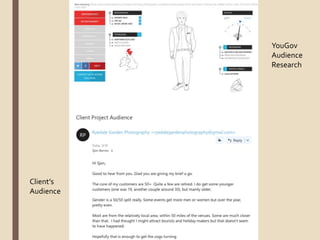
OnYouGov I searched for the audience of the activity of Photography, what I found wasn’t very surprising.The
average age is 55+, with the majority gender being male with a social grade of ABC1.This will help with my
project as by knowing the audience I will be able to change my products to be more appealing towards that age
and gender, for example I’ll make the font size bigger than usual on the products to make it more acceptable for
the older age gap which dominates this activity.
According to the client the age range has been a majority 50+ with many of the customers being retired, however
they do get on occasion some younger people.The gender is split in half with no one gender being more
dominant, while the location of their audience is within 50 miles of most of the sites they go to.They usually get
locals rather than tourists, so there’s no language barrier that needs to be solved.
Client’s
Audience
YouGov
Audience
Research
Content research:
This should take the form of secondary research (exiting products from your client and the competition and
wider market) and also some primary research (asking potential audience, your client and your market,) to help
you formalise the content of your project.
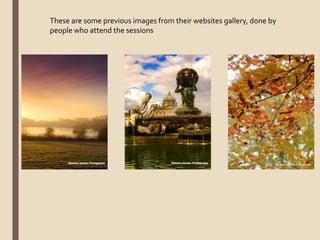
The work that the company does is to teach people about photography and help people take nice photographs while
learning about cameras and how to operate them for photography, they show off some people’s previous work on
their website.
These are some previous images from their websites gallery, done by
people who attend the sessions
Treatment:
The treatment evokes how an audience will experience what you are making.
Write in the active-voice in present tense.Tell the reader what they will see.
Describe the content of your project.
Write vibrantly, so the reader gets excited about your work.They should be able to
visualise the finished pieces.You could also supplement this with some mood boards or
mock ups.
Be specific—don’t use words like may, might or possibly.
Treatment
Treatment (visual elements)
Timescales:
You should prepare a production schedule that will allow you to manage your time over
the 3 weeks of production.This should include:
• Deadlines: Interim deadlines help you keep on track, final deadlines are final.
• Availability: The availability of the client and any other people you may need to help
you with your project.You will need to contact them.You might to do visit.You may
need to liaise with models, or photographers.
• Feedback: This is a working brief with a real client.You will need to get feedback on
your work and also allow yourself time to make appropriate changes. Plan appropriate
time in to you schedule so that you can do this.
• Resources: You should include a list of resources that you will need to complete your
project. Remember that this all needs to be your own work
YOU CAN DELETETHIS ONCEYOU DON’T NEED IT:
Production is due to start on Monday the 8thth of May.
You will have 3 weeks of lessons.The last day of production will be Friday the 19th of
May.This gives you a whole half term, should you need it.
.
Client project pro forma

Client project pro forma

  • 1.
  • 2.
    Mind Maps/Brainstorms Start byusing the first few slides to create mind maps and or brainstorms for ideas related to your project. Get as many possibilities as you can. Don’t worry about practicality, suitability or potential at this stage.You will assess the ideas later.
  • 3.
  • 4.
  • 5.
  • 6.
    Assessing ideas Now youhave generated lots of potential ideas, it is time to rationalise those against the requirements of the brief from your client. Use the next few slides to consolidate your ideas and then assess them against the requirements and constraints of the project. Finally, select an idea to take forward for further development.
  • 7.
    Idea 1 The firstidea will be to include a poster, a business card, a new logo and colour scheme and a leaflet of events.The poster will be to advertise the latest events happening right now and that will be simple and will not be detailed, as this is supposed to attract the audience over to the events. However the leaflet will be a more detailed version of the poster which will include locations, times, equipment needed and other information that the audience will need for the events.The other products that I will include will be a new logo and a colour scheme, I have decided to include these because the client has noted that the company doesn’t exactly have a logo right now and I think having one will be key for this project as I can make the logo fit with the new poster and leaflet.The last product on this idea is the business card, this will be a small card that will include basic details about the company including social media, e-mail address, phone numbers etc., these will be key for the company as you can pass them onto people who will contact the company for other events.
  • 8.
    Evaluation of idea Whatdo you like about the idea? This first idea is full of potential to really rebrand the company, and because I’m changing a lot of the design elements I can really do a different style that won’t be like the last one. Due to me making a lot of new products this means the products will fit with one another in a style that I and hopefully the client will like. Does it match what the client wants? Yes, this should fit with the brief the client gave me. It includes the core items they want including the extras that they suggested in the additional information box, this means I should have more than enough to match what the client wants. Are you capable of delivering this and on time? I am more than capable of delivering these ideas, this is because I have dealt with doing products like this before in past projects.The only problem I’ll have with this idea will be if I change my mind last minute then it could take longer than usual to complete it. Do you have the resources available to do this? The resources I’ll need for this idea will be at college so I’m completely fine with this idea for resources as all I’ll need will be the Mac with Photoshop.
  • 9.
    Idea 2 The secondidea for this project is very similar to the first idea just without the added extras, this idea is meant to work for scheduling rather than doing loads of products in a small amount of time.The products that I will include in this will be a business card, a logo and colour scheme, and a leaflet.The card will include basic contact details including phone numbers, E-mail addresses, social media accounts and a website link. The leaflet will include details about future events, times, equipment needed for these events and other related information.The last product on this list, the logo and colour scheme will be made as the client has required a new logo as the company doesn’t exactly have a logo and it would be nice to add one to the list.
  • 10.
    Evaluation of idea Whatdo you like about the idea? I like this idea because it’s a more simplified version of the first idea, with me keeping the majority of the ideas but the additional ideas have been removed to save time. Does it match what the client wants? This does match what the client wants in a basic way as I’m doing everything they asked me to do in the brief just I’m not doing any of the work they suggested, I could do in the additional section so I can save time and produce maybe better quality work rather than do loads of work. Are you capable of delivering this and on time? I believe I will be fully capable of finishing this idea as there’s not as much work to do for this idea as there is for the other one, so I can assume I would finish this one faster than the others. Do you have the resources available to do this? Just like the other idea I will have the exact same resources available to me.
  • 11.
    Idea Evaluation Which ofyour ideas do you want to develop further? Explain why you think that is the right idea to take forward. Idea 1
  • 12.
    Development Use the nextslides to document your idea development. This should include mood boards and other visual examples of work. It could include basic mock ups of your vision for the project using the work of others. If you are taking doing something outside of your ordinary skill set or way of working, you could include test work or practice work here too. There is room to develop a second idea here as well.This could give you a greater variety of options to give to your client. You will then assess your developed idea against the constraints of the project before producing a final treatment.
  • 13.
  • 14.
    Assessment of finalideas Suitable for audience? Suitability for client? Appeal of the work: Timescales for production: Costs: Personnel:
  • 15.
    Assessment of finalideas Legal and ethical issues:
  • 16.
  • 17.
    Competition/Market research: Who isin competition with your client? What is their design/photography/marketing/promotional/advertising work like? What wider market is your client part of? Undertake research in to that market.This could be in the form of sales figures, audience figures, turnover, job roles, customer base, market share, rules, regulations and codes of practice. One company that is in competition with my client is a photography tuition company called Paul Whittle PhotographyTuition which is based inYork, he is similar to the client but instead runs it himself and also does other photography business outside of tuition. Compared to my client, Paul Whittle charges a lot more for his tuition ranging from £25 per hour for wedding photography to £155 for studio photography.While my client charges £50 per person on most events for a half day which is 3 hours, this is considerably cheaper and a better option for people looking at getting photography tuition. Just like my client, Paul Whittle doesn't have much design going on for his website neither have I seen any other promotional pieces. Another company that would be in competition with my client is Baily Cooper Photography, he runs his company very similar to Paul Whittle because they both don’t prioritise in tuition.The difference between Baily Cooper and the others I have looked at including my client is design, the website design of Baily Coopers is far more developed than the others which leads me to suggest that their social media and other promotional products are probably more developed too.This means the prices for this company could be higher than the others and they were, the starting prices for the basic lessons were £50 and rose to a high of £200+ for the more advanced lessons.These prices are astronomically higher than my clients prices for tuition events. The last company I will be looking at is far different than the other independent photographers, it’s the camera company Jessops who also offer courses in photography to help amateur photographers understand their camera more.They have 2 levels of course both costing £120 in total, they teach the basics of a camera and all the controls of a camera and then they teach more advanced techniques in level 2.The total amount of time these courses are is 6 hours, which is far more than the other tuitions I have looked at. In conclusion Jessops is the most affordable course that has a good amount of time for tuition, I would consider this company which is inYork to be the main competition for my client.
  • 18.
    Audience/Customer research: Who isthe audience or customer that your client is trying to reach? Perhaps they have already told you. Perhaps you should ask.You could also do further research in to the type of audience or customer you are hoping to appeal to. “Here at Ryedale Garden Photography, we focus on photography days and tuition based at some of the regions finest country houses and gardens.”This is the opening on their website that describes basically what they do as a company and now I shall find what their audience is, I will do this in two ways; the first is through the website YouGov and the next will be through what the company knows, for example what is there average age and gender of customers who go on their trips. OnYouGov I searched for the audience of the activity of Photography, what I found wasn’t very surprising.The average age is 55+, with the majority gender being male with a social grade of ABC1.This will help with my project as by knowing the audience I will be able to change my products to be more appealing towards that age and gender, for example I’ll make the font size bigger than usual on the products to make it more acceptable for the older age gap which dominates this activity. According to the client the age range has been a majority 50+ with many of the customers being retired, however they do get on occasion some younger people.The gender is split in half with no one gender being more dominant, while the location of their audience is within 50 miles of most of the sites they go to.They usually get locals rather than tourists, so there’s no language barrier that needs to be solved.
  • 19.
  • 20.
    Content research: This shouldtake the form of secondary research (exiting products from your client and the competition and wider market) and also some primary research (asking potential audience, your client and your market,) to help you formalise the content of your project. The work that the company does is to teach people about photography and help people take nice photographs while learning about cameras and how to operate them for photography, they show off some people’s previous work on their website.
  • 21.
    These are someprevious images from their websites gallery, done by people who attend the sessions
  • 22.
    Treatment: The treatment evokeshow an audience will experience what you are making. Write in the active-voice in present tense.Tell the reader what they will see. Describe the content of your project. Write vibrantly, so the reader gets excited about your work.They should be able to visualise the finished pieces.You could also supplement this with some mood boards or mock ups. Be specific—don’t use words like may, might or possibly.
  • 23.
  • 24.
  • 25.
    Timescales: You should preparea production schedule that will allow you to manage your time over the 3 weeks of production.This should include: • Deadlines: Interim deadlines help you keep on track, final deadlines are final. • Availability: The availability of the client and any other people you may need to help you with your project.You will need to contact them.You might to do visit.You may need to liaise with models, or photographers. • Feedback: This is a working brief with a real client.You will need to get feedback on your work and also allow yourself time to make appropriate changes. Plan appropriate time in to you schedule so that you can do this. • Resources: You should include a list of resources that you will need to complete your project. Remember that this all needs to be your own work
  • 26.
    YOU CAN DELETETHISONCEYOU DON’T NEED IT: Production is due to start on Monday the 8thth of May. You will have 3 weeks of lessons.The last day of production will be Friday the 19th of May.This gives you a whole half term, should you need it. .