How to Make
the Perfect Logo
2 | How to Make the Perfect Logo
Nike. Apple. Starbucks. These are
a few of the biggest brands in the
world for many reasons. One of them
is because each has an iconic calling
card, a logo design that consumers
instantly associate with their
product and values.
If you’re a small business owner, or
someone making money by being your
own boss, having a dedicated logo can
give you a business advantage.
If your logo is strong enough and
appears in the right places at the
right times, it can act as a shorthand
that causes a customer or potential
customer that call to mind a complex
How to Make the Perfect Logo
variety of feelings, moods,
and sensations: trust, safety,
coolness, reliability, or youth.
But how do you come up with
the perfect logo? Where do
you begin, especially when
you’re not at all design minded
or otherwise have no idea
how to go about creating
something you hope will be
iconic in the very literal sense
of the word. This latest eBook
has suggestions for how to
make the perfect logo, one
that clearly identifies you and
endears you to customers.
3 | How to Make the Perfect Logo
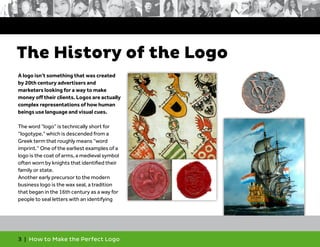
A logo isn’t something that was created
by 20th century advertisers and
marketers looking for a way to make
money off their clients. Logos are actually
complex representations of how human
beings use language and visual cues.
The word “logo” is technically short for
“logotype,” which is descended from a
Greek term that roughly means “word
imprint.” One of the earliest examples of a
logo is the coat of arms, a medieval symbol
often worn by knights that identified their
family or state.
Another early precursor to the modern
business logo is the wax seal, a tradition
that began in the 16th century as a way for
people to seal letters with an identifying
The History of the Logo
4 | How to Make the Perfect Logo
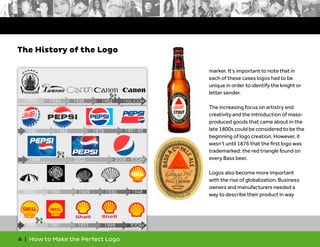
marker. It’s important to note that in
each of these cases logos had to be
unique in order to identify the knight or
letter sender.
The increasing focus on artistry and
creativity and the introduction of mass-
produced goods that came about in the
late 1800s could be considered to be the
beginning of logo creation. However, it
wasn’t until 1876 that the first logo was
trademarked: the red triangle found on
every Bass beer.
Logos also become more important
with the rise of globalization. Business
owners and manufacturers needed a
way to describe their product in way
The History of the Logo
5 | How to Make the Perfect Logo
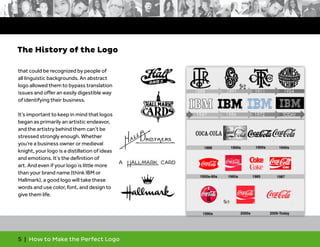
that could be recognized by people of
all linguistic backgrounds. An abstract
logo allowed them to bypass translation
issues and offer an easily digestible way
of identifying their business.
It’s important to keep in mind that logos
began as primarily an artistic endeavor,
and the artistry behind them can’t be
stressed strongly enough. Whether
you’re a business owner or medieval
knight, your logo is a distillation of ideas
and emotions. It’s the definition of
art. And even if your logo is little more
than your brand name (think IBM or
Hallmark), a good logo will take these
words and use color, font, and design to
give them life.
The History of the Logo
6 | How to Make the Perfect Logo
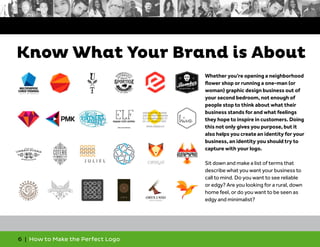
Whether you’re opening a neighborhood
flower shop or running a one-man (or
woman) graphic design business out of
your second bedroom, not enough of
people stop to think about what their
business stands for and what feelings
they hope to inspire in customers. Doing
this not only gives you purpose, but it
also helps you create an identity for your
business, an identity you should try to
capture with your logo.
Sit down and make a list of terms that
describe what you want your business to
call to mind. Do you want to see reliable
or edgy? Are you looking for a rural, down
home feel, or do you want to be seen as
edgy and minimalist?
Know What Your Brand is About
7 | How to Make the Perfect Logo
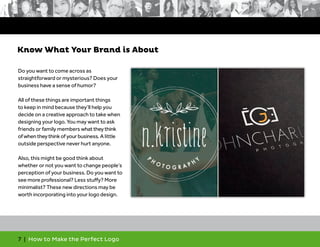
Do you want to come across as
straightforward or mysterious? Does your
business have a sense of humor?
All of these things are important things
to keep in mind because they’ll help you
decide on a creative approach to take when
designing your logo. You may want to ask
friends or family members whattheythink
ofwhentheythinkofyourbusiness. A little
outside perspective never hurt anyone.
Also, this might be good think about
whether or not you want to change people’s
perception of your business. Do you want to
see more professional? Less stuffy? More
minimalist? These new directions may be
worth incorporating into your logo design.
Know What Your Brand is About
8 | How to Make the Perfect Logo
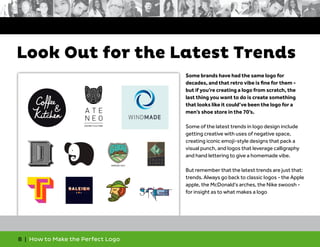
Some brands have had the same logo for
decades, and that retro vibe is fine for them -
but if you’re creating a logo from scratch, the
last thing you want to do is create something
that looks like it could’ve been the logo for a
men’s shoe store in the 70’s.
Some of the latest trends in logo design include
getting creative with uses of negative space,
creating iconic emoji-style designs that pack a
visual punch, and logos that leverage calligraphy
and hand lettering to give a homemade vibe.
But remember that the latest trends are just that:
trends. Always go back to classic logos - the Apple
apple, the McDonald’s arches, the Nike swoosh -
for insight as to what makes a logo
Look Out for the Latest Trends
9 | How to Make the Perfect Logo
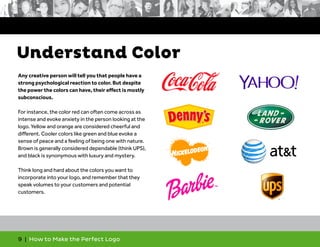
Any creative person will tell you that people have a
strong psychological reaction to color. But despite
the power the colors can have, their effect is mostly
subconscious.
For instance, the color red can often come across as
intense and evoke anxiety in the person looking at the
logo. Yellow and orange are considered cheerful and
different. Cooler colors like green and blue evoke a
sense of peace and a feeling of being one with nature.
Brown is generally considered dependable (think UPS),
and black is synonymous with luxury and mystery.
Think long and hard about the colors you want to
incorporate into your logo, and remember that they
speak volumes to your customers and potential
customers.
Understand Color
10 | How to Make the Perfect Logo
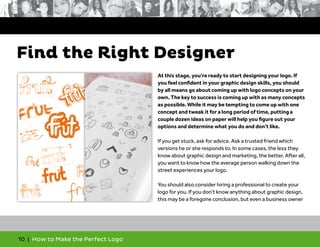
At this stage, you’re ready to start designing your logo. If
you feel confident in your graphic design skills, you should
by all means go about coming up with logo concepts on your
own. The key to success is coming up with as many concepts
as possible. While it may be tempting to come up with one
concept and tweak it for a long period of time, putting a
couple dozen ideas on paper will help you figure out your
options and determine what you do and don’t like.
If you get stuck, ask for advice. Ask a trusted friend which
versions he or she responds to. In some cases, the less they
know about graphic design and marketing, the better. After all,
you want to know how the average person walking down the
street experiences your logo.
You should also consider hiring a professional to create your
logo for you. If you don’t know anything about graphic design,
this may be a foregone conclusion, but even a business owner
Find the Right Designer
11 | How to Make the Perfect Logo
who knows (or thinks they know)
how to design a logo can benefit
from turning to a professional
for assistance.
Having a stranger or
professional work on your logo
can offer valuable perspective.
For instance, you might think
a whimsical, floral logo is best
for your restaurant, but an
outsider may introduce another
element - a futuristic font, or
an unexpected use of color -
that totally changes how you
envision your logo.
However, even if you’ve turned
to a professional for help with
your logo, don’t be afraid to
voice your opinion. Be sure to
tell them what you do and don’t
like. And of course, that list of
words and phrases you created
to help identify will definitely
come in handy about now.
Hiring a solid logo designer
doesn’t have to cost an arm
and a leg. There are plenty of
places online where you can
find talented creatives willing to
work for a relatively low prince
in order to build their design
portfolio and help out business
owners in need.
Find the Right Designer
12 | How to Make the Perfect Logo
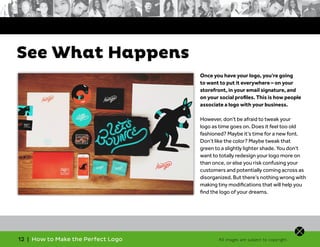
Once you have your logo, you’re going
to want to put it everywhere – on your
storefront, in your email signature, and
on your social profiles. This is how people
associate a logo with your business.
However, don’t be afraid to tweak your
logo as time goes on. Does it feel too old
fashioned? Maybe it’s time for a new font.
Don’t like the color? Maybe tweak that
green to a slightly lighter shade. You don’t
want to totally redesign your logo more on
than once, or else you risk confusing your
customers and potentially coming across as
disorganized. But there’s nothing wrong with
making tiny modifications that will help you
find the logo of your dreams.
See What Happens
All images are subject to copyright.

How to Make the Perfect Logo

  • 1.
    How to Make thePerfect Logo
  • 2.
    2 | Howto Make the Perfect Logo Nike. Apple. Starbucks. These are a few of the biggest brands in the world for many reasons. One of them is because each has an iconic calling card, a logo design that consumers instantly associate with their product and values. If you’re a small business owner, or someone making money by being your own boss, having a dedicated logo can give you a business advantage. If your logo is strong enough and appears in the right places at the right times, it can act as a shorthand that causes a customer or potential customer that call to mind a complex How to Make the Perfect Logo variety of feelings, moods, and sensations: trust, safety, coolness, reliability, or youth. But how do you come up with the perfect logo? Where do you begin, especially when you’re not at all design minded or otherwise have no idea how to go about creating something you hope will be iconic in the very literal sense of the word. This latest eBook has suggestions for how to make the perfect logo, one that clearly identifies you and endears you to customers.
  • 3.
    3 | Howto Make the Perfect Logo A logo isn’t something that was created by 20th century advertisers and marketers looking for a way to make money off their clients. Logos are actually complex representations of how human beings use language and visual cues. The word “logo” is technically short for “logotype,” which is descended from a Greek term that roughly means “word imprint.” One of the earliest examples of a logo is the coat of arms, a medieval symbol often worn by knights that identified their family or state. Another early precursor to the modern business logo is the wax seal, a tradition that began in the 16th century as a way for people to seal letters with an identifying The History of the Logo
  • 4.
    4 | Howto Make the Perfect Logo marker. It’s important to note that in each of these cases logos had to be unique in order to identify the knight or letter sender. The increasing focus on artistry and creativity and the introduction of mass- produced goods that came about in the late 1800s could be considered to be the beginning of logo creation. However, it wasn’t until 1876 that the first logo was trademarked: the red triangle found on every Bass beer. Logos also become more important with the rise of globalization. Business owners and manufacturers needed a way to describe their product in way The History of the Logo
  • 5.
    5 | Howto Make the Perfect Logo that could be recognized by people of all linguistic backgrounds. An abstract logo allowed them to bypass translation issues and offer an easily digestible way of identifying their business. It’s important to keep in mind that logos began as primarily an artistic endeavor, and the artistry behind them can’t be stressed strongly enough. Whether you’re a business owner or medieval knight, your logo is a distillation of ideas and emotions. It’s the definition of art. And even if your logo is little more than your brand name (think IBM or Hallmark), a good logo will take these words and use color, font, and design to give them life. The History of the Logo
  • 6.
    6 | Howto Make the Perfect Logo Whether you’re opening a neighborhood flower shop or running a one-man (or woman) graphic design business out of your second bedroom, not enough of people stop to think about what their business stands for and what feelings they hope to inspire in customers. Doing this not only gives you purpose, but it also helps you create an identity for your business, an identity you should try to capture with your logo. Sit down and make a list of terms that describe what you want your business to call to mind. Do you want to see reliable or edgy? Are you looking for a rural, down home feel, or do you want to be seen as edgy and minimalist? Know What Your Brand is About
  • 7.
    7 | Howto Make the Perfect Logo Do you want to come across as straightforward or mysterious? Does your business have a sense of humor? All of these things are important things to keep in mind because they’ll help you decide on a creative approach to take when designing your logo. You may want to ask friends or family members whattheythink ofwhentheythinkofyourbusiness. A little outside perspective never hurt anyone. Also, this might be good think about whether or not you want to change people’s perception of your business. Do you want to see more professional? Less stuffy? More minimalist? These new directions may be worth incorporating into your logo design. Know What Your Brand is About
  • 8.
    8 | Howto Make the Perfect Logo Some brands have had the same logo for decades, and that retro vibe is fine for them - but if you’re creating a logo from scratch, the last thing you want to do is create something that looks like it could’ve been the logo for a men’s shoe store in the 70’s. Some of the latest trends in logo design include getting creative with uses of negative space, creating iconic emoji-style designs that pack a visual punch, and logos that leverage calligraphy and hand lettering to give a homemade vibe. But remember that the latest trends are just that: trends. Always go back to classic logos - the Apple apple, the McDonald’s arches, the Nike swoosh - for insight as to what makes a logo Look Out for the Latest Trends
  • 9.
    9 | Howto Make the Perfect Logo Any creative person will tell you that people have a strong psychological reaction to color. But despite the power the colors can have, their effect is mostly subconscious. For instance, the color red can often come across as intense and evoke anxiety in the person looking at the logo. Yellow and orange are considered cheerful and different. Cooler colors like green and blue evoke a sense of peace and a feeling of being one with nature. Brown is generally considered dependable (think UPS), and black is synonymous with luxury and mystery. Think long and hard about the colors you want to incorporate into your logo, and remember that they speak volumes to your customers and potential customers. Understand Color
  • 10.
    10 | Howto Make the Perfect Logo At this stage, you’re ready to start designing your logo. If you feel confident in your graphic design skills, you should by all means go about coming up with logo concepts on your own. The key to success is coming up with as many concepts as possible. While it may be tempting to come up with one concept and tweak it for a long period of time, putting a couple dozen ideas on paper will help you figure out your options and determine what you do and don’t like. If you get stuck, ask for advice. Ask a trusted friend which versions he or she responds to. In some cases, the less they know about graphic design and marketing, the better. After all, you want to know how the average person walking down the street experiences your logo. You should also consider hiring a professional to create your logo for you. If you don’t know anything about graphic design, this may be a foregone conclusion, but even a business owner Find the Right Designer
  • 11.
    11 | Howto Make the Perfect Logo who knows (or thinks they know) how to design a logo can benefit from turning to a professional for assistance. Having a stranger or professional work on your logo can offer valuable perspective. For instance, you might think a whimsical, floral logo is best for your restaurant, but an outsider may introduce another element - a futuristic font, or an unexpected use of color - that totally changes how you envision your logo. However, even if you’ve turned to a professional for help with your logo, don’t be afraid to voice your opinion. Be sure to tell them what you do and don’t like. And of course, that list of words and phrases you created to help identify will definitely come in handy about now. Hiring a solid logo designer doesn’t have to cost an arm and a leg. There are plenty of places online where you can find talented creatives willing to work for a relatively low prince in order to build their design portfolio and help out business owners in need. Find the Right Designer
  • 12.
    12 | Howto Make the Perfect Logo Once you have your logo, you’re going to want to put it everywhere – on your storefront, in your email signature, and on your social profiles. This is how people associate a logo with your business. However, don’t be afraid to tweak your logo as time goes on. Does it feel too old fashioned? Maybe it’s time for a new font. Don’t like the color? Maybe tweak that green to a slightly lighter shade. You don’t want to totally redesign your logo more on than once, or else you risk confusing your customers and potentially coming across as disorganized. But there’s nothing wrong with making tiny modifications that will help you find the logo of your dreams. See What Happens All images are subject to copyright.