Client Project Pro- Forma
Tom Armstrong
Mind Maps/Brainstorms
Star by using the first few slides to create mind
maps and or brainstorms for ideas related to
your project. Get as many possibilities as you
can.
Don’t worry about practicality, suitability or
potential at this stage. You will assess the ideas
later.
Mind Maps/Brainstorms
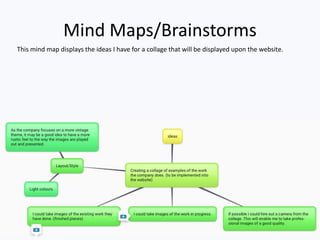
This mind map displays the ideas I have for a collage that will be displayed upon the website.
Mind Maps/Brainstorms
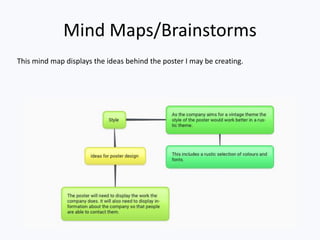
This mind map displays the ideas behind the poster I may be creating.
Assessing ideas
Now you have generated lots of potential ideas, it is
time to rationalise those against the requirements of
the brief from your client.
Use the next few slides to consolidate your ideas and
then assess them against the requirements and
constraints of the project.
Finally, select an idea to take forward for further
development.
Idea 1
• My first idea consists of creating a collage that will display what the business does. This will be
done by presenting images of pre-existing and in progress work by the client. To achieve this is I
will hire/take out a professional camera so I am able to get good quality images. The images will
be then further edited to fit the clients style (this will be achieved by adding a rustic/vintage
effect). The images will be then laid out to be then placed onto the clients website. The college
could include small captions, these captions would describe what was going on within the image.
The font would be a vintage font or I would use the font they have already used on the website
(to help things flow better). The colours would also be kept to the websites colour scheme.
Evaluation:
• I like the idea as I feel it’s very manageable. This matches what the client wants and I feel as
though I will be able to deliver this in the time set. To ensure that I am able to deliver this in time
I will have to create a plan of when I'm able to take the images needed and when I'm able to edit
them (set a layout). I do have some of the resources available to me, these being a laptop and
software that I'm able to edit images upon. However I don’t have a camera available to me, this
will need to be hired for a small period of time.
Idea 2
• My second idea consists of creating pages for the clients website. These pages will be for the new
area of the business (landscape design). The pages will need to include a range of information
regarding this area of the business. It will also need to include a range of images to give examples
of what the work looks like. As mentioned before the business has a vintage theme to it, therefor
I feel it would be suitable to base these new pages in a vintage/rustic theme. This will relate with
the rest of the website (as the rest of the website is already placed into a vintage/rustic theme).
As mentioned before these pages will need to follow the same colour scheme and fonts as the
rest of the pages to the website (in order to create a flow through the pages).
Evaluation:
• I like this idea as it gives me a range of things to do, its manageable and will benefit the
businesses website greatly. This does match what the client wants. The idea I came up with was
spoken to with the client and they confirmed it would work. I feel that its manageable and I will
be able to deliver this within the time set. When it comes to the resources that will be needed, I
have a laptop with the correct software that can help me. However for the images that will be
implemented onto the website, I will either need to ask for images that they already have or hire
out a camera and take images of their pre-existing/in place work.
Evaluation of idea
• What do you like about the idea?
• Does it match what the client wants?
• Are you capable of delivering this?
• Can you do this on time?
• Do you have the resources available to do this?
Idea 3
• This idea consists of creating a small poster. The posters main use would be to inform
people of what the clients business does. This would be achieved by displaying images and
text regarding the things they do. The poster idea seems to be just like the image collage
idea. The poster could include information informing people how they could get in contact
with the business if they wanted too. The colour scheme and fonts could be different to the
ones used on the website as the website is separate. This opens me up to a range of things
I could do. The only difference I can see is that the poster would include more text.
Evaluation:
• I don’t feel that this idea is that great as its too similar to the collage idea (idea 1) the only
difference being the amount of text would be slightly more. The idea does match what the
client wants. As its similar to the collage I’m confident I would be able capable of delivering
this in the time set to me. Yet again as its similar to the collage, I do have the resources
needed to complete this task.
Evaluation of idea
• What do you like about the idea?
• Does it match what the client wants?
• Are you capable of delivering this?
• Can you do this on time?
• Do you have the resources available to do this?
Idea 4
Evaluation of idea
• What do you like about the idea?
• Does it match what the client wants?
• Are you capable of delivering this?
• Can you do this on time?
• Do you have the resources available to do this?
Idea 5
Evaluation of idea
• What do you like about the idea?
• Does it match what the client wants?
• Are you capable of delivering this?
• Can you do this on time?
• Do you have the resources available to do this?
Idea Evaluation
Which of your ideas do you want to develop further? Explain why you think that is
the right idea to take forward.
Development
Use the next slides to document your idea development.
This should include mood boards and other visual examples of work. It
could include basic mock ups of your vision for the project using the
work of others.
If you are taking doing something outside of your ordinary skill set or
way of working, you could include test work or practice work here too.
There is room to develop a second idea here as well. This could give
you a greater variety of options to give to your client.
You will then assess your developed idea against the constraints of the
project before producing a final treatment.
Developed Idea 1
x
Developed Idea 1
x
Developed Idea 1
Developed Idea 2
Developed Idea 2
Developed Idea 2
Assessment of final ideas
Suitable for audience?
Suitability for client?
Appeal of the work:
Timescales for production:
Costs:
Personnel:
Assessment of final ideas
Legal and ethical issues:
Research
Competition/Market research:
Who is in competition with your client?
What is their design/photography/marketing/promotional/advertising work like?
What wider market is your client part of? Undertake research in to that market. This could be in the form of sales
figures, audience figures, turnover, job roles, customer base, market share, rules, regulations and codes of practice.
Audience/Customer research:
Who is the audience or customer that your client is trying to reach? Perhaps they have already told you. Perhaps you
should ask. You could also do further research in to the type of audience or customer you are hoping to appeal to.
Content research:
This should take the form of secondary research (exiting products from your client and the competition and wider
market) and also some primary research (asking potential audience, your client and your market,) to help you
formalise the content of your project.
Treatment:
The treatment evokes how an audience will experience what you are making.
Write in the active-voice in present tense. Tell the reader what they will see.
Describe the content of your project.
Write vibrantly, so the reader gets excited about your work. They should be able to
visualise the finished pieces. You could also supplement this with some mood boards or
mock ups.
Be specific—don’t use words like may, might or possibly.
Treatment
Treatment (visual elements)
Timescales:
You should prepare a production schedule that will allow you to manage your time over
the 3 weeks of production. This should include:
• Deadlines: Interim deadlines help you keep on track, final deadlines are final.
• Availability: The availability of the client and any other people you may need to help
you with your project. You will need to contact them. You might to do visit. You may
need to liaise with models, or photographers.
• Feedback: This is a working brief with a real client. You will need to get feedback on
your work and also allow yourself time to make appropriate changes. Plan appropriate
time in to you schedule so that you can do this.
• Resources: You should include a list of resources that you will need to complete your
project. Remember that this all needs to be your own work
YOU CAN DELETE THIS ONCE YOU DON’T NEED IT:
Production is due to start on Monday the 8thth of May at 12:50pm.
You will have 3 weeks of lessons. The last day of production will be Friday the 19th of
May. This gives you a whole half term, should you need it.
.
Idea development pro forma

Idea development pro forma

  • 1.
    Client Project Pro-Forma Tom Armstrong
  • 2.
    Mind Maps/Brainstorms Star byusing the first few slides to create mind maps and or brainstorms for ideas related to your project. Get as many possibilities as you can. Don’t worry about practicality, suitability or potential at this stage. You will assess the ideas later.
  • 3.
    Mind Maps/Brainstorms This mindmap displays the ideas I have for a collage that will be displayed upon the website.
  • 4.
    Mind Maps/Brainstorms This mindmap displays the ideas behind the poster I may be creating.
  • 5.
    Assessing ideas Now youhave generated lots of potential ideas, it is time to rationalise those against the requirements of the brief from your client. Use the next few slides to consolidate your ideas and then assess them against the requirements and constraints of the project. Finally, select an idea to take forward for further development.
  • 6.
    Idea 1 • Myfirst idea consists of creating a collage that will display what the business does. This will be done by presenting images of pre-existing and in progress work by the client. To achieve this is I will hire/take out a professional camera so I am able to get good quality images. The images will be then further edited to fit the clients style (this will be achieved by adding a rustic/vintage effect). The images will be then laid out to be then placed onto the clients website. The college could include small captions, these captions would describe what was going on within the image. The font would be a vintage font or I would use the font they have already used on the website (to help things flow better). The colours would also be kept to the websites colour scheme. Evaluation: • I like the idea as I feel it’s very manageable. This matches what the client wants and I feel as though I will be able to deliver this in the time set. To ensure that I am able to deliver this in time I will have to create a plan of when I'm able to take the images needed and when I'm able to edit them (set a layout). I do have some of the resources available to me, these being a laptop and software that I'm able to edit images upon. However I don’t have a camera available to me, this will need to be hired for a small period of time.
  • 7.
    Idea 2 • Mysecond idea consists of creating pages for the clients website. These pages will be for the new area of the business (landscape design). The pages will need to include a range of information regarding this area of the business. It will also need to include a range of images to give examples of what the work looks like. As mentioned before the business has a vintage theme to it, therefor I feel it would be suitable to base these new pages in a vintage/rustic theme. This will relate with the rest of the website (as the rest of the website is already placed into a vintage/rustic theme). As mentioned before these pages will need to follow the same colour scheme and fonts as the rest of the pages to the website (in order to create a flow through the pages). Evaluation: • I like this idea as it gives me a range of things to do, its manageable and will benefit the businesses website greatly. This does match what the client wants. The idea I came up with was spoken to with the client and they confirmed it would work. I feel that its manageable and I will be able to deliver this within the time set. When it comes to the resources that will be needed, I have a laptop with the correct software that can help me. However for the images that will be implemented onto the website, I will either need to ask for images that they already have or hire out a camera and take images of their pre-existing/in place work.
  • 8.
    Evaluation of idea •What do you like about the idea? • Does it match what the client wants? • Are you capable of delivering this? • Can you do this on time? • Do you have the resources available to do this?
  • 9.
    Idea 3 • Thisidea consists of creating a small poster. The posters main use would be to inform people of what the clients business does. This would be achieved by displaying images and text regarding the things they do. The poster idea seems to be just like the image collage idea. The poster could include information informing people how they could get in contact with the business if they wanted too. The colour scheme and fonts could be different to the ones used on the website as the website is separate. This opens me up to a range of things I could do. The only difference I can see is that the poster would include more text. Evaluation: • I don’t feel that this idea is that great as its too similar to the collage idea (idea 1) the only difference being the amount of text would be slightly more. The idea does match what the client wants. As its similar to the collage I’m confident I would be able capable of delivering this in the time set to me. Yet again as its similar to the collage, I do have the resources needed to complete this task.
  • 10.
    Evaluation of idea •What do you like about the idea? • Does it match what the client wants? • Are you capable of delivering this? • Can you do this on time? • Do you have the resources available to do this?
  • 11.
  • 12.
    Evaluation of idea •What do you like about the idea? • Does it match what the client wants? • Are you capable of delivering this? • Can you do this on time? • Do you have the resources available to do this?
  • 13.
  • 14.
    Evaluation of idea •What do you like about the idea? • Does it match what the client wants? • Are you capable of delivering this? • Can you do this on time? • Do you have the resources available to do this?
  • 15.
    Idea Evaluation Which ofyour ideas do you want to develop further? Explain why you think that is the right idea to take forward.
  • 16.
    Development Use the nextslides to document your idea development. This should include mood boards and other visual examples of work. It could include basic mock ups of your vision for the project using the work of others. If you are taking doing something outside of your ordinary skill set or way of working, you could include test work or practice work here too. There is room to develop a second idea here as well. This could give you a greater variety of options to give to your client. You will then assess your developed idea against the constraints of the project before producing a final treatment.
  • 17.
  • 18.
  • 19.
  • 20.
  • 21.
  • 22.
  • 23.
    Assessment of finalideas Suitable for audience? Suitability for client? Appeal of the work: Timescales for production: Costs: Personnel:
  • 24.
    Assessment of finalideas Legal and ethical issues:
  • 25.
  • 26.
    Competition/Market research: Who isin competition with your client? What is their design/photography/marketing/promotional/advertising work like? What wider market is your client part of? Undertake research in to that market. This could be in the form of sales figures, audience figures, turnover, job roles, customer base, market share, rules, regulations and codes of practice.
  • 29.
    Audience/Customer research: Who isthe audience or customer that your client is trying to reach? Perhaps they have already told you. Perhaps you should ask. You could also do further research in to the type of audience or customer you are hoping to appeal to.
  • 31.
    Content research: This shouldtake the form of secondary research (exiting products from your client and the competition and wider market) and also some primary research (asking potential audience, your client and your market,) to help you formalise the content of your project.
  • 35.
    Treatment: The treatment evokeshow an audience will experience what you are making. Write in the active-voice in present tense. Tell the reader what they will see. Describe the content of your project. Write vibrantly, so the reader gets excited about your work. They should be able to visualise the finished pieces. You could also supplement this with some mood boards or mock ups. Be specific—don’t use words like may, might or possibly.
  • 36.
  • 37.
  • 38.
    Timescales: You should preparea production schedule that will allow you to manage your time over the 3 weeks of production. This should include: • Deadlines: Interim deadlines help you keep on track, final deadlines are final. • Availability: The availability of the client and any other people you may need to help you with your project. You will need to contact them. You might to do visit. You may need to liaise with models, or photographers. • Feedback: This is a working brief with a real client. You will need to get feedback on your work and also allow yourself time to make appropriate changes. Plan appropriate time in to you schedule so that you can do this. • Resources: You should include a list of resources that you will need to complete your project. Remember that this all needs to be your own work
  • 39.
    YOU CAN DELETETHIS ONCE YOU DON’T NEED IT: Production is due to start on Monday the 8thth of May at 12:50pm. You will have 3 weeks of lessons. The last day of production will be Friday the 19th of May. This gives you a whole half term, should you need it. .