Cleft palate
CLASSIFICATION
Davis and Ritchie
• Group I - Clefts anterior to the alveolus
(unilateral, median, or bilateral cleft lip)
• Group II - Postalveolar clefts (cleft palate
alone, soft palate alone, soft palate and hard
palate, or submucous cleft)
• Group III: Alveolar process cleft (any cleft
involving the alveolar process)
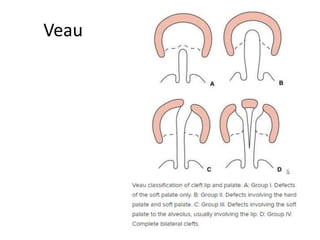
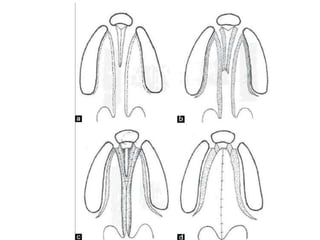
Veau
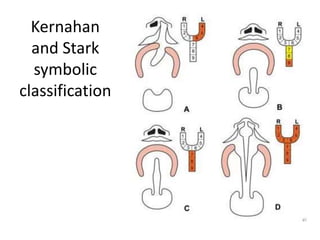
Kernahan
and Stark
symbolic
classification
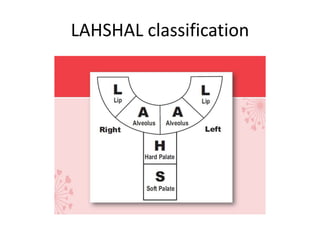
LAHSHAL classification
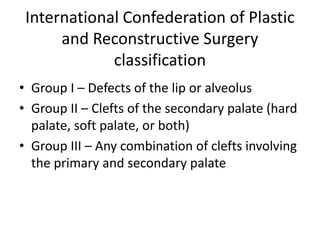
International Confederation of Plastic
and Reconstructive Surgery
classification
• Group I – Defects of the lip or alveolus
• Group II – Clefts of the secondary palate (hard
palate, soft palate, or both)
• Group III – Any combination of clefts involving
the primary and secondary palate
Repair
Timing
• 12-18 months
• Babbling as indicator
Principles
• Closure of the defect.
• Correction of the abnormal position of the
muscles of the soft palate, especially Levator
Palati.
• Reconstruction of the muscle sling.
• Retropositioning of the soft palate so much so
that during speech the posterior part of the
soft palate comes in contact with the
posterior pharyngeal wall during speech.
• Minimal or no raw area should be left on the
nasal side or the oral surface.
• Tension-free suturing.
• Two-layer closure in the hard palate region
and a three-layer closure of the soft palate.
Pre op
• Pre operative evaluation
• Position: supine with neck extended
• Mouth gags: Kilner-Dott and Dingman mouth
gags
• Adrenaline saline solution in dilution of
1:200,000
Surgical techniques
• von Langenbeck's bipedicle flap technique
• Veau-Wardill-Kilner Pushback technique
• Bardach's two-flap technique
• Furlow Double opposing Z-Plasty
• Two-stage palatal repair
• Hole in one repair
• Raw area free palatoplasty
• Alveolar extension palatoplasty (AEP)
• Primary pharyngeal flap
• Intravelar veloplasty
• Vomer flap
• Buccal myomucosal flap
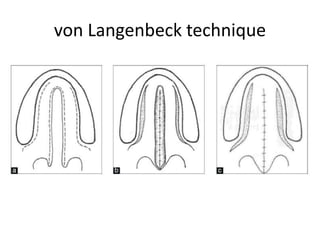
von Langenbeck technique
• still used in isolated cleft palate repair
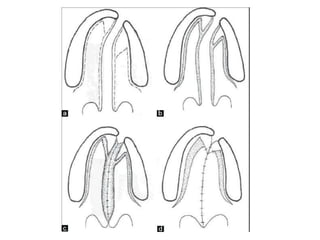
Veau-Wardill-Kilner Palatoplasty
• leaves an extensive raw area anteriorly and
laterally along alveolar margin with exposed
bare membranous bone.
• causes shortening of the palate and results in
velopharyngeal incompetence.
• alveolar arch deformity and dental
malalignment
Bardach two-flap plasty
• Free mucoperiosteal flaps
• based on the greater palatine vessels
• reconstruction of the muscle sling is
performed as in intravelar veloplasty
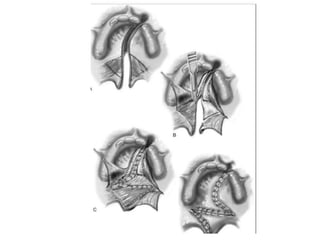
Furlow Double Opposing Z-Plasty
• double reverse Z-plasty for the oral and nasal
surfaces
• effective lengthening of the soft palate
• suture line is horizontal
• good overlap of the levator muscle
Two-stage Palatoplasty
• soft palate was repaired along with the lip at
around four to six months of age and the hard
palate was repaired at age of 10-12 years
• later reduced to four to five years
• Early palatal surgical intervention causes
maxillary hypoplasia
• speech result was compromised
Hole in one repair (One-stage cleft lip
and palate repair)
• in children above 10 months of age
• popularised by Prof. K.S. Goleria
• ‘hole in one’ is borrowed from the Game of
Golf
Raw area free palatoplasty
• two-flap palatoplasty.
• palatal lengthening is performed by the nasal
mucosa back-cut
• raw area is covered with a local flap like the
vomer flap or buccal mucosal flap.
• On the oral side too an attempt is made to
suture all the lateral incisions
• Healing with primary intention
Variations
• Bumsted's two-layer closure of palate in very
wide cleft palate
• Widmaier-Perko Palatoplasty
• Supraperiosteal dissection of flap in the region
of hard palate instead of mucoperiosteal flap.
(to minimize the maxillary hypoplasia)
• Osada's two-stage palatoplasty
• Frolova primary palatoplasty technique
• Anterior mucoperiosteal hinge for nasal lining
in partial cleft palate
• Marginal musculo-mucosal flap
Post op
• Early feeding
• Arm restraint
• Analgesics
Complications
Immediate complications
• Haemorrhage
• Respiratory obstruction
• Hanging Palate
• Dehiscence of the repair
• Oronasal fistula formation
Late complications
• Bifid uvula
• Velopharyngeal Incompetence
• Abnormal speech
• Maxillary hypoplasia
• Dental malpositioning and malalignment
• Otitis media

Cleft palate repair

  • 1.
  • 2.
  • 3.
    Davis and Ritchie •Group I - Clefts anterior to the alveolus (unilateral, median, or bilateral cleft lip) • Group II - Postalveolar clefts (cleft palate alone, soft palate alone, soft palate and hard palate, or submucous cleft) • Group III: Alveolar process cleft (any cleft involving the alveolar process)
  • 4.
  • 5.
  • 6.
  • 7.
    International Confederation ofPlastic and Reconstructive Surgery classification • Group I – Defects of the lip or alveolus • Group II – Clefts of the secondary palate (hard palate, soft palate, or both) • Group III – Any combination of clefts involving the primary and secondary palate
  • 9.
  • 10.
    Timing • 12-18 months •Babbling as indicator
  • 11.
    Principles • Closure ofthe defect. • Correction of the abnormal position of the muscles of the soft palate, especially Levator Palati. • Reconstruction of the muscle sling. • Retropositioning of the soft palate so much so that during speech the posterior part of the soft palate comes in contact with the posterior pharyngeal wall during speech.
  • 12.
    • Minimal orno raw area should be left on the nasal side or the oral surface. • Tension-free suturing. • Two-layer closure in the hard palate region and a three-layer closure of the soft palate.
  • 13.
    Pre op • Preoperative evaluation • Position: supine with neck extended • Mouth gags: Kilner-Dott and Dingman mouth gags • Adrenaline saline solution in dilution of 1:200,000
  • 14.
    Surgical techniques • vonLangenbeck's bipedicle flap technique • Veau-Wardill-Kilner Pushback technique • Bardach's two-flap technique • Furlow Double opposing Z-Plasty
  • 15.
    • Two-stage palatalrepair • Hole in one repair • Raw area free palatoplasty • Alveolar extension palatoplasty (AEP) • Primary pharyngeal flap • Intravelar veloplasty • Vomer flap • Buccal myomucosal flap
  • 16.
  • 17.
    • still usedin isolated cleft palate repair
  • 18.
    Veau-Wardill-Kilner Palatoplasty • leavesan extensive raw area anteriorly and laterally along alveolar margin with exposed bare membranous bone. • causes shortening of the palate and results in velopharyngeal incompetence. • alveolar arch deformity and dental malalignment
  • 20.
    Bardach two-flap plasty •Free mucoperiosteal flaps • based on the greater palatine vessels • reconstruction of the muscle sling is performed as in intravelar veloplasty
  • 22.
    Furlow Double OpposingZ-Plasty • double reverse Z-plasty for the oral and nasal surfaces • effective lengthening of the soft palate • suture line is horizontal • good overlap of the levator muscle
  • 24.
    Two-stage Palatoplasty • softpalate was repaired along with the lip at around four to six months of age and the hard palate was repaired at age of 10-12 years • later reduced to four to five years • Early palatal surgical intervention causes maxillary hypoplasia • speech result was compromised
  • 25.
    Hole in onerepair (One-stage cleft lip and palate repair) • in children above 10 months of age • popularised by Prof. K.S. Goleria • ‘hole in one’ is borrowed from the Game of Golf
  • 26.
    Raw area freepalatoplasty • two-flap palatoplasty. • palatal lengthening is performed by the nasal mucosa back-cut • raw area is covered with a local flap like the vomer flap or buccal mucosal flap. • On the oral side too an attempt is made to suture all the lateral incisions • Healing with primary intention
  • 27.
    Variations • Bumsted's two-layerclosure of palate in very wide cleft palate • Widmaier-Perko Palatoplasty • Supraperiosteal dissection of flap in the region of hard palate instead of mucoperiosteal flap. (to minimize the maxillary hypoplasia)
  • 28.
    • Osada's two-stagepalatoplasty • Frolova primary palatoplasty technique • Anterior mucoperiosteal hinge for nasal lining in partial cleft palate • Marginal musculo-mucosal flap
  • 29.
    Post op • Earlyfeeding • Arm restraint • Analgesics
  • 30.
  • 31.
    Immediate complications • Haemorrhage •Respiratory obstruction • Hanging Palate • Dehiscence of the repair • Oronasal fistula formation
  • 32.
    Late complications • Bifiduvula • Velopharyngeal Incompetence • Abnormal speech • Maxillary hypoplasia • Dental malpositioning and malalignment • Otitis media