PALATO-MAXILLARY
RECONSTRUCTION
DR JAMEEL KIFAYATULLAH
SENIOR LECTURER KHYBER
COLLEGE OF DENTISTRY
PESHAWAR PAKISTAN
CLASSIFICATION OF DEFECT
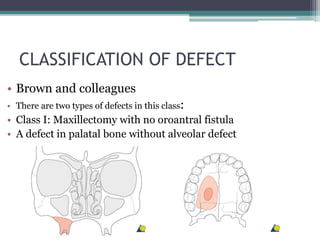
• Brown and colleagues
• There are two types of defects in this class:
• Class I: Maxillectomy with no oroantral fistula
• A defect in palatal bone without alveolar defect
CLASSIFICATION OF DEFECT
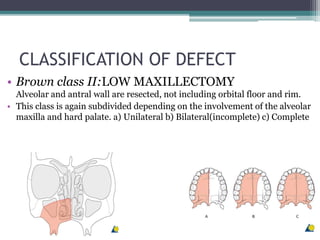
• Brown class II:LOW MAXILLECTOMY
Alveolar and antral wall are resected, not including orbital floor and rim.
• This class is again subdivided depending on the involvement of the alveolar
maxilla and hard palate. a) Unilateral b) Bilateral(incomplete) c) Complete
CLASSIFICATION OF DEFECT
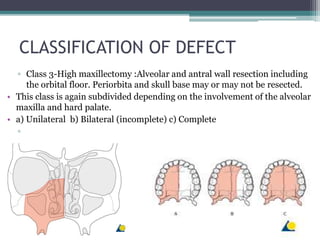
▫ Class 3-High maxillectomy :Alveolar and antral wall resection including
the orbital floor. Periorbita and skull base may or may not be resected.
• This class is again subdivided depending on the involvement of the alveolar
maxilla and hard palate.
• a) Unilateral b) Bilateral (incomplete) c) Complete
▫
CLASSIFICATION OF DEFECT
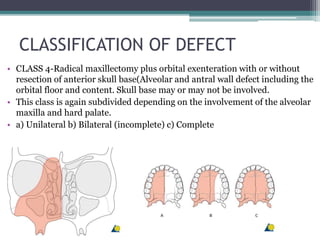
• CLASS 4-Radical maxillectomy plus orbital exenteration with or without
resection of anterior skull base(Alveolar and antral wall defect including the
orbital floor and content. Skull base may or may not be involved.
• This class is again subdivided depending on the involvement of the alveolar
maxilla and hard palate.
• a) Unilateral b) Bilateral (incomplete) c) Complete
Treatment or reconstructive Goals
• Achieve a healed surgical wound
• Restoration of facial contour and esthetics
• Separation of antronasal cavity from oral cavity
• Restoration of palatal competence required for
speech and swallowing
• Maintenance of globe position within the orbit
or obliteration of orbital cavity incase of
exenteration
• Restoration of dentition for masticatory function
• Restoration of patients body image and sense of
wholeness
Reconstruction by defect type
Class 1 defect
• Functional requirement: separation of nasal and
oral cavities
▫ Smaller defects:palatal rotation flap, tongue
flap,buccal fat pad,
▫ Large defects: temporalis or temporoparietal
galiel flaps
Reconstruction by defect type
Class 2 defect
Functional requirements:need to separate the
oral and nasal cavities, position of
defect,horizontal extent, condition of remaining
dentition
Class 2 defects reconstruction
• OBTURATOR or soft tissue only flaps:Posterolateral
defects(Distal to canine) if remaining dentition
adequate
• Soft tissue flap options: radial fore arm,ALT free
flaps
• When existing dentition inadequate to support
prosthesis or implants planned for dental
rehabilitation Bone containing flaps(fibula
osteocutaneous free flap) alternative bone
containing flapsRadial forearm osteocutanous
free flap,subscapular system of free flaps
Class 3 and 4 defects
• More challenging to reconstruct
• Complex geometry of defect makes it more
demanding
• Reconstructive goals: to maintain support for
globe,nasal base and cheek contours
• Goals achieved by reconstruction of skeletal
support and soft tissue coverage or obliteration
of defect with large volume soft tissue flaps such
as rectus abdominus or ALT flaps harvested with
muscle
Class 3 and 4 defects
• Subunit lost
Alveolar bone and palatal shelf:
Bone containing free
flaps:RFFF,FIBULA,SCAPULA,DCIA
Goals: separate the oral and nasal
cavities,provide a platform against which the
tongue can initiate swallowing and create
sounds,provide a base for dental rehabilitation
Class 3 and 4 defects
• Subunit lost
Orbital floor: free flap plus free bone graft
composte free flap:
RFFF,FIBULA,SCAPULA, DCIA
Goals: support the globe
Class 3 AND class 4 defects
• Subunit lost
Orbital contents:
Soft tissue free flaps:rectus abdominus,LD,radial
forearm
Composite free flap: scapula,radial forearm
recon goals: obliterate the orbital cavity
Class 3 and 4 defects
• Subunit lost
cranial base
OPTIONS: Soft tissue fre flaps:rectus
abdominus,latissimus dorsi,radial forearm free
flap
Recon goals: separate the cranial and nasal
cavities
Class 3 and 4 defects
• Subunit lost
Facial skin:Multiple component free
flaps:scapular system ,second fasciocutaneous
free flaps:RFFF,ALT
Reconstructive goals: replace facial skin
Palato maxillary reconstruction

Palato maxillary reconstruction

  • 1.
    PALATO-MAXILLARY RECONSTRUCTION DR JAMEEL KIFAYATULLAH SENIORLECTURER KHYBER COLLEGE OF DENTISTRY PESHAWAR PAKISTAN
  • 3.
    CLASSIFICATION OF DEFECT •Brown and colleagues • There are two types of defects in this class: • Class I: Maxillectomy with no oroantral fistula • A defect in palatal bone without alveolar defect
  • 4.
    CLASSIFICATION OF DEFECT •Brown class II:LOW MAXILLECTOMY Alveolar and antral wall are resected, not including orbital floor and rim. • This class is again subdivided depending on the involvement of the alveolar maxilla and hard palate. a) Unilateral b) Bilateral(incomplete) c) Complete
  • 5.
    CLASSIFICATION OF DEFECT ▫Class 3-High maxillectomy :Alveolar and antral wall resection including the orbital floor. Periorbita and skull base may or may not be resected. • This class is again subdivided depending on the involvement of the alveolar maxilla and hard palate. • a) Unilateral b) Bilateral (incomplete) c) Complete ▫
  • 6.
    CLASSIFICATION OF DEFECT •CLASS 4-Radical maxillectomy plus orbital exenteration with or without resection of anterior skull base(Alveolar and antral wall defect including the orbital floor and content. Skull base may or may not be involved. • This class is again subdivided depending on the involvement of the alveolar maxilla and hard palate. • a) Unilateral b) Bilateral (incomplete) c) Complete
  • 7.
    Treatment or reconstructiveGoals • Achieve a healed surgical wound • Restoration of facial contour and esthetics • Separation of antronasal cavity from oral cavity • Restoration of palatal competence required for speech and swallowing • Maintenance of globe position within the orbit or obliteration of orbital cavity incase of exenteration • Restoration of dentition for masticatory function • Restoration of patients body image and sense of wholeness
  • 8.
    Reconstruction by defecttype Class 1 defect • Functional requirement: separation of nasal and oral cavities ▫ Smaller defects:palatal rotation flap, tongue flap,buccal fat pad, ▫ Large defects: temporalis or temporoparietal galiel flaps
  • 9.
    Reconstruction by defecttype Class 2 defect Functional requirements:need to separate the oral and nasal cavities, position of defect,horizontal extent, condition of remaining dentition
  • 10.
    Class 2 defectsreconstruction • OBTURATOR or soft tissue only flaps:Posterolateral defects(Distal to canine) if remaining dentition adequate • Soft tissue flap options: radial fore arm,ALT free flaps • When existing dentition inadequate to support prosthesis or implants planned for dental rehabilitation Bone containing flaps(fibula osteocutaneous free flap) alternative bone containing flapsRadial forearm osteocutanous free flap,subscapular system of free flaps
  • 11.
    Class 3 and4 defects • More challenging to reconstruct • Complex geometry of defect makes it more demanding • Reconstructive goals: to maintain support for globe,nasal base and cheek contours • Goals achieved by reconstruction of skeletal support and soft tissue coverage or obliteration of defect with large volume soft tissue flaps such as rectus abdominus or ALT flaps harvested with muscle
  • 12.
    Class 3 and4 defects • Subunit lost Alveolar bone and palatal shelf: Bone containing free flaps:RFFF,FIBULA,SCAPULA,DCIA Goals: separate the oral and nasal cavities,provide a platform against which the tongue can initiate swallowing and create sounds,provide a base for dental rehabilitation
  • 13.
    Class 3 and4 defects • Subunit lost Orbital floor: free flap plus free bone graft composte free flap: RFFF,FIBULA,SCAPULA, DCIA Goals: support the globe
  • 14.
    Class 3 ANDclass 4 defects • Subunit lost Orbital contents: Soft tissue free flaps:rectus abdominus,LD,radial forearm Composite free flap: scapula,radial forearm recon goals: obliterate the orbital cavity
  • 15.
    Class 3 and4 defects • Subunit lost cranial base OPTIONS: Soft tissue fre flaps:rectus abdominus,latissimus dorsi,radial forearm free flap Recon goals: separate the cranial and nasal cavities
  • 16.
    Class 3 and4 defects • Subunit lost Facial skin:Multiple component free flaps:scapular system ,second fasciocutaneous free flaps:RFFF,ALT Reconstructive goals: replace facial skin