



HTTP/2 for Developers
How HTTP/2 Works and How
It Changes Developer's Life?
Svetlin Nakov
Manager Training
and Inspiration
Software University
http://softuni.bg
2
 Co-founder of the Software University (SoftUni) – https://softuni.bg
 Trained thousands people in programming and software development
 Taught hundreds of software development lessons
 20+ years in software development
 15 years in training programmers
 Author of 7 programming books
 Speaker at hundreds talks, presentations, lessons,
courses, seminars, conferences, and technical events
 Blog: http://www.nakov.com
About Me
3
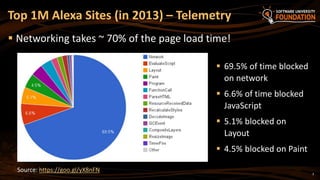
 Networking takes ~ 70% of the page load time!
Top 1M Alexa Sites (in 2013) – Telemetry
Source: https://goo.gl/yX8nFN
 69.5% of time blocked
on network
 6.6% of time blocked
JavaScript
 5.1% blocked on
Layout
 4.5% blocked on Paint
4
 Opening a typical site in 2014, e.g. https://softuni.bg
 HTTP 1.0 supports only one connection per request
 65 connections need to be open, then closed
 HTTP 1.1 supports "keep alive"
 Open connection, download a resource, then another resource, …
 Works in serial mode: if one resource is slow, page load is slow
 Modern Web needs "a better HTTP protocol"
HTTP/2: The Problem
5
 HTTP/2 is protocol designed for
 Low latency transport of content over the Web
 No change to HTTP semantics
 It’s about how data travels through the wire
 Key new features in HTTP/2
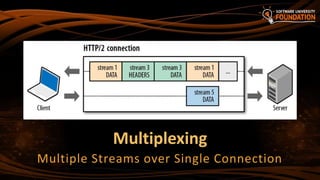
 Multiplexing: multiple streams over a single connection
 Header compression: reuse headers from previous requests
 Sever push: multiple parallel responses for a single request
 Prioritization: some resources have priorities
What is HTTP/2?
6
 HTTP 0.9 (1991) – supports simple GET requests
 HTTP 1.0 (1996) – single connection, POST, headers, …
 HTTP 1.1 (1999) – keep-alive connections + pipelining
 SPDY (2009-2010) – connection multiplexing + server push
 Google developed the SPDY to replace HTTP 1.1 in Chrome and in
the Google ecosystem
 HTTP/2 (2014-2015) – de facto standardized SPDY
 An official standard for the new low-latency HTTP protocol
HTTP/2 History
HTTP/2 Enabled Web Sites – Examples
 Facebook
 Technically not HTTP/2
 SPDY/3.1
 Google and its sites
(GMail, YouTube, …)
 Use the latest HTTP/2
 Combines QUIC + SPDY
 Twitter, Yahoo, Wikipedia
Multiplexing
Multiple Streams over Single Connection
9
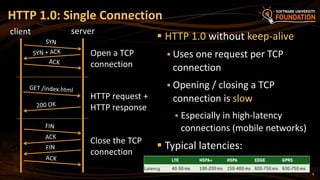
 HTTP 1.0 without keep-alive
 Uses one request per TCP
connection
 Opening / closing a TCP
connection is slow
 Especially in high-latency
connections (mobile networks)
 Typical latencies:
HTTP 1.0: Single Connection
client server
Open a TCP
connection
HTTP request +
HTTP response
Close the TCP
connection
10
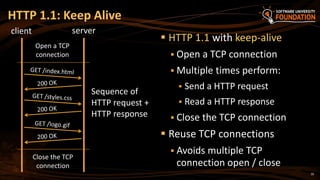
 HTTP 1.1 with keep-alive
 Open a TCP connection
 Multiple times perform:
 Send a HTTP request
 Read a HTTP response
 Close the TCP connection
 Reuse TCP connections
 Avoids multiple TCP
connection open / close
HTTP 1.1: Keep Alive
client server
Open a TCP
connection
Sequence of
HTTP request +
HTTP response
Close the TCP
connection
11
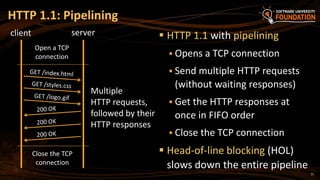
 HTTP 1.1 with pipelining
 Opens a TCP connection
 Send multiple HTTP requests
(without waiting responses)
 Get the HTTP responses at
once in FIFO order
 Close the TCP connection
 Head-of-line blocking (HOL)
slows down the entire pipeline
HTTP 1.1: Pipelining
client server
Open a TCP
connection
Multiple
HTTP requests,
followed by their
HTTP responses
Close the TCP
connection
12
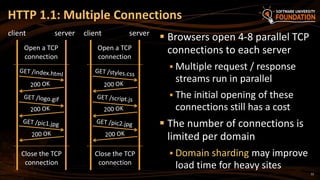
 Browsers open 4-8 parallel TCP
connections to each server
 Multiple request / response
streams run in parallel
 The initial opening of these
connections still has a cost
 The number of connections is
limited per domain
 Domain sharding may improve
load time for heavy sites
HTTP 1.1: Multiple Connections
client server
Open a TCP
connection
Close the TCP
connection
client server
Open a TCP
connection
Close the TCP
connection
13
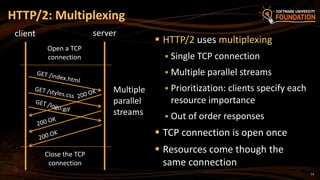
HTTP/2: Multiplexing
 HTTP/2 uses multiplexing
 Single TCP connection
 Multiple parallel streams
 Prioritization: clients specify each
resource importance
 Out of order responses
 TCP connection is open once
 Resources come though the
same connection
Multiple
parallel
streams
client server
Open a TCP
connection
Close the TCP
connection
14
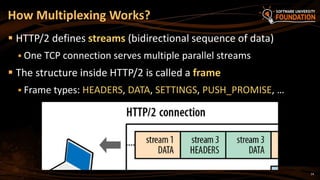
 HTTP/2 defines streams (bidirectional sequence of data)
 One TCP connection serves multiple parallel streams
 The structure inside HTTP/2 is called a frame
 Frame types: HEADERS, DATA, SETTINGS, PUSH_PROMISE, …
How Multiplexing Works?
HTTP Header Compression
Reuse Headers from Previous Requests
16
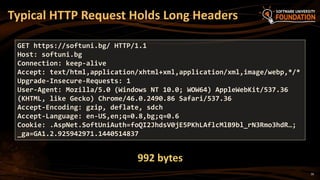
992 bytes
Typical HTTP Request Holds Long Headers
GET https://softuni.bg/ HTTP/1.1
Host: softuni.bg
Connection: keep-alive
Accept: text/html,application/xhtml+xml,application/xml,image/webp,*/*
Upgrade-Insecure-Requests: 1
User-Agent: Mozilla/5.0 (Windows NT 10.0; WOW64) AppleWebKit/537.36
(KHTML, like Gecko) Chrome/46.0.2490.86 Safari/537.36
Accept-Encoding: gzip, deflate, sdch
Accept-Language: en-US,en;q=0.8,bg;q=0.6
Cookie: .AspNet.SoftUniAuth=foQI2JhdsV0jE5PKhLAflcMlB9bl_rN3Rmo3hdR…;
_ga=GA1.2.925942971.1440514837
17
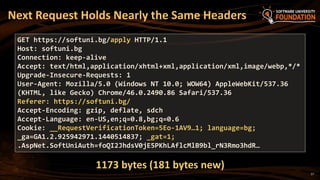
1173 bytes (181 bytes new)
Next Request Holds Nearly the Same Headers
GET https://softuni.bg/apply HTTP/1.1
Host: softuni.bg
Connection: keep-alive
Accept: text/html,application/xhtml+xml,application/xml,image/webp,*/*
Upgrade-Insecure-Requests: 1
User-Agent: Mozilla/5.0 (Windows NT 10.0; WOW64) AppleWebKit/537.36
(KHTML, like Gecko) Chrome/46.0.2490.86 Safari/537.36
Referer: https://softuni.bg/
Accept-Encoding: gzip, deflate, sdch
Accept-Language: en-US,en;q=0.8,bg;q=0.6
Cookie: __RequestVerificationToken=5Eo-1AV9…1; language=bg;
_ga=GA1.2.925942971.1440514837; _gat=1;
.AspNet.SoftUniAuth=foQI2JhdsV0jE5PKhLAflcMlB9bl_rN3Rmo3hdR…
18
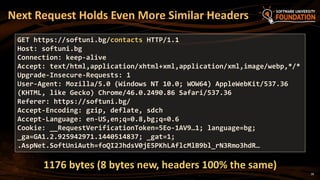
1176 bytes (8 bytes new, headers 100% the same)
Next Request Holds Even More Similar Headers
GET https://softuni.bg/contacts HTTP/1.1
Host: softuni.bg
Connection: keep-alive
Accept: text/html,application/xhtml+xml,application/xml,image/webp,*/*
Upgrade-Insecure-Requests: 1
User-Agent: Mozilla/5.0 (Windows NT 10.0; WOW64) AppleWebKit/537.36
(KHTML, like Gecko) Chrome/46.0.2490.86 Safari/537.36
Referer: https://softuni.bg/
Accept-Encoding: gzip, deflate, sdch
Accept-Language: en-US,en;q=0.8,bg;q=0.6
Cookie: __RequestVerificationToken=5Eo-1AV9…1; language=bg;
_ga=GA1.2.925942971.1440514837; _gat=1;
.AspNet.SoftUniAuth=foQI2JhdsV0jE5PKhLAflcMlB9bl_rN3Rmo3hdR…
19
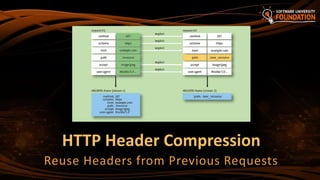
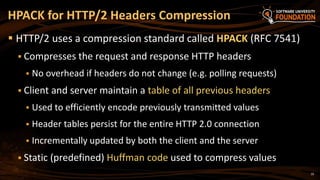
 HTTP/2 uses a compression standard called HPACK (RFC 7541)
 Compresses the request and response HTTP headers
 No overhead if headers do not change (e.g. polling requests)
 Client and server maintain a table of all previous headers
 Used to efficiently encode previously transmitted values
 Header tables persist for the entire HTTP 2.0 connection
 Incrementally updated by both the client and the server
 Static (predefined) Huffman code used to compress values
HPACK for HTTP/2 Headers Compression
20
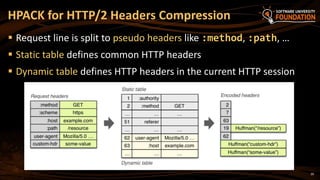
 Request line is split to pseudo headers like :method, :path, …
 Static table defines common HTTP headers
 Dynamic table defines HTTP headers in the current HTTP session
HPACK for HTTP/2 Headers Compression
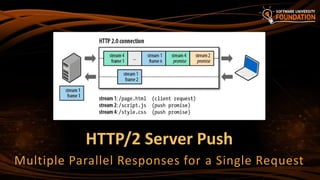
HTTP/2 Server Push
Multiple Parallel Responses for a Single Request
22
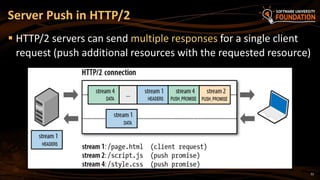
 HTTP/2 servers can send multiple responses for a single client
request (push additional resources with the requested resource)
Server Push in HTTP/2
23
 PUSH_PROMISE frames in HTTP/2 allows the server to send
additional resources
 First headers are sent, so clients can decide what to do
 Clients can decline pushed resources (via a RST_STREAM frame)
 E.g. when the pushed resource is already in the cache
 Pushed resources can be cached and reused later
 Pushed resources can be multiplexed alongside other resources
 Pushed resources can be prioritized by the server
Push Promises
Prioritization and Flow Control
Weights, Dependencies, Flow Control
25
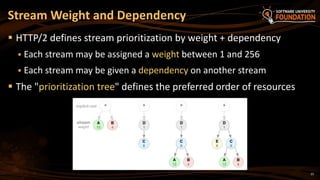
 HTTP/2 defines stream prioritization by weight + dependency
 Each stream may be assigned a weight between 1 and 256
 Each stream may be given a dependency on another stream
 The "prioritization tree" defines the preferred order of resources
Stream Weight and Dependency
26
 What is flow control?
 Managing the rate of data transmission between two nodes to
prevent a fast sender from overwhelming a slow receiver
 Example:
 User watches a video and presses the "pause" button
 For each HTTP/2 stream and for the entire connection
 Receivers can specify how many DATA bytes is ready to receive
 WINDOW_UPDATE frames configure the window size
Flow Control in HTTP/2
27
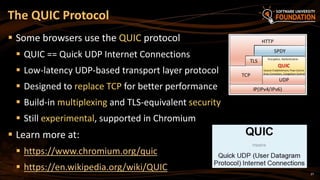
 Some browsers use the QUIC protocol
 QUIC == Quick UDP Internet Connections
 Low-latency UDP-based transport layer protocol
 Designed to replace TCP for better performance
 Build-in multiplexing and TLS-equivalent security
 Still experimental, supported in Chromium
 Learn more at:
 https://www.chromium.org/quic
 https://en.wikipedia.org/wiki/QUIC
The QUIC Protocol
Using HTTP/2
How to Switch to HTTP/2?
29
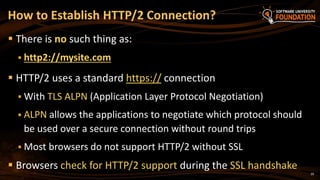
 There is no such thing as:
 http2://mysite.com
 HTTP/2 uses a standard https:// connection
 With TLS ALPN (Application Layer Protocol Negotiation)
 ALPN allows the applications to negotiate which protocol should
be used over a secure connection without round trips
 Most browsers do not support HTTP/2 without SSL
 Browsers check for HTTP/2 support during the SSL handshake
How to Establish HTTP/2 Connection?
30
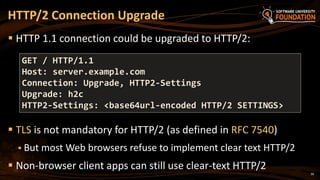
 HTTP 1.1 connection could be upgraded to HTTP/2:
 TLS is not mandatory for HTTP/2 (as defined in RFC 7540)
 But most Web browsers refuse to implement clear text HTTP/2
 Non-browser client apps can still use clear-text HTTP/2
HTTP/2 Connection Upgrade
GET / HTTP/1.1
Host: server.example.com
Connection: Upgrade, HTTP2-Settings
Upgrade: h2c
HTTP2-Settings: <base64url-encoded HTTP/2 SETTINGS>
HTTP/2 Tools
How It Changes Developer's Life?
32
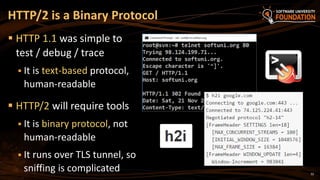
 HTTP 1.1 was simple to
test / debug / trace
 It is text-based protocol,
human-readable
 HTTP/2 will require tools
 It is binary protocol, not
human-readable
 It runs over TLS tunnel, so
sniffing is complicated
HTTP/2 is a Binary Protocol
33
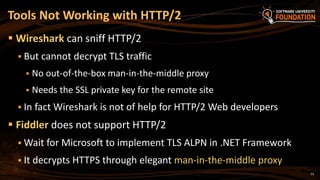
 Wireshark can sniff HTTP/2
 But cannot decrypt TLS traffic
 No out-of-the-box man-in-the-middle proxy
 Needs the SSL private key for the remote site
 In fact Wireshark is not of help for HTTP/2 Web developers
 Fiddler does not support HTTP/2
 Wait for Microsoft to implement TLS ALPN in .NET Framework
 It decrypts HTTPS through elegant man-in-the-middle proxy
Tools Not Working with HTTP/2
34
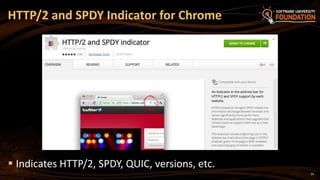
 Indicates HTTP/2, SPDY, QUIC, versions, etc.
HTTP/2 and SPDY Indicator for Chrome
35
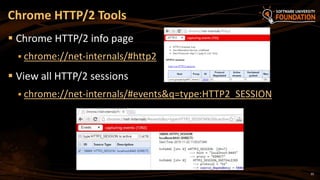
 Chrome HTTP/2 info page
 chrome://net-internals/#http2
 View all HTTP/2 sessions
 chrome://net-internals/#events&q=type:HTTP2_SESSION
Chrome HTTP/2 Tools
36
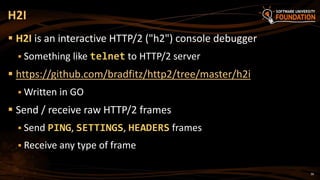
 H2I is an interactive HTTP/2 ("h2") console debugger
 Something like telnet to HTTP/2 server
 https://github.com/bradfitz/http2/tree/master/h2i
 Written in GO
 Send / receive raw HTTP/2 frames
 Send PING, SETTINGS, HEADERS frames
 Receive any type of frame
H2I
37
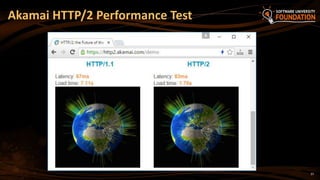
Akamai HTTP/2 Performance Test
HTTP/2 from Dev Perspective
How It Changes Developer's Life?
39
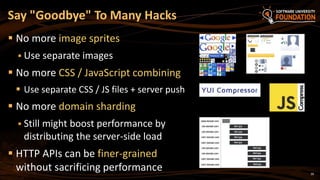
 No more image sprites
 Use separate images
 No more CSS / JavaScript combining
 Use separate CSS / JS files + server push
 No more domain sharding
 Still might boost performance by
distributing the server-side load
 HTTP APIs can be finer-grained
without sacrificing performance
Say "Goodbye" To Many Hacks
40
 Prioritization
 Developers may specify resource prioritization for faster page load
 Web servers / browsers may automatically set priorities
 When to push?
 Developers may push resources for faster page load
 Web servers may push resources transparently of developers
 How to optimize the flow control ?
 Developers may change the flow-control of data streams
Lots of Tweaking for Developers / Admins
Jetty and HTTP/2
HTTP/2 for Java Developers
42
 Jetty is a Java HTTP (Web) server and Servlet engine
 Developed under the Eclipse open-source project
 Supports HTTP/2, WebSocket, OSGi, JMX, JNDI, JAAS
 Enable HTTP/2 in Jetty:
Jetty and HTTP/s
$ java -jar $JETTY_HOME/start.jar --add-to-startd=http2
$ java -jar $JETTY_HOME/start.jar
…
2015-06-17 14:16:12.549:INFO:oejs.ServerConnector:main: Started
ServerConnector@34c9c77f{HTTP/1.1,[http/1.1]}{0.0.0.0:8080}
2015-06-17 14:16:12.782:INFO:oejs.ServerConnector:main: Started
ServerConnector@711f39f9{SSL,[ssl, alpn, h2, h2-17, http/1.1]}{0.0.0.0:8443}
…
43
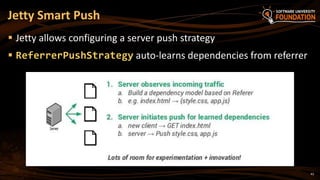
 Jetty allows configuring a server push strategy
 ReferrerPushStrategy auto-learns dependencies from referrer
Jetty Smart Push
44
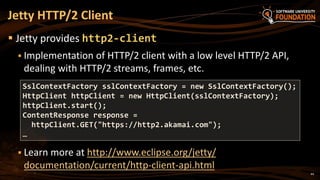
 Jetty provides http2-client
 Implementation of HTTP/2 client with a low level HTTP/2 API,
dealing with HTTP/2 streams, frames, etc.
 Learn more at http://www.eclipse.org/jetty/
documentation/current/http-client-api.html
Jetty HTTP/2 Client
SslContextFactory sslContextFactory = new SslContextFactory();
HttpClient httpClient = new HttpClient(sslContextFactory);
httpClient.start();
ContentResponse response =
httpClient.GET("https://http2.akamai.com");
…
?
http://softuni.bg
HTTP/2 for Developers
License
 This course (slides, examples, demos, videos, homework, etc.)
is licensed under the "Creative Commons Attribution-
NonCommercial-ShareAlike 4.0 International" license
46
Free Trainings @ Software University
 Software University Foundation – softuni.org
 Software University – High-Quality Education,
Profession and Job for Software Developers
 softuni.bg
 Software University @ Facebook
 facebook.com/SoftwareUniversity
 Software University @ YouTube
 youtube.com/SoftwareUniversity
 Software University Forums – forum.softuni.bg

HTTP/2 for Developers

  • 1.
    HTTP/2 for Developers HowHTTP/2 Works and How It Changes Developer's Life? Svetlin Nakov Manager Training and Inspiration Software University http://softuni.bg
  • 2.
    2  Co-founder ofthe Software University (SoftUni) – https://softuni.bg  Trained thousands people in programming and software development  Taught hundreds of software development lessons  20+ years in software development  15 years in training programmers  Author of 7 programming books  Speaker at hundreds talks, presentations, lessons, courses, seminars, conferences, and technical events  Blog: http://www.nakov.com About Me
  • 3.
    3  Networking takes~ 70% of the page load time! Top 1M Alexa Sites (in 2013) – Telemetry Source: https://goo.gl/yX8nFN  69.5% of time blocked on network  6.6% of time blocked JavaScript  5.1% blocked on Layout  4.5% blocked on Paint
  • 4.
    4  Opening atypical site in 2014, e.g. https://softuni.bg  HTTP 1.0 supports only one connection per request  65 connections need to be open, then closed  HTTP 1.1 supports "keep alive"  Open connection, download a resource, then another resource, …  Works in serial mode: if one resource is slow, page load is slow  Modern Web needs "a better HTTP protocol" HTTP/2: The Problem
  • 5.
    5  HTTP/2 isprotocol designed for  Low latency transport of content over the Web  No change to HTTP semantics  It’s about how data travels through the wire  Key new features in HTTP/2  Multiplexing: multiple streams over a single connection  Header compression: reuse headers from previous requests  Sever push: multiple parallel responses for a single request  Prioritization: some resources have priorities What is HTTP/2?
  • 6.
    6  HTTP 0.9(1991) – supports simple GET requests  HTTP 1.0 (1996) – single connection, POST, headers, …  HTTP 1.1 (1999) – keep-alive connections + pipelining  SPDY (2009-2010) – connection multiplexing + server push  Google developed the SPDY to replace HTTP 1.1 in Chrome and in the Google ecosystem  HTTP/2 (2014-2015) – de facto standardized SPDY  An official standard for the new low-latency HTTP protocol HTTP/2 History
  • 7.
    HTTP/2 Enabled WebSites – Examples  Facebook  Technically not HTTP/2  SPDY/3.1  Google and its sites (GMail, YouTube, …)  Use the latest HTTP/2  Combines QUIC + SPDY  Twitter, Yahoo, Wikipedia
  • 8.
  • 9.
    9  HTTP 1.0without keep-alive  Uses one request per TCP connection  Opening / closing a TCP connection is slow  Especially in high-latency connections (mobile networks)  Typical latencies: HTTP 1.0: Single Connection client server Open a TCP connection HTTP request + HTTP response Close the TCP connection
  • 10.
    10  HTTP 1.1with keep-alive  Open a TCP connection  Multiple times perform:  Send a HTTP request  Read a HTTP response  Close the TCP connection  Reuse TCP connections  Avoids multiple TCP connection open / close HTTP 1.1: Keep Alive client server Open a TCP connection Sequence of HTTP request + HTTP response Close the TCP connection
  • 11.
    11  HTTP 1.1with pipelining  Opens a TCP connection  Send multiple HTTP requests (without waiting responses)  Get the HTTP responses at once in FIFO order  Close the TCP connection  Head-of-line blocking (HOL) slows down the entire pipeline HTTP 1.1: Pipelining client server Open a TCP connection Multiple HTTP requests, followed by their HTTP responses Close the TCP connection
  • 12.
    12  Browsers open4-8 parallel TCP connections to each server  Multiple request / response streams run in parallel  The initial opening of these connections still has a cost  The number of connections is limited per domain  Domain sharding may improve load time for heavy sites HTTP 1.1: Multiple Connections client server Open a TCP connection Close the TCP connection client server Open a TCP connection Close the TCP connection
  • 13.
    13 HTTP/2: Multiplexing  HTTP/2uses multiplexing  Single TCP connection  Multiple parallel streams  Prioritization: clients specify each resource importance  Out of order responses  TCP connection is open once  Resources come though the same connection Multiple parallel streams client server Open a TCP connection Close the TCP connection
  • 14.
    14  HTTP/2 definesstreams (bidirectional sequence of data)  One TCP connection serves multiple parallel streams  The structure inside HTTP/2 is called a frame  Frame types: HEADERS, DATA, SETTINGS, PUSH_PROMISE, … How Multiplexing Works?
  • 15.
    HTTP Header Compression ReuseHeaders from Previous Requests
  • 16.
    16 992 bytes Typical HTTPRequest Holds Long Headers GET https://softuni.bg/ HTTP/1.1 Host: softuni.bg Connection: keep-alive Accept: text/html,application/xhtml+xml,application/xml,image/webp,*/* Upgrade-Insecure-Requests: 1 User-Agent: Mozilla/5.0 (Windows NT 10.0; WOW64) AppleWebKit/537.36 (KHTML, like Gecko) Chrome/46.0.2490.86 Safari/537.36 Accept-Encoding: gzip, deflate, sdch Accept-Language: en-US,en;q=0.8,bg;q=0.6 Cookie: .AspNet.SoftUniAuth=foQI2JhdsV0jE5PKhLAflcMlB9bl_rN3Rmo3hdR…; _ga=GA1.2.925942971.1440514837
  • 17.
    17 1173 bytes (181bytes new) Next Request Holds Nearly the Same Headers GET https://softuni.bg/apply HTTP/1.1 Host: softuni.bg Connection: keep-alive Accept: text/html,application/xhtml+xml,application/xml,image/webp,*/* Upgrade-Insecure-Requests: 1 User-Agent: Mozilla/5.0 (Windows NT 10.0; WOW64) AppleWebKit/537.36 (KHTML, like Gecko) Chrome/46.0.2490.86 Safari/537.36 Referer: https://softuni.bg/ Accept-Encoding: gzip, deflate, sdch Accept-Language: en-US,en;q=0.8,bg;q=0.6 Cookie: __RequestVerificationToken=5Eo-1AV9…1; language=bg; _ga=GA1.2.925942971.1440514837; _gat=1; .AspNet.SoftUniAuth=foQI2JhdsV0jE5PKhLAflcMlB9bl_rN3Rmo3hdR…
  • 18.
    18 1176 bytes (8bytes new, headers 100% the same) Next Request Holds Even More Similar Headers GET https://softuni.bg/contacts HTTP/1.1 Host: softuni.bg Connection: keep-alive Accept: text/html,application/xhtml+xml,application/xml,image/webp,*/* Upgrade-Insecure-Requests: 1 User-Agent: Mozilla/5.0 (Windows NT 10.0; WOW64) AppleWebKit/537.36 (KHTML, like Gecko) Chrome/46.0.2490.86 Safari/537.36 Referer: https://softuni.bg/ Accept-Encoding: gzip, deflate, sdch Accept-Language: en-US,en;q=0.8,bg;q=0.6 Cookie: __RequestVerificationToken=5Eo-1AV9…1; language=bg; _ga=GA1.2.925942971.1440514837; _gat=1; .AspNet.SoftUniAuth=foQI2JhdsV0jE5PKhLAflcMlB9bl_rN3Rmo3hdR…
  • 19.
    19  HTTP/2 usesa compression standard called HPACK (RFC 7541)  Compresses the request and response HTTP headers  No overhead if headers do not change (e.g. polling requests)  Client and server maintain a table of all previous headers  Used to efficiently encode previously transmitted values  Header tables persist for the entire HTTP 2.0 connection  Incrementally updated by both the client and the server  Static (predefined) Huffman code used to compress values HPACK for HTTP/2 Headers Compression
  • 20.
    20  Request lineis split to pseudo headers like :method, :path, …  Static table defines common HTTP headers  Dynamic table defines HTTP headers in the current HTTP session HPACK for HTTP/2 Headers Compression
  • 21.
    HTTP/2 Server Push MultipleParallel Responses for a Single Request
  • 22.
    22  HTTP/2 serverscan send multiple responses for a single client request (push additional resources with the requested resource) Server Push in HTTP/2
  • 23.
    23  PUSH_PROMISE framesin HTTP/2 allows the server to send additional resources  First headers are sent, so clients can decide what to do  Clients can decline pushed resources (via a RST_STREAM frame)  E.g. when the pushed resource is already in the cache  Pushed resources can be cached and reused later  Pushed resources can be multiplexed alongside other resources  Pushed resources can be prioritized by the server Push Promises
  • 24.
    Prioritization and FlowControl Weights, Dependencies, Flow Control
  • 25.
    25  HTTP/2 definesstream prioritization by weight + dependency  Each stream may be assigned a weight between 1 and 256  Each stream may be given a dependency on another stream  The "prioritization tree" defines the preferred order of resources Stream Weight and Dependency
  • 26.
    26  What isflow control?  Managing the rate of data transmission between two nodes to prevent a fast sender from overwhelming a slow receiver  Example:  User watches a video and presses the "pause" button  For each HTTP/2 stream and for the entire connection  Receivers can specify how many DATA bytes is ready to receive  WINDOW_UPDATE frames configure the window size Flow Control in HTTP/2
  • 27.
    27  Some browsersuse the QUIC protocol  QUIC == Quick UDP Internet Connections  Low-latency UDP-based transport layer protocol  Designed to replace TCP for better performance  Build-in multiplexing and TLS-equivalent security  Still experimental, supported in Chromium  Learn more at:  https://www.chromium.org/quic  https://en.wikipedia.org/wiki/QUIC The QUIC Protocol
  • 28.
    Using HTTP/2 How toSwitch to HTTP/2?
  • 29.
    29  There isno such thing as:  http2://mysite.com  HTTP/2 uses a standard https:// connection  With TLS ALPN (Application Layer Protocol Negotiation)  ALPN allows the applications to negotiate which protocol should be used over a secure connection without round trips  Most browsers do not support HTTP/2 without SSL  Browsers check for HTTP/2 support during the SSL handshake How to Establish HTTP/2 Connection?
  • 30.
    30  HTTP 1.1connection could be upgraded to HTTP/2:  TLS is not mandatory for HTTP/2 (as defined in RFC 7540)  But most Web browsers refuse to implement clear text HTTP/2  Non-browser client apps can still use clear-text HTTP/2 HTTP/2 Connection Upgrade GET / HTTP/1.1 Host: server.example.com Connection: Upgrade, HTTP2-Settings Upgrade: h2c HTTP2-Settings: <base64url-encoded HTTP/2 SETTINGS>
  • 31.
    HTTP/2 Tools How ItChanges Developer's Life?
  • 32.
    32  HTTP 1.1was simple to test / debug / trace  It is text-based protocol, human-readable  HTTP/2 will require tools  It is binary protocol, not human-readable  It runs over TLS tunnel, so sniffing is complicated HTTP/2 is a Binary Protocol
  • 33.
    33  Wireshark cansniff HTTP/2  But cannot decrypt TLS traffic  No out-of-the-box man-in-the-middle proxy  Needs the SSL private key for the remote site  In fact Wireshark is not of help for HTTP/2 Web developers  Fiddler does not support HTTP/2  Wait for Microsoft to implement TLS ALPN in .NET Framework  It decrypts HTTPS through elegant man-in-the-middle proxy Tools Not Working with HTTP/2
  • 34.
    34  Indicates HTTP/2,SPDY, QUIC, versions, etc. HTTP/2 and SPDY Indicator for Chrome
  • 35.
    35  Chrome HTTP/2info page  chrome://net-internals/#http2  View all HTTP/2 sessions  chrome://net-internals/#events&q=type:HTTP2_SESSION Chrome HTTP/2 Tools
  • 36.
    36  H2I isan interactive HTTP/2 ("h2") console debugger  Something like telnet to HTTP/2 server  https://github.com/bradfitz/http2/tree/master/h2i  Written in GO  Send / receive raw HTTP/2 frames  Send PING, SETTINGS, HEADERS frames  Receive any type of frame H2I
  • 37.
  • 38.
    HTTP/2 from DevPerspective How It Changes Developer's Life?
  • 39.
    39  No moreimage sprites  Use separate images  No more CSS / JavaScript combining  Use separate CSS / JS files + server push  No more domain sharding  Still might boost performance by distributing the server-side load  HTTP APIs can be finer-grained without sacrificing performance Say "Goodbye" To Many Hacks
  • 40.
    40  Prioritization  Developersmay specify resource prioritization for faster page load  Web servers / browsers may automatically set priorities  When to push?  Developers may push resources for faster page load  Web servers may push resources transparently of developers  How to optimize the flow control ?  Developers may change the flow-control of data streams Lots of Tweaking for Developers / Admins
  • 41.
    Jetty and HTTP/2 HTTP/2for Java Developers
  • 42.
    42  Jetty isa Java HTTP (Web) server and Servlet engine  Developed under the Eclipse open-source project  Supports HTTP/2, WebSocket, OSGi, JMX, JNDI, JAAS  Enable HTTP/2 in Jetty: Jetty and HTTP/s $ java -jar $JETTY_HOME/start.jar --add-to-startd=http2 $ java -jar $JETTY_HOME/start.jar … 2015-06-17 14:16:12.549:INFO:oejs.ServerConnector:main: Started ServerConnector@34c9c77f{HTTP/1.1,[http/1.1]}{0.0.0.0:8080} 2015-06-17 14:16:12.782:INFO:oejs.ServerConnector:main: Started ServerConnector@711f39f9{SSL,[ssl, alpn, h2, h2-17, http/1.1]}{0.0.0.0:8443} …
  • 43.
    43  Jetty allowsconfiguring a server push strategy  ReferrerPushStrategy auto-learns dependencies from referrer Jetty Smart Push
  • 44.
    44  Jetty provideshttp2-client  Implementation of HTTP/2 client with a low level HTTP/2 API, dealing with HTTP/2 streams, frames, etc.  Learn more at http://www.eclipse.org/jetty/ documentation/current/http-client-api.html Jetty HTTP/2 Client SslContextFactory sslContextFactory = new SslContextFactory(); HttpClient httpClient = new HttpClient(sslContextFactory); httpClient.start(); ContentResponse response = httpClient.GET("https://http2.akamai.com"); …
  • 45.
  • 46.
    License  This course(slides, examples, demos, videos, homework, etc.) is licensed under the "Creative Commons Attribution- NonCommercial-ShareAlike 4.0 International" license 46
  • 47.
    Free Trainings @Software University  Software University Foundation – softuni.org  Software University – High-Quality Education, Profession and Job for Software Developers  softuni.bg  Software University @ Facebook  facebook.com/SoftwareUniversity  Software University @ YouTube  youtube.com/SoftwareUniversity  Software University Forums – forum.softuni.bg

Editor's Notes

  • #8 DEMO jprime:80 with DEV TOOLS