Step-by-Step Approaches for Anterior Direct Restorative Challenges


Mastering Composite Artistry to
Create Anterior Masterpieces
Newton Fahl, Jr., DDS
This slide show presents a conservative, effective, and artistic
philosophy for performing esthetic direct anterior composite restorations
based on the principles of emulating the proper form, color, and function
     of natural dentition. This particular article outlines step-by-step
 procedural approaches to solving day-to-day anterior direct restorative
 challenges, including tooth preparation, artistic application, and how to
    create seamless transitions from tooth substance to the synthetic
composite restoratives using correct finishing and polishing techniques.


 Adapted from the full article, which originally appeared in the AACD’s
          Journal of Cosmetic Dentistry, Winter 2011 issue.
            For more information, visit www.AACD.com.

             © 2011-2013 American Academy of Cosmetic Dentistry, All Rights Reserved
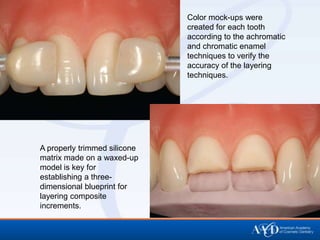
Color mock-ups were
                              created for each tooth
                              according to the achromatic
                              and chromatic enamel
                              techniques to verify the
                              accuracy of the layering
                              techniques.


A properly trimmed silicone
matrix made on a waxed-up
model is key for
establishing a three-
dimensional blueprint for
layering composite
increments.
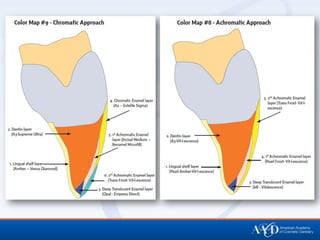
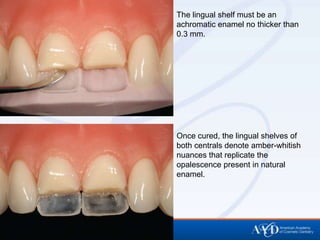
The lingual shelf must be an
achromatic enamel no thicker than
0.3 mm.


Once cured, the lingual shelves of
both centrals denote amber-whitish
nuances that replicate the
opalescence present in natural
enamel.
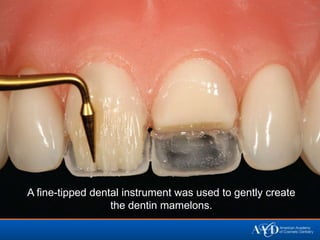
A fine-tipped dental instrument was used to gently create
                  the dentin mamelons.
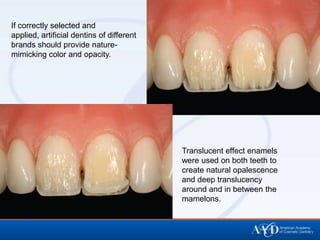
If correctly selected and
applied, artificial dentins of different
brands should provide nature-
mimicking color and opacity.


                                           Translucent effect enamels
                                           were used on both teeth to
                                           create natural opalescence
                                           and deep translucency
                                           around and in between the
                                           mamelons.
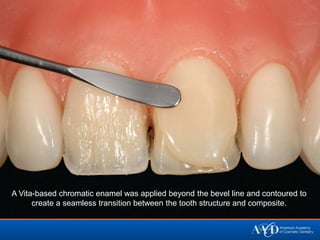
A Vita-based chromatic enamel was applied beyond the bevel line and contoured to
      create a seamless transition between the tooth structure and composite.
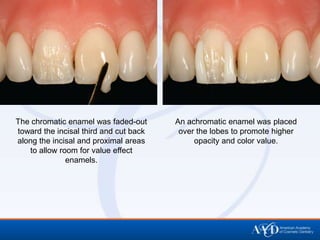
The chromatic enamel was faded-out      An achromatic enamel was placed
toward the incisal third and cut back    over the lobes to promote higher
along the incisal and proximal areas         opacity and color value.
   to allow room for value effect
              enamels.
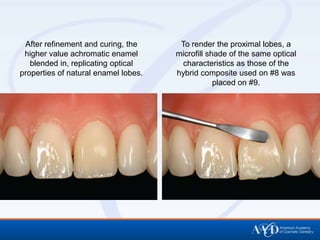
After refinement and curing, the      To render the proximal lobes, a
 higher value achromatic enamel       microfill shade of the same optical
   blended in, replicating optical     characteristics as those of the
properties of natural enamel lobes.   hybrid composite used on #8 was
                                                  placed on #9.
A non-VITA, more translucent achromatic hybrid composite enamel was chosen
for the middle lobes of both central incisors to allow more dentin show-through.


  After application and light-curing of chromatic and achromatic enamels, both
 centrals depict similar optical characteristics. [Right] To establish natural facial
planes, the transitional line angles were evaluated and the facial planes worked
              with finishing discs to establish the primary anatomy.
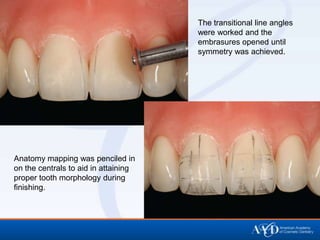
The transitional line angles
                                      were worked and the
                                      embrasures opened until
                                      symmetry was achieved.


Anatomy mapping was penciled in
on the centrals to aid in attaining
proper tooth morphology during
finishing.
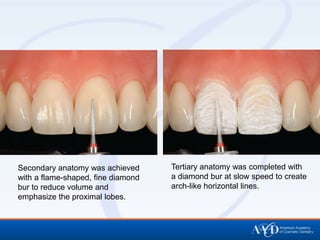
Secondary anatomy was achieved      Tertiary anatomy was completed with
with a flame-shaped, fine diamond   a diamond bur at slow speed to create
bur to reduce volume and            arch-like horizontal lines.
emphasize the proximal lobes.
[Left] Worn blunt rubber rotaries were used to eliminate undesired texture and to
impart a smoother appearance. [Right] Specialized chamois and cotton wheels
were used in the polishing steps to produce an enamel-like gloss.


             Felt disc and aluminum
             oxide paste finalized the
             polishing, bringing the
             restorations to a smooth
             and glossy surface.
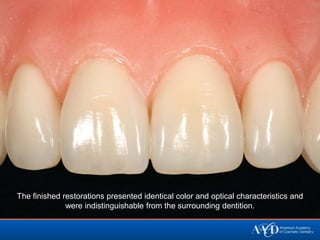
The finished restorations presented identical color and optical characteristics and
              were indistinguishable from the surrounding dentition.
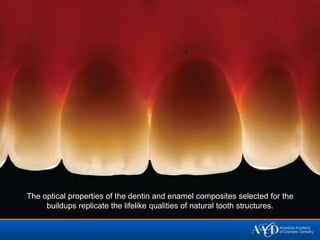
The optical properties of the dentin and enamel composites selected for the
     buildups replicate the lifelike qualities of natural tooth structures.
To receive the quarterly, peer-reviewed
    Journal of Cosmetic Dentistry,
     become an AACD member at
         www.AACD.com/join

Anterior Direct Restorations

  • 1.
    Step-by-Step Approaches forAnterior Direct Restorative Challenges Mastering Composite Artistry to Create Anterior Masterpieces Newton Fahl, Jr., DDS
  • 2.
    This slide showpresents a conservative, effective, and artistic philosophy for performing esthetic direct anterior composite restorations based on the principles of emulating the proper form, color, and function of natural dentition. This particular article outlines step-by-step procedural approaches to solving day-to-day anterior direct restorative challenges, including tooth preparation, artistic application, and how to create seamless transitions from tooth substance to the synthetic composite restoratives using correct finishing and polishing techniques. Adapted from the full article, which originally appeared in the AACD’s Journal of Cosmetic Dentistry, Winter 2011 issue. For more information, visit www.AACD.com. © 2011-2013 American Academy of Cosmetic Dentistry, All Rights Reserved
  • 3.
    Color mock-ups were created for each tooth according to the achromatic and chromatic enamel techniques to verify the accuracy of the layering techniques. A properly trimmed silicone matrix made on a waxed-up model is key for establishing a three- dimensional blueprint for layering composite increments.
  • 5.
    The lingual shelfmust be an achromatic enamel no thicker than 0.3 mm. Once cured, the lingual shelves of both centrals denote amber-whitish nuances that replicate the opalescence present in natural enamel.
  • 6.
    A fine-tipped dentalinstrument was used to gently create the dentin mamelons.
  • 7.
    If correctly selectedand applied, artificial dentins of different brands should provide nature- mimicking color and opacity. Translucent effect enamels were used on both teeth to create natural opalescence and deep translucency around and in between the mamelons.
  • 8.
    A Vita-based chromaticenamel was applied beyond the bevel line and contoured to create a seamless transition between the tooth structure and composite.
  • 9.
    The chromatic enamelwas faded-out An achromatic enamel was placed toward the incisal third and cut back over the lobes to promote higher along the incisal and proximal areas opacity and color value. to allow room for value effect enamels.
  • 10.
    After refinement andcuring, the To render the proximal lobes, a higher value achromatic enamel microfill shade of the same optical blended in, replicating optical characteristics as those of the properties of natural enamel lobes. hybrid composite used on #8 was placed on #9.
  • 11.
    A non-VITA, moretranslucent achromatic hybrid composite enamel was chosen for the middle lobes of both central incisors to allow more dentin show-through. After application and light-curing of chromatic and achromatic enamels, both centrals depict similar optical characteristics. [Right] To establish natural facial planes, the transitional line angles were evaluated and the facial planes worked with finishing discs to establish the primary anatomy.
  • 12.
    The transitional lineangles were worked and the embrasures opened until symmetry was achieved. Anatomy mapping was penciled in on the centrals to aid in attaining proper tooth morphology during finishing.
  • 13.
    Secondary anatomy wasachieved Tertiary anatomy was completed with with a flame-shaped, fine diamond a diamond bur at slow speed to create bur to reduce volume and arch-like horizontal lines. emphasize the proximal lobes.
  • 14.
    [Left] Worn bluntrubber rotaries were used to eliminate undesired texture and to impart a smoother appearance. [Right] Specialized chamois and cotton wheels were used in the polishing steps to produce an enamel-like gloss. Felt disc and aluminum oxide paste finalized the polishing, bringing the restorations to a smooth and glossy surface.
  • 15.
    The finished restorationspresented identical color and optical characteristics and were indistinguishable from the surrounding dentition.
  • 16.
    The optical propertiesof the dentin and enamel composites selected for the buildups replicate the lifelike qualities of natural tooth structures.
  • 17.
    To receive thequarterly, peer-reviewed Journal of Cosmetic Dentistry, become an AACD member at www.AACD.com/join