Clean, Sanitize
and Store
Kitchen Tools
and Equipment
PREPARED BY: MECHILLE E. LUGO
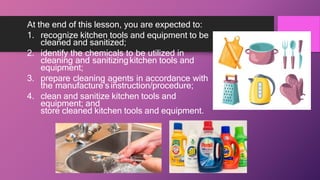
At the end of this lesson, you are expected to:
1. recognize kitchen tools and equipment to be
cleaned and sanitized;
2. identify the chemicals to be utilized in
cleaning and sanitizingkitchen tools and
equipment;
3. prepare cleaning agents in accordance with
the manufacture’sinstruction/procedure;
4. clean and sanitize kitchen tools and
equipment; and
store cleaned kitchen tools and equipment.
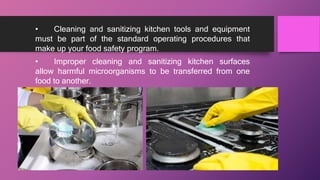
• Cleaning and sanitizing kitchen tools and equipment
must be part of the standard operating procedures that
make up your food safety program.
• Improper cleaning and sanitizing kitchen surfaces
allow harmful microorganisms to be transferred from one
food to another.
PRE-TEST
Direction: Below are jumbled letters. Write the
correct spelling opposite the scrambled letters.
Write your answer on board.
1. AINSZTEI-
2. PENMEQUTI -
3. NGILCAEN -
4. CNKTIEH -
5. LCEHIMAC -
6. RBNSGICUB–
7. EKFNIE-
8. EONTFL-
9. SRNEI-
10. GOENPS-
PRE-TEST
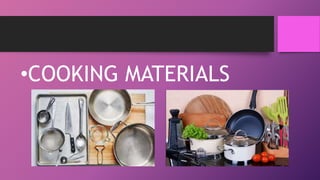
•COOKING MATERIALS
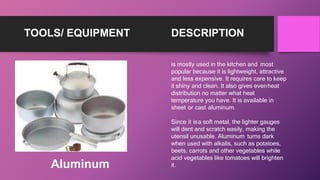
TOOLS/ EQUIPMENT DESCRIPTION
is mostly used in the kitchen and most
popular because it is lightweight, attractive
and less expensive. It requires care to keep
it shiny and clean. It also gives evenheat
distribution no matter what heat
temperature you have. It is available in
sheet or cast aluminum.
Since it isa soft metal, the lighter gauges
will dent and scratch easily, making the
utensil unusable. Aluminum turns dark
when used with alkalis, such as potatoes,
beets, carrots and other vegetables while
acid vegetables like tomatoes will brighten
it.
Aluminum
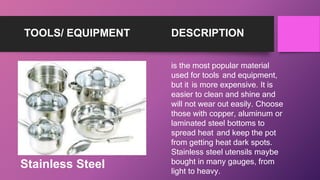
TOOLS/ EQUIPMENT DESCRIPTION
is the most popular material
used for tools and equipment,
but it is more expensive. It is
easier to clean and shine and
will not wear out easily. Choose
those with copper, aluminum or
laminated steel bottoms to
spread heat and keep the pot
from getting heat dark spots.

Stainless steel utensils maybe
bought in many gauges, from
light to heavy.
Stainless Steel
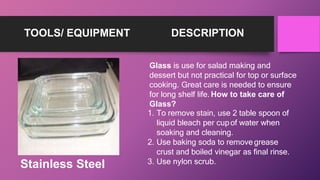
TOOLS/ EQUIPMENT DESCRIPTION
Glass is use for salad making and
dessert but not practical for top or surface
cooking. Great care is needed to ensure
for long shelf life. How to take care of
Glass?
1. To remove stain, use 2 table spoon of
liquid bleach per cupof water when
soaking and cleaning.
2. Use baking soda to removegrease
crust and boiled vinegar as final rinse.
3. Use nylon scrub.
Stainless Steel
TOOLS/ EQUIPMENT DESCRIPTION
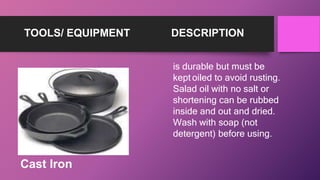
is durable but must be
kept oiled to avoid rusting.
Salad oil with no salt or
shortening can be rubbed
inside and out and dried.
Wash with soap (not
detergent) before using.
Cast Iron
TOOLS/ EQUIPMENT DESCRIPTION
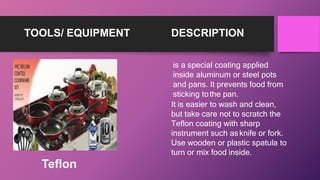
is a special coating applied
inside aluminum or steel pots
and pans. It prevents food from
sticking tothe pan.
It is easier to wash and clean,
but take care not to scratch the
Teflon coating with sharp
instrument such asknife or fork.
Use wooden or plastic spatula to
turn or mix food inside.
Teflon
Care of the Cooking Ware
• After using any cookware, they must be allowed to
cool before washing and soaking to prevent accidental
burns from handling and to prevent damage. They
should be free from all grease, food, etc. by washing
them using warm soapy water and rubbing them with a
steel wool cleaner and rinse thoroughly with warm
water.
Care of the Cooking Ware
• Drying them using a cloth after washing may preserve its
appearance. If food or grease is badly burned on the surface of a
utensil, the pan should be filled with water and allowed to boil hard
for five minutes. This will loosen the burned food and the pan may
be clean in the usual manner.
Kitchen Tools
is used to open a food
containers.
Can Opener
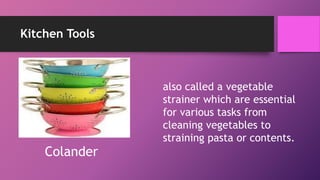
Kitchen Tools
also called a vegetable
strainer which are essential
for various tasks from
cleaning vegetables to
straining pasta or contents.
Colander
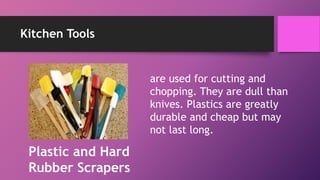
Kitchen Tools
are used for cutting and
chopping. They are dull than
knives. Plastics are greatly
durable and cheap but may
not last long.
Plastic and Hard
Rubber Scrapers
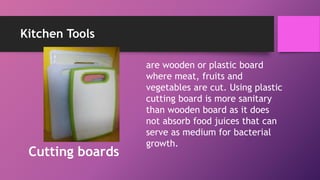
Kitchen Tools
are wooden or plastic board
where meat, fruits and
vegetables are cut. Using plastic
cutting board is more sanitary
than wooden board as it does
not absorb food juices that can
serve as medium for bacterial
growth.
Cutting boards
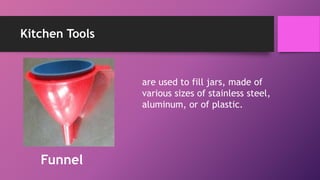
Kitchen Tools
are used to fill jars, made of
various sizes of stainless steel,
aluminum, or of plastic.
Funnel
Kitchen Tools
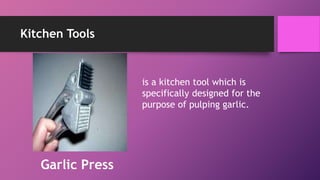
is a kitchen tool which is
specifically designed for the
purpose of pulping garlic.
Garlic Press
Kitchen Tools
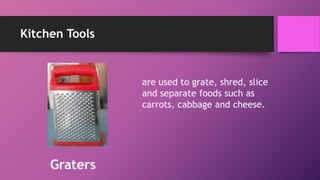
are used to grate, shred, slice
and separate foods such as
carrots, cabbage and cheese.
Graters
Kitchen Tools
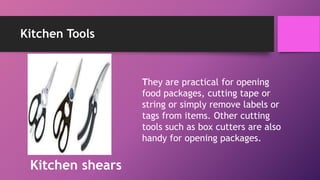
They are practical for opening
food packages, cutting tape or
string or simply remove labels or
tags from items. Other cutting
tools such as box cutters are also
handy for opening packages.
Kitchen shears
Kitchen Tools
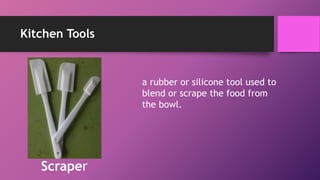
a rubber or silicone tool used to
blend or scrape the food from
the bowl.
Scraper
Kitchen Tools
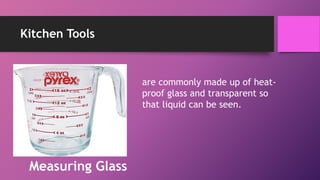
are commonly made up of heat-
proof glass and transparent so
that liquid can be seen.
Measuring Glass
Kitchen Tools
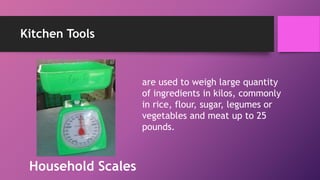
are used to weigh large quantity
of ingredients in kilos, commonly
in rice, flour, sugar, legumes or
vegetables and meat up to 25
pounds.
Household Scales
Kitchen Tools
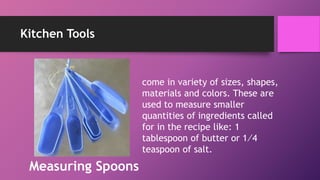
come in variety of sizes, shapes,
materials and colors. These are
used to measure smaller
quantities of ingredients called
for in the recipe like: 1
tablespoon of butter or 1⁄4
teaspoon of salt.
Measuring Spoons
Kitchen Tools
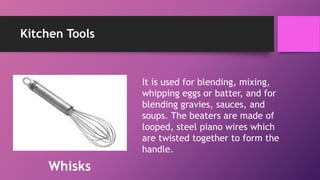
It is used for blending, mixing,
whipping eggs or batter, and for
blending gravies, sauces, and
soups. The beaters are made of
looped, steel piano wires which
are twisted together to form the
handle.
Whisks
SHORT ACTIVITY
1.GROUP YOURSELVES INTO TWO
2.MATCH THE FOLLOWING TOOLS
WITH THEIR APPROPRIATE WAY OF
CLEANING/ SANITIZING OR ITS
USES.
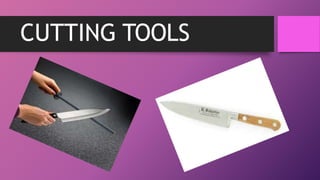
CUTTING TOOLS
CARING FOR KNIVES
1. SHARPEN KNIVES
OFTEN WITH A
SHAPENING STEEL
AND
OCCASIONALLY
WITH A STONE.
CARING FOR KNIVES
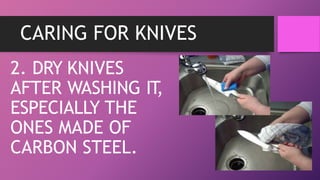
2. DRY KNIVES
AFTER WASHING IT
,
ESPECIALLY THE
ONES MADE OF
CARBON STEEL.
CARING FOR KNIVES
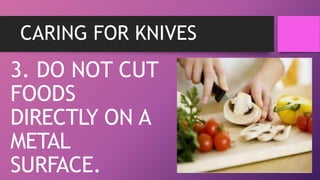
3. DO NOT CUT
FOODS
DIRECTLY ON A
METAL
SURFACE.
CARING FOR KNIVES
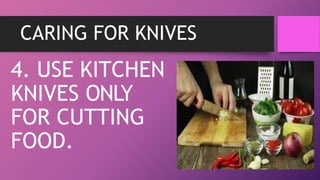
4. USE KITCHEN
KNIVES ONLY
FOR CUTTING
FOOD.
CARING FOR KNIVES
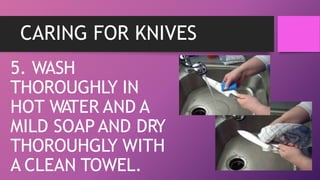
5. WASH
THOROUGHLY IN
HOT WATER AND A
MILD SOAP AND DRY
THOROUHGLY WITH
A CLEAN TOWEL.
CARING FOR KNIVES
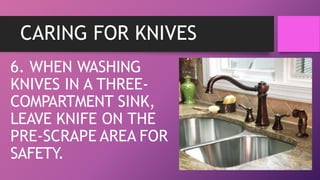
6. WHEN WASHING
KNIVES IN A THREE-
COMPARTMENT SINK,
LEAVE KNIFE ON THE
PRE-SCRAPE AREA FOR
SAFETY.
CARING FOR KNIVES
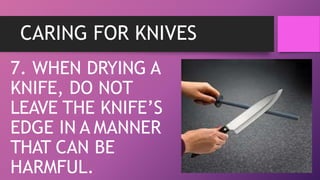
7. WHEN DRYING A
KNIFE, DO NOT
LEAVE THE KNIFE’S
EDGE IN A MANNER
THAT CAN BE
HARMFUL.
CARING FOR KNIVES
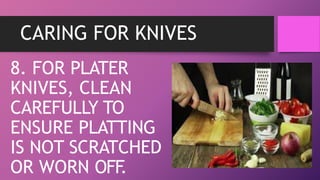
8. FOR PLATER
KNIVES, CLEAN
CAREFULLY TO
ENSURE PLATTING
IS NOT SCRATCHED
OR WORN OFF
.
CARING FOR KNIVES
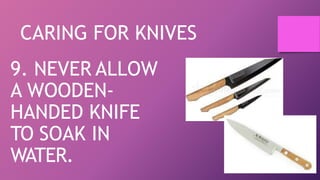
9. NEVER ALLOW
A WOODEN-
HANDED KNIFE
TO SOAK IN
WATER.
CUTTING BOARDS
CUTTING BOARDS
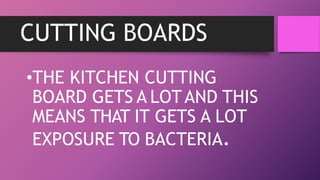
•THE KITCHEN CUTTING
BOARD GETS A LOTAND THIS
MEANS THAT IT GETS A LOT
EXPOSURE TO BACTERIA.
CLEANING THE CUTTING BOARD
1. AFTER USING THE CUTTING BOARD
TO SCLICE, DICE OR CHOP ALL KINDS
OF MEAT
, USE A METAL SCRAPER OR
SP
ATULA TO SCRAPE AWA
Y ANY
REMAINING BITS OF FOOD.
CLEANING THE CUTTING BOARD
• 2. SCRUB THE BOARD WITH HOT
, SOAPY WATER
THOROUGHL
YALLOW THE BOARD TOAIR DR
Y
.
REMOVING STAINS FROM THE
CUTTING BOARD
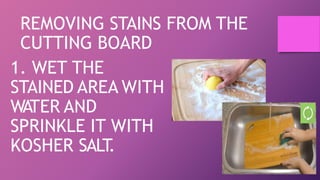
1. WET THE
STAINED AREA WITH
WATER AND
SPRINKLE IT WITH
KOSHER SALT
.
REMOVING STAINS FROM THE CUTTING BOARD
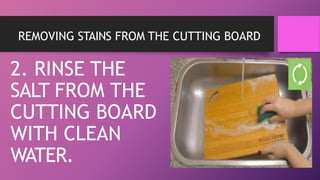
2. RINSE THE
SALT FROM THE
CUTTING BOARD
WITH CLEAN
WATER.
REMOVING STAINS FROM THE CUTTING BOARD
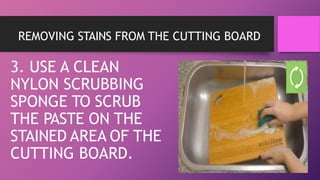
3. USE A CLEAN
NYLON SCRUBBING
SPONGE TO SCRUB
THE PASTE ON THE
STAINED AREA OF THE
CUTTING BOARD.
REMOVING STAINS FROM THE CUTTING BOARD
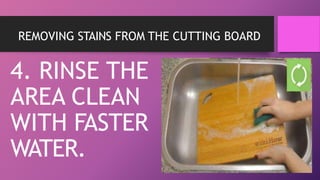
4. RINSE THE
AREA CLEAN
WITH FASTER
WATER.
REMOVING STAINS FROM THE CUTTING BOARD
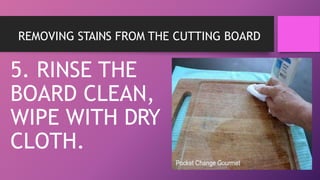
5. RINSE THE
BOARD CLEAN,
WIPE WITH DRY
CLOTH.
SANITIZING CUTTING BOARD
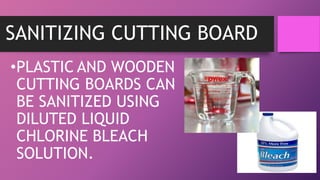
•PLASTIC AND WOODEN
CUTTING BOARDS CAN
BE SANITIZED USING
DILUTED LIQUID
CHLORINE BLEACH
SOLUTION.
SANITIZING CUTTING BOARD
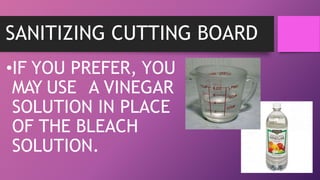
•IF YOU PREFER, YOU
MAY USE A VINEGAR
SOLUTION IN PLACE
OF THE BLEACH
SOLUTION.
STORING CUTTING BOARD
•CUTTING BOARD
SHOULD BE STORED
VERTICALLY OR IN
UPRIGHT
POSITION.
MEASURING AND MIXING TOOLS
CLEANING BAKING TOOLS
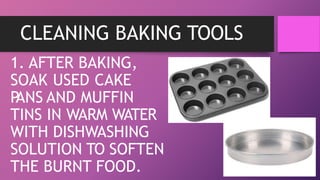
1. AFTER BAKING,
SOAK USED CAKE
P
ANS AND MUFFIN
TINS IN WARM WATER
WITH DISHWASHING
SOLUTION TO SOFTEN
THE BURNT FOOD.
CLEANING BAKING TOOLS
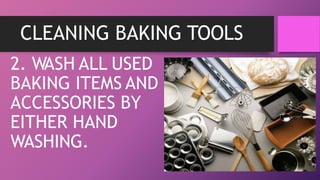
2. WASH ALL USED
BAKING ITEMS AND
ACCESSORIES BY
EITHER HAND
WASHING.
BAKING TOOLS
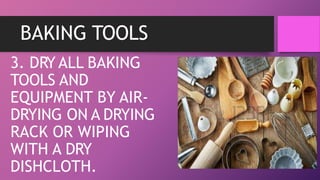
3. DRY ALL BAKING
TOOLS AND
EQUIPMENT BY AIR-
DRYING ON A DRYING
RACK OR WIPING
WITH A DRY
DISHCLOTH.
BAKING TOOLS
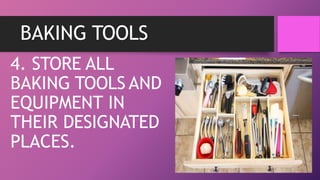
4. STORE ALL
BAKING TOOLS AND
EQUIPMENT IN
THEIR DESIGNATED
PLACES.

LESSON 1 Clean, Sanitize and Store Kitchen Tools and.pptx

  • 1.
    Clean, Sanitize and Store KitchenTools and Equipment PREPARED BY: MECHILLE E. LUGO
  • 2.
    At the endof this lesson, you are expected to: 1. recognize kitchen tools and equipment to be cleaned and sanitized; 2. identify the chemicals to be utilized in cleaning and sanitizingkitchen tools and equipment; 3. prepare cleaning agents in accordance with the manufacture’sinstruction/procedure; 4. clean and sanitize kitchen tools and equipment; and store cleaned kitchen tools and equipment.
  • 3.
    • Cleaning andsanitizing kitchen tools and equipment must be part of the standard operating procedures that make up your food safety program. • Improper cleaning and sanitizing kitchen surfaces allow harmful microorganisms to be transferred from one food to another.
  • 4.
    PRE-TEST Direction: Below arejumbled letters. Write the correct spelling opposite the scrambled letters. Write your answer on board. 1. AINSZTEI- 2. PENMEQUTI - 3. NGILCAEN - 4. CNKTIEH - 5. LCEHIMAC -
  • 5.
    6. RBNSGICUB– 7. EKFNIE- 8.EONTFL- 9. SRNEI- 10. GOENPS- PRE-TEST
  • 6.
  • 7.
    TOOLS/ EQUIPMENT DESCRIPTION ismostly used in the kitchen and most popular because it is lightweight, attractive and less expensive. It requires care to keep it shiny and clean. It also gives evenheat distribution no matter what heat temperature you have. It is available in sheet or cast aluminum. Since it isa soft metal, the lighter gauges will dent and scratch easily, making the utensil unusable. Aluminum turns dark when used with alkalis, such as potatoes, beets, carrots and other vegetables while acid vegetables like tomatoes will brighten it. Aluminum
  • 8.
    TOOLS/ EQUIPMENT DESCRIPTION isthe most popular material used for tools and equipment, but it is more expensive. It is easier to clean and shine and will not wear out easily. Choose those with copper, aluminum or laminated steel bottoms to spread heat and keep the pot from getting heat dark spots. Stainless steel utensils maybe bought in many gauges, from light to heavy. Stainless Steel
  • 9.
    TOOLS/ EQUIPMENT DESCRIPTION Glassis use for salad making and dessert but not practical for top or surface cooking. Great care is needed to ensure for long shelf life. How to take care of Glass? 1. To remove stain, use 2 table spoon of liquid bleach per cupof water when soaking and cleaning. 2. Use baking soda to removegrease crust and boiled vinegar as final rinse. 3. Use nylon scrub. Stainless Steel
  • 10.
    TOOLS/ EQUIPMENT DESCRIPTION isdurable but must be kept oiled to avoid rusting. Salad oil with no salt or shortening can be rubbed inside and out and dried. Wash with soap (not detergent) before using. Cast Iron
  • 11.
    TOOLS/ EQUIPMENT DESCRIPTION isa special coating applied inside aluminum or steel pots and pans. It prevents food from sticking tothe pan. It is easier to wash and clean, but take care not to scratch the Teflon coating with sharp instrument such asknife or fork. Use wooden or plastic spatula to turn or mix food inside. Teflon
  • 12.
    Care of theCooking Ware • After using any cookware, they must be allowed to cool before washing and soaking to prevent accidental burns from handling and to prevent damage. They should be free from all grease, food, etc. by washing them using warm soapy water and rubbing them with a steel wool cleaner and rinse thoroughly with warm water.
  • 13.
    Care of theCooking Ware • Drying them using a cloth after washing may preserve its appearance. If food or grease is badly burned on the surface of a utensil, the pan should be filled with water and allowed to boil hard for five minutes. This will loosen the burned food and the pan may be clean in the usual manner.
  • 14.
    Kitchen Tools is usedto open a food containers. Can Opener
  • 15.
    Kitchen Tools also calleda vegetable strainer which are essential for various tasks from cleaning vegetables to straining pasta or contents. Colander
  • 16.
    Kitchen Tools are usedfor cutting and chopping. They are dull than knives. Plastics are greatly durable and cheap but may not last long. Plastic and Hard Rubber Scrapers
  • 17.
    Kitchen Tools are woodenor plastic board where meat, fruits and vegetables are cut. Using plastic cutting board is more sanitary than wooden board as it does not absorb food juices that can serve as medium for bacterial growth. Cutting boards
  • 18.
    Kitchen Tools are usedto fill jars, made of various sizes of stainless steel, aluminum, or of plastic. Funnel
  • 19.
    Kitchen Tools is akitchen tool which is specifically designed for the purpose of pulping garlic. Garlic Press
  • 20.
    Kitchen Tools are usedto grate, shred, slice and separate foods such as carrots, cabbage and cheese. Graters
  • 21.
    Kitchen Tools They arepractical for opening food packages, cutting tape or string or simply remove labels or tags from items. Other cutting tools such as box cutters are also handy for opening packages. Kitchen shears
  • 22.
    Kitchen Tools a rubberor silicone tool used to blend or scrape the food from the bowl. Scraper
  • 23.
    Kitchen Tools are commonlymade up of heat- proof glass and transparent so that liquid can be seen. Measuring Glass
  • 24.
    Kitchen Tools are usedto weigh large quantity of ingredients in kilos, commonly in rice, flour, sugar, legumes or vegetables and meat up to 25 pounds. Household Scales
  • 25.
    Kitchen Tools come invariety of sizes, shapes, materials and colors. These are used to measure smaller quantities of ingredients called for in the recipe like: 1 tablespoon of butter or 1⁄4 teaspoon of salt. Measuring Spoons
  • 26.
    Kitchen Tools It isused for blending, mixing, whipping eggs or batter, and for blending gravies, sauces, and soups. The beaters are made of looped, steel piano wires which are twisted together to form the handle. Whisks
  • 27.
    SHORT ACTIVITY 1.GROUP YOURSELVESINTO TWO 2.MATCH THE FOLLOWING TOOLS WITH THEIR APPROPRIATE WAY OF CLEANING/ SANITIZING OR ITS USES.
  • 28.
  • 29.
    CARING FOR KNIVES 1.SHARPEN KNIVES OFTEN WITH A SHAPENING STEEL AND OCCASIONALLY WITH A STONE.
  • 30.
    CARING FOR KNIVES 2.DRY KNIVES AFTER WASHING IT , ESPECIALLY THE ONES MADE OF CARBON STEEL.
  • 31.
    CARING FOR KNIVES 3.DO NOT CUT FOODS DIRECTLY ON A METAL SURFACE.
  • 32.
    CARING FOR KNIVES 4.USE KITCHEN KNIVES ONLY FOR CUTTING FOOD.
  • 33.
    CARING FOR KNIVES 5.WASH THOROUGHLY IN HOT WATER AND A MILD SOAP AND DRY THOROUHGLY WITH A CLEAN TOWEL.
  • 34.
    CARING FOR KNIVES 6.WHEN WASHING KNIVES IN A THREE- COMPARTMENT SINK, LEAVE KNIFE ON THE PRE-SCRAPE AREA FOR SAFETY.
  • 35.
    CARING FOR KNIVES 7.WHEN DRYING A KNIFE, DO NOT LEAVE THE KNIFE’S EDGE IN A MANNER THAT CAN BE HARMFUL.
  • 36.
    CARING FOR KNIVES 8.FOR PLATER KNIVES, CLEAN CAREFULLY TO ENSURE PLATTING IS NOT SCRATCHED OR WORN OFF .
  • 37.
    CARING FOR KNIVES 9.NEVER ALLOW A WOODEN- HANDED KNIFE TO SOAK IN WATER.
  • 38.
  • 39.
    CUTTING BOARDS •THE KITCHENCUTTING BOARD GETS A LOTAND THIS MEANS THAT IT GETS A LOT EXPOSURE TO BACTERIA.
  • 40.
    CLEANING THE CUTTINGBOARD 1. AFTER USING THE CUTTING BOARD TO SCLICE, DICE OR CHOP ALL KINDS OF MEAT , USE A METAL SCRAPER OR SP ATULA TO SCRAPE AWA Y ANY REMAINING BITS OF FOOD.
  • 41.
    CLEANING THE CUTTINGBOARD • 2. SCRUB THE BOARD WITH HOT , SOAPY WATER THOROUGHL YALLOW THE BOARD TOAIR DR Y .
  • 42.
    REMOVING STAINS FROMTHE CUTTING BOARD 1. WET THE STAINED AREA WITH WATER AND SPRINKLE IT WITH KOSHER SALT .
  • 43.
    REMOVING STAINS FROMTHE CUTTING BOARD 2. RINSE THE SALT FROM THE CUTTING BOARD WITH CLEAN WATER.
  • 44.
    REMOVING STAINS FROMTHE CUTTING BOARD 3. USE A CLEAN NYLON SCRUBBING SPONGE TO SCRUB THE PASTE ON THE STAINED AREA OF THE CUTTING BOARD.
  • 45.
    REMOVING STAINS FROMTHE CUTTING BOARD 4. RINSE THE AREA CLEAN WITH FASTER WATER.
  • 46.
    REMOVING STAINS FROMTHE CUTTING BOARD 5. RINSE THE BOARD CLEAN, WIPE WITH DRY CLOTH.
  • 47.
    SANITIZING CUTTING BOARD •PLASTICAND WOODEN CUTTING BOARDS CAN BE SANITIZED USING DILUTED LIQUID CHLORINE BLEACH SOLUTION.
  • 48.
    SANITIZING CUTTING BOARD •IFYOU PREFER, YOU MAY USE A VINEGAR SOLUTION IN PLACE OF THE BLEACH SOLUTION.
  • 49.
    STORING CUTTING BOARD •CUTTINGBOARD SHOULD BE STORED VERTICALLY OR IN UPRIGHT POSITION.
  • 50.
  • 51.
    CLEANING BAKING TOOLS 1.AFTER BAKING, SOAK USED CAKE P ANS AND MUFFIN TINS IN WARM WATER WITH DISHWASHING SOLUTION TO SOFTEN THE BURNT FOOD.
  • 52.
    CLEANING BAKING TOOLS 2.WASH ALL USED BAKING ITEMS AND ACCESSORIES BY EITHER HAND WASHING.
  • 53.
    BAKING TOOLS 3. DRYALL BAKING TOOLS AND EQUIPMENT BY AIR- DRYING ON A DRYING RACK OR WIPING WITH A DRY DISHCLOTH.
  • 54.
    BAKING TOOLS 4. STOREALL BAKING TOOLS AND EQUIPMENT IN THEIR DESIGNATED PLACES.