AMARESH JHA
CLEANING
Accumulation of dust, soil, and microbial
contaminants on environmental surfaces is
both aesthetically displeasing and a potential
source of Nosocomial infections. Effective
and efficient cleaning methods and schedules
are, therefore, necessary to maintain a clean
and healthy environment in healthcare
settings.”
THE PURPOSE OF GENERAL HOUSEKEEPING IS TO:
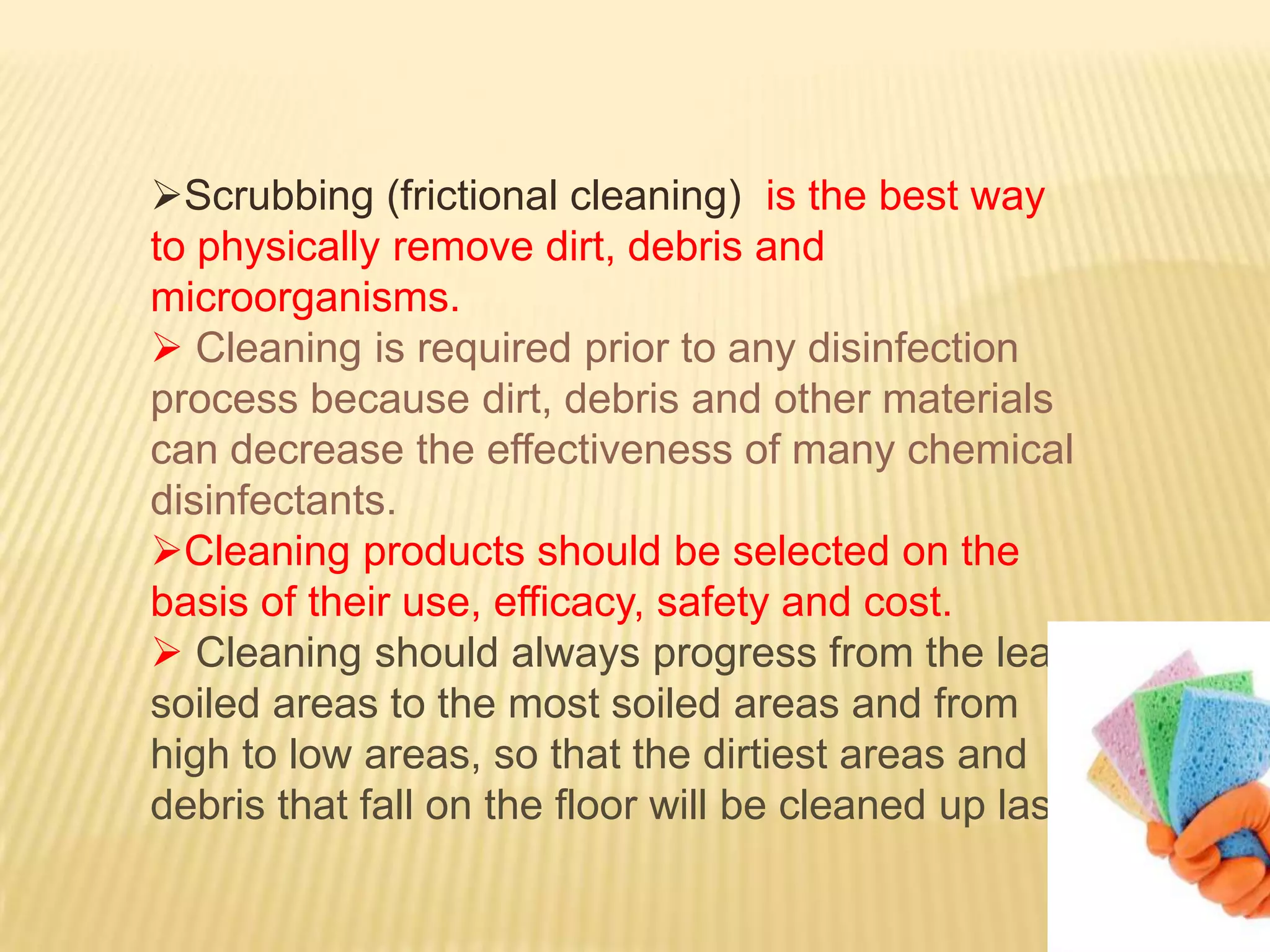
Scrubbing (frictional cleaning) is the best way
to physically remove dirt, debris and
microorganisms.
 Cleaning is required prior to any disinfection
process because dirt, debris and other materials
can decrease the effectiveness of many chemical
disinfectants.
Cleaning products should be selected on the
basis of their use, efficacy, safety and cost.
 Cleaning should always progress from the least
soiled areas to the most soiled areas and from
high to low areas, so that the dirtiest areas and
debris that fall on the floor will be cleaned up last.
Dry sweeping, mopping and dusting should be avoided
to prevent dust, debris and microorganisms from getting
into the air and landing on clean surfaces. Airborne fungal
spores are especially important as they can cause fatal
infections in immuno suppressed person.
 Mixing (dilution) instructions should be followed when
using disinfectants. (Too much or too little water may
reduce the effectiveness of disinfectants.)
Cleaning methods and written cleaning schedules should
be based on the type of surface, amount and type of soil
present and the purpose of the area.
Routine cleaning is necessary to maintain a standard of
cleanliness. Schedules and procedures should be
consistent and posted.
Cleaning solution:
Any combination of soap (or
detergent) and water, with or
without a chemical disinfectant,
used to wash or wipe down
environmental surfaces such as
floors, chairs, bench tops, walls
and ceilings.
1. Disinfectant.
Chemical that destroys or inactivates
microorganisms.Disinfectants are classified as:
 low-intermediate- or high-level depending on
their ability to kill or immobilize some
(low- or intermediate-level) or all (high-level)
microorganisms (but not all spores).
Phenols, chlorine or chlorine-containing
compounds and QUATs are classes of
disinfectants frequently used to clean
noncritical surfaces such as floors, walls and
furniture.
2.Disinfectant cleaning solution.
 Products that are a combination of a detergent (soap)
and a chemical disinfectant. Not all detergents and
disinfectants are compatible. Several combinations are
available commercially or can be prepared, such as
alkaline detergents with chlorine compounds, alkaline
detergents with quaternary ammonium compounds
(QUATs) or other nonionic surfactants, and acid
detergents with iodophors.
3.Environmental controls.
Standards specifying procedures to be followed for the
routine care, cleaning and disinfection of environmental
surfaces, beds, bedrails, bedside equipment and other
frequently touched surfaces.
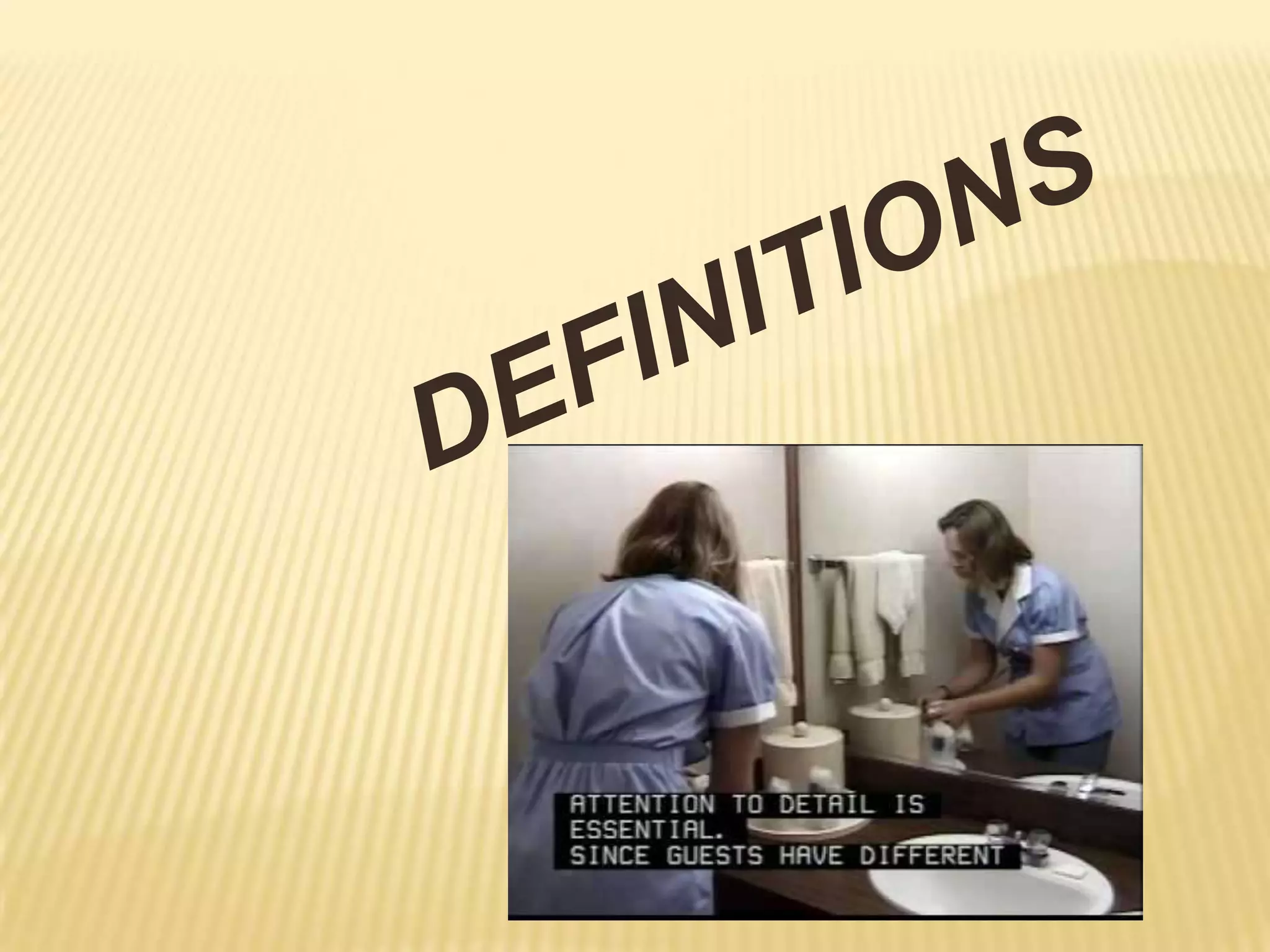
4.Environmental hygiene. Process of maintaining a clean,
healthy and pleasing patient and work environment.
 5.Sanitizer. Chemical that reduces the number of bacterial
contaminants to safe levels on inanimate objects based on
public health requirements (i.e., a chemical that kills
99.999% of the specific test bacteria in 30 seconds under the
conditions of the test).
6.soaps and detergents (terms used interchangeably).
Cleaning products (bar, liquid, leaflet or powder) that lower
surface tension, thereby helping remove dirt, debris and
transient microorganisms from hands. Plain soaps require
friction (scrubbing) to mechanically remove microorganisms;
antiseptic (antimicrobial) soaps kill or inhibit the growth of
most microorganisms.
7.Sterilants. Chemicals used to destroy all forms of
microorganisms,
including endospores. Most sterilants are also high-level
disinfectants
when used for a shorter period of time. Sterilants are used
only on inanimate objects (e.g., surgical instruments) that
are used in semicritical and critical areas (e.g., surgery).
Sterilants are not meant to be used for cleaning
environmental surfaces.
8.Surfactant. Agent that reduces the surface tension of
water or the tension at the interface between water and
another liquid; a wetting agent found in many sterilants and
disinfectants.
9.Type of detergent: Commercial cleaning product (liquid or
powder) that are composed of a hydrophilic (water-seeking)
component and a lipophilic (fat-seeking) component and can
be divided into four types: anionic, cationic, amphoteric and
nonionic detergents.
N IDEAL CLEANING PRODUCT SHOULD ACCOMPLISH THE FOLLOWING:


    1.Suspension of fats (suspend fats in water)
    2.Saponification of fats (make fats water-soluble)
    3.Surfaction (decrease surface tension of water
      and allow greater penetration of the agent into
      the dirt or soil)
    4.Dispersion (break up of soil into small particles)
    5.Protein destruction (break up proteins)
    6.Softening the water (removal of calcium and
      magnesium)
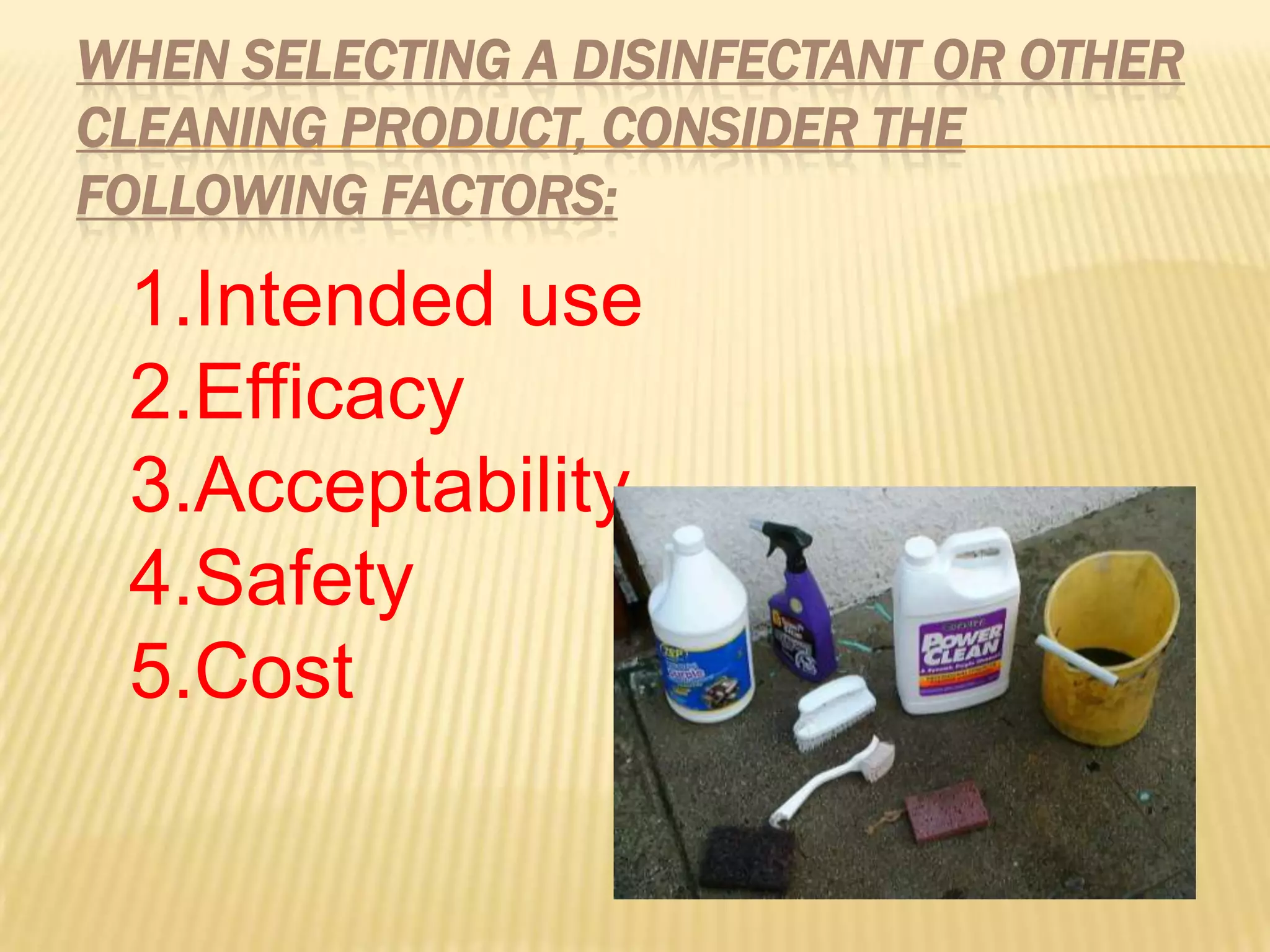
WHEN SELECTING A DISINFECTANT OR OTHER
CLEANING PRODUCT, CONSIDER THE
FOLLOWING FACTORS:
 1.Intended use
 2.Efficacy
 3.Acceptability
 4.Safety
 5.Cost
CLEANING METHODS
1. Wet mopping is the most common
   and preferred method to clean floors.
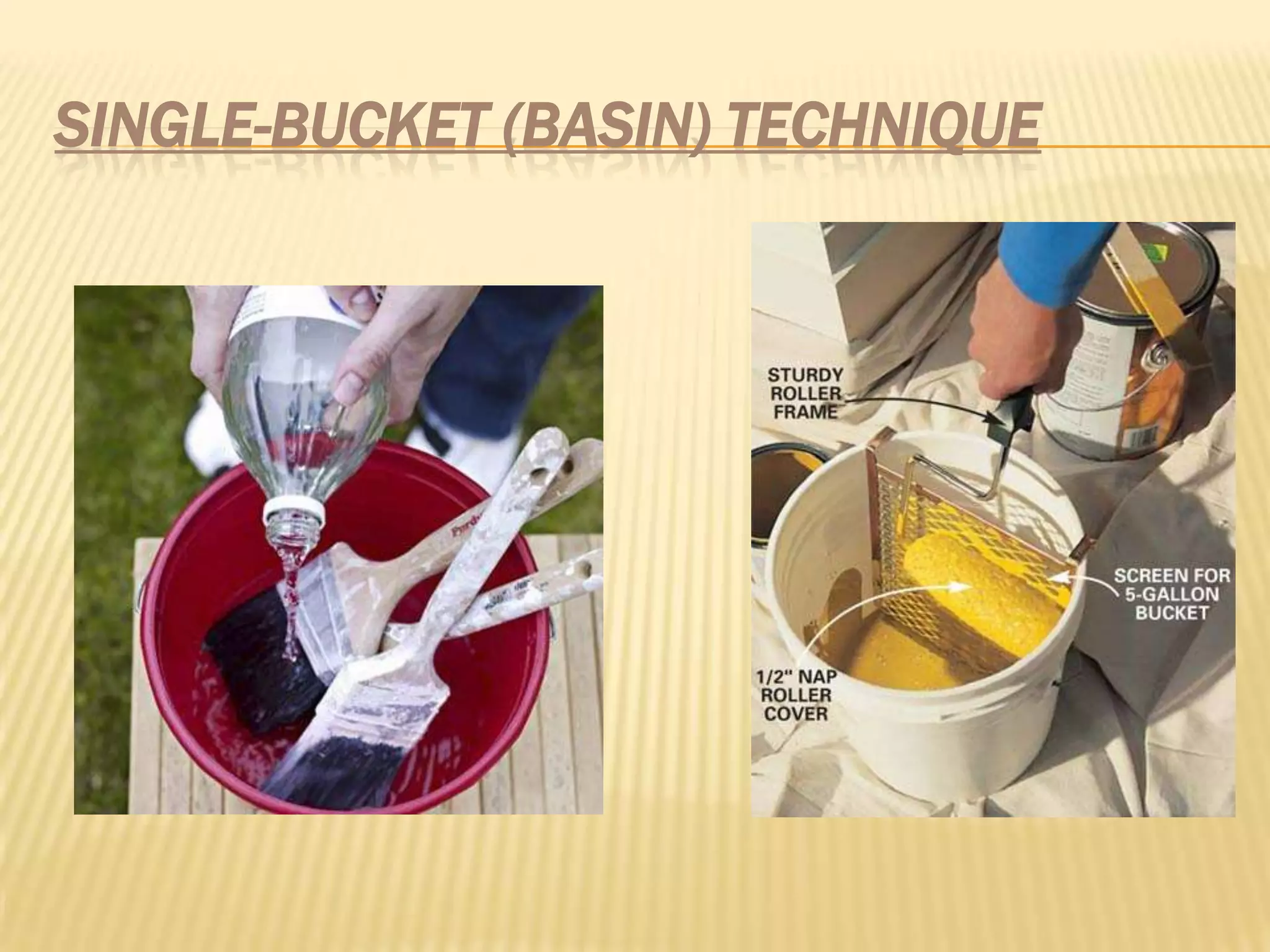
2. Single-bucket (basin) technique:
   One bucket of cleaning solution is
   used. The solution must be changed
   when dirty. (The killing power of the
   cleaning product decreases with the
   increased load of soil and organic
   material present.)
SINGLE-BUCKET (BASIN) TECHNIQUE
DOUBLE-BUCKET TECHNIQUE
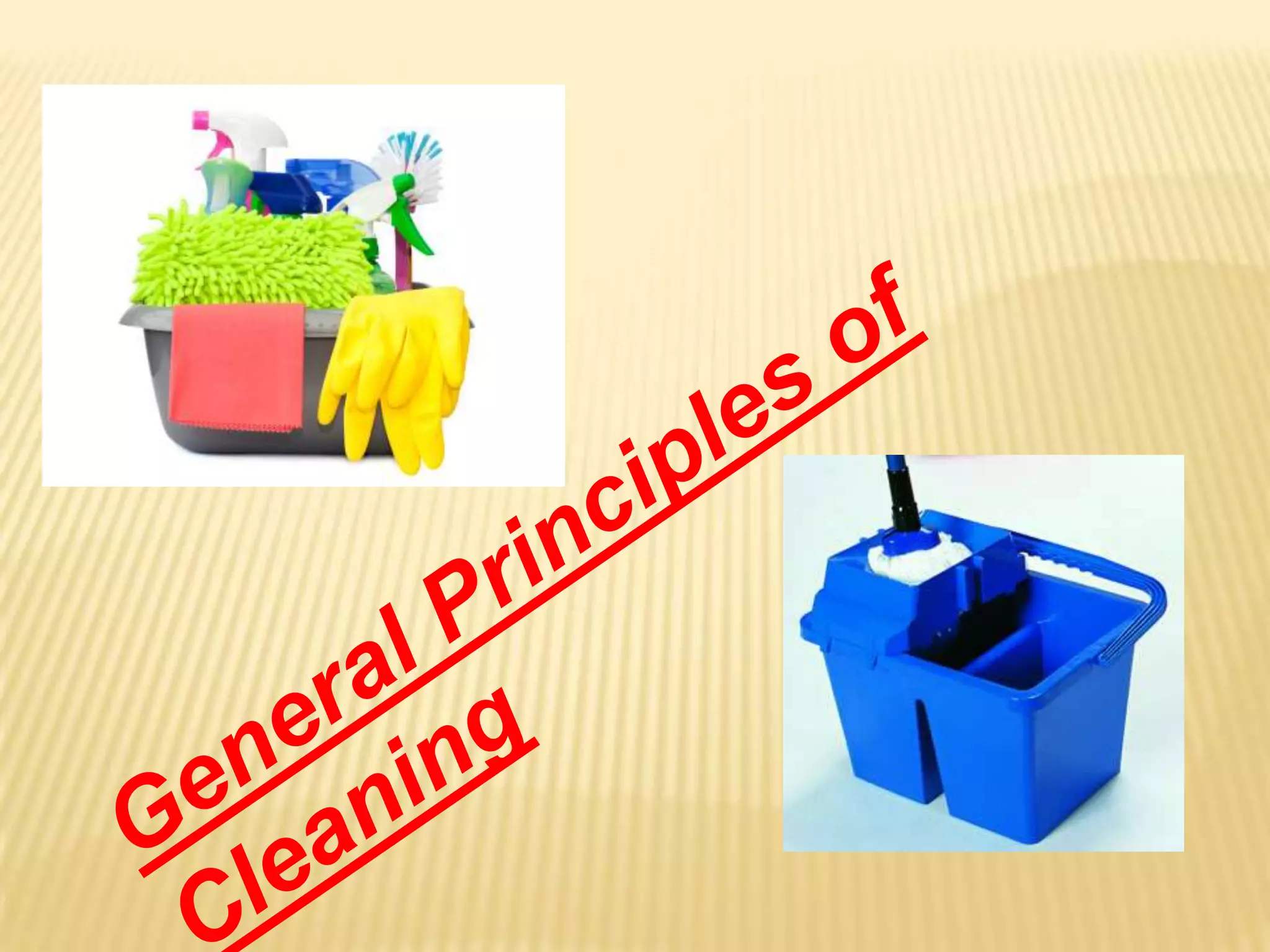
3.Double-bucket technique: Two different buckets are
    used, one containing a cleaning solution and the other
    containing rinse water. The mop is always rinsed and
    wrung out before it is dipped into the cleaning solution.
    The double-bucket technique extends the life of the
    cleaning solution (fewer changes are required), saving
    both labor and material costs.
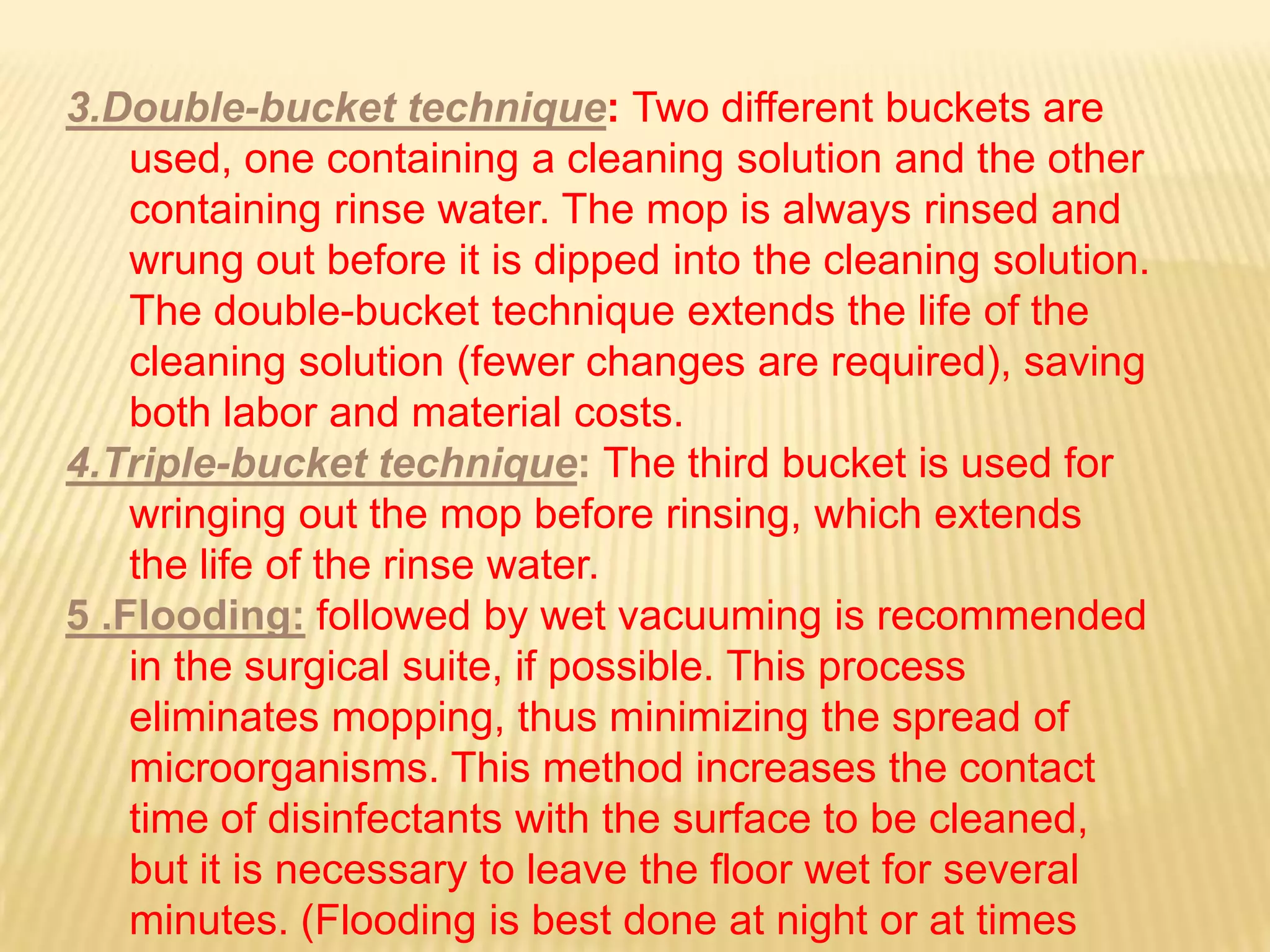
4.Triple-bucket technique: The third bucket is used for
    wringing out the mop before rinsing, which extends
    the life of the rinse water.
5 .Flooding: followed by wet vacuuming is recommended
    in the surgical suite, if possible. This process
    eliminates mopping, thus minimizing the spread of
    microorganisms. This method increases the contact
    time of disinfectants with the surface to be cleaned,
    but it is necessary to leave the floor wet for several
    minutes. (Flooding is best done at night or at times
TRIPLE-BUCKET TECHNIQUE:
FLOOD CLEANING
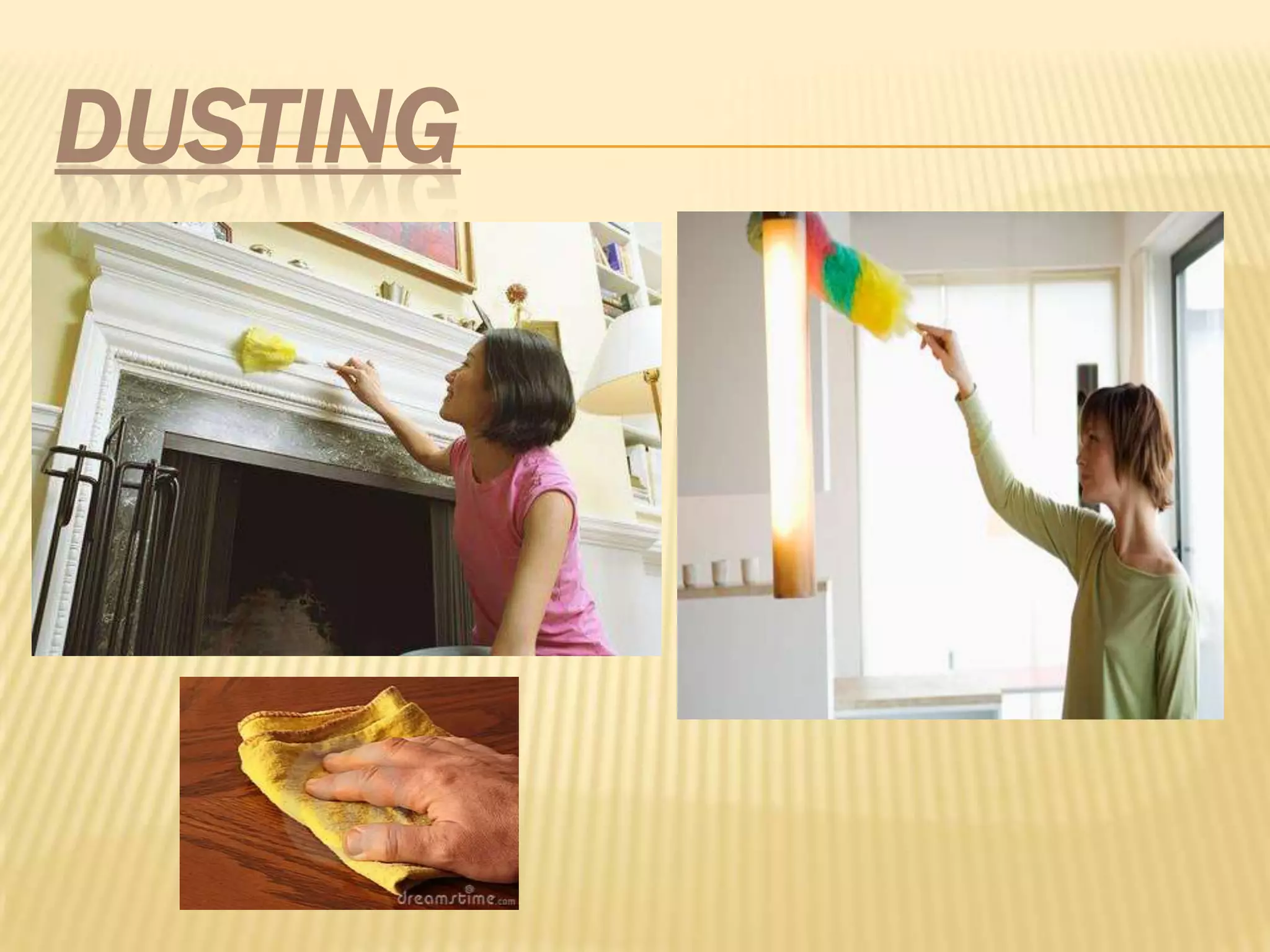
7.Dusting is most commonly used for cleaning walls, ceilings, doors,
   windows, furniture and other environmental surfaces. Dusting is most
   commonly used for cleaning walls, ceilings, doors, windows, furniture
   and other environmental surfaces.
Clean cloths or mops are wetted with cleaning solution contained in a
basin or bucket. The double-bucket system minimizes the contamination
of the cleaning solution.
Dry dusting should be avoided and dust cloths and mops should never
be
shaken to avoid the spread of microorganisms.
Dusting should be performed in a systematic way, using a starting
point
as a reference to ensure that all surfaces have been reached.
When doing high dusting (ceiling tiles and walls), check for stains that
may indicate possible leaks. (Leaks should be repaired as soon as
possible because moist ceiling tiles provide a reservoir for fungal
growth.)
8.Dry vacuuming is only recommended for cleaning of carpets.
DUSTING
DRY DUSTING

Principles of cleaning

  • 1.
  • 2.
    CLEANING Accumulation of dust,soil, and microbial contaminants on environmental surfaces is both aesthetically displeasing and a potential source of Nosocomial infections. Effective and efficient cleaning methods and schedules are, therefore, necessary to maintain a clean and healthy environment in healthcare settings.”
  • 3.
    THE PURPOSE OFGENERAL HOUSEKEEPING IS TO:
  • 5.
    Scrubbing (frictional cleaning)is the best way to physically remove dirt, debris and microorganisms.  Cleaning is required prior to any disinfection process because dirt, debris and other materials can decrease the effectiveness of many chemical disinfectants. Cleaning products should be selected on the basis of their use, efficacy, safety and cost.  Cleaning should always progress from the least soiled areas to the most soiled areas and from high to low areas, so that the dirtiest areas and debris that fall on the floor will be cleaned up last.
  • 6.
    Dry sweeping, moppingand dusting should be avoided to prevent dust, debris and microorganisms from getting into the air and landing on clean surfaces. Airborne fungal spores are especially important as they can cause fatal infections in immuno suppressed person.  Mixing (dilution) instructions should be followed when using disinfectants. (Too much or too little water may reduce the effectiveness of disinfectants.) Cleaning methods and written cleaning schedules should be based on the type of surface, amount and type of soil present and the purpose of the area. Routine cleaning is necessary to maintain a standard of cleanliness. Schedules and procedures should be consistent and posted.
  • 8.
    Cleaning solution: Any combinationof soap (or detergent) and water, with or without a chemical disinfectant, used to wash or wipe down environmental surfaces such as floors, chairs, bench tops, walls and ceilings.
  • 10.
    1. Disinfectant. Chemical thatdestroys or inactivates microorganisms.Disinfectants are classified as: low-intermediate- or high-level depending on their ability to kill or immobilize some (low- or intermediate-level) or all (high-level) microorganisms (but not all spores). Phenols, chlorine or chlorine-containing compounds and QUATs are classes of disinfectants frequently used to clean noncritical surfaces such as floors, walls and furniture.
  • 11.
    2.Disinfectant cleaning solution. Products that are a combination of a detergent (soap) and a chemical disinfectant. Not all detergents and disinfectants are compatible. Several combinations are available commercially or can be prepared, such as alkaline detergents with chlorine compounds, alkaline detergents with quaternary ammonium compounds (QUATs) or other nonionic surfactants, and acid detergents with iodophors. 3.Environmental controls. Standards specifying procedures to be followed for the routine care, cleaning and disinfection of environmental surfaces, beds, bedrails, bedside equipment and other frequently touched surfaces.
  • 12.
    4.Environmental hygiene. Processof maintaining a clean, healthy and pleasing patient and work environment. 5.Sanitizer. Chemical that reduces the number of bacterial contaminants to safe levels on inanimate objects based on public health requirements (i.e., a chemical that kills 99.999% of the specific test bacteria in 30 seconds under the conditions of the test). 6.soaps and detergents (terms used interchangeably). Cleaning products (bar, liquid, leaflet or powder) that lower surface tension, thereby helping remove dirt, debris and transient microorganisms from hands. Plain soaps require friction (scrubbing) to mechanically remove microorganisms; antiseptic (antimicrobial) soaps kill or inhibit the growth of most microorganisms.
  • 13.
    7.Sterilants. Chemicals usedto destroy all forms of microorganisms, including endospores. Most sterilants are also high-level disinfectants when used for a shorter period of time. Sterilants are used only on inanimate objects (e.g., surgical instruments) that are used in semicritical and critical areas (e.g., surgery). Sterilants are not meant to be used for cleaning environmental surfaces. 8.Surfactant. Agent that reduces the surface tension of water or the tension at the interface between water and another liquid; a wetting agent found in many sterilants and disinfectants. 9.Type of detergent: Commercial cleaning product (liquid or powder) that are composed of a hydrophilic (water-seeking) component and a lipophilic (fat-seeking) component and can be divided into four types: anionic, cationic, amphoteric and nonionic detergents.
  • 15.
    N IDEAL CLEANINGPRODUCT SHOULD ACCOMPLISH THE FOLLOWING: 1.Suspension of fats (suspend fats in water) 2.Saponification of fats (make fats water-soluble) 3.Surfaction (decrease surface tension of water and allow greater penetration of the agent into the dirt or soil) 4.Dispersion (break up of soil into small particles) 5.Protein destruction (break up proteins) 6.Softening the water (removal of calcium and magnesium)
  • 16.
    WHEN SELECTING ADISINFECTANT OR OTHER CLEANING PRODUCT, CONSIDER THE FOLLOWING FACTORS: 1.Intended use 2.Efficacy 3.Acceptability 4.Safety 5.Cost
  • 17.
    CLEANING METHODS 1. Wetmopping is the most common and preferred method to clean floors. 2. Single-bucket (basin) technique: One bucket of cleaning solution is used. The solution must be changed when dirty. (The killing power of the cleaning product decreases with the increased load of soil and organic material present.)
  • 18.
  • 19.
  • 20.
    3.Double-bucket technique: Twodifferent buckets are used, one containing a cleaning solution and the other containing rinse water. The mop is always rinsed and wrung out before it is dipped into the cleaning solution. The double-bucket technique extends the life of the cleaning solution (fewer changes are required), saving both labor and material costs. 4.Triple-bucket technique: The third bucket is used for wringing out the mop before rinsing, which extends the life of the rinse water. 5 .Flooding: followed by wet vacuuming is recommended in the surgical suite, if possible. This process eliminates mopping, thus minimizing the spread of microorganisms. This method increases the contact time of disinfectants with the surface to be cleaned, but it is necessary to leave the floor wet for several minutes. (Flooding is best done at night or at times
  • 21.
  • 22.
  • 23.
    7.Dusting is mostcommonly used for cleaning walls, ceilings, doors, windows, furniture and other environmental surfaces. Dusting is most commonly used for cleaning walls, ceilings, doors, windows, furniture and other environmental surfaces. Clean cloths or mops are wetted with cleaning solution contained in a basin or bucket. The double-bucket system minimizes the contamination of the cleaning solution. Dry dusting should be avoided and dust cloths and mops should never be shaken to avoid the spread of microorganisms. Dusting should be performed in a systematic way, using a starting point as a reference to ensure that all surfaces have been reached. When doing high dusting (ceiling tiles and walls), check for stains that may indicate possible leaks. (Leaks should be repaired as soon as possible because moist ceiling tiles provide a reservoir for fungal growth.) 8.Dry vacuuming is only recommended for cleaning of carpets.
  • 24.
  • 25.

Editor's Notes

  • #16 A system in which microscopically visible particles are dispersed throughout a less dense liquid or gas from which they are easily filtered but not easily settled because of system viscocity or molecular interactions.