1. A CONTACT TIME IN USING
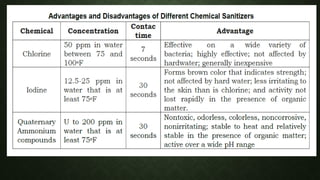
CHLORINE IS _________________.
A. 5 SECONDS C. 20 SECONDS
B. 7 SECONDS D. 30 SECONDS
2. AN ADVANTAGE OF THIS
CHEMICAL IS NON-TOXIC, ODORLESS
, COLORLESS, NON-CORROSIVE AND
NON-IRRITATING.
A. CHEMICALS C. DETERGENT
B. CHLORINE D. QUARTERNARY AMMONIUM
3. 12.5-22 PPM IN WATER THAT IS AT
LEAST 75F IS A CONCENTRATION USED
IN __________.
A. CHEMICALS C. IODINE
B. CHLORINE D. QUARTERNARY AMMONIUM
4. The advantage/advantages of using
iodine as chemical sanitizers is ____________.
A. highly effective
B non-toxic, odorless and colorless
C. generally inexpensive
D. forms brown color that indicates
strength
5. HOW MANY SECONDS
ARE ALLOWED IN
QUATERNARY AMMONIUM
AS CHEMICAL SANITIZER?
A. 7 SECONDS
C. 30 SECONDS
B. 20 SECONDS
D. 10 SECONDS
MAINTAINING APPROPRIATE
KITCHEN TOOLS, EQUIPMENT AND
PARAPHERNALIA
• Aluminum, stainless steel, glass, cast iron,
ceramic, plastic and hard rubber are examples of
MATERIALS. Baster, colanders, cutting boards
and dredgers are some KITCHEN/COOKING
UTENSILS that every kitchen need, while the
refrigerators, auxiliary equipment like steamer,
microwave ovens and blenders are the
EQUIPMENTS needed in the kitchen.
• The things mentioned above will last longer if you
know how to clean and sanitize it. Try to look at
your kitchen particularly in the dish washing area,
what are the things you see? Write your answer on
a separate sheet. Give at least three.
• 1.
• 2.
• 3.
•If your answer is like bleach,
sponge, detergent,
dishwashing liquid. Great job!
HAPPY BAKING
BY: VIVIAN P. MORA
Questions:
1. What did the character use for
cleaning the tools?
2. What did she do next after cleaning?
3. What is the importance of sanitizing
the equipment before using?
Cleaning and sanitizing procedures
must be part of the standard operating
procedures that make up your food
safety program. Improperly cleaned
and sanitized surfaces allow harmful
microorganisms to be transferred from
one food to other foods.
CLEANING
is the process of removing
food and other types of soil
from a surface, such as a dish,
glass, or cutting board.
Cleaning is done with a cleaning
agent that removes food, soil, or
other substances. The right
cleaning agent must be selected
because not all cleaning agents can
be used on food-contact surfaces.
(A FOOD-CONTACT SURFACE IS THE
SURFACE OF EQUIPMENT OR UTENSIL
THAT FOOD NORMALLY COMES INTO
CONTACT.) FOR EXAMPLE, GLASS
CLEANERS, SOME METAL CLEANERS,
AND MOST BATHROOM CLEANERS
CANNOT BE USED BECAUSE THEY
MIGHT LEAVE AN UNSAFE RESIDUE ON
THE FOOD CONTACT SURFACE.
The label should indicate if the
product can be used on a food-
contact surface. The right
cleaning agent must also be
selected to make cleaning easy.
FOUR CATEGORIES OF CLEANING
AGENTS
1. Detergents – used to routinely wash
tableware, surfaces, and equipment.
Detergents can penetrate soil quickly and
soften it. Examples include dishwashing
detergent and automatic dishwasher
detergents.
2. SOLVENT CLEANERS - USED
PERIODICALLY ON SURFACES
WHERE GREASE
HAS BURNED ON.
SOLVENT CLEANERS ARE
OFTEN CALLED DEGREASERS.
3. Acid cleaners - used periodically
on mineral deposits and other
soils that detergents cannot remove.
These cleaners are often used
to remove scale in ware washing
machines and steam tables.
4. Abrasive cleaners – use to remove heavy
accumulations of soil that are difficult to remove
with detergents. Some abrasive cleaners also
disinfect.
Clean food-contact surfaces that are used to
prepare potentially hazardous foods as needed
throughout the day but no less than every four
hours. If they are not properly cleaned, food that
comes into contact with these surfaces could
become contaminated.
Sanitizing is done using heat, radiation, or chemicals.
Heat and chemicals are commonly used as a method
for sanitizing in a restaurant; radiation rarely is.
The item to be sanitized must first be washed
properly before it can be properly sanitized.
Some chemical sanitizers, such as chlorine and
iodine, react with food and soil and so will be less
effective on a surface that has not been properly
cleaned.
SANITIZING METHODS
1. Heat – there are three methods of using heat to sanitize
surfaces- steam, hot water, and hot air.
Hot water is the most common method used in restaurants.
If hot water is used in the third compartment of a three-
compartment sink, it must be at least 171oF (77oC). If a
high-temperature ware washing machine is used to sanitize
cleaned dishes, the final sanitizing rinse must be at least
180 oF (82oC). For stationary rack, single temperature
machines, it must be at least 165oF (74oC). Cleaned items
must be exposed to these temperatures for at least 30
seconds.
2. CHEMICALS – CHEMICALS
THAT ARE APPROVED
SANITIZERS ARE CHLORINE,
IODINE, AND QUATERNARY
AMMONIUM.
THE THREE FACTORS THAT
MUST BE CONSIDERED ARE:
Concentration – the presence of too little
sanitizer will result in an inadequate
reduction of harmful microorganisms. Too
much can be toxic.
Temperature – generally
chemical sanitizers work best
in water that is
between 55oF (13oC) and
120oF (49oC).
Contact time – in order for the sanitizer
to kill harmful microorganisms, the
cleaned item must be in contact with the
sanitizer (either heat or approved
chemical) for the recommended
length of time.
SANITIZER TESTING
To accurately test the strength of a sanitizing
solution, one must first determine which
chemical is being used—chlorine, iodine, or
quaternary ammonium. Test kits are not
interchangeable so check with your chemical
supplier to be certain that you are using the
correct kit. The appropriate test kit must then
be used throughout the day to measure chemical
sanitizer concentrations.
THERE ARE THE THREE
STEPS NEEDED TO
EFFECTIVELY CLEAN AND
SANITIZE UTENSILS:
• WASHING
• SANITIZING
• DRYING
CLEANING KITCHEN
PREMISES
Things you will need:
• broom
• cleaning rags
• bucket
1. COLLECT LOOSE DUST BY
SWEEPING THE KITCHEN
FLOOR DAILY WITH A BROOM
OR STATIC SWEEPER AND
WIPING DOWN COUNTER TOPS,
TABLES AND OTHER
SURFACES WITH A CLEANING
RAG.
2. MIX 1GALLON WARM WATER
IN A BUCKET WITH ½ CUP
WHITE VINEGAR AND 1 TSP.
DISH SOAP. DIP YOUR MOP
INTO THE BUCKET, WRING THE
MOP OUT AND WIPE ACROSS
YOUR KITCHEN FLOORS.
3. MAKE AN ALL-PURPOSE
CLEANER IN A SPRAY
BOTTLE. COMBINE 3
CUPS WARM WATER WITH
½ CUP WHITE VINEGAR
AND 1 TSP. DISH SOAP
4. SPRAY THIS
SOLUTION ONTO
KITCHEN SURFACES
AND WIPE OFF WITH A
DAMP CLEANING RAG.
5. FILL A FEW BOWLS WITH
ABOUT ½ CUP EACH OF
BAKING SODA. PLACE
THESE AROUND YOUR
KITCHEN TO ABSORB ODOR
AND KEEP THE KITCHEN
SMELLING FRESH.
1. Heat and chemicals are commonly used as a
method for ____ in a restaurant.
2. In order to clean and sanitize utensils, there
are three steps needed and these are washing,
sanitizing, and _________.
3.Cutting boards, bowls and knives are the
utensils need to be wash in a warm soapy_______.
4.The step in cleaning and sanitizing that
considered as the best is____________.
5. In the absence of hot water ___________ can be
used.
6. A way of removing food and other type of
soil from a surface is called ___________.
7. From the three - compartment sink, the
temperature of the hot water must be at
least_____________.
8. Quaternary ammonium, iodine, and
chlorine are the approved____________
9. Too much use of sanitizer can be_______
10. Chemical sanitizers will work best in water
with a temperature of___________.
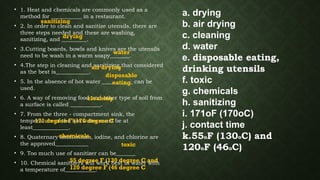
• 1. Heat and chemicals are commonly used as a
method for ___________ in a restaurant.
• 2. In order to clean and sanitize utensils, there are
three steps needed and these are washing,
sanitizing, and _________.
• 3.Cutting boards, bowls and knives are the utensils
need to be wash in a warm soapy_______.
• 4.The step in cleaning and sanitizing that considered
as the best is____________.
• 5. In the absence of hot water ___________ can be
used.
• 6. A way of removing food and other type of soil from
a surface is called ___________.
• 7. From the three - compartment sink, the
temperature of the hot water must be at
least_____________.
• 8. Quaternary ammonium, iodine, and chlorine are
the approved____________
• 9. Too much use of sanitizer can be_______
• 10. Chemical sanitizers will work best in water with
a temperature of___________.
a. drying
b. air drying
c. cleaning
d. water
e. disposable eating,
drinking utensils
f. toxic
g. chemicals
h. sanitizing
i. 171oF (170oC)
j. contact time
k.55oF (130oC) and
120oF (46oC)
sanitizing
drying
water
air drying
disposable
eating
cleaning
171 degree F (170 degree C
chemicals.
toxic
55 degree F (130 degree C and
120 degree F (46 degree C

TECHNOLOGY AND LIVELIHOOD EDUCATIONLESSON 2.pptx

  • 1.
    1. A CONTACTTIME IN USING CHLORINE IS _________________. A. 5 SECONDS C. 20 SECONDS B. 7 SECONDS D. 30 SECONDS
  • 2.
    2. AN ADVANTAGEOF THIS CHEMICAL IS NON-TOXIC, ODORLESS , COLORLESS, NON-CORROSIVE AND NON-IRRITATING. A. CHEMICALS C. DETERGENT B. CHLORINE D. QUARTERNARY AMMONIUM
  • 3.
    3. 12.5-22 PPMIN WATER THAT IS AT LEAST 75F IS A CONCENTRATION USED IN __________. A. CHEMICALS C. IODINE B. CHLORINE D. QUARTERNARY AMMONIUM
  • 4.
    4. The advantage/advantagesof using iodine as chemical sanitizers is ____________. A. highly effective B non-toxic, odorless and colorless C. generally inexpensive D. forms brown color that indicates strength
  • 5.
    5. HOW MANYSECONDS ARE ALLOWED IN QUATERNARY AMMONIUM AS CHEMICAL SANITIZER? A. 7 SECONDS C. 30 SECONDS B. 20 SECONDS D. 10 SECONDS
  • 6.
    MAINTAINING APPROPRIATE KITCHEN TOOLS,EQUIPMENT AND PARAPHERNALIA
  • 7.
    • Aluminum, stainlesssteel, glass, cast iron, ceramic, plastic and hard rubber are examples of MATERIALS. Baster, colanders, cutting boards and dredgers are some KITCHEN/COOKING UTENSILS that every kitchen need, while the refrigerators, auxiliary equipment like steamer, microwave ovens and blenders are the EQUIPMENTS needed in the kitchen.
  • 8.
    • The thingsmentioned above will last longer if you know how to clean and sanitize it. Try to look at your kitchen particularly in the dish washing area, what are the things you see? Write your answer on a separate sheet. Give at least three. • 1. • 2. • 3.
  • 9.
    •If your answeris like bleach, sponge, detergent, dishwashing liquid. Great job!
  • 10.
  • 11.
    Questions: 1. What didthe character use for cleaning the tools? 2. What did she do next after cleaning? 3. What is the importance of sanitizing the equipment before using?
  • 12.
    Cleaning and sanitizingprocedures must be part of the standard operating procedures that make up your food safety program. Improperly cleaned and sanitized surfaces allow harmful microorganisms to be transferred from one food to other foods.
  • 13.
    CLEANING is the processof removing food and other types of soil from a surface, such as a dish, glass, or cutting board.
  • 14.
    Cleaning is donewith a cleaning agent that removes food, soil, or other substances. The right cleaning agent must be selected because not all cleaning agents can be used on food-contact surfaces.
  • 15.
    (A FOOD-CONTACT SURFACEIS THE SURFACE OF EQUIPMENT OR UTENSIL THAT FOOD NORMALLY COMES INTO CONTACT.) FOR EXAMPLE, GLASS CLEANERS, SOME METAL CLEANERS, AND MOST BATHROOM CLEANERS CANNOT BE USED BECAUSE THEY MIGHT LEAVE AN UNSAFE RESIDUE ON THE FOOD CONTACT SURFACE.
  • 16.
    The label shouldindicate if the product can be used on a food- contact surface. The right cleaning agent must also be selected to make cleaning easy.
  • 17.
    FOUR CATEGORIES OFCLEANING AGENTS 1. Detergents – used to routinely wash tableware, surfaces, and equipment. Detergents can penetrate soil quickly and soften it. Examples include dishwashing detergent and automatic dishwasher detergents.
  • 18.
    2. SOLVENT CLEANERS- USED PERIODICALLY ON SURFACES WHERE GREASE HAS BURNED ON. SOLVENT CLEANERS ARE OFTEN CALLED DEGREASERS.
  • 19.
    3. Acid cleaners- used periodically on mineral deposits and other soils that detergents cannot remove. These cleaners are often used to remove scale in ware washing machines and steam tables.
  • 20.
    4. Abrasive cleaners– use to remove heavy accumulations of soil that are difficult to remove with detergents. Some abrasive cleaners also disinfect. Clean food-contact surfaces that are used to prepare potentially hazardous foods as needed throughout the day but no less than every four hours. If they are not properly cleaned, food that comes into contact with these surfaces could become contaminated.
  • 21.
    Sanitizing is doneusing heat, radiation, or chemicals. Heat and chemicals are commonly used as a method for sanitizing in a restaurant; radiation rarely is. The item to be sanitized must first be washed properly before it can be properly sanitized. Some chemical sanitizers, such as chlorine and iodine, react with food and soil and so will be less effective on a surface that has not been properly cleaned.
  • 22.
    SANITIZING METHODS 1. Heat– there are three methods of using heat to sanitize surfaces- steam, hot water, and hot air. Hot water is the most common method used in restaurants. If hot water is used in the third compartment of a three- compartment sink, it must be at least 171oF (77oC). If a high-temperature ware washing machine is used to sanitize cleaned dishes, the final sanitizing rinse must be at least 180 oF (82oC). For stationary rack, single temperature machines, it must be at least 165oF (74oC). Cleaned items must be exposed to these temperatures for at least 30 seconds.
  • 23.
    2. CHEMICALS –CHEMICALS THAT ARE APPROVED SANITIZERS ARE CHLORINE, IODINE, AND QUATERNARY AMMONIUM.
  • 24.
    THE THREE FACTORSTHAT MUST BE CONSIDERED ARE: Concentration – the presence of too little sanitizer will result in an inadequate reduction of harmful microorganisms. Too much can be toxic.
  • 25.
    Temperature – generally chemicalsanitizers work best in water that is between 55oF (13oC) and 120oF (49oC).
  • 26.
    Contact time –in order for the sanitizer to kill harmful microorganisms, the cleaned item must be in contact with the sanitizer (either heat or approved chemical) for the recommended length of time.
  • 27.
    SANITIZER TESTING To accuratelytest the strength of a sanitizing solution, one must first determine which chemical is being used—chlorine, iodine, or quaternary ammonium. Test kits are not interchangeable so check with your chemical supplier to be certain that you are using the correct kit. The appropriate test kit must then be used throughout the day to measure chemical sanitizer concentrations.
  • 29.
    THERE ARE THETHREE STEPS NEEDED TO EFFECTIVELY CLEAN AND SANITIZE UTENSILS: • WASHING • SANITIZING • DRYING
  • 30.
  • 31.
    Things you willneed: • broom • cleaning rags • bucket
  • 32.
    1. COLLECT LOOSEDUST BY SWEEPING THE KITCHEN FLOOR DAILY WITH A BROOM OR STATIC SWEEPER AND WIPING DOWN COUNTER TOPS, TABLES AND OTHER SURFACES WITH A CLEANING RAG.
  • 33.
    2. MIX 1GALLONWARM WATER IN A BUCKET WITH ½ CUP WHITE VINEGAR AND 1 TSP. DISH SOAP. DIP YOUR MOP INTO THE BUCKET, WRING THE MOP OUT AND WIPE ACROSS YOUR KITCHEN FLOORS.
  • 34.
    3. MAKE ANALL-PURPOSE CLEANER IN A SPRAY BOTTLE. COMBINE 3 CUPS WARM WATER WITH ½ CUP WHITE VINEGAR AND 1 TSP. DISH SOAP
  • 35.
    4. SPRAY THIS SOLUTIONONTO KITCHEN SURFACES AND WIPE OFF WITH A DAMP CLEANING RAG.
  • 36.
    5. FILL AFEW BOWLS WITH ABOUT ½ CUP EACH OF BAKING SODA. PLACE THESE AROUND YOUR KITCHEN TO ABSORB ODOR AND KEEP THE KITCHEN SMELLING FRESH.
  • 37.
    1. Heat andchemicals are commonly used as a method for ____ in a restaurant. 2. In order to clean and sanitize utensils, there are three steps needed and these are washing, sanitizing, and _________. 3.Cutting boards, bowls and knives are the utensils need to be wash in a warm soapy_______. 4.The step in cleaning and sanitizing that considered as the best is____________. 5. In the absence of hot water ___________ can be used.
  • 38.
    6. A wayof removing food and other type of soil from a surface is called ___________. 7. From the three - compartment sink, the temperature of the hot water must be at least_____________. 8. Quaternary ammonium, iodine, and chlorine are the approved____________ 9. Too much use of sanitizer can be_______ 10. Chemical sanitizers will work best in water with a temperature of___________.
  • 39.
    • 1. Heatand chemicals are commonly used as a method for ___________ in a restaurant. • 2. In order to clean and sanitize utensils, there are three steps needed and these are washing, sanitizing, and _________. • 3.Cutting boards, bowls and knives are the utensils need to be wash in a warm soapy_______. • 4.The step in cleaning and sanitizing that considered as the best is____________. • 5. In the absence of hot water ___________ can be used. • 6. A way of removing food and other type of soil from a surface is called ___________. • 7. From the three - compartment sink, the temperature of the hot water must be at least_____________. • 8. Quaternary ammonium, iodine, and chlorine are the approved____________ • 9. Too much use of sanitizer can be_______ • 10. Chemical sanitizers will work best in water with a temperature of___________. a. drying b. air drying c. cleaning d. water e. disposable eating, drinking utensils f. toxic g. chemicals h. sanitizing i. 171oF (170oC) j. contact time k.55oF (130oC) and 120oF (46oC) sanitizing drying water air drying disposable eating cleaning 171 degree F (170 degree C chemicals. toxic 55 degree F (130 degree C and 120 degree F (46 degree C