CLEANING
AND
SANITIZING
- the process of removing food and
other types of soil from a surface
Cleaning
1. Detergents
-use detergents to routinely wash
tableware, surfaces, and equipment.
-can penetrate soil quickly and soften
it.
Cleaning agents are divided
into four categories:
2. Solvent cleaners – Use
periodically on surfaces where
grease has burned on. Solvent
cleaners are often called
degreasers.
Cleaning agents are divided
into four categories:
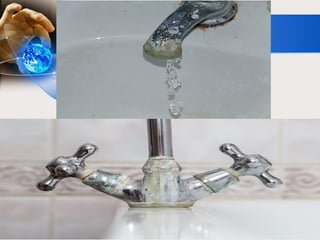
3. Acid cleaners -- Use periodically
on mineral deposits and other soils
that detergents cannot remove. These
cleaners are often used to remove
scale in ware washing machines and
steam tables.
Cleaning agents are divided
into four categories:
4. Abrasive cleaners -- Use these
cleaners to remove heavy accumulations of
soil that are difficult to remove with
detergents. Some abrasive cleaners also
disinfect.
Cleaning agents are divided
into four categories:
-done using heat, radiation, or
chemicals. Heat and chemicals are
commonly used as a method for
sanitizing in a restaurant; radiation
rarely is.
Sanitizing
1. Heat. There are three methods of
using heat to sanitize surfaces –
steam, hot water, and hot air. Hot
water is the most common method
used in restaurants
Sanitizing Methods
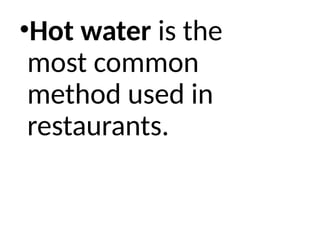
•Hot water is the
most common
method used in
restaurants.
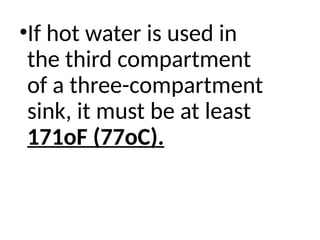
•If hot water is used in
the third compartment
of a three-compartment
sink, it must be at least
171oF (77oC).
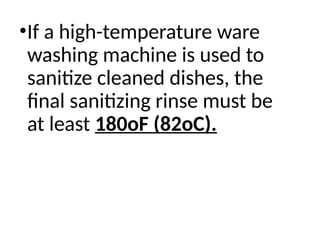
•If a high-temperature ware
washing machine is used to
sanitize cleaned dishes, the
final sanitizing rinse must be
at least 180oF (82oC).
•For stationary rack,
single temperature
machines, it must be
at least 165oF (74oC).
2. Chemicals. Chemicals that are
approved sanitizers are chlorine,
iodine, and quaternary ammonium.
Different factors influence the
effectiveness of chemical sanitizers.
Sanitizing Methods
 Concentration -- The presence of
too little sanitizer will result in an
inadequate reduction of harmful
microorganisms. Too much can be
toxic.
The three factors that must be
considered are:
Temperature -- Generally
chemical sanitizers work best in
water that is between 55˚F(13˚C)
and 120˚F (49˚C).
The three factors that must be
considered are:
 Contact time -- In order for the
sanitizer to kill harmful
microorganisms, the item must be
in contact with the sanitizer (either
heat or approved chemical) for the
recommended length of time.
The three factors that must be
considered are:
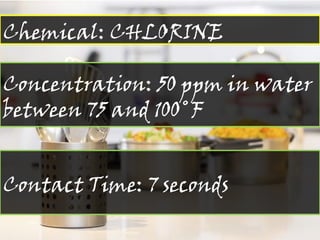
Chemical: CHLORINE
Concentration: 50 ppm in water
between 75 and 100˚F
Contact Time: 7 seconds
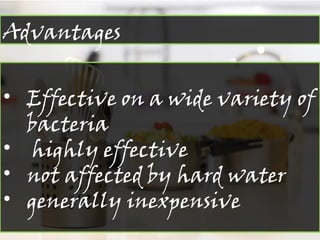
Advantages
• Effective on a wide variety of
bacteria
• highly effective
• not affected by hard water
• generally inexpensive
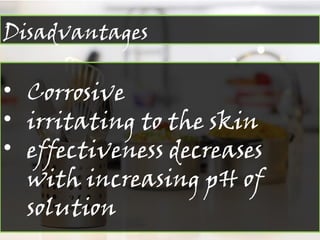
Disadvantages
• Corrosive
• irritating to the skin
• effectiveness decreases
with increasing pH of
solution
Disadvantages
• deteriorates during storage
and when exposed to light
• dissipates rapidly
• loses activity in the presence
of organic matter
Chemical: IODINE
Concentration: 12.5-25 ppm in
water that is at least 75˚F
Contact Time: 30 seconds
Advantages
• Forms brown color that
indicates strength
• not affected by hard water
• less irritating to the skin
than is chlorine
Advantages
• activity not lost rapidly
in the presence of organic
matter.
Disadvantages
• Effectiveness decreases
greatly with an increase in
pH (most active at pH 3.0
very low acting at pH 7.0);
Disadvantages
• should not be used in water
that is at 120˚F or hotter
• and might discolor equipment
and surfaces
Chemical: QUATERNARY AMMONIUM
COMPOUND
Concentration: Up to 200 ppm
in water that is at least 75˚F
Contact Time: 30 seconds
Advantages
• Nontoxic
• Odorless
• Colorless
• Noncorrosive
• Nonirritating
Advantages
• stable to heat and
relatively stable in the
presence of organic matter
• active over a wide pH
range
Disadvantages
• Slow destruction of some
microorganisms
• not compatible with some
detergents and hard water
How to Clean and Store Cooking Tools and
Equipment
1.After measuring and mixing ingredients,
soak all used mixing bowls, spatulas,
measuring spoons and cups and mixer
accessories in a tub of warm water (add a
small amount of dishwasher detergent to
help start the cleaning).
2. Use a damp washcloth to wipe off
all cake mix splatter from the mixer.
Wipe off any stray spatter from the
countertops and nearby areas. If
necessary, wipe off with a dry
dishcloth.
3. Return electric mixers and other
electronic equipment to their
designated storage spaces.
4. After cooking, soak used pans or
tools in warm water with dishwashing
solution to soften the baked-on or
burnt food.
5. Wash all used utensils or tools by
either hand washing or loading in a
dishwasher.
6. Dry all cooking tools and
equipment by air-drying on a drying
rack or wiping with a dry dishcloth.
Make sure all wooden spoons and
accessories are dry before storing.
7. Store all tools and equipment in
their designated places. Put
frequently used items in conveniently
accessible locations. Gather and
secure electrical cords to prevent
entanglement or snagging.
8.Proper storage and handling of cleaned and
sanitized equipment and utensils is very important
to prevent recontamination prior to use.
Cleaned and sanitized equipment and utensils must
be:
• stored on clean surfaces; and
• handled to minimize contamination of food
contact surface.
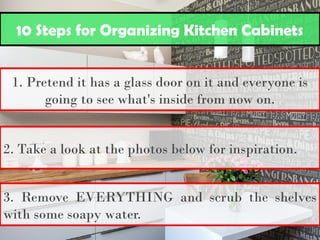
10 Steps for Organizing Kitchen Cabinets
1. Pretend it has a glass door on it and everyone is
going to see what's inside from now on.
2. Take a look at the photos below for inspiration.
3. Remove EVERYTHING and scrub the shelves
with some soapy water.
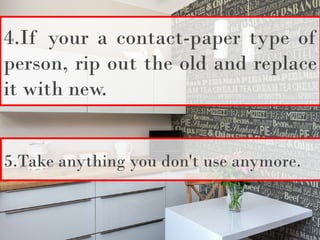
4.If your a contact-paper type of
person, rip out the old and replace
it with new.
5.Take anything you don't use anymore.
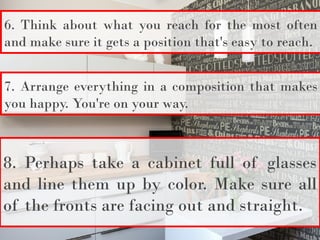
6. Think about what you reach for the most often
and make sure it gets a position that's easy to reach.
7. Arrange everything in a composition that makes
you happy. You're on your way.
8. Perhaps take a cabinet full of glasses
and line them up by color. Make sure all
of the fronts are facing out and straight.
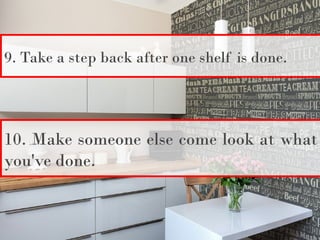
9. Take a step back after one shelf is done.
10. Make someone else come look at what
you've done.
cleaning AND SANITIZING POWERPOINT,.pptx

cleaning AND SANITIZING POWERPOINT,.pptx

  • 1.
  • 2.
    - the processof removing food and other types of soil from a surface Cleaning
  • 3.
    1. Detergents -use detergentsto routinely wash tableware, surfaces, and equipment. -can penetrate soil quickly and soften it. Cleaning agents are divided into four categories:
  • 4.
    2. Solvent cleaners– Use periodically on surfaces where grease has burned on. Solvent cleaners are often called degreasers. Cleaning agents are divided into four categories:
  • 5.
    3. Acid cleaners-- Use periodically on mineral deposits and other soils that detergents cannot remove. These cleaners are often used to remove scale in ware washing machines and steam tables. Cleaning agents are divided into four categories:
  • 7.
    4. Abrasive cleaners-- Use these cleaners to remove heavy accumulations of soil that are difficult to remove with detergents. Some abrasive cleaners also disinfect. Cleaning agents are divided into four categories:
  • 8.
    -done using heat,radiation, or chemicals. Heat and chemicals are commonly used as a method for sanitizing in a restaurant; radiation rarely is. Sanitizing
  • 9.
    1. Heat. Thereare three methods of using heat to sanitize surfaces – steam, hot water, and hot air. Hot water is the most common method used in restaurants Sanitizing Methods
  • 10.
    •Hot water isthe most common method used in restaurants.
  • 11.
    •If hot wateris used in the third compartment of a three-compartment sink, it must be at least 171oF (77oC).
  • 12.
    •If a high-temperatureware washing machine is used to sanitize cleaned dishes, the final sanitizing rinse must be at least 180oF (82oC).
  • 13.
    •For stationary rack, singletemperature machines, it must be at least 165oF (74oC).
  • 14.
    2. Chemicals. Chemicalsthat are approved sanitizers are chlorine, iodine, and quaternary ammonium. Different factors influence the effectiveness of chemical sanitizers. Sanitizing Methods
  • 15.
     Concentration --The presence of too little sanitizer will result in an inadequate reduction of harmful microorganisms. Too much can be toxic. The three factors that must be considered are:
  • 16.
    Temperature -- Generally chemicalsanitizers work best in water that is between 55˚F(13˚C) and 120˚F (49˚C). The three factors that must be considered are:
  • 17.
     Contact time-- In order for the sanitizer to kill harmful microorganisms, the item must be in contact with the sanitizer (either heat or approved chemical) for the recommended length of time. The three factors that must be considered are:
  • 18.
    Chemical: CHLORINE Concentration: 50ppm in water between 75 and 100˚F Contact Time: 7 seconds
  • 19.
    Advantages • Effective ona wide variety of bacteria • highly effective • not affected by hard water • generally inexpensive
  • 20.
    Disadvantages • Corrosive • irritatingto the skin • effectiveness decreases with increasing pH of solution
  • 21.
    Disadvantages • deteriorates duringstorage and when exposed to light • dissipates rapidly • loses activity in the presence of organic matter
  • 22.
    Chemical: IODINE Concentration: 12.5-25ppm in water that is at least 75˚F Contact Time: 30 seconds
  • 23.
    Advantages • Forms browncolor that indicates strength • not affected by hard water • less irritating to the skin than is chlorine
  • 24.
    Advantages • activity notlost rapidly in the presence of organic matter.
  • 25.
    Disadvantages • Effectiveness decreases greatlywith an increase in pH (most active at pH 3.0 very low acting at pH 7.0);
  • 26.
    Disadvantages • should notbe used in water that is at 120˚F or hotter • and might discolor equipment and surfaces
  • 27.
    Chemical: QUATERNARY AMMONIUM COMPOUND Concentration:Up to 200 ppm in water that is at least 75˚F Contact Time: 30 seconds
  • 28.
    Advantages • Nontoxic • Odorless •Colorless • Noncorrosive • Nonirritating
  • 29.
    Advantages • stable toheat and relatively stable in the presence of organic matter • active over a wide pH range
  • 30.
    Disadvantages • Slow destructionof some microorganisms • not compatible with some detergents and hard water
  • 31.
    How to Cleanand Store Cooking Tools and Equipment 1.After measuring and mixing ingredients, soak all used mixing bowls, spatulas, measuring spoons and cups and mixer accessories in a tub of warm water (add a small amount of dishwasher detergent to help start the cleaning).
  • 32.
    2. Use adamp washcloth to wipe off all cake mix splatter from the mixer. Wipe off any stray spatter from the countertops and nearby areas. If necessary, wipe off with a dry dishcloth.
  • 33.
    3. Return electricmixers and other electronic equipment to their designated storage spaces. 4. After cooking, soak used pans or tools in warm water with dishwashing solution to soften the baked-on or burnt food.
  • 34.
    5. Wash allused utensils or tools by either hand washing or loading in a dishwasher.
  • 35.
    6. Dry allcooking tools and equipment by air-drying on a drying rack or wiping with a dry dishcloth. Make sure all wooden spoons and accessories are dry before storing.
  • 36.
    7. Store alltools and equipment in their designated places. Put frequently used items in conveniently accessible locations. Gather and secure electrical cords to prevent entanglement or snagging.
  • 37.
    8.Proper storage andhandling of cleaned and sanitized equipment and utensils is very important to prevent recontamination prior to use. Cleaned and sanitized equipment and utensils must be: • stored on clean surfaces; and • handled to minimize contamination of food contact surface.
  • 38.
    10 Steps forOrganizing Kitchen Cabinets 1. Pretend it has a glass door on it and everyone is going to see what's inside from now on. 2. Take a look at the photos below for inspiration. 3. Remove EVERYTHING and scrub the shelves with some soapy water.
  • 39.
    4.If your acontact-paper type of person, rip out the old and replace it with new. 5.Take anything you don't use anymore.
  • 40.
    6. Think aboutwhat you reach for the most often and make sure it gets a position that's easy to reach. 7. Arrange everything in a composition that makes you happy. You're on your way. 8. Perhaps take a cabinet full of glasses and line them up by color. Make sure all of the fronts are facing out and straight.
  • 41.
    9. Take astep back after one shelf is done. 10. Make someone else come look at what you've done.

Editor's Notes

  • #2 such as a dish, glass, or cutting board
  • #3 Examples include dishwashing detergent and automatic dishwasher detergents.
  • #4 Examples include dishwashing detergent and automatic dishwasher detergents. Examples: Chlorine, Zonrox
  • #5 lime·scale-a whitish deposit on the inside of pipes, pots, and kettles, caused by minerals leeched from the water. Examples : items with citrus extract
  • #6 lime·scale-a whitish deposit on the inside of pipes, pots, and kettles, caused by minerals leeched from the water.
  • #7 Clean food-contact surfaces that are used to prepare potentially hazardous foods as needed throughout the day but no less than every four hours. If they are not properly cleaned, food that comes into contact with these surfaces could become contaminated.
  • #18 Parts per million- used to measure the concentration of contaminant
  • #20 Corrosive- can destroy any metal PH- potential of hydrogen
  • #23 Acidic solution have a lower pH
  • #32 Splatter-large drops Spatter-drops at any surface
  • #36 Wire na nasabit sa sharp object-snag Twisted- entangled intanglement