ED 401.01
CLASSROOM MANAGEMENT
IN PERSPECTIVES
Contents:
 Who are we?
 Matrix diagram
 The problem
 Why did we choose it?
 Literature review
 Analysis of the Literature review
 Fishbone Diagram
 Survey
 Recommendations
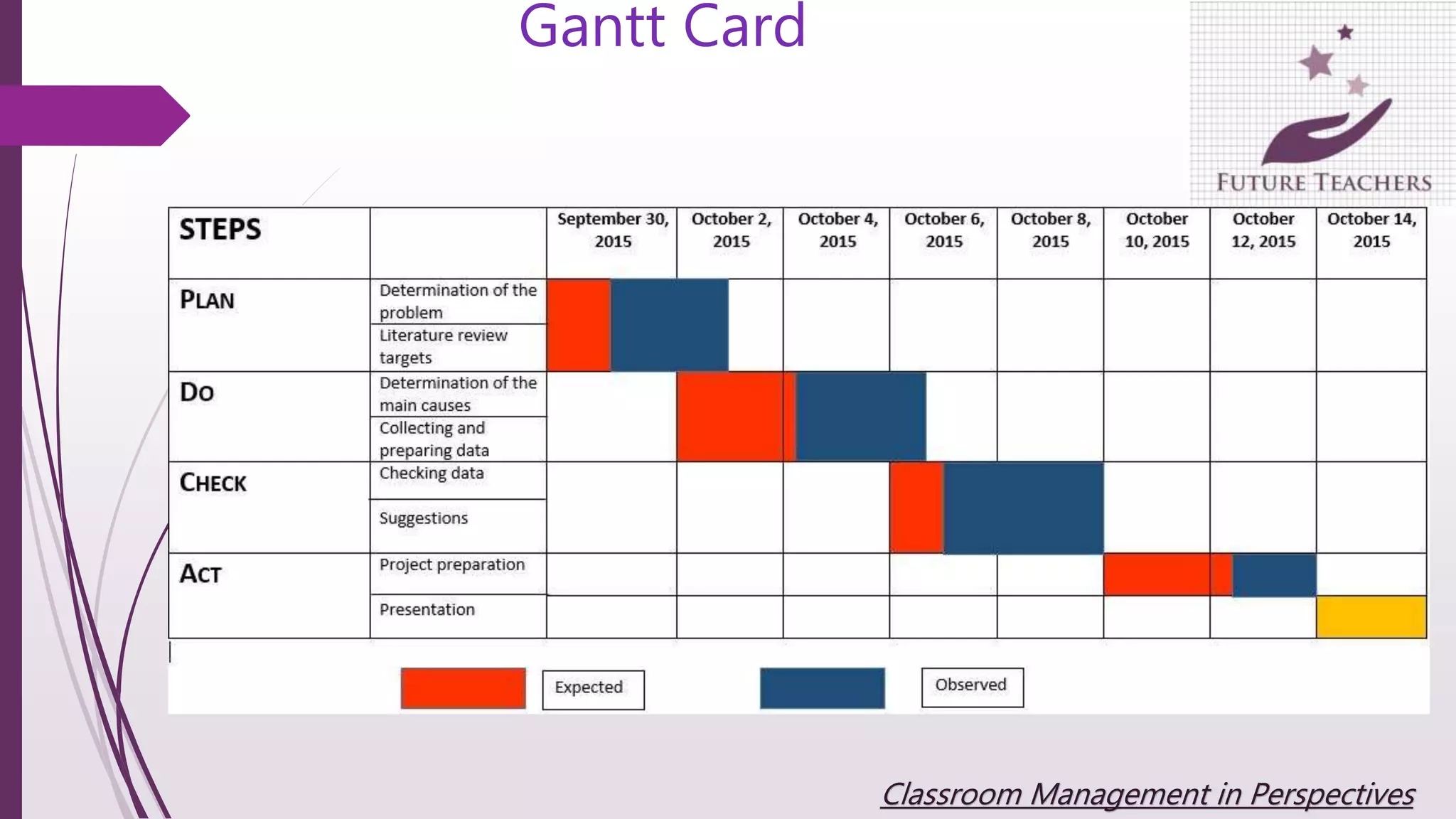
 Gantt Card
 References
Classroom Management in Perspectives
Future Teachers
Classroom Management in Perspectives
Project Managers
Specialists
Analysts
Ceren Kalender Deniz Koyuncu
Tahir Demircan Simten Koyuncu
Seçil Ayna Gizem Erdoğan
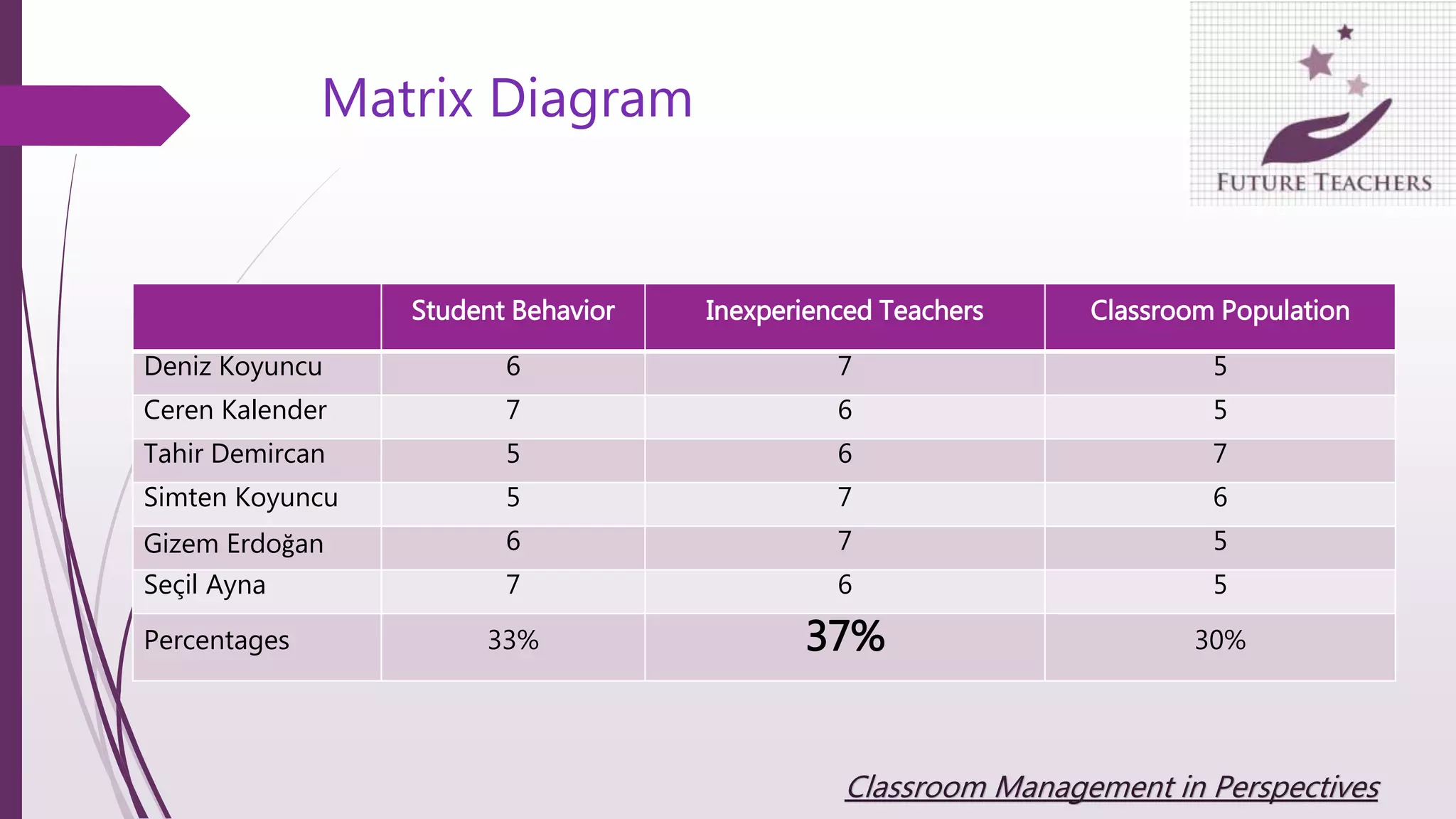
Matrix Diagram
Student Behavior Inexperienced Teachers Classroom Population
Deniz Koyuncu 6 7 5
Ceren Kalender 7 6 5
Tahir Demircan 5 6 7
Simten Koyuncu 5 7 6
Gizem Erdoğan 6 7 5
Seçil Ayna 7 6 5
Percentages 33% 37% 30%
Classroom Management in Perspectives
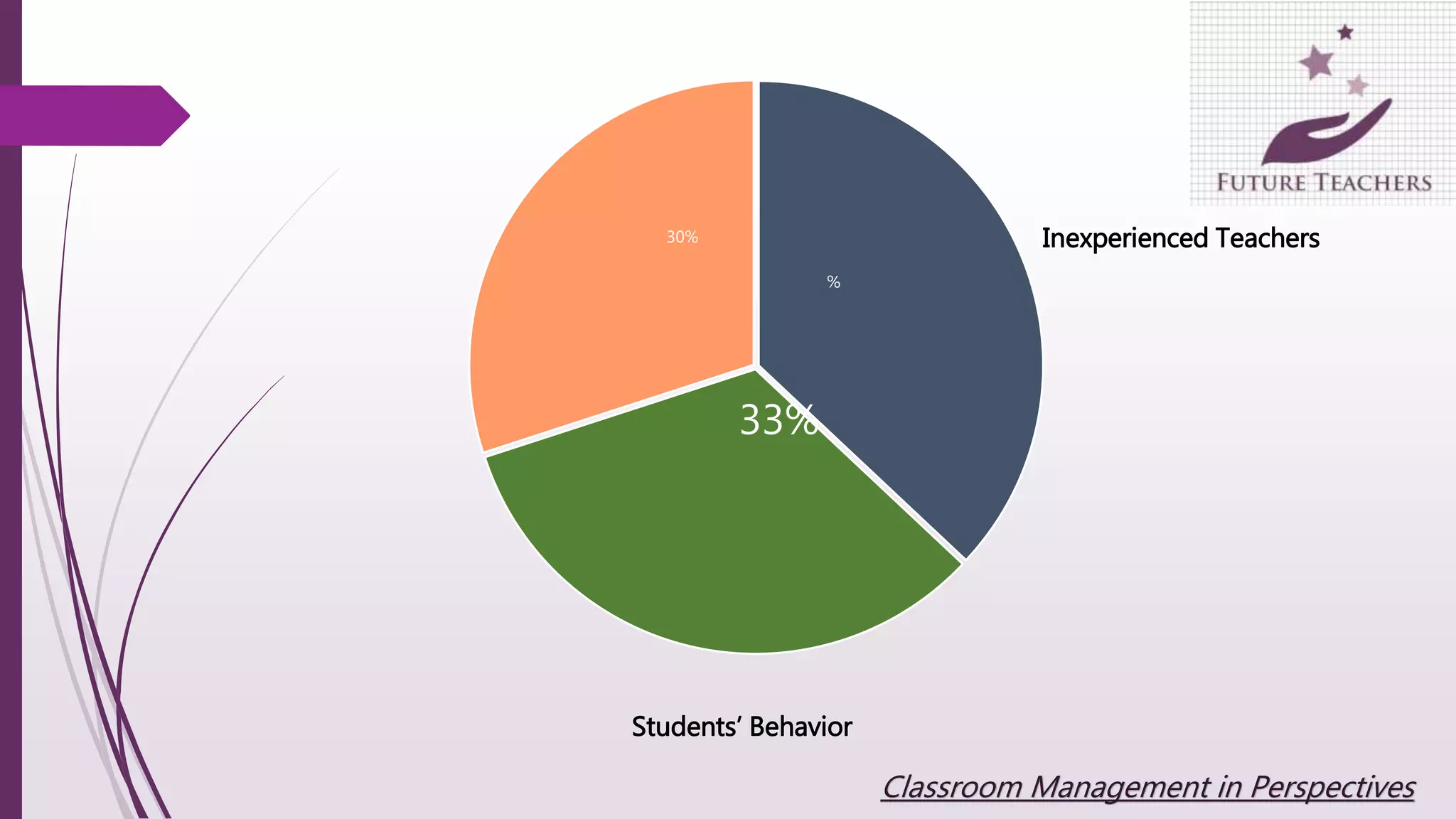
%
33%
30%
Students’ Behavior
Inexperienced Teachers
The Problem
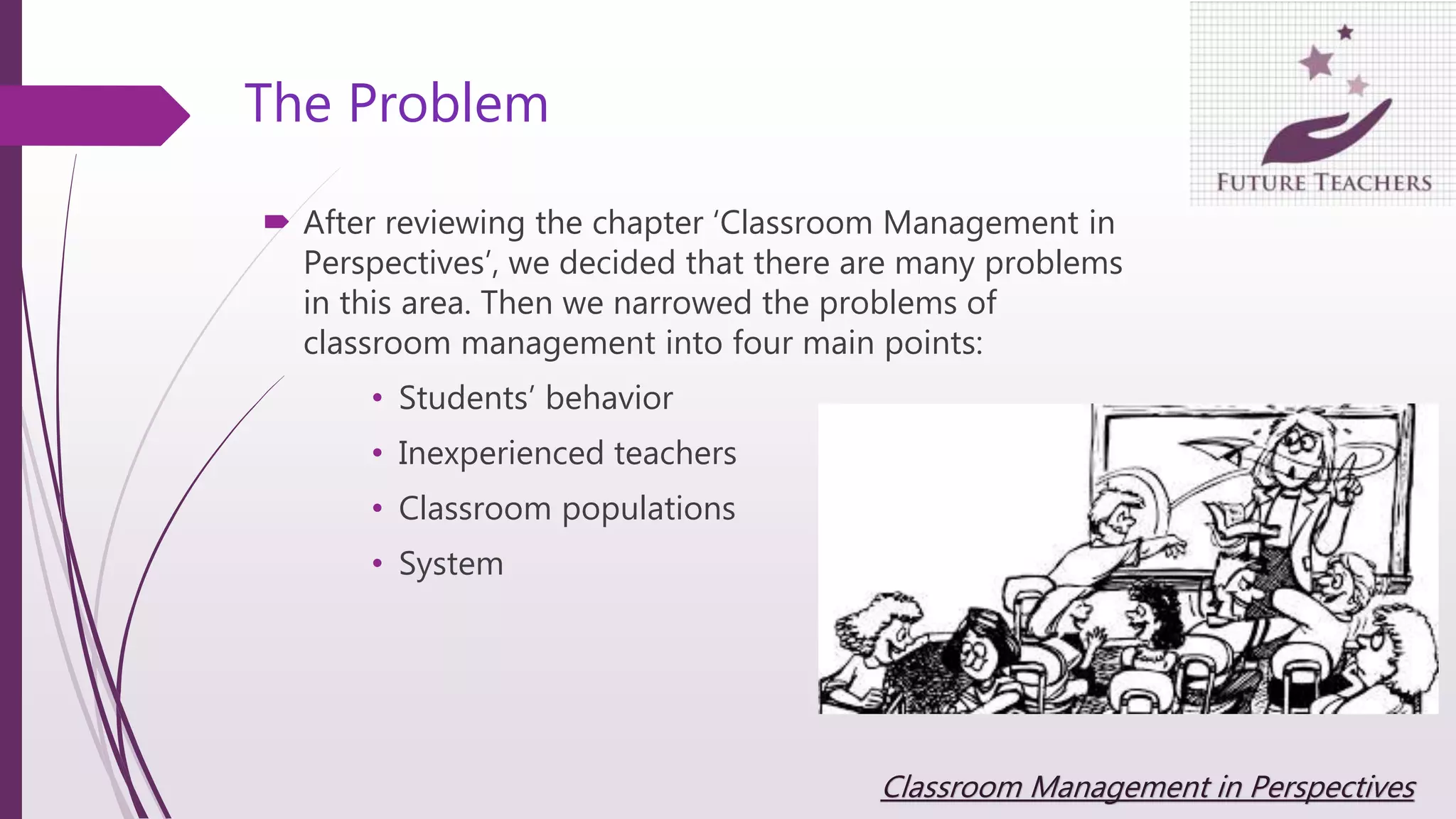
 After reviewing the chapter ‘Classroom Management in
Perspectives’, we decided that there are many problems
in this area. Then we narrowed the problems of
classroom management into four main points:
• Students’ behavior
• Inexperienced teachers
• Classroom populations
• System
Classroom Management in Perspectives
Why did we choose this problem?
 We thought inexperienced teacher is the most important
factor when it comes to classroom management. Therefore,
our focus will be mainly on this point.
Classroom Management in Perspectives
Literature Review
STUDENTS’ BEHAVIOR
 Verbal harrassment by students may be witnessed in poorly managed classrooms.
 Students may also engage in physical harm to the teacher although it is not as
common as verbal harrassment.
 58 % of classroom time allocated for instruction is lost due to student behavior that
disrupts their learning and that of others (Martella, Nelson, Marchand-Martella, &
O’Reilly, 2012).
“at any one time at least 12 % of students in K–12 classrooms have a relatively serious
behavioral and emotional disorder, and 20 % experience mild to serious problems
in this area” (Forness, Kim, & Walker, 2012).
Ronald C. Martella, J. Ron Nelson, Nancy E. Marchand-Martella, & O'Reilly, M. (2012). Comprehensive behavior management: Individualized, classroom, and schoolwide
approaches. (2nd ed.). Thousand Oaks, CA: SAGE Publications, Inc
Forness, S. R., Kim, J., & Walker, H. M. (2012). Prevalence of Students with EBD: Impact on General Education. Beyond Behavior, 21(2), 3-10.
Classroom Management in Perspectives
 These numbers explain why many teachers report students with severe
behavior problems are their greatest concern in the classroom
environment (Burkman, 2012) because these problems put a barrier on the
way to teaching and learning.
Burkman, A. (2012). Preparing Novice Teachers for Success in Elementary Classrooms through Professional Development. Delta Kappa Gamma
Bulletin,78(3), 23.
Classroom Management in Perspectives
Classroom Population
 Sizes of classrooms greatly affect the management.
 In large and crowded classes, an increasing number of students have been
experiencing considerable emotional stress.
 In some classes, students’ academic and behavior skills vary widely, so,
teachers are experiencing a need for improving effectiveness in motivating
and managing students.
Finn, J. D., Pannozzo, G. M., & Achilles, C. M. (2003). The "why’s" of class size: student behavior in small classes. Review of Educational Research, 73(3), 321-368
Glass, Gene V., Leonard S. Cahen, Mary Lee Smith, and Nikola N. Filby. School Class Size: Research and Policy. Beverly Hills, Calif.: Sage Publications,
1982.
Classroom Management in Perspectives
 Finn et al. (2003) argue that the effects of class size on pupils’ classroom
engagement are more important than those on teaching.
 Glass et al. stated that
“average pupil achievement increases as class size decreases, that
achievement increases dramatically when class size falls below 20, and that
the mean achievement of students in instructional groups of 15 or fewer is
several percentile ranks above that of students in classes of 25-30
students. “
Glass, Gene V., Leonard S. Cahen, Mary Lee Smith, and Nikola N. Filby. School Class Size: Research and Policy. Beverly Hills, Calif.: Sage Publications,
1982.
Finn, J. D., Pannozzo, G. M., & Achilles, C. M. (2003). The "why’s" of class size: student behavior in small classes. Review of Educational Research, 73(3), 321-368
Classroom Management in Perspectives
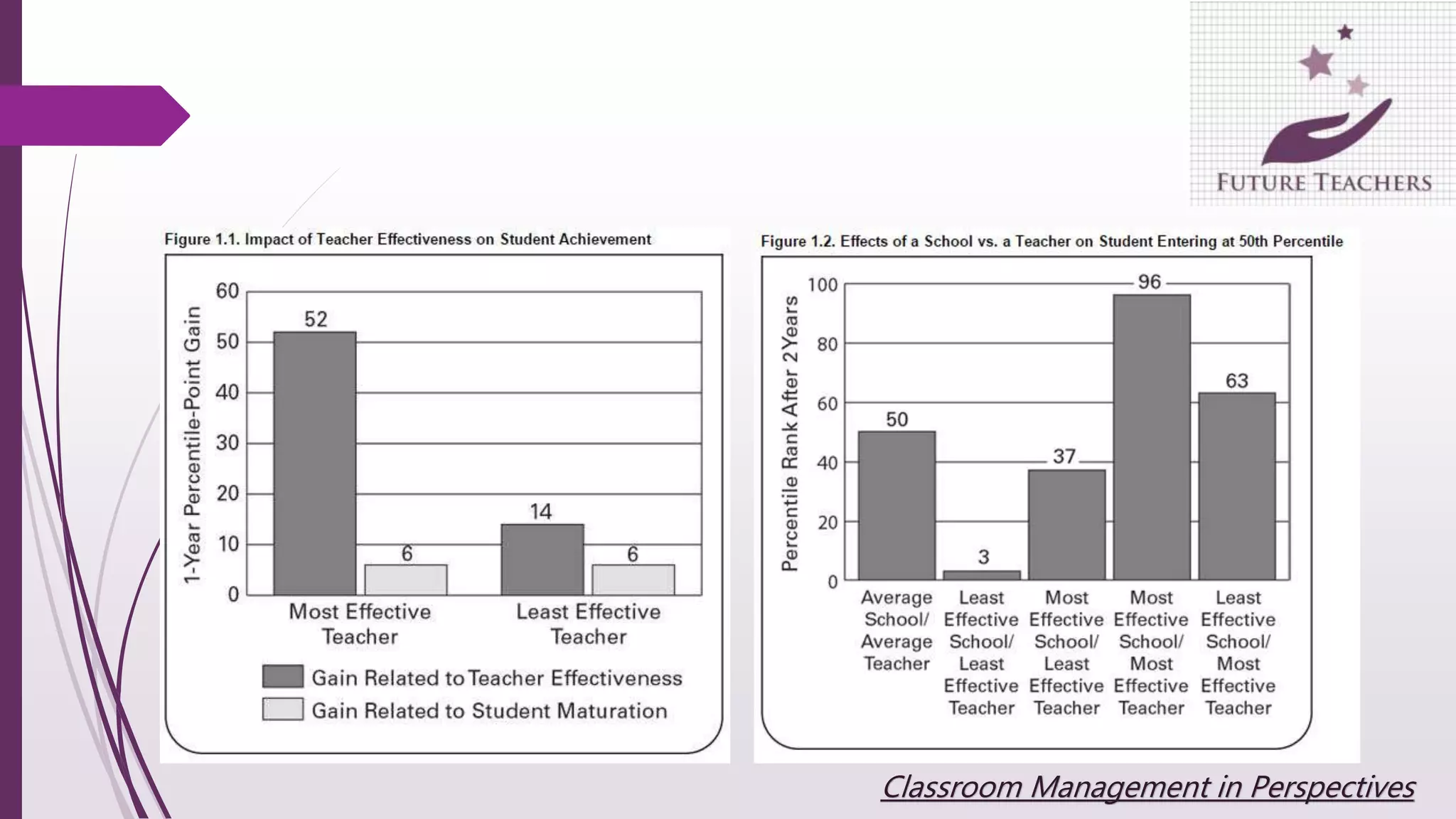
INEXPERIENCED TEACHERS
 ‘The research over the past 30 years indicates that
classroom management is one of the critical ingredients of
effective teaching. Many studies and many books have
been published articulating the specifics of effective
classroom management.’
Marzano, R. J., Marzano, J. S., & Pickering, D. (2003). Classroom management that works: Research-based strategies for every teacher.
Alexandria, VA: Association for Supervision and Curriculum Development.
Classroom Management in Perspectives
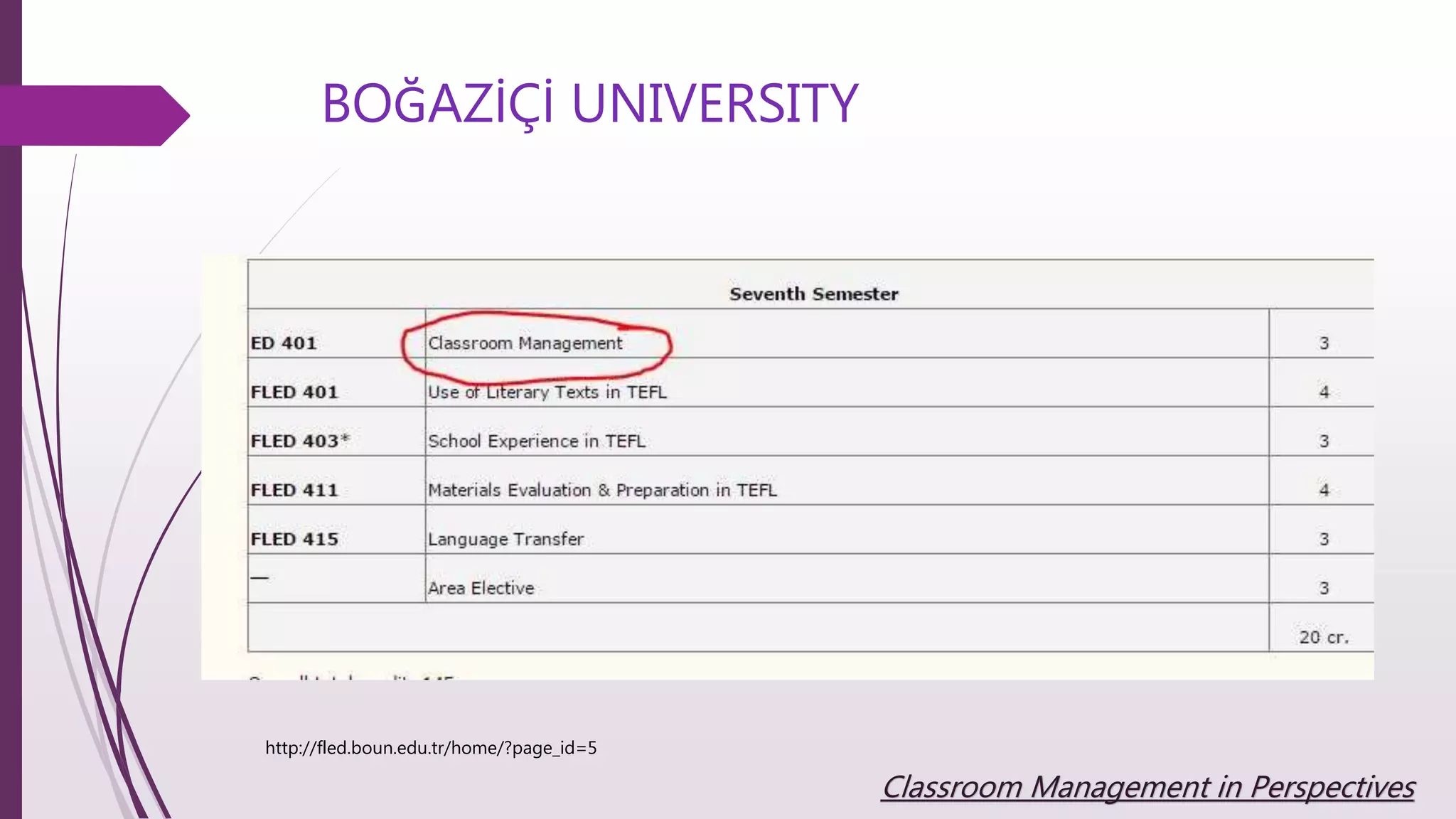
BOĞAZİÇİ UNIVERSITY
http://fled.boun.edu.tr/home/?page_id=5
Classroom Management in Perspectives
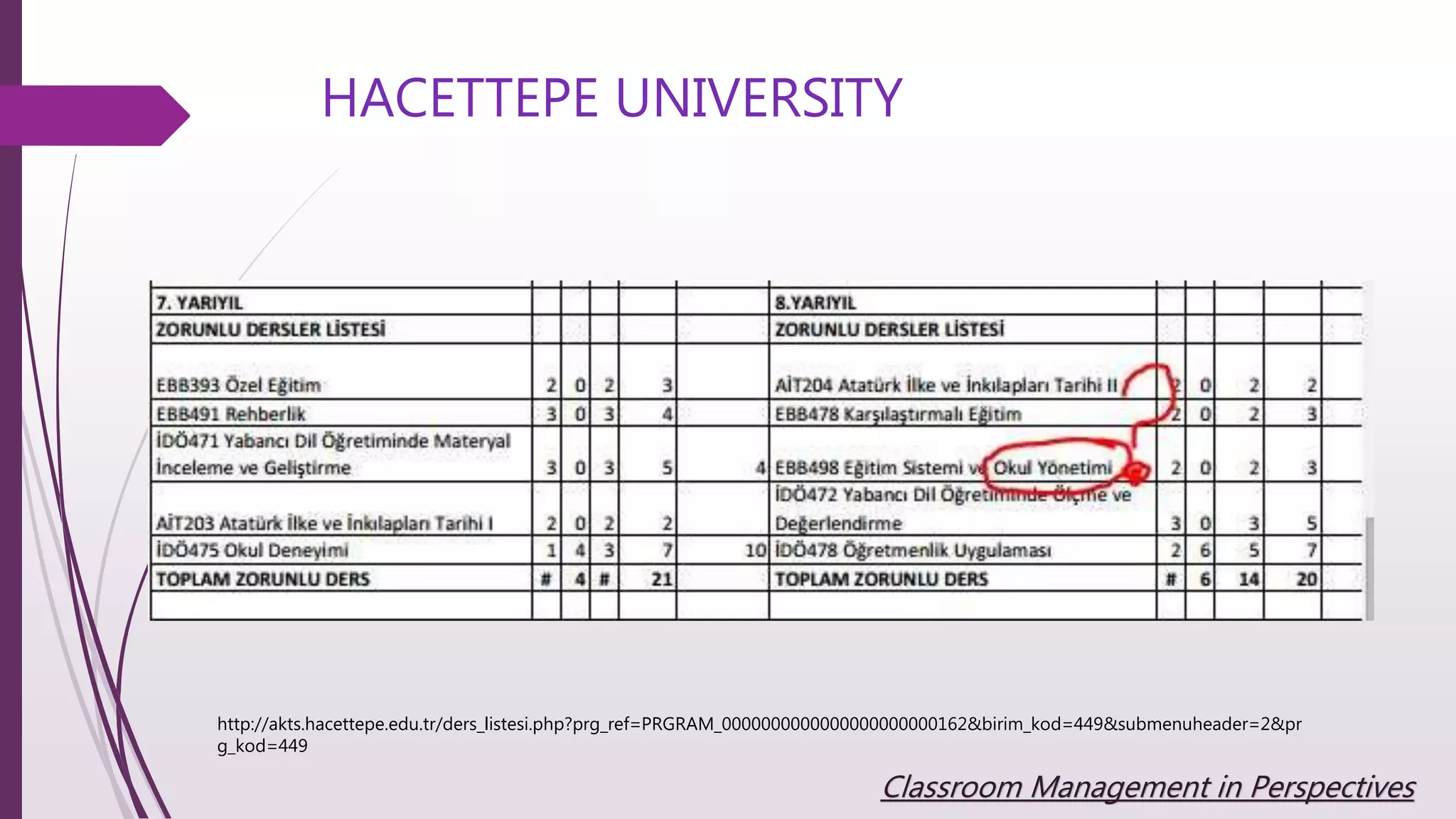
HACETTEPE UNIVERSITY
http://akts.hacettepe.edu.tr/ders_listesi.php?prg_ref=PRGRAM_0000000000000000000000162&birim_kod=449&submenuheader=2&pr
g_kod=449
Classroom Management in Perspectives
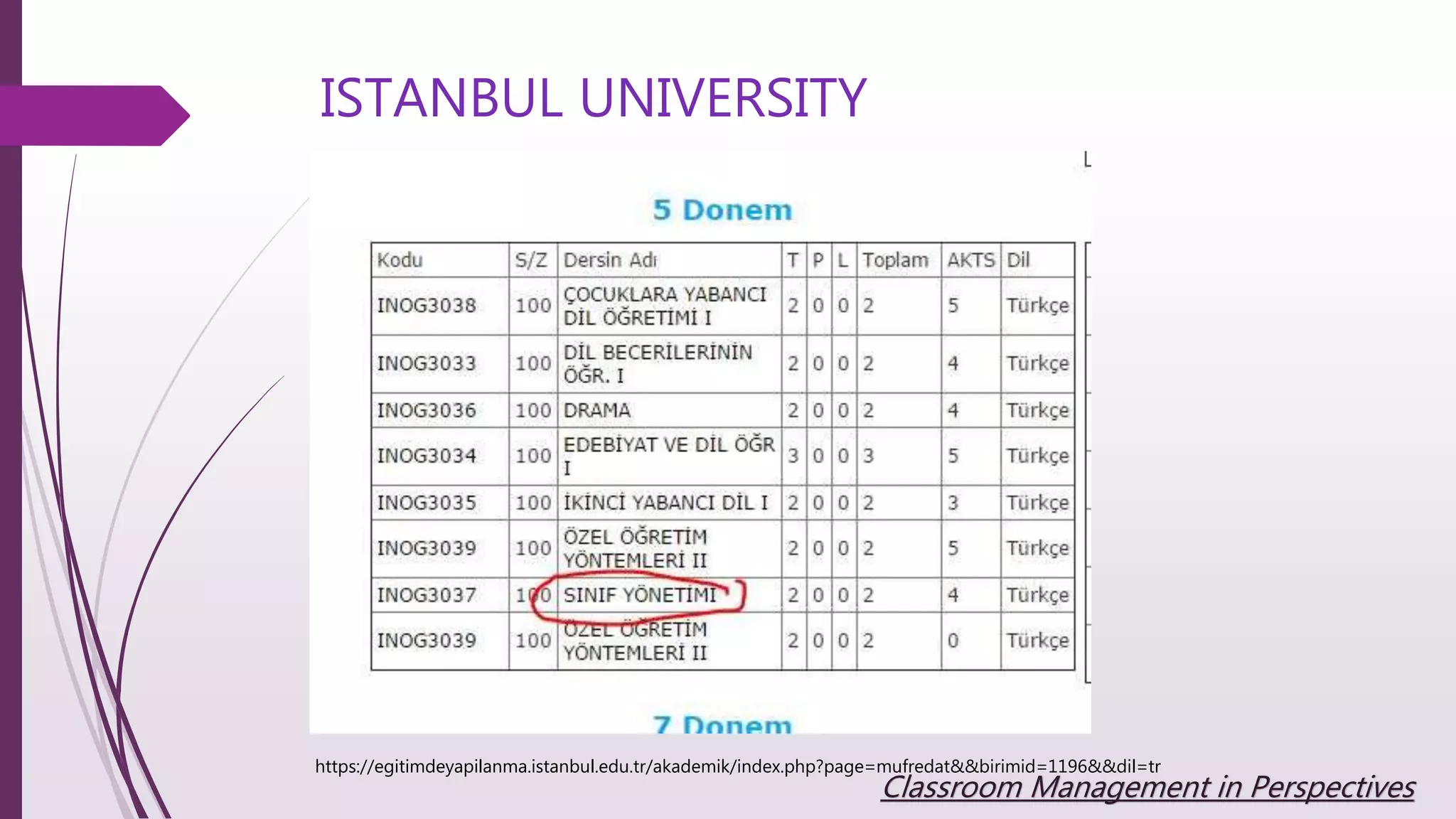
ISTANBUL UNIVERSITY
https://egitimdeyapilanma.istanbul.edu.tr/akademik/index.php?page=mufredat&&birimid=1196&&dil=tr
Classroom Management in Perspectives
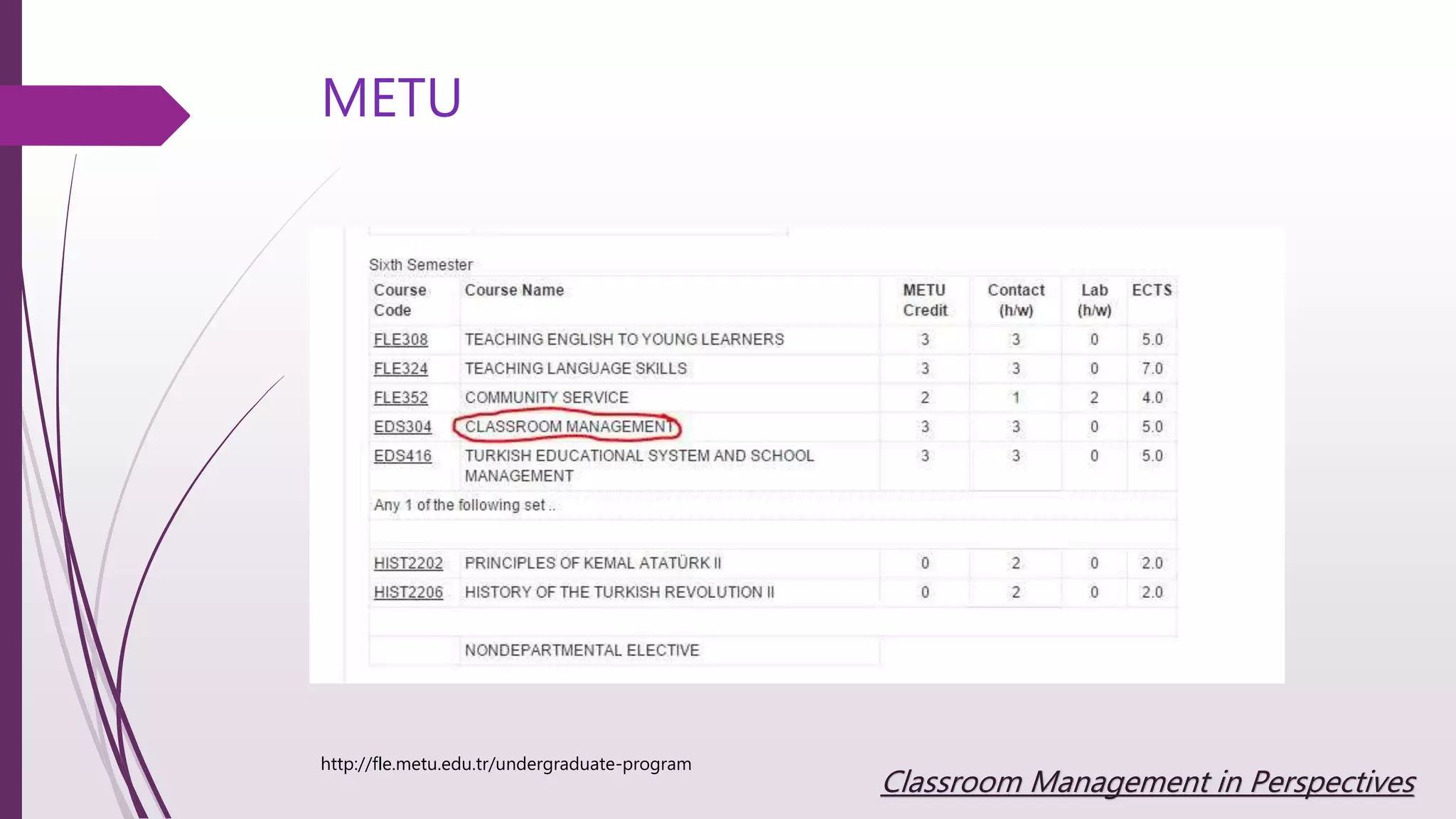
METU
http://fle.metu.edu.tr/undergraduate-program
Classroom Management in Perspectives
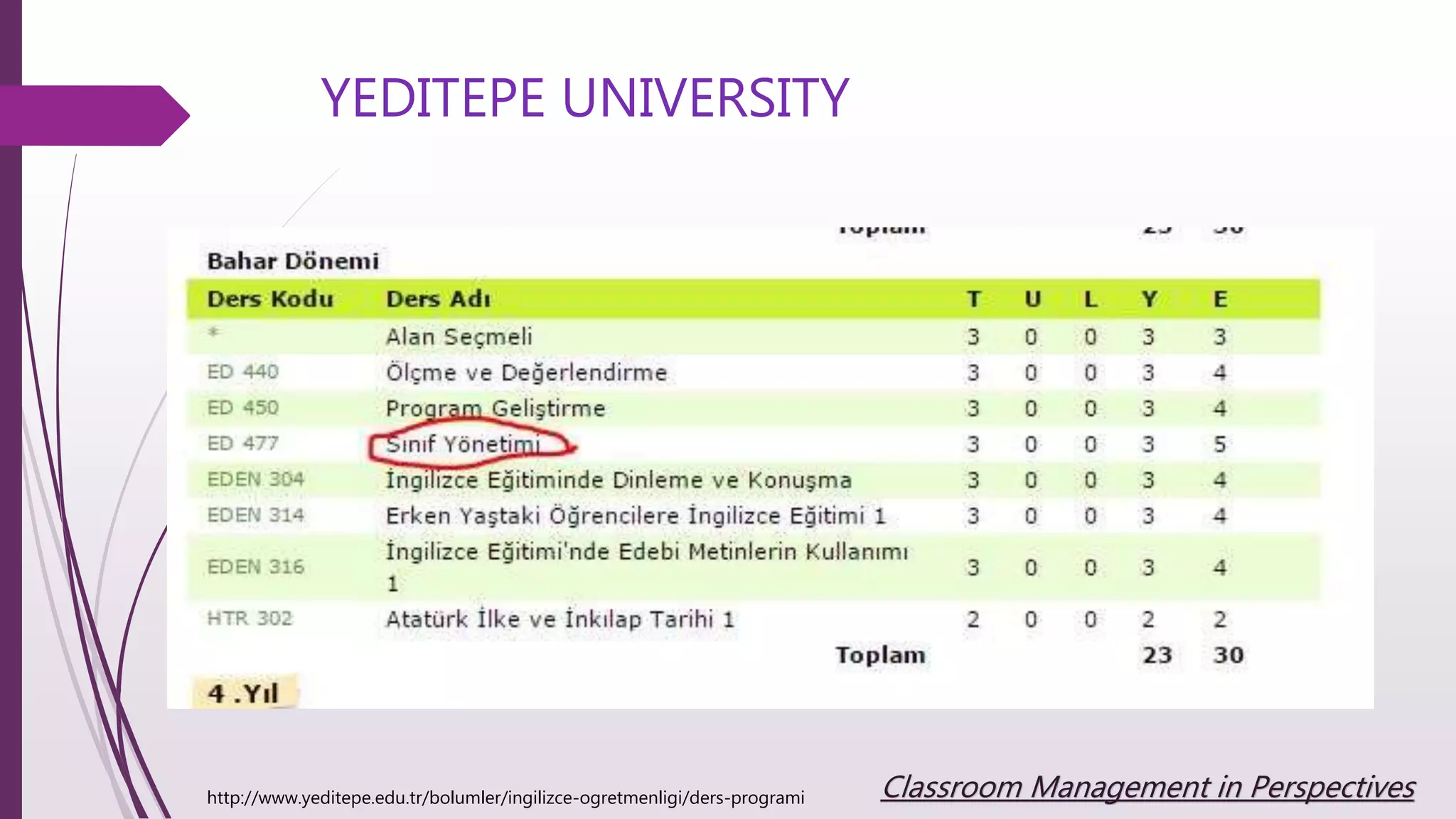
YEDITEPE UNIVERSITY
http://www.yeditepe.edu.tr/bolumler/ingilizce-ogretmenligi/ders-programi Classroom Management in Perspectives
Post literature analysis
One might think that teachers in Turkey are very
inexperienced in terms of classroom management.
However, when we look at the major universities’
course requirements, the result is the opposite. Only
1 out of 5 universities does not require a type of
CLASSROOM MANAGEMENT course for their
undergraduate students.
Classroom Management in Perspectives
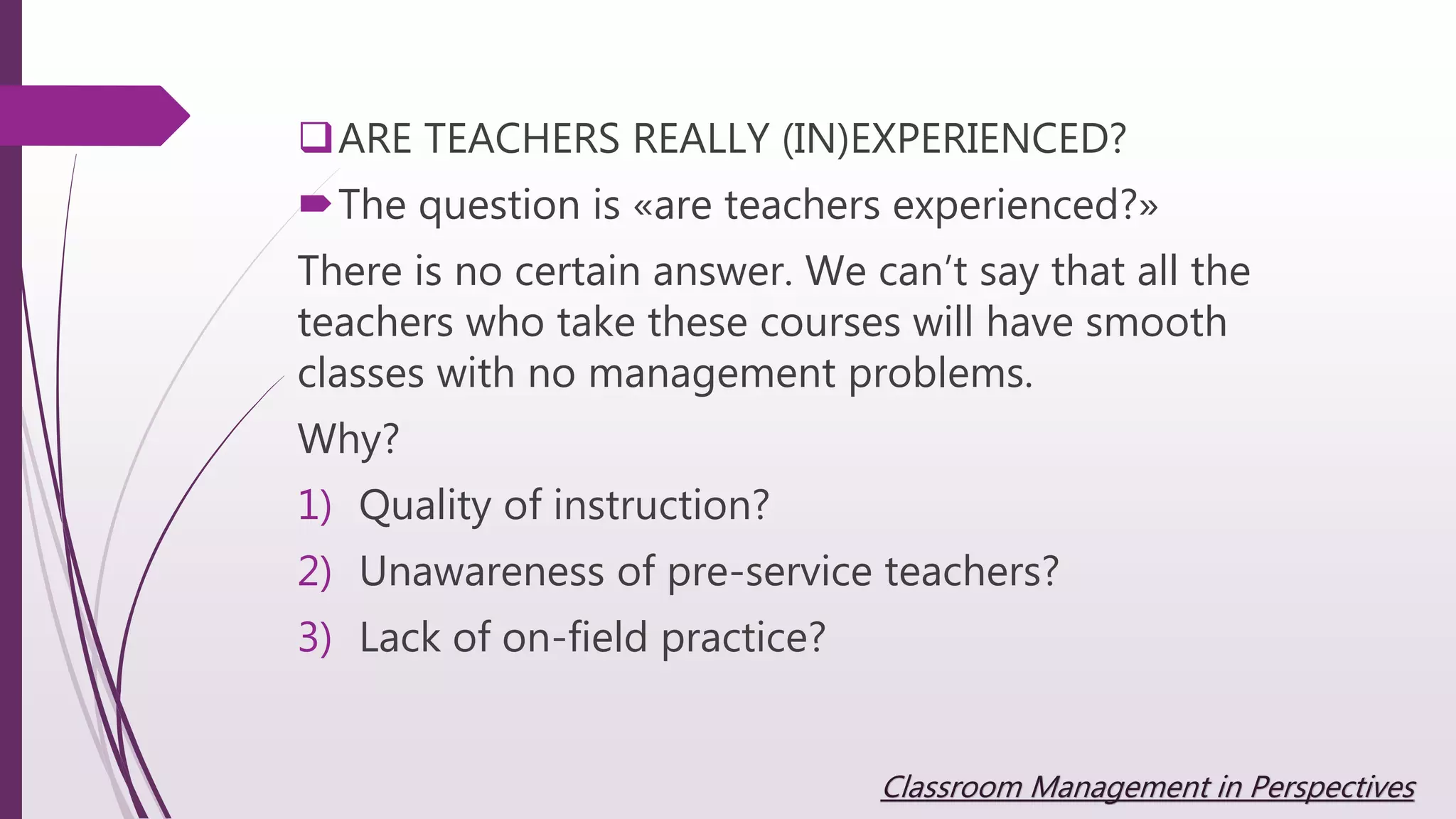
ARE TEACHERS REALLY (IN)EXPERIENCED?
The question is «are teachers experienced?»
There is no certain answer. We can’t say that all the
teachers who take these courses will have smooth
classes with no management problems.
Why?
1) Quality of instruction?
2) Unawareness of pre-service teachers?
3) Lack of on-field practice?
Classroom Management in Perspectives
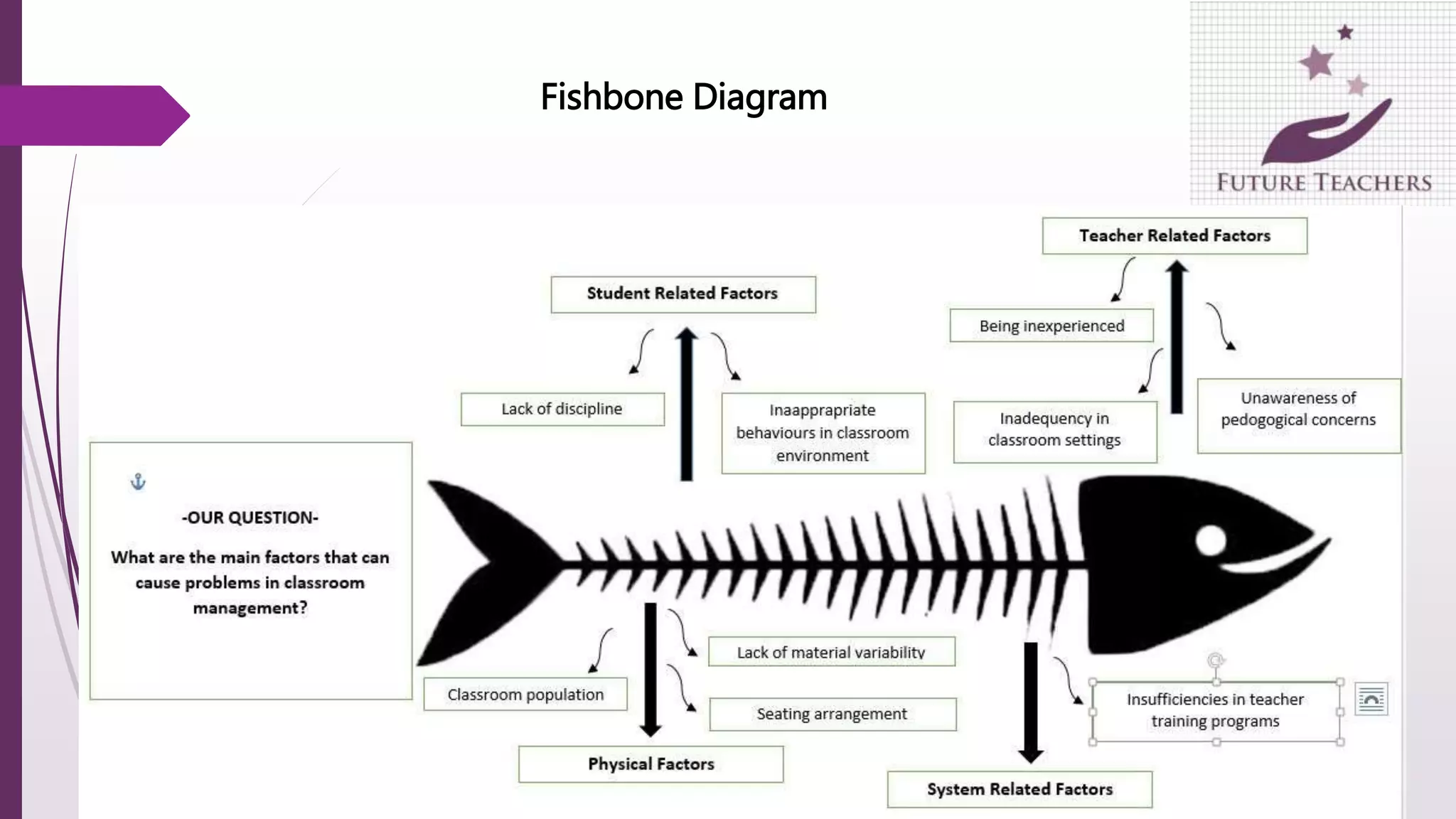
Fishbone Diagram
 We conducted a survey among and 20 university students. It
includes 5 questions which we hope to reflect the students’
general thoughts on the reasons and possible ways of
improvements for classroom management problems. We
turned the results into percentages and reflected on pie
charts as follow.
SURVEY
Classroom Management in Perspectives
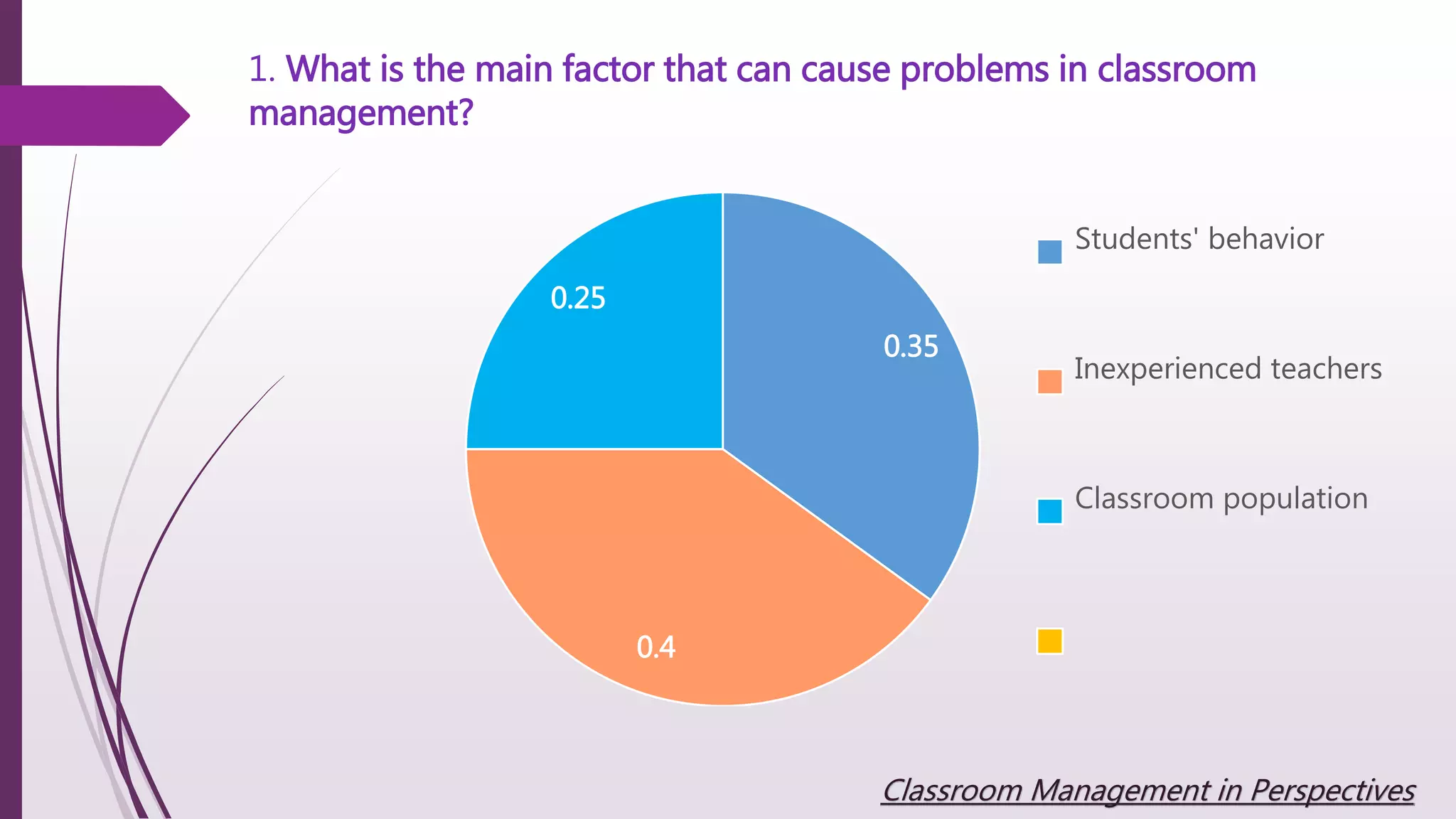
1. What is the main factor that can cause problems in classroom
management?
0.35
0.4
0.25
Students' behavior
Inexperienced teachers
Classroom population
Classroom Management in Perspectives
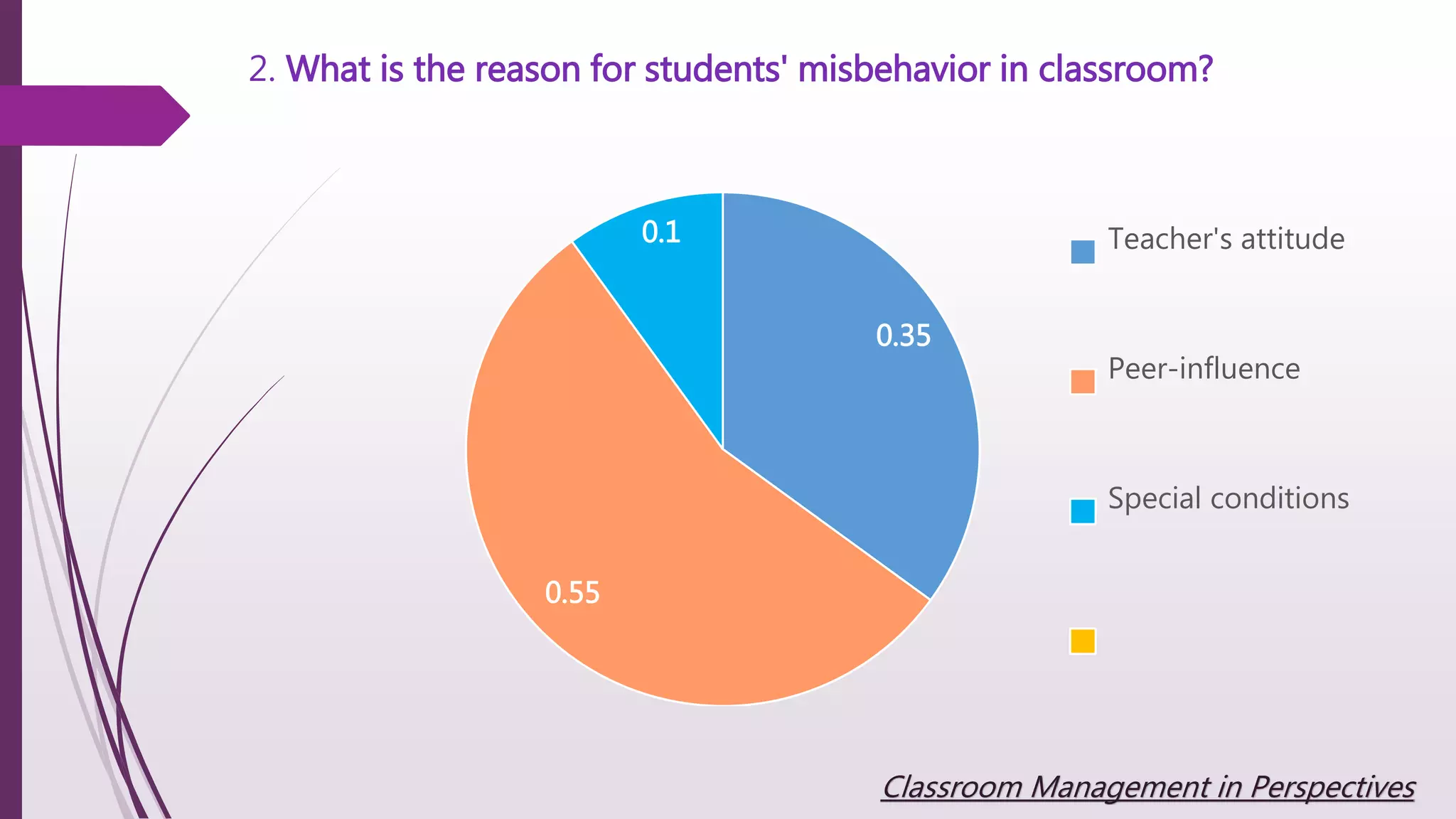
2. What is the reason for students' misbehavior in classroom?
0.35
0.55
0.1 Teacher's attitude
Peer-influence
Special conditions
Classroom Management in Perspectives
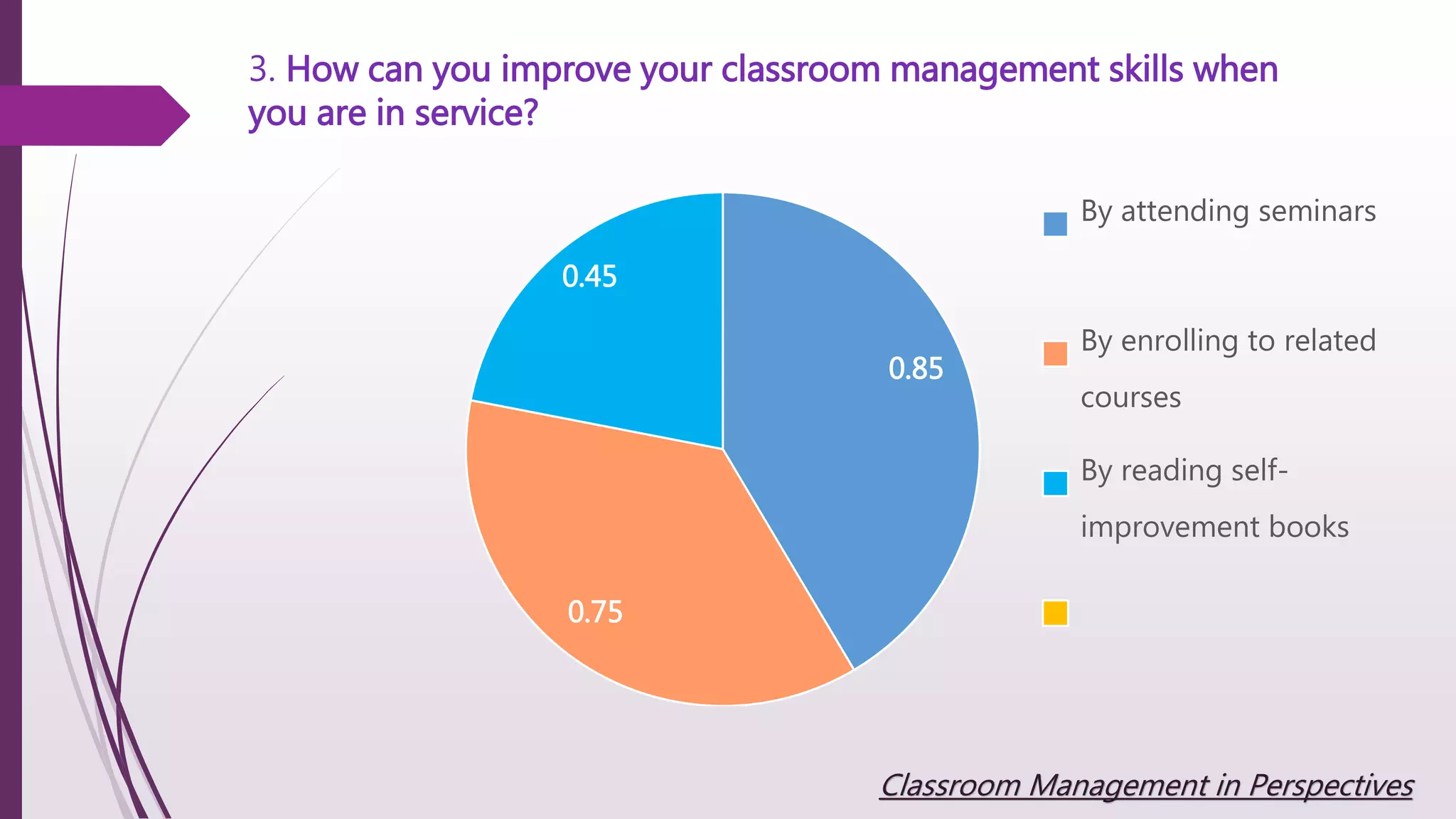
3. How can you improve your classroom management skills when
you are in service?
0.85
0.75
0.45
By attending seminars
By enrolling to related
courses
By reading self-
improvement books
Classroom Management in Perspectives
4. Which physical condition should be improved in order to
facilitate management in classroom?
0.45
0.45
0.1 Classroom population
Seating arrangement
Material variability
Classroom Management in Perspectives
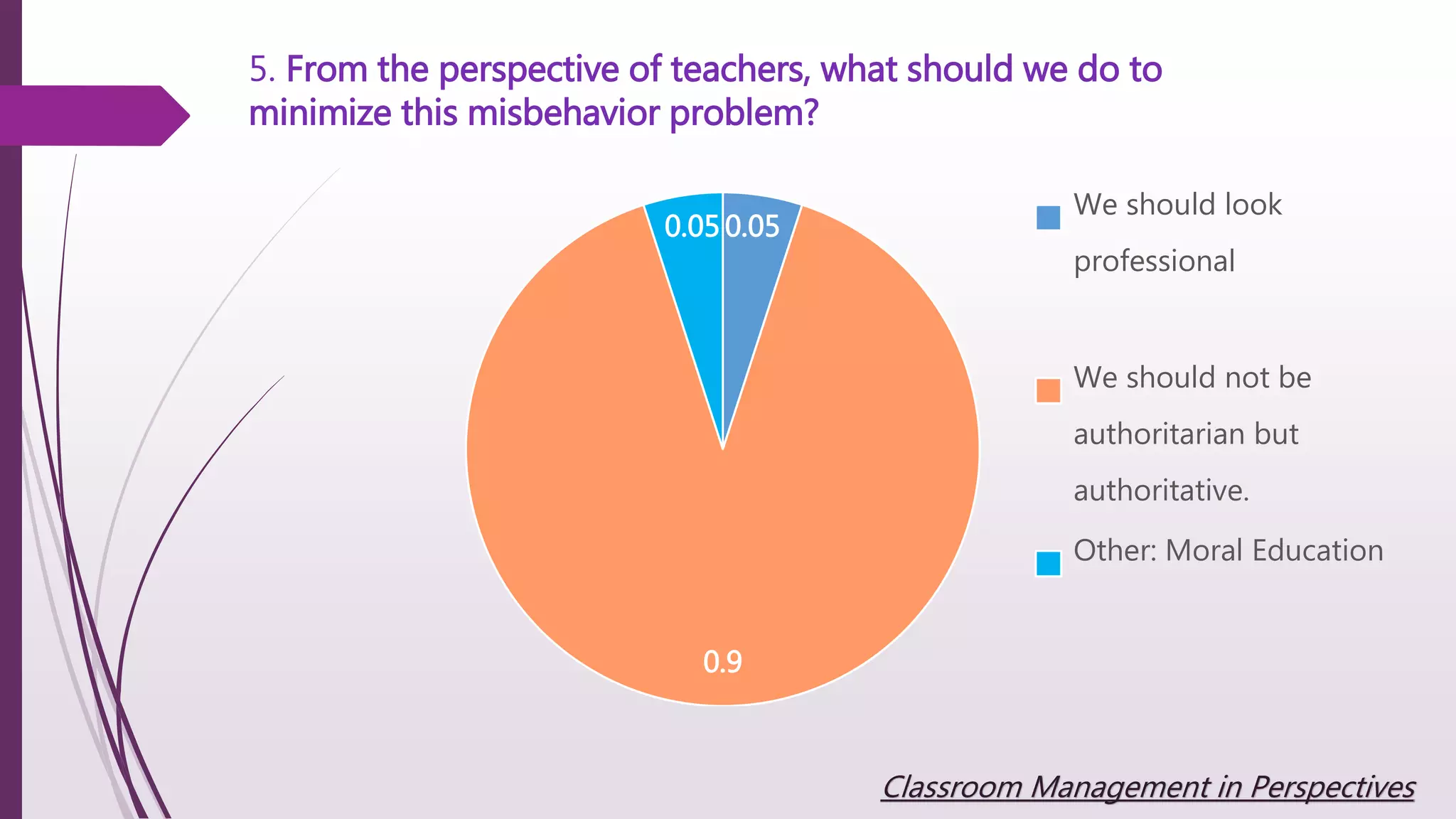
5. From the perspective of teachers, what should we do to
minimize this misbehavior problem?
0.05
0.9
0.05
We should look
professional
We should not be
authoritarian but
authoritative.
Other: Moral Education
Classroom Management in Perspectives
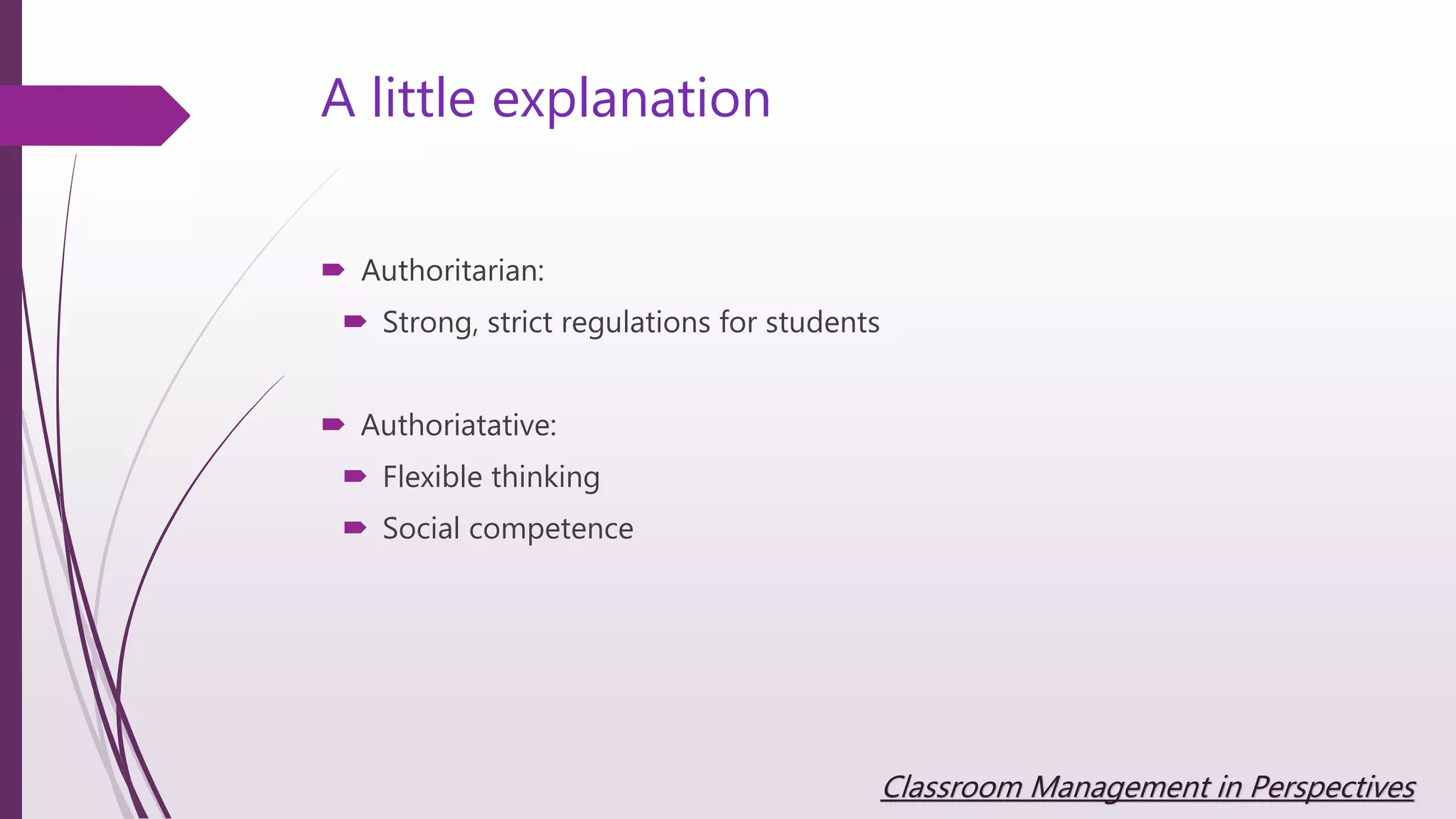
A little explanation
 Authoritarian:
 Strong, strict regulations for students
 Authoriatative:
 Flexible thinking
 Social competence
Classroom Management in Perspectives
Recommendations
Classroom Management in Perspectives
 1. Teachers should focus more on problem-focused strategies than emotion-
focused strategies. Because problem-focused strategies have been found effective
for teaching material and preparing the lesson thoroughly. (Cockburn, 1996)
 2. Teachers should be confident, they should be well-prepared with well-designed,
flexible-to-adapt lesson plans according to their target group.
 3. In classroom environment, teachers may be faced with misbehaviors of some
students. For this purpose, teachers should improve their pedagogical knowledge;
they should attend in-service training programs (organized and non-organized
professional activities) during their in-service experience, they can do more
informal exchange of ideas with their peers, it could be beneficial to take important
notes or dip notes of their own teaching experience during education process and
to read professional journal and books.
Bond, N. (2007). 12 Questioning Strategies that Minimize Classroom Management Problems. Kappa Delta Pi Record, 44, 18-21.
Cockburn A. D. (1996). Primary teachers' knowledge and acquisition of stress relieving strategies. British Journal of Educational Psychology, 66,
399-410. Classroom Management in Perspectives
 4. Needs assessment and evaluation is very crucial for the course development to be
able to know what to do or what to change.
 5. To be able to control the whole class, there should always be in-class rules for
discipline.
 6. Speaking skills are very important. Teachers should improve their public speaking.
 7. In any classroom settings, all the teachers should do their job with love. With the
love of teaching, they can be more motivated and get experienced in a better way.
 8.It is fruitless to expect that any technique will work with all people who present the
same symptom. The competent teacher needs to get at the reasons or functions of a
given maladaptive behavior to formulate a strategy likely to work. (Mendler, 1992)
Mendler, A. (1992). What Do I Do When...? How to Achieve Discipline With Dignity in the Classroom. National Educational Service, 25-27.
Classroom Management in Perspectives
Gantt Card
Classroom Management in Perspectives
Special thanks to Dr. Hayal Köksal
Classroom Management in Perspectives
References
 Imece circles by Hayal Köksal
 Jones, V. F. & Jones, L. S.(2007). Comprehensive Classroom Management: Creating communities of support and
solving problems, 8th edition. Boston: Pearson/Allyn & Bacon.
 Bond, N. (2007). 12 Questioning Strategies that Minimize Classroom Management Problems. Kappa Delta Pi Record,
44, 18-21.
 Burkman, A. (2012). Preparing Novice Teachers for Success in Elementary Classrooms through Professional
Development. Delta Kappa Gamma Bulletin,78(3), 23.
 Cockburn A. D. (1996). Primary teachers' knowledge and acquisition of stress relieving strategies. British Journal of
Educational Psychology, 66, 399-410.
 Finn, J. D., Pannozzo, G. M., & Achilles, C. M. (2003). The "why’s" of class size: student behavior in small classes.
Review of Educational Research, 73(3), 321-368
 Forness, S. R., Kim, J., & Walker, H. M. (2012). Prevalence of Students with EBD: Impact on General Education. Beyond
Behavior, 21(2), 3-10.
 Glass, Gene V., Leonard S. Cahen, Mary Lee Smith, and Nikola N. Filby. School Class Size: Research and Policy. Beverly
Hills, Calif.: Sage Publications, 1982.
 Marzano, R. J., Marzano, J. S., & Pickering, D. (2003). Classroom management that works: Research-based strategies
for every teacher. Alexandria, VA: Association for Supervision and Curriculum Development
 Mendler, A. (1992). What Do I Do When...? How to Achieve Discipline With Dignity in the Classroom. National
Educational Service, 25-27.
 Ronald C. Martella, J. Ron Nelson, Nancy E. Marchand-Martella, & O'Reilly, M. (2012). Comprehensive behavior
management: Individualized, classroom, and schoolwide approaches. (2nd ed.). Thousand Oaks, CA: SAGE
Publications, Inc
Classroom Management in Perspectives

CLASSROOM MANAGEMENT IN PERSPECTIVES

  • 1.
  • 2.
    Contents:  Who arewe?  Matrix diagram  The problem  Why did we choose it?  Literature review  Analysis of the Literature review  Fishbone Diagram  Survey  Recommendations  Gantt Card  References Classroom Management in Perspectives
  • 3.
    Future Teachers Classroom Managementin Perspectives Project Managers Specialists Analysts Ceren Kalender Deniz Koyuncu Tahir Demircan Simten Koyuncu Seçil Ayna Gizem Erdoğan
  • 4.
    Matrix Diagram Student BehaviorInexperienced Teachers Classroom Population Deniz Koyuncu 6 7 5 Ceren Kalender 7 6 5 Tahir Demircan 5 6 7 Simten Koyuncu 5 7 6 Gizem Erdoğan 6 7 5 Seçil Ayna 7 6 5 Percentages 33% 37% 30% Classroom Management in Perspectives
  • 5.
    Classroom Management inPerspectives % 33% 30% Students’ Behavior Inexperienced Teachers
  • 6.
    The Problem  Afterreviewing the chapter ‘Classroom Management in Perspectives’, we decided that there are many problems in this area. Then we narrowed the problems of classroom management into four main points: • Students’ behavior • Inexperienced teachers • Classroom populations • System Classroom Management in Perspectives
  • 7.
    Why did wechoose this problem?  We thought inexperienced teacher is the most important factor when it comes to classroom management. Therefore, our focus will be mainly on this point. Classroom Management in Perspectives
  • 8.
  • 9.
    STUDENTS’ BEHAVIOR  Verbalharrassment by students may be witnessed in poorly managed classrooms.  Students may also engage in physical harm to the teacher although it is not as common as verbal harrassment.  58 % of classroom time allocated for instruction is lost due to student behavior that disrupts their learning and that of others (Martella, Nelson, Marchand-Martella, & O’Reilly, 2012). “at any one time at least 12 % of students in K–12 classrooms have a relatively serious behavioral and emotional disorder, and 20 % experience mild to serious problems in this area” (Forness, Kim, & Walker, 2012). Ronald C. Martella, J. Ron Nelson, Nancy E. Marchand-Martella, & O'Reilly, M. (2012). Comprehensive behavior management: Individualized, classroom, and schoolwide approaches. (2nd ed.). Thousand Oaks, CA: SAGE Publications, Inc Forness, S. R., Kim, J., & Walker, H. M. (2012). Prevalence of Students with EBD: Impact on General Education. Beyond Behavior, 21(2), 3-10. Classroom Management in Perspectives
  • 10.
     These numbersexplain why many teachers report students with severe behavior problems are their greatest concern in the classroom environment (Burkman, 2012) because these problems put a barrier on the way to teaching and learning. Burkman, A. (2012). Preparing Novice Teachers for Success in Elementary Classrooms through Professional Development. Delta Kappa Gamma Bulletin,78(3), 23. Classroom Management in Perspectives
  • 11.
    Classroom Population  Sizesof classrooms greatly affect the management.  In large and crowded classes, an increasing number of students have been experiencing considerable emotional stress.  In some classes, students’ academic and behavior skills vary widely, so, teachers are experiencing a need for improving effectiveness in motivating and managing students. Finn, J. D., Pannozzo, G. M., & Achilles, C. M. (2003). The "why’s" of class size: student behavior in small classes. Review of Educational Research, 73(3), 321-368 Glass, Gene V., Leonard S. Cahen, Mary Lee Smith, and Nikola N. Filby. School Class Size: Research and Policy. Beverly Hills, Calif.: Sage Publications, 1982. Classroom Management in Perspectives
  • 12.
     Finn etal. (2003) argue that the effects of class size on pupils’ classroom engagement are more important than those on teaching.  Glass et al. stated that “average pupil achievement increases as class size decreases, that achievement increases dramatically when class size falls below 20, and that the mean achievement of students in instructional groups of 15 or fewer is several percentile ranks above that of students in classes of 25-30 students. “ Glass, Gene V., Leonard S. Cahen, Mary Lee Smith, and Nikola N. Filby. School Class Size: Research and Policy. Beverly Hills, Calif.: Sage Publications, 1982. Finn, J. D., Pannozzo, G. M., & Achilles, C. M. (2003). The "why’s" of class size: student behavior in small classes. Review of Educational Research, 73(3), 321-368 Classroom Management in Perspectives
  • 13.
    INEXPERIENCED TEACHERS  ‘Theresearch over the past 30 years indicates that classroom management is one of the critical ingredients of effective teaching. Many studies and many books have been published articulating the specifics of effective classroom management.’ Marzano, R. J., Marzano, J. S., & Pickering, D. (2003). Classroom management that works: Research-based strategies for every teacher. Alexandria, VA: Association for Supervision and Curriculum Development. Classroom Management in Perspectives
  • 14.
  • 15.
  • 16.
  • 17.
  • 18.
  • 19.
  • 20.
    Post literature analysis Onemight think that teachers in Turkey are very inexperienced in terms of classroom management. However, when we look at the major universities’ course requirements, the result is the opposite. Only 1 out of 5 universities does not require a type of CLASSROOM MANAGEMENT course for their undergraduate students. Classroom Management in Perspectives
  • 21.
    ARE TEACHERS REALLY(IN)EXPERIENCED? The question is «are teachers experienced?» There is no certain answer. We can’t say that all the teachers who take these courses will have smooth classes with no management problems. Why? 1) Quality of instruction? 2) Unawareness of pre-service teachers? 3) Lack of on-field practice? Classroom Management in Perspectives
  • 22.
  • 23.
     We conducteda survey among and 20 university students. It includes 5 questions which we hope to reflect the students’ general thoughts on the reasons and possible ways of improvements for classroom management problems. We turned the results into percentages and reflected on pie charts as follow. SURVEY Classroom Management in Perspectives
  • 24.
    1. What isthe main factor that can cause problems in classroom management? 0.35 0.4 0.25 Students' behavior Inexperienced teachers Classroom population Classroom Management in Perspectives
  • 25.
    2. What isthe reason for students' misbehavior in classroom? 0.35 0.55 0.1 Teacher's attitude Peer-influence Special conditions Classroom Management in Perspectives
  • 26.
    3. How canyou improve your classroom management skills when you are in service? 0.85 0.75 0.45 By attending seminars By enrolling to related courses By reading self- improvement books Classroom Management in Perspectives
  • 27.
    4. Which physicalcondition should be improved in order to facilitate management in classroom? 0.45 0.45 0.1 Classroom population Seating arrangement Material variability Classroom Management in Perspectives
  • 28.
    5. From theperspective of teachers, what should we do to minimize this misbehavior problem? 0.05 0.9 0.05 We should look professional We should not be authoritarian but authoritative. Other: Moral Education Classroom Management in Perspectives
  • 29.
    A little explanation Authoritarian:  Strong, strict regulations for students  Authoriatative:  Flexible thinking  Social competence Classroom Management in Perspectives
  • 30.
  • 31.
     1. Teachersshould focus more on problem-focused strategies than emotion- focused strategies. Because problem-focused strategies have been found effective for teaching material and preparing the lesson thoroughly. (Cockburn, 1996)  2. Teachers should be confident, they should be well-prepared with well-designed, flexible-to-adapt lesson plans according to their target group.  3. In classroom environment, teachers may be faced with misbehaviors of some students. For this purpose, teachers should improve their pedagogical knowledge; they should attend in-service training programs (organized and non-organized professional activities) during their in-service experience, they can do more informal exchange of ideas with their peers, it could be beneficial to take important notes or dip notes of their own teaching experience during education process and to read professional journal and books. Bond, N. (2007). 12 Questioning Strategies that Minimize Classroom Management Problems. Kappa Delta Pi Record, 44, 18-21. Cockburn A. D. (1996). Primary teachers' knowledge and acquisition of stress relieving strategies. British Journal of Educational Psychology, 66, 399-410. Classroom Management in Perspectives
  • 32.
     4. Needsassessment and evaluation is very crucial for the course development to be able to know what to do or what to change.  5. To be able to control the whole class, there should always be in-class rules for discipline.  6. Speaking skills are very important. Teachers should improve their public speaking.  7. In any classroom settings, all the teachers should do their job with love. With the love of teaching, they can be more motivated and get experienced in a better way.  8.It is fruitless to expect that any technique will work with all people who present the same symptom. The competent teacher needs to get at the reasons or functions of a given maladaptive behavior to formulate a strategy likely to work. (Mendler, 1992) Mendler, A. (1992). What Do I Do When...? How to Achieve Discipline With Dignity in the Classroom. National Educational Service, 25-27. Classroom Management in Perspectives
  • 33.
  • 34.
    Special thanks toDr. Hayal Köksal Classroom Management in Perspectives
  • 35.
    References  Imece circlesby Hayal Köksal  Jones, V. F. & Jones, L. S.(2007). Comprehensive Classroom Management: Creating communities of support and solving problems, 8th edition. Boston: Pearson/Allyn & Bacon.  Bond, N. (2007). 12 Questioning Strategies that Minimize Classroom Management Problems. Kappa Delta Pi Record, 44, 18-21.  Burkman, A. (2012). Preparing Novice Teachers for Success in Elementary Classrooms through Professional Development. Delta Kappa Gamma Bulletin,78(3), 23.  Cockburn A. D. (1996). Primary teachers' knowledge and acquisition of stress relieving strategies. British Journal of Educational Psychology, 66, 399-410.  Finn, J. D., Pannozzo, G. M., & Achilles, C. M. (2003). The "why’s" of class size: student behavior in small classes. Review of Educational Research, 73(3), 321-368  Forness, S. R., Kim, J., & Walker, H. M. (2012). Prevalence of Students with EBD: Impact on General Education. Beyond Behavior, 21(2), 3-10.  Glass, Gene V., Leonard S. Cahen, Mary Lee Smith, and Nikola N. Filby. School Class Size: Research and Policy. Beverly Hills, Calif.: Sage Publications, 1982.  Marzano, R. J., Marzano, J. S., & Pickering, D. (2003). Classroom management that works: Research-based strategies for every teacher. Alexandria, VA: Association for Supervision and Curriculum Development  Mendler, A. (1992). What Do I Do When...? How to Achieve Discipline With Dignity in the Classroom. National Educational Service, 25-27.  Ronald C. Martella, J. Ron Nelson, Nancy E. Marchand-Martella, & O'Reilly, M. (2012). Comprehensive behavior management: Individualized, classroom, and schoolwide approaches. (2nd ed.). Thousand Oaks, CA: SAGE Publications, Inc Classroom Management in Perspectives