•ClassroomClassroom
ManagementManagement
Run byRun by
Mrs. Faiza YOUSFI-Tipaza-AlgeriaMrs. Faiza YOUSFI-Tipaza-Algeria
tipazaenglish@hotmail.frtipazaenglish@hotmail.fr
List 5 featuresList 5 features
of a successfulof a successful
lesson.lesson.
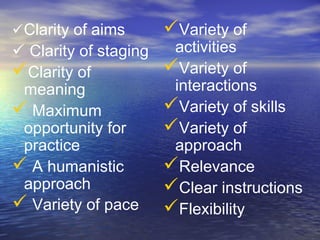
Clarity of aims
 Clarity of staging
Clarity of
meaning
 Maximum
opportunity for
practice
 A humanistic
approach
 Variety of pace
Variety of
activities
Variety of
interactions
Variety of skills
Variety of
approach
Relevance
Clear instructions
Flexibility
Classroom ManagementClassroom Management
–The teacherThe teacher
–InstructingInstructing
–Seating ArrangementSeating Arrangement
–Students groupingsStudents groupings
–Creating lesson stagesCreating lesson stages
What’s aWhat’s a
goodgood
teacher?teacher?
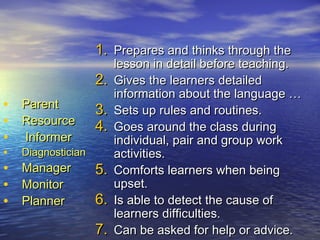
• ParentParent
• ResourceResource
• InformerInformer
• DiagnosticianDiagnostician
• ManagerManager
• MonitorMonitor
• PlannerPlanner
1.1. Prepares and thinks through thePrepares and thinks through the
lesson in detail before teaching.lesson in detail before teaching.
2.2. Gives the learners detailedGives the learners detailed
information about the language …information about the language …
3.3. Sets up rules and routines.Sets up rules and routines.
4.4. Goes around the class duringGoes around the class during
individual, pair and group workindividual, pair and group work
activities.activities.
5.5. Comforts learners when beingComforts learners when being
upset.upset.
6.6. Is able to detect the cause ofIs able to detect the cause of
learners difficulties.learners difficulties.
7.7. Can be asked for help or advice.Can be asked for help or advice.
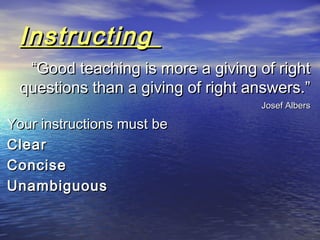
InstructingInstructing
““Good teaching is more a giving of rightGood teaching is more a giving of right
questions than a giving of right answers.”questions than a giving of right answers.”
Josef AlbersJosef Albers
Your instructions must beYour instructions must be
ClearClear
ConciseConcise
UnambiguousUnambiguous
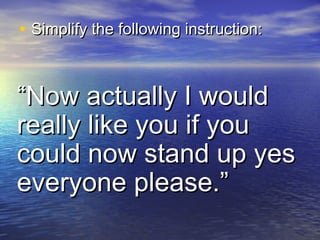
• Simplify the following instruction:Simplify the following instruction:
““Now actually I wouldNow actually I would
really like you if youreally like you if you
could now stand up yescould now stand up yes
everyone please.”everyone please.”
Group work:Group work:
• Flash-cardsFlash-cards
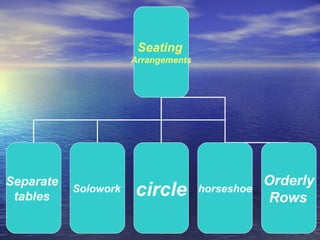
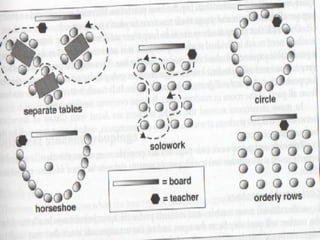
Seating
Arrangements
Separate
tables
Solowork circle horseshoe
Orderly
Rows
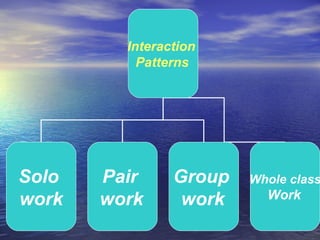
Interaction
Patterns
Solo
work
Pair
work
Group
work
Whole class
Work
Overcoming Difficulties in Pair and GroupOvercoming Difficulties in Pair and Group
Work byWork by John WheelerJohn Wheeler
“…“…in my first teaching position at a universityin my first teaching position at a university
in Turkey, I favoredin Turkey, I favored the "safe" traditionalthe "safe" traditional
methodsmethods that I had used in my own learningthat I had used in my own learning
of foreign languages. Years later, I started toof foreign languages. Years later, I started to
feel the need for afeel the need for a more interactivemore interactive
approachapproach to language teaching andto language teaching and
learning. I started to experiment withlearning. I started to experiment with pairpair
and group workand group work, but as any novice in any, but as any novice in any
field, I found that the going was not always sofield, I found that the going was not always so
smooth. Some of the problems I encounteredsmooth. Some of the problems I encountered
were:were:
• The students often spoke in their native language.The students often spoke in their native language.
• One student would dominate while the othersOne student would dominate while the others
listened (or maybe did nothing at all).listened (or maybe did nothing at all).
• Students might learn each others mistakes byStudents might learn each others mistakes by
practicing English together.practicing English together.
• Students were not clear about how to go through anStudents were not clear about how to go through an
activity.activity.
• Some students, being loner types, were simplySome students, being loner types, were simply
uninterested in working with others.uninterested in working with others.
• The class became very noisy with so many peopleThe class became very noisy with so many people
speaking at once.speaking at once.
• The class seemed to be in a state of chaos.The class seemed to be in a state of chaos.
•Add more problemsAdd more problems
you faced.you faced.
•What are theWhat are the
suggested solutions?suggested solutions?
Some suggested solutionsSome suggested solutions
• Explain the activityExplain the activity
• Arrange the groupsArrange the groups
• Set rolesSet roles
• Set time limitsSet time limits
• Give examples orGive examples or
demonstrationsdemonstrations
• CirculateCirculate
• Follow upFollow up
• Discuss the activityDiscuss the activity
Roles to group membersRoles to group members
• Here are some roles that can be used:Here are some roles that can be used:
1.1. TimekeeperTimekeeper – makes sure the group finishes on time.– makes sure the group finishes on time.
2.2. ReaderReader – reads the text or questions to the group.– reads the text or questions to the group.
3.3. Secretary/scribe/recorderSecretary/scribe/recorder – writes down the group’s– writes down the group’s
ideas.ideas.
4.4. LeaderLeader – makes sure that everyone is taking turns and– makes sure that everyone is taking turns and
answering questions.answering questions.
5.5. EncouragerEncourager – encourages learner to participate.– encourages learner to participate.
6.6. Presenter/spokesperson/speakerPresenter/spokesperson/speaker – presents the– presents the
group’s ideas to the class.group’s ideas to the class.
7.7. MonitorMonitor – makes sure that the group completes the– makes sure that the group completes the
task and speaks in English.task and speaks in English.
8.8. SpySpy – can check and see what other groups are doing.– can check and see what other groups are doing.
Creating lesson stagesCreating lesson stages
• Lesson ObjectivesLesson Objectives
• StagesStages
• ActivitiesActivities
• AssessmentAssessment
Classroom management.

Classroom management.

  • 1.
    •ClassroomClassroom ManagementManagement Run byRun by Mrs.Faiza YOUSFI-Tipaza-AlgeriaMrs. Faiza YOUSFI-Tipaza-Algeria tipazaenglish@hotmail.frtipazaenglish@hotmail.fr
  • 2.
    List 5 featuresList5 features of a successfulof a successful lesson.lesson.
  • 3.
    Clarity of aims Clarity of staging Clarity of meaning  Maximum opportunity for practice  A humanistic approach  Variety of pace Variety of activities Variety of interactions Variety of skills Variety of approach Relevance Clear instructions Flexibility
  • 4.
    Classroom ManagementClassroom Management –TheteacherThe teacher –InstructingInstructing –Seating ArrangementSeating Arrangement –Students groupingsStudents groupings –Creating lesson stagesCreating lesson stages
  • 5.
  • 6.
    • ParentParent • ResourceResource •InformerInformer • DiagnosticianDiagnostician • ManagerManager • MonitorMonitor • PlannerPlanner 1.1. Prepares and thinks through thePrepares and thinks through the lesson in detail before teaching.lesson in detail before teaching. 2.2. Gives the learners detailedGives the learners detailed information about the language …information about the language … 3.3. Sets up rules and routines.Sets up rules and routines. 4.4. Goes around the class duringGoes around the class during individual, pair and group workindividual, pair and group work activities.activities. 5.5. Comforts learners when beingComforts learners when being upset.upset. 6.6. Is able to detect the cause ofIs able to detect the cause of learners difficulties.learners difficulties. 7.7. Can be asked for help or advice.Can be asked for help or advice.
  • 7.
    InstructingInstructing ““Good teaching ismore a giving of rightGood teaching is more a giving of right questions than a giving of right answers.”questions than a giving of right answers.” Josef AlbersJosef Albers Your instructions must beYour instructions must be ClearClear ConciseConcise UnambiguousUnambiguous
  • 8.
    • Simplify thefollowing instruction:Simplify the following instruction: ““Now actually I wouldNow actually I would really like you if youreally like you if you could now stand up yescould now stand up yes everyone please.”everyone please.”
  • 9.
    Group work:Group work: •Flash-cardsFlash-cards
  • 10.
  • 12.
  • 13.
    Overcoming Difficulties inPair and GroupOvercoming Difficulties in Pair and Group Work byWork by John WheelerJohn Wheeler “…“…in my first teaching position at a universityin my first teaching position at a university in Turkey, I favoredin Turkey, I favored the "safe" traditionalthe "safe" traditional methodsmethods that I had used in my own learningthat I had used in my own learning of foreign languages. Years later, I started toof foreign languages. Years later, I started to feel the need for afeel the need for a more interactivemore interactive approachapproach to language teaching andto language teaching and learning. I started to experiment withlearning. I started to experiment with pairpair and group workand group work, but as any novice in any, but as any novice in any field, I found that the going was not always sofield, I found that the going was not always so smooth. Some of the problems I encounteredsmooth. Some of the problems I encountered were:were:
  • 14.
    • The studentsoften spoke in their native language.The students often spoke in their native language. • One student would dominate while the othersOne student would dominate while the others listened (or maybe did nothing at all).listened (or maybe did nothing at all). • Students might learn each others mistakes byStudents might learn each others mistakes by practicing English together.practicing English together. • Students were not clear about how to go through anStudents were not clear about how to go through an activity.activity. • Some students, being loner types, were simplySome students, being loner types, were simply uninterested in working with others.uninterested in working with others. • The class became very noisy with so many peopleThe class became very noisy with so many people speaking at once.speaking at once. • The class seemed to be in a state of chaos.The class seemed to be in a state of chaos.
  • 15.
    •Add more problemsAddmore problems you faced.you faced. •What are theWhat are the suggested solutions?suggested solutions?
  • 16.
    Some suggested solutionsSomesuggested solutions • Explain the activityExplain the activity • Arrange the groupsArrange the groups • Set rolesSet roles • Set time limitsSet time limits • Give examples orGive examples or demonstrationsdemonstrations • CirculateCirculate • Follow upFollow up • Discuss the activityDiscuss the activity
  • 17.
    Roles to groupmembersRoles to group members • Here are some roles that can be used:Here are some roles that can be used: 1.1. TimekeeperTimekeeper – makes sure the group finishes on time.– makes sure the group finishes on time. 2.2. ReaderReader – reads the text or questions to the group.– reads the text or questions to the group. 3.3. Secretary/scribe/recorderSecretary/scribe/recorder – writes down the group’s– writes down the group’s ideas.ideas. 4.4. LeaderLeader – makes sure that everyone is taking turns and– makes sure that everyone is taking turns and answering questions.answering questions. 5.5. EncouragerEncourager – encourages learner to participate.– encourages learner to participate. 6.6. Presenter/spokesperson/speakerPresenter/spokesperson/speaker – presents the– presents the group’s ideas to the class.group’s ideas to the class. 7.7. MonitorMonitor – makes sure that the group completes the– makes sure that the group completes the task and speaks in English.task and speaks in English. 8.8. SpySpy – can check and see what other groups are doing.– can check and see what other groups are doing.
  • 18.
    Creating lesson stagesCreatinglesson stages • Lesson ObjectivesLesson Objectives • StagesStages • ActivitiesActivities • AssessmentAssessment