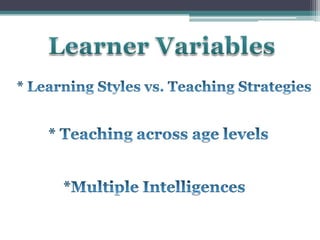
Learner Variables
Practical Aspects of English I
Natalia Guevara
&
Stephany Fernández
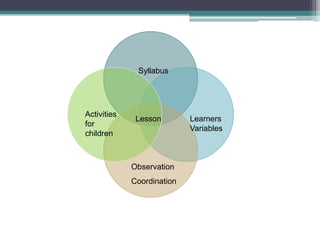
Syllabus


Activities
              Lesson        Learners
for
                            Variables
children


             Observation
             Coordination
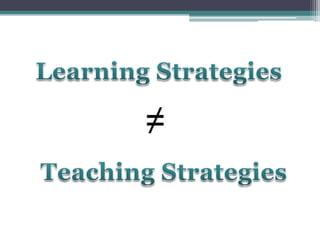
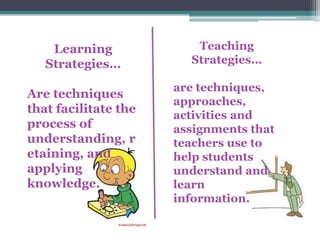
Learning             Teaching
   Strategies…          Strategies…

                      are techniques,
Are techniques
                      approaches,
that facilitate the
                      activities and
process of            assignments that
understanding, r      teachers use to
etaining, and         help students
applying              understand and
knowledge.            learn
                      information.
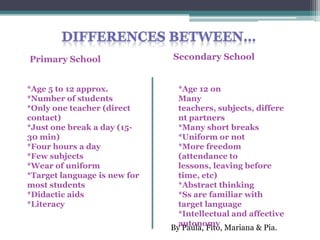
Primary School                Secondary School


*Age 5 to 12 approx.            *Age 12 on
*Number of students             Many
*Only one teacher (direct       teachers, subjects, differe
contact)                        nt partners
*Just one break a day (15-      *Many short breaks
30 min)                         *Uniform or not
*Four hours a day               *More freedom
*Few subjects                   (attendance to
*Wear of uniform                lessons, leaving before
*Target language is new for     time, etc)
most students                   *Abstract thinking
*Didactic aids                  *Ss are familiar with
*Literacy                       target language
                                *Intellectual and affective
                                autonomy
                              By Paula, Fito, Mariana & Pia.
o IntellectualDevelopment:
Children are centered on the here and now. We can
not teach linguistic concepts because they have little
notion of “correctness”.
o Attention Span:
Make lesson interesting, lively and fun. Activities
should be designed to capture their immediate
interest.

 o Sensory input:
 Children need to have all five senses stimulated.
 Pepper your lessons with physical activities.
o AffectiveFactors:
Children are extremely sensitive, especially to
peers. Their egos are still being shaped. Teachers
need to help them to overcome potential barriers.


o Authentic,meaningful language.
Children are focused on what this new language
can actually be used for.

 o Multiple Intelligences
• Adults
       are more able to handle abstract rules and
concepts.

• Adults have longer attention spans for material
that may not be intrinsically interesting to them.
Keep activities short.

• Sensory input need not always be quite as varied
with adults.
• We shouls never underestimate the emotional
factors that may be attendant to adult second
language learning.


• Adults, with their more developed abstract
thinking ability, are better able to
understand a context-reduced segment of
language.
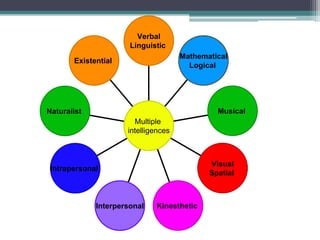
Verbal
                      Linguistic
                                     Mathematical
       Existential
                                       Logical


Naturalist                                    Musical
                       Multiple
                     intelligences


                                            Visual
 Intrapersonal
                                            Spatial


             Interpersonal   Kinesthetic
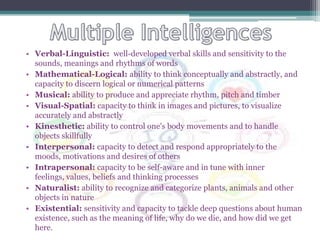
• Verbal-Linguistic: well-developed verbal skills and sensitivity to the
  sounds, meanings and rhythms of words
• Mathematical-Logical: ability to think conceptually and abstractly, and
  capacity to discern logical or numerical patterns
• Musical: ability to produce and appreciate rhythm, pitch and timber
• Visual-Spatial: capacity to think in images and pictures, to visualize
  accurately and abstractly
• Kinesthetic: ability to control one's body movements and to handle
  objects skillfully
• Interpersonal: capacity to detect and respond appropriately to the
  moods, motivations and desires of others
• Intrapersonal: capacity to be self-aware and in tune with inner
  feelings, values, beliefs and thinking processes
• Naturalist: ability to recognize and categorize plants, animals and other
  objects in nature
• Existential: sensitivity and capacity to tackle deep questions about human
  existence, such as the meaning of life, why do we die, and how did we get
  here.
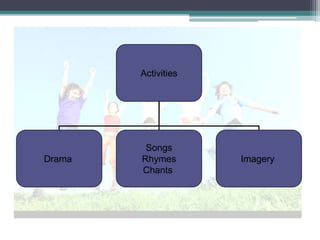
Activities


         Songs
Drama   Rhymes       Imagery
        Chants
•   Provide the possibility to play
•   Give confidence
•   Arouse interest
•   Movement and gesture help illustrate meaning
•   Practise stress,rhythm,pronunciation
•   Make language easy to remember
•   Appeal to the whole class trough visual,aural and
    kinaesthetic channels.
• Advantages:                 • Drama…

 Create a social context      Needs hardwork and
 Ss actively involved in       commitment
  learning                     Do not be put off by failure:
 Identification and            learn from it
  distancing                   Process based
 Compliments any syllabus     not product based
 Words related to physical
  actions
 Learning language becomes
  a creative process
• Children:                • Role of the teacher:

Builds confidence         Function/attitude
Holistic approach
¨Failsafe¨ climate         Carefully planned
Paralinguistic features    Guide
Equal participation in     Check pace
 learning                   Allow mistakes
                            Patient
Produces productive
                            Enthusiastic
 environment
                            Committed
Fun and exciting way to
 learn
Guided Imagery can be used effectively to
stimulate students’ problem solving. It is used to
   help students to explore their feelings and
  attitudes. The students’ prior experience and
 knowledge about the topic must be considered.
 Teaching by Principles by Douglas Brown

 Teaching Content to English Language learners by
Jodi Reiss.

Classroom Teacher’s Survival Guide by Ronald L.
Partin

Drama with children by Sarah Phillips. Oxford

Drama by Charlyn Wessels. Oxford

 Planes y programas anep: primer año

Teaching across age levels

  • 1.
    Learner Variables Practical Aspectsof English I Natalia Guevara & Stephany Fernández
  • 2.
    Syllabus Activities Lesson Learners for Variables children Observation Coordination
  • 5.
    Learning Teaching Strategies… Strategies… are techniques, Are techniques approaches, that facilitate the activities and process of assignments that understanding, r teachers use to etaining, and help students applying understand and knowledge. learn information.
  • 8.
    Primary School Secondary School *Age 5 to 12 approx. *Age 12 on *Number of students Many *Only one teacher (direct teachers, subjects, differe contact) nt partners *Just one break a day (15- *Many short breaks 30 min) *Uniform or not *Four hours a day *More freedom *Few subjects (attendance to *Wear of uniform lessons, leaving before *Target language is new for time, etc) most students *Abstract thinking *Didactic aids *Ss are familiar with *Literacy target language *Intellectual and affective autonomy By Paula, Fito, Mariana & Pia.
  • 9.
    o IntellectualDevelopment: Children arecentered on the here and now. We can not teach linguistic concepts because they have little notion of “correctness”. o Attention Span: Make lesson interesting, lively and fun. Activities should be designed to capture their immediate interest. o Sensory input: Children need to have all five senses stimulated. Pepper your lessons with physical activities.
  • 10.
    o AffectiveFactors: Children areextremely sensitive, especially to peers. Their egos are still being shaped. Teachers need to help them to overcome potential barriers. o Authentic,meaningful language. Children are focused on what this new language can actually be used for. o Multiple Intelligences
  • 11.
    • Adults are more able to handle abstract rules and concepts. • Adults have longer attention spans for material that may not be intrinsically interesting to them. Keep activities short. • Sensory input need not always be quite as varied with adults.
  • 12.
    • We shoulsnever underestimate the emotional factors that may be attendant to adult second language learning. • Adults, with their more developed abstract thinking ability, are better able to understand a context-reduced segment of language.
  • 13.
    Verbal Linguistic Mathematical Existential Logical Naturalist Musical Multiple intelligences Visual Intrapersonal Spatial Interpersonal Kinesthetic
  • 14.
    • Verbal-Linguistic: well-developedverbal skills and sensitivity to the sounds, meanings and rhythms of words • Mathematical-Logical: ability to think conceptually and abstractly, and capacity to discern logical or numerical patterns • Musical: ability to produce and appreciate rhythm, pitch and timber • Visual-Spatial: capacity to think in images and pictures, to visualize accurately and abstractly • Kinesthetic: ability to control one's body movements and to handle objects skillfully • Interpersonal: capacity to detect and respond appropriately to the moods, motivations and desires of others • Intrapersonal: capacity to be self-aware and in tune with inner feelings, values, beliefs and thinking processes • Naturalist: ability to recognize and categorize plants, animals and other objects in nature • Existential: sensitivity and capacity to tackle deep questions about human existence, such as the meaning of life, why do we die, and how did we get here.
  • 15.
    Activities Songs Drama Rhymes Imagery Chants
  • 16.
    Provide the possibility to play • Give confidence • Arouse interest • Movement and gesture help illustrate meaning • Practise stress,rhythm,pronunciation • Make language easy to remember • Appeal to the whole class trough visual,aural and kinaesthetic channels.
  • 17.
    • Advantages: • Drama…  Create a social context  Needs hardwork and  Ss actively involved in commitment learning  Do not be put off by failure:  Identification and learn from it distancing  Process based  Compliments any syllabus not product based  Words related to physical actions  Learning language becomes a creative process
  • 18.
    • Children: • Role of the teacher: Builds confidence Function/attitude Holistic approach ¨Failsafe¨ climate  Carefully planned Paralinguistic features  Guide Equal participation in  Check pace learning  Allow mistakes  Patient Produces productive  Enthusiastic environment  Committed Fun and exciting way to learn
  • 19.
    Guided Imagery canbe used effectively to stimulate students’ problem solving. It is used to help students to explore their feelings and attitudes. The students’ prior experience and knowledge about the topic must be considered.
  • 20.
     Teaching byPrinciples by Douglas Brown  Teaching Content to English Language learners by Jodi Reiss. Classroom Teacher’s Survival Guide by Ronald L. Partin Drama with children by Sarah Phillips. Oxford Drama by Charlyn Wessels. Oxford  Planes y programas anep: primer año