Teacher Professional Development
Classroom Action Research
Madan Rijal
M.Ed. in Mathematics
Kathmandu University
School of Education
Instructor : Mr. Amrit Bahadur Thapa
8/2/2021 1
OUTLINES
 Action Research
 Classroom Action Research (CAR) and its importance

 Steps in Conducting an Action Research Study
 Criteria for evaluating action research report
8/2/2021 2
Action Research
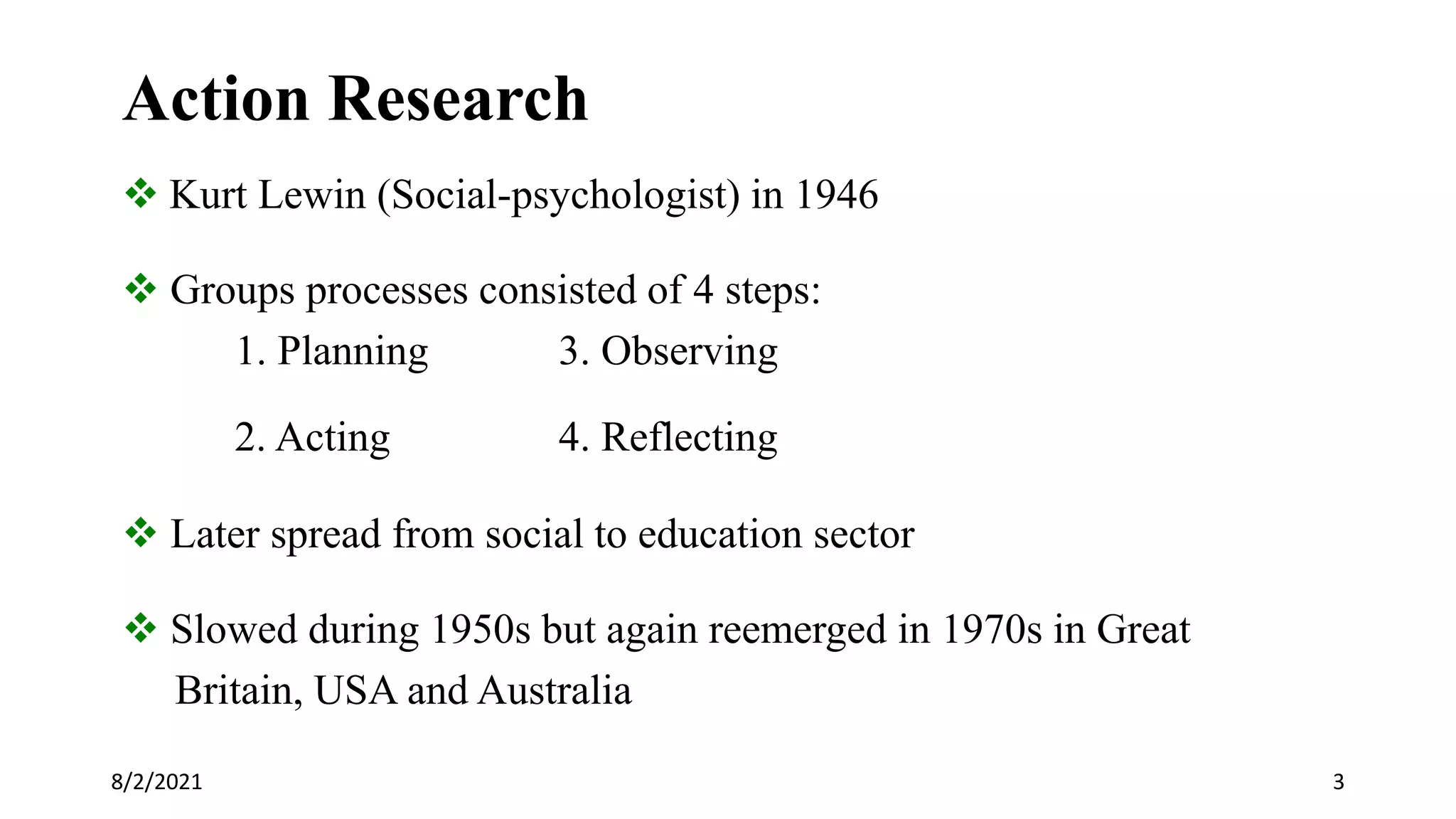
 Kurt Lewin (Social-psychologist) in 1946
 Groups processes consisted of 4 steps:
1. Planning 3. Observing
2. Acting 4. Reflecting
 Later spread from social to education sector
 Slowed during 1950s but again reemerged in 1970s in Great
Britain, USA and Australia
8/2/2021 3
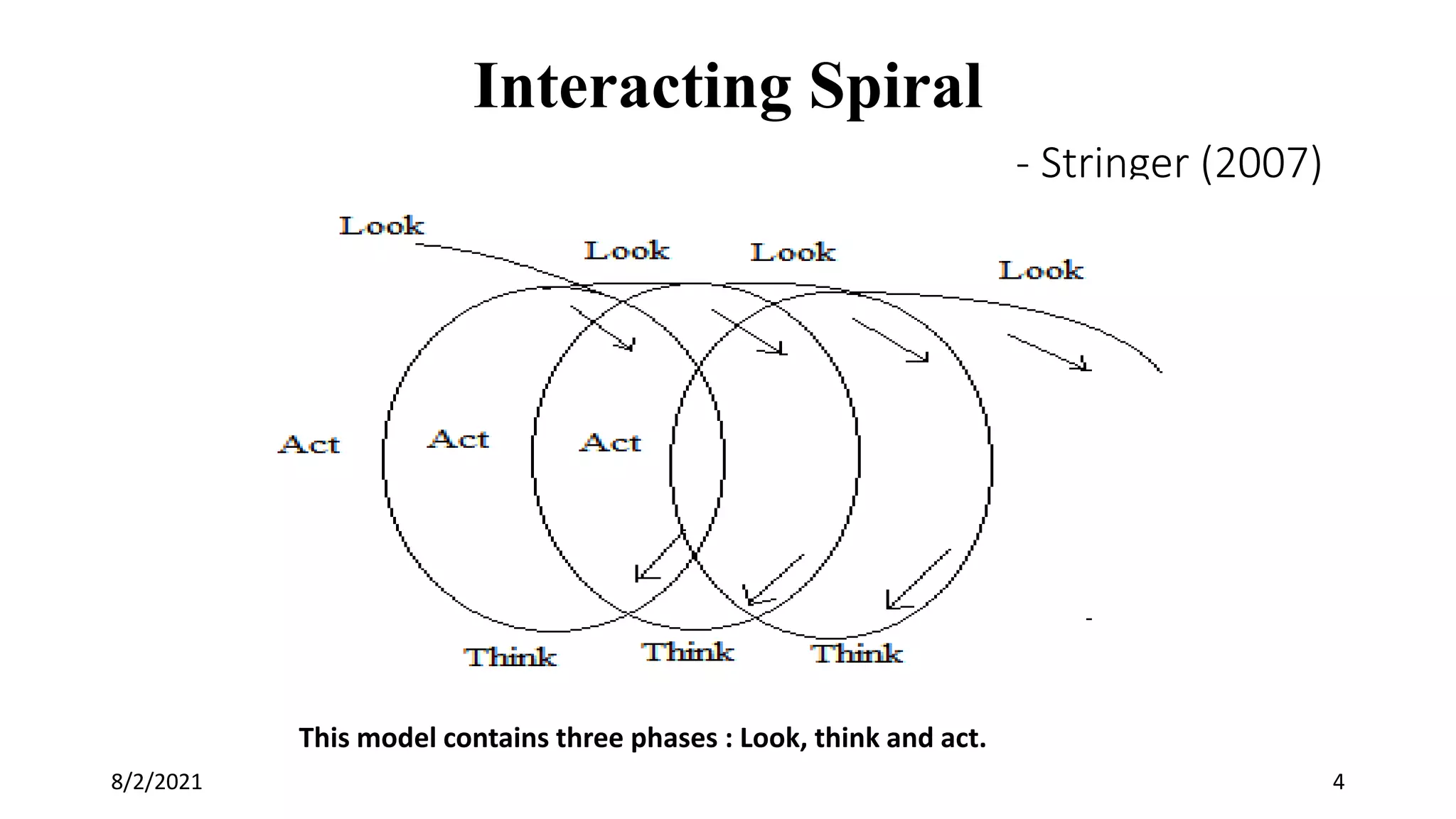
Interacting Spiral
- Stringer (2007)
8/2/2021 4
This model contains three phases : Look, think and act.
Classroom Action Research
 A method of finding out what works best in own classroom to improve
students learning.
 A kind of research begins with a question (questions) about
i) classroom experiences ii) issues or challenges
 CAR fits in the center of a continuum ranging from personal reflection
at one end to formal educational research at the other.
 It helps teachers to explore and examine aspects of teaching and
learning and to take action to change and improve.
8/2/2021 5
Why do Classroom Action Research (CAR)?
 A very effective way of improving teaching,
(different approaches, reflective practices, develop confidence)
 CAR provides a means of documenting teaching effectiveness,
 CAR provides a renewed sense of excitement about teaching.
8/2/2021 6
Who is it for?
For any teacher who wants to :
• Take action to improve student learning
• Understand more about teaching and learning
• Develop teaching skills and knowledge
8/2/2021 7
Seven Step process of CAR
(Bell, 1993; Sagor, 2000; and Hubbard and Power, 1993)
• Step 1 : Identify a question or problem
• Step 2 : Review Literature
• Step 3 : Plan a research strategy
• Step 4 : Gather Data
• Step 5 : Make sense of the data
• Step 6 : Take action
• Step 7 : Share own findings
8/2/2021 8
Step 1 : Identify a question or problem
This question should be something related to student learning in classroom.
Eg:
a) Would a different types of assignment enhance student understanding?
a) Would a strict attendance policy result in better performance?
a) Would more time spent in co-operative learning groups help students
understand concept at a higher level?
a) ….
8/2/2021 9
Step 2 : Review Literature
• Need to gather two types of information
1. Background literature (Cross and Steadman, 1996; Woolfolk, 2000)
provides background information on learning, motivation and
classroom management topics
2. Data (ERIC database, http://ericir.syr.edu)
provides references to a huge number of published and unpublished
manuscripts.
8/2/2021 10
Step 3 : Plan a research strategy
CAR study may take many forms such as
i) Pretest – Posttest design
ii) Comparison of similar classes
iii) Descriptive case study of a single class or student
8/2/2021 11
Step 4 : Gather Data
CAR tends to rely largely on existing data such as
i) Scores,
ii) Teachers evaluations
iii) final course grades
iv) Review (for adult students)
v) Peer observation
vi) Teacher diary
vii) Learner feedback
viii) Lesson evaluation
ix) Recording lessons
x) Reflecting on learners’ work
xi) Surveys
8/2/2021 12
Step 5 : Make sense of the data
Means analyze own data and looking for findings with practical significance.
i) For quantitative data : simple t-tests, correlations, tables and graphs
and others
i) For qualitative data : recurring themes, citing supporting evidence
Practical significance, rather than statistical
significance, is the goal.
8/2/2021 13
Step 6 : Take action
 Use findings to make decisions about teaching
strategies or
 In case of equally effective findings according to
teachers’ preference or that of the students.
8/2/2021 14
Step 7 : Share own findings
Findings can be shared with peers in many ways
 General meeting
International conference for teacher-researchers
(http://www.educ.ubc.ca/ictr2001)
8/2/2021 15
References
Mettetal, G. and Cowan, P. (2000), Assessing learning through classroom research: The
Supporting Teachers As Researchers Project (STAR). Classroom Leadership
Online, 3 (8) at http://www.ascd.org/readingroom/classlead/0005/1may00.html
Bell, J. (1993). Doing your research project, 2nd edition. Philadelphia: Open University
Press.
Hubbard, R.S. and Power, B.M. (1993) The Art of classroom inquiry. Portsmouth, NH :
Heinemann.
Sagor, R. (2000). Guiding school improvement with action research. Alexandria, VA :
Association for Supervision and Curriculum Development.
8/2/2021 16
References
Cross, K.P. and Steadman, M.H. (1996). Classroom research: Implementing the
scholarship of teaching. San Francisco, CA: Jossey-Bass.
Woolfolk, A. (2000). Educationalpsychology, 8th edition. Needham Heights, MA: Allyn
and Bacon.
8/2/2021 17
8/2/2021 18

Classroom action research

  • 1.
    Teacher Professional Development ClassroomAction Research Madan Rijal M.Ed. in Mathematics Kathmandu University School of Education Instructor : Mr. Amrit Bahadur Thapa 8/2/2021 1
  • 2.
    OUTLINES  Action Research Classroom Action Research (CAR) and its importance   Steps in Conducting an Action Research Study  Criteria for evaluating action research report 8/2/2021 2
  • 3.
    Action Research  KurtLewin (Social-psychologist) in 1946  Groups processes consisted of 4 steps: 1. Planning 3. Observing 2. Acting 4. Reflecting  Later spread from social to education sector  Slowed during 1950s but again reemerged in 1970s in Great Britain, USA and Australia 8/2/2021 3
  • 4.
    Interacting Spiral - Stringer(2007) 8/2/2021 4 This model contains three phases : Look, think and act.
  • 5.
    Classroom Action Research A method of finding out what works best in own classroom to improve students learning.  A kind of research begins with a question (questions) about i) classroom experiences ii) issues or challenges  CAR fits in the center of a continuum ranging from personal reflection at one end to formal educational research at the other.  It helps teachers to explore and examine aspects of teaching and learning and to take action to change and improve. 8/2/2021 5
  • 6.
    Why do ClassroomAction Research (CAR)?  A very effective way of improving teaching, (different approaches, reflective practices, develop confidence)  CAR provides a means of documenting teaching effectiveness,  CAR provides a renewed sense of excitement about teaching. 8/2/2021 6
  • 7.
    Who is itfor? For any teacher who wants to : • Take action to improve student learning • Understand more about teaching and learning • Develop teaching skills and knowledge 8/2/2021 7
  • 8.
    Seven Step processof CAR (Bell, 1993; Sagor, 2000; and Hubbard and Power, 1993) • Step 1 : Identify a question or problem • Step 2 : Review Literature • Step 3 : Plan a research strategy • Step 4 : Gather Data • Step 5 : Make sense of the data • Step 6 : Take action • Step 7 : Share own findings 8/2/2021 8
  • 9.
    Step 1 :Identify a question or problem This question should be something related to student learning in classroom. Eg: a) Would a different types of assignment enhance student understanding? a) Would a strict attendance policy result in better performance? a) Would more time spent in co-operative learning groups help students understand concept at a higher level? a) …. 8/2/2021 9
  • 10.
    Step 2 :Review Literature • Need to gather two types of information 1. Background literature (Cross and Steadman, 1996; Woolfolk, 2000) provides background information on learning, motivation and classroom management topics 2. Data (ERIC database, http://ericir.syr.edu) provides references to a huge number of published and unpublished manuscripts. 8/2/2021 10
  • 11.
    Step 3 :Plan a research strategy CAR study may take many forms such as i) Pretest – Posttest design ii) Comparison of similar classes iii) Descriptive case study of a single class or student 8/2/2021 11
  • 12.
    Step 4 :Gather Data CAR tends to rely largely on existing data such as i) Scores, ii) Teachers evaluations iii) final course grades iv) Review (for adult students) v) Peer observation vi) Teacher diary vii) Learner feedback viii) Lesson evaluation ix) Recording lessons x) Reflecting on learners’ work xi) Surveys 8/2/2021 12
  • 13.
    Step 5 :Make sense of the data Means analyze own data and looking for findings with practical significance. i) For quantitative data : simple t-tests, correlations, tables and graphs and others i) For qualitative data : recurring themes, citing supporting evidence Practical significance, rather than statistical significance, is the goal. 8/2/2021 13
  • 14.
    Step 6 :Take action  Use findings to make decisions about teaching strategies or  In case of equally effective findings according to teachers’ preference or that of the students. 8/2/2021 14
  • 15.
    Step 7 :Share own findings Findings can be shared with peers in many ways  General meeting International conference for teacher-researchers (http://www.educ.ubc.ca/ictr2001) 8/2/2021 15
  • 16.
    References Mettetal, G. andCowan, P. (2000), Assessing learning through classroom research: The Supporting Teachers As Researchers Project (STAR). Classroom Leadership Online, 3 (8) at http://www.ascd.org/readingroom/classlead/0005/1may00.html Bell, J. (1993). Doing your research project, 2nd edition. Philadelphia: Open University Press. Hubbard, R.S. and Power, B.M. (1993) The Art of classroom inquiry. Portsmouth, NH : Heinemann. Sagor, R. (2000). Guiding school improvement with action research. Alexandria, VA : Association for Supervision and Curriculum Development. 8/2/2021 16
  • 17.
    References Cross, K.P. andSteadman, M.H. (1996). Classroom research: Implementing the scholarship of teaching. San Francisco, CA: Jossey-Bass. Woolfolk, A. (2000). Educationalpsychology, 8th edition. Needham Heights, MA: Allyn and Bacon. 8/2/2021 17
  • 18.