Writing Action Research
Proposal
Joel A. Alfarero
College of Education
Easter Visayas State University
District In-Service training on Research and innovation Towards Improving
the Curriculum
Sta. Rita I District
San Juan Elementary School
Sta. Rita, Samar
February 10, 2023
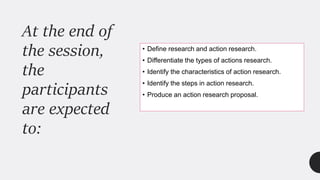
At the end of
the session,
the
participants
are expected
to:
• Define research and action research.
• Differentiate the types of actions research.
• Identify the characteristics of action research.
• Identify the steps in action research.
• Produce an action research proposal.
Activity 1: Think-Pair Share
• Think of a classroom problem or
issue that you have experienced in
the course of your teaching?
•What did you do to address the
problem or issue?
Reflect
is a process of steps used to collect and analyze
information to increase our understanding of a topic or
issue. At a general level, research consists of three steps:
1. Pose a question.
2. Collect data to answer the question.
3. Present an answer to the question.
Research . . .
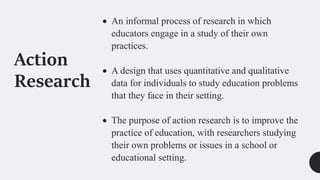
 An informal process of research in which
educators engage in a study of their own
practices.
 A design that uses quantitative and qualitative
data for individuals to study education problems
that they face in their setting.
 The purpose of action research is to improve the
practice of education, with researchers studying
their own problems or issues in a school or
educational setting.
Action
Research
Is an approach that involves
educators examining a school
situation with a view toward
improving practice.
Practical
Action
Research
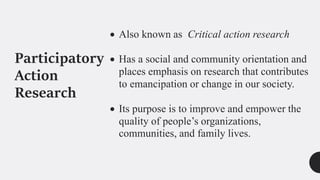
 Also known as Critical action research
 Has a social and community orientation and
places emphasis on research that contributes
to emancipation or change in our society.
 Its purpose is to improve and empower the
quality of people’s organizations,
communities, and family lives.
Participatory
Action
Research
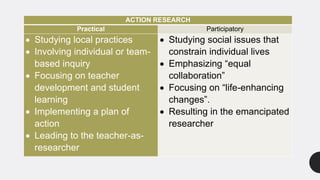
ACTION RESEARCH
Practical Participatory
 Studying local practices
 Involving individual or team-
based inquiry
 Focusing on teacher
development and student
learning
 Implementing a plan of
action
 Leading to the teacher-as-
researcher
 Studying social issues that
constrain individual lives
 Emphasizing “equal
collaboration”
 Focusing on “life-enhancing
changes”.
 Resulting in the emancipated
researcher
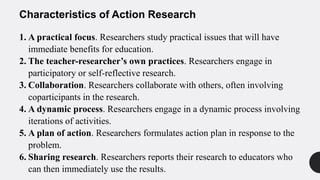
1. A practical focus. Researchers study practical issues that will have
immediate benefits for education.
2. The teacher-researcher’s own practices. Researchers engage in
participatory or self-reflective research.
3. Collaboration. Researchers collaborate with others, often involving
coparticipants in the research.
4. A dynamic process. Researchers engage in a dynamic process involving
iterations of activities.
5. A plan of action. Researchers formulates action plan in response to the
problem.
6. Sharing research. Researchers reports their research to educators who
can then immediately use the results.
Characteristics of Action Research
Steps in Classroom-Based Action Research
(Enclosure No.2 to DepEd Memorandum
No 114, s. 2017)
STEPS STEMS
Step 1. Identify the
problem
Reflect on your
experiences and
identify the most
critical problem that
affects your student’s
learning
One of the most prevalent issues in my classroom
that affects the learning of my students is
_____________________________________________
_____________________________________________
_____________________________________________
_____________________________________________
_____________________________________________
_____________________________________________
STEPS STEMS
Step 2. Search the
literature or interview
your colleagues for
previous
strategies/interventions
used to solve this
problem
Refer to previous studies
(use internet if you do not
have access to journals)
and see if there have
been efforts done to
solve the problem or
similar problems
The strategies/interventions used before
to solve this issue are the following:
(include the name of the author and the
year of publication and briefly discuss
their findings)
__________________________________________________
__________________________________________________
__________________________________________________
__________________________________________________
__________________________________________________
__________________________________________________
__________________________________________________
__________________________________________________
STEPS STEMS
Step 3: Develop a
strategy/intervention
Based on previous studies,
along with your experiences,
develop a
strategy/intervention to solve
the problem. Then,
implement the
strategy/intervention in your
classroom
I will solve the problem by (your
strategy/intervention – what will you do)
_________________________________________
__________________________________________
The data that I will record include ( the kind
of data that you need to gather and record
will provide evidence to the effectiveness of
your/strategy/intervention)
____________________________________
____________________________________
STEPS STEMS
Step 4: Identify findings
Analyze your data – looking
for findings with practical
significance. If you are
dealing with quantitative
data, simple statistical tools
are enough. If dealing with
qualitative data (interview,
observation, discussion) then
look for recurring themes or
patterns.
The data show that
___________________________________
____________________________________
____________________________________
The findings show that I have solved/have
not solved the problem because
____________________________________
____________________________________
____________________________________
____________________________________
STEPS STEMS
Step 5: Make a
decision
Use your findings to
make decisions related
to the learning of your
students
I will continue/discontinue using the strategy/approach
because more than half f my students have shown very
high score in reading comprehension test after 3
weeks.______________________________________
____________________________________________
The approach/intervention I used worked/ did not
work well because
___________________________________________
___________________________________________
In case where the strategy/intervention failed to solve
the problem
I will try another strategy/intervention like (then go
back to Step 3)
Writing-Action-Research-Proposal.pptx

Writing-Action-Research-Proposal.pptx

  • 1.
    Writing Action Research Proposal JoelA. Alfarero College of Education Easter Visayas State University District In-Service training on Research and innovation Towards Improving the Curriculum Sta. Rita I District San Juan Elementary School Sta. Rita, Samar February 10, 2023
  • 2.
    At the endof the session, the participants are expected to: • Define research and action research. • Differentiate the types of actions research. • Identify the characteristics of action research. • Identify the steps in action research. • Produce an action research proposal.
  • 3.
    Activity 1: Think-PairShare • Think of a classroom problem or issue that you have experienced in the course of your teaching? •What did you do to address the problem or issue? Reflect
  • 4.
    is a processof steps used to collect and analyze information to increase our understanding of a topic or issue. At a general level, research consists of three steps: 1. Pose a question. 2. Collect data to answer the question. 3. Present an answer to the question. Research . . .
  • 5.
     An informalprocess of research in which educators engage in a study of their own practices.  A design that uses quantitative and qualitative data for individuals to study education problems that they face in their setting.  The purpose of action research is to improve the practice of education, with researchers studying their own problems or issues in a school or educational setting. Action Research
  • 6.
    Is an approachthat involves educators examining a school situation with a view toward improving practice. Practical Action Research
  • 7.
     Also knownas Critical action research  Has a social and community orientation and places emphasis on research that contributes to emancipation or change in our society.  Its purpose is to improve and empower the quality of people’s organizations, communities, and family lives. Participatory Action Research
  • 8.
    ACTION RESEARCH Practical Participatory Studying local practices  Involving individual or team- based inquiry  Focusing on teacher development and student learning  Implementing a plan of action  Leading to the teacher-as- researcher  Studying social issues that constrain individual lives  Emphasizing “equal collaboration”  Focusing on “life-enhancing changes”.  Resulting in the emancipated researcher
  • 9.
    1. A practicalfocus. Researchers study practical issues that will have immediate benefits for education. 2. The teacher-researcher’s own practices. Researchers engage in participatory or self-reflective research. 3. Collaboration. Researchers collaborate with others, often involving coparticipants in the research. 4. A dynamic process. Researchers engage in a dynamic process involving iterations of activities. 5. A plan of action. Researchers formulates action plan in response to the problem. 6. Sharing research. Researchers reports their research to educators who can then immediately use the results. Characteristics of Action Research
  • 10.
    Steps in Classroom-BasedAction Research (Enclosure No.2 to DepEd Memorandum No 114, s. 2017)
  • 11.
    STEPS STEMS Step 1.Identify the problem Reflect on your experiences and identify the most critical problem that affects your student’s learning One of the most prevalent issues in my classroom that affects the learning of my students is _____________________________________________ _____________________________________________ _____________________________________________ _____________________________________________ _____________________________________________ _____________________________________________
  • 12.
    STEPS STEMS Step 2.Search the literature or interview your colleagues for previous strategies/interventions used to solve this problem Refer to previous studies (use internet if you do not have access to journals) and see if there have been efforts done to solve the problem or similar problems The strategies/interventions used before to solve this issue are the following: (include the name of the author and the year of publication and briefly discuss their findings) __________________________________________________ __________________________________________________ __________________________________________________ __________________________________________________ __________________________________________________ __________________________________________________ __________________________________________________ __________________________________________________
  • 13.
    STEPS STEMS Step 3:Develop a strategy/intervention Based on previous studies, along with your experiences, develop a strategy/intervention to solve the problem. Then, implement the strategy/intervention in your classroom I will solve the problem by (your strategy/intervention – what will you do) _________________________________________ __________________________________________ The data that I will record include ( the kind of data that you need to gather and record will provide evidence to the effectiveness of your/strategy/intervention) ____________________________________ ____________________________________
  • 14.
    STEPS STEMS Step 4:Identify findings Analyze your data – looking for findings with practical significance. If you are dealing with quantitative data, simple statistical tools are enough. If dealing with qualitative data (interview, observation, discussion) then look for recurring themes or patterns. The data show that ___________________________________ ____________________________________ ____________________________________ The findings show that I have solved/have not solved the problem because ____________________________________ ____________________________________ ____________________________________ ____________________________________
  • 15.
    STEPS STEMS Step 5:Make a decision Use your findings to make decisions related to the learning of your students I will continue/discontinue using the strategy/approach because more than half f my students have shown very high score in reading comprehension test after 3 weeks.______________________________________ ____________________________________________ The approach/intervention I used worked/ did not work well because ___________________________________________ ___________________________________________ In case where the strategy/intervention failed to solve the problem I will try another strategy/intervention like (then go back to Step 3)