IIT Bombay
By
Birupakshya Panda
M.Tech Petroleum Geoscience
Department of Earth Sciences
What is diagenesis?
• The sum of all processes (physical, chemical or biological) that bring
changes in composition or texture of sediments or any pre-existing
sedimentary rock during or after its formation. It includes
• The range of physical and chemical conditions included in diagenesis is 0o
to 200o C, 1 to 2000 bars and water salinities from fresh water to
concentrated brines.
• Surface alteration (weathering) and metamorphism are not included in
this process.
• Porosity decreases during diagenesis, except in rare cases such as
dissolution of minerals and dolomitization.
 Compaction
 Bioturbation
 Replacement of pre-existing minerals
 Formation of new minerals by precipitation
 Dissolution
 Bio-degradation
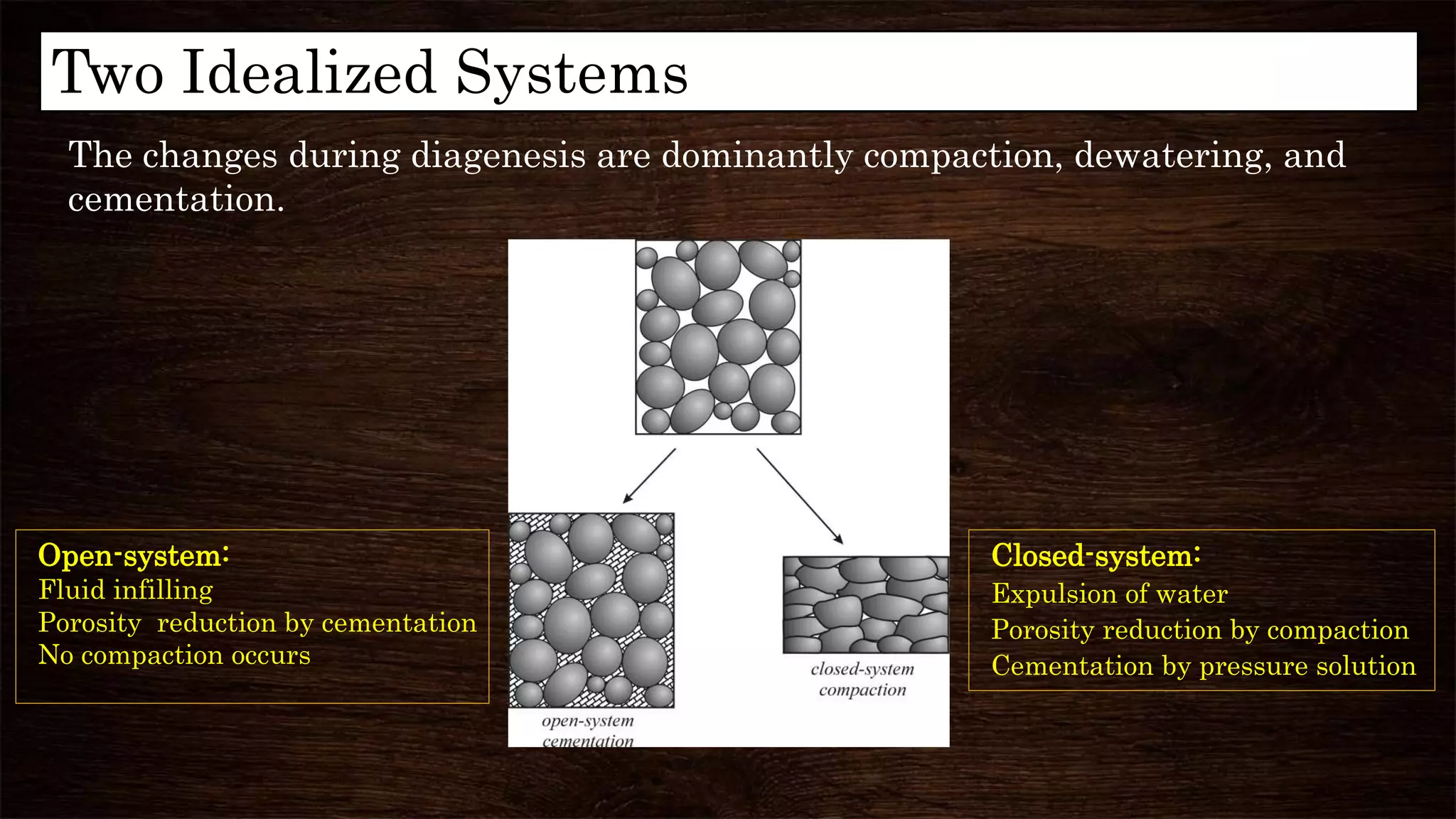
Two Idealized Systems
The changes during diagenesis are dominantly compaction, dewatering, and
cementation.
Closed-system:
Expulsion of water
Porosity reduction by compaction
Cementation by pressure solution
Open-system:
Fluid infilling
Porosity reduction by cementation
No compaction occurs
(a) Syndiagenesis (the sedimentation phase)
(b) Anadiagenesis (the compaction-maturation phase)
(c) Epidiagenesis (the emergent-pre-erosion phase)
Three stages of diagenesis
• The main diagenetic processes that have affected
the mudrocks are compaction, authigenic
minerals, and replacement
• Mechanical compaction: porosity reduction and
hence the volume (function of grain strength and
effective stress) The texture was affected by
compaction allowing the clay and silt grains to lie
parallel to the lamination of the rocks as shown
• Chemical compaction: temperature dependent,
mineral dissolution and precipitation (function of
mineral stability and precipitation of mineral
phases)
e.g. Porosity of the montmorillonite clay reduces
very less as compared to kaolinite and illite at the
same overburden stress. Compaction depends on
smectite content.
• Calcite is the most abundant replacement
mineral in the mudrocks. Calcite replaced both
the clay matrix and silt-grains.
Diagenesis of mudstone or claystone
Mechanical and chemical compaction in mudrocks
Mechanical compaction Chemical compaction
• Illite (low alumina clays, 10-20%)
• Kaolinite (high alumina clays, 20-40%)
• Smectite (Montmorillonite [Al], Saponite [Mg], Nontronite [Fe])
• Chlorite
Common clay minerals
Hydrous aluminium phyllosilicates
kaolinite
illite smectite chlorite
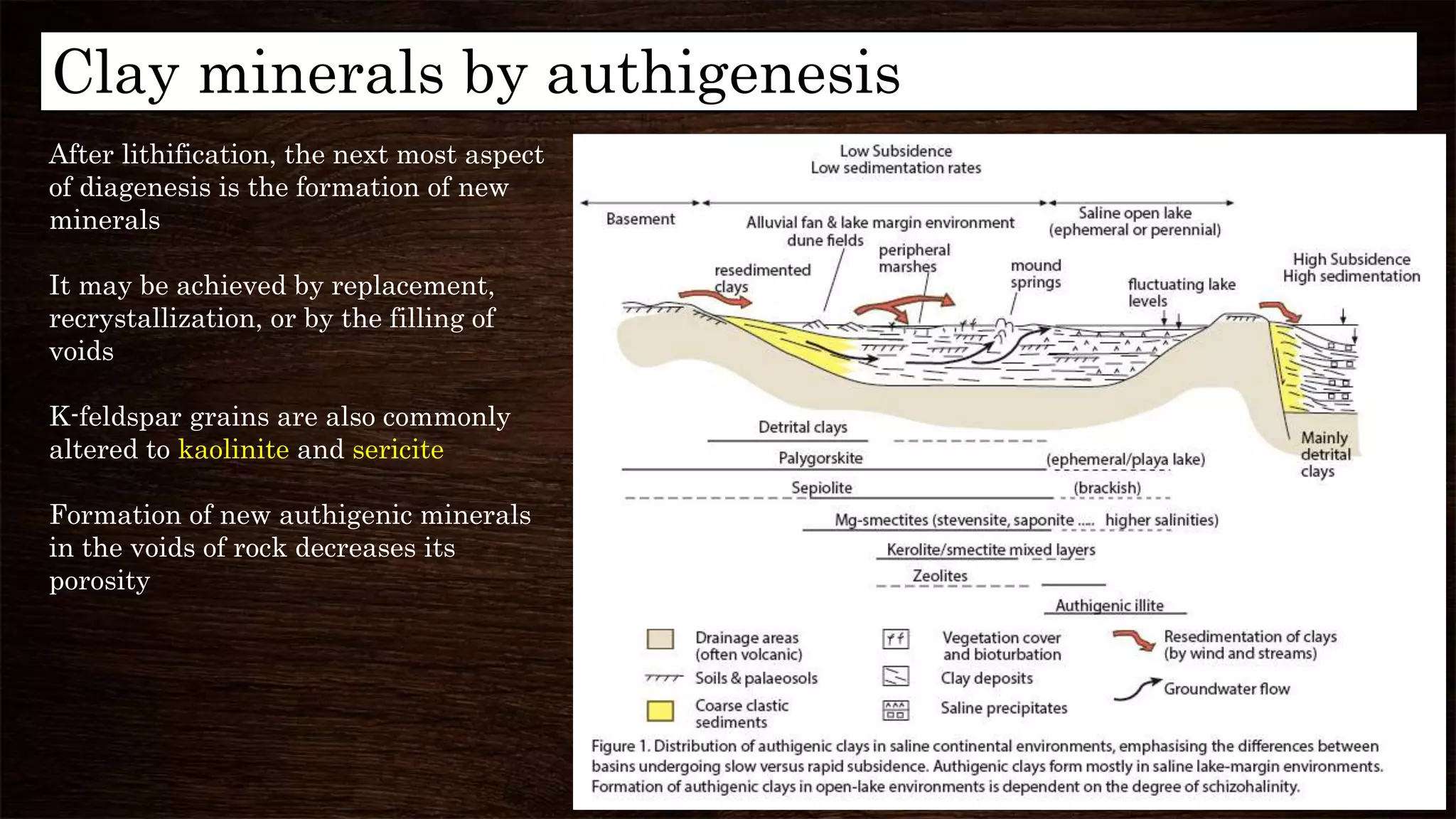
Clay minerals by authigenesis
After lithification, the next most aspect
of diagenesis is the formation of new
minerals
It may be achieved by replacement,
recrystallization, or by the filling of
voids
K-feldspar grains are also commonly
altered to kaolinite and sericite
Formation of new authigenic minerals
in the voids of rock decreases its
porosity
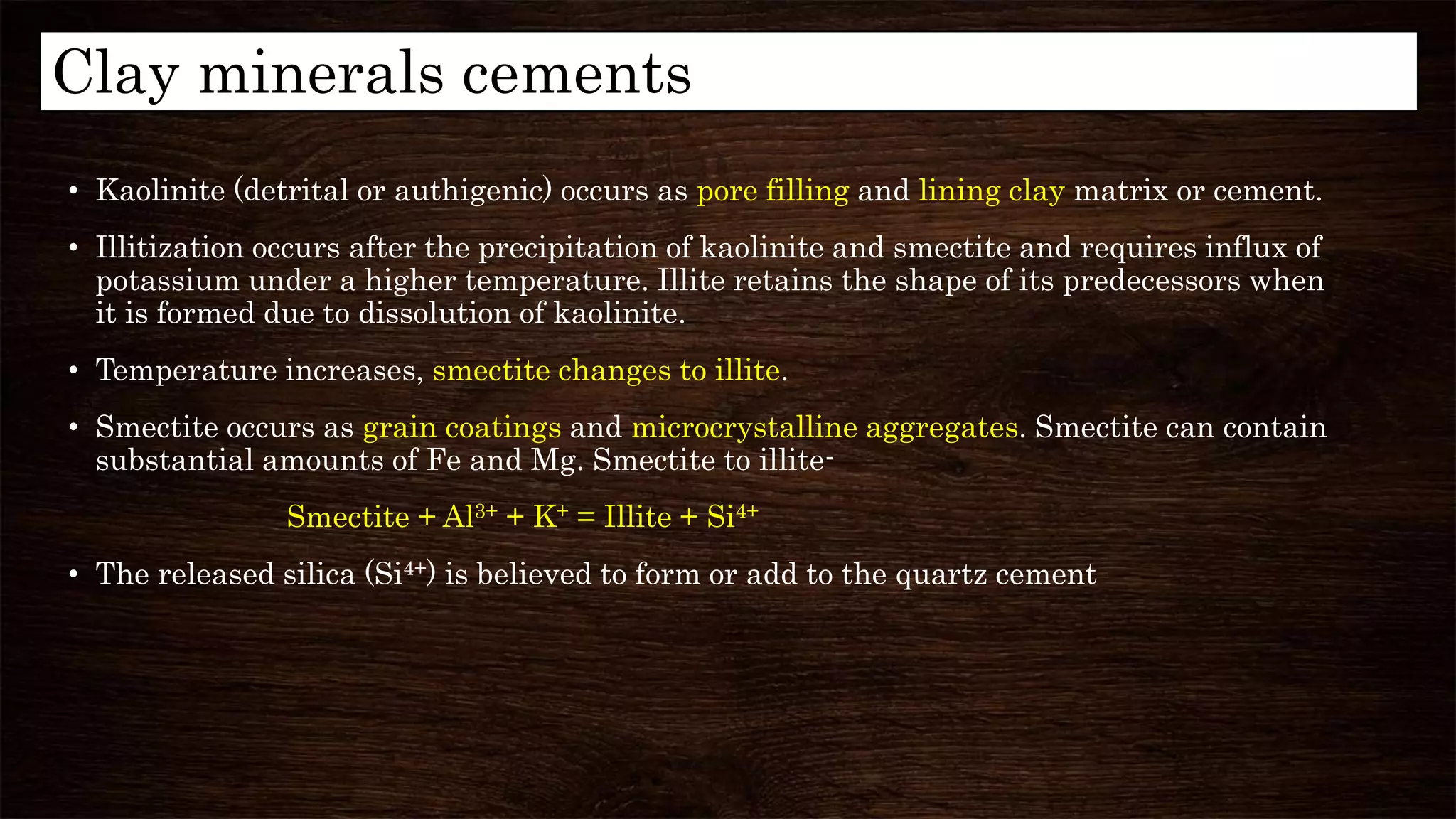
• Kaolinite (detrital or authigenic) occurs as pore filling and lining clay matrix or cement.
• Illitization occurs after the precipitation of kaolinite and smectite and requires influx of
potassium under a higher temperature. Illite retains the shape of its predecessors when
it is formed due to dissolution of kaolinite.
• Temperature increases, smectite changes to illite.
• Smectite occurs as grain coatings and microcrystalline aggregates. Smectite can contain
substantial amounts of Fe and Mg. Smectite to illite-
Smectite + Al3+ + K+ = Illite + Si4+
• The released silica (Si4+) is believed to form or add to the quartz cement
Clay minerals cements
Three common types of clay cements
Kaolinite to illite
Clay minerals of hydrocarbon-bearing Permian Rotliegend sandstones of the North Sea
• Indication of tectonics and sedimentation
The amount and type of clay minerals are a function of the provenance of clastic minerals and of diagenetic
reactions at shallow and greater depth in different tectonic and sedimentary settings.
• Indicator of hydrocarbon generation and expulsion
Since clay minerals and organic matters usually coexist in the sedimentary rocks and the ultrafine clay minerals
are sensitive to the changes in the rocks accompanying the hydrocarbon generation and expulsion processes.
Transformation of montmorillonite to mixed-layer montmorillonite/illite to illite and changes in the ordering of
Illite/smectite (I/S) are particularly useful in studying the hydrocarbon generation because of the common
coincidence between the temperatures of peak oil generation.
• Hydrocarbon migration and accumulation
The replacement of kaolinite by illite or direct precipitation of illite indicates fluid flow where the fluids is in
disequilibrium within the reservoir sandstone. The existence of secondary illite does indicate aqueous fluid flow
and thus can be used as indices of fluid movement and hence signal the possible hydrocarbon migration.
• Petrophysical property study
Porosity, permeability, shale volume, water saturation and hydrocarbon saturation
Importance of clay in hydrocarbon exploration
References
• Larsen, G., & Chilingar, G. V. (Eds.). (1983). Diagenesis in sediments and sedimentary rocks (Vol. 2). Elsevier.
• Baiyegunhi, C., Liu, K., & Gwavava, O. (2017). Diagenesis and Reservoir Properties of the Permian Ecca Group
Sandstones and Mudrocks in the Eastern Cape Province, South Africa. Minerals, 7(6), 88.
• Bjørlykke, K. (1998). Clay mineral diagenesis in sedimentary basins—a key to the prediction of rock properties. Examples
from the North Sea Basin. Clay minerals, 33(1), 15-34.
• Jiang, S. (2012). Clay minerals from the perspective of oil and gas exploration. In Clay Minerals in Nature-Their
Characterization, Modification and Application. InTech.
• Ziegler, K. (2006). Clay minerals of the Permian Rotliegend Group in the North Sea and adjacent areas. Clay
minerals, 41(1), 355-393.
• Wilson, M. J., Wilson, L., & Patey, I. (2014). The influence of individual clay minerals on formation damage of reservoir
sandstones: a critical review with some new insights. Clay Minerals, 49(2), 147-164.
• Neasham, J. W. (1979). Characterization of Rock Mineral and Pore Space Properties for Proper Reservoir Description and
Formation Evaluation, Gulf Coast. AAPG Bulletin, 63(3), 501-501.
• Warren, J, Clays, S. Salty Matters
Diagenesis of clay minerals

Diagenesis of clay minerals

  • 1.
    IIT Bombay By Birupakshya Panda M.TechPetroleum Geoscience Department of Earth Sciences
  • 2.
    What is diagenesis? •The sum of all processes (physical, chemical or biological) that bring changes in composition or texture of sediments or any pre-existing sedimentary rock during or after its formation. It includes • The range of physical and chemical conditions included in diagenesis is 0o to 200o C, 1 to 2000 bars and water salinities from fresh water to concentrated brines. • Surface alteration (weathering) and metamorphism are not included in this process. • Porosity decreases during diagenesis, except in rare cases such as dissolution of minerals and dolomitization.  Compaction  Bioturbation  Replacement of pre-existing minerals  Formation of new minerals by precipitation  Dissolution  Bio-degradation
  • 3.
    Two Idealized Systems Thechanges during diagenesis are dominantly compaction, dewatering, and cementation. Closed-system: Expulsion of water Porosity reduction by compaction Cementation by pressure solution Open-system: Fluid infilling Porosity reduction by cementation No compaction occurs
  • 4.
    (a) Syndiagenesis (thesedimentation phase) (b) Anadiagenesis (the compaction-maturation phase) (c) Epidiagenesis (the emergent-pre-erosion phase) Three stages of diagenesis
  • 5.
    • The maindiagenetic processes that have affected the mudrocks are compaction, authigenic minerals, and replacement • Mechanical compaction: porosity reduction and hence the volume (function of grain strength and effective stress) The texture was affected by compaction allowing the clay and silt grains to lie parallel to the lamination of the rocks as shown • Chemical compaction: temperature dependent, mineral dissolution and precipitation (function of mineral stability and precipitation of mineral phases) e.g. Porosity of the montmorillonite clay reduces very less as compared to kaolinite and illite at the same overburden stress. Compaction depends on smectite content. • Calcite is the most abundant replacement mineral in the mudrocks. Calcite replaced both the clay matrix and silt-grains. Diagenesis of mudstone or claystone
  • 6.
    Mechanical and chemicalcompaction in mudrocks Mechanical compaction Chemical compaction
  • 7.
    • Illite (lowalumina clays, 10-20%) • Kaolinite (high alumina clays, 20-40%) • Smectite (Montmorillonite [Al], Saponite [Mg], Nontronite [Fe]) • Chlorite Common clay minerals Hydrous aluminium phyllosilicates kaolinite illite smectite chlorite
  • 8.
    Clay minerals byauthigenesis After lithification, the next most aspect of diagenesis is the formation of new minerals It may be achieved by replacement, recrystallization, or by the filling of voids K-feldspar grains are also commonly altered to kaolinite and sericite Formation of new authigenic minerals in the voids of rock decreases its porosity
  • 9.
    • Kaolinite (detritalor authigenic) occurs as pore filling and lining clay matrix or cement. • Illitization occurs after the precipitation of kaolinite and smectite and requires influx of potassium under a higher temperature. Illite retains the shape of its predecessors when it is formed due to dissolution of kaolinite. • Temperature increases, smectite changes to illite. • Smectite occurs as grain coatings and microcrystalline aggregates. Smectite can contain substantial amounts of Fe and Mg. Smectite to illite- Smectite + Al3+ + K+ = Illite + Si4+ • The released silica (Si4+) is believed to form or add to the quartz cement Clay minerals cements
  • 10.
    Three common typesof clay cements
  • 11.
    Kaolinite to illite Clayminerals of hydrocarbon-bearing Permian Rotliegend sandstones of the North Sea
  • 12.
    • Indication oftectonics and sedimentation The amount and type of clay minerals are a function of the provenance of clastic minerals and of diagenetic reactions at shallow and greater depth in different tectonic and sedimentary settings. • Indicator of hydrocarbon generation and expulsion Since clay minerals and organic matters usually coexist in the sedimentary rocks and the ultrafine clay minerals are sensitive to the changes in the rocks accompanying the hydrocarbon generation and expulsion processes. Transformation of montmorillonite to mixed-layer montmorillonite/illite to illite and changes in the ordering of Illite/smectite (I/S) are particularly useful in studying the hydrocarbon generation because of the common coincidence between the temperatures of peak oil generation. • Hydrocarbon migration and accumulation The replacement of kaolinite by illite or direct precipitation of illite indicates fluid flow where the fluids is in disequilibrium within the reservoir sandstone. The existence of secondary illite does indicate aqueous fluid flow and thus can be used as indices of fluid movement and hence signal the possible hydrocarbon migration. • Petrophysical property study Porosity, permeability, shale volume, water saturation and hydrocarbon saturation Importance of clay in hydrocarbon exploration
  • 13.
    References • Larsen, G.,& Chilingar, G. V. (Eds.). (1983). Diagenesis in sediments and sedimentary rocks (Vol. 2). Elsevier. • Baiyegunhi, C., Liu, K., & Gwavava, O. (2017). Diagenesis and Reservoir Properties of the Permian Ecca Group Sandstones and Mudrocks in the Eastern Cape Province, South Africa. Minerals, 7(6), 88. • Bjørlykke, K. (1998). Clay mineral diagenesis in sedimentary basins—a key to the prediction of rock properties. Examples from the North Sea Basin. Clay minerals, 33(1), 15-34. • Jiang, S. (2012). Clay minerals from the perspective of oil and gas exploration. In Clay Minerals in Nature-Their Characterization, Modification and Application. InTech. • Ziegler, K. (2006). Clay minerals of the Permian Rotliegend Group in the North Sea and adjacent areas. Clay minerals, 41(1), 355-393. • Wilson, M. J., Wilson, L., & Patey, I. (2014). The influence of individual clay minerals on formation damage of reservoir sandstones: a critical review with some new insights. Clay Minerals, 49(2), 147-164. • Neasham, J. W. (1979). Characterization of Rock Mineral and Pore Space Properties for Proper Reservoir Description and Formation Evaluation, Gulf Coast. AAPG Bulletin, 63(3), 501-501. • Warren, J, Clays, S. Salty Matters