1
CLASS 11 CHEMISTRY
ORGANIC CHEMISTRY:
SOME BASIC PRINCIPLES
&
TECHNIQUES
[PART 1]
2
Q. What is catenation? Why carbon show maximum
tendency of catenation?
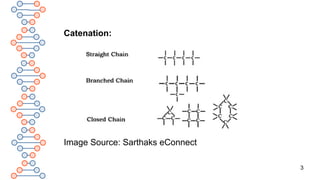
A. The property of self-linking of atoms of an element
through covalent bonds in order to form straight chains,
branched chains, and cyclic chains of different sizes is
known as ‘catenation’.
The high tendency of carbon to catenate is because of
high C-C bond strength.
3
Catenation:
Image Source: Sarthaks eConnect
4
Q. What is ‘Tetravalency’ of carbon?
A. Carbon can neither lose nor gain electrons to attain octet.
Thus, it shares four electrons with other atoms. The
characteristic of carbon by virtue of which it forms four
covalent bonds is called ‘Tetravalency’ of carbon.
Ground state electronic configuration of carbon is 1s2
, 2s2
,
2p2
. It has 4 valence electrons, so the probability of
formation of four bonds is maximum. The bonds formed by
the s orbital electrons will not be the same as that of p
orbitals electrons. So, in the formation of one molecule of
CH4 , there will be a combination of 1C atom with 4 H atoms.
5
Q. What are the shapes of organic compounds?
A. The overall shapes of organic molecules is determined
by the shape of the central carbon atoms that make up
the molecule’s backbone. The types of hybrid orbid
orbitals that make up the bonds between the central
carbon atoms determine the backbone of the shapes of
organic molecules.
A tetrahedral molecule will exist if the central carbon
atoms are sp3
hybridized. sp2
hybridization of the central
carbon atoms results in trigonal-planar shapes, whereas
sp hybridization results in linear molecules.
6
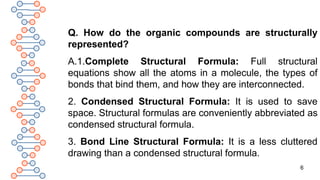
Q. How do the organic compounds are structurally
represented?
A.1.Complete Structural Formula: Full structural
equations show all the atoms in a molecule, the types of
bonds that bind them, and how they are interconnected.
2. Condensed Structural Formula: It is used to save
space. Structural formulas are conveniently abbreviated as
condensed structural formula.
3. Bond Line Structural Formula: It is a less cluttered
drawing than a condensed structural formula.
7
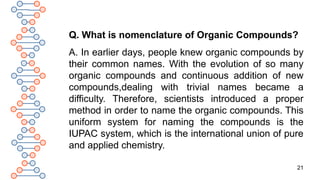
Q. What are the classification of organic compounds?
A. The organic compounds are mainly divided into two
categories:
1. Open-chain compounds, also known as acyclic
compounds.
2. Closed-chain compounds, also known as cyclic
compounds.
These compounds can be subdivided into different
compounds.
8
Q. What are Acyclic or Open-chain compounds?
A. When organic compounds are formed by joining
carbon atoms in the form of an open chain they are
called Open-chain organic compounds.
Initially, they are called Aliphatic compounds because
they are derived from either animal fats or vegetable
fats.
9
Q. What are the classification of open-chain
compounds?
A. Open-chain compounds are classified as straight-
chain compounds and branched-chain compounds.
1. Straight-chain compounds: In straight-chain
compounds, the carbon skeleton is in the form of a
straight chain.
Example: n-Butane [CH3-CH2-CH2-CH3]
Contd.
10
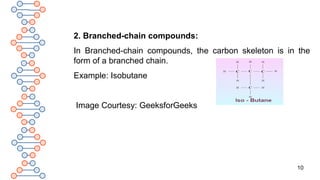
2. Branched-chain compounds:
In Branched-chain compounds, the carbon skeleton is in the
form of a branched chain.
Example: Isobutane
Image Courtesy: GeeksforGeeks
11
Q. What are Cyclic or Closed-chain compounds?
A. Cyclic or Closed-chain compounds are the compounds
in which carbon atoms are joined to form one or more
rings with or without heteroatom.
Q. On what basis, cyclic or closed chain compounds
are classified?
A. On the basis of heteroatoms in the cycle, they are
further classified into two types:
1. Homocyclic compounds
2. Heterocyclic compounds
12
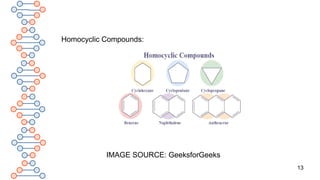
Q. What are Homocyclic compounds?
A. Homocyclic compounds are cyclic compounds, which
have ring structures made up of only carbon in the ring
and hydrogen atoms. Examples of homocyclic aromatic
compounds are Benzene, Toluene, Phenol etc.
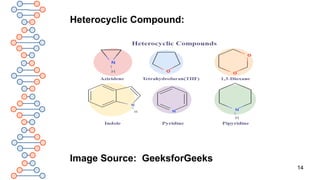
Q. What are Heterocyclic compounds?
A. Heterocyclic compounds are cyclic compounds with
the ring containing carbon and other element, the
component being oxygen, nitrogen and sulphur. The
simplest of the five membered heterocyclic compounds
are pyrrole, furan and thiophene, each of which contain
single heteroatoms.
13
Homocyclic Compounds:
IMAGE SOURCE: GeeksforGeeks
14
Heterocyclic Compound:
Image Source: GeeksforGeeks
15
Q. How are Heterocyclic compounds are classified?
A. Heterocyclic compounds are classified as:
1. Hetero-alicyclic compounds
2. Hetero-aromatic compounds
Hetero-alicyclic compounds: Alicyclic compounds which
contain one heteroatom in the ring are called hetero-
alicyclic compounds, e.g. Tetrahydrofuran[THF].
Hetero-aromatic compounds: Aromatic compounds
which contain at least one heteroatom in the ring are
called hetero-aromatic compounds, e.g. Furan.
16
Q. What are aromatic compounds?
A. Aromatic compounds are a special type of organic
compound that involves benzene and other ring-related
compounds. They are called Aromatic compounds
because these compounds carry a special aroma, which
distinguishes them from other organic compounds.
Aromatic compounds are highly stable organic
compounds and can further be classified into two
categories.
1. Benzenoid aromatic compounds
2. Non-Benzenoid aromatic compounds.
17
Q. What are Benzenoid aromatic compounds?
A. Benzenoid aromatic compounds are derivatives of
benzene. These compounds are distinguished from
other organic compounds as they contain one or more
than one benzene ring. These compounds can be
further arranged on the basis of the benzene ring fused
together as:
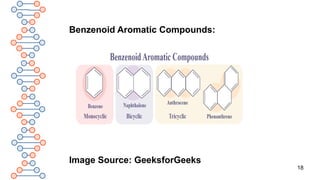
1. Monocyclic, example: Benzene
2. Bicyclic, example: Napthalene
3. Tricyclic, example: Anthracene
18
Benzenoid Aromatic Compounds:
Image Source: GeeksforGeeks
19
Q.What are Non-Benzenoid aromatic compounds?
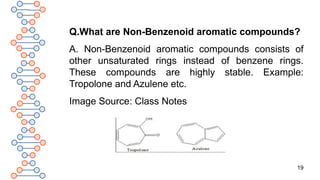
A. Non-Benzenoid aromatic compounds consists of
other unsaturated rings instead of benzene rings.
These compounds are highly stable. Example:
Tropolone and Azulene etc.
Image Source: Class Notes
20
Classification of Organic compounds:
Image Source: Sarthaks eConnect
21
Q. What is nomenclature of Organic Compounds?
A. In earlier days, people knew organic compounds by
their common names. With the evolution of so many
organic compounds and continuous addition of new
compounds,dealing with trivial names became a
difficulty. Therefore, scientists introduced a proper
method in order to name the organic compounds. This
uniform system for naming the compounds is the
IUPAC system, which is the international union of pure
and applied chemistry.
22
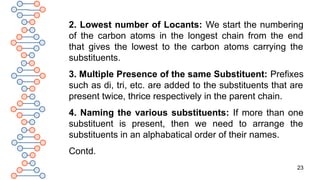
Q. What are the steps that are followed in chemical
nomenclature?
A. According to IUPAC system, the nomenclature of
organic compounds consists of the following parts:
Steps Involved:
1. Longest Chain Rule: In this step, all we have to do is to
identify the parent hydrocarbon and give the name to it.
The parent chain of the compound is the longest chain of
carbon atoms. This chain could be straight or of a different
shape.
Contd.
23
2. Lowest number of Locants: We start the numbering
of the carbon atoms in the longest chain from the end
that gives the lowest to the carbon atoms carrying the
substituents.
3. Multiple Presence of the same Substituent: Prefixes
such as di, tri, etc. are added to the substituents that are
present twice, thrice respectively in the parent chain.
4. Naming the various substituents: If more than one
substituent is present, then we need to arrange the
substituents in an alphabatical order of their names.
Contd.
24
5. Naming different substituents at equivalent
positions: If we find the presence of two different
substituents on the same position from the two ends, the
substituent first in the alphabetical order gets the lowest
number.
6. The Naming of complex Substituents: The complex
substituent is when the substituent on the parent chain
has a branched structure [i.e. complex structure]. We
name these substituents as a substituted alkyl group. It is
also important to note that the carbon atom of this
substituent gets the number 1. We write the name of this
substituent in the bracket.
25
The final name will be in format : Locant+Prefix
+Root+Locant+Suffix.
Q. What is Word Root?
A. Word Root indicates the number of carbon atoms
in the longest selected carbon chain. Example: C1 is
‘Meth’ and C5 is ‘Pent’.
Q. What is Suffix?
A. A suffix is generally a functional group in the
molecule which follows the word root.
26
Q. What are different types of suffix?
A. A suffix can be divided into two types: 1. Primary
suffix, 2. Secondary suffix.
1. Primary Suffix: It is written immediately after the
word root..For example, for alkane, the suffix is ane.
2. Secondary Suffix: It is written after the primary
suffix. For instance, if a compound has alkane and
alcohol group attached to it, the naming will be
alkanol, -ol being suffix for alcohol.
27
Q. What is Prefix?
A. Prefix is added to the word root while naming the
compound. It indicates the presence of substituent groups or
side chains in the organic molecule. It reveals the cyclic and
acyclic nature of the compound.
Q. What are different types of Prefix?
A. 1. Primary prefix: It indicates whether the molecule is
cyclic or not . For example, for cyclic compounds the prefix
used is cyclo.
2. Secondary prefix: It indicates the presence of
substituent groups or any side chain. For example, -CH3 is
known as Methyl and -Br is Bromo.
28
Q. How many types of chemical nomenclature are
there?
A. There are three methods of nomenclature:-
1. Compositional Nomenclature
2. Substitutive Nomenclature
3. Additive Nomenclature
29
Q. What is Compositional Nomenclature?
A. Compositional nomenclature is based on the
composition of the species or substances being named,
against the systems that involve structural composition
or information. One among them is the generalised
stoichiometric name. Substances or the elements are
named with multiple prefixes in order to give the overall
stoichiometry of an element or a compound. When there
are more components, then we divide them into two
classes namely, electropositive or electronegative
components. These names will sound like salt names
and these does not imply the chemical nature or
behaviour of those species. Ex: NaCl, PCl3 etc.
30
Q. What is Substitutive Nomenclature?
A. Substitutive Nomenclature is based on the
approach where parent hydride is changed by
replacement of hydrogen atoms with other atoms or a
group of atoms.. It is a system where we name the
organic compounds using the functional groups as the
suffix or prefix to the name of the parent compound.
We use this system in naming compounds derived
from hydrides of specific group elements in the
periodic table.
Contd.
31
Similar to that of carbon, these elements may form
rings or chains that will have many derivatives. Rules
come in handy in naming the parent or main
compounds and their substituents. Hydrides
belonging to the group 13-17 of the periodic table get
the suffix -ane. For example, -Borane, Phosphane,
and Oxidane etc.
Therefore, substitutive nomenclature takes a parent
compound and identifies substituents which replaces
hydrogen on it with either prefixes [chloro-] or suffixes
[-ol, -one] etc.
32
Q. What is additive nomenclature?
A. Additive nomenclature is the method of naming that
has been developed principally for coordination of
compounds, although it can be applied more widely.
An example of its application is penta-amine-chlorido-
cobaltchloride, used to describe the coordination
compound given by the formula [CoCl(NH3)5]Cl2.
The prefix ‘chloro’ corresponds to a chloride, whereas
the prefix ‘chlorido’ corresponds to the ligand.
33
Q. What is the need of purification of an organic
compound?
A. An organic compound is either isolated from a natural
source or synthesised in a laboratory by a suitable
process. The compound thus obtained is generally impure
and needs to be purified before its structural formula is
determined.
Q. What is characterisation of an organic compound?
A. The determination of structural formula of an unknown
organic compound is known as characterisation of the
compound.
34
Q. What are the common processes used for the
purification of organic compounds?
A. The common processes used for the purification of
organic compounds are :
1. Crystallisation
2. Sublimation
3. Distillation
4. Differential Extraction
5. Chromatography.
35
Q. What are the different steps involved in the
characterisation of an organic compound?
A. The characterisation of an organic compound involves a
series of steps:
1. Qualitative analysis [Detection of an element]
2. Quantitative analysis [Estimation of an element]
3. Determination of molecular mass
4. Calculation of empirical and molecular formulae
5. Elucidation of structure by various physical and chemical
methods.
36
Q. What is qualitative analysis of of organic compound?
A. The qualitative analysis of of organic compound involves the
detection of various element, commonly present in it such as
carbon, hydrogen, oxygen, nitrogen, halogens, sulphur and
phosphorus.
Q. How do carbon and hydrogen could be determined in
organic compound?
A. Carbon and hydrogen are present in almost all the organic
compounds. Carbon and hydrogen are detected by heating the
organic compound with cupric oxide[CuO] strongly, where carbon is
oxidized to carbon dioxide and hydrogen to water. Carbon dioxide
is tested by lime water test, whereas water is tested by anhydrous
copper sulphate test.
37
Q. Explain the procedure of detection of carbon and
hydrogen in an organic compound.
A. The given organic compound is heated with dry copper[II]
oxide or cupric oxide in a hard glass test tube when carbon
present is oxidised to carbon dioxide and hydrogen is oxidised to
water.
I] C + 2CuO → CO2 + 2Cu, ii] 2H + CuO → H2O + Cu
Carbon dioxide turns lime water milky while water condenses on
the cooler parts of the test tube and turns anhydrous copper
sulphate blue.
Ca[OH]2+CO2→CaCO3+CuSO4, CuSO4+5H2O→CuSO4.5CuSO4
38
Q. How can oxygen be detected in an organic
compound?
A. There is no satisfactory qualitative test for oxygen.
However, an idea of presence of oxygen in the given
compound can be had by heating the compound in an
atmosphere of nitrogen. If water drops are formed, the
presence of oxygen is inferred.
Presence of oxygen in organic compounds cannot be
detected by direct method. We can only detect it in the
form of a functional group. The functional group reacts with
specialized reagent to give oxygen containing compounds.
39
Q. How is nitrogen detected in an organic compound?
A.1.The presence of nitrogen in an organic compound is
detected by fusing organic compounds with sodium metal to
give sodium cyanide[NaCN].
2.Sodium cyanide formed during fusion dissolves in distilled
water. Excess of sodium reacts with water to give sodium
hydroxide. Thus an alkaline solution of sodium cyanide is
obtained if the compound contains nitrogen.
3.The solution is filtered. The filtrate thus obtained is called
Lassaigne’s solution or sodium extract.
Na + C + N → NaCN
Contd.
40
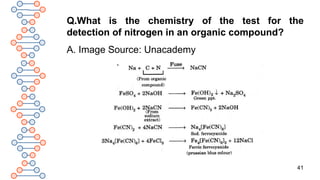
4. About 2ml of sodium extract taken in a test tube and a
few drops of freshly prepared ferrous sulphate solution is
added. A dirty green precipitate of ferrous hydroxide is
obtained. In case, it is not obtained, a few drops of sodium
hydroxide are added.
5.The contents of the test tube are now boiled and the
solution is cooled. A few drops of ferric chloride and
excess of concentrated HCl are then added to the cooled
solution. If nitrogen is present, a prussian blue colouration
or a prussian blue precipitate is obtained. This confirms
the presence of nitrogen in the given compound.
41
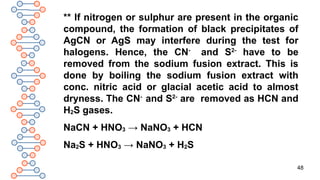
Q.What is the chemistry of the test for the
detection of nitrogen in an organic compound?
A. Image Source: Unacademy
42
Q. How can the presence of both nitrogen and sulphur be
detected in an organic compound?
A. If both nitrogen and sulphur are present in an organic
compound, they may combine during fusion to form
thiocyanate[SCN-
] instead of cyanide ion[CN-
], due to
insufficient amount of sodium metal. Thus, sodium
sulphocyanide is formed instead of sodium cyanide. This
sodium sulphocyanide when reacts with ferric chloride gives
blood red colouration due to formation of blood red coloured
ferric sulphocyanide.
i) Na+C+N+S → NaCNS[sodium sulphocyanide]
Ii] 3NaCNS+FeCl3 → Fe(CNS)3 + 3NaCl
43
Q.How is sulphur detected in an organic compound?
A.(1) Lassaigne’s test:
If sulphur is present in the organic compound, then on
fusion with sodium metal, sodium sulphide is formed. 2Na
+ S → Na2S
i] Sodium nitroprusside test : A small portion of the
Lassaigne’s filtrate is treated with a few drops of sodium
nitroprusside solution when a violet colouration is
obtained. This colour slowly fades on standing.
Na2S + Na2[Fe(CN)5(NO)] → Na4[Fe(CN)5(NOS)]
Contd.
44
ii) Lead Acetate test: Another portion of Lassaigne’s
filtrate is acidified with dilute acetic acid and a few drops
of lead acetate solution are added to it. Formation of
black lead sulphide indicates the presence of sulphur in
the given compound.
Na2S + [CH3COOH]Pb → PbS + 2CH3COONa
Iii) Oxidation test: The given organic compound is fused
with a mixture of potassium nitrate and sodium
carbonate. If sulphur is present, it gets oxidized to
sulphate.The fused mass is then extracted with water
and filtered.
Contd.
45
The filtrate is first acidified with dilute hydrochloric acid
and then treated with barium chloride solution when a
white precipitate insoluble in hydrochloric is obtained.
KNO3 → KNO2 + [O]
Na2CO3 + S + 3[O] → Na2SO4 + CO2
Na2SO4 + BaCl2 → 2NaCl + BaSO4
46
Q. How is the presence of halogen is detected in an
organic compound?
A. Lassaigne’s test for halogen: The sodium fusion extract,
SFE can be used to detect the presence of chlorine, bromine
and iodine but not fluorine. To detect their presence, the SFE is
first acidified with HNO3 and then added with AgNO3 solution.
1] The formation of a curdy white precipitate that is soluble in
NH4OH, indicates the presence of chlorine in the organic
compound.
Cl-
+ AgNO3 → AgCl[white ppt] + [NO3]-
AgCl + 2NH4OH → [Ag(NH3)2]Cl [soluble complex] + 2H2O
47
2] The formation of a pale yellow precipitate that is
partially soluble in NH4OH confirms the presence of
bromine.
Br-
+ AgNO3 → AgBr[pale yellow ppt.] + [NO3]-
3] Whereas the formation of a yellow precipitate
insoluble in NH4OH confirms the presence of iodine in
the organic compound.
I-
+ AgNO3 → AgI[yellow ppt.] + [NO3]-
It is not possible to detect the presence of fluorine,
since the solubility of AgF is more and thus no
precipitate is formed.
48
** If nitrogen or sulphur are present in the organic
compound, the formation of black precipitates of
AgCN or AgS may interfere during the test for
halogens. Hence, the CN-
and S2-
have to be
removed from the sodium fusion extract. This is
done by boiling the sodium fusion extract with
conc. nitric acid or glacial acetic acid to almost
dryness. The CN-
and S2-
are removed as HCN and
H2S gases.
NaCN + HNO3 → NaNO3 + HCN
Na2S + HNO3 → NaNO3 + H2S
49
Q. Write down the summary of Lassaigane’s test.
A. SFE → Sodium fusion extract
1. SFE + FeSO4 + FeCl3 + HCl → a] If a prussian blue colour is
formed → Nitrogen is confirmed.
b] If blood red colouration is observed → b] Both nitrogen and
sulphur are confirmed.
2. SFE + Sodium nitroprusside → a] If a violet colouration is
observed, sulphur is confirmed.
SFE + CH3COOH + Pb[CH3COO]2 → b] If a black precipitate is
formed, sulphur is confirmed.
Contd.
50
3. SFE + HNO3 + AgNO3 → a] If a white ppt, soluble in
NH4OH is formed → Chlorine is confirmed.
SFE + HNO3 + AgNO3 → b] If a pale yellow ppt,
partially soluble in NH4OH is formed → Bromine is
confirmed.
SFE + HNO3 + AgNO3 → c] If a yellow ppt, insoluble
in NH4OH is formed → Iodine is confirmed.
51
THANK YOU
FOR
WATCHING!!

ORGANIC CHEMISTRY: SOME BASIC PRINCIPLES AND TECHNIQUES

  • 1.
    1 CLASS 11 CHEMISTRY ORGANICCHEMISTRY: SOME BASIC PRINCIPLES & TECHNIQUES [PART 1]
  • 2.
    2 Q. What iscatenation? Why carbon show maximum tendency of catenation? A. The property of self-linking of atoms of an element through covalent bonds in order to form straight chains, branched chains, and cyclic chains of different sizes is known as ‘catenation’. The high tendency of carbon to catenate is because of high C-C bond strength.
  • 3.
  • 4.
    4 Q. What is‘Tetravalency’ of carbon? A. Carbon can neither lose nor gain electrons to attain octet. Thus, it shares four electrons with other atoms. The characteristic of carbon by virtue of which it forms four covalent bonds is called ‘Tetravalency’ of carbon. Ground state electronic configuration of carbon is 1s2 , 2s2 , 2p2 . It has 4 valence electrons, so the probability of formation of four bonds is maximum. The bonds formed by the s orbital electrons will not be the same as that of p orbitals electrons. So, in the formation of one molecule of CH4 , there will be a combination of 1C atom with 4 H atoms.
  • 5.
    5 Q. What arethe shapes of organic compounds? A. The overall shapes of organic molecules is determined by the shape of the central carbon atoms that make up the molecule’s backbone. The types of hybrid orbid orbitals that make up the bonds between the central carbon atoms determine the backbone of the shapes of organic molecules. A tetrahedral molecule will exist if the central carbon atoms are sp3 hybridized. sp2 hybridization of the central carbon atoms results in trigonal-planar shapes, whereas sp hybridization results in linear molecules.
  • 6.
    6 Q. How dothe organic compounds are structurally represented? A.1.Complete Structural Formula: Full structural equations show all the atoms in a molecule, the types of bonds that bind them, and how they are interconnected. 2. Condensed Structural Formula: It is used to save space. Structural formulas are conveniently abbreviated as condensed structural formula. 3. Bond Line Structural Formula: It is a less cluttered drawing than a condensed structural formula.
  • 7.
    7 Q. What arethe classification of organic compounds? A. The organic compounds are mainly divided into two categories: 1. Open-chain compounds, also known as acyclic compounds. 2. Closed-chain compounds, also known as cyclic compounds. These compounds can be subdivided into different compounds.
  • 8.
    8 Q. What areAcyclic or Open-chain compounds? A. When organic compounds are formed by joining carbon atoms in the form of an open chain they are called Open-chain organic compounds. Initially, they are called Aliphatic compounds because they are derived from either animal fats or vegetable fats.
  • 9.
    9 Q. What arethe classification of open-chain compounds? A. Open-chain compounds are classified as straight- chain compounds and branched-chain compounds. 1. Straight-chain compounds: In straight-chain compounds, the carbon skeleton is in the form of a straight chain. Example: n-Butane [CH3-CH2-CH2-CH3] Contd.
  • 10.
    10 2. Branched-chain compounds: InBranched-chain compounds, the carbon skeleton is in the form of a branched chain. Example: Isobutane Image Courtesy: GeeksforGeeks
  • 11.
    11 Q. What areCyclic or Closed-chain compounds? A. Cyclic or Closed-chain compounds are the compounds in which carbon atoms are joined to form one or more rings with or without heteroatom. Q. On what basis, cyclic or closed chain compounds are classified? A. On the basis of heteroatoms in the cycle, they are further classified into two types: 1. Homocyclic compounds 2. Heterocyclic compounds
  • 12.
    12 Q. What areHomocyclic compounds? A. Homocyclic compounds are cyclic compounds, which have ring structures made up of only carbon in the ring and hydrogen atoms. Examples of homocyclic aromatic compounds are Benzene, Toluene, Phenol etc. Q. What are Heterocyclic compounds? A. Heterocyclic compounds are cyclic compounds with the ring containing carbon and other element, the component being oxygen, nitrogen and sulphur. The simplest of the five membered heterocyclic compounds are pyrrole, furan and thiophene, each of which contain single heteroatoms.
  • 13.
  • 14.
  • 15.
    15 Q. How areHeterocyclic compounds are classified? A. Heterocyclic compounds are classified as: 1. Hetero-alicyclic compounds 2. Hetero-aromatic compounds Hetero-alicyclic compounds: Alicyclic compounds which contain one heteroatom in the ring are called hetero- alicyclic compounds, e.g. Tetrahydrofuran[THF]. Hetero-aromatic compounds: Aromatic compounds which contain at least one heteroatom in the ring are called hetero-aromatic compounds, e.g. Furan.
  • 16.
    16 Q. What arearomatic compounds? A. Aromatic compounds are a special type of organic compound that involves benzene and other ring-related compounds. They are called Aromatic compounds because these compounds carry a special aroma, which distinguishes them from other organic compounds. Aromatic compounds are highly stable organic compounds and can further be classified into two categories. 1. Benzenoid aromatic compounds 2. Non-Benzenoid aromatic compounds.
  • 17.
    17 Q. What areBenzenoid aromatic compounds? A. Benzenoid aromatic compounds are derivatives of benzene. These compounds are distinguished from other organic compounds as they contain one or more than one benzene ring. These compounds can be further arranged on the basis of the benzene ring fused together as: 1. Monocyclic, example: Benzene 2. Bicyclic, example: Napthalene 3. Tricyclic, example: Anthracene
  • 18.
  • 19.
    19 Q.What are Non-Benzenoidaromatic compounds? A. Non-Benzenoid aromatic compounds consists of other unsaturated rings instead of benzene rings. These compounds are highly stable. Example: Tropolone and Azulene etc. Image Source: Class Notes
  • 20.
    20 Classification of Organiccompounds: Image Source: Sarthaks eConnect
  • 21.
    21 Q. What isnomenclature of Organic Compounds? A. In earlier days, people knew organic compounds by their common names. With the evolution of so many organic compounds and continuous addition of new compounds,dealing with trivial names became a difficulty. Therefore, scientists introduced a proper method in order to name the organic compounds. This uniform system for naming the compounds is the IUPAC system, which is the international union of pure and applied chemistry.
  • 22.
    22 Q. What arethe steps that are followed in chemical nomenclature? A. According to IUPAC system, the nomenclature of organic compounds consists of the following parts: Steps Involved: 1. Longest Chain Rule: In this step, all we have to do is to identify the parent hydrocarbon and give the name to it. The parent chain of the compound is the longest chain of carbon atoms. This chain could be straight or of a different shape. Contd.
  • 23.
    23 2. Lowest numberof Locants: We start the numbering of the carbon atoms in the longest chain from the end that gives the lowest to the carbon atoms carrying the substituents. 3. Multiple Presence of the same Substituent: Prefixes such as di, tri, etc. are added to the substituents that are present twice, thrice respectively in the parent chain. 4. Naming the various substituents: If more than one substituent is present, then we need to arrange the substituents in an alphabatical order of their names. Contd.
  • 24.
    24 5. Naming differentsubstituents at equivalent positions: If we find the presence of two different substituents on the same position from the two ends, the substituent first in the alphabetical order gets the lowest number. 6. The Naming of complex Substituents: The complex substituent is when the substituent on the parent chain has a branched structure [i.e. complex structure]. We name these substituents as a substituted alkyl group. It is also important to note that the carbon atom of this substituent gets the number 1. We write the name of this substituent in the bracket.
  • 25.
    25 The final namewill be in format : Locant+Prefix +Root+Locant+Suffix. Q. What is Word Root? A. Word Root indicates the number of carbon atoms in the longest selected carbon chain. Example: C1 is ‘Meth’ and C5 is ‘Pent’. Q. What is Suffix? A. A suffix is generally a functional group in the molecule which follows the word root.
  • 26.
    26 Q. What aredifferent types of suffix? A. A suffix can be divided into two types: 1. Primary suffix, 2. Secondary suffix. 1. Primary Suffix: It is written immediately after the word root..For example, for alkane, the suffix is ane. 2. Secondary Suffix: It is written after the primary suffix. For instance, if a compound has alkane and alcohol group attached to it, the naming will be alkanol, -ol being suffix for alcohol.
  • 27.
    27 Q. What isPrefix? A. Prefix is added to the word root while naming the compound. It indicates the presence of substituent groups or side chains in the organic molecule. It reveals the cyclic and acyclic nature of the compound. Q. What are different types of Prefix? A. 1. Primary prefix: It indicates whether the molecule is cyclic or not . For example, for cyclic compounds the prefix used is cyclo. 2. Secondary prefix: It indicates the presence of substituent groups or any side chain. For example, -CH3 is known as Methyl and -Br is Bromo.
  • 28.
    28 Q. How manytypes of chemical nomenclature are there? A. There are three methods of nomenclature:- 1. Compositional Nomenclature 2. Substitutive Nomenclature 3. Additive Nomenclature
  • 29.
    29 Q. What isCompositional Nomenclature? A. Compositional nomenclature is based on the composition of the species or substances being named, against the systems that involve structural composition or information. One among them is the generalised stoichiometric name. Substances or the elements are named with multiple prefixes in order to give the overall stoichiometry of an element or a compound. When there are more components, then we divide them into two classes namely, electropositive or electronegative components. These names will sound like salt names and these does not imply the chemical nature or behaviour of those species. Ex: NaCl, PCl3 etc.
  • 30.
    30 Q. What isSubstitutive Nomenclature? A. Substitutive Nomenclature is based on the approach where parent hydride is changed by replacement of hydrogen atoms with other atoms or a group of atoms.. It is a system where we name the organic compounds using the functional groups as the suffix or prefix to the name of the parent compound. We use this system in naming compounds derived from hydrides of specific group elements in the periodic table. Contd.
  • 31.
    31 Similar to thatof carbon, these elements may form rings or chains that will have many derivatives. Rules come in handy in naming the parent or main compounds and their substituents. Hydrides belonging to the group 13-17 of the periodic table get the suffix -ane. For example, -Borane, Phosphane, and Oxidane etc. Therefore, substitutive nomenclature takes a parent compound and identifies substituents which replaces hydrogen on it with either prefixes [chloro-] or suffixes [-ol, -one] etc.
  • 32.
    32 Q. What isadditive nomenclature? A. Additive nomenclature is the method of naming that has been developed principally for coordination of compounds, although it can be applied more widely. An example of its application is penta-amine-chlorido- cobaltchloride, used to describe the coordination compound given by the formula [CoCl(NH3)5]Cl2. The prefix ‘chloro’ corresponds to a chloride, whereas the prefix ‘chlorido’ corresponds to the ligand.
  • 33.
    33 Q. What isthe need of purification of an organic compound? A. An organic compound is either isolated from a natural source or synthesised in a laboratory by a suitable process. The compound thus obtained is generally impure and needs to be purified before its structural formula is determined. Q. What is characterisation of an organic compound? A. The determination of structural formula of an unknown organic compound is known as characterisation of the compound.
  • 34.
    34 Q. What arethe common processes used for the purification of organic compounds? A. The common processes used for the purification of organic compounds are : 1. Crystallisation 2. Sublimation 3. Distillation 4. Differential Extraction 5. Chromatography.
  • 35.
    35 Q. What arethe different steps involved in the characterisation of an organic compound? A. The characterisation of an organic compound involves a series of steps: 1. Qualitative analysis [Detection of an element] 2. Quantitative analysis [Estimation of an element] 3. Determination of molecular mass 4. Calculation of empirical and molecular formulae 5. Elucidation of structure by various physical and chemical methods.
  • 36.
    36 Q. What isqualitative analysis of of organic compound? A. The qualitative analysis of of organic compound involves the detection of various element, commonly present in it such as carbon, hydrogen, oxygen, nitrogen, halogens, sulphur and phosphorus. Q. How do carbon and hydrogen could be determined in organic compound? A. Carbon and hydrogen are present in almost all the organic compounds. Carbon and hydrogen are detected by heating the organic compound with cupric oxide[CuO] strongly, where carbon is oxidized to carbon dioxide and hydrogen to water. Carbon dioxide is tested by lime water test, whereas water is tested by anhydrous copper sulphate test.
  • 37.
    37 Q. Explain theprocedure of detection of carbon and hydrogen in an organic compound. A. The given organic compound is heated with dry copper[II] oxide or cupric oxide in a hard glass test tube when carbon present is oxidised to carbon dioxide and hydrogen is oxidised to water. I] C + 2CuO → CO2 + 2Cu, ii] 2H + CuO → H2O + Cu Carbon dioxide turns lime water milky while water condenses on the cooler parts of the test tube and turns anhydrous copper sulphate blue. Ca[OH]2+CO2→CaCO3+CuSO4, CuSO4+5H2O→CuSO4.5CuSO4
  • 38.
    38 Q. How canoxygen be detected in an organic compound? A. There is no satisfactory qualitative test for oxygen. However, an idea of presence of oxygen in the given compound can be had by heating the compound in an atmosphere of nitrogen. If water drops are formed, the presence of oxygen is inferred. Presence of oxygen in organic compounds cannot be detected by direct method. We can only detect it in the form of a functional group. The functional group reacts with specialized reagent to give oxygen containing compounds.
  • 39.
    39 Q. How isnitrogen detected in an organic compound? A.1.The presence of nitrogen in an organic compound is detected by fusing organic compounds with sodium metal to give sodium cyanide[NaCN]. 2.Sodium cyanide formed during fusion dissolves in distilled water. Excess of sodium reacts with water to give sodium hydroxide. Thus an alkaline solution of sodium cyanide is obtained if the compound contains nitrogen. 3.The solution is filtered. The filtrate thus obtained is called Lassaigne’s solution or sodium extract. Na + C + N → NaCN Contd.
  • 40.
    40 4. About 2mlof sodium extract taken in a test tube and a few drops of freshly prepared ferrous sulphate solution is added. A dirty green precipitate of ferrous hydroxide is obtained. In case, it is not obtained, a few drops of sodium hydroxide are added. 5.The contents of the test tube are now boiled and the solution is cooled. A few drops of ferric chloride and excess of concentrated HCl are then added to the cooled solution. If nitrogen is present, a prussian blue colouration or a prussian blue precipitate is obtained. This confirms the presence of nitrogen in the given compound.
  • 41.
    41 Q.What is thechemistry of the test for the detection of nitrogen in an organic compound? A. Image Source: Unacademy
  • 42.
    42 Q. How canthe presence of both nitrogen and sulphur be detected in an organic compound? A. If both nitrogen and sulphur are present in an organic compound, they may combine during fusion to form thiocyanate[SCN- ] instead of cyanide ion[CN- ], due to insufficient amount of sodium metal. Thus, sodium sulphocyanide is formed instead of sodium cyanide. This sodium sulphocyanide when reacts with ferric chloride gives blood red colouration due to formation of blood red coloured ferric sulphocyanide. i) Na+C+N+S → NaCNS[sodium sulphocyanide] Ii] 3NaCNS+FeCl3 → Fe(CNS)3 + 3NaCl
  • 43.
    43 Q.How is sulphurdetected in an organic compound? A.(1) Lassaigne’s test: If sulphur is present in the organic compound, then on fusion with sodium metal, sodium sulphide is formed. 2Na + S → Na2S i] Sodium nitroprusside test : A small portion of the Lassaigne’s filtrate is treated with a few drops of sodium nitroprusside solution when a violet colouration is obtained. This colour slowly fades on standing. Na2S + Na2[Fe(CN)5(NO)] → Na4[Fe(CN)5(NOS)] Contd.
  • 44.
    44 ii) Lead Acetatetest: Another portion of Lassaigne’s filtrate is acidified with dilute acetic acid and a few drops of lead acetate solution are added to it. Formation of black lead sulphide indicates the presence of sulphur in the given compound. Na2S + [CH3COOH]Pb → PbS + 2CH3COONa Iii) Oxidation test: The given organic compound is fused with a mixture of potassium nitrate and sodium carbonate. If sulphur is present, it gets oxidized to sulphate.The fused mass is then extracted with water and filtered. Contd.
  • 45.
    45 The filtrate isfirst acidified with dilute hydrochloric acid and then treated with barium chloride solution when a white precipitate insoluble in hydrochloric is obtained. KNO3 → KNO2 + [O] Na2CO3 + S + 3[O] → Na2SO4 + CO2 Na2SO4 + BaCl2 → 2NaCl + BaSO4
  • 46.
    46 Q. How isthe presence of halogen is detected in an organic compound? A. Lassaigne’s test for halogen: The sodium fusion extract, SFE can be used to detect the presence of chlorine, bromine and iodine but not fluorine. To detect their presence, the SFE is first acidified with HNO3 and then added with AgNO3 solution. 1] The formation of a curdy white precipitate that is soluble in NH4OH, indicates the presence of chlorine in the organic compound. Cl- + AgNO3 → AgCl[white ppt] + [NO3]- AgCl + 2NH4OH → [Ag(NH3)2]Cl [soluble complex] + 2H2O
  • 47.
    47 2] The formationof a pale yellow precipitate that is partially soluble in NH4OH confirms the presence of bromine. Br- + AgNO3 → AgBr[pale yellow ppt.] + [NO3]- 3] Whereas the formation of a yellow precipitate insoluble in NH4OH confirms the presence of iodine in the organic compound. I- + AgNO3 → AgI[yellow ppt.] + [NO3]- It is not possible to detect the presence of fluorine, since the solubility of AgF is more and thus no precipitate is formed.
  • 48.
    48 ** If nitrogenor sulphur are present in the organic compound, the formation of black precipitates of AgCN or AgS may interfere during the test for halogens. Hence, the CN- and S2- have to be removed from the sodium fusion extract. This is done by boiling the sodium fusion extract with conc. nitric acid or glacial acetic acid to almost dryness. The CN- and S2- are removed as HCN and H2S gases. NaCN + HNO3 → NaNO3 + HCN Na2S + HNO3 → NaNO3 + H2S
  • 49.
    49 Q. Write downthe summary of Lassaigane’s test. A. SFE → Sodium fusion extract 1. SFE + FeSO4 + FeCl3 + HCl → a] If a prussian blue colour is formed → Nitrogen is confirmed. b] If blood red colouration is observed → b] Both nitrogen and sulphur are confirmed. 2. SFE + Sodium nitroprusside → a] If a violet colouration is observed, sulphur is confirmed. SFE + CH3COOH + Pb[CH3COO]2 → b] If a black precipitate is formed, sulphur is confirmed. Contd.
  • 50.
    50 3. SFE +HNO3 + AgNO3 → a] If a white ppt, soluble in NH4OH is formed → Chlorine is confirmed. SFE + HNO3 + AgNO3 → b] If a pale yellow ppt, partially soluble in NH4OH is formed → Bromine is confirmed. SFE + HNO3 + AgNO3 → c] If a yellow ppt, insoluble in NH4OH is formed → Iodine is confirmed.
  • 51.