Presented By
Sijo A
Ph.D. Research Scholar (Microbiology)
School of Biosciences, MACFAST College
Tiruvalla, Kerala
CLASSIFICATION OF MICROORGANISMS
MEMBERS OF THE MICROBIAL WORLD
• Microbiology is defined as the study of organisms and agents too small to be seen clearly by the
unaided eye.
• It primarily focuses on microorganisms, which are typically less than 1 millimeter in diameter.
• Because of their small size, these organisms usually require a microscope for examination.
• However, some microorganisms, especially certain eukaryotic microbes, can be seen without a
microscope.
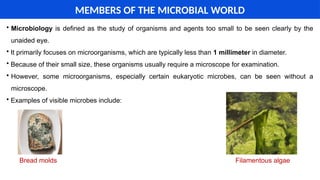
• Examples of visible microbes include:
Bread molds Filamentous algae
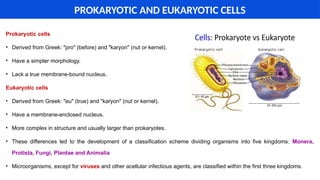
Prokaryotic cells
• Derived from Greek: "pro" (before) and "karyon" (nut or kernel).
• Have a simpler morphology.
• Lack a true membrane-bound nucleus.
Eukaryotic cells
• Derived from Greek: "eu" (true) and "karyon" (nut or kernel).
• Have a membrane-enclosed nucleus.
• More complex in structure and usually larger than prokaryotes.
• These differences led to the development of a classification scheme dividing organisms into five kingdoms: Monera,
Protista, Fungi, Plantae and Animalia
• Microorganisms, except for viruses and other acellular infectious agents, are classified within the first three kingdoms.
PROKARYOTIC AND EUKARYOTIC CELLS
MICROBIAL CLASSIFICATION
• Recent progress in microbial classification has been made in three key areas:
1. Electron microscopy: Provided detailed insights into the structure of microbial cells.
2. Biochemical and physiological studies: Determined characteristics of many different microorganisms.
3. Nucleic acid and protein sequencing: Enabled comparisons across a wide variety of organisms.
• Carl Woese began comparing ribosomal RNA (rRNA) sequences in the 1970s, revealing:
• Two distinct groups of prokaryotic organisms: Bacteria and Archaea.
• These were previously classified together as Monera in the five-kingdom system.
• Further rRNA studies showed that:
• Protista is not a cohesive taxonomic unit and should be divided into three or more kingdoms.
• Conclusion:
• The five-kingdom system is considered too simplistic.
• Many taxonomists now support a classification system with three domains:
1. Bacteria (true bacteria or eubacteria)
2. Archaea
3. Eucarya (all eukaryotic organisms)
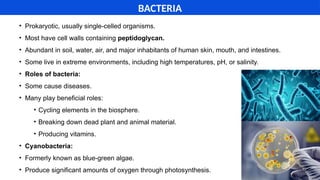
• Prokaryotic, usually single-celled organisms.
• Most have cell walls containing peptidoglycan.
• Abundant in soil, water, air, and major inhabitants of human skin, mouth, and intestines.
• Some live in extreme environments, including high temperatures, pH, or salinity.
• Roles of bacteria:
• Some cause diseases.
• Many play beneficial roles:
• Cycling elements in the biosphere.
• Breaking down dead plant and animal material.
• Producing vitamins.
• Cyanobacteria:
• Formerly known as blue-green algae.
• Produce significant amounts of oxygen through photosynthesis.
BACTERIA
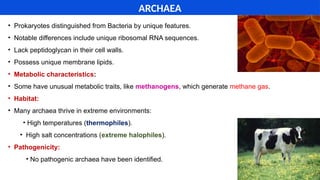
• Prokaryotes distinguished from Bacteria by unique features.
• Notable differences include unique ribosomal RNA sequences.
• Lack peptidoglycan in their cell walls.
• Possess unique membrane lipids.
• Metabolic characteristics:
• Some have unusual metabolic traits, like methanogens, which generate methane gas.
• Habitat:
• Many archaea thrive in extreme environments:
• High temperatures (thermophiles).
• High salt concentrations (extreme halophiles).
• Pathogenicity:
• No pathogenic archaea have been identified.
ARCHAEA
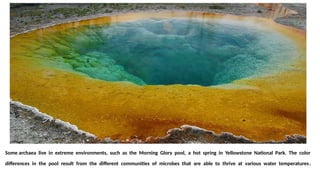
Some archaea live in extreme environments, such as the Morning Glory pool, a hot spring in Yellowstone National Park. The color
differences in the pool result from the different communities of microbes that are able to thrive at various water temperatures.
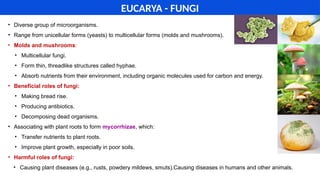
• Diverse group of microorganisms.
• Range from unicellular forms (yeasts) to multicellular forms (molds and mushrooms).
• Molds and mushrooms:
• Multicellular fungi.
• Form thin, threadlike structures called hyphae.
• Absorb nutrients from their environment, including organic molecules used for carbon and energy.
• Beneficial roles of fungi:
• Making bread rise.
• Producing antibiotics.
• Decomposing dead organisms.
• Associating with plant roots to form mycorrhizae, which:
• Transfer nutrients to plant roots.
• Improve plant growth, especially in poor soils.
• Harmful roles of fungi:
• Causing plant diseases (e.g., rusts, powdery mildews, smuts).Causing diseases in humans and other animals.
EUCARYA - FUNGI
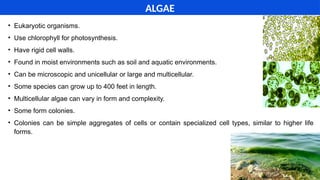
• Eukaryotic organisms.
• Use chlorophyll for photosynthesis.
• Have rigid cell walls.
• Found in moist environments such as soil and aquatic environments.
• Can be microscopic and unicellular or large and multicellular.
• Some species can grow up to 400 feet in length.
• Multicellular algae can vary in form and complexity.
• Some form colonies.
• Colonies can be simple aggregates of cells or contain specialized cell types, similar to higher life
forms.
ALGAE
VIRUS, VIROIDS, PRIONS
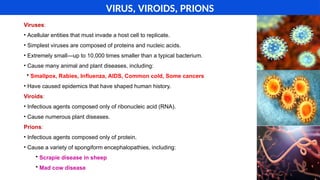
Viruses:
• Acellular entities that must invade a host cell to replicate.
• Simplest viruses are composed of proteins and nucleic acids.
• Extremely small—up to 10,000 times smaller than a typical bacterium.
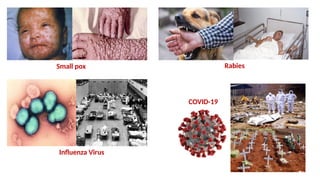
• Cause many animal and plant diseases, including:
• Smallpox, Rabies, Influenza, AIDS, Common cold, Some cancers
• Have caused epidemics that have shaped human history.
Viroids:
• Infectious agents composed only of ribonucleic acid (RNA).
• Cause numerous plant diseases.
Prions:
• Infectious agents composed only of protein.
• Cause a variety of spongiform encephalopathies, including:
• Scrapie disease in sheep
• Mad cow disease
Small pox Rabies
Influenza Virus
COVID-19
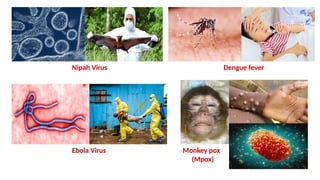
Nipah Virus
Ebola Virus
Dengue fever
Monkey pox
(Mpox)

Classification of Microorganisms (Microbiology)

  • 1.
    Presented By Sijo A Ph.D.Research Scholar (Microbiology) School of Biosciences, MACFAST College Tiruvalla, Kerala CLASSIFICATION OF MICROORGANISMS
  • 2.
    MEMBERS OF THEMICROBIAL WORLD • Microbiology is defined as the study of organisms and agents too small to be seen clearly by the unaided eye. • It primarily focuses on microorganisms, which are typically less than 1 millimeter in diameter. • Because of their small size, these organisms usually require a microscope for examination. • However, some microorganisms, especially certain eukaryotic microbes, can be seen without a microscope. • Examples of visible microbes include: Bread molds Filamentous algae
  • 3.
    Prokaryotic cells • Derivedfrom Greek: "pro" (before) and "karyon" (nut or kernel). • Have a simpler morphology. • Lack a true membrane-bound nucleus. Eukaryotic cells • Derived from Greek: "eu" (true) and "karyon" (nut or kernel). • Have a membrane-enclosed nucleus. • More complex in structure and usually larger than prokaryotes. • These differences led to the development of a classification scheme dividing organisms into five kingdoms: Monera, Protista, Fungi, Plantae and Animalia • Microorganisms, except for viruses and other acellular infectious agents, are classified within the first three kingdoms. PROKARYOTIC AND EUKARYOTIC CELLS
  • 4.
    MICROBIAL CLASSIFICATION • Recentprogress in microbial classification has been made in three key areas: 1. Electron microscopy: Provided detailed insights into the structure of microbial cells. 2. Biochemical and physiological studies: Determined characteristics of many different microorganisms. 3. Nucleic acid and protein sequencing: Enabled comparisons across a wide variety of organisms. • Carl Woese began comparing ribosomal RNA (rRNA) sequences in the 1970s, revealing: • Two distinct groups of prokaryotic organisms: Bacteria and Archaea. • These were previously classified together as Monera in the five-kingdom system. • Further rRNA studies showed that: • Protista is not a cohesive taxonomic unit and should be divided into three or more kingdoms. • Conclusion: • The five-kingdom system is considered too simplistic. • Many taxonomists now support a classification system with three domains: 1. Bacteria (true bacteria or eubacteria) 2. Archaea 3. Eucarya (all eukaryotic organisms)
  • 5.
    • Prokaryotic, usuallysingle-celled organisms. • Most have cell walls containing peptidoglycan. • Abundant in soil, water, air, and major inhabitants of human skin, mouth, and intestines. • Some live in extreme environments, including high temperatures, pH, or salinity. • Roles of bacteria: • Some cause diseases. • Many play beneficial roles: • Cycling elements in the biosphere. • Breaking down dead plant and animal material. • Producing vitamins. • Cyanobacteria: • Formerly known as blue-green algae. • Produce significant amounts of oxygen through photosynthesis. BACTERIA
  • 6.
    • Prokaryotes distinguishedfrom Bacteria by unique features. • Notable differences include unique ribosomal RNA sequences. • Lack peptidoglycan in their cell walls. • Possess unique membrane lipids. • Metabolic characteristics: • Some have unusual metabolic traits, like methanogens, which generate methane gas. • Habitat: • Many archaea thrive in extreme environments: • High temperatures (thermophiles). • High salt concentrations (extreme halophiles). • Pathogenicity: • No pathogenic archaea have been identified. ARCHAEA
  • 7.
    Some archaea livein extreme environments, such as the Morning Glory pool, a hot spring in Yellowstone National Park. The color differences in the pool result from the different communities of microbes that are able to thrive at various water temperatures.
  • 8.
    • Diverse groupof microorganisms. • Range from unicellular forms (yeasts) to multicellular forms (molds and mushrooms). • Molds and mushrooms: • Multicellular fungi. • Form thin, threadlike structures called hyphae. • Absorb nutrients from their environment, including organic molecules used for carbon and energy. • Beneficial roles of fungi: • Making bread rise. • Producing antibiotics. • Decomposing dead organisms. • Associating with plant roots to form mycorrhizae, which: • Transfer nutrients to plant roots. • Improve plant growth, especially in poor soils. • Harmful roles of fungi: • Causing plant diseases (e.g., rusts, powdery mildews, smuts).Causing diseases in humans and other animals. EUCARYA - FUNGI
  • 9.
    • Eukaryotic organisms. •Use chlorophyll for photosynthesis. • Have rigid cell walls. • Found in moist environments such as soil and aquatic environments. • Can be microscopic and unicellular or large and multicellular. • Some species can grow up to 400 feet in length. • Multicellular algae can vary in form and complexity. • Some form colonies. • Colonies can be simple aggregates of cells or contain specialized cell types, similar to higher life forms. ALGAE
  • 10.
    VIRUS, VIROIDS, PRIONS Viruses: •Acellular entities that must invade a host cell to replicate. • Simplest viruses are composed of proteins and nucleic acids. • Extremely small—up to 10,000 times smaller than a typical bacterium. • Cause many animal and plant diseases, including: • Smallpox, Rabies, Influenza, AIDS, Common cold, Some cancers • Have caused epidemics that have shaped human history. Viroids: • Infectious agents composed only of ribonucleic acid (RNA). • Cause numerous plant diseases. Prions: • Infectious agents composed only of protein. • Cause a variety of spongiform encephalopathies, including: • Scrapie disease in sheep • Mad cow disease
  • 11.
  • 12.
    Nipah Virus Ebola Virus Denguefever Monkey pox (Mpox)