Prof. Rupesh G. Vaishnav
rupesh.vaishnav@darshan.ac.in
94280-37452
Information & Network Security (2170709) Darshan Institute of Engineering & Technology
UNIT-8
Key management
and distribution
Unit-8 Key management and distribution Darshan Institute of Engineering & Technology 2
INS is very Interesting Subject
Outline
 Key management and distribution
 Symmetric key distribution using symmetric encryption
 Symmetric key distribution asymmetric encryption
 Distribution of public keys
 X.509 certificates
 Public key infrastructure (PKI)
Unit-8 Key management and distribution Darshan Institute of Engineering & Technology 3
INS is very Interesting Subject
Key Distribution
 Key distribution is the function that delivers a key to two parties
who wish to exchange secure encrypted data.
 Some sort of mechanism or protocol is needed to provide for the
secure distribution of keys.
 Key distribution often involves the use of master keys, which are
infrequently used and are long lasting, and session keys, which are
generated and distributed for temporary use between two parties.
Unit-8 Key management and distribution Darshan Institute of Engineering & Technology 4
INS is very Interesting Subject
Key Hierarchy
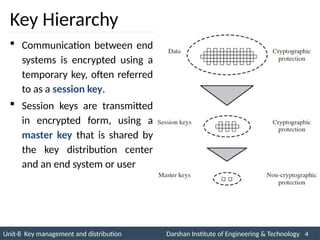
 Communication between end
systems is encrypted using a
temporary key, often referred
to as a session key.
 Session keys are transmitted
in encrypted form, using a
master key that is shared by
the key distribution center
and an end system or user
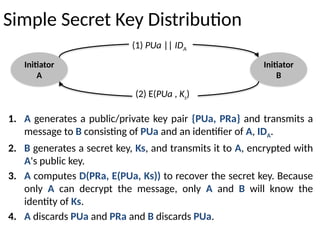
Simple Secret Key Distribution
1. A generates a public/private key pair {PUa, PRa} and transmits a
message to B consisting of PUa and an identifier of A, IDA.
2. B generates a secret key, Ks, and transmits it to A, encrypted with
A's public key.
3. A computes D(PRa, E(PUa, Ks)) to recover the secret key. Because
only A can decrypt the message, only A and B will know the
identity of Ks.
4. A discards PUa and PRa and B discards PUa.
Initiator
A
Initiator
B
(2) E(PUa , Ks)
(1) PUa || IDA
Secret Key Distribution with Confidentiality & Authentication
1. A uses B's public key to encrypt a message to B containing an
identifier of A (IA) and a nonce (N1), which is used to identify this
transaction uniquely.
2. B sends a message to A encrypted with PUa and containing A's (N1)
as well as a new nonce generated by B (N2). Because only B could
have decrypted message (1), the presence of N1 in message (2)
assures A that the correspondent is B.
Initiator
A
Initiator
B
(1) E(PUb,[N1||IDA])
(2) E(PUa,[N1|| N2])
(3) E(PUb,N2])
(4) E(Pub,E(PRa,Ks))
Secret Key Distribution with Confidentiality & Authentication
3. A returns N2, encrypted using B's public key, to assure B that its
correspondent is A.
4. A selects a secret key Ks and sends M = E(PUb, E(PRa, Ks)) to B.
Encryption with B's public key ensures that only B can read it;
encryption with A's private key ensures that only A could have
sent it.
5. B computes D(PUa, D(PRb, M)) to recover the secret key.
Initiator
A
Initiator
B
(1) E(PUb,[N1||IDA])
(2) E(PUa,[N1|| N2])
(3) E(PUb,N2])
(4) E(Pub,E(PRa,Ks))
Unit-8 Key management and distribution Darshan Institute of Engineering & Technology 8
INS is very Interesting Subject
Symmetric key distribution using symmetric encryption
 Two parties A and B, key distribution can be achieved in a number
of ways, as follows:
1. A can select a key and physically deliver key to B.
2. Third party can select the key and physically deliver it to A and
B.
3. If A and B have previously and recently used a key, one party
can transmit the new key to the other, encrypted using the old
key.
4. If A and B each has an encrypted connection to a third party
C, C can deliver a key on the encrypted links to A and B.
Unit-8 Key management and distribution Darshan Institute of Engineering & Technology 9
INS is very Interesting Subject
Key Distribution Scenario
Key
Distribution
Center (Key)
Initiator
A
Initiator
B
(1) IDA || IDB || N1
(2) E(Ka, [Ks || IDA || IDB || N1]) || E(Kb, [Ks || IDA])
(3) E(Kb, [Ks || IDA])
(4) E(Ks, N2])
(5) E(Ks, f(N2))
Unit-8 Key management and distribution Darshan Institute of Engineering & Technology 10
INS is very Interesting Subject
Key Distribution Scenario
1. A requests from the KDC a session key to protect a logical connection to B.
The message includes the identity of A and B and a unique nonce N1.
2. The KDC responds with a message encrypted using Ka that includes a one-
time session key Ks to be used for the session, the original request message to
enable A to match response with appropriate request, and info for B
3. A stores the session key for use in the upcoming session and forwards to B
the information from the KDC for B, namely, E(Kb, [Ks || IDA]).
4. At this point, a session key has been securely delivered to A and B, and they
may begin their protected exchange.
5. Using the new session key for encryption B sends a nonce N2 to A.
6. Also using Ks, A responds with f(N2). These steps assure B that the original
message it received (step 3) was not a replay. Note that the actual key
distribution involves only steps 1 through 3 but that steps 4 and 5, as well as
3, perform an authentication function.
Unit-8 Key management and distribution Darshan Institute of Engineering & Technology 11
INS is very Interesting Subject
Distribution of Public Keys
1. Public announcement
2. Publicly available directory
3. Public-key authority
4. Public-key certificates
Unit-8 Key management and distribution Darshan Institute of Engineering & Technology 12
INS is very Interesting Subject
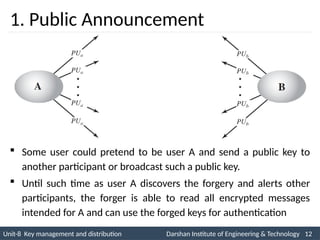
1. Public Announcement
 Some user could pretend to be user A and send a public key to
another participant or broadcast such a public key.
 Until such time as user A discovers the forgery and alerts other
participants, the forger is able to read all encrypted messages
intended for A and can use the forged keys for authentication
Unit-8 Key management and distribution Darshan Institute of Engineering & Technology 13
INS is very Interesting Subject
2. Publicly Available Directory
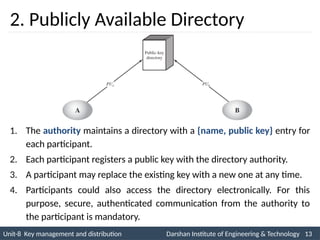
1. The authority maintains a directory with a {name, public key} entry for
each participant.
2. Each participant registers a public key with the directory authority.
3. A participant may replace the existing key with a new one at any time.
4. Participants could also access the directory electronically. For this
purpose, secure, authenticated communication from the authority to
the participant is mandatory.
3. Public-Key Authority
Initiator
A
Initiator
B
(6) E(PUa , [N1 || N2])
Public-Key
Authority
(1) Request || T1
(2) E(PRauth, [PUb || Request || T1])
(4) Request || T2
(5) E(PRauth, [PUa || Request || T2])
(3) E (PUb, [IDa, N1])
(7) E(PUb, N2)
Unit-8 Key management and distribution Darshan Institute of Engineering & Technology 15
INS is very Interesting Subject
3. Public-Key Authority – Cont…
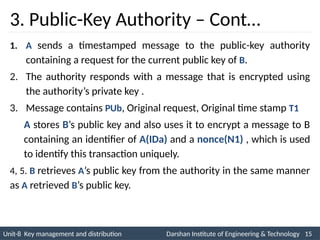
1. A sends a timestamped message to the public-key authority
containing a request for the current public key of B.
2. The authority responds with a message that is encrypted using
the authority’s private key .
3. Message contains PUb, Original request, Original time stamp T1
A stores B’s public key and also uses it to encrypt a message to B
containing an identifier of A(IDa) and a nonce(N1) , which is used
to identify this transaction uniquely.
4, 5. B retrieves A’s public key from the authority in the same manner
as A retrieved B’s public key.
Unit-8 Key management and distribution Darshan Institute of Engineering & Technology 16
INS is very Interesting Subject
3. Public-Key Authority – Cont…
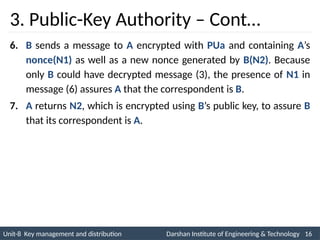
6. B sends a message to A encrypted with PUa and containing A’s
nonce(N1) as well as a new nonce generated by B(N2). Because
only B could have decrypted message (3), the presence of N1 in
message (6) assures A that the correspondent is B.
7. A returns N2, which is encrypted using B’s public key, to assure B
that its correspondent is A.
Unit-8 Key management and distribution Darshan Institute of Engineering & Technology 17
INS is very Interesting Subject
4. Public-Key Certificates
 Any participant can read a certificate to determine the name and
public key of the certificate’s owner.
 Any participant can verify that the certificate originated from the
certificate authority and is not counterfeit.
 Only the certificate authority can create and update certificates.
 Any participant can verify the currency of the certificate.
4. Public-Key Certificates – Cont…
Initiator
A
Initiator
B
(2) CA
(1) CA
Certificate
Authority
PUa
CA = E(PRauth, [T1 || IDa || PUa])
PUb
CA = E(PRauth, [T2 || IDb || PUb])
Unit-8 Key management and distribution Darshan Institute of Engineering & Technology 19
INS is very Interesting Subject
4. Public-Key Certificates – Cont…
 Each participant applies to the certificate authority, supplying a
public key and requesting a certificate.
 For participant A, the authority provides a certificate of the form
CA = E (PRauth, [T || IDa || PUa] )
 A may then pass this certificate on to any other participant, who
reads and verifies the certificate as follows:
D(PUauth, CA)
= D(PUauth, E (PRauth, [T || IDa || PUa] ))
= (T || IDa || PUa)
Unit-8 Key management and distribution Darshan Institute of Engineering & Technology 20
INS is very Interesting Subject
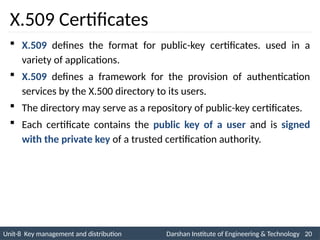
X.509 Certificates
 X.509 defines the format for public-key certificates. used in a
variety of applications.
 X.509 defines a framework for the provision of authentication
services by the X.500 directory to its users.
 The directory may serve as a repository of public-key certificates.
 Each certificate contains the public key of a user and is signed
with the private key of a trusted certification authority.
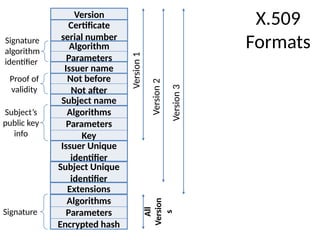
X.509
Formats
Version
Certificate
serial number
Algorithm
Parameters
Issuer name
Not before
Not after
Subject name
Algorithms
Parameters
Key
Issuer Unique
identifier
Extensions
Algorithms
Parameters
Encrypted hash
Signature
algorithm
identifier
Proof of
validity
Subject’s
public key
info
Signature
Subject Unique
identifier
Version
1
Version
2
Version
3
All
Version
s
Unit-8 Key management and distribution Darshan Institute of Engineering & Technology 22
INS is very Interesting Subject
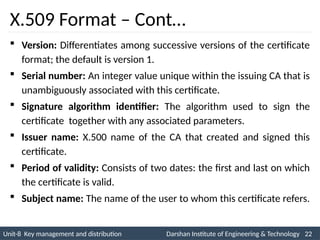
X.509 Format – Cont…
 Version: Differentiates among successive versions of the certificate
format; the default is version 1.
 Serial number: An integer value unique within the issuing CA that is
unambiguously associated with this certificate.
 Signature algorithm identifier: The algorithm used to sign the
certificate together with any associated parameters.
 Issuer name: X.500 name of the CA that created and signed this
certificate.
 Period of validity: Consists of two dates: the first and last on which
the certificate is valid.
 Subject name: The name of the user to whom this certificate refers.
Unit-8 Key management and distribution Darshan Institute of Engineering & Technology 23
INS is very Interesting Subject
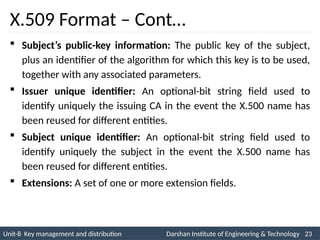
X.509 Format – Cont…
 Subject’s public-key information: The public key of the subject,
plus an identifier of the algorithm for which this key is to be used,
together with any associated parameters.
 Issuer unique identifier: An optional-bit string field used to
identify uniquely the issuing CA in the event the X.500 name has
been reused for different entities.
 Subject unique identifier: An optional-bit string field used to
identify uniquely the subject in the event the X.500 name has
been reused for different entities.
 Extensions: A set of one or more extension fields.
Unit-8 Key management and distribution Darshan Institute of Engineering & Technology 24
INS is very Interesting Subject
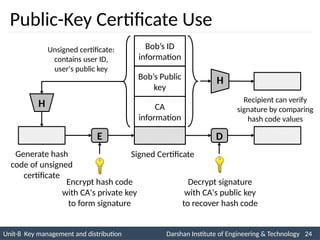
Public-Key Certificate Use
H
E D
CA
information
Bob’s Public
key
Bob’s ID
information
H
Generate hash
code of unsigned
certificate
Encrypt hash code
with CA's private key
to form signature
Decrypt signature
with CA's public key
to recover hash code
Recipient can verify
signature by comparing
hash code values
Signed Certificate
Unsigned certificate:
contains user ID,
user's public key
Unit-8 Key management and distribution Darshan Institute of Engineering & Technology 25
INS is very Interesting Subject
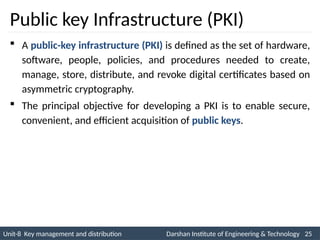
Public key Infrastructure (PKI)
 A public-key infrastructure (PKI) is defined as the set of hardware,
software, people, policies, and procedures needed to create,
manage, store, distribute, and revoke digital certificates based on
asymmetric cryptography.
 The principal objective for developing a PKI is to enable secure,
convenient, and efficient acquisition of public keys.
Unit-8 Key management and distribution Darshan Institute of Engineering & Technology 26
INS is very Interesting Subject
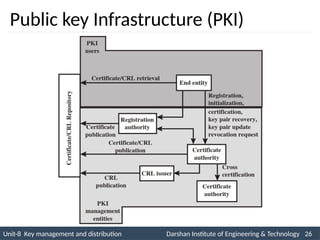
Public key Infrastructure (PKI)
Unit-8 Key management and distribution Darshan Institute of Engineering & Technology 27
INS is very Interesting Subject
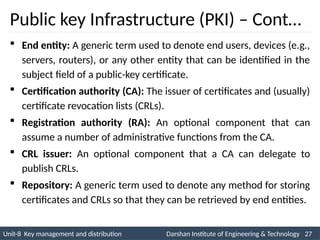
Public key Infrastructure (PKI) – Cont…
 End entity: A generic term used to denote end users, devices (e.g.,
servers, routers), or any other entity that can be identified in the
subject field of a public-key certificate.
 Certification authority (CA): The issuer of certificates and (usually)
certificate revocation lists (CRLs).
 Registration authority (RA): An optional component that can
assume a number of administrative functions from the CA.
 CRL issuer: An optional component that a CA can delegate to
publish CRLs.
 Repository: A generic term used to denote any method for storing
certificates and CRLs so that they can be retrieved by end entities.
Key management and Distribution in Network security.ppt

Key management and Distribution in Network security.ppt

  • 1.
    Prof. Rupesh G.Vaishnav rupesh.vaishnav@darshan.ac.in 94280-37452 Information & Network Security (2170709) Darshan Institute of Engineering & Technology UNIT-8 Key management and distribution
  • 2.
    Unit-8 Key managementand distribution Darshan Institute of Engineering & Technology 2 INS is very Interesting Subject Outline  Key management and distribution  Symmetric key distribution using symmetric encryption  Symmetric key distribution asymmetric encryption  Distribution of public keys  X.509 certificates  Public key infrastructure (PKI)
  • 3.
    Unit-8 Key managementand distribution Darshan Institute of Engineering & Technology 3 INS is very Interesting Subject Key Distribution  Key distribution is the function that delivers a key to two parties who wish to exchange secure encrypted data.  Some sort of mechanism or protocol is needed to provide for the secure distribution of keys.  Key distribution often involves the use of master keys, which are infrequently used and are long lasting, and session keys, which are generated and distributed for temporary use between two parties.
  • 4.
    Unit-8 Key managementand distribution Darshan Institute of Engineering & Technology 4 INS is very Interesting Subject Key Hierarchy  Communication between end systems is encrypted using a temporary key, often referred to as a session key.  Session keys are transmitted in encrypted form, using a master key that is shared by the key distribution center and an end system or user
  • 5.
    Simple Secret KeyDistribution 1. A generates a public/private key pair {PUa, PRa} and transmits a message to B consisting of PUa and an identifier of A, IDA. 2. B generates a secret key, Ks, and transmits it to A, encrypted with A's public key. 3. A computes D(PRa, E(PUa, Ks)) to recover the secret key. Because only A can decrypt the message, only A and B will know the identity of Ks. 4. A discards PUa and PRa and B discards PUa. Initiator A Initiator B (2) E(PUa , Ks) (1) PUa || IDA
  • 6.
    Secret Key Distributionwith Confidentiality & Authentication 1. A uses B's public key to encrypt a message to B containing an identifier of A (IA) and a nonce (N1), which is used to identify this transaction uniquely. 2. B sends a message to A encrypted with PUa and containing A's (N1) as well as a new nonce generated by B (N2). Because only B could have decrypted message (1), the presence of N1 in message (2) assures A that the correspondent is B. Initiator A Initiator B (1) E(PUb,[N1||IDA]) (2) E(PUa,[N1|| N2]) (3) E(PUb,N2]) (4) E(Pub,E(PRa,Ks))
  • 7.
    Secret Key Distributionwith Confidentiality & Authentication 3. A returns N2, encrypted using B's public key, to assure B that its correspondent is A. 4. A selects a secret key Ks and sends M = E(PUb, E(PRa, Ks)) to B. Encryption with B's public key ensures that only B can read it; encryption with A's private key ensures that only A could have sent it. 5. B computes D(PUa, D(PRb, M)) to recover the secret key. Initiator A Initiator B (1) E(PUb,[N1||IDA]) (2) E(PUa,[N1|| N2]) (3) E(PUb,N2]) (4) E(Pub,E(PRa,Ks))
  • 8.
    Unit-8 Key managementand distribution Darshan Institute of Engineering & Technology 8 INS is very Interesting Subject Symmetric key distribution using symmetric encryption  Two parties A and B, key distribution can be achieved in a number of ways, as follows: 1. A can select a key and physically deliver key to B. 2. Third party can select the key and physically deliver it to A and B. 3. If A and B have previously and recently used a key, one party can transmit the new key to the other, encrypted using the old key. 4. If A and B each has an encrypted connection to a third party C, C can deliver a key on the encrypted links to A and B.
  • 9.
    Unit-8 Key managementand distribution Darshan Institute of Engineering & Technology 9 INS is very Interesting Subject Key Distribution Scenario Key Distribution Center (Key) Initiator A Initiator B (1) IDA || IDB || N1 (2) E(Ka, [Ks || IDA || IDB || N1]) || E(Kb, [Ks || IDA]) (3) E(Kb, [Ks || IDA]) (4) E(Ks, N2]) (5) E(Ks, f(N2))
  • 10.
    Unit-8 Key managementand distribution Darshan Institute of Engineering & Technology 10 INS is very Interesting Subject Key Distribution Scenario 1. A requests from the KDC a session key to protect a logical connection to B. The message includes the identity of A and B and a unique nonce N1. 2. The KDC responds with a message encrypted using Ka that includes a one- time session key Ks to be used for the session, the original request message to enable A to match response with appropriate request, and info for B 3. A stores the session key for use in the upcoming session and forwards to B the information from the KDC for B, namely, E(Kb, [Ks || IDA]). 4. At this point, a session key has been securely delivered to A and B, and they may begin their protected exchange. 5. Using the new session key for encryption B sends a nonce N2 to A. 6. Also using Ks, A responds with f(N2). These steps assure B that the original message it received (step 3) was not a replay. Note that the actual key distribution involves only steps 1 through 3 but that steps 4 and 5, as well as 3, perform an authentication function.
  • 11.
    Unit-8 Key managementand distribution Darshan Institute of Engineering & Technology 11 INS is very Interesting Subject Distribution of Public Keys 1. Public announcement 2. Publicly available directory 3. Public-key authority 4. Public-key certificates
  • 12.
    Unit-8 Key managementand distribution Darshan Institute of Engineering & Technology 12 INS is very Interesting Subject 1. Public Announcement  Some user could pretend to be user A and send a public key to another participant or broadcast such a public key.  Until such time as user A discovers the forgery and alerts other participants, the forger is able to read all encrypted messages intended for A and can use the forged keys for authentication
  • 13.
    Unit-8 Key managementand distribution Darshan Institute of Engineering & Technology 13 INS is very Interesting Subject 2. Publicly Available Directory 1. The authority maintains a directory with a {name, public key} entry for each participant. 2. Each participant registers a public key with the directory authority. 3. A participant may replace the existing key with a new one at any time. 4. Participants could also access the directory electronically. For this purpose, secure, authenticated communication from the authority to the participant is mandatory.
  • 14.
    3. Public-Key Authority Initiator A Initiator B (6)E(PUa , [N1 || N2]) Public-Key Authority (1) Request || T1 (2) E(PRauth, [PUb || Request || T1]) (4) Request || T2 (5) E(PRauth, [PUa || Request || T2]) (3) E (PUb, [IDa, N1]) (7) E(PUb, N2)
  • 15.
    Unit-8 Key managementand distribution Darshan Institute of Engineering & Technology 15 INS is very Interesting Subject 3. Public-Key Authority – Cont… 1. A sends a timestamped message to the public-key authority containing a request for the current public key of B. 2. The authority responds with a message that is encrypted using the authority’s private key . 3. Message contains PUb, Original request, Original time stamp T1 A stores B’s public key and also uses it to encrypt a message to B containing an identifier of A(IDa) and a nonce(N1) , which is used to identify this transaction uniquely. 4, 5. B retrieves A’s public key from the authority in the same manner as A retrieved B’s public key.
  • 16.
    Unit-8 Key managementand distribution Darshan Institute of Engineering & Technology 16 INS is very Interesting Subject 3. Public-Key Authority – Cont… 6. B sends a message to A encrypted with PUa and containing A’s nonce(N1) as well as a new nonce generated by B(N2). Because only B could have decrypted message (3), the presence of N1 in message (6) assures A that the correspondent is B. 7. A returns N2, which is encrypted using B’s public key, to assure B that its correspondent is A.
  • 17.
    Unit-8 Key managementand distribution Darshan Institute of Engineering & Technology 17 INS is very Interesting Subject 4. Public-Key Certificates  Any participant can read a certificate to determine the name and public key of the certificate’s owner.  Any participant can verify that the certificate originated from the certificate authority and is not counterfeit.  Only the certificate authority can create and update certificates.  Any participant can verify the currency of the certificate.
  • 18.
    4. Public-Key Certificates– Cont… Initiator A Initiator B (2) CA (1) CA Certificate Authority PUa CA = E(PRauth, [T1 || IDa || PUa]) PUb CA = E(PRauth, [T2 || IDb || PUb])
  • 19.
    Unit-8 Key managementand distribution Darshan Institute of Engineering & Technology 19 INS is very Interesting Subject 4. Public-Key Certificates – Cont…  Each participant applies to the certificate authority, supplying a public key and requesting a certificate.  For participant A, the authority provides a certificate of the form CA = E (PRauth, [T || IDa || PUa] )  A may then pass this certificate on to any other participant, who reads and verifies the certificate as follows: D(PUauth, CA) = D(PUauth, E (PRauth, [T || IDa || PUa] )) = (T || IDa || PUa)
  • 20.
    Unit-8 Key managementand distribution Darshan Institute of Engineering & Technology 20 INS is very Interesting Subject X.509 Certificates  X.509 defines the format for public-key certificates. used in a variety of applications.  X.509 defines a framework for the provision of authentication services by the X.500 directory to its users.  The directory may serve as a repository of public-key certificates.  Each certificate contains the public key of a user and is signed with the private key of a trusted certification authority.
  • 21.
    X.509 Formats Version Certificate serial number Algorithm Parameters Issuer name Notbefore Not after Subject name Algorithms Parameters Key Issuer Unique identifier Extensions Algorithms Parameters Encrypted hash Signature algorithm identifier Proof of validity Subject’s public key info Signature Subject Unique identifier Version 1 Version 2 Version 3 All Version s
  • 22.
    Unit-8 Key managementand distribution Darshan Institute of Engineering & Technology 22 INS is very Interesting Subject X.509 Format – Cont…  Version: Differentiates among successive versions of the certificate format; the default is version 1.  Serial number: An integer value unique within the issuing CA that is unambiguously associated with this certificate.  Signature algorithm identifier: The algorithm used to sign the certificate together with any associated parameters.  Issuer name: X.500 name of the CA that created and signed this certificate.  Period of validity: Consists of two dates: the first and last on which the certificate is valid.  Subject name: The name of the user to whom this certificate refers.
  • 23.
    Unit-8 Key managementand distribution Darshan Institute of Engineering & Technology 23 INS is very Interesting Subject X.509 Format – Cont…  Subject’s public-key information: The public key of the subject, plus an identifier of the algorithm for which this key is to be used, together with any associated parameters.  Issuer unique identifier: An optional-bit string field used to identify uniquely the issuing CA in the event the X.500 name has been reused for different entities.  Subject unique identifier: An optional-bit string field used to identify uniquely the subject in the event the X.500 name has been reused for different entities.  Extensions: A set of one or more extension fields.
  • 24.
    Unit-8 Key managementand distribution Darshan Institute of Engineering & Technology 24 INS is very Interesting Subject Public-Key Certificate Use H E D CA information Bob’s Public key Bob’s ID information H Generate hash code of unsigned certificate Encrypt hash code with CA's private key to form signature Decrypt signature with CA's public key to recover hash code Recipient can verify signature by comparing hash code values Signed Certificate Unsigned certificate: contains user ID, user's public key
  • 25.
    Unit-8 Key managementand distribution Darshan Institute of Engineering & Technology 25 INS is very Interesting Subject Public key Infrastructure (PKI)  A public-key infrastructure (PKI) is defined as the set of hardware, software, people, policies, and procedures needed to create, manage, store, distribute, and revoke digital certificates based on asymmetric cryptography.  The principal objective for developing a PKI is to enable secure, convenient, and efficient acquisition of public keys.
  • 26.
    Unit-8 Key managementand distribution Darshan Institute of Engineering & Technology 26 INS is very Interesting Subject Public key Infrastructure (PKI)
  • 27.
    Unit-8 Key managementand distribution Darshan Institute of Engineering & Technology 27 INS is very Interesting Subject Public key Infrastructure (PKI) – Cont…  End entity: A generic term used to denote end users, devices (e.g., servers, routers), or any other entity that can be identified in the subject field of a public-key certificate.  Certification authority (CA): The issuer of certificates and (usually) certificate revocation lists (CRLs).  Registration authority (RA): An optional component that can assume a number of administrative functions from the CA.  CRL issuer: An optional component that a CA can delegate to publish CRLs.  Repository: A generic term used to denote any method for storing certificates and CRLs so that they can be retrieved by end entities.

Editor's Notes

  • #2 X.800 and RFC 2828 International Telecommunication Union (ITU)