Prof. Rupesh G. Vaishnav
rupesh.vaishnav@darshan.ac.in
94280-37452
Information & Network Security (2170709) Darshan Institute of Engineering & Technology
UNIT-6
Message
Authentication
Codes
Unit-6 Message Authentication Codes Darshan Institute of Engineering & Technology 2
INS is very Interesting Subject
Outline
 Message Authentication Codes
 MAC requirements and security
 MACs based on Hash Functions
 MACs based on Block Ciphers
Unit-6 Message Authentication Codes Darshan Institute of Engineering & Technology 3
INS is very Interesting Subject
Message Authentication
 Message authentication is a procedure to verify that received
messages come from the genuine source and have not been
altered.
 Message authentication may also verify sequencing and
timeliness.
 Message authentication is a mechanism or service used to verify
the integrity of a message.
 Message authentication assures that data received are exactly as
sent (i.e., contain no modification, insertion, deletion, or replay).
Unit-6 Message Authentication Codes Darshan Institute of Engineering & Technology 4
INS is very Interesting Subject
Message Authentication Requirements
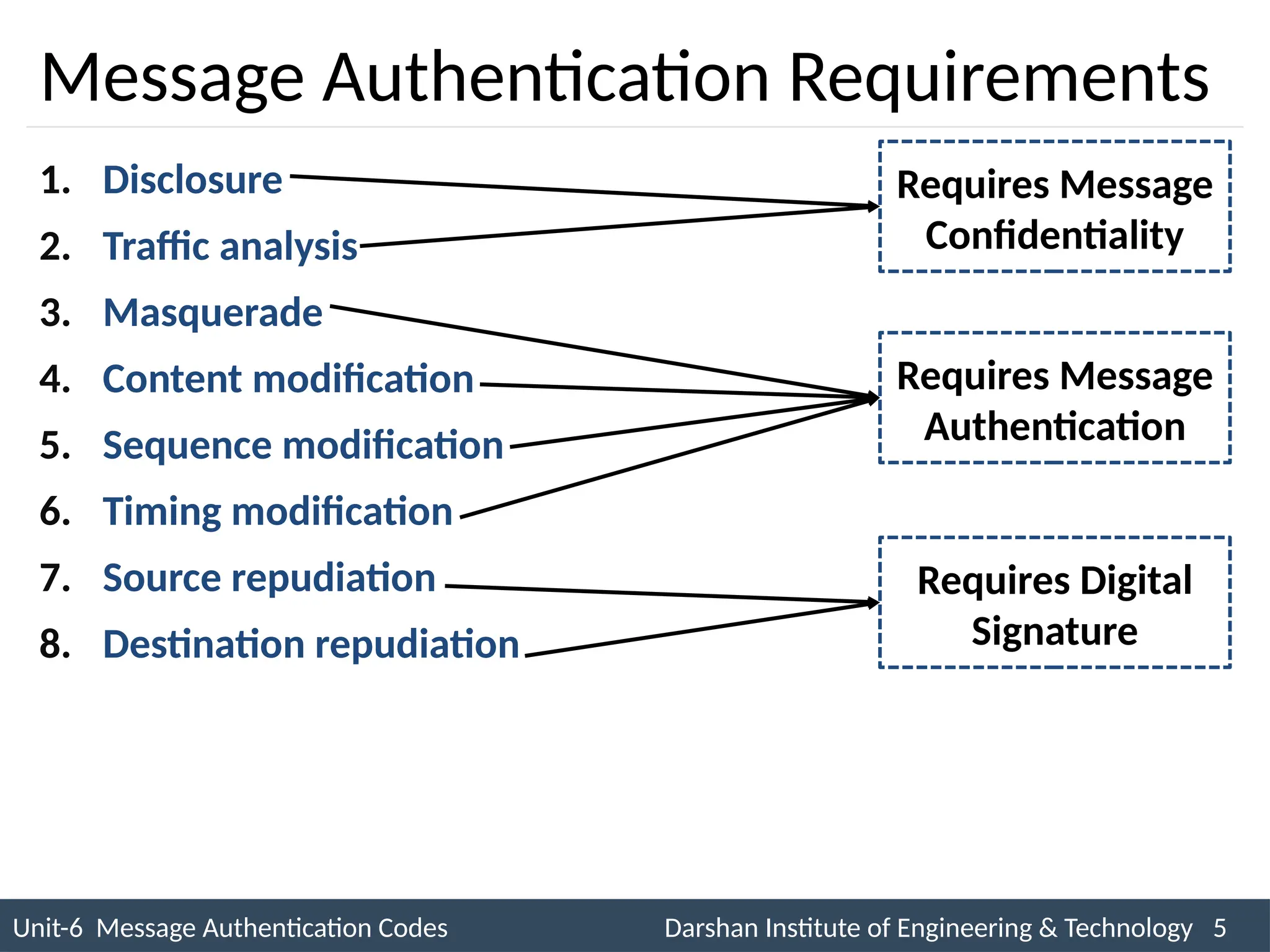
1. Disclosure: Release of message contents
2. Traffic analysis: Discovery of the pattern of traffic between parties
3. Masquerade: Insertion of messages into the network from a
fraudulent source
4. Content modification: Changes to the contents of a message
5. Sequence modification: Any modification to a sequence of
messages between parties
6. Timing modification: Delay or replay of messages
7. Source repudiation: Denial of transmission of message by source
8. Destination repudiation: Denial of receipt of message by
destination
Unit-6 Message Authentication Codes Darshan Institute of Engineering & Technology 5
INS is very Interesting Subject
Message Authentication Requirements
1. Disclosure
2. Traffic analysis
3. Masquerade
4. Content modification
5. Sequence modification
6. Timing modification
7. Source repudiation
8. Destination repudiation
Requires Message
Confidentiality
Requires Message
Authentication
Requires Digital
Signature
Unit-6 Message Authentication Codes Darshan Institute of Engineering & Technology 7
INS is very Interesting Subject
Message Authentication Code
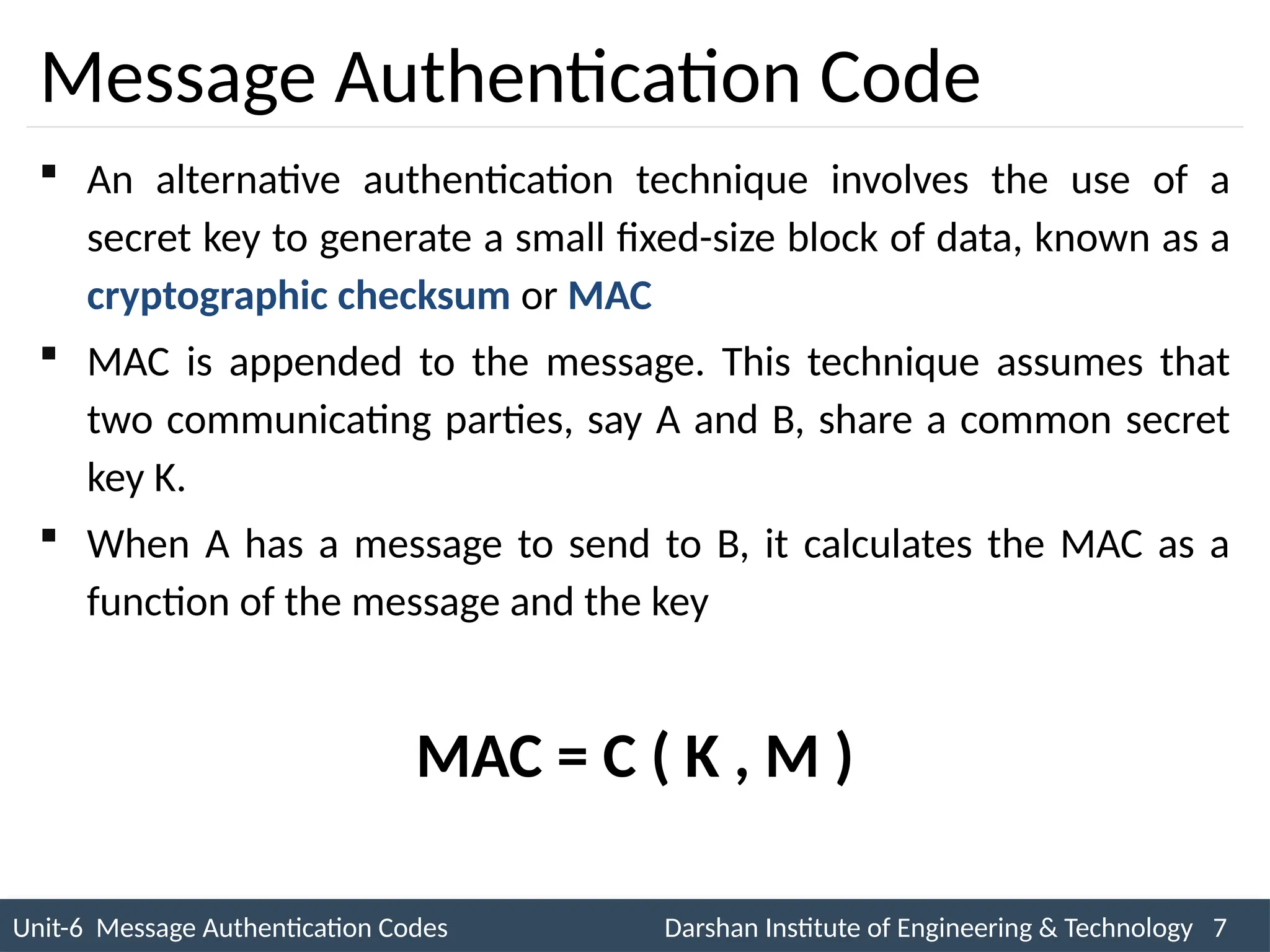
 An alternative authentication technique involves the use of a
secret key to generate a small fixed-size block of data, known as a
cryptographic checksum or MAC
 MAC is appended to the message. This technique assumes that
two communicating parties, say A and B, share a common secret
key K.
 When A has a message to send to B, it calculates the MAC as a
function of the message and the key
MAC = C ( K , M )
Unit-6 Message Authentication Codes Darshan Institute of Engineering & Technology 8
INS is very Interesting Subject
Message Authentication Code
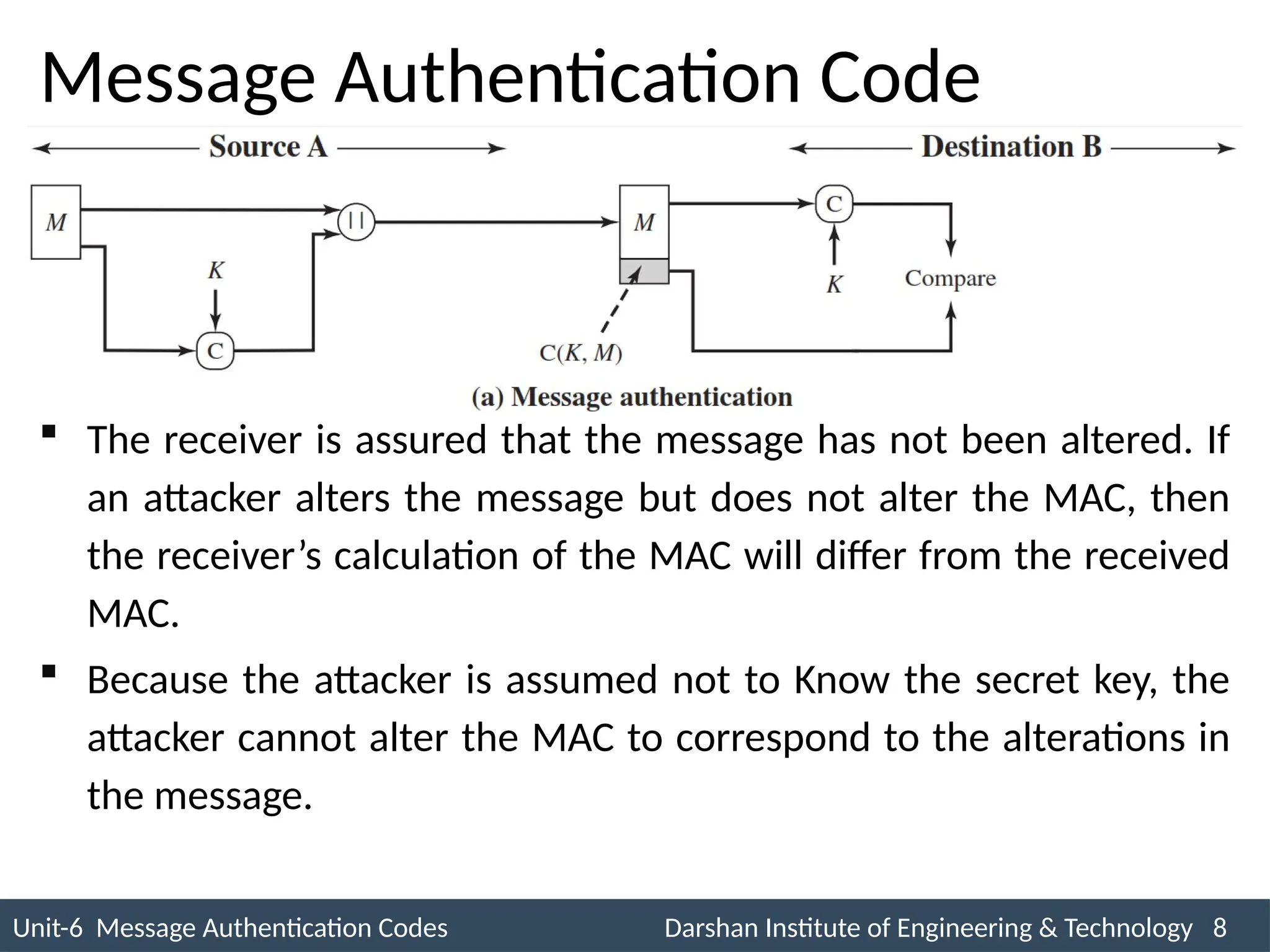
 The receiver is assured that the message has not been altered. If
an attacker alters the message but does not alter the MAC, then
the receiver’s calculation of the MAC will differ from the received
MAC.
 Because the attacker is assumed not to Know the secret key, the
attacker cannot alter the MAC to correspond to the alterations in
the message.
Unit-6 Message Authentication Codes Darshan Institute of Engineering & Technology 9
INS is very Interesting Subject
Message Authentication code - Cont…
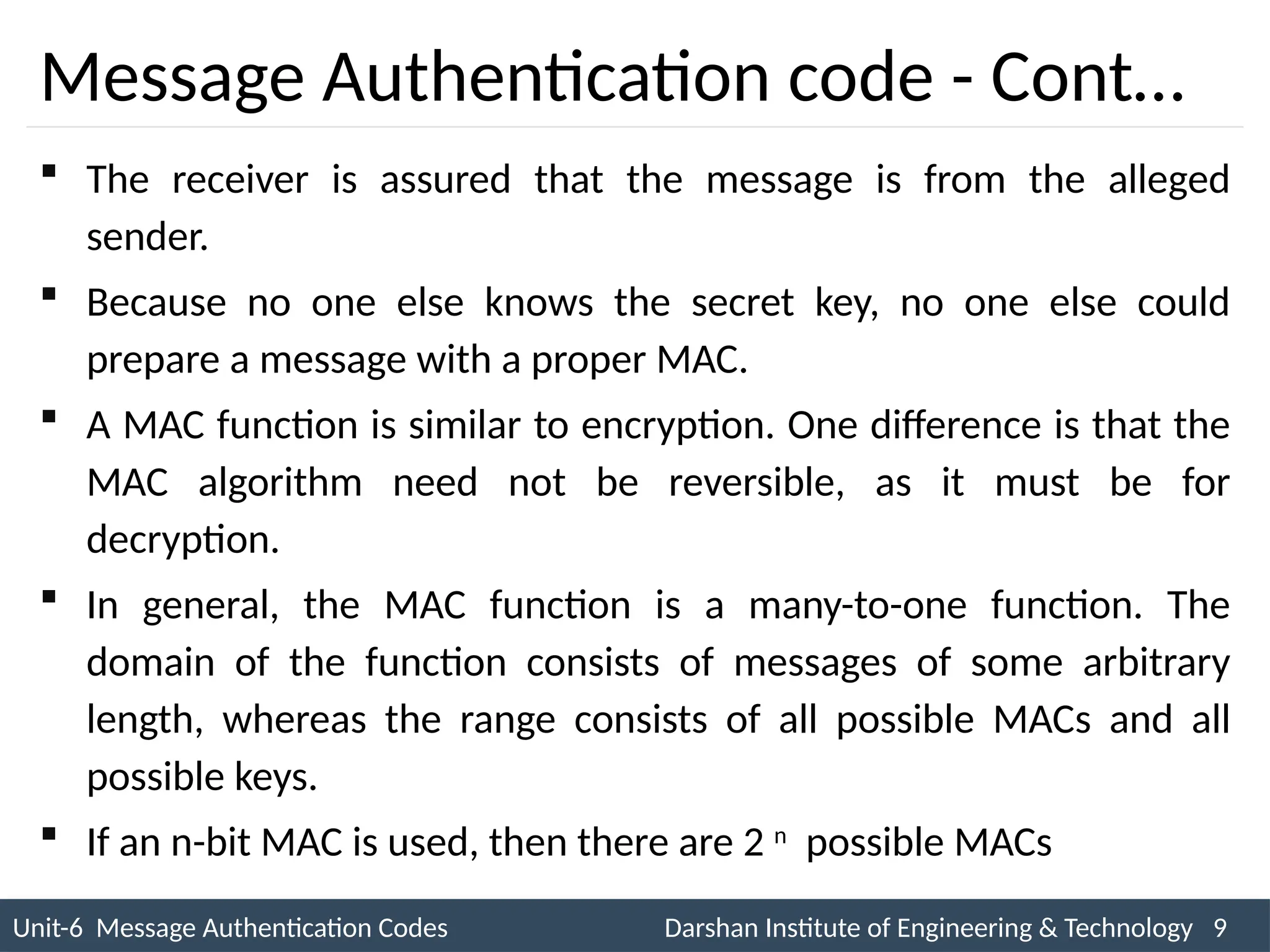
 The receiver is assured that the message is from the alleged
sender.
 Because no one else knows the secret key, no one else could
prepare a message with a proper MAC.
 A MAC function is similar to encryption. One difference is that the
MAC algorithm need not be reversible, as it must be for
decryption.
 In general, the MAC function is a many-to-one function. The
domain of the function consists of messages of some arbitrary
length, whereas the range consists of all possible MACs and all
possible keys.
 If an n-bit MAC is used, then there are 2 n
possible MACs
Unit-6 Message Authentication Codes Darshan Institute of Engineering & Technology 10
INS is very Interesting Subject
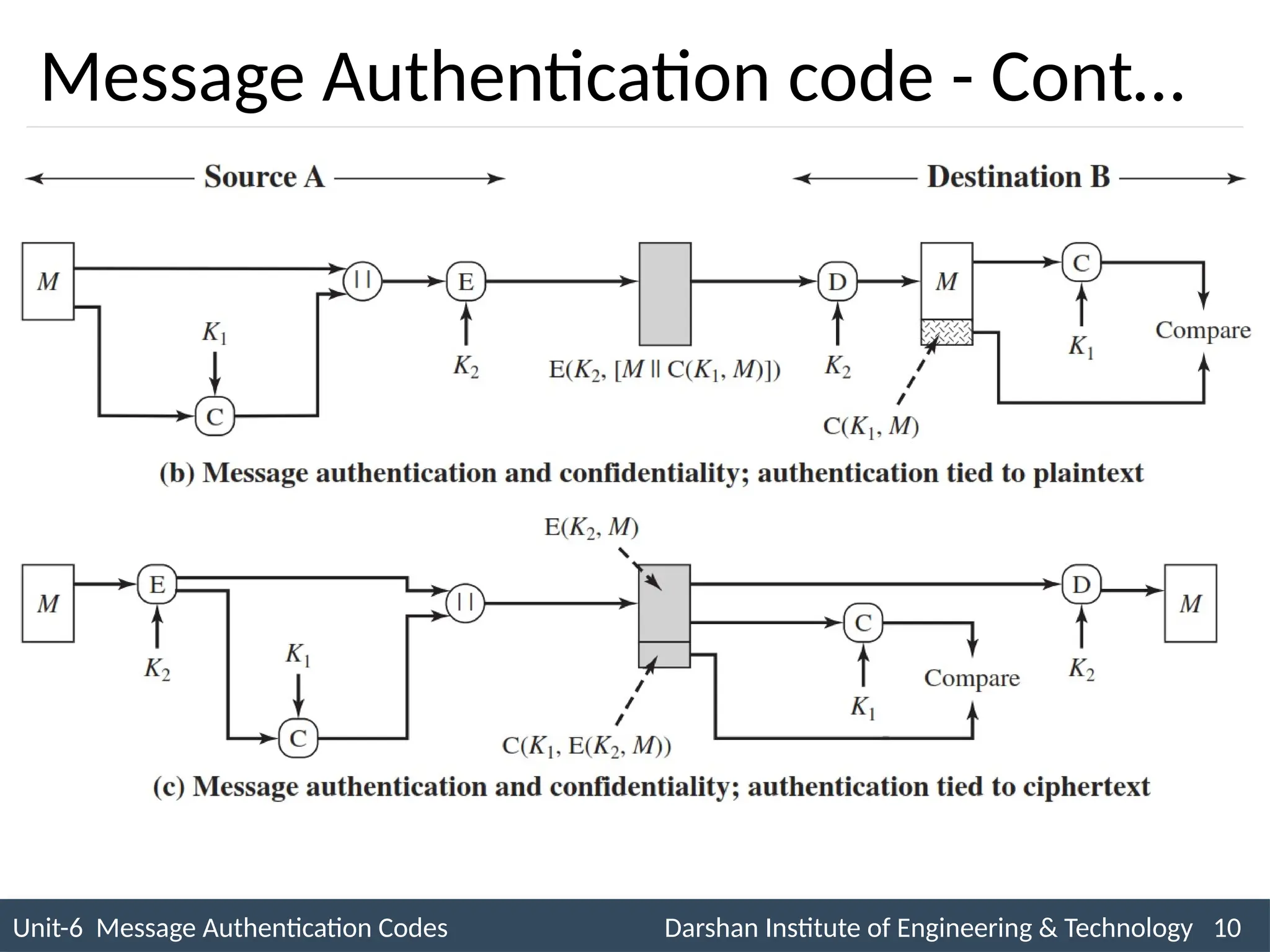
Message Authentication code - Cont…
Unit-6 Message Authentication Codes Darshan Institute of Engineering & Technology 11
INS is very Interesting Subject
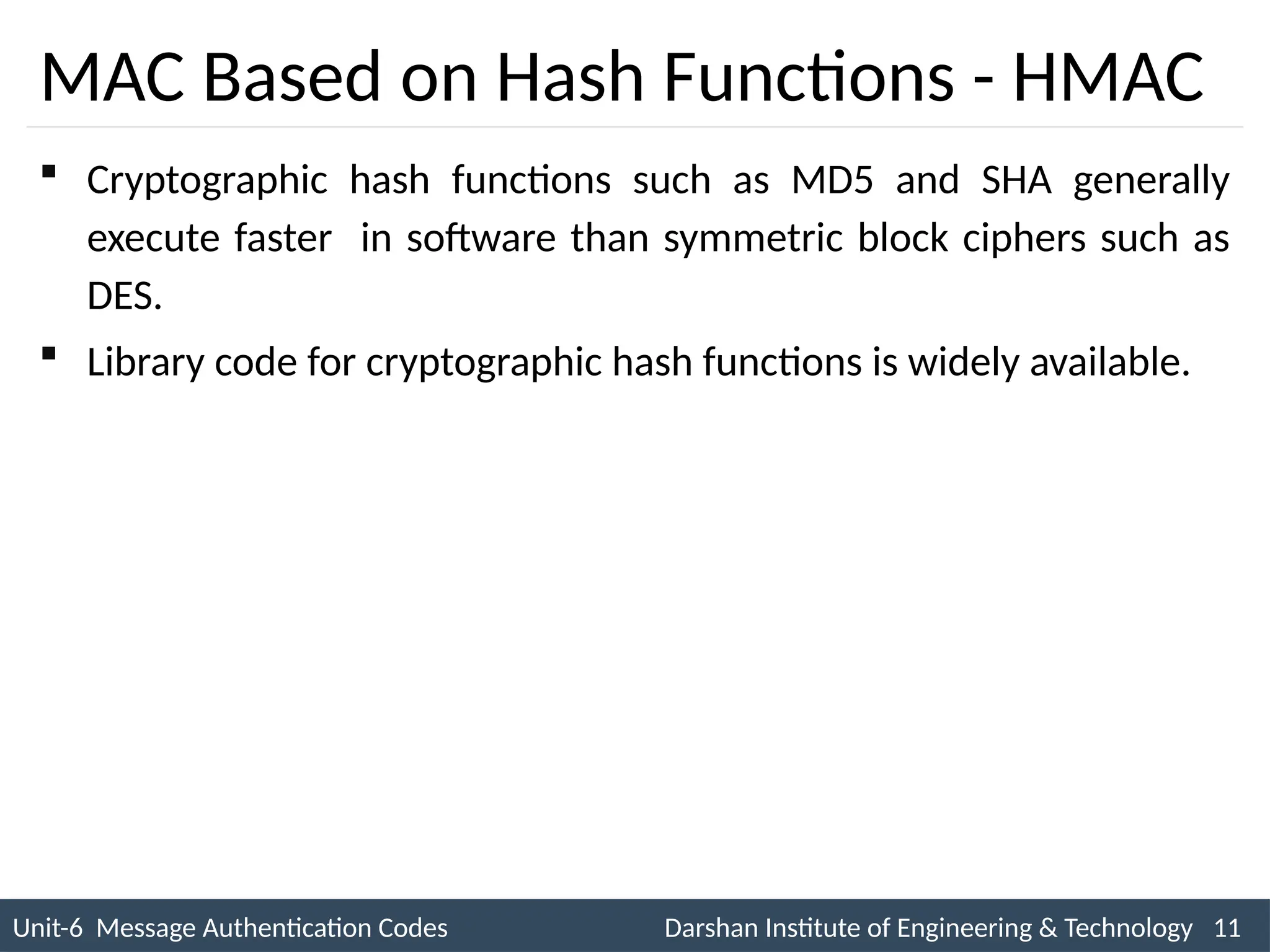
MAC Based on Hash Functions - HMAC
 Cryptographic hash functions such as MD5 and SHA generally
execute faster in software than symmetric block ciphers such as
DES.
 Library code for cryptographic hash functions is widely available.
Unit-6 Message Authentication Codes Darshan Institute of Engineering & Technology 12
INS is very Interesting Subject
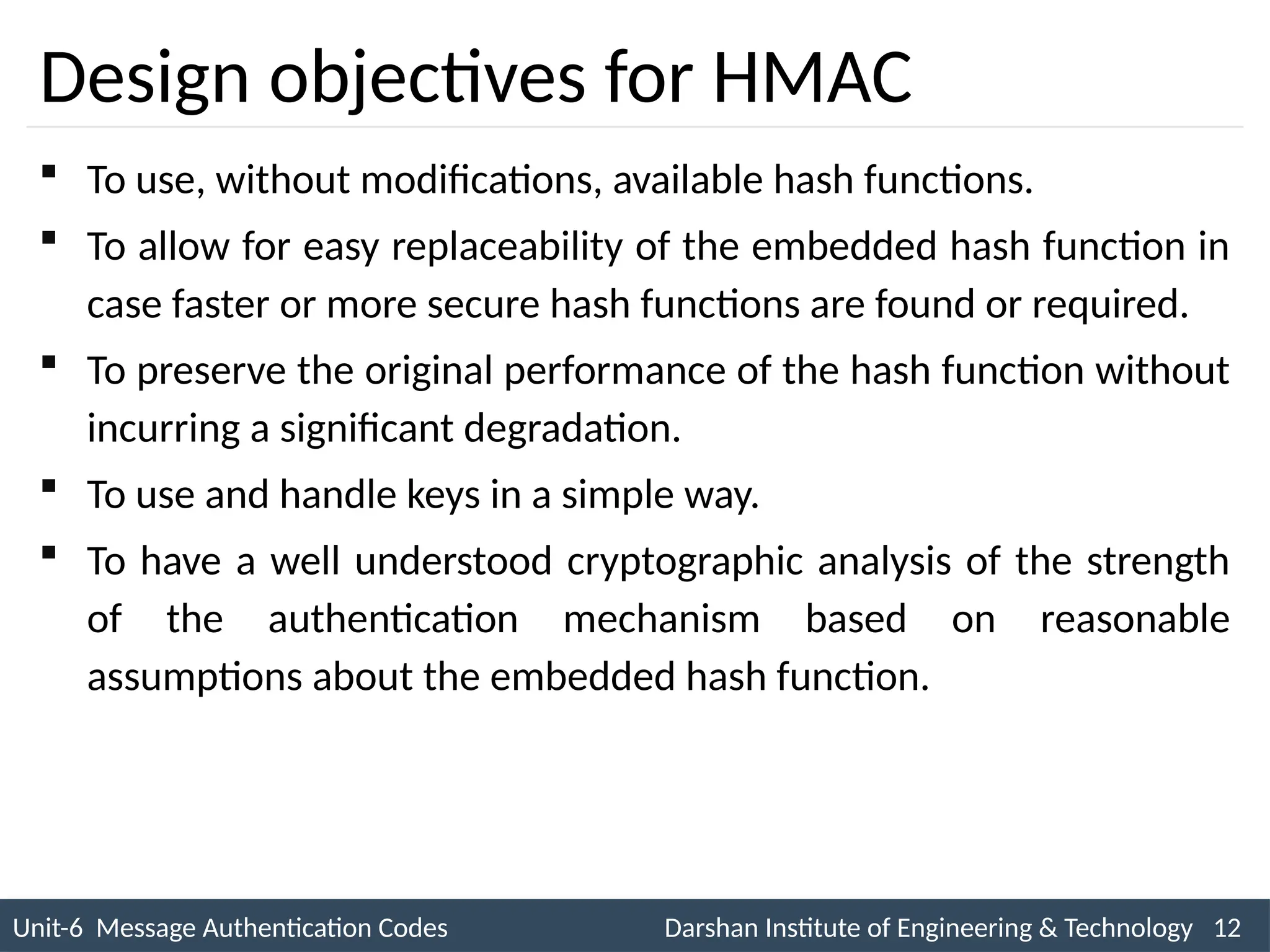
Design objectives for HMAC
 To use, without modifications, available hash functions.
 To allow for easy replaceability of the embedded hash function in
case faster or more secure hash functions are found or required.
 To preserve the original performance of the hash function without
incurring a significant degradation.
 To use and handle keys in a simple way.
 To have a well understood cryptographic analysis of the strength
of the authentication mechanism based on reasonable
assumptions about the embedded hash function.
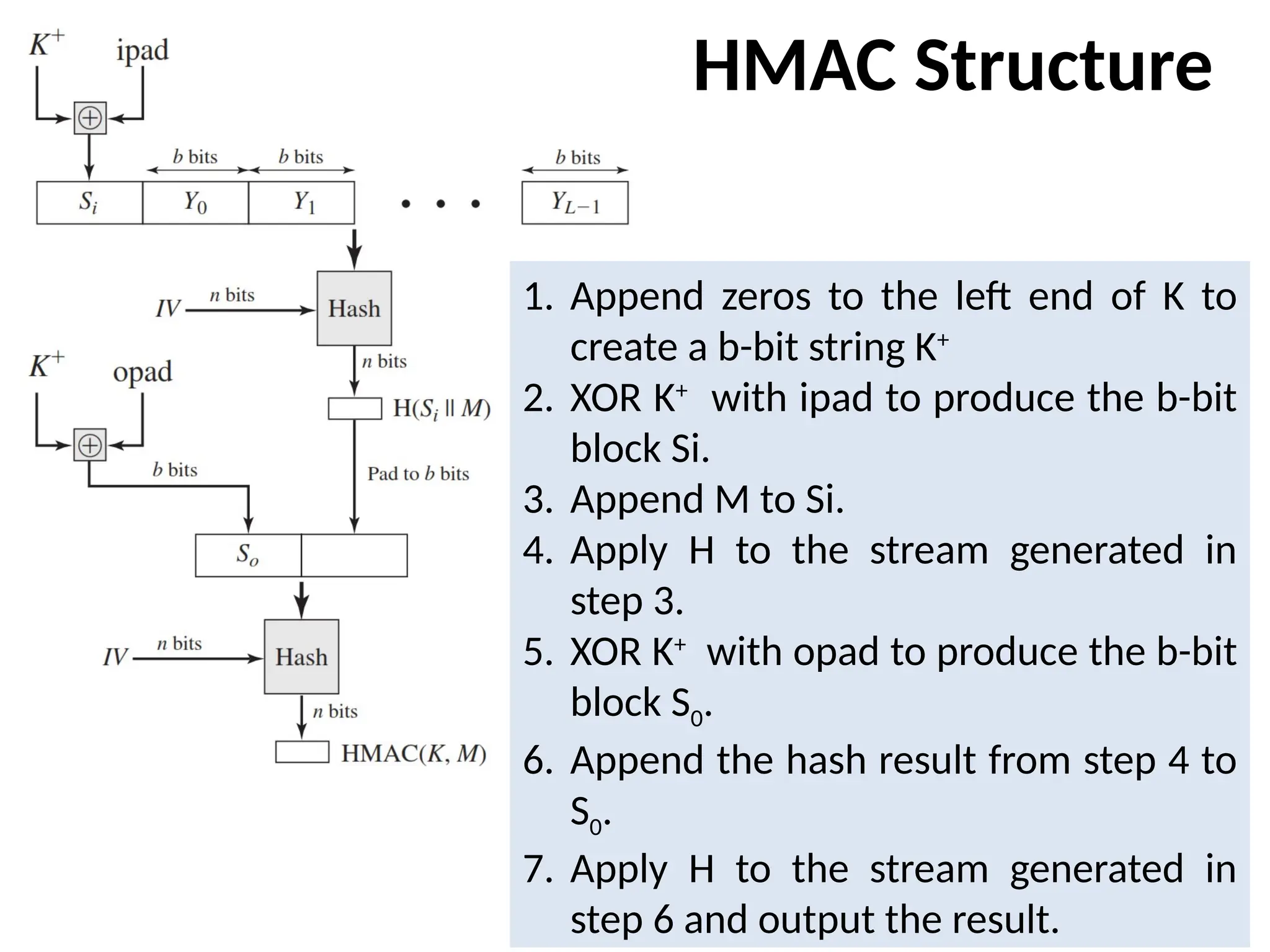
HMAC Structure
1. Append zeros to the left end of K to
create a b-bit string K+
2. XOR K+
with ipad to produce the b-bit
block Si.
3. Append M to Si.
4. Apply H to the stream generated in
step 3.
5. XOR K+
with opad to produce the b-bit
block S0.
6. Append the hash result from step 4 to
S0.
7. Apply H to the stream generated in
step 6 and output the result.
Unit-6 Message Authentication Codes Darshan Institute of Engineering & Technology 14
INS is very Interesting Subject
HMAC Structure
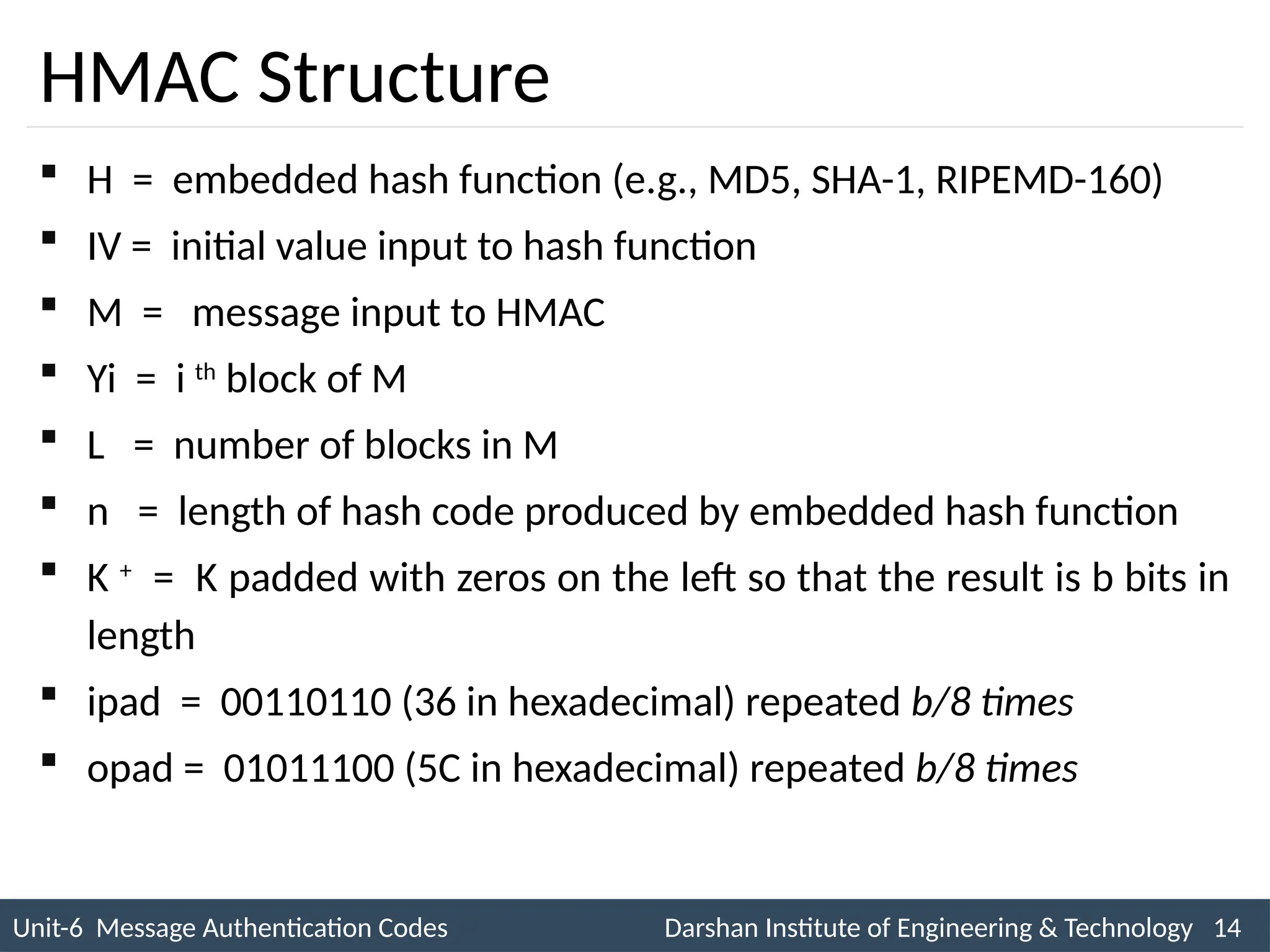
 H = embedded hash function (e.g., MD5, SHA-1, RIPEMD-160)
 IV = initial value input to hash function
 M = message input to HMAC
 Yi = i th
block of M
 L = number of blocks in M
 n = length of hash code produced by embedded hash function
 K +
= K padded with zeros on the left so that the result is b bits in
length
 ipad = 00110110 (36 in hexadecimal) repeated b/8 times
 opad = 01011100 (5C in hexadecimal) repeated b/8 times
Unit-6 Message Authentication Codes Darshan Institute of Engineering & Technology 15
INS is very Interesting Subject
MAC based on Block Ciphers
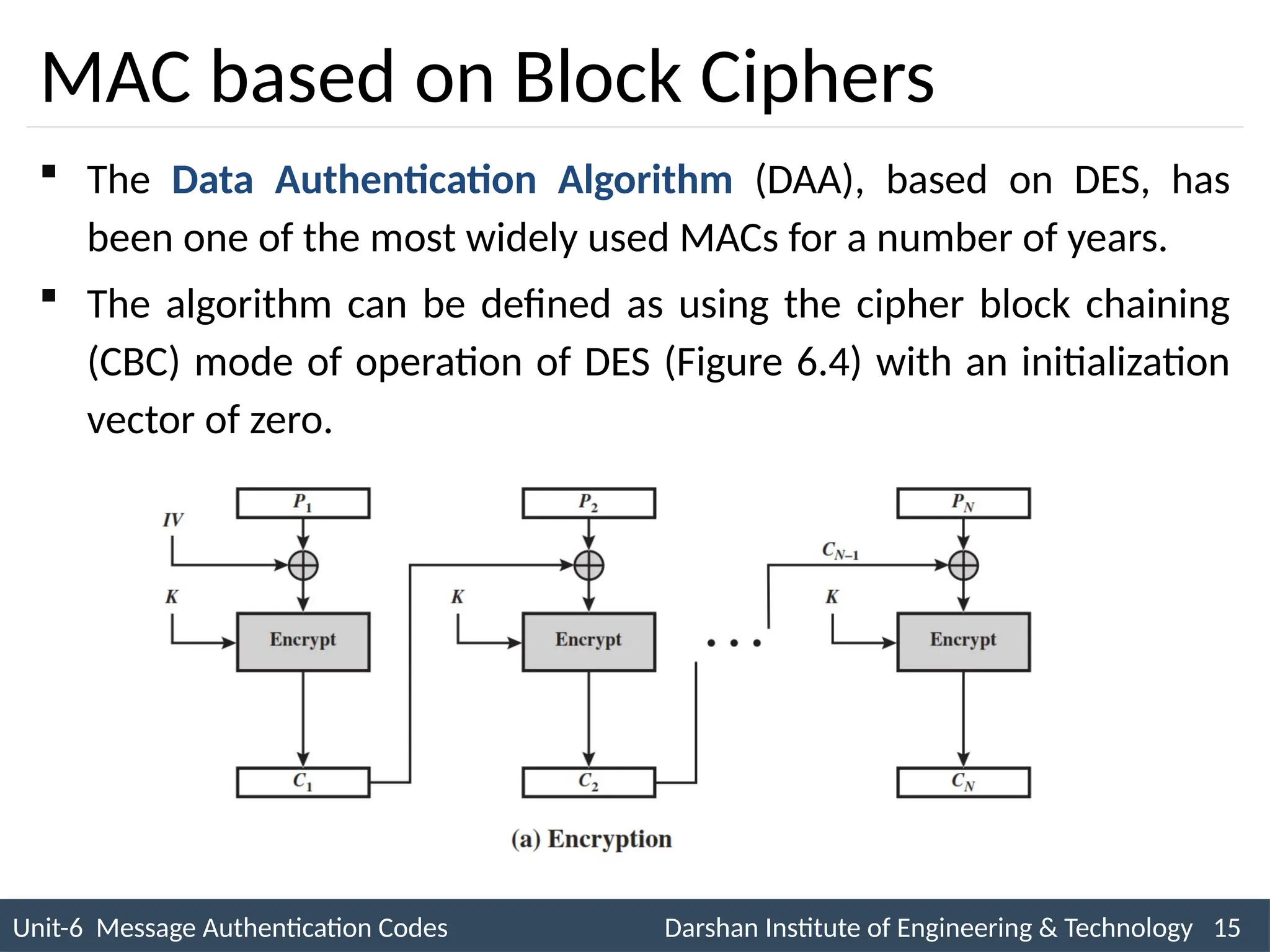
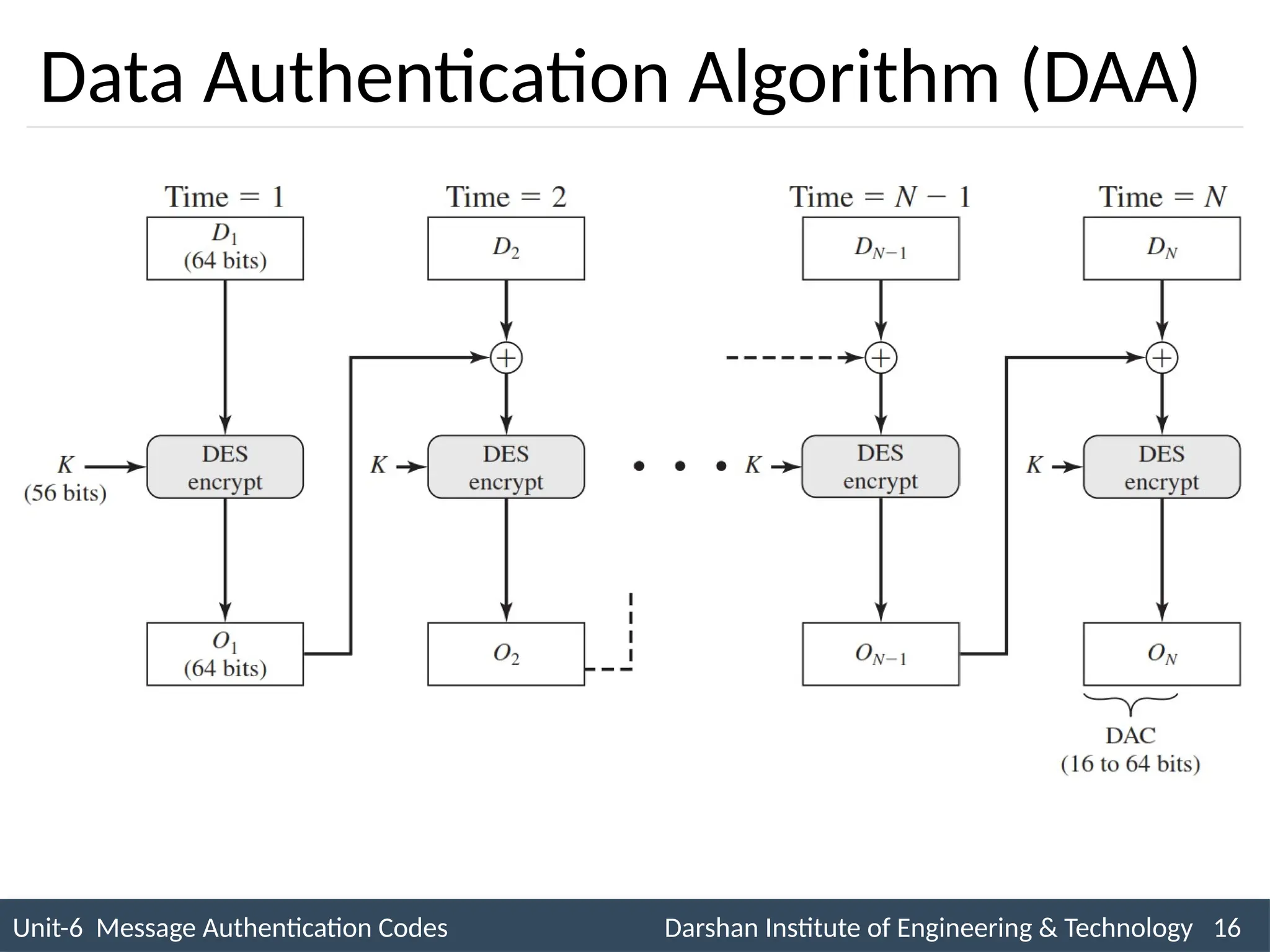
 The Data Authentication Algorithm (DAA), based on DES, has
been one of the most widely used MACs for a number of years.
 The algorithm can be defined as using the cipher block chaining
(CBC) mode of operation of DES (Figure 6.4) with an initialization
vector of zero.
Unit-6 Message Authentication Codes Darshan Institute of Engineering & Technology 16
INS is very Interesting Subject
Data Authentication Algorithm (DAA)
Unit-6 Message Authentication Codes Darshan Institute of Engineering & Technology 17
INS is very Interesting Subject
Data Authentication Algorithm (DAA)
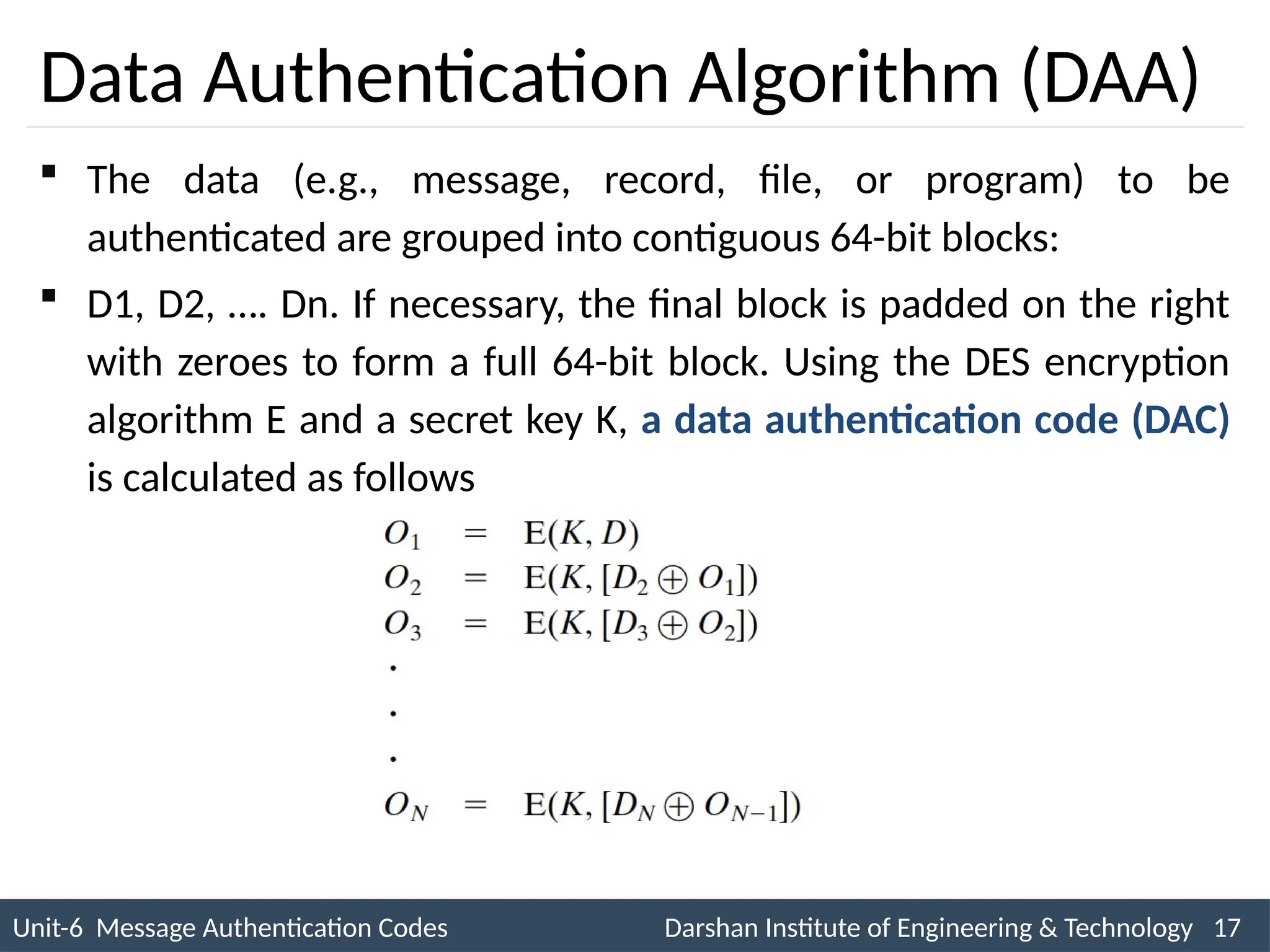
 The data (e.g., message, record, file, or program) to be
authenticated are grouped into contiguous 64-bit blocks:
 D1, D2, …. Dn. If necessary, the final block is padded on the right
with zeroes to form a full 64-bit block. Using the DES encryption
algorithm E and a secret key K, a data authentication code (DAC)
is calculated as follows
Unit-6 Message Authentication Codes Darshan Institute of Engineering & Technology 18
INS is very Interesting Subject
Cipher-Based Message Authentication Code (CMAC)
 Cipher-based Message Authentication Code (CMAC) mode of
operation for use with AES and triple DES.
 First, let us define the operation of CMAC when the message is an
integer multiple n of the cipher block length b. For AES, b = 128,
and for triple DES, b = 64. The message is divided into n blocks
(M1, M2,… Mn)
Unit-6 Message Authentication Codes Darshan Institute of Engineering & Technology 19
INS is very Interesting Subject
Cipher-Based Message Authentication Code (CMAC)
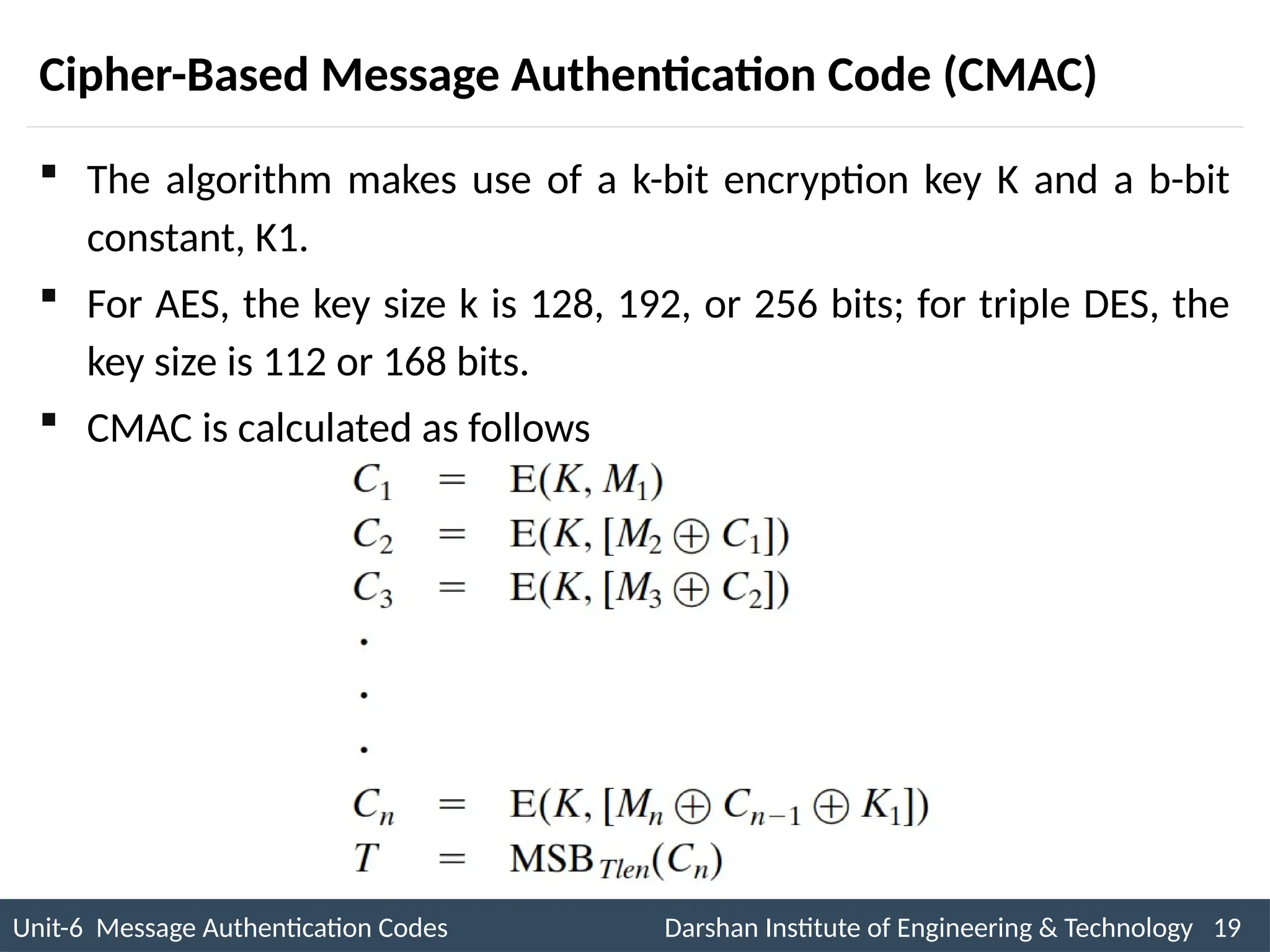
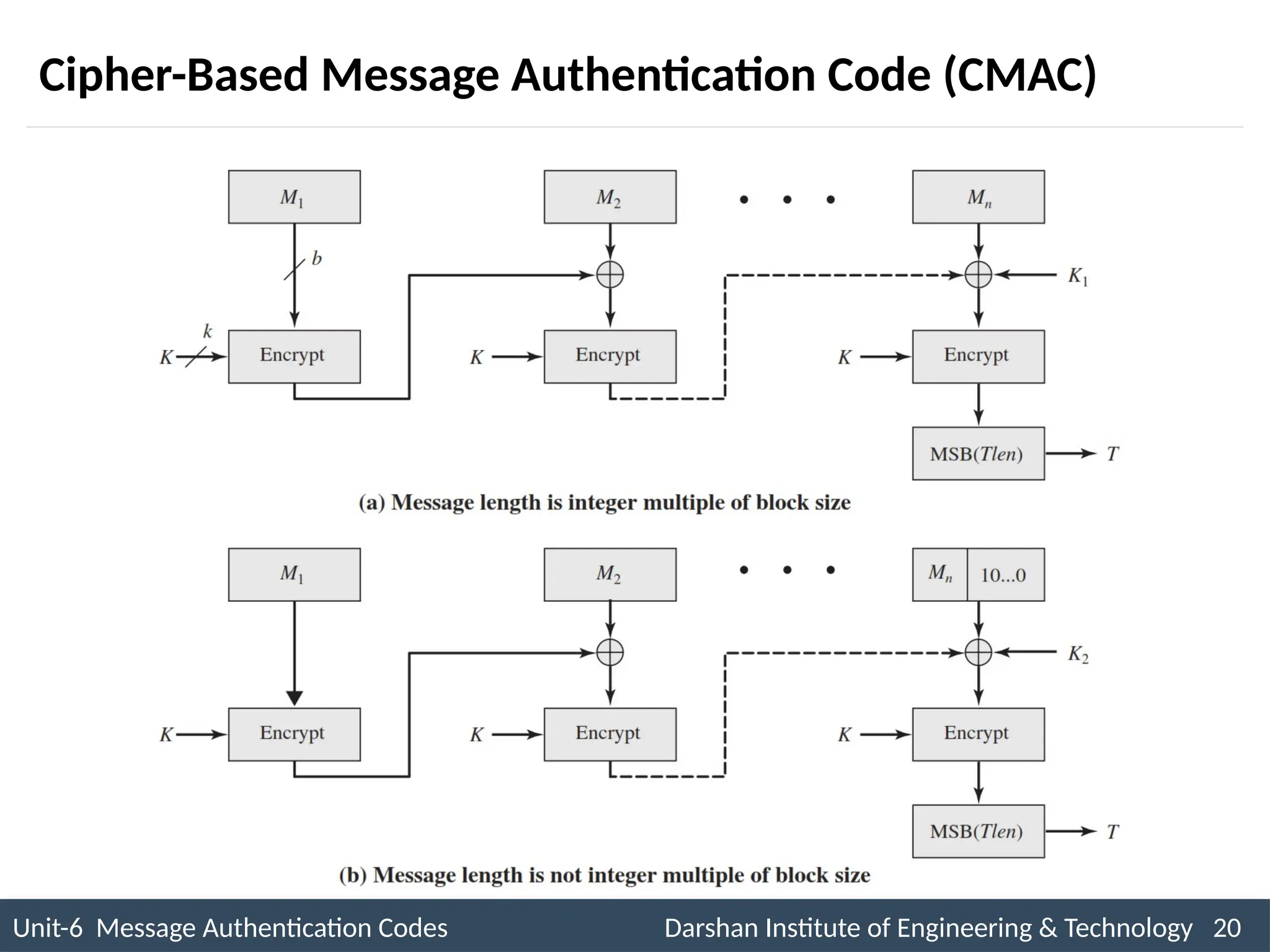
 The algorithm makes use of a k-bit encryption key K and a b-bit
constant, K1.
 For AES, the key size k is 128, 192, or 256 bits; for triple DES, the
key size is 112 or 168 bits.
 CMAC is calculated as follows
Unit-6 Message Authentication Codes Darshan Institute of Engineering & Technology 20
INS is very Interesting Subject
Cipher-Based Message Authentication Code (CMAC)
Message Authentication Codes in Security.pptx

Message Authentication Codes in Security.pptx

  • 1.
    Prof. Rupesh G.Vaishnav rupesh.vaishnav@darshan.ac.in 94280-37452 Information & Network Security (2170709) Darshan Institute of Engineering & Technology UNIT-6 Message Authentication Codes
  • 2.
    Unit-6 Message AuthenticationCodes Darshan Institute of Engineering & Technology 2 INS is very Interesting Subject Outline  Message Authentication Codes  MAC requirements and security  MACs based on Hash Functions  MACs based on Block Ciphers
  • 3.
    Unit-6 Message AuthenticationCodes Darshan Institute of Engineering & Technology 3 INS is very Interesting Subject Message Authentication  Message authentication is a procedure to verify that received messages come from the genuine source and have not been altered.  Message authentication may also verify sequencing and timeliness.  Message authentication is a mechanism or service used to verify the integrity of a message.  Message authentication assures that data received are exactly as sent (i.e., contain no modification, insertion, deletion, or replay).
  • 4.
    Unit-6 Message AuthenticationCodes Darshan Institute of Engineering & Technology 4 INS is very Interesting Subject Message Authentication Requirements 1. Disclosure: Release of message contents 2. Traffic analysis: Discovery of the pattern of traffic between parties 3. Masquerade: Insertion of messages into the network from a fraudulent source 4. Content modification: Changes to the contents of a message 5. Sequence modification: Any modification to a sequence of messages between parties 6. Timing modification: Delay or replay of messages 7. Source repudiation: Denial of transmission of message by source 8. Destination repudiation: Denial of receipt of message by destination
  • 5.
    Unit-6 Message AuthenticationCodes Darshan Institute of Engineering & Technology 5 INS is very Interesting Subject Message Authentication Requirements 1. Disclosure 2. Traffic analysis 3. Masquerade 4. Content modification 5. Sequence modification 6. Timing modification 7. Source repudiation 8. Destination repudiation Requires Message Confidentiality Requires Message Authentication Requires Digital Signature
  • 7.
    Unit-6 Message AuthenticationCodes Darshan Institute of Engineering & Technology 7 INS is very Interesting Subject Message Authentication Code  An alternative authentication technique involves the use of a secret key to generate a small fixed-size block of data, known as a cryptographic checksum or MAC  MAC is appended to the message. This technique assumes that two communicating parties, say A and B, share a common secret key K.  When A has a message to send to B, it calculates the MAC as a function of the message and the key MAC = C ( K , M )
  • 8.
    Unit-6 Message AuthenticationCodes Darshan Institute of Engineering & Technology 8 INS is very Interesting Subject Message Authentication Code  The receiver is assured that the message has not been altered. If an attacker alters the message but does not alter the MAC, then the receiver’s calculation of the MAC will differ from the received MAC.  Because the attacker is assumed not to Know the secret key, the attacker cannot alter the MAC to correspond to the alterations in the message.
  • 9.
    Unit-6 Message AuthenticationCodes Darshan Institute of Engineering & Technology 9 INS is very Interesting Subject Message Authentication code - Cont…  The receiver is assured that the message is from the alleged sender.  Because no one else knows the secret key, no one else could prepare a message with a proper MAC.  A MAC function is similar to encryption. One difference is that the MAC algorithm need not be reversible, as it must be for decryption.  In general, the MAC function is a many-to-one function. The domain of the function consists of messages of some arbitrary length, whereas the range consists of all possible MACs and all possible keys.  If an n-bit MAC is used, then there are 2 n possible MACs
  • 10.
    Unit-6 Message AuthenticationCodes Darshan Institute of Engineering & Technology 10 INS is very Interesting Subject Message Authentication code - Cont…
  • 11.
    Unit-6 Message AuthenticationCodes Darshan Institute of Engineering & Technology 11 INS is very Interesting Subject MAC Based on Hash Functions - HMAC  Cryptographic hash functions such as MD5 and SHA generally execute faster in software than symmetric block ciphers such as DES.  Library code for cryptographic hash functions is widely available.
  • 12.
    Unit-6 Message AuthenticationCodes Darshan Institute of Engineering & Technology 12 INS is very Interesting Subject Design objectives for HMAC  To use, without modifications, available hash functions.  To allow for easy replaceability of the embedded hash function in case faster or more secure hash functions are found or required.  To preserve the original performance of the hash function without incurring a significant degradation.  To use and handle keys in a simple way.  To have a well understood cryptographic analysis of the strength of the authentication mechanism based on reasonable assumptions about the embedded hash function.
  • 13.
    HMAC Structure 1. Appendzeros to the left end of K to create a b-bit string K+ 2. XOR K+ with ipad to produce the b-bit block Si. 3. Append M to Si. 4. Apply H to the stream generated in step 3. 5. XOR K+ with opad to produce the b-bit block S0. 6. Append the hash result from step 4 to S0. 7. Apply H to the stream generated in step 6 and output the result.
  • 14.
    Unit-6 Message AuthenticationCodes Darshan Institute of Engineering & Technology 14 INS is very Interesting Subject HMAC Structure  H = embedded hash function (e.g., MD5, SHA-1, RIPEMD-160)  IV = initial value input to hash function  M = message input to HMAC  Yi = i th block of M  L = number of blocks in M  n = length of hash code produced by embedded hash function  K + = K padded with zeros on the left so that the result is b bits in length  ipad = 00110110 (36 in hexadecimal) repeated b/8 times  opad = 01011100 (5C in hexadecimal) repeated b/8 times
  • 15.
    Unit-6 Message AuthenticationCodes Darshan Institute of Engineering & Technology 15 INS is very Interesting Subject MAC based on Block Ciphers  The Data Authentication Algorithm (DAA), based on DES, has been one of the most widely used MACs for a number of years.  The algorithm can be defined as using the cipher block chaining (CBC) mode of operation of DES (Figure 6.4) with an initialization vector of zero.
  • 16.
    Unit-6 Message AuthenticationCodes Darshan Institute of Engineering & Technology 16 INS is very Interesting Subject Data Authentication Algorithm (DAA)
  • 17.
    Unit-6 Message AuthenticationCodes Darshan Institute of Engineering & Technology 17 INS is very Interesting Subject Data Authentication Algorithm (DAA)  The data (e.g., message, record, file, or program) to be authenticated are grouped into contiguous 64-bit blocks:  D1, D2, …. Dn. If necessary, the final block is padded on the right with zeroes to form a full 64-bit block. Using the DES encryption algorithm E and a secret key K, a data authentication code (DAC) is calculated as follows
  • 18.
    Unit-6 Message AuthenticationCodes Darshan Institute of Engineering & Technology 18 INS is very Interesting Subject Cipher-Based Message Authentication Code (CMAC)  Cipher-based Message Authentication Code (CMAC) mode of operation for use with AES and triple DES.  First, let us define the operation of CMAC when the message is an integer multiple n of the cipher block length b. For AES, b = 128, and for triple DES, b = 64. The message is divided into n blocks (M1, M2,… Mn)
  • 19.
    Unit-6 Message AuthenticationCodes Darshan Institute of Engineering & Technology 19 INS is very Interesting Subject Cipher-Based Message Authentication Code (CMAC)  The algorithm makes use of a k-bit encryption key K and a b-bit constant, K1.  For AES, the key size k is 128, 192, or 256 bits; for triple DES, the key size is 112 or 168 bits.  CMAC is calculated as follows
  • 20.
    Unit-6 Message AuthenticationCodes Darshan Institute of Engineering & Technology 20 INS is very Interesting Subject Cipher-Based Message Authentication Code (CMAC)

Editor's Notes

  • #2 X.800 and RFC 2828 International Telecommunication Union (ITU)