December 20, 2024
204521 Digital System Architecture
Technology Trends
Pradondet Nilagupta
Spring 2001
(original notes from Randy Katz, & Prof. Jan
M. Rabaey , UC Berkeley)
December 20, 2024
204521 Digital System Architecture 2
Original
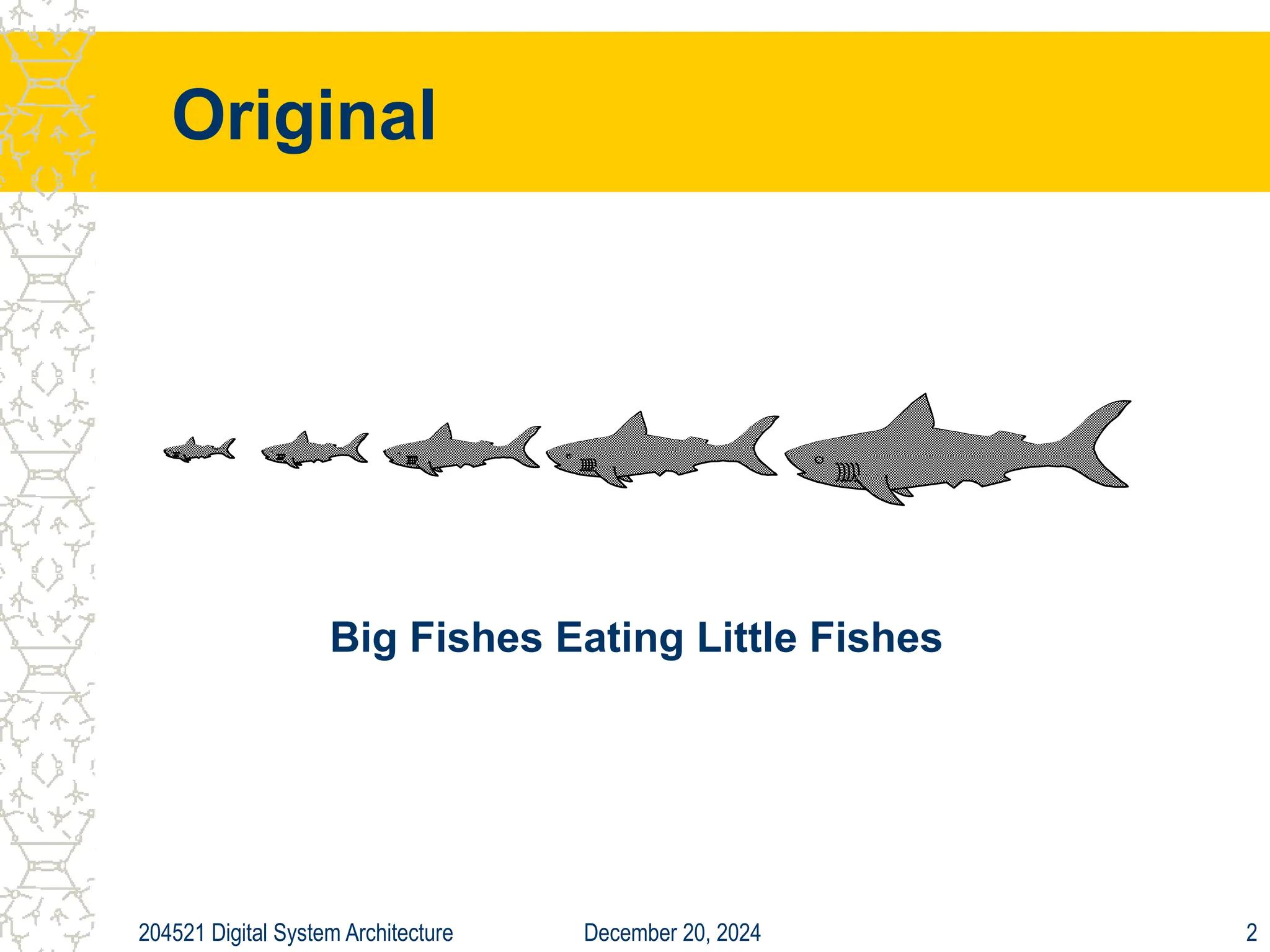
Big Fishes Eating Little Fishes
December 20, 2024
204521 Digital System Architecture 3
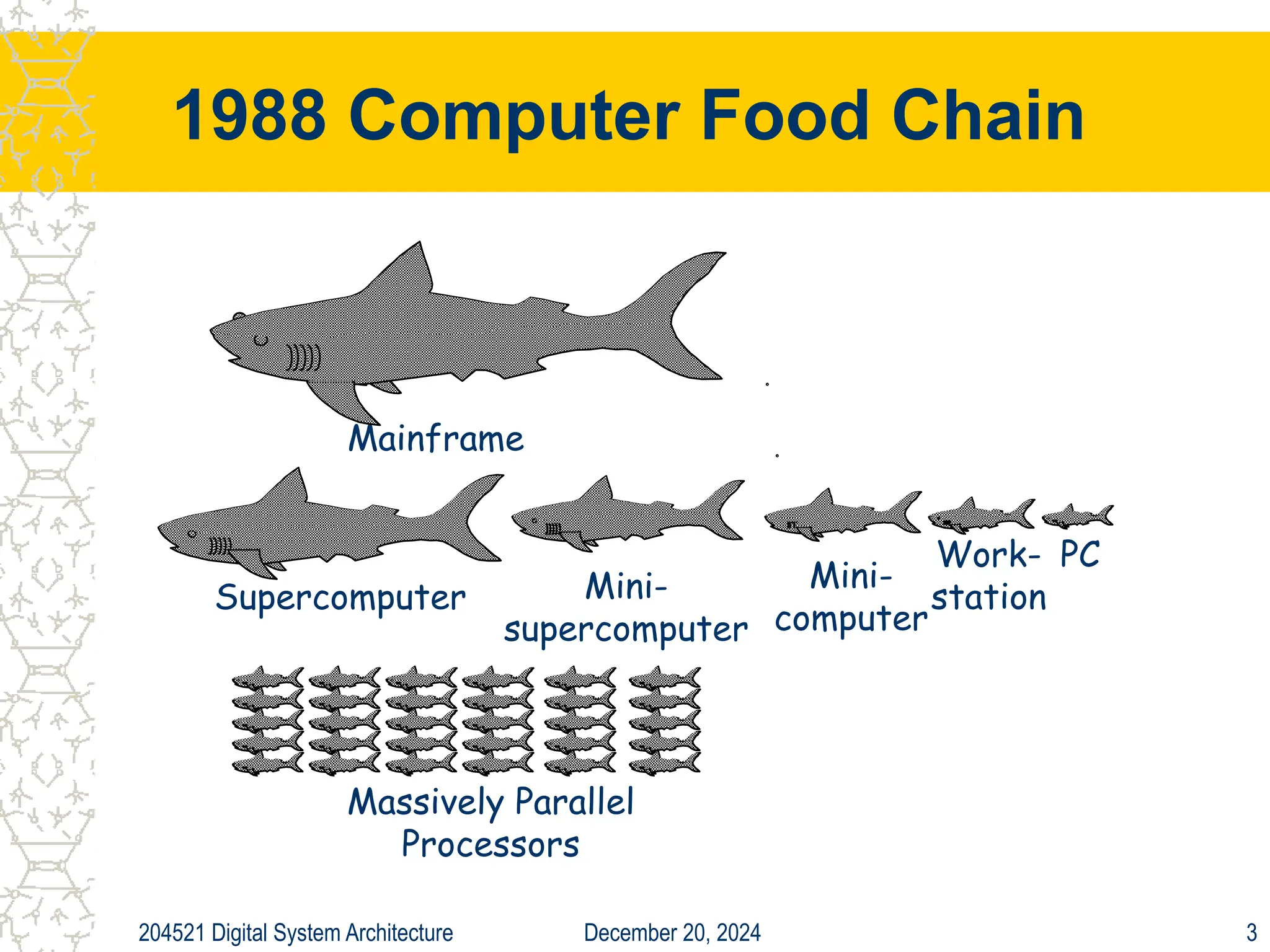
1988 Computer Food Chain
PC
Work-
station
Mini-
computer
Mainframe
Mini-
supercomputer
Supercomputer
Massively Parallel
Processors
December 20, 2024
204521 Digital System Architecture 4
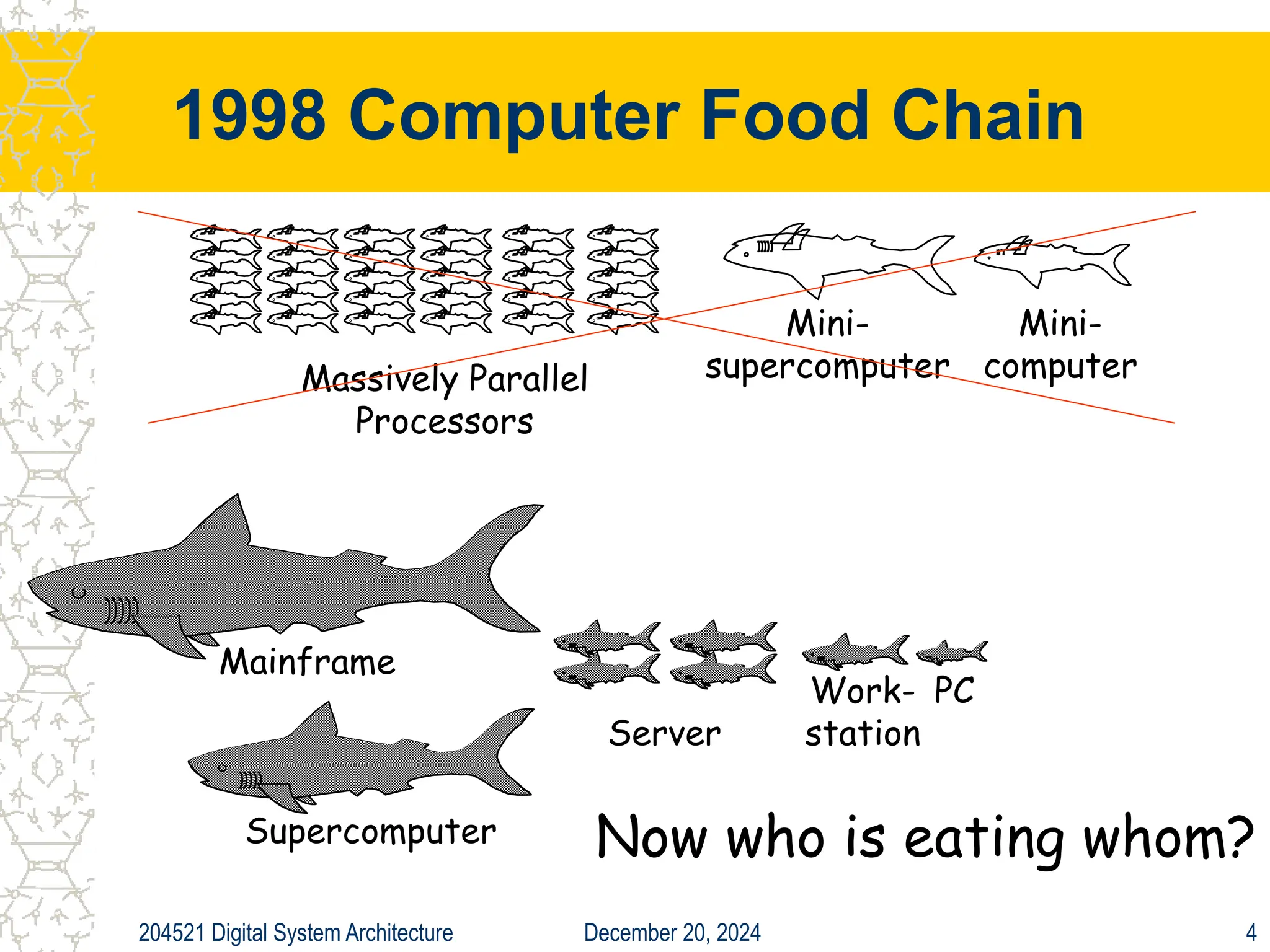
1998 Computer Food Chain
Mini-
supercomputer
Massively Parallel
Processors
Mini-
computer
PC
Work-
station
Mainframe
Supercomputer Now who is eating whom?
Server
December 20, 2024
204521 Digital System Architecture 5
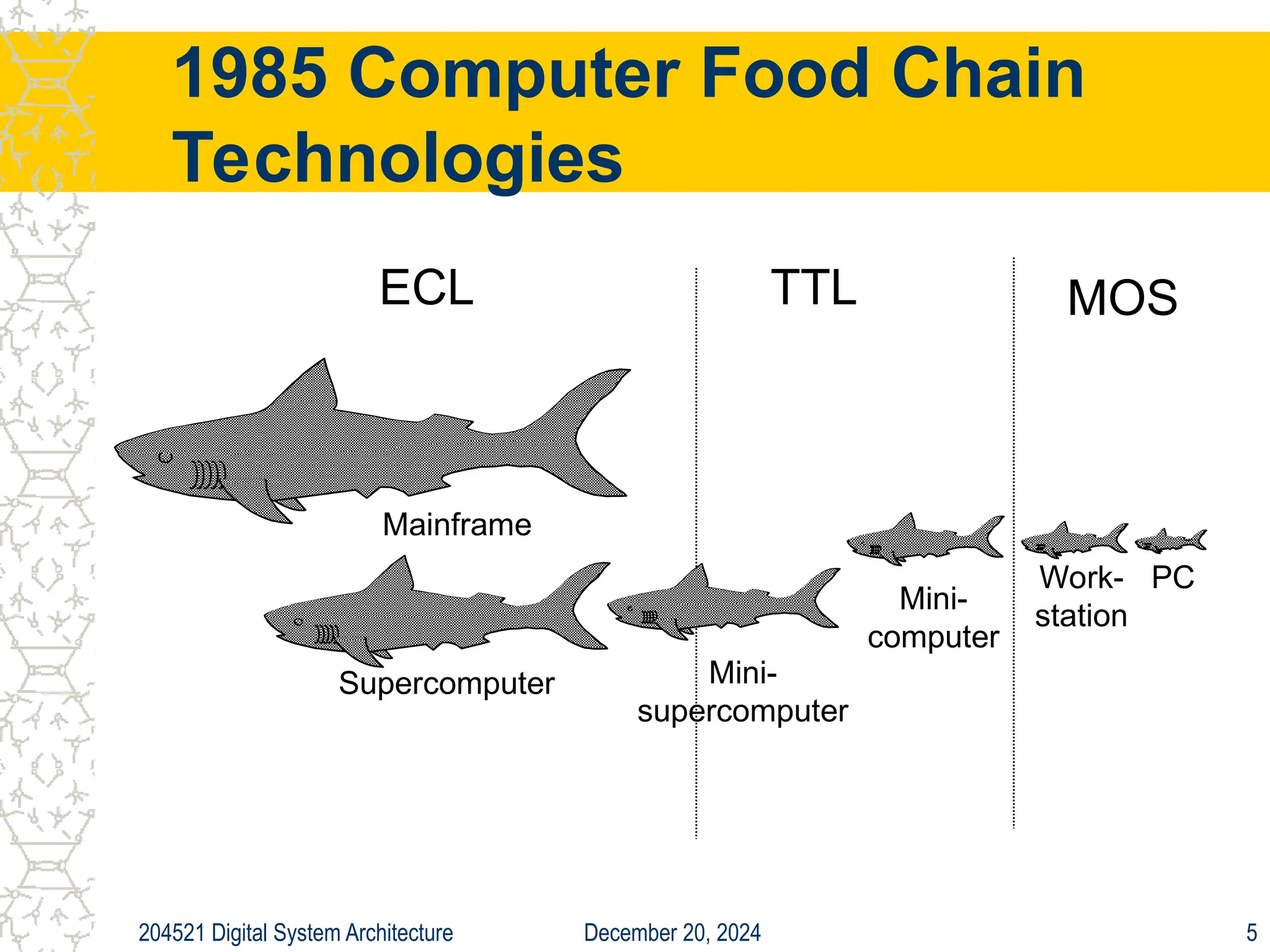
1985 Computer Food Chain
Technologies
PC
Work-
station
Mini-
computer
Mainframe
Mini-
supercomputer
Supercomputer
ECL TTL MOS
December 20, 2024
204521 Digital System Architecture 6
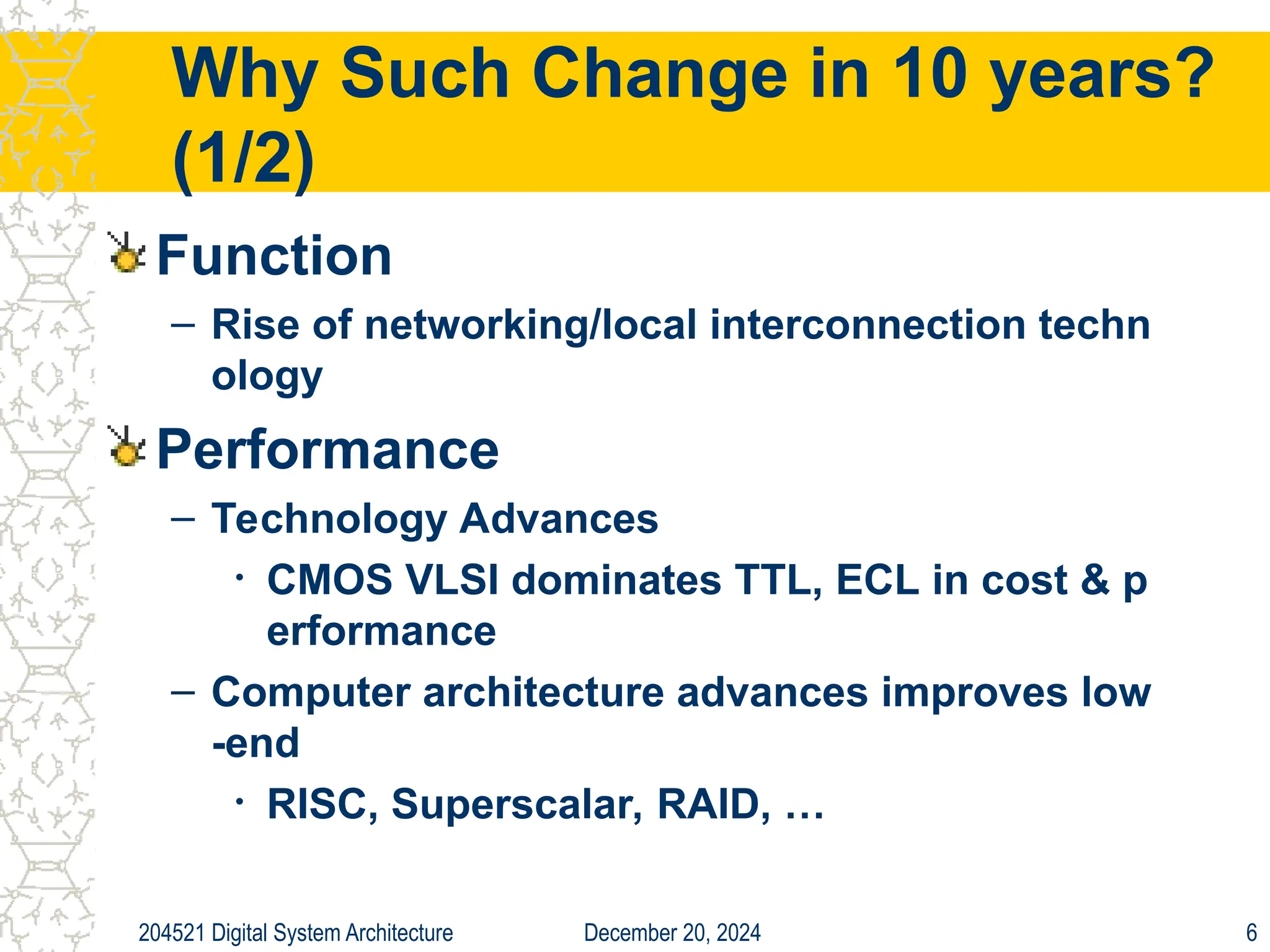
Why Such Change in 10 years?
(1/2)
Function
– Rise of networking/local interconnection techn
ology
Performance
– Technology Advances
• CMOS VLSI dominates TTL, ECL in cost & p
erformance
– Computer architecture advances improves low
-end
• RISC, Superscalar, RAID, …
December 20, 2024
204521 Digital System Architecture 7
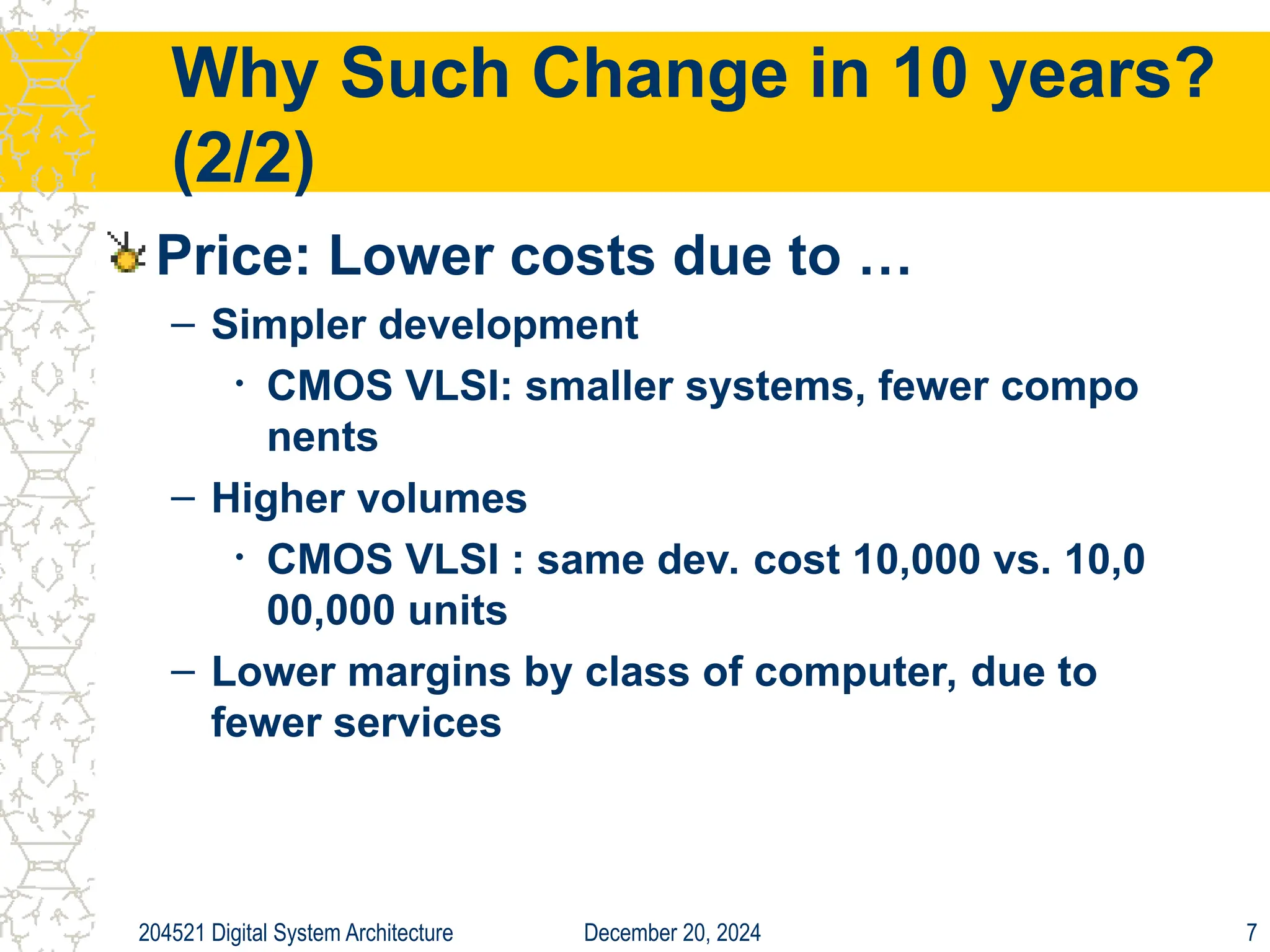
Why Such Change in 10 years?
(2/2)
Price: Lower costs due to …
– Simpler development
• CMOS VLSI: smaller systems, fewer compo
nents
– Higher volumes
• CMOS VLSI : same dev. cost 10,000 vs. 10,0
00,000 units
– Lower margins by class of computer, due to
fewer services
December 20, 2024
204521 Digital System Architecture 8
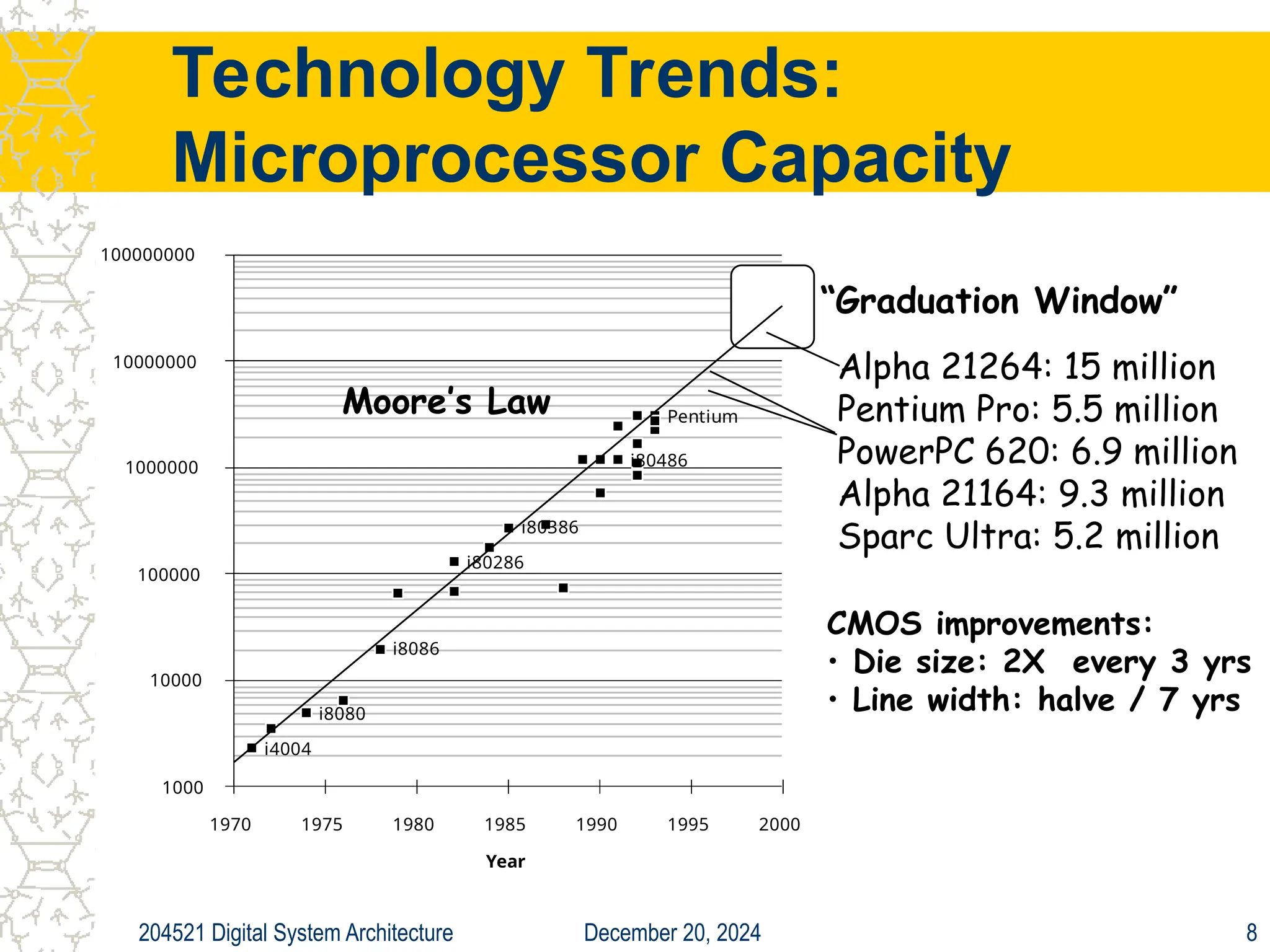
Technology Trends:
Microprocessor Capacity
Year
Transistors
1000
10000
100000
1000000
10000000
100000000
1970 1975 1980 1985 1990 1995 2000
i80386
i4004
i8080
Pentium
i80486
i80286
i8086
Moore’s Law
CMOS improvements:
• Die size: 2X every 3 yrs
• Line width: halve / 7 yrs
“Graduation Window”
Alpha 21264: 15 million
Pentium Pro: 5.5 million
PowerPC 620: 6.9 million
Alpha 21164: 9.3 million
Sparc Ultra: 5.2 million
December 20, 2024
204521 Digital System Architecture 9
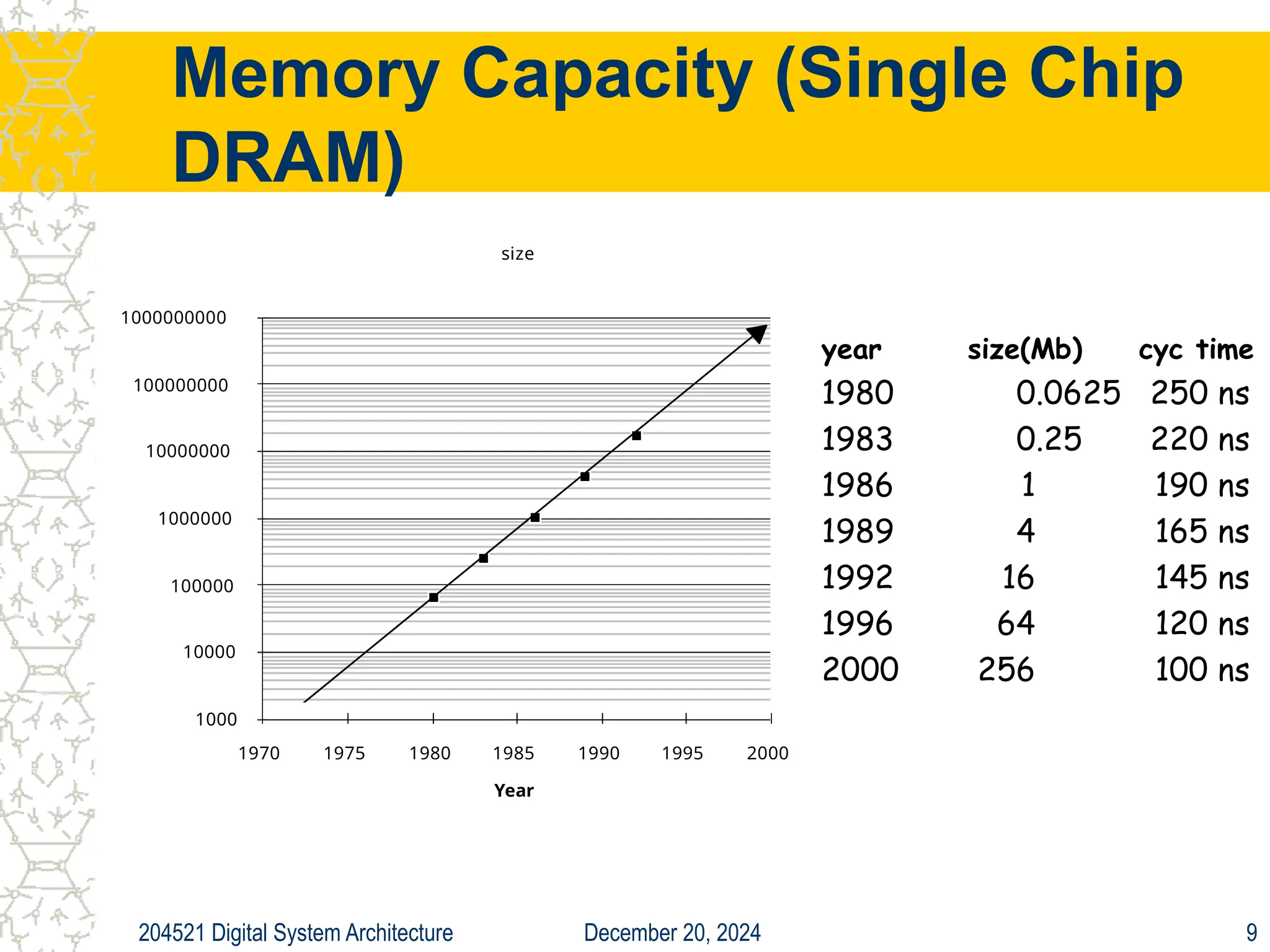
Memory Capacity (Single Chip
DRAM)
size
Year
Bits
1000
10000
100000
1000000
10000000
100000000
1000000000
1970 1975 1980 1985 1990 1995 2000
year size(Mb) cyc time
1980 0.0625 250 ns
1983 0.25 220 ns
1986 1 190 ns
1989 4 165 ns
1992 16 145 ns
1996 64 120 ns
2000 256 100 ns
December 20, 2024
204521 Digital System Architecture 10
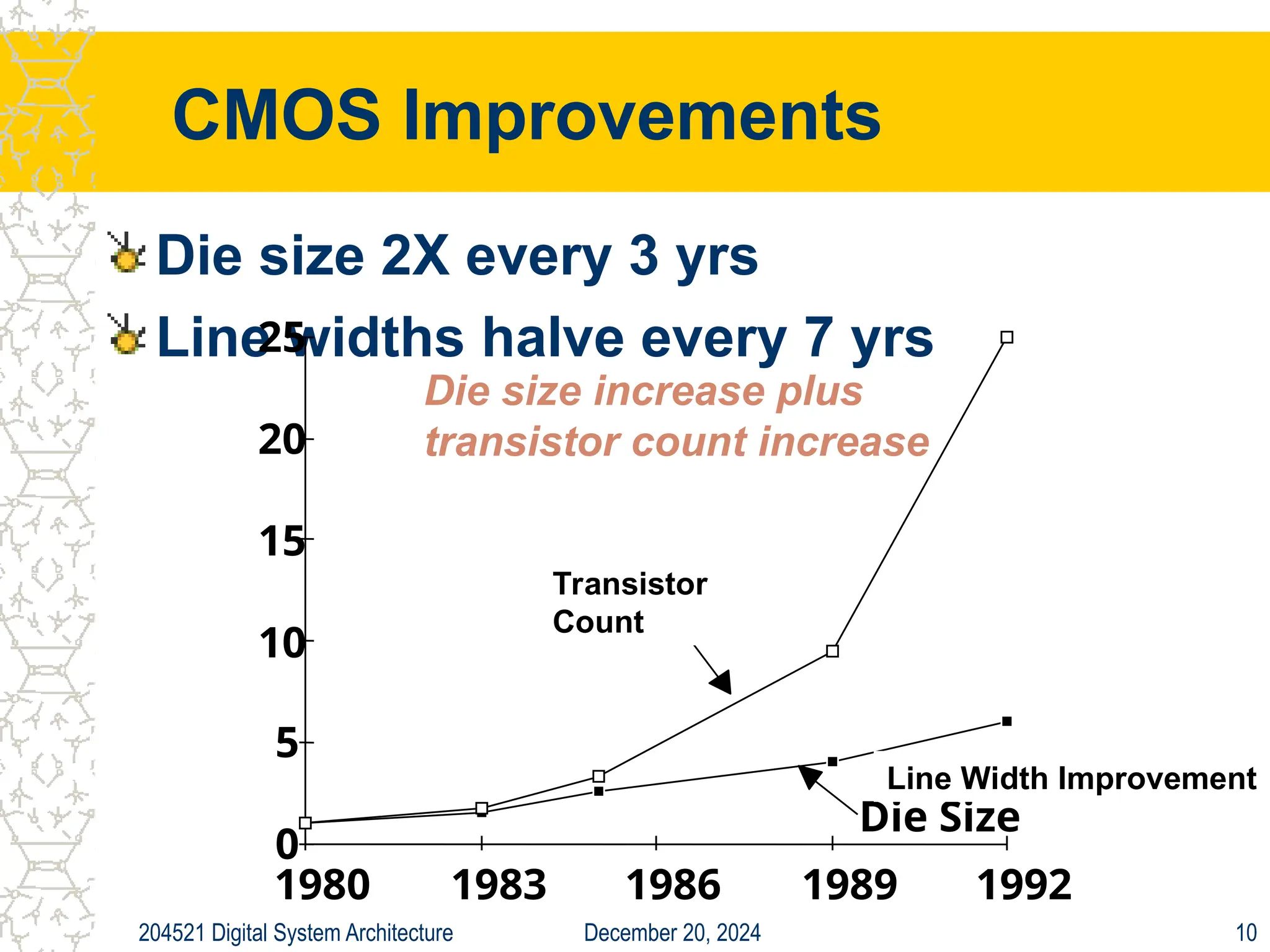
CMOS Improvements
Die size 2X every 3 yrs
Line widths halve every 7 yrs
0
5
10
15
20
25
1980 1983 1986 1989 1992
Die Size
Line Width Improvement
Die size increase plus
transistor count increase
Transistor
Count
December 20, 2024
204521 Digital System Architecture 11
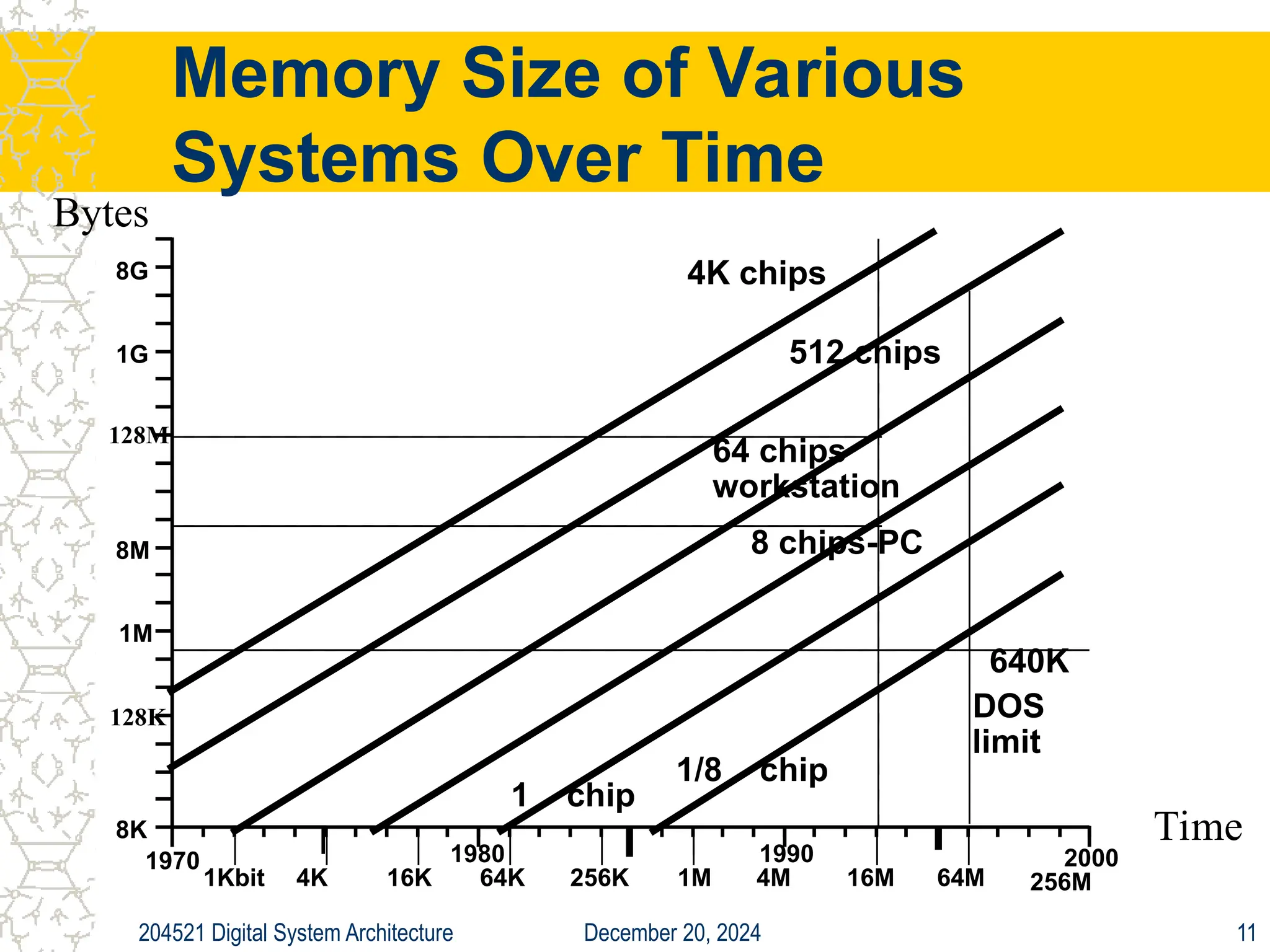
Memory Size of Various
Systems Over Time
128K
128M
2000
8K
1M
8M
1G
8G
1970 1980 1990
1 chip
1Kbit
640K
4K 16K 64K 256K 1M 4M 16M 64M 256M
DOS
limit
1/8 chip
8 chips-PC
64 chips
workstation
512 chips
4K chips
Bytes
Time
December 20, 2024
204521 Digital System Architecture 12
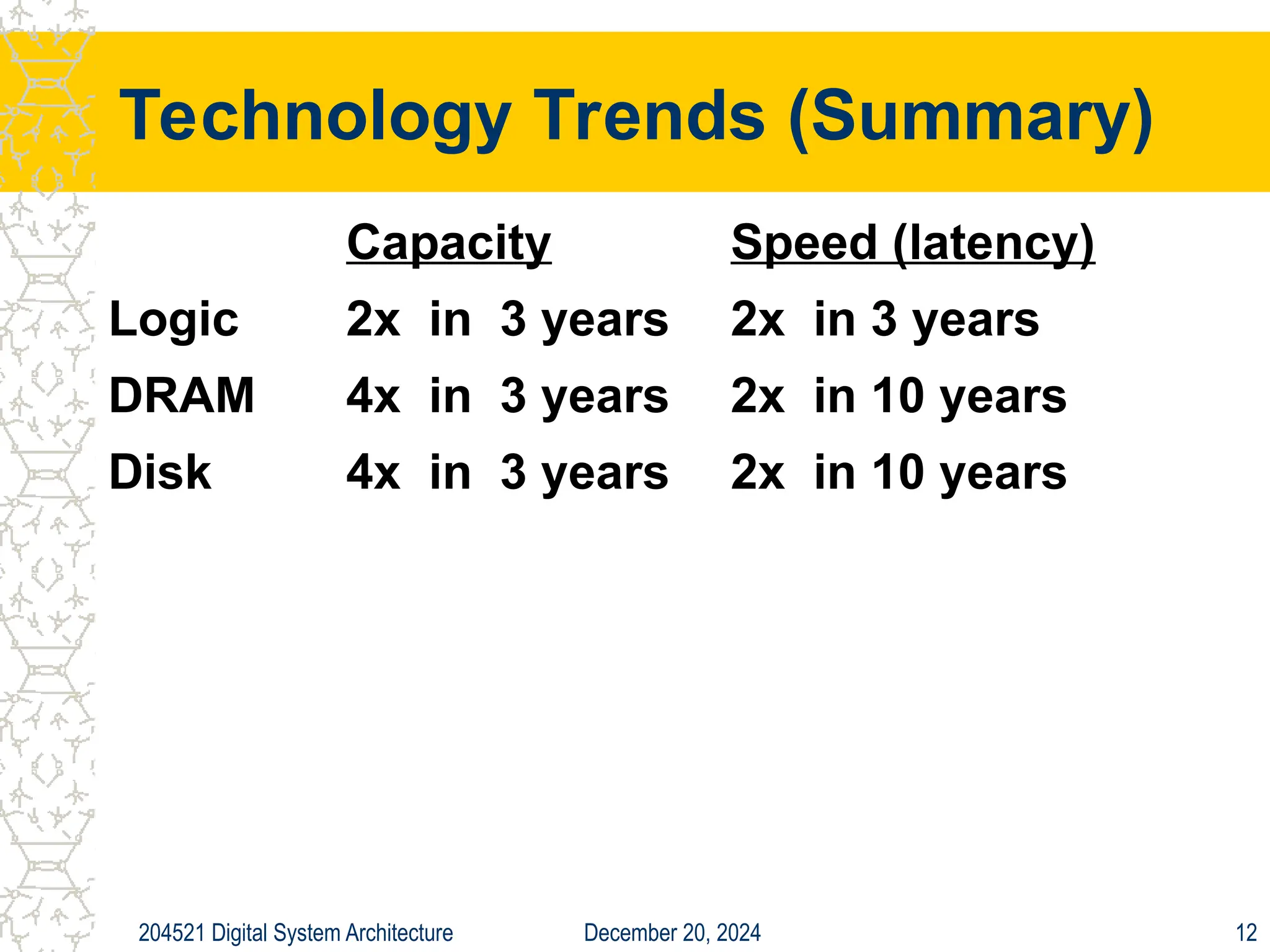
Technology Trends (Summary)
Capacity Speed (latency)
Logic 2x in 3 years 2x in 3 years
DRAM 4x in 3 years 2x in 10 years
Disk 4x in 3 years 2x in 10 years
December 20, 2024
204521 Digital System Architecture 13
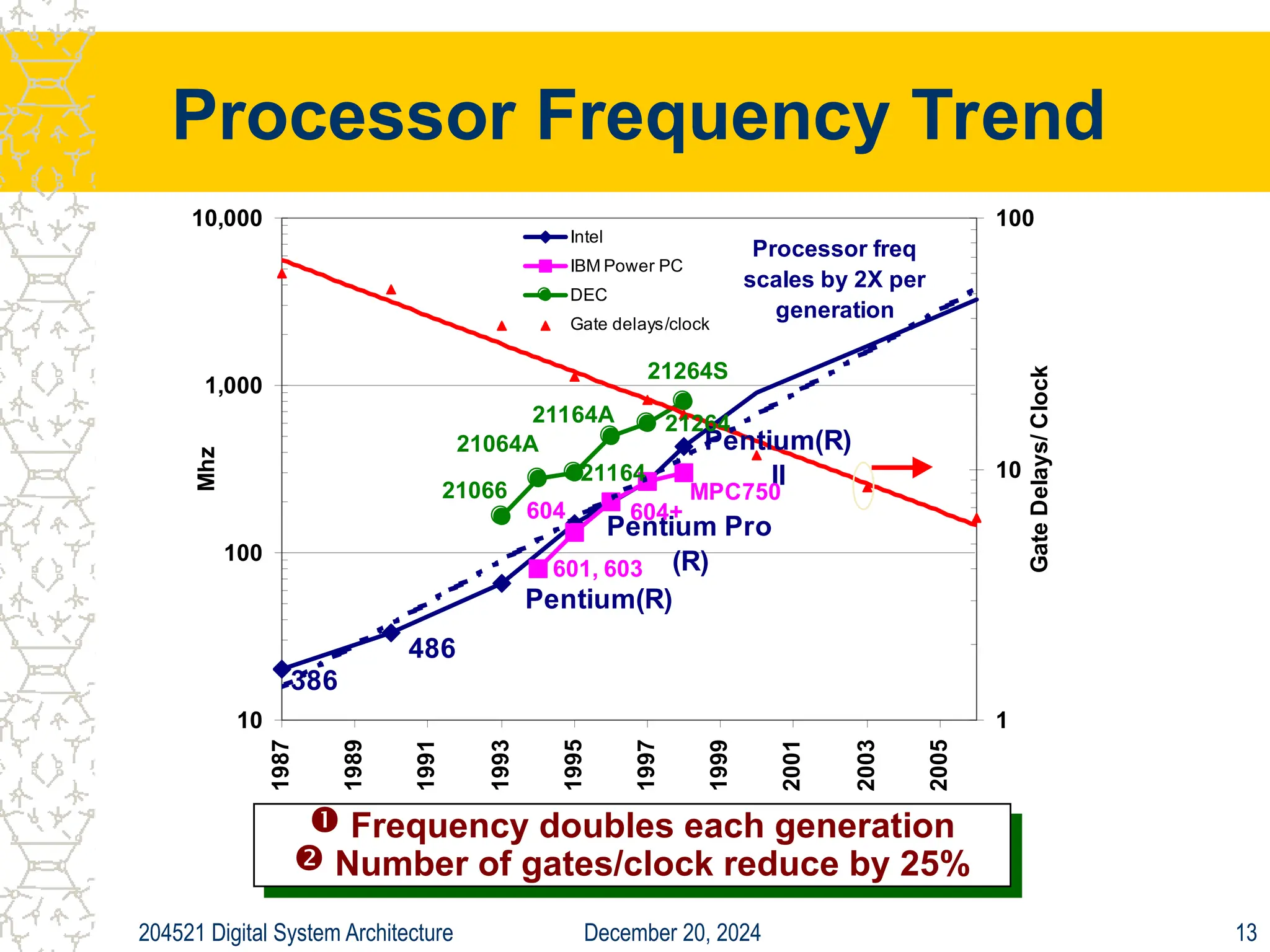
Processor Frequency Trend
 Frequency doubles each generation
 Number of gates/clock reduce by 25%
386
486
Pentium(R)
Pentium Pro
(R)
Pentium(R)
II
MPC750
604+
604
601, 603
21264S
21264
21164A
21164
21064A
21066
10
100
1,000
10,000
1987
1989
1991
1993
1995
1997
1999
2001
2003
2005
Mhz
1
10
100
Gate
Delays/
Clock
Intel
IBM Power PC
DEC
Gate delays/clock
Processor freq
scales by 2X per
generation
December 20, 2024
204521 Digital System Architecture 14
Processor Performance Trends
Microprocessors
Minicomputers
Mainframes
Supercomputers
0.1
1
10
100
1000
1965 1970 1975 1980 1985 1990 1995 2000
December 20, 2024
204521 Digital System Architecture 15
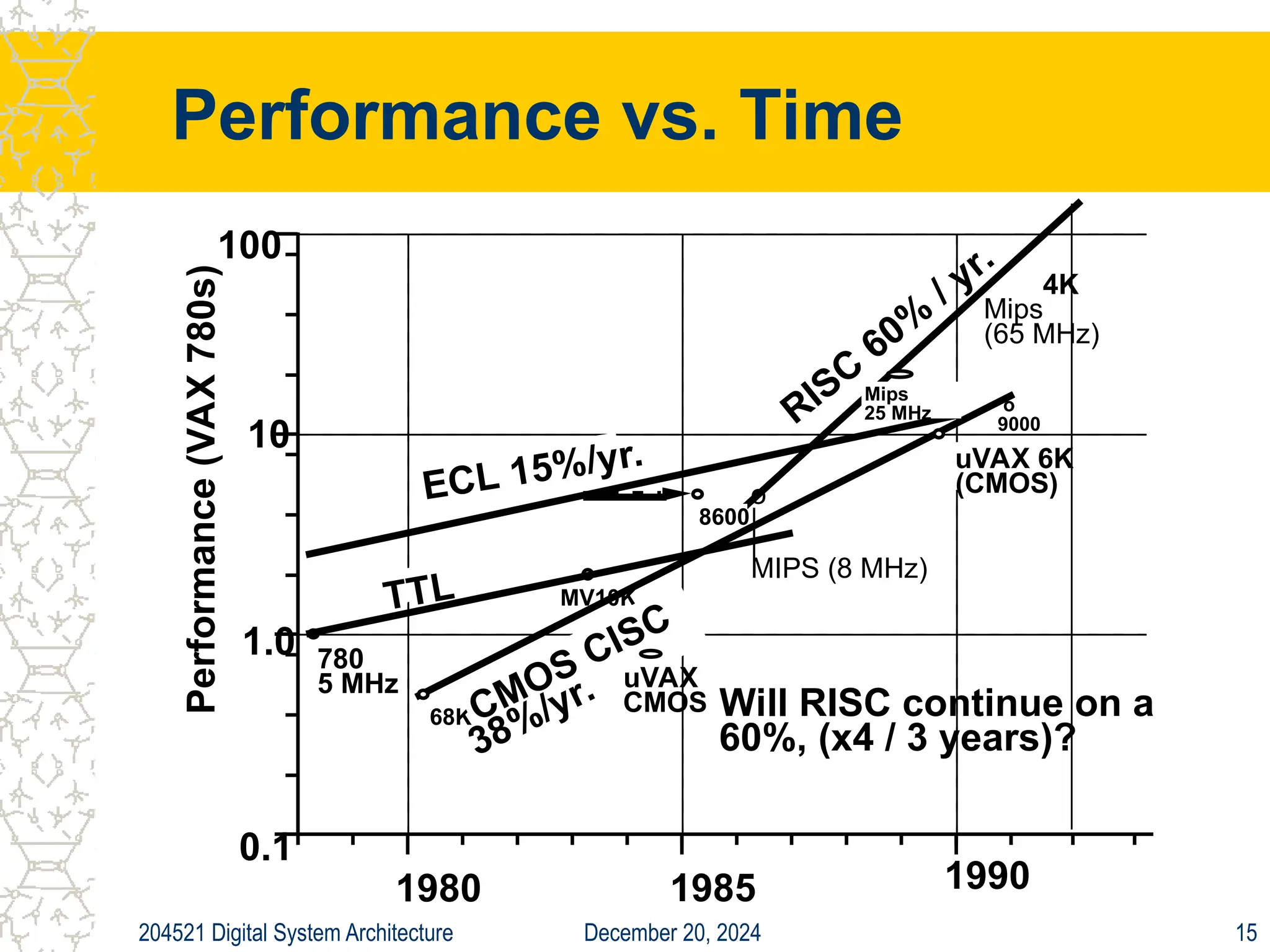
Performance vs. Time
Mips
25 MHz
0.1
1.0
10
100
Performance
(VAX
780s)
1980 1985 1990
MV10K
68K
780
5 MHz
RISC
60%
/ yr.
uVAX 6K
(CMOS)
8600
TTL
ECL 15%/yr.
CMOS CISC
38%/yr.
o
|
|
MIPS (8 MHz)
o
9000
Mips
(65 MHz)
uVAX
CMOS Will RISC continue on a
60%, (x4 / 3 years)?
4K
December 20, 2024
204521 Digital System Architecture 16
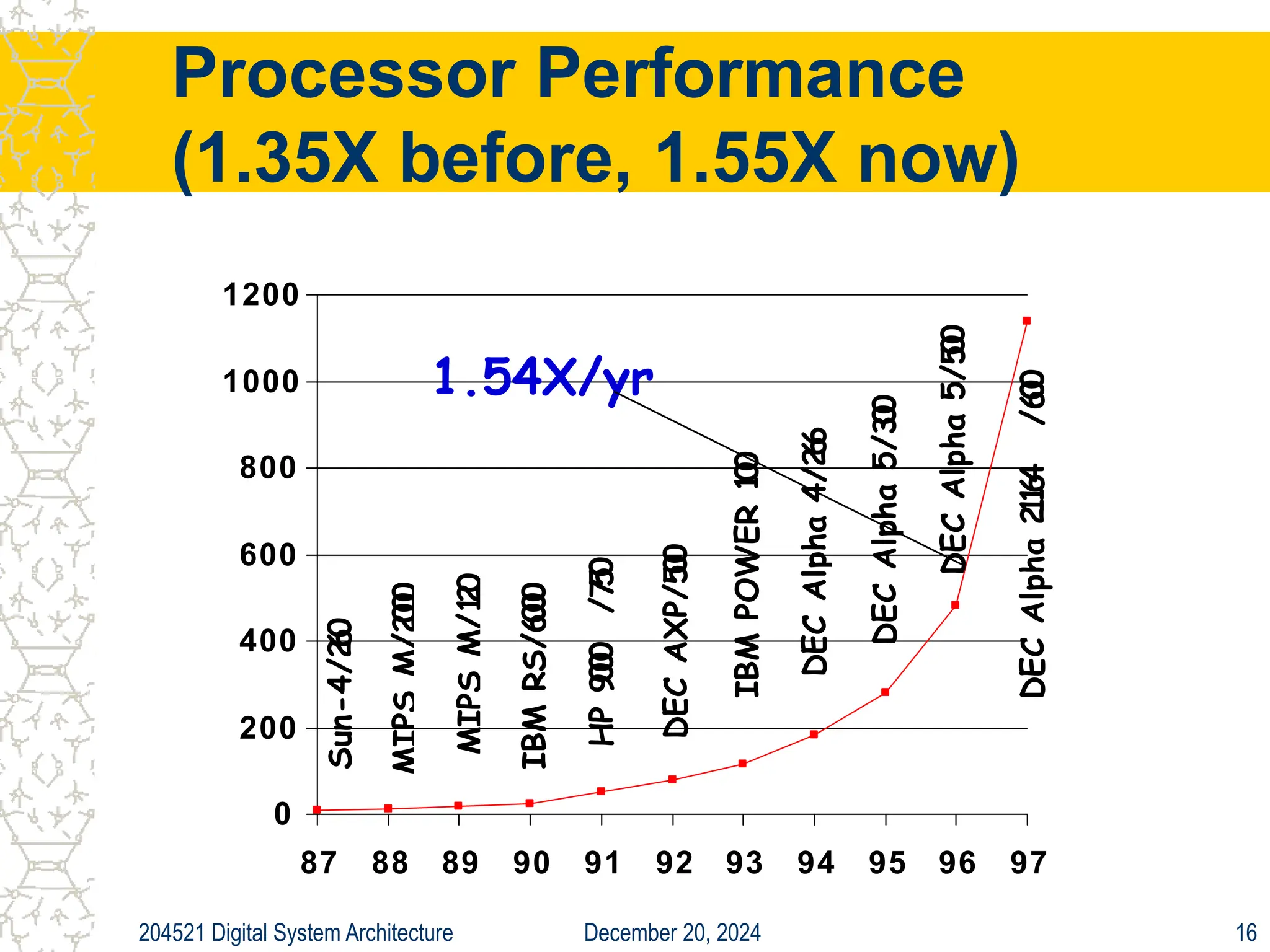
Processor Performance
(1.35X before, 1.55X now)
0
200
400
600
800
1000
1200
87 88 89 90 91 92 93 94 95 96 97
DEC
Alpha
2
1
1
6
4
/6
0
0
DEC
Alpha
5/5
0
0
DEC
Alpha
5/3
0
0
DEC
Alpha
4/2
6
6
IBM
POWER
1
0
0
DEC
AXP/5
0
0
HP
9
0
0
0
/7
5
0
Sun-4/2
6
0
IBM
RS/6
0
0
0
MIPS
M/1
2
0
MIPS
M/2
0
0
0
1.54X/yr
December 20, 2024
204521 Digital System Architecture 17
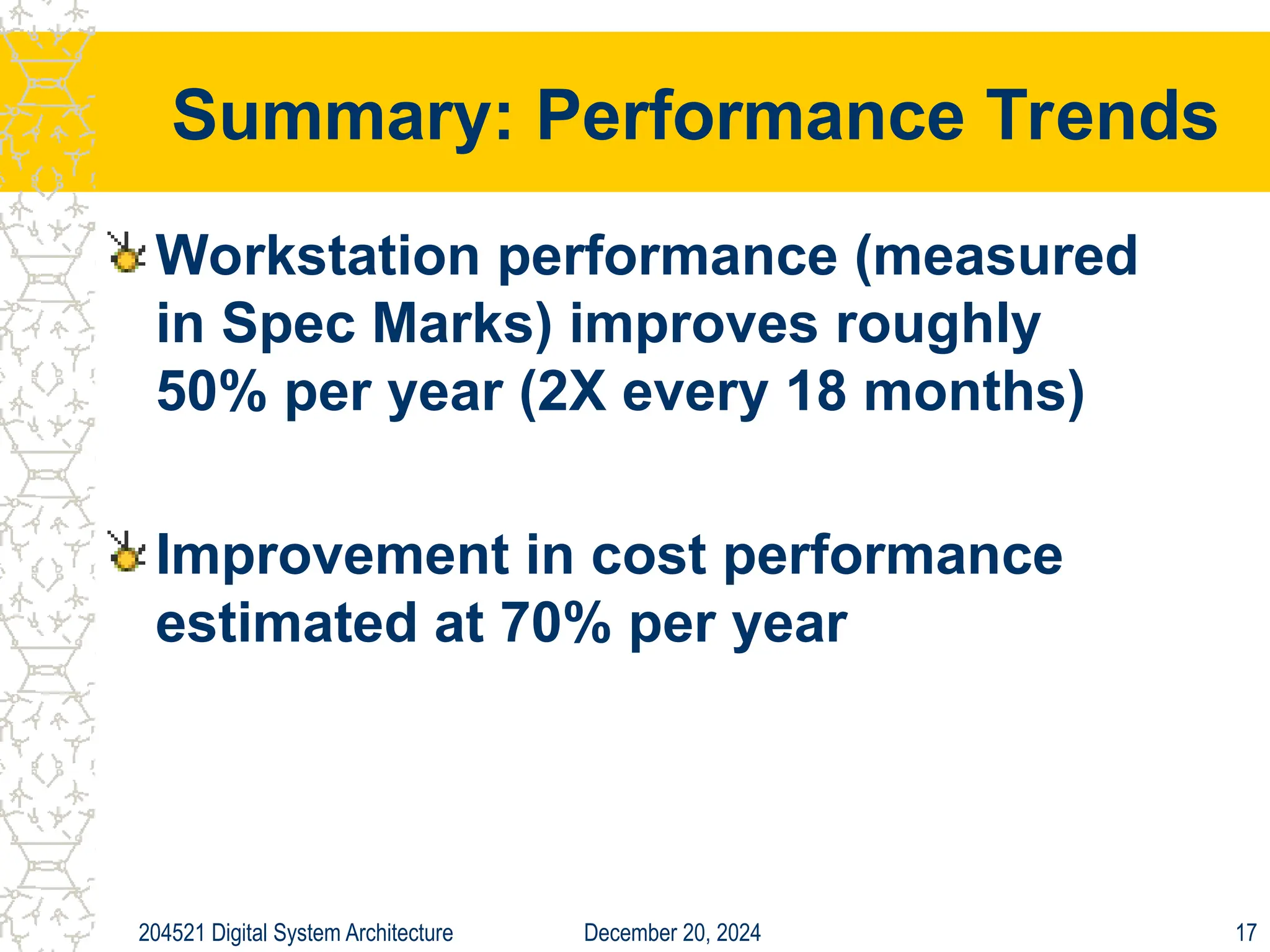
Summary: Performance Trends
Workstation performance (measured
in Spec Marks) improves roughly
50% per year (2X every 18 months)
Improvement in cost performance
estimated at 70% per year
December 20, 2024
204521 Digital System Architecture 18
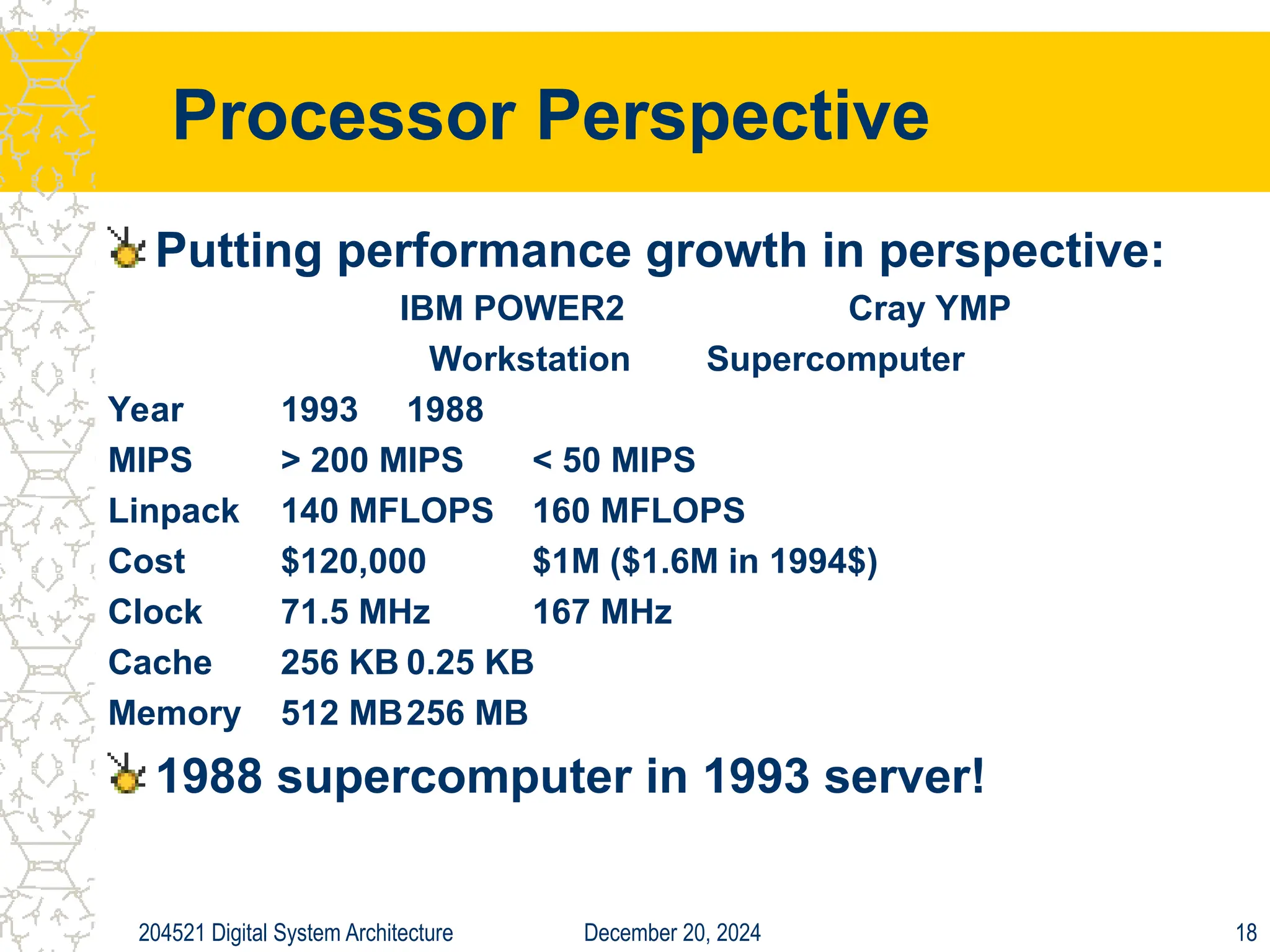
Processor Perspective
Putting performance growth in perspective:
IBM POWER2 Cray YMP
Workstation Supercomputer
Year 1993 1988
MIPS > 200 MIPS < 50 MIPS
Linpack 140 MFLOPS 160 MFLOPS
Cost $120,000 $1M ($1.6M in 1994$)
Clock 71.5 MHz 167 MHz
Cache 256 KB 0.25 KB
Memory 512 MB256 MB
1988 supercomputer in 1993 server!
December 20, 2024
204521 Digital System Architecture 19
Where Has This Performance
Improvement Come From?
Technology?
Organization?
Instruction Set Architecture?
Software?
Some combination of all of the
above?
December 20, 2024
204521 Digital System Architecture 20
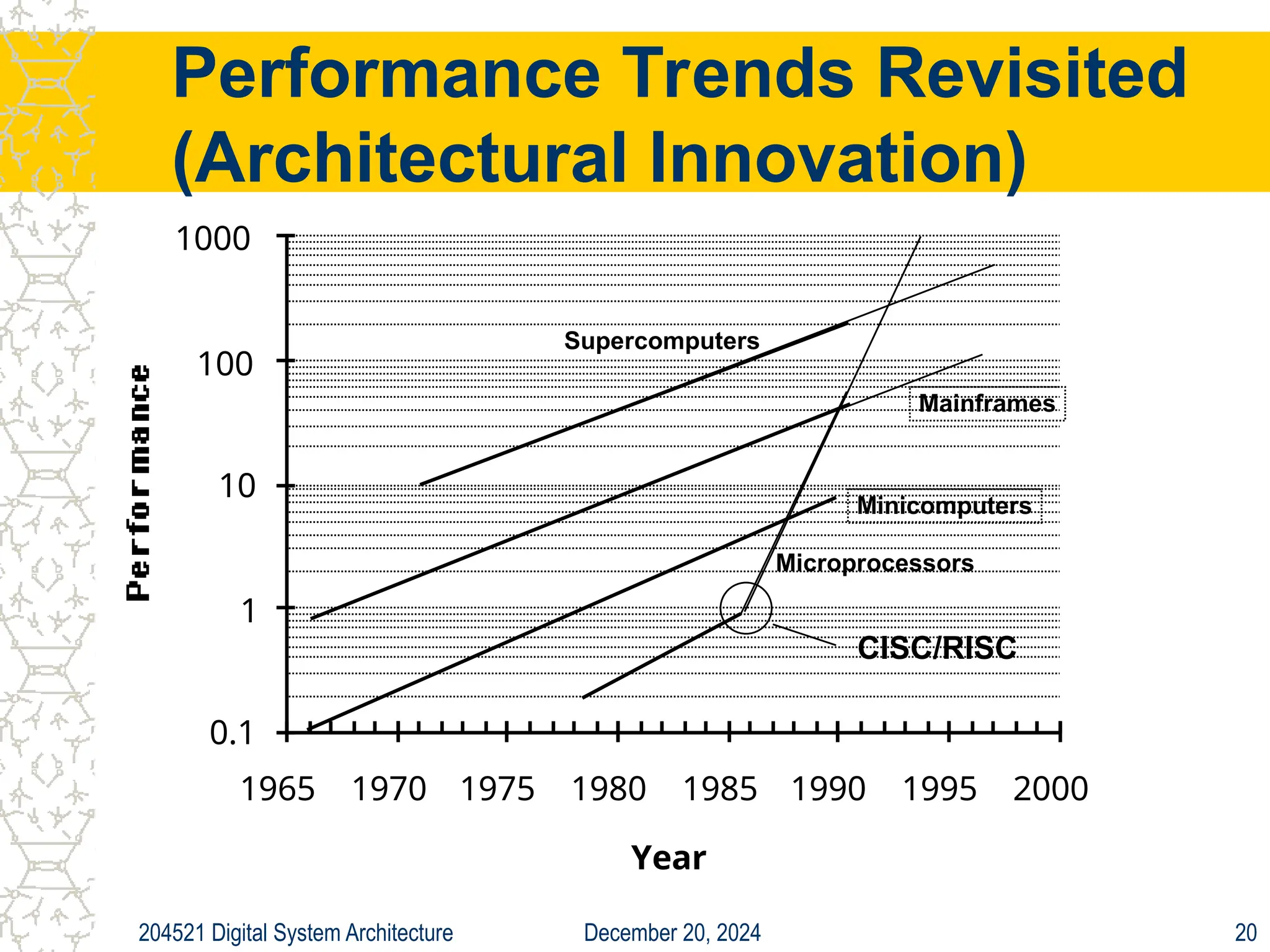
Performance Trends Revisited
(Architectural Innovation)
Microprocessors
Minicomputers
Mainframes
Supercomputers
Year
0.1
1
10
100
1000
1965 1970 1975 1980 1985 1990 1995 2000
CISC/RISC
December 20, 2024
204521 Digital System Architecture 21
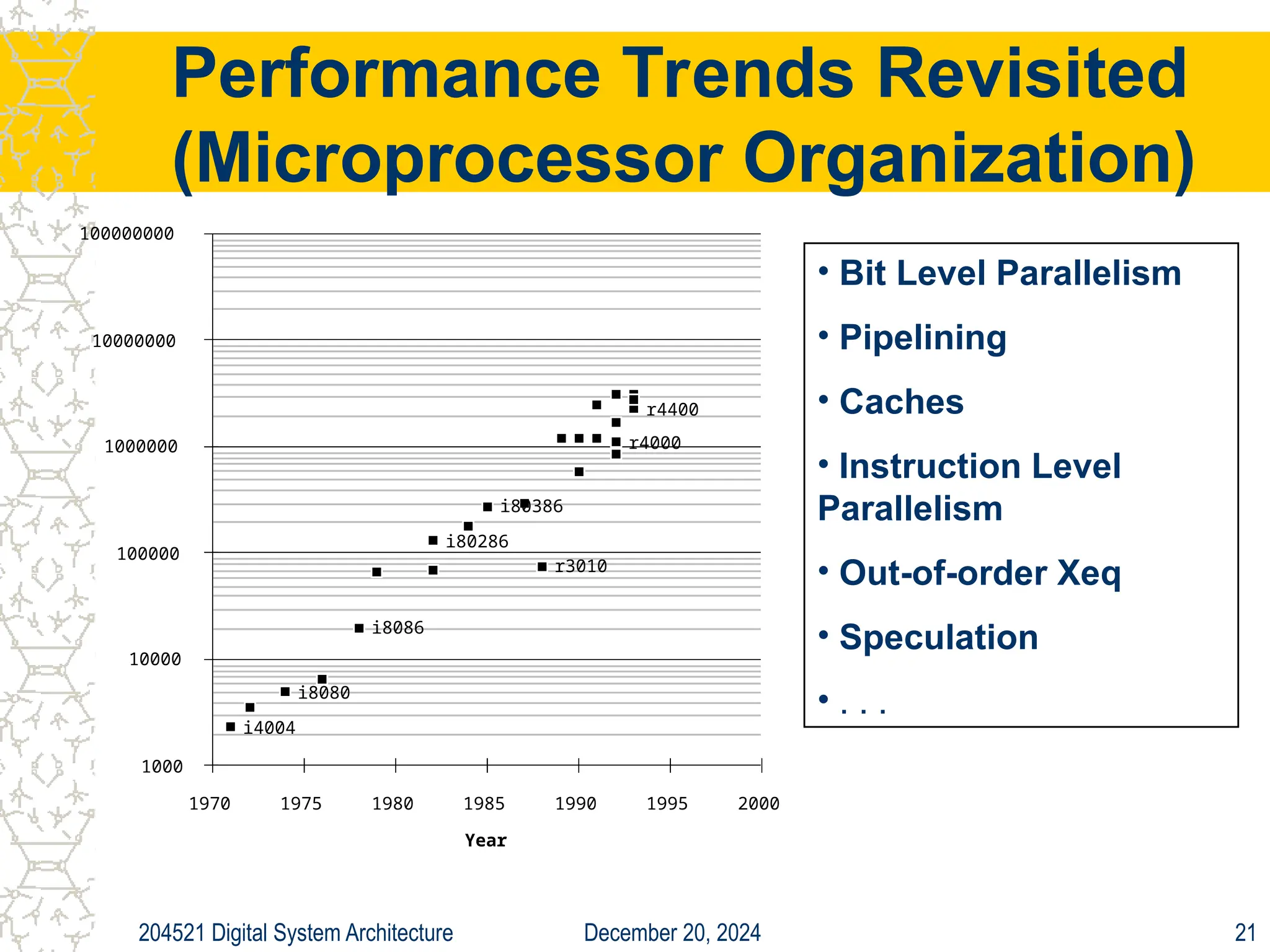
Performance Trends Revisited
(Microprocessor Organization)
Year
Transistors
1000
10000
100000
1000000
10000000
100000000
1970 1975 1980 1985 1990 1995 2000
r4400
r4000
r3010
i80386
i4004
i8080
i80286
i8086
• Bit Level Parallelism
• Pipelining
• Caches
• Instruction Level
Parallelism
• Out-of-order Xeq
• Speculation
• . . .
December 20, 2024
204521 Digital System Architecture 22
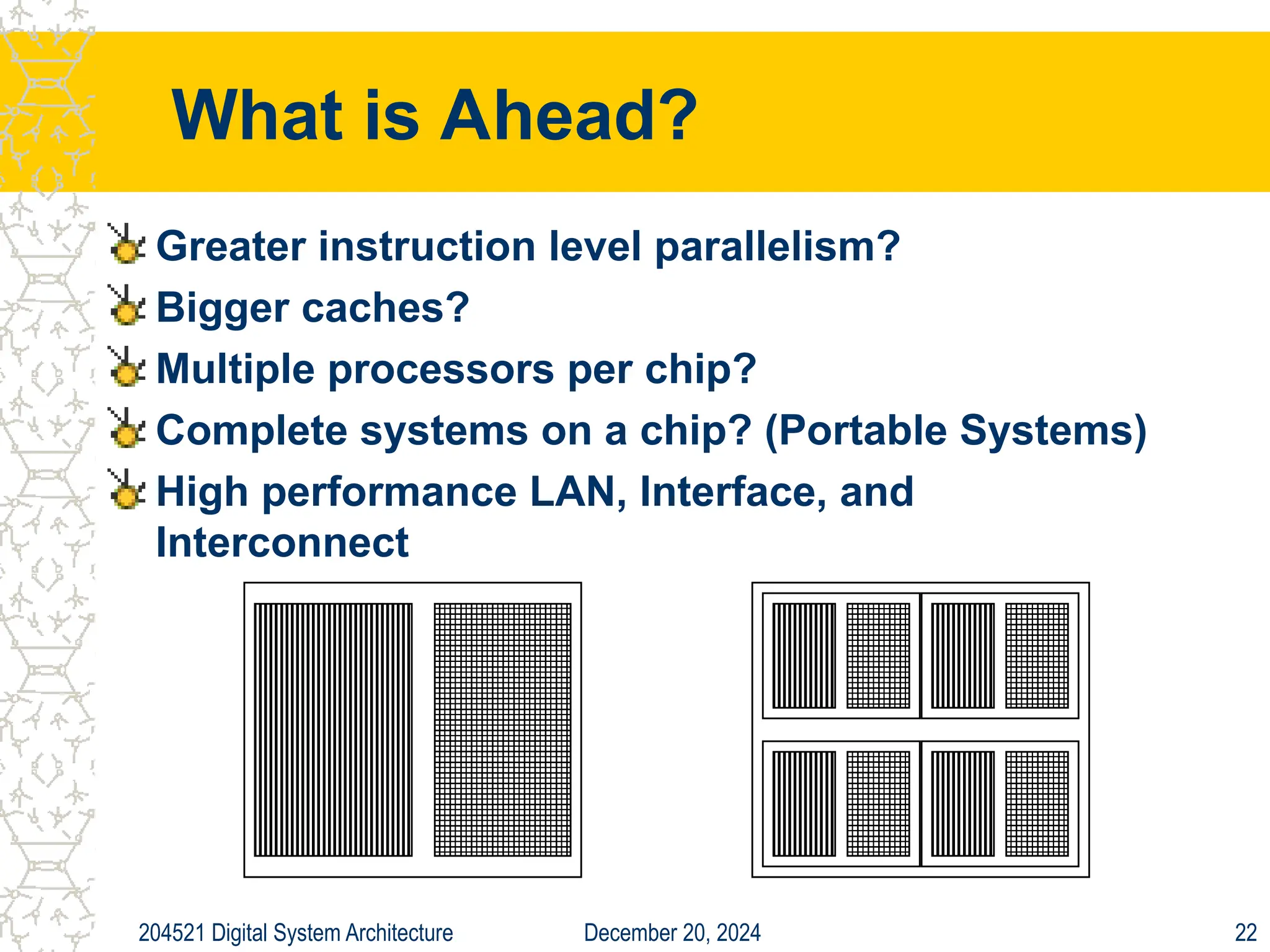
What is Ahead?
Greater instruction level parallelism?
Bigger caches?
Multiple processors per chip?
Complete systems on a chip? (Portable Systems)
High performance LAN, Interface, and
Interconnect
December 20, 2024
204521 Digital System Architecture 23
Hardware Technology
1980 1990 2000
Memory chips 64 K 4 M 256 M-1 G
Speed 1-2 20-40 400-1000
5-1/4 in. disks 40 M 1 G 20 G
Floppies .256 M 1.5 M 500-2,000 M
LAN (Switch) 2-10 Mbits 10 (100) 155-655
(ATM)
Busses 2-20 Mbytes 40-400
December 20, 2024
204521 Digital System Architecture 24
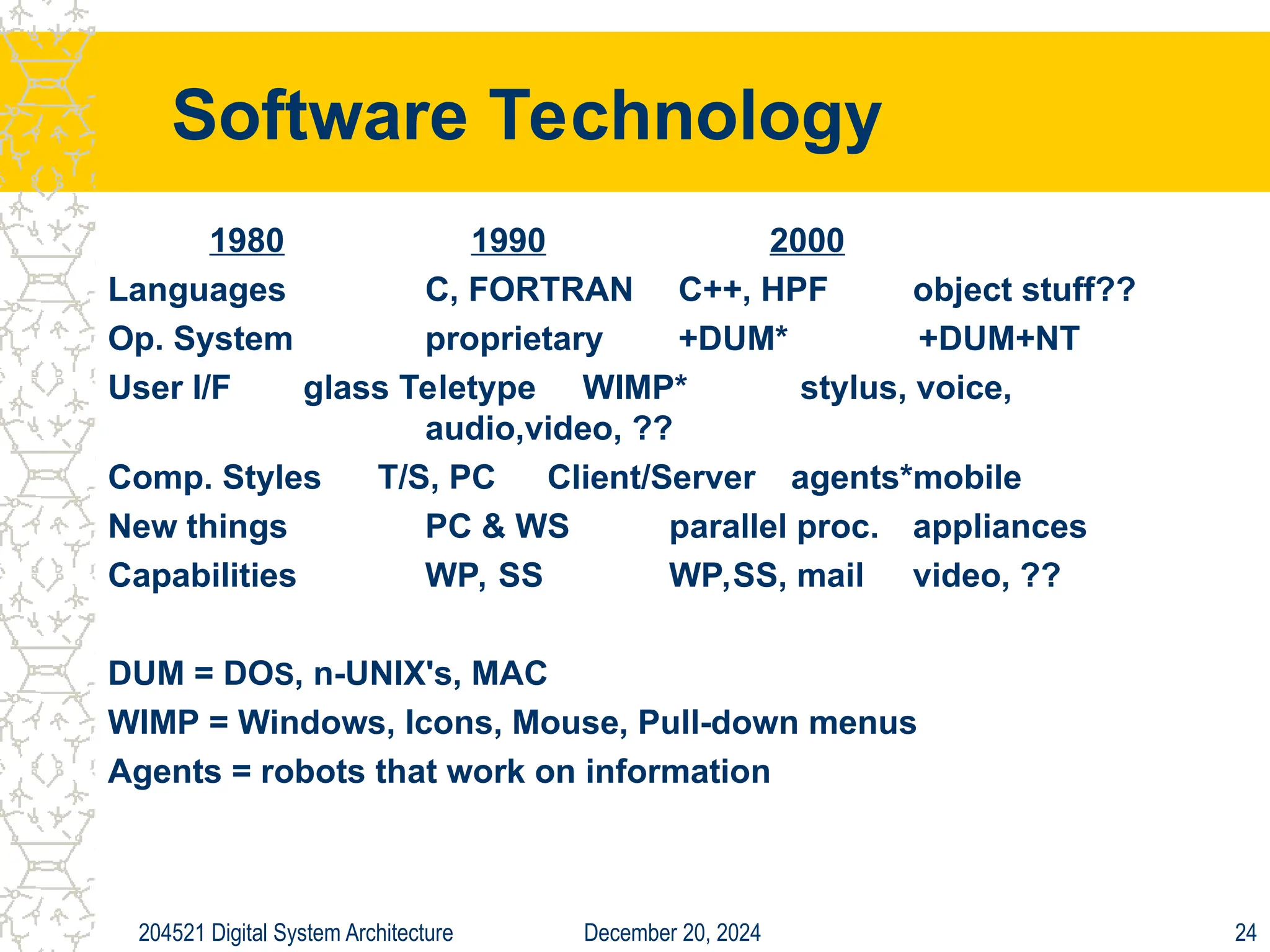
Software Technology
1980 1990 2000
Languages C, FORTRAN C++, HPF object stuff??
Op. System proprietary +DUM* +DUM+NT
User I/F glass Teletype WIMP* stylus, voice,
audio,video, ??
Comp. Styles T/S, PC Client/Server agents*mobile
New things PC & WS parallel proc. appliances
Capabilities WP, SS WP,SS, mail video, ??
DUM = DOS, n-UNIX's, MAC
WIMP = Windows, Icons, Mouse, Pull-down menus
Agents = robots that work on information
December 20, 2024
204521 Digital System Architecture 25
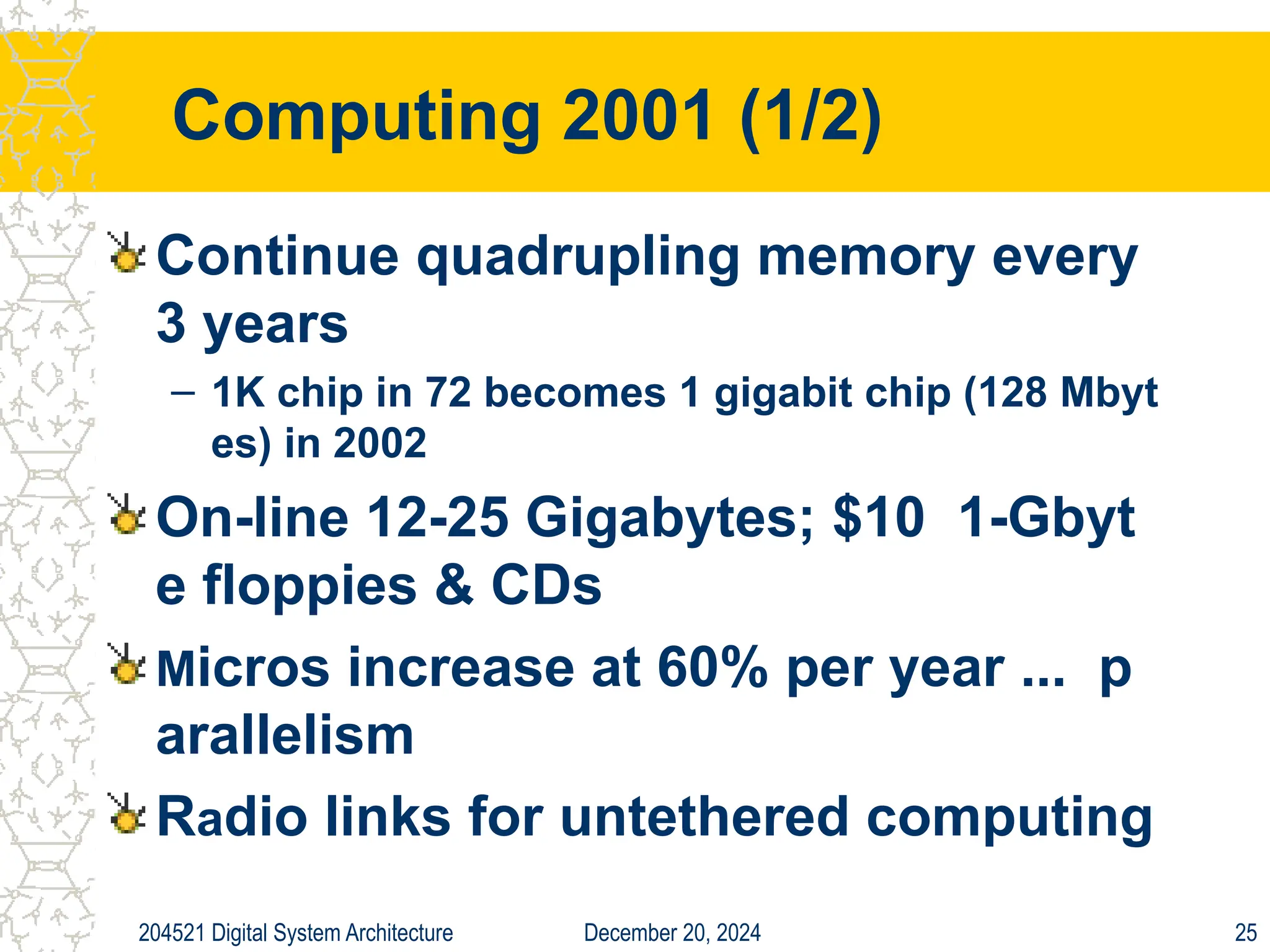
Computing 2001 (1/2)
Continue quadrupling memory every
3 years
– 1K chip in 72 becomes 1 gigabit chip (128 Mbyt
es) in 2002
On-line 12-25 Gigabytes; $10 1-Gbyt
e floppies & CDs
Micros increase at 60% per year ... p
arallelism
Radio links for untethered computing
December 20, 2024
204521 Digital System Architecture 26
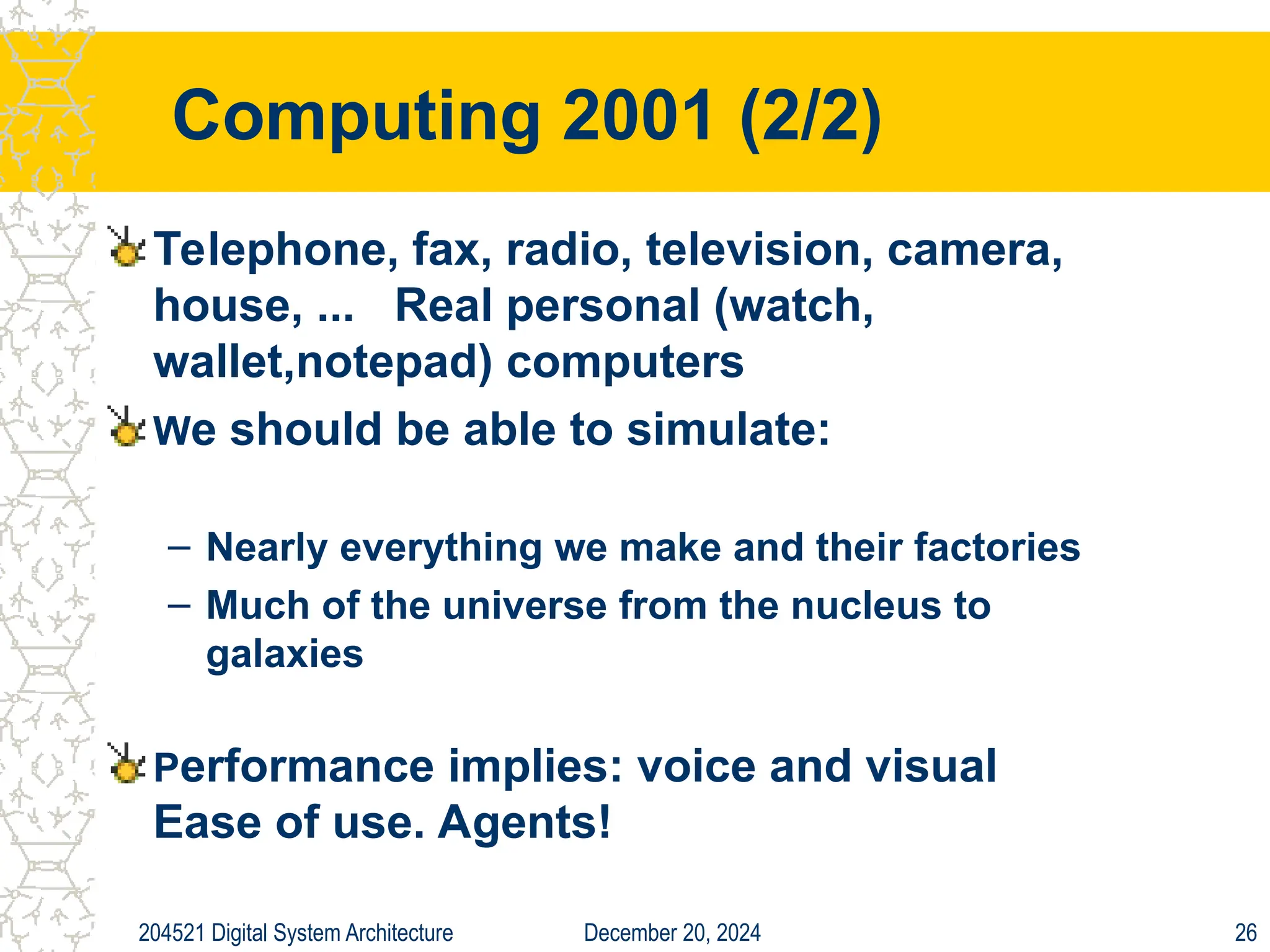
Computing 2001 (2/2)
Telephone, fax, radio, television, camera,
house, ... Real personal (watch,
wallet,notepad) computers
We should be able to simulate:
– Nearly everything we make and their factories
– Much of the universe from the nucleus to
galaxies
Performance implies: voice and visual
Ease of use. Agents!
December 20, 2024
204521 Digital System Architecture 27
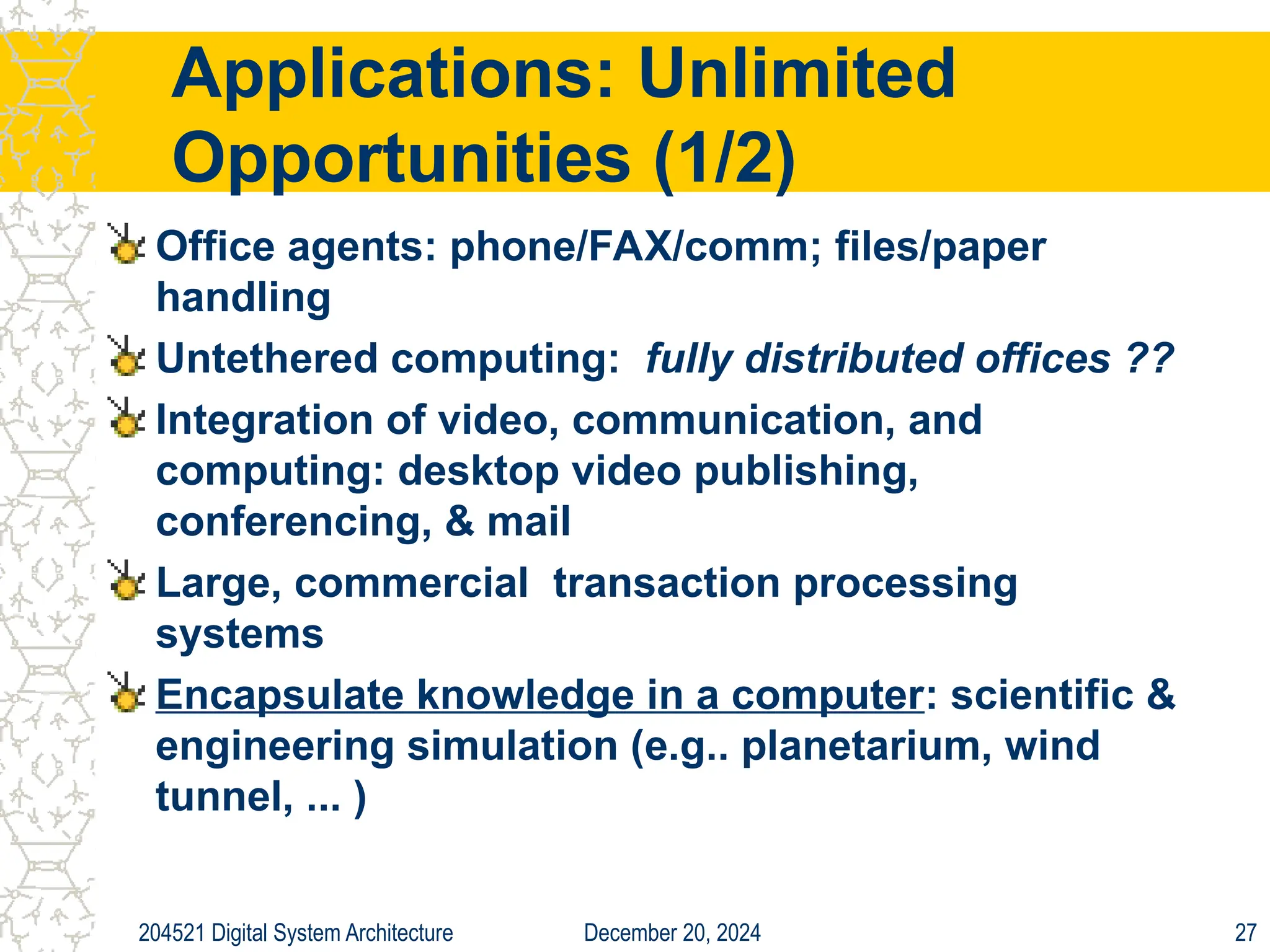
Applications: Unlimited
Opportunities (1/2)
Office agents: phone/FAX/comm; files/paper
handling
Untethered computing: fully distributed offices ??
Integration of video, communication, and
computing: desktop video publishing,
conferencing, & mail
Large, commercial transaction processing
systems
Encapsulate knowledge in a computer: scientific &
engineering simulation (e.g.. planetarium, wind
tunnel, ... )
December 20, 2024
204521 Digital System Architecture 28
Applications: Unlimited
Opportunities (2/2)
Visualization & virtual reality
Computational chemistry e.g.
biochemistry and materials
Mechanical engineering without
prototypes
Image/signal processing: medicine, maps,
surveillance.
Personal computers in 2001 are today's
supercomputers
Integration of the PC & TV => TC
December 20, 2024
204521 Digital System Architecture 29
Challenges for 1990s Platforms
(1/2)
64-bit computers
video, voice, communication, any really ne
w apps?
Increasingly large, complex systems and e
nvironments Usability?
Plethora of non-portable, distributed, inco
mpatible, non-interoperable computers: Us
ability?
Scalable parallel computers can provide “c
ommodity supercomputing”: Markets and t
rained users?
December 20, 2024
204521 Digital System Architecture 30
Challenges for 1990s Platforms
(2/2)
Apps to fuel and support a chubby
industry: communications,
paper/office, and digital video
The true portable, wireless
communication computer
Truly personal card, pencil, pocket,
wallet computer
Networks continue to limit: WAN,
ISDN, and ATM?

Technology trends-Computer food chain technologies

  • 1.
    December 20, 2024 204521Digital System Architecture Technology Trends Pradondet Nilagupta Spring 2001 (original notes from Randy Katz, & Prof. Jan M. Rabaey , UC Berkeley)
  • 2.
    December 20, 2024 204521Digital System Architecture 2 Original Big Fishes Eating Little Fishes
  • 3.
    December 20, 2024 204521Digital System Architecture 3 1988 Computer Food Chain PC Work- station Mini- computer Mainframe Mini- supercomputer Supercomputer Massively Parallel Processors
  • 4.
    December 20, 2024 204521Digital System Architecture 4 1998 Computer Food Chain Mini- supercomputer Massively Parallel Processors Mini- computer PC Work- station Mainframe Supercomputer Now who is eating whom? Server
  • 5.
    December 20, 2024 204521Digital System Architecture 5 1985 Computer Food Chain Technologies PC Work- station Mini- computer Mainframe Mini- supercomputer Supercomputer ECL TTL MOS
  • 6.
    December 20, 2024 204521Digital System Architecture 6 Why Such Change in 10 years? (1/2) Function – Rise of networking/local interconnection techn ology Performance – Technology Advances • CMOS VLSI dominates TTL, ECL in cost & p erformance – Computer architecture advances improves low -end • RISC, Superscalar, RAID, …
  • 7.
    December 20, 2024 204521Digital System Architecture 7 Why Such Change in 10 years? (2/2) Price: Lower costs due to … – Simpler development • CMOS VLSI: smaller systems, fewer compo nents – Higher volumes • CMOS VLSI : same dev. cost 10,000 vs. 10,0 00,000 units – Lower margins by class of computer, due to fewer services
  • 8.
    December 20, 2024 204521Digital System Architecture 8 Technology Trends: Microprocessor Capacity Year Transistors 1000 10000 100000 1000000 10000000 100000000 1970 1975 1980 1985 1990 1995 2000 i80386 i4004 i8080 Pentium i80486 i80286 i8086 Moore’s Law CMOS improvements: • Die size: 2X every 3 yrs • Line width: halve / 7 yrs “Graduation Window” Alpha 21264: 15 million Pentium Pro: 5.5 million PowerPC 620: 6.9 million Alpha 21164: 9.3 million Sparc Ultra: 5.2 million
  • 9.
    December 20, 2024 204521Digital System Architecture 9 Memory Capacity (Single Chip DRAM) size Year Bits 1000 10000 100000 1000000 10000000 100000000 1000000000 1970 1975 1980 1985 1990 1995 2000 year size(Mb) cyc time 1980 0.0625 250 ns 1983 0.25 220 ns 1986 1 190 ns 1989 4 165 ns 1992 16 145 ns 1996 64 120 ns 2000 256 100 ns
  • 10.
    December 20, 2024 204521Digital System Architecture 10 CMOS Improvements Die size 2X every 3 yrs Line widths halve every 7 yrs 0 5 10 15 20 25 1980 1983 1986 1989 1992 Die Size Line Width Improvement Die size increase plus transistor count increase Transistor Count
  • 11.
    December 20, 2024 204521Digital System Architecture 11 Memory Size of Various Systems Over Time 128K 128M 2000 8K 1M 8M 1G 8G 1970 1980 1990 1 chip 1Kbit 640K 4K 16K 64K 256K 1M 4M 16M 64M 256M DOS limit 1/8 chip 8 chips-PC 64 chips workstation 512 chips 4K chips Bytes Time
  • 12.
    December 20, 2024 204521Digital System Architecture 12 Technology Trends (Summary) Capacity Speed (latency) Logic 2x in 3 years 2x in 3 years DRAM 4x in 3 years 2x in 10 years Disk 4x in 3 years 2x in 10 years
  • 13.
    December 20, 2024 204521Digital System Architecture 13 Processor Frequency Trend  Frequency doubles each generation  Number of gates/clock reduce by 25% 386 486 Pentium(R) Pentium Pro (R) Pentium(R) II MPC750 604+ 604 601, 603 21264S 21264 21164A 21164 21064A 21066 10 100 1,000 10,000 1987 1989 1991 1993 1995 1997 1999 2001 2003 2005 Mhz 1 10 100 Gate Delays/ Clock Intel IBM Power PC DEC Gate delays/clock Processor freq scales by 2X per generation
  • 14.
    December 20, 2024 204521Digital System Architecture 14 Processor Performance Trends Microprocessors Minicomputers Mainframes Supercomputers 0.1 1 10 100 1000 1965 1970 1975 1980 1985 1990 1995 2000
  • 15.
    December 20, 2024 204521Digital System Architecture 15 Performance vs. Time Mips 25 MHz 0.1 1.0 10 100 Performance (VAX 780s) 1980 1985 1990 MV10K 68K 780 5 MHz RISC 60% / yr. uVAX 6K (CMOS) 8600 TTL ECL 15%/yr. CMOS CISC 38%/yr. o | | MIPS (8 MHz) o 9000 Mips (65 MHz) uVAX CMOS Will RISC continue on a 60%, (x4 / 3 years)? 4K
  • 16.
    December 20, 2024 204521Digital System Architecture 16 Processor Performance (1.35X before, 1.55X now) 0 200 400 600 800 1000 1200 87 88 89 90 91 92 93 94 95 96 97 DEC Alpha 2 1 1 6 4 /6 0 0 DEC Alpha 5/5 0 0 DEC Alpha 5/3 0 0 DEC Alpha 4/2 6 6 IBM POWER 1 0 0 DEC AXP/5 0 0 HP 9 0 0 0 /7 5 0 Sun-4/2 6 0 IBM RS/6 0 0 0 MIPS M/1 2 0 MIPS M/2 0 0 0 1.54X/yr
  • 17.
    December 20, 2024 204521Digital System Architecture 17 Summary: Performance Trends Workstation performance (measured in Spec Marks) improves roughly 50% per year (2X every 18 months) Improvement in cost performance estimated at 70% per year
  • 18.
    December 20, 2024 204521Digital System Architecture 18 Processor Perspective Putting performance growth in perspective: IBM POWER2 Cray YMP Workstation Supercomputer Year 1993 1988 MIPS > 200 MIPS < 50 MIPS Linpack 140 MFLOPS 160 MFLOPS Cost $120,000 $1M ($1.6M in 1994$) Clock 71.5 MHz 167 MHz Cache 256 KB 0.25 KB Memory 512 MB256 MB 1988 supercomputer in 1993 server!
  • 19.
    December 20, 2024 204521Digital System Architecture 19 Where Has This Performance Improvement Come From? Technology? Organization? Instruction Set Architecture? Software? Some combination of all of the above?
  • 20.
    December 20, 2024 204521Digital System Architecture 20 Performance Trends Revisited (Architectural Innovation) Microprocessors Minicomputers Mainframes Supercomputers Year 0.1 1 10 100 1000 1965 1970 1975 1980 1985 1990 1995 2000 CISC/RISC
  • 21.
    December 20, 2024 204521Digital System Architecture 21 Performance Trends Revisited (Microprocessor Organization) Year Transistors 1000 10000 100000 1000000 10000000 100000000 1970 1975 1980 1985 1990 1995 2000 r4400 r4000 r3010 i80386 i4004 i8080 i80286 i8086 • Bit Level Parallelism • Pipelining • Caches • Instruction Level Parallelism • Out-of-order Xeq • Speculation • . . .
  • 22.
    December 20, 2024 204521Digital System Architecture 22 What is Ahead? Greater instruction level parallelism? Bigger caches? Multiple processors per chip? Complete systems on a chip? (Portable Systems) High performance LAN, Interface, and Interconnect
  • 23.
    December 20, 2024 204521Digital System Architecture 23 Hardware Technology 1980 1990 2000 Memory chips 64 K 4 M 256 M-1 G Speed 1-2 20-40 400-1000 5-1/4 in. disks 40 M 1 G 20 G Floppies .256 M 1.5 M 500-2,000 M LAN (Switch) 2-10 Mbits 10 (100) 155-655 (ATM) Busses 2-20 Mbytes 40-400
  • 24.
    December 20, 2024 204521Digital System Architecture 24 Software Technology 1980 1990 2000 Languages C, FORTRAN C++, HPF object stuff?? Op. System proprietary +DUM* +DUM+NT User I/F glass Teletype WIMP* stylus, voice, audio,video, ?? Comp. Styles T/S, PC Client/Server agents*mobile New things PC & WS parallel proc. appliances Capabilities WP, SS WP,SS, mail video, ?? DUM = DOS, n-UNIX's, MAC WIMP = Windows, Icons, Mouse, Pull-down menus Agents = robots that work on information
  • 25.
    December 20, 2024 204521Digital System Architecture 25 Computing 2001 (1/2) Continue quadrupling memory every 3 years – 1K chip in 72 becomes 1 gigabit chip (128 Mbyt es) in 2002 On-line 12-25 Gigabytes; $10 1-Gbyt e floppies & CDs Micros increase at 60% per year ... p arallelism Radio links for untethered computing
  • 26.
    December 20, 2024 204521Digital System Architecture 26 Computing 2001 (2/2) Telephone, fax, radio, television, camera, house, ... Real personal (watch, wallet,notepad) computers We should be able to simulate: – Nearly everything we make and their factories – Much of the universe from the nucleus to galaxies Performance implies: voice and visual Ease of use. Agents!
  • 27.
    December 20, 2024 204521Digital System Architecture 27 Applications: Unlimited Opportunities (1/2) Office agents: phone/FAX/comm; files/paper handling Untethered computing: fully distributed offices ?? Integration of video, communication, and computing: desktop video publishing, conferencing, & mail Large, commercial transaction processing systems Encapsulate knowledge in a computer: scientific & engineering simulation (e.g.. planetarium, wind tunnel, ... )
  • 28.
    December 20, 2024 204521Digital System Architecture 28 Applications: Unlimited Opportunities (2/2) Visualization & virtual reality Computational chemistry e.g. biochemistry and materials Mechanical engineering without prototypes Image/signal processing: medicine, maps, surveillance. Personal computers in 2001 are today's supercomputers Integration of the PC & TV => TC
  • 29.
    December 20, 2024 204521Digital System Architecture 29 Challenges for 1990s Platforms (1/2) 64-bit computers video, voice, communication, any really ne w apps? Increasingly large, complex systems and e nvironments Usability? Plethora of non-portable, distributed, inco mpatible, non-interoperable computers: Us ability? Scalable parallel computers can provide “c ommodity supercomputing”: Markets and t rained users?
  • 30.
    December 20, 2024 204521Digital System Architecture 30 Challenges for 1990s Platforms (2/2) Apps to fuel and support a chubby industry: communications, paper/office, and digital video The true portable, wireless communication computer Truly personal card, pencil, pocket, wallet computer Networks continue to limit: WAN, ISDN, and ATM?