The document discusses the importance of reading and establishing class libraries. It emphasizes that class libraries are an essential component for developing reading habits in students from an early age. The key points are:
1) Class libraries provide easy access to reading materials and help energize classrooms. Teachers should motivate students to read and integrate reading activities into the curriculum.
2) Setting up attractive and well-maintained reading corners in classrooms stocked with a variety of books can help develop a culture of reading.
3) Regular reading-related activities like reading aloud, book reviews, literary competitions etc. can help engage students and promote reading for pleasure.
“I am onlyone,
but still, I am one.
I cannot do everything,
but still, I can do something;
and because I cannot do everything,
I will not refuse to do
something that I can do.”
-Edward Everett Hale
3.
• School Libraryan essential component of the school at all levels
• Both teachers and students need to be motivated and trained to use
the library as a resource for learning, pleasure and concentration
• An intellectual space where teachers, Children and members of the
community can expect to find the means to deepen their knowledge
and imagination
4.
• One period a week to be devoted to library reading. During this time,
children sit and read silently in the library.
• It is important to let the child choose rather than having the teacher
distribute the books
• Library books can be used in the language class
• For class projects, encourage children to look up reference in the
library
• Children can be asked to write about the book they have read that
week during the language class
• Let them share a story that they have read with the other children in
the class
5.
Encourage the studentsin reading books
Motivate students to read extensively
Make them aware of the value of books
Integrate reading with the curriculum
Proper and full utilization of library resources
6.
"The greatest giftis the passion for reading.
It is cheap, it consoles, it distracts, it excites,
it gives you knowledge of the world
and experience of a wide kind.
It is a moral illumination."
Elizabeth Hardwick
7.
Beneficial for languageimprovement
Develop literary skills
Vocabulary building
Comprehension skills
Exposure to the literature
Character building
Value education
General awareness
Imagination, source of ideas …
8.
Do You ReallyThink So?
• Not aware of the benefits of reading
• Insufficient exposure to good books
• Family background
• No time to read – examination oriented study
• Language problems
• No motivation or encouragement
• Not aware of the books available
• Lack of fully functional libraries
10.
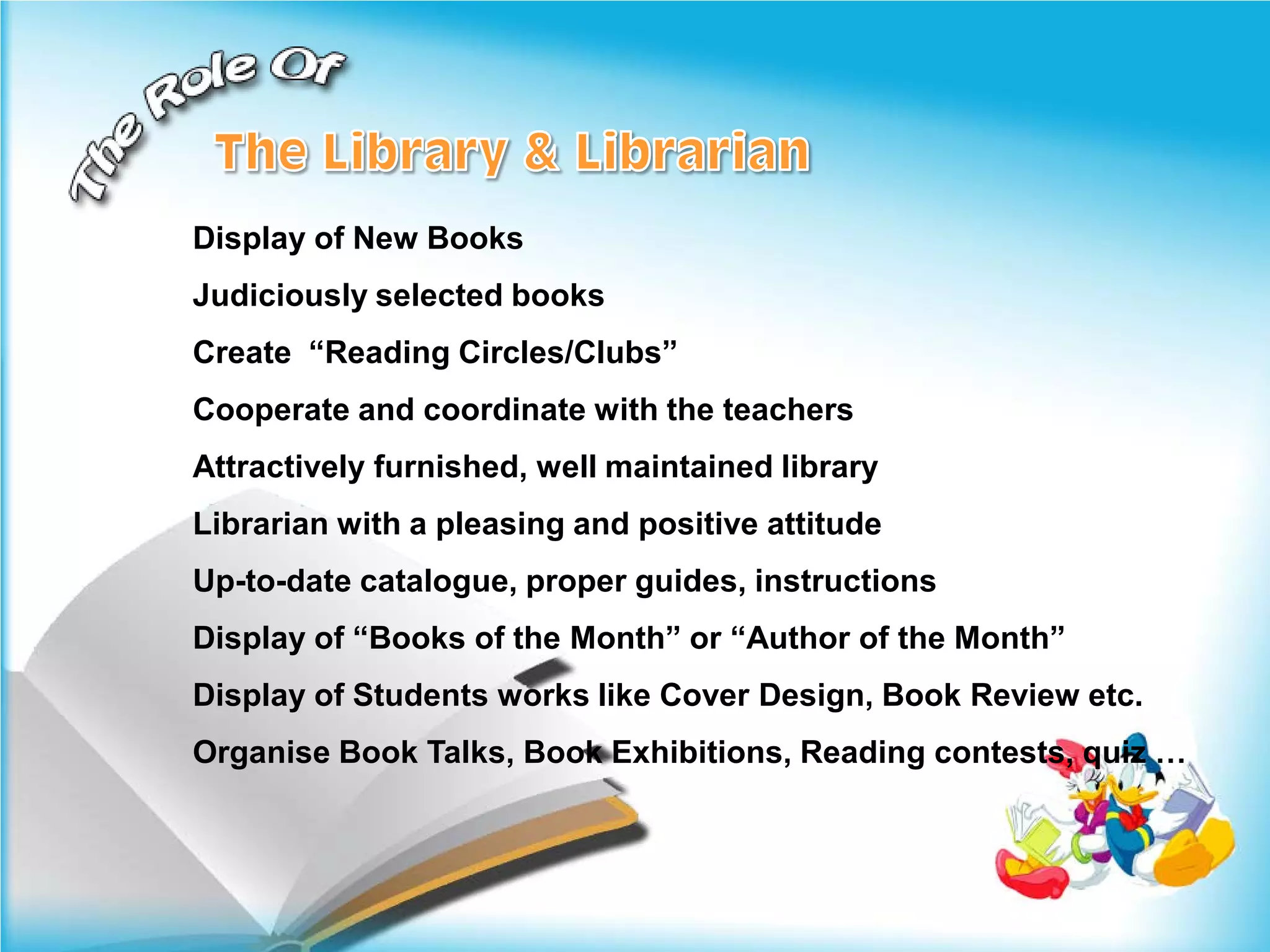
Display of NewBooks
Judiciously selected books
Create “Reading Circles/Clubs”
Cooperate and coordinate with the teachers
Attractively furnished, well maintained library
Librarian with a pleasing and positive attitude
Up-to-date catalogue, proper guides, instructions
Display of “Books of the Month” or “Author of the Month”
Display of Students works like Cover Design, Book Review etc.
Organise Book Talks, Book Exhibitions, Reading contests, quiz …
11.
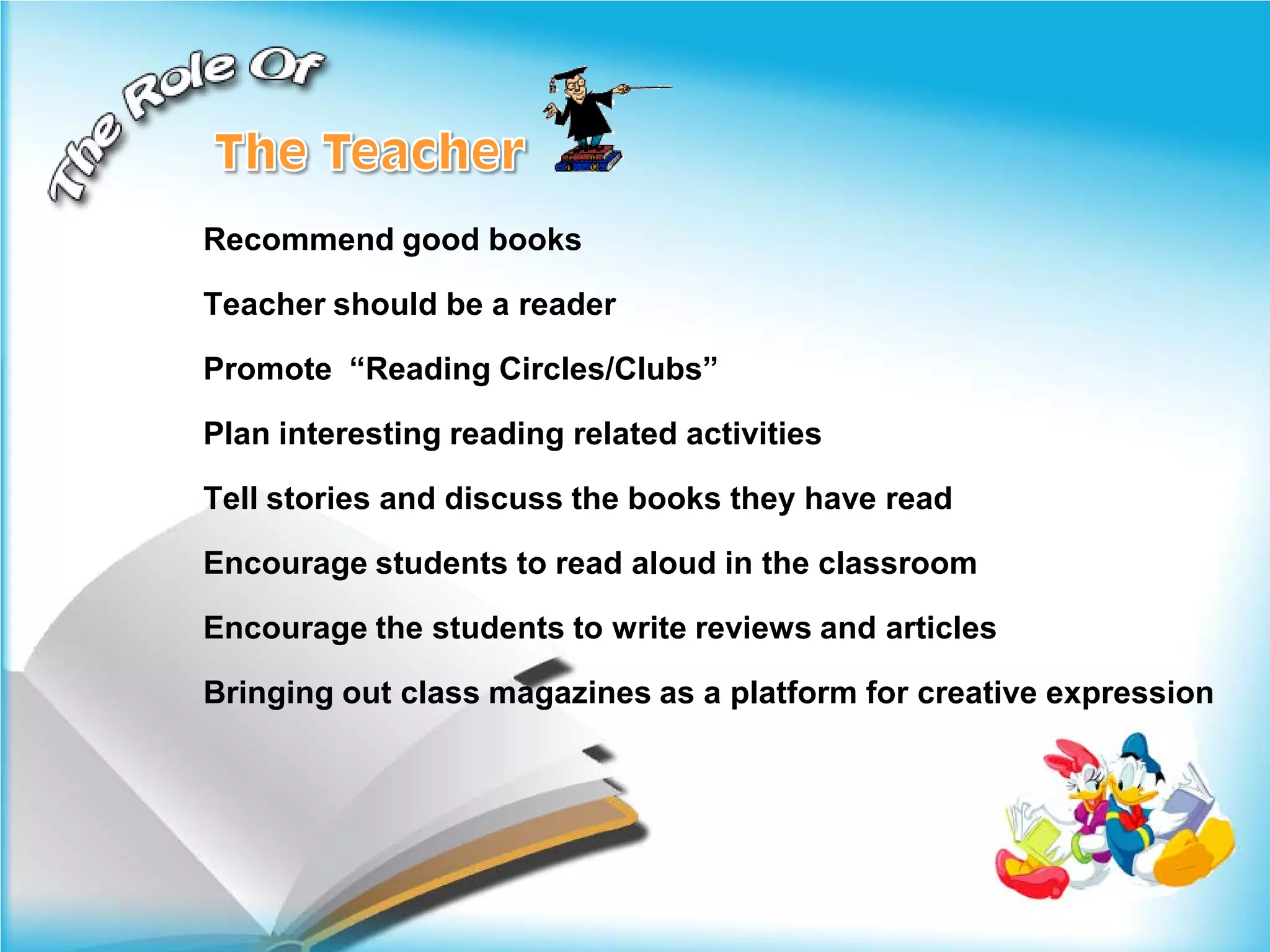
Recommend good books
Teachershould be a reader
Promote “Reading Circles/Clubs”
Plan interesting reading related activities
Tell stories and discuss the books they have read
Encourage students to read aloud in the classroom
Encourage the students to write reviews and articles
Bringing out class magazines as a platform for creative expression
12.
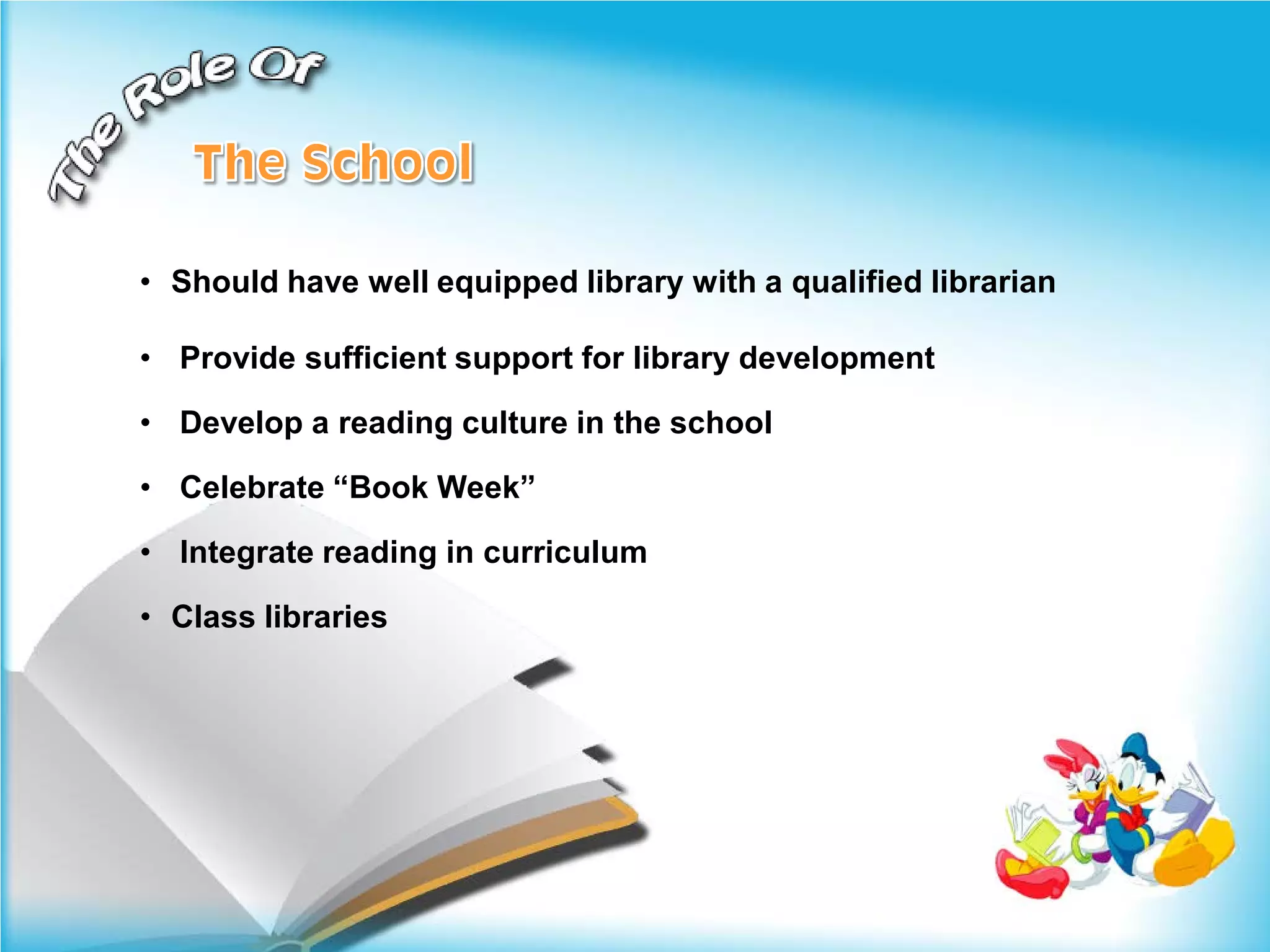
• Should havewell equipped library with a qualified librarian
• Provide sufficient support for library development
• Develop a reading culture in the school
• Celebrate “Book Week”
• Integrate reading in curriculum
• Class libraries
13.
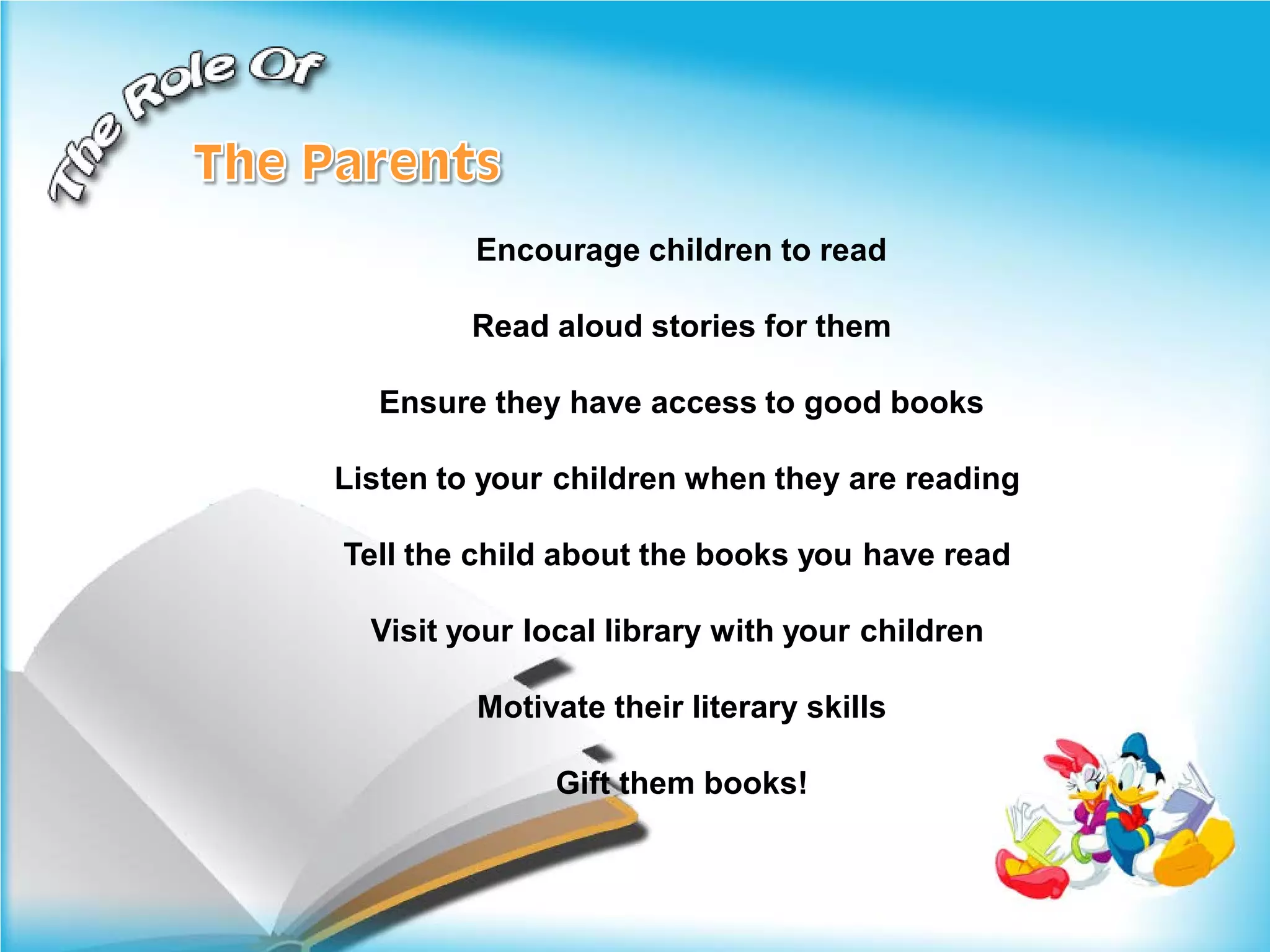
Encourage children toread
Read aloud stories for them
Ensure they have access to good books
Listen to your children when they are reading
Tell the child about the books you have read
Visit your local library with your children
Motivate their literary skills
Gift them books!
14.
• Allocating space within the classroom for displaying a variety
of reading materials
• Provides ready access to reading materials and act as activity
centres to energise the class rooms
• Class Teacher will be in-charge
• From Class I – V
• Kendriya Vidyalaya Library Policy, Common Minimum
Programme, NCF 2005
15.
• Class teacher should maintain a register to keep track of the books
read
• Ensure that every student maintains a notebook in which the name
of book read, its author and a brief account of the content
• The books will be provided from the main library and it can be
replaced from time to time
• Display the books attractively in cupboards
16.
• The books need not be stacked where only the spine is
visible. The cover page carries the visual appeal.
• Emphasis should be on usability of the book rather than
longevity. Hardbound, dull binding should be avoided.
• Make this reading corner attractive and comfortable.
• Create an environment that is supportive of early writing by
making sure paper, crayons, pens, pencils, and markers are
available.
17.
• Use flashy slogans, poems, banners that talks about a new
book and motivate children to read.
• Novelity is key to motivation and thus the content of class
libraries should change frequently.
• They need to be regularly updated with new books from the
main library so as to keep the enthusiasm alive.
18.
• The teachermay read aloud the title, sub-title, author’s name,
illustrator, and also talk about the illustrations of the cover and the
back page.
• Encourage children to predict the plot, share what they see on the
cover page, share their experiences.
• Engage learners to respond to what they read. The idea is their
opinion about the book and their view point needs to be respected.
• Introduce sharing time when children share their reading
experiences/books.
• Key words from a book can be selected on the bulletin as sight
words. Key word selection does not imply difficult words or simple
phonic based words.
19.
• The teachercan ask children to read and narrate a story
• make picture books using the characters of a story but altering the plot
• frame riddles about the characters they studied and play a quiz, build story
maps.
• Other literary activities may include writing an introduction for a book,
making a poster, role play, letter writing.
• Class library bulletin boards may be maintained
• Book Reviews, Book exhibitions and book clubs
• Celebration of reading day/reading week
• Book review competition
• Vote for Favourite Book
• Best Reader Award
20.
• Children should feel class library to be their own and not an
inaccessible space.
• they should be empowered in multiple ways to use this space
creatively.
• Their voices need attention and demand implementation.
• Children’s projects, diaries, work, journals, self made books
ought to be displayed.
• This should be a space for learning together and not for giving
stars, grades and displaying the best.
• Efforts are important not the final products.
21.
• Visit the main library with children and allow them to select material
for reading and place it in their class library.
• Children can be engaged in making posters, slogans, book covers etc.
to attract the readers.
• Wear and tear of books is natural. Children should be engaged in
mending books and thus tapes, scissors, glue should be provided to
them.
• Encourage children to share the books they read at home and place it
in class library for a day or two for others to read.
22.
• A classlibrary needs to be equipped with a variety of reading
material.
A variety of children’s literature should be available to readers.
This includes wordless picture books, comics, fantasy stories,
humorous stories, mysteries, biographies, experiential stories,
folk tales, fables , poems...
Other reading material like book reviews, catalogues, brochures,
pamphlets, magazines, newspapers ...
Diversity of language should be encouraged
23.
A GOOD BOOKIS…
Entertaining
With attractive illustrations
Presented in a clear, rich and simple language
Contains interesting imaginative characters, events,
themes and situations
Provides knowledge/pleasure
Rich and varied content
24.
"To read isto empower
To empower is to write
To write is to influence
To Influence is to change
To change is to live."
~ Jane Evershed ~
25.
REFERENCES
• Role ofclass libraries in promoting reading habits by Meeta Mohanty, National
Seminar on Libraries at NCERT on 10/ 11 Feb. 2009
• National Curriuclum Framework 2005, NCERT
• Library Policy for Kendriya Vidyalayas, Kendriya Vidyalaya Sangathan
• School Library Guidelines, CBSE
Clipart Credits
• http://wondrouspics.com/cool-question-marks/
• http://www.clipartfree123.com
• http://www.kidclipart.net
• http://disney-clipart.com/