Love your Library

How teachers can get the most from
their class library visits
• Why the library is crucial to students' academic
success
• Things you can do in your class visits to the library
• What to teach during extra sessions in the library
• What your librarian can do for you
• Latest research from University of London's Institute of
Education (September 2013)
• Children who read for pleasure are likely to do
significantly better at school than their peers

• The influence of reading for pleasure is four times
greater than the advantage of having a universityeducated parent
• Competent Children, Competent Learners project
(NZ research, partly funded by the Ministry of Education)
• Enjoyment of reading is a key indicator for
competency levels in learning
• "...it is not enough just to learn to read - one of the
strongest indicators of positive engagement in school
and learning was the enjoyment of reading".
Library = Reading for pleasure
Class Visits
• Overdues management

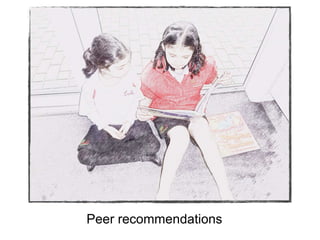
• Peer recommendations
• Read a picture book
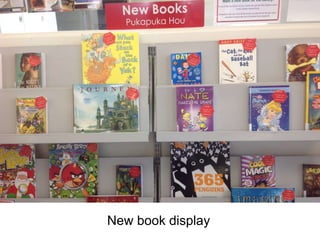
• New book display
• Topic of the week
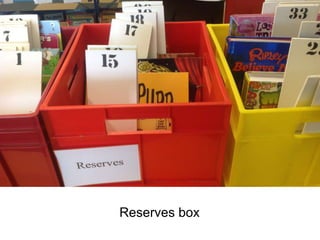
• Check the reserves box
• Book selection
• Return/issue books
• Tidy up
Overdues management
Peer recommendations
Read a picture book
New book display
Topic of the week
Reserves box
Reserves
Book selection
Return/issue books
Tidy up
Extra Sessions
• Terminology

• Library layout
• Library policies
• Library staff
• Care of books
• Genres
• Book selection strategies
• Introduction to Dewey system
• Using the catalog
• Promote summer reading
Stretchy
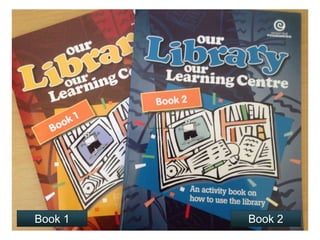
Book 1

Book 2
Terminology
• The difference between fiction and non-fiction (Stretchy,
pg.27)
• The names of the parts of a book e.g. title,spine, blurb
(Stretchy, pg.43)
• The main features of a non-fiction book e.g. contents, chapter
headings, glossary, index (Book 1, pgs.29-31, Book 2,
pgs.29-31)
• Understand the different kinds of books in the library e.g.
graphic novels, sophisticated picture books, readers (Book 1,
pg.55)
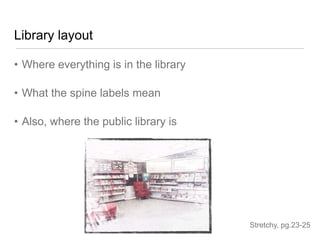
Library layout
• Where everything is in the library
• What the spine labels mean

• Also, where the public library is

Stretchy, pg.23-25
Library policies
• How many books students can borrow
• How long books are issued for

• The requirement for a book bag
• How to reserve and renew books
• How to return a book to the shelves

Book 2, pg.11
Library staff
• Who we are
• What we do

Book 1, pg.8.
Care of books
• Handle gently
• Turn pages from top right-hand corner

• Use bookmarks
• Keep away from animals, younger siblings, food and
drink
• Examples of damaged books
Stretchy, pg.33.
Genre
• How are these categories defined?
• Examples - Animal stories, adventure, mysteries,
science fiction, historical fiction, fantasy
• Try to choose a range of genres for your class library, as
well as formats e.g. graphic novels, sophisticated picture
books

Stretchy, pg.9.
Book selection strategies
• Questions students can ask themselves to help them think
about their reading preferences:
• Which books are my favourites?

• Do I like books by certain authors?
• What topics or subjects interest me?
• Do I prefer fiction or non-fiction (or both)?
• What genres do I enjoy reading?

Book 1, pg.33,
Book 2, pg.14
Stretchy, pgs.31-32
Book selection strategies
• How to browse the shelves and find a book:
• Choose which shelves to get your book from
• Skim your eyes over the books and let an interesting cover or title catch your
eye
• Read the summary on the back of the book or inside the book jacket - does it
make you want to read more?
• Does the first sentence or paragraph make you want to keep reading?
• Flip through the pages, look at the pictures, the size of the words and the space
around the words. Does it feel good to you?
• Use the five finger rule to find out if the book is at the right level for you
Book selection strategies
• The five finger rule:
• Children choose a book they might like to read.
• They read one page in the middle of the book and start
with a closed fist.
• They hold up one finger for each word they don't know.
• If they get all five fingers up then the book is probably too
challenging for them to read independently. They could
ask an adult to read it with them, or choose a different
book.
Book selection strategies
• "A recent survey showed that the primary factor in
choosing a book for 7- to 12-year-olds was a familiar
character or series" - What do children's book
consumers want? Publishers' Weekly Survey 2010
Introduction to Dewey Decimal System

Book 2, pg.27,
Stretchy, pgs.38-40
Using the catalogue
• Show students how to find books using a title, subject or
author search
• Encourage them to:

• Find books that help them with research questions
• See if an author they like has written any more books
• Check if there are any books about topics that
interest them

Book 1, pg.34, 36,
Book 2, pg.34, 36
Promote summer reading
• Significant summer reading loss is a well known effect in
NZ and worldwide
• During the school holidays, and the long summer holiday
especially, students can lose ground if they don't
maintain the reading habit
• In particular this has a huge impact on struggling readers
who lose momentum, habits and confidence
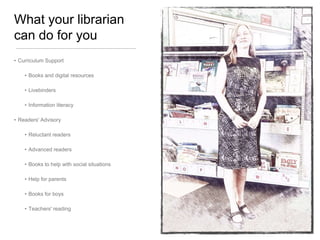
What your librarian
can do for you
• Curriculum Support

• Books and digital resources
• Livebinders
• Information literacy

• Readers' Advisory
• Reluctant readers
• Advanced readers

• Books to help with social situations
• Help for parents
• Books for boys

• Teachers' reading
Books for boys
"In New Zealand, like in many countries, girls perform
better in reading literacy than boys by a statistically
significant amount."
- National Library, Services to Schools website
Books for boys
• Studies reveal boys often prefer:
• Non-fiction
• Graphic novels
• Fun facts books
• Fast-paced fiction with plenty of action
• Series books
• Humourous books
Teachers as readers
"Research in the UK & US suggests many teachers
depend on their own childhood reading, their children's
reading, and perennial favourites such as Roald Dahl and
Paul Jennings."
- National Library, Services to Schools website
How you can help me
• Please let me know:
• If a student is about to leave school. Try and have a
conversation with them about bringing their books
and readers back before they go.
• What books you'd like me to buy, or your students
would like me to buy.
Action plan
• Teach some library skills in the library
• Think about whether I could help you with students who
are not yet reading for pleasure
• Have an overdue book blitz

Love your library

  • 1.
    Love your Library Howteachers can get the most from their class library visits
  • 2.
    • Why thelibrary is crucial to students' academic success • Things you can do in your class visits to the library • What to teach during extra sessions in the library • What your librarian can do for you
  • 3.
    • Latest researchfrom University of London's Institute of Education (September 2013) • Children who read for pleasure are likely to do significantly better at school than their peers • The influence of reading for pleasure is four times greater than the advantage of having a universityeducated parent
  • 4.
    • Competent Children,Competent Learners project (NZ research, partly funded by the Ministry of Education) • Enjoyment of reading is a key indicator for competency levels in learning • "...it is not enough just to learn to read - one of the strongest indicators of positive engagement in school and learning was the enjoyment of reading".
  • 5.
    Library = Readingfor pleasure
  • 6.
    Class Visits • Overduesmanagement • Peer recommendations • Read a picture book • New book display • Topic of the week • Check the reserves box • Book selection • Return/issue books • Tidy up
  • 7.
  • 8.
  • 9.
  • 10.
  • 11.
  • 12.
  • 13.
  • 14.
  • 15.
  • 16.
  • 17.
    Extra Sessions • Terminology •Library layout • Library policies • Library staff • Care of books • Genres • Book selection strategies • Introduction to Dewey system • Using the catalog • Promote summer reading
  • 18.
  • 19.
  • 20.
    Terminology • The differencebetween fiction and non-fiction (Stretchy, pg.27) • The names of the parts of a book e.g. title,spine, blurb (Stretchy, pg.43) • The main features of a non-fiction book e.g. contents, chapter headings, glossary, index (Book 1, pgs.29-31, Book 2, pgs.29-31) • Understand the different kinds of books in the library e.g. graphic novels, sophisticated picture books, readers (Book 1, pg.55)
  • 21.
    Library layout • Whereeverything is in the library • What the spine labels mean • Also, where the public library is Stretchy, pg.23-25
  • 22.
    Library policies • Howmany books students can borrow • How long books are issued for • The requirement for a book bag • How to reserve and renew books • How to return a book to the shelves Book 2, pg.11
  • 23.
    Library staff • Whowe are • What we do Book 1, pg.8.
  • 24.
    Care of books •Handle gently • Turn pages from top right-hand corner • Use bookmarks • Keep away from animals, younger siblings, food and drink • Examples of damaged books Stretchy, pg.33.
  • 25.
    Genre • How arethese categories defined? • Examples - Animal stories, adventure, mysteries, science fiction, historical fiction, fantasy • Try to choose a range of genres for your class library, as well as formats e.g. graphic novels, sophisticated picture books Stretchy, pg.9.
  • 26.
    Book selection strategies •Questions students can ask themselves to help them think about their reading preferences: • Which books are my favourites? • Do I like books by certain authors? • What topics or subjects interest me? • Do I prefer fiction or non-fiction (or both)? • What genres do I enjoy reading? Book 1, pg.33, Book 2, pg.14 Stretchy, pgs.31-32
  • 29.
    Book selection strategies •How to browse the shelves and find a book: • Choose which shelves to get your book from • Skim your eyes over the books and let an interesting cover or title catch your eye • Read the summary on the back of the book or inside the book jacket - does it make you want to read more? • Does the first sentence or paragraph make you want to keep reading? • Flip through the pages, look at the pictures, the size of the words and the space around the words. Does it feel good to you? • Use the five finger rule to find out if the book is at the right level for you
  • 30.
    Book selection strategies •The five finger rule: • Children choose a book they might like to read. • They read one page in the middle of the book and start with a closed fist. • They hold up one finger for each word they don't know. • If they get all five fingers up then the book is probably too challenging for them to read independently. They could ask an adult to read it with them, or choose a different book.
  • 33.
  • 34.
    Book selection strategies •"A recent survey showed that the primary factor in choosing a book for 7- to 12-year-olds was a familiar character or series" - What do children's book consumers want? Publishers' Weekly Survey 2010
  • 35.
    Introduction to DeweyDecimal System Book 2, pg.27, Stretchy, pgs.38-40
  • 36.
    Using the catalogue •Show students how to find books using a title, subject or author search • Encourage them to: • Find books that help them with research questions • See if an author they like has written any more books • Check if there are any books about topics that interest them Book 1, pg.34, 36, Book 2, pg.34, 36
  • 37.
    Promote summer reading •Significant summer reading loss is a well known effect in NZ and worldwide • During the school holidays, and the long summer holiday especially, students can lose ground if they don't maintain the reading habit • In particular this has a huge impact on struggling readers who lose momentum, habits and confidence
  • 38.
    What your librarian cando for you • Curriculum Support • Books and digital resources • Livebinders • Information literacy • Readers' Advisory • Reluctant readers • Advanced readers • Books to help with social situations • Help for parents • Books for boys • Teachers' reading
  • 39.
    Books for boys "InNew Zealand, like in many countries, girls perform better in reading literacy than boys by a statistically significant amount." - National Library, Services to Schools website
  • 40.
    Books for boys •Studies reveal boys often prefer: • Non-fiction • Graphic novels • Fun facts books • Fast-paced fiction with plenty of action • Series books • Humourous books
  • 41.
    Teachers as readers "Researchin the UK & US suggests many teachers depend on their own childhood reading, their children's reading, and perennial favourites such as Roald Dahl and Paul Jennings." - National Library, Services to Schools website
  • 42.
    How you canhelp me • Please let me know: • If a student is about to leave school. Try and have a conversation with them about bringing their books and readers back before they go. • What books you'd like me to buy, or your students would like me to buy.
  • 43.
    Action plan • Teachsome library skills in the library • Think about whether I could help you with students who are not yet reading for pleasure • Have an overdue book blitz