Hypolipidemic Agents Sachin Kuchya,  MD Assistant Professor, Department of Pharmacology NSCB Medical College, Jabalpur
Why do we need them? Low HDL & elevated LDL-c are known risk factor for CHD. Elevated TG’s are known to cause Pancreatitis. In well controlled  clinical trials ,fatal & nonfatal CHD events & strokes was reduced by as much as 30-40% as per Scandinavian  Simvastatin Survival Study.
Overview of Presentation  Physiology Pharmacological targets Drugs Clinical states Special populations Combination Drug Regimens
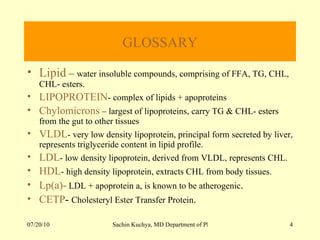
GLOSSARY Lipid  –  water insoluble compounds, comprising of FFA, TG, CHL, CHL- esters. LIPOPROTEIN - complex of lipids + apoproteins Chylomicrons  – largest of lipoproteins, carry TG & CHL- esters from the gut to other tissues VLDL - very low density lipoprotein, principal form secreted by liver, represents triglyceride content in lipid profile. LDL - low density lipoprotein, derived from VLDL, represents CHL. HDL - high density lipoprotein, extracts CHL from body tissues. Lp(a)-  LDL + apoprotein a, is known to be atherogenic . CETP -  Cholesteryl Ester Transfer Protein .
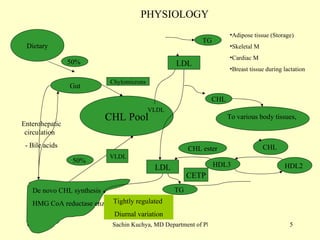
PHYSIOLOGY Enterohepatic circulation  - Bile acids CHL Pool Dietary CHL  De novo CHL synthesis HMG CoA reductase enz. VLDL Chylomicrons 50%  50%  VLDL LDL TG  CHL Adipose tissue (Storage) Skeletal M Cardiac M Breast tissue during lactation To various body tissues,  Gut  HDL2  HDL3  CHL ester TG  LDL CETP Tightly regulated  Diurnal variation
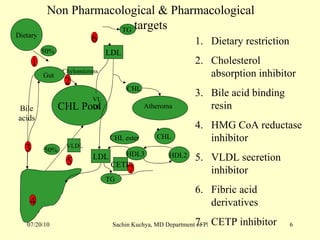
Dietary restriction Cholesterol absorption inhibitor Bile acid binding resin HMG CoA reductase inhibitor VLDL secretion inhibitor Fibric acid derivatives CETP inhibitor Non Pharmacological & Pharmacological targets 1 2 3 4 5 6 7 Dietary Atheroma HDL2  CHL Pool CHL  VLDL Chylomicrons 50%  50%  VLDL LDL TG  CHL Gut  HDL3  CHL ester TG  LDL CETP Bile acids
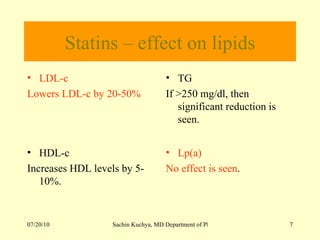
Statins – effect on lipids LDL-c  Lowers LDL-c by 20-50% TG If >250 mg/dl, then significant reduction is seen. HDL-c  Increases HDL levels by 5- 10%. Lp(a) No effect is seen .
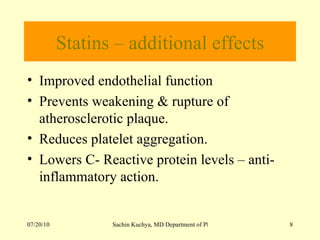
Statins – additional effects Improved endothelial function Prevents weakening & rupture of atherosclerotic plaque. Reduces platelet aggregation. Lowers C- Reactive protein levels – anti-inflammatory action.
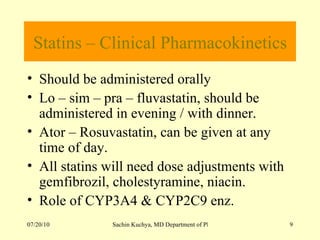
Statins – Clinical Pharmacokinetics Should be administered orally Lo – sim – pra – fluvastatin, should be administered in evening / with dinner. Ator – Rosuvastatin, can be given at any time of day. All statins will need dose adjustments with gemfibrozil, cholestyramine, niacin. Role of CYP3A4 & CYP2C9 enz.
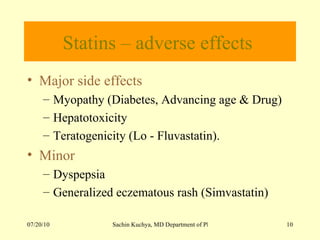
Statins – adverse effects  Major side effects Myopathy (Diabetes, Advancing age & Drug) Hepatotoxicity  Teratogenicity (Lo - Fluvastatin). Minor   Dyspepsia Generalized eczematous rash (Simvastatin)
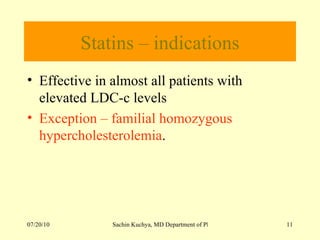
Statins – indications Effective in almost all patients with elevated LDC-c levels Exception – familial homozygous hypercholesterolemia .
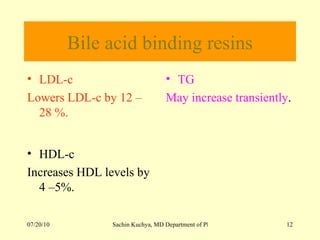
Bile acid binding resins LDL-c  Lowers LDL-c by 12 –28 %. TG May increase transiently . HDL-c  Increases HDL levels by 4 –5%.
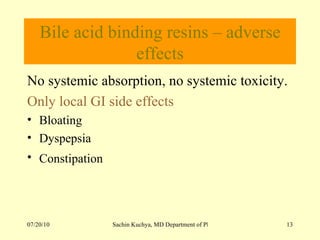
Bile acid binding resins – adverse effects No systemic absorption, no systemic toxicity. Only local GI side effects Bloating Dyspepsia  Constipation
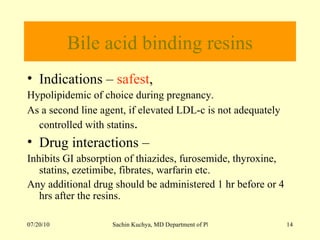
Bile acid binding resins Indications –  safest , Hypolipidemic of choice during pregnancy. As a second line agent, if elevated LDL-c is not adequately controlled with statins .  Drug interactions –  Inhibits GI absorption of thiazides, furosemide, thyroxine, statins, ezetimibe, fibrates, warfarin etc. Any additional drug should be administered 1 hr before or 4 hrs after the resins.
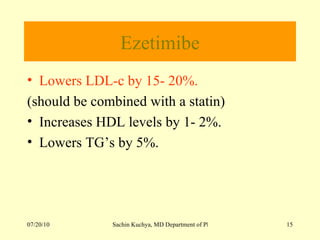
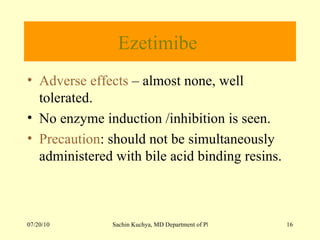
Ezetimibe Lowers LDL-c by 15- 20%. (should be combined with a statin) Increases HDL levels by 1- 2%. Lowers TG’s by 5%.
Ezetimibe  Adverse effects  – almost none, well tolerated. No enzyme induction /inhibition is seen.  Precaution : should not be simultaneously administered with bile acid binding resins.
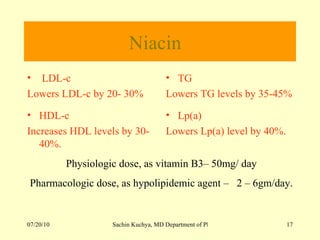
Niacin  LDL-c  Lowers LDL-c by 20-   30% TG Lowers TG levels by 35-45% HDL-c  Increases HDL levels by 30- 40%. Lp(a) Lowers Lp(a) level by 40%. Physiologic dose, as vitamin B3– 50mg/ day Pharmacologic dose, as hypolipidemic agent –  2 – 6gm/day.
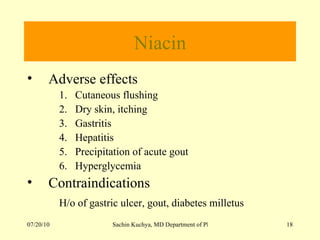
Niacin Adverse effects  Cutaneous flushing Dry skin, itching Gastritis Hepatitis Precipitation of acute gout Hyperglycemia Contraindications  H/o of gastric ulcer, gout, diabetes milletus
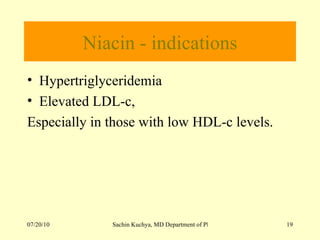
Niacin - indications Hypertriglyceridemia Elevated LDL-c, Especially in those with low HDL-c levels.
Fibric acid derivatives LDL-c  Increases LDL-c by upto 10-30%. TG  Lowers TG’s by upto 50% HDL-c  Increases HDL levels by  15%.
Fibric acid derivatives Adverse effects  Gallstone  (Clofibrate) Dyspepsia & abdominal pain Increased risk of myopathy  (gemfibrozil + statins) Contraindications Hepatic & renal dysfunction
Fibric acid  - indications Hypertriglyceridemia  Chylomicronemia Type III dysbetalipoproteinemia
CETP inhibitor - Torcetrapib Increases HDL levels by 45- 100%. Under clinical trial.
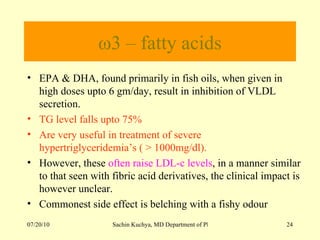
ω3 – fatty acids EPA & DHA, found primarily in fish oils, when given in high doses upto 6 gm/day, result in inhibition of VLDL secretion. TG level falls upto 75% Are very useful in treatment of severe hypertriglyceridemia’s ( > 1000mg/dl). However, these  often raise LDL-c levels , in a manner similar to that seen with fibric acid derivatives, the clinical impact is however unclear. Commonest side effect is belching with a fishy odour
Clinical states  In this section, we will have some clinical states. This exercise shall rationalize the use of hypolipidemic agents.
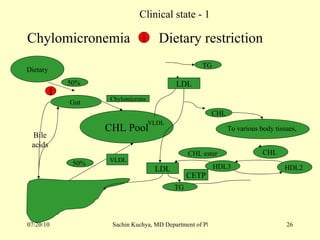
Chylomicronemia  Dietary restriction  1 Clinical state - 1 CHL Pool Dietary CHL  VLDL Chylomicrons 50%  50%  VLDL LDL TG  CHL To various body tissues,  Gut  HDL2  HDL3  CHL ester TG  LDL CETP 1 Bile acids
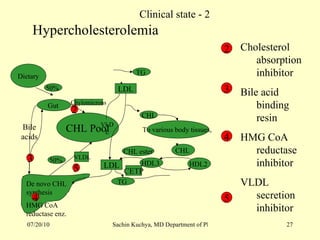
Hypercholesterolemia 2 5 4 3 Cholesterol absorption inhibitor Bile acid binding resin HMG CoA reductase inhibitor VLDL secretion inhibitor Clinical state - 2 CHL Pool Dietary CHL  De novo CHL synthesis HMG CoA reductase enz. VLDL Chylomicrons 50%  50%  VLDL LDL TG  CHL To various body tissues,  Gut  HDL2  HDL3  CHL ester TG  LDL CETP 2 5 3 4 Bile acids
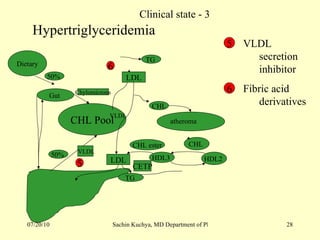
CHL Pool Dietary CHL  VLDL Chylomicrons 50%  50%  VLDL LDL TG  CHL atheroma Gut  HDL2  HDL3  CHL ester TG  LDL CETP 6 5 Hypertriglyceridemia  6 5 VLDL secretion inhibitor Fibric acid derivatives Clinical state - 3
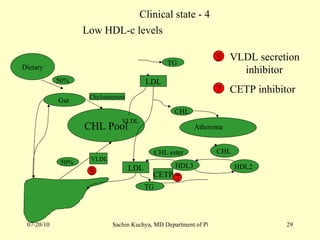
Low HDL-c levels VLDL secretion inhibitor CETP inhibitor 5 7 Clinical state - 4 CHL Pool Dietary CHL  VLDL Chylomicrons 50%  50%  VLDL LDL TG  CHL Atheroma  Gut  HDL2  HDL3  CHL ester TG  LDL CETP 7 5
Special Population Children  Women – Adolescence / Pregnancy/ Lactation/ Postmenopausal.
Special population – Children Less than 2 yrs of age – no dietary restriction & no drug therapy. > 2yrs – 10yrs – Dietary restriction of saturated and total fats ; CHL restricted diet only. 10 yrs & above – Diet therapy Drug therapy is indicated only after an adequate trial of dietary control for 6mo – 1 yr.
Special population – Children Drugs  Bile acid sequestrants (resins) are the first line agents of choice. If not - tolerated then, Statins can be given, Ator – lova – sim, approved for 11yrs & above. Pravastatin, for 8 yrs & above .
Women Statins should be used with caution in adolescent girls / females, likely to conceive. Bile acid binding resins are the only CHL – lowering drugs used during pregnancy . In post menopausal women, who wish to have HRT, elevated TG’s if any should be controlled with Dietary restriction, weight control and fibrates/ statins + fibrates, prior to initiation of HRT.
Combination regimens – why? Maximize reduction of LDL & VLDL. Minimize side effects by using smaller doses of drugs. Allow use of resins,  patients with elevated TG’s & LDL. Treat increased LDL, found consequent to treatment of elevated  TG with fibric acid derivatives.
Combination regimens – when? After diet & a single drug have been found insufficient. Statins, being the most effective & well tolerated, should be the first drug. Effect on Plasma lipoprotein levels & side effects should be assesed only after 4 –8 weeks of therapy.
LDL-c reduction Statin + Fenofibrate Statin + Niacin Statin + Resins
VLDL reduction Nicotinic acid + fibric acid  Addition of fish oils, may be helpful.
Minimize doses and side effects Statin + Ezetimibe is the safest combination.
Diabetic patient The defect, Elevated TG’s / LDL Low HDL-c Glycosylated LDL The treatment, Adequate glycemic control & dietary restrictions. Drugs
Diabetic patient - drugs Niacin – impairs glycemic control Resins – increases TG  Fibric acid level – increases LDL   So, combination of hypolipidemics is must, Statin + fenofibrate, is the ideal combination .
Thank you  Topic is open for queries

Hypolipidemic agents

  • 1.
    Hypolipidemic Agents SachinKuchya, MD Assistant Professor, Department of Pharmacology NSCB Medical College, Jabalpur
  • 2.
    Why do weneed them? Low HDL & elevated LDL-c are known risk factor for CHD. Elevated TG’s are known to cause Pancreatitis. In well controlled clinical trials ,fatal & nonfatal CHD events & strokes was reduced by as much as 30-40% as per Scandinavian Simvastatin Survival Study.
  • 3.
    Overview of Presentation Physiology Pharmacological targets Drugs Clinical states Special populations Combination Drug Regimens
  • 4.
    GLOSSARY Lipid – water insoluble compounds, comprising of FFA, TG, CHL, CHL- esters. LIPOPROTEIN - complex of lipids + apoproteins Chylomicrons – largest of lipoproteins, carry TG & CHL- esters from the gut to other tissues VLDL - very low density lipoprotein, principal form secreted by liver, represents triglyceride content in lipid profile. LDL - low density lipoprotein, derived from VLDL, represents CHL. HDL - high density lipoprotein, extracts CHL from body tissues. Lp(a)- LDL + apoprotein a, is known to be atherogenic . CETP - Cholesteryl Ester Transfer Protein .
  • 5.
    PHYSIOLOGY Enterohepatic circulation - Bile acids CHL Pool Dietary CHL De novo CHL synthesis HMG CoA reductase enz. VLDL Chylomicrons 50% 50% VLDL LDL TG CHL Adipose tissue (Storage) Skeletal M Cardiac M Breast tissue during lactation To various body tissues, Gut HDL2 HDL3 CHL ester TG LDL CETP Tightly regulated Diurnal variation
  • 6.
    Dietary restriction Cholesterolabsorption inhibitor Bile acid binding resin HMG CoA reductase inhibitor VLDL secretion inhibitor Fibric acid derivatives CETP inhibitor Non Pharmacological & Pharmacological targets 1 2 3 4 5 6 7 Dietary Atheroma HDL2 CHL Pool CHL VLDL Chylomicrons 50% 50% VLDL LDL TG CHL Gut HDL3 CHL ester TG LDL CETP Bile acids
  • 7.
    Statins – effecton lipids LDL-c Lowers LDL-c by 20-50% TG If >250 mg/dl, then significant reduction is seen. HDL-c Increases HDL levels by 5- 10%. Lp(a) No effect is seen .
  • 8.
    Statins – additionaleffects Improved endothelial function Prevents weakening & rupture of atherosclerotic plaque. Reduces platelet aggregation. Lowers C- Reactive protein levels – anti-inflammatory action.
  • 9.
    Statins – ClinicalPharmacokinetics Should be administered orally Lo – sim – pra – fluvastatin, should be administered in evening / with dinner. Ator – Rosuvastatin, can be given at any time of day. All statins will need dose adjustments with gemfibrozil, cholestyramine, niacin. Role of CYP3A4 & CYP2C9 enz.
  • 10.
    Statins – adverseeffects Major side effects Myopathy (Diabetes, Advancing age & Drug) Hepatotoxicity Teratogenicity (Lo - Fluvastatin). Minor Dyspepsia Generalized eczematous rash (Simvastatin)
  • 11.
    Statins – indicationsEffective in almost all patients with elevated LDC-c levels Exception – familial homozygous hypercholesterolemia .
  • 12.
    Bile acid bindingresins LDL-c Lowers LDL-c by 12 –28 %. TG May increase transiently . HDL-c Increases HDL levels by 4 –5%.
  • 13.
    Bile acid bindingresins – adverse effects No systemic absorption, no systemic toxicity. Only local GI side effects Bloating Dyspepsia Constipation
  • 14.
    Bile acid bindingresins Indications – safest , Hypolipidemic of choice during pregnancy. As a second line agent, if elevated LDL-c is not adequately controlled with statins . Drug interactions – Inhibits GI absorption of thiazides, furosemide, thyroxine, statins, ezetimibe, fibrates, warfarin etc. Any additional drug should be administered 1 hr before or 4 hrs after the resins.
  • 15.
    Ezetimibe Lowers LDL-cby 15- 20%. (should be combined with a statin) Increases HDL levels by 1- 2%. Lowers TG’s by 5%.
  • 16.
    Ezetimibe Adverseeffects – almost none, well tolerated. No enzyme induction /inhibition is seen. Precaution : should not be simultaneously administered with bile acid binding resins.
  • 17.
    Niacin LDL-c Lowers LDL-c by 20- 30% TG Lowers TG levels by 35-45% HDL-c Increases HDL levels by 30- 40%. Lp(a) Lowers Lp(a) level by 40%. Physiologic dose, as vitamin B3– 50mg/ day Pharmacologic dose, as hypolipidemic agent – 2 – 6gm/day.
  • 18.
    Niacin Adverse effects Cutaneous flushing Dry skin, itching Gastritis Hepatitis Precipitation of acute gout Hyperglycemia Contraindications H/o of gastric ulcer, gout, diabetes milletus
  • 19.
    Niacin - indicationsHypertriglyceridemia Elevated LDL-c, Especially in those with low HDL-c levels.
  • 20.
    Fibric acid derivativesLDL-c Increases LDL-c by upto 10-30%. TG Lowers TG’s by upto 50% HDL-c Increases HDL levels by 15%.
  • 21.
    Fibric acid derivativesAdverse effects Gallstone (Clofibrate) Dyspepsia & abdominal pain Increased risk of myopathy (gemfibrozil + statins) Contraindications Hepatic & renal dysfunction
  • 22.
    Fibric acid - indications Hypertriglyceridemia Chylomicronemia Type III dysbetalipoproteinemia
  • 23.
    CETP inhibitor -Torcetrapib Increases HDL levels by 45- 100%. Under clinical trial.
  • 24.
    ω3 – fattyacids EPA & DHA, found primarily in fish oils, when given in high doses upto 6 gm/day, result in inhibition of VLDL secretion. TG level falls upto 75% Are very useful in treatment of severe hypertriglyceridemia’s ( > 1000mg/dl). However, these often raise LDL-c levels , in a manner similar to that seen with fibric acid derivatives, the clinical impact is however unclear. Commonest side effect is belching with a fishy odour
  • 25.
    Clinical states In this section, we will have some clinical states. This exercise shall rationalize the use of hypolipidemic agents.
  • 26.
    Chylomicronemia Dietaryrestriction 1 Clinical state - 1 CHL Pool Dietary CHL VLDL Chylomicrons 50% 50% VLDL LDL TG CHL To various body tissues, Gut HDL2 HDL3 CHL ester TG LDL CETP 1 Bile acids
  • 27.
    Hypercholesterolemia 2 54 3 Cholesterol absorption inhibitor Bile acid binding resin HMG CoA reductase inhibitor VLDL secretion inhibitor Clinical state - 2 CHL Pool Dietary CHL De novo CHL synthesis HMG CoA reductase enz. VLDL Chylomicrons 50% 50% VLDL LDL TG CHL To various body tissues, Gut HDL2 HDL3 CHL ester TG LDL CETP 2 5 3 4 Bile acids
  • 28.
    CHL Pool DietaryCHL VLDL Chylomicrons 50% 50% VLDL LDL TG CHL atheroma Gut HDL2 HDL3 CHL ester TG LDL CETP 6 5 Hypertriglyceridemia 6 5 VLDL secretion inhibitor Fibric acid derivatives Clinical state - 3
  • 29.
    Low HDL-c levelsVLDL secretion inhibitor CETP inhibitor 5 7 Clinical state - 4 CHL Pool Dietary CHL VLDL Chylomicrons 50% 50% VLDL LDL TG CHL Atheroma Gut HDL2 HDL3 CHL ester TG LDL CETP 7 5
  • 30.
    Special Population Children Women – Adolescence / Pregnancy/ Lactation/ Postmenopausal.
  • 31.
    Special population –Children Less than 2 yrs of age – no dietary restriction & no drug therapy. > 2yrs – 10yrs – Dietary restriction of saturated and total fats ; CHL restricted diet only. 10 yrs & above – Diet therapy Drug therapy is indicated only after an adequate trial of dietary control for 6mo – 1 yr.
  • 32.
    Special population –Children Drugs Bile acid sequestrants (resins) are the first line agents of choice. If not - tolerated then, Statins can be given, Ator – lova – sim, approved for 11yrs & above. Pravastatin, for 8 yrs & above .
  • 33.
    Women Statins shouldbe used with caution in adolescent girls / females, likely to conceive. Bile acid binding resins are the only CHL – lowering drugs used during pregnancy . In post menopausal women, who wish to have HRT, elevated TG’s if any should be controlled with Dietary restriction, weight control and fibrates/ statins + fibrates, prior to initiation of HRT.
  • 34.
    Combination regimens –why? Maximize reduction of LDL & VLDL. Minimize side effects by using smaller doses of drugs. Allow use of resins, patients with elevated TG’s & LDL. Treat increased LDL, found consequent to treatment of elevated TG with fibric acid derivatives.
  • 35.
    Combination regimens –when? After diet & a single drug have been found insufficient. Statins, being the most effective & well tolerated, should be the first drug. Effect on Plasma lipoprotein levels & side effects should be assesed only after 4 –8 weeks of therapy.
  • 36.
    LDL-c reduction Statin+ Fenofibrate Statin + Niacin Statin + Resins
  • 37.
    VLDL reduction Nicotinicacid + fibric acid Addition of fish oils, may be helpful.
  • 38.
    Minimize doses andside effects Statin + Ezetimibe is the safest combination.
  • 39.
    Diabetic patient Thedefect, Elevated TG’s / LDL Low HDL-c Glycosylated LDL The treatment, Adequate glycemic control & dietary restrictions. Drugs
  • 40.
    Diabetic patient -drugs Niacin – impairs glycemic control Resins – increases TG Fibric acid level – increases LDL So, combination of hypolipidemics is must, Statin + fenofibrate, is the ideal combination .
  • 41.
    Thank you Topic is open for queries