The Fundamental
Unit of Life
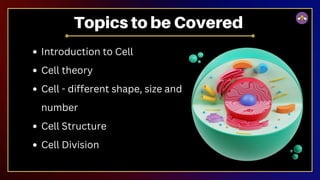
Introduction to Cell
Cell theory
Cell - different shape, size and
number
Cell Structure
Cell Division
Topics to be Covered
Cells are the structural, functional, and biological
units of all living beings.
The entire functioning of living organsims begins
from basic unit called cell, that’s why it’s called
fundamental unit of life.
A cell can replicate itself independently. Hence,
they are known as the building blocks of life.
CELLS
Introduction to Cell
TISSUES ORGANS
ORGAN
SYSTEM
ORGANISM
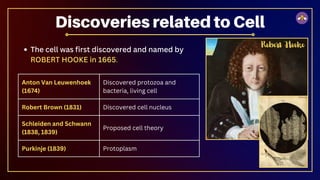
The cell was first discovered and named by
ROBERT HOOKE in 1665.
Anton Van Leuwenhoek
(1674)
Discovered protozoa and
bacteria, living cell
Robert Brown (1831) Discovered cell nucleus
Schleiden and Schwann
(1838, 1839)
Proposed cell theory
Purkinje (1839) Protoplasm
Discoveries related to Cell
Robert Hooke
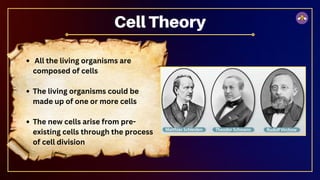
All the living organisms are
composed of cells
The living organisms could be
made up of one or more cells
The new cells arise from pre-
existing cells through the process
of cell division
Cell Theory
Size Number Shape
Unicellular
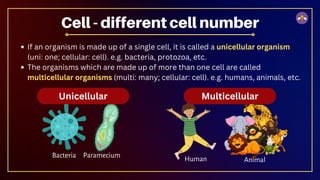
Cell - different cell number
If an organism is made up of a single cell, it is called a unicellular organism
(uni: one; cellular: cell). e.g. bacteria, protozoa, etc.
The organisms which are made up of more than one cell are called
multicellular organisms (multi: many; cellular: cell). e.g. humans, animals, etc.
Bacteria Paramecium
Multicellular
Human Animal
Cell - different shape
SPHERICAL
SPINDLE
BRANCHED &
ELONGATED
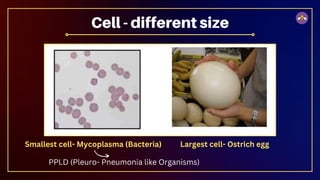
Cell - different size
Largest cell- Ostrich egg
Smallest cell- Mycoplasma (Bacteria)
PPLD (Pleuro- Pneumonia like Organisms)
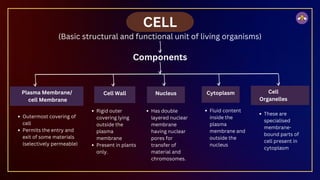
Components
CELL
(Basic structural and functional unit of living organisms)
Plasma Membrane/
cell Membrane
Outermost covering of
cell
Permits the entry and
exit of some materials
(selectively permeable)
Cell Wall Nucleus Cell
Organelles
Rigid outer
covering lying
outside the
plasma
membrane
Present in plants
only.
Has double
layered nuclear
membrane
having nuclear
pores for
transfer of
material and
chromosomes.
Cytoplasm
Fluid content
inside the
plasma
membrane and
outside the
nucleus
These are
specialised
membrane-
bound parts of
cell present in
cytoplasm
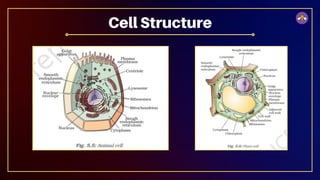
Cell Structure
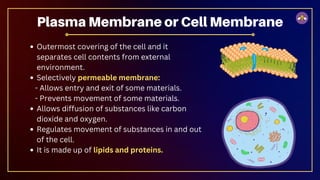
Outermost covering of the cell and it
separates cell contents from external
environment.
Selectively permeable membrane:
- Allows entry and exit of some materials.
- Prevents movement of some materials.
Allows diffusion of substances like carbon
dioxide and oxygen.
Regulates movement of substances in and out
of the cell.
It is made up of lipids and proteins.
Plasma Membrane or Cell Membrane
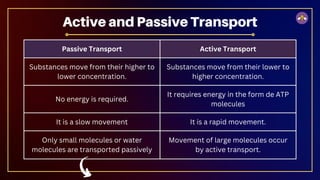
Passive Transport Active Transport
Substances move from their higher to
lower concentration.
Substances move from their lower to
higher concentration.
No energy is required.
It requires energy in the form de ATP
molecules
It is a slow movement It is a rapid movement.
Only small molecules or water
molecules are transported passively
Movement of large molecules occur
by active transport.
Active and Passive Transport
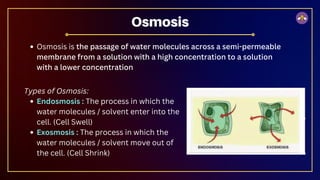
Osmosis is the passage of water molecules across a semi-permeable
membrane from a solution with a high concentration to a solution
with a lower concentration
Osmosis
Types of Osmosis:
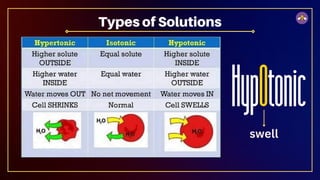
Endosmosis : The process in which the
water molecules / solvent enter into the
cell. (Cell Swell)
Exosmosis : The process in which the
water molecules / solvent move out of
the cell. (Cell Shrink)
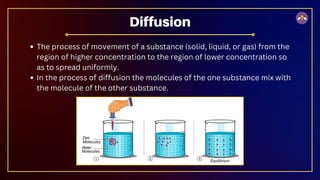
The process of movement of a substance (solid, liquid, or gas) from the
region of higher concentration to the region of lower concentration so
as to spread uniformly.
In the process of diffusion the molecules of the one substance mix with
the molecule of the other substance.
Diffusion
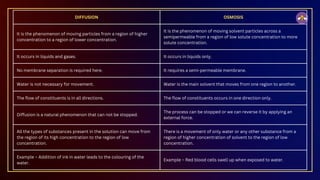
DIFFUSION OSMOSIS
It is the phenomenon of moving particles from a region of higher
concentration to a region of lower concentration.
It is the phenomenon of moving solvent particles across a
semipermeable from a region of low solute concentration to more
solute concentration.
It occurs in liquids and gases. It occurs in liquids only.
No membrane separation is required here. It requires a semi-permeable membrane.
Water is not necessary for movement. Water is the main solvent that moves from one region to another.
The flow of constituents is in all directions. The flow of constituents occurs in one direction only.
Diffusion is a natural phenomenon that can not be stopped.
The process can be stopped or we can reverse it by applying an
external force.
All the types of substances present in the solution can move from
the region of its high concentration to the region of low
concentration.
There is a movement of only water or any other substance from a
region of higher concentration of solvent to the region of low
concentration.
Example – Addition of ink in water leads to the colouring of the
water.
Example – Red blood cells swell up when exposed to water.
Types of Solutions
swell
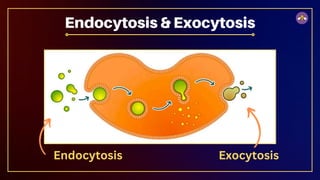
Endocytosis & Exocytosis
Endocytosis Exocytosis
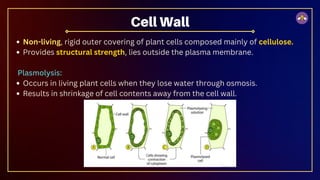
Cell Wall
Non-living, rigid outer covering of plant cells composed mainly of cellulose.
Provides structural strength, lies outside the plasma membrane.
Plasmolysis:
Occurs in living plant cells when they lose water through osmosis.
Results in shrinkage of cell contents away from the cell wall.
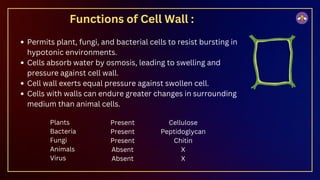
Functions of Cell Wall :
Permits plant, fungi, and bacterial cells to resist bursting in
hypotonic environments.
Cells absorb water by osmosis, leading to swelling and
pressure against cell wall.
Cell wall exerts equal pressure against swollen cell.
Cells with walls can endure greater changes in surrounding
medium than animal cells.
Plants
Bacteria
Fungi
Animals
Virus
Present
Present
Present
Absent
Absent
Cellulose
Peptidoglycan
Chitin
X
X
Why cell walls are only present in
plants and not animals?
Cell wall is present in plants while animals have cell membrane.
Cell wall mainly helps the plant to remain rigid and fixed. this helps
the plants because they are immobile. the cell wall mainly contains
cellulose and other substances, which are the main reasons why the
trunks and branches of the trees are strong.
(PYQ)
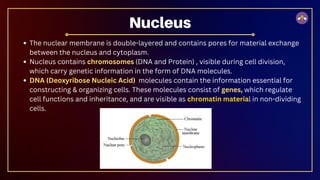
The nuclear membrane is double-layered and contains pores for material exchange
between the nucleus and cytoplasm.
Nucleus contains chromosomes (DNA and Protein) , visible during cell division,
which carry genetic information in the form of DNA molecules.
DNA (Deoxyribose Nucleic Acid) molecules contain the information essential for
constructing & organizing cells. These molecules consist of genes, which regulate
cell functions and inheritance, and are visible as chromatin material in non-dividing
cells.
Nucleus
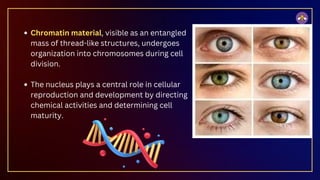
Chromatin material, visible as an entangled
mass of thread-like structures, undergoes
organization into chromosomes during cell
division.
The nucleus plays a central role in cellular
reproduction and development by directing
chemical activities and determining cell
maturity.
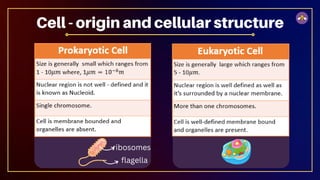
Cell - origin and cellular structure
flagella
ribosomes
Q. The undefined nuclear region of prokaryotes are also
known as
(a) nucleus
(b) nucleolus
(c) nucleic acid
(d) nucleoid
(PYQ)
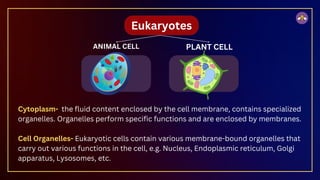
Eukaryotes
ANIMAL CELL PLANT CELL
Cytoplasm- the fluid content enclosed by the cell membrane, contains specialized
organelles. Organelles perform specific functions and are enclosed by membranes.
Cell Organelles- Eukaryotic cells contain various membrane-bound organelles that
carry out various functions in the cell, e.g. Nucleus, Endoplasmic reticulum, Golgi
apparatus, Lysosomes, etc.
Q. The only cell organelle seen in prokaryotic cell
(a) Mitochondria
(b) Ribosomes
(c) Plastids
(d) Lysosomes
(PYQ)
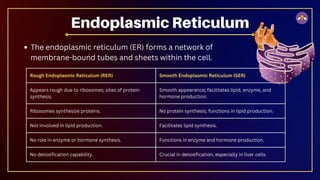
Rough Endoplasmic Reticulum (RER) Smooth Endoplasmic Reticulum (SER)
Appears rough due to ribosomes; sites of protein
synthesis.
Smooth appearance; facilitates lipid, enzyme, and
hormone production.
Ribosomes synthesize proteins. No protein synthesis; functions in lipid production.
Not involved in lipid production. Facilitates lipid synthesis.
No role in enzyme or hormone synthesis. Functions in enzyme and hormone production.
No detoxification capability. Crucial in detoxification, especially in liver cells.
The endoplasmic reticulum (ER) forms a network of
membrane-bound tubes and sheets within the cell.
Endoplasmic Reticulum
Q. Lipid molecules in the cell are synthesised by
a. Smooth endoplasmic reticulum
b. Rough endoplasmic reticulum
c. Golgi apparatus
d. Plastids
(PYQ)
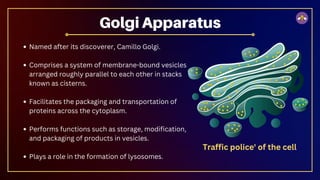
Named after its discoverer, Camillo Golgi.
Comprises a system of membrane-bound vesicles
arranged roughly parallel to each other in stacks
known as cisterns.
Facilitates the packaging and transportation of
proteins across the cytoplasm.
Performs functions such as storage, modification,
and packaging of products in vesicles.
Plays a role in the formation of lysosomes.
Golgi Apparatus
Traffic police' of the cell
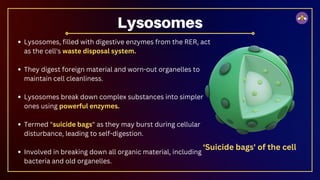
Lysosomes, filled with digestive enzymes from the RER, act
as the cell's waste disposal system.
They digest foreign material and worn-out organelles to
maintain cell cleanliness.
Lysosomes break down complex substances into simpler
ones using powerful enzymes.
Termed "suicide bags" as they may burst during cellular
disturbance, leading to self-digestion.
Involved in breaking down all organic material, including
bacteria and old organelles.
Lysosomes
‘Suicide bags' of the cell
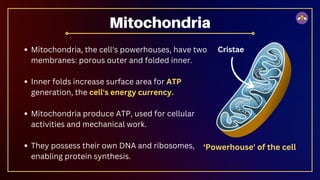
Mitochondria, the cell's powerhouses, have two
membranes: porous outer and folded inner.
Inner folds increase surface area for ATP
generation, the cell's energy currency.
Mitochondria produce ATP, used for cellular
activities and mechanical work.
They possess their own DNA and ribosomes,
enabling protein synthesis.
Mitochondria
‘Powerhouse' of the cell
Cristae
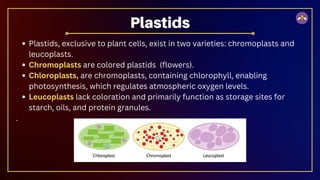
Plastids, exclusive to plant cells, exist in two varieties: chromoplasts and
leucoplasts.
Chromoplasts are colored plastids (flowers).
Chloroplasts, are chromoplasts, containing chlorophyll, enabling
photosynthesis, which regulates atmospheric oxygen levels.
Leucoplasts lack coloration and primarily function as storage sites for
starch, oils, and protein granules.
.
Plastids
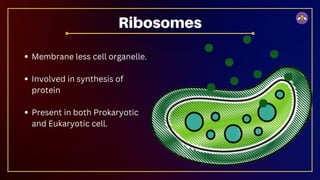
Membrane less cell organelle.
Involved in synthesis of
protein
Present in both Prokaryotic
and Eukaryotic cell.
Ribosomes
Q. Which of these options are not the functions of ribosomes?
I. It helps in manufacture of protein molecules.
II. It helps in manufacture of enzymes.
III. It helps in manufacture of hormones.
IV. It helps in manufacture of starch molecules.
(a) I and II
(b) I and III
(c) III and IV
(d) IV and I
(PYQ)
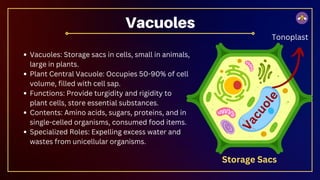
Vacuoles: Storage sacs in cells, small in animals,
large in plants.
Plant Central Vacuole: Occupies 50-90% of cell
volume, filled with cell sap.
Functions: Provide turgidity and rigidity to
plant cells, store essential substances.
Contents: Amino acids, sugars, proteins, and in
single-celled organisms, consumed food items.
Specialized Roles: Expelling excess water and
wastes from unicellular organisms.
Vacuoles
V
a
c
u
o
l
e
Storage Sacs
Tonoplast
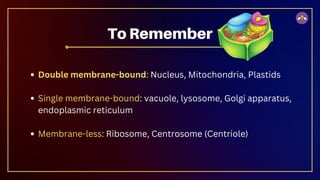
Double membrane-bound: Nucleus, Mitochondria, Plastids
Single membrane-bound: vacuole, lysosome, Golgi apparatus,
endoplasmic reticulum
Membrane-less: Ribosome, Centrosome (Centriole)
To Remember
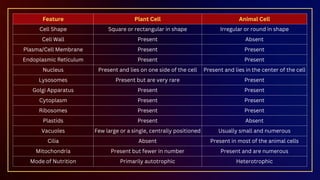
Feature Plant Cell Animal Cell
Cell Shape Square or rectangular in shape Irregular or round in shape
Cell Wall Present Absent
Plasma/Cell Membrane Present Present
Endoplasmic Reticulum Present Present
Nucleus Present and lies on one side of the cell Present and lies in the center of the cell
Lysosomes Present but are very rare Present
Golgi Apparatus Present Present
Cytoplasm Present Present
Ribosomes Present Present
Plastids Present Absent
Vacuoles Few large or a single, centrally positioned Usually small and numerous
Cilia Absent Present in most of the animal cells
Mitochondria Present but fewer in number Present and are numerous
Mode of Nutrition Primarily autotrophic Heterotrophic
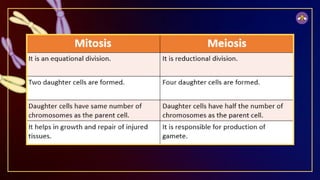
Cell division is the process through which new cells are formed in
organisms.
New cells formed for growth, cell replacement, and reproduction.
Two main types: mitosis and meiosis.
Cell Division
Q. In brief state what happens when
(a) Dry apricots are left for sometime in pure water and later
transferred to sugar solution?
(b) A red blood cell is kept in concentrated saline solution?
(c) The plasma membrane of a cell breaks down?
(d) Rhoeo leaves are boiled in water first and then a drop of sugar
syrup is put on it?
(e) Golgi apparatus is removed from the cell?
(PYQ)
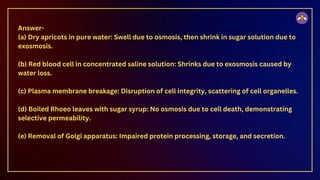
Answer-
(a) Dry apricots in pure water: Swell due to osmosis, then shrink in sugar solution due to
exosmosis.
(b) Red blood cell in concentrated saline solution: Shrinks due to exosmosis caused by
water loss.
(c) Plasma membrane breakage: Disruption of cell integrity, scattering of cell organelles.
(d) Boiled Rhoeo leaves with sugar syrup: No osmosis due to cell death, demonstrating
selective permeability.
(e) Removal of Golgi apparatus: Impaired protein processing, storage, and secretion.
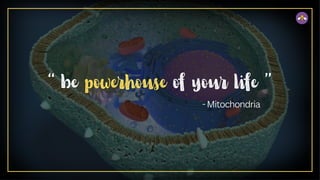
“ be powerhouse of your life ”