

Web 2.0 & Online Communities, Summer School 2011


  Day 4: Projects & Internet/Web technologies
This week (Week 2)
Tuesday (day 4):
– Internet/Web technologies (web server, HTML, AJAX, 
  ...)
Wednesday (day 5):
– Diving deeper into Facebook pages
Thursday (day 6):
– Social media case studies (strategies!)
– Power of free (Phil Osborne ‐ Marketing)
Assessment:
– Blog assignment  1
– Group roles organised & ideas being explored

                                                        2
Getting these things done
Us:
– Group allocations (done)
– Blog assignment 1 (done)
– Schedule (today?)
You:
– Who wants to be the class rep?
– Start thinking of viable online community ideas 
– All accounts set up including blogs, Twitter accounts, 
  & wiki page
– Blog assignment submitted by Friday 5:00pm
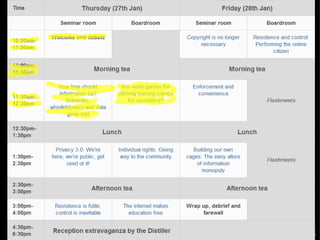
– Who wants to be on a gaming panel at IRGO 2?
                                                            3
Gaming blurb
“Resistance and control are familiar themes in video games. In 
fact, a great majority of plots and narratives found in games 
focus on humans battling it out with some form of invader 
(e.g., aliens, demons, zombies) or fomenting a rebellion against 
some giant corporation or governmental authority. The notion 
of control is also central in video games. First and foremost, the 
player controls the avatar and in many ways ‘plays god’ with its 
life and death. But the game itself also controls the player 
through the available choices of avatars and their skills, and 
the parameters of the game and its environment, practically 
begging players to try to circumvent them.

This panel will discuss the idea that video games are the 
ultimate training camps for resistance in the 21st century 
?real? world.”                                                        4
5
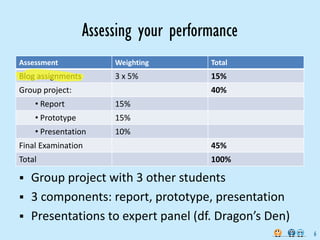
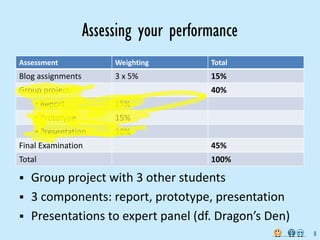
Assessing your performance
Assessment              Weighting       Total
Blog assignments        3 x 5%          15%
Group project:                          40%
    • Report            15%
    • Prototype         15%
    • Presentation      10%
Final Examination                       45%
Total                                   100%

   Group project with 3 other students
   3 components: report, prototype, presentation
   Presentations to expert panel (df. Dragon’s Den)
                                                      6
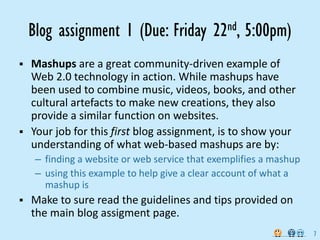
Blog assignment 1 (Due: Friday           22 nd,   5:00pm)
Mashups are a great community‐driven example of 
Web 2.0 technology in action. While mashups have 
been used to combine music, videos, books, and other 
cultural artefacts to make new creations, they also 
provide a similar function on websites.
Your job for this first blog assignment, is to show your 
understanding of what web‐based mashups are by:
 – finding a website or web service that exemplifies a mashup
 – using this example to help give a clear account of what a 
   mashup is
Make to sure read the guidelines and tips provided on 
the main blog assigment page.
                                                                7
Assessing your performance
Assessment              Weighting       Total
Blog assignments        3 x 5%          15%
Group project:                          40%
    • Report            15%
    • Prototype         15%
    • Presentation      10%
Final Examination                       45%
Total                                   100%

   Group project with 3 other students
   3 components: report, prototype, presentation
   Presentations to expert panel (df. Dragon’s Den)
                                                      8
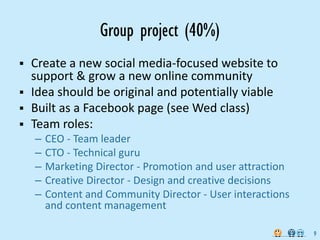
Group project (40%)
Create a new social media‐focused website to 
support & grow a new online community
Idea should be original and potentially viable
Built as a Facebook page (see Wed class)
Team roles:
–   CEO ‐ Team leader
–   CTO ‐ Technical guru
–   Marketing Director ‐ Promotion and user attraction
–   Creative Director ‐ Design and creative decisions
–   Content and Community Director ‐ User interactions 
    and content management

                                                          9
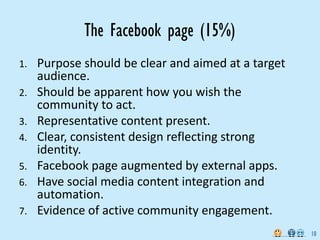
The Facebook page (15%)
1.   Purpose should be clear and aimed at a target 
     audience.
2.   Should be apparent how you wish the 
     community to act.
3.   Representative content present.
4.   Clear, consistent design reflecting strong 
     identity.
5.   Facebook page augmented by external apps.
6.   Have social media content integration and 
     automation.
7.   Evidence of active community engagement.
                                                      10
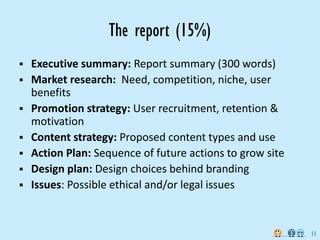
The report (15%)
Executive summary: Report summary (300 words)
Market research: Need, competition, niche, user 
benefits
Promotion strategy: User recruitment, retention & 
motivation
Content strategy: Proposed content types and use
Action Plan: Sequence of future actions to grow site
Design plan: Design choices behind branding
Issues: Possible ethical and/or legal issues


                                                       11
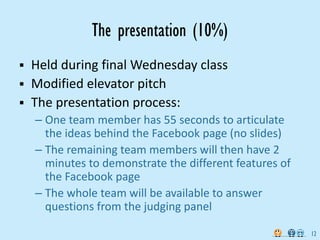
The presentation (10%)
Held during final Wednesday class
Modified elevator pitch
The presentation process:
– One team member has 55 seconds to articulate 
  the ideas behind the Facebook page (no slides)
– The remaining team members will then have 2 
  minutes to demonstrate the different features of 
  the Facebook page
– The whole team will be available to answer 
  questions from the judging panel

                                                      12
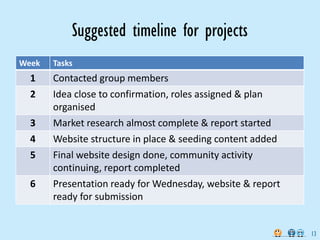
Suggested timeline for projects
Week   Tasks
  1    Contacted group members
  2    Idea close to confirmation, roles assigned & plan 
       organised
  3    Market research almost complete & report started
  4    Website structure in place & seeding content added
  5    Final website design done, community activity 
       continuing, report completed
  6    Presentation ready for Wednesday, website & report 
       ready for submission


                                                             13
Time to meet your group mates!


END OF PART 1
                                 14
Part 2: Internet/Web
    technologies
                       15
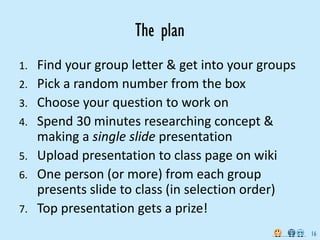
The plan
1.   Find your group letter & get into your groups
2.   Pick a random number from the box
3.   Choose your question to work on
4.   Spend 30 minutes researching concept & 
     making a single slide presentation
5.   Upload presentation to class page on wiki
6.   One person (or more) from each group 
     presents slide to class (in selection order)
7.   Top presentation gets a prize!
                                                     16
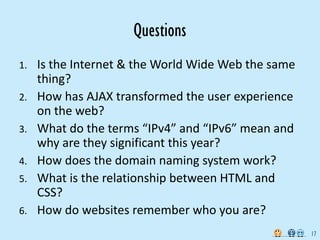
Questions
1.   Is the Internet & the World Wide Web the same 
     thing?
2.   How has AJAX transformed the user experience 
     on the web?
3.   What do the terms “IPv4” and “IPv6” mean and 
     why are they significant this year?
4.   How does the domain naming system work?
5.   What is the relationship between HTML and 
     CSS?
6.   How do websites remember who you are?
                                                      17
The end

          18

Class 5: Project details