Lecture 5


 Privacy, TOS &
   Copyrights
This week (Week 3!)
• Tuesday (day 7):
  – Privacy, TOS, copyright
  – #eqnz (Sarah Gallagher)
• Wednesday (day 8):
  – Mashing up web content
• Thursday (day 9):
  – Adopting and Integrating SM in organisations
  – Suzanne Frew: Social Media in Disaster
• Miscellany:
  – Blog assignment 1 marks (today or tomorrow)
  – Blog assignment 2 due Friday
  – Project: Idea selected, research underway, page
    created
                                                      2
Blog comments
• Copying without acknowledging is a breach of copyright
• Titles not descriptive and not containing keywords of post
  (i.e., don’t use COMP 113 or Assignment 1!)
• Links not embedded in the text but appended to the bottom
• Links open in the same tab not separate tabs
• Images and video discussed but not included in the post
• No comments and no sign of invitations to others to comment
• Closing paragraph is important and should include your
  likeness for others to comment
• Paragraphs too dense
• Difficult to see a author point of view
• Typos!

                                                         3
PART 1
Terms of privacy
       &
   Copyrights


                   4
Google knows all
Facebook is exposing our life


                           5
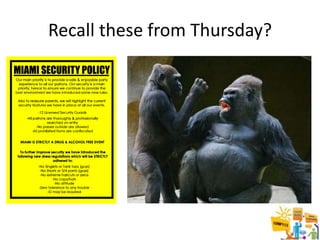
Recall these from Thursday?


                              6
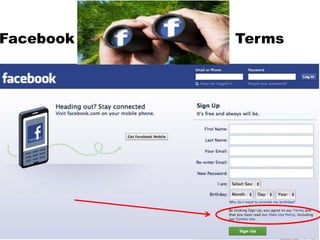
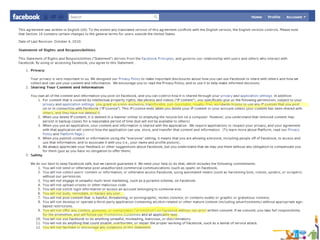
Facebook   Terms
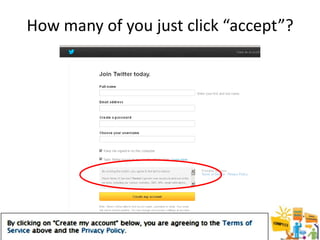
How many of you just click “accept”?


                                       8
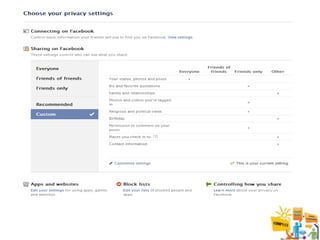
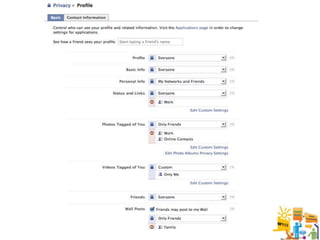
TOS and privacy policies
• Provided by all community-driven websites
  – E.g., Facebook, Twitter, Ning, etc.
• Governs collection, storage, transfer, usage, etc.
  of user data by operators (services)
• Sets expectations of behaviour and
  responsibilities of both parties
• Users agree to adhere to TOS and privacy policy
• Lays out consequences of breaching TOS or
  privacy guidelines
Types of data collection
• Mandatory personal information:
  – Collected on registration
  – Name, email address, password
• Optional personal information:
  – Identity driven
  – Biography, photos, tags, location, interests, ...
• Log information:
  – Automatic (IP address, browser, visited pages, ...)
  – 3rd party services (Google analytics)
  – Cookies (file stored on your machine)
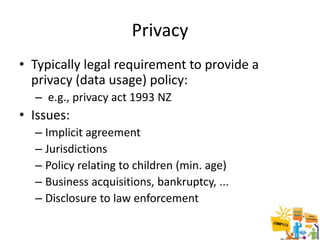
Privacy
• Typically legal requirement to provide a
  privacy (data usage) policy:
  – e.g., privacy act 1993 NZ
• Issues:
  – Implicit agreement
  – Jurisdictions
  – Policy relating to children (min. age)
  – Business acquisitions, bankruptcy, ...
  – Disclosure to law enforcement
12
14
15
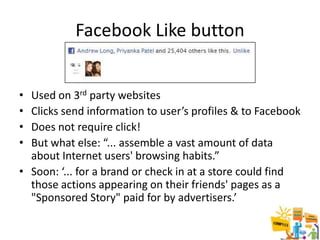
Facebook Like button


• Used on 3rd party websites
• Clicks send information to user’s profiles & to Facebook
• Does not require click!
• But what else: “... assemble a vast amount of data
  about Internet users' browsing habits.”
• Soon: ‘... for a brand or check in at a store could find
  those actions appearing on their friends' pages as a
  "Sponsored Story" paid for by advertisers.’

                                                        16
Content & copyright

• What is a copyright?
• How does a work get copyrighted?
• How does copyright work with social
  media?


                                        17
Remember this?


[Adapted: http://www.sizlopedia.com]
The online content situation
• User generated content (UGC)
• Roles: Consumer, producer, sharer, remixer, …
• Much social media lives by this model
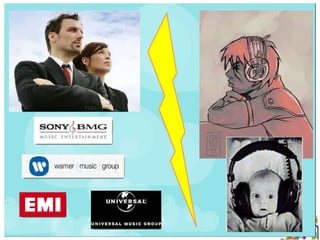
• Original content producers
  (Sony, Universal, …) & representatives
  (MPAA, RIAA) dislike copying, remixing &
  sharing
• Copyright breaches = thievery
• Mismatch between technology and law             19
20
Twitter Terms of service
The Twitter Terms of Service state that:
You retain your rights to any Content you
submit, post or display on or through the
Services. By submitting, posting or displaying
Content on or through the Services, you grant us
a worldwide, non-exclusive, royalty-free license
(with the right to sublicense) to
use, copy, reproduce, process, adapt, modify, pub
lish, transmit, display and distribute such Content
in any and all media or distribution methods (now
known or later developed).
                                                21
Facebook Terms
The Facebook Terms are stating that you (the
Facebook user) “own all of the content and
information you post on Facebook, and you
can control how it is shared through your
privacy and application settings. In
addition, for content protected by intellectual
property rights,
you grant us a non-
exclusive, transferable, sub-licensable, royalty-
free, worldwide license to use any IP content
that you post on or in connection with
Facebook (IP License).                       22
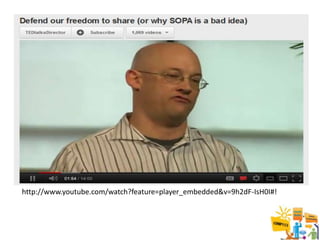
http://www.youtube.com/watch?feature=player_embedded&v=9h2dF-IsH0I#!


                                                                       23
Your Job
• Compare Facebook and Twitter privacy policies
  and answer these questions:
  1. Which privacy policy is easiest to locate?
  2. Which is the most onerous and why?
  3. Which (if any) appears to hold user’s interests as
     paramount?
  4. Which service do you trust more?
  5. Anything in the policies that you find especially
     troubling?
  6. Are there any other privacy issues that these
     services can’t control?

                                                          24
In your own time
1. Consider your online practices in relation to
   consumption and discuss with your neighbour
2. Imagine if the SOPA & PIPA had gone ahead (in
   addition to NZ equivalents), how would they have
   changed how you use online content for each of the
   following activities:
   – Consume
   – Produce
   – Share
3. Apply an appropriate creative commons license to
   your blog (see: link below:
            http://www.creativecommons.org.nz
END OF PART 1


Time for a short commercial break
PART 2: #EQNZ


                27

5 privacy terms

  • 1.
    Lecture 5 Privacy,TOS & Copyrights
  • 2.
    This week (Week3!) • Tuesday (day 7): – Privacy, TOS, copyright – #eqnz (Sarah Gallagher) • Wednesday (day 8): – Mashing up web content • Thursday (day 9): – Adopting and Integrating SM in organisations – Suzanne Frew: Social Media in Disaster • Miscellany: – Blog assignment 1 marks (today or tomorrow) – Blog assignment 2 due Friday – Project: Idea selected, research underway, page created 2
  • 3.
    Blog comments • Copyingwithout acknowledging is a breach of copyright • Titles not descriptive and not containing keywords of post (i.e., don’t use COMP 113 or Assignment 1!) • Links not embedded in the text but appended to the bottom • Links open in the same tab not separate tabs • Images and video discussed but not included in the post • No comments and no sign of invitations to others to comment • Closing paragraph is important and should include your likeness for others to comment • Paragraphs too dense • Difficult to see a author point of view • Typos! 3
  • 4.
    PART 1 Terms ofprivacy & Copyrights 4
  • 5.
    Google knows all Facebookis exposing our life 5
  • 6.
    Recall these fromThursday? 6
  • 7.
    Facebook Terms
  • 8.
    How many ofyou just click “accept”? 8
  • 9.
    TOS and privacypolicies • Provided by all community-driven websites – E.g., Facebook, Twitter, Ning, etc. • Governs collection, storage, transfer, usage, etc. of user data by operators (services) • Sets expectations of behaviour and responsibilities of both parties • Users agree to adhere to TOS and privacy policy • Lays out consequences of breaching TOS or privacy guidelines
  • 10.
    Types of datacollection • Mandatory personal information: – Collected on registration – Name, email address, password • Optional personal information: – Identity driven – Biography, photos, tags, location, interests, ... • Log information: – Automatic (IP address, browser, visited pages, ...) – 3rd party services (Google analytics) – Cookies (file stored on your machine)
  • 11.
    Privacy • Typically legalrequirement to provide a privacy (data usage) policy: – e.g., privacy act 1993 NZ • Issues: – Implicit agreement – Jurisdictions – Policy relating to children (min. age) – Business acquisitions, bankruptcy, ... – Disclosure to law enforcement
  • 12.
  • 13.
  • 14.
  • 15.
    Facebook Like button •Used on 3rd party websites • Clicks send information to user’s profiles & to Facebook • Does not require click! • But what else: “... assemble a vast amount of data about Internet users' browsing habits.” • Soon: ‘... for a brand or check in at a store could find those actions appearing on their friends' pages as a "Sponsored Story" paid for by advertisers.’ 16
  • 16.
    Content & copyright •What is a copyright? • How does a work get copyrighted? • How does copyright work with social media? 17
  • 17.
  • 18.
    The online contentsituation • User generated content (UGC) • Roles: Consumer, producer, sharer, remixer, … • Much social media lives by this model • Original content producers (Sony, Universal, …) & representatives (MPAA, RIAA) dislike copying, remixing & sharing • Copyright breaches = thievery • Mismatch between technology and law 19
  • 19.
  • 20.
    Twitter Terms ofservice The Twitter Terms of Service state that: You retain your rights to any Content you submit, post or display on or through the Services. By submitting, posting or displaying Content on or through the Services, you grant us a worldwide, non-exclusive, royalty-free license (with the right to sublicense) to use, copy, reproduce, process, adapt, modify, pub lish, transmit, display and distribute such Content in any and all media or distribution methods (now known or later developed). 21
  • 21.
    Facebook Terms The FacebookTerms are stating that you (the Facebook user) “own all of the content and information you post on Facebook, and you can control how it is shared through your privacy and application settings. In addition, for content protected by intellectual property rights, you grant us a non- exclusive, transferable, sub-licensable, royalty- free, worldwide license to use any IP content that you post on or in connection with Facebook (IP License). 22
  • 22.
  • 23.
    Your Job • CompareFacebook and Twitter privacy policies and answer these questions: 1. Which privacy policy is easiest to locate? 2. Which is the most onerous and why? 3. Which (if any) appears to hold user’s interests as paramount? 4. Which service do you trust more? 5. Anything in the policies that you find especially troubling? 6. Are there any other privacy issues that these services can’t control? 24
  • 24.
    In your owntime 1. Consider your online practices in relation to consumption and discuss with your neighbour 2. Imagine if the SOPA & PIPA had gone ahead (in addition to NZ equivalents), how would they have changed how you use online content for each of the following activities: – Consume – Produce – Share 3. Apply an appropriate creative commons license to your blog (see: link below: http://www.creativecommons.org.nz
  • 25.
    END OF PART1 Time for a short commercial break
  • 26.

Editor's Notes

  • #6 Youtube in the wiki
  • #10 Disclaimers, rights, ...
  • #17 http://news.cnet.com/8301-13578_3-20006532-38.htmlhttp://www.facebook.com/help/?faq=17512
  • #21 Tension between fans (access to the content they love) versus the control of distributors (don’t make content, artists do)
  • #22 In other words, Twitter users grant Twitter a license to make Tweets available to other Twitter users.
  • #24 http://www.guardian.co.uk/commentisfree/cifamerica/2012/jan/18/sopa-pipa-consumption-only-internethttp://www.youtube.com/watch?feature=player_embedded&v=9h2dF-IsH0I#!
  • #25 http://twitter.com/privacyhttp://www.facebook.com/policy.php