MEDP/FILMP 160: Summer 2015
Plan for Today
A Brief History of the Moving Image (Film)
Basic Intro to Framing and camera moves
Introduce shooting exercise (lab #3)
Introduce Assignment 1: Define a Space
When you pick up a camera ...
First photograph: 1830
Etienne-Jules Marey, Pelican Studies 1882
Matrix Trilogy, 1999 - 2003 Muybridge experiments
1877
Why does this matter?
aka “Persistence of Vision”
flipbook
“Short Range Apparent Motion”
victorian toys (mid-1800’s)
zoetrope
thaumatrope
Photography - silver nitrate
Daguerrotype, 1839
Boulevard du Temple, 1838
Edison’s Kinetograph (1891)
first movie cameras
Lumieres’ Cinematographe (1895)
Clip from Pioneers of Cinema
qualities of early film
•black and white
•silent
•grainy
•flicker
•short
•Square
•Basic lighting
how film cameras work
Intermittent movement: stop and start action that
positions the film one frame at a time in the gate, using
sprocket holes.
the film shutter
how the camera gate works
how film projectors work
frame rate
• flip book = 10 fps
• early film cameras = 16 fps
• modern film cameras = 24 fps
• video = 30 fps (NTSC, US)
24 (sometimes)
25 (PAL, Europe)
What frame rate should I shoot at?
24 (24p) vs. 30 (60i)?
● film “look”
● subject matter
● destination
● transfer to film?
Time Lapse
(“under-cranking”)
http://en.wikipedia.org/wiki/
Time-lapse_photography
What if you shoot at one frame rate
and play back (project) at another?
Slow Motion http://en.wikipedia.org/wiki/Slow_motion
(“over-cranking”)
film formats
Resolution
aspect ratio
Days of Heaven (Terrence Malick, 1978)
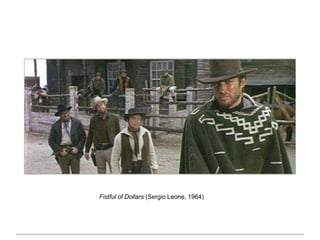
Fistful of Dollars (Sergio Leone, 1964)
some aspect ratios
why aspect ratio matters now
Setting up cameras - most of what you
shoot now will be 16 x 9 but older material
other formats. You may have started a film
on SD 4:3 aspect ratio, then moved HiDef
halfway through.
Or, you may be incorporating archival
footage that was shot on film, or SD video.
pillarbox
“letterboxing”
basic cinematic
vocabulary
shot sizes & types
FILM/MEDIA 160 • LEC 02 PT 2
extreme long shot (e.l.s.)
long shot (l.s.)
medium long shot (m.l.s.)
medium shot (m.s.)
medium close up (m.c.u.)
close up (c.u.)
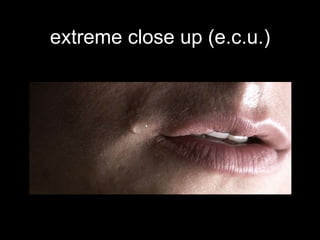
extreme close up (e.c.u.)
two shot
low angle shot
high angle shot
Moving the camera through space
Pivot moves: Pan (right/left)
Tilt
(up/down)
Dynamic moves: Track/Truck (right/left)
Dolly
(in/out)
Boom (up/down)
Examples of camera moves:
• Manufactured Landscapes Clip 2
• Manufactured Landscape Clip 1
• Citizen Kane Clip 1
• Farmingville Clip 1
Camera Workshop Exercise
In your groups, go out (not too far!) and shoot the following:
1. One subject you can shoot from at least three different points of view (various shot sizes or camera angles).
2. A shot where you zoom in to emphasize an important detail.
3. A shot where you zoom out from a close-up to reveal its context.
4. A shot where the frame stays still but there is movement within the frame.
5. A pan or tilt that has clear beginning and end destinations for your camera.
6. Walk with a person (your partner) maintaining consistent distance and framing.
Try and plan your shots before pushing the record button. Remember to look AT the viewfinder, not THROUGH
it.

Class 2 lecture summer