Understanding Aspect Ratios
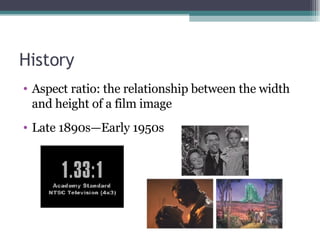
History Aspect ratio: the relationship between the width and height of a film image Late 1890s—Early 1950s
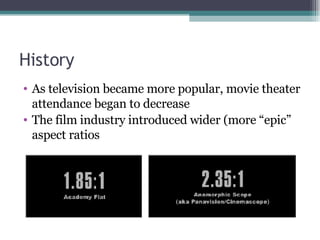
History As television became more popular, movie theater attendance began to decrease The film industry introduced wider (more “epic” aspect ratios
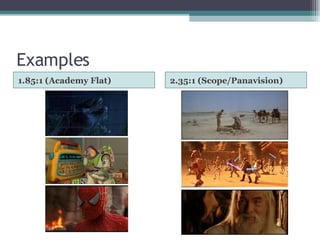
Examples 1.85:1 (Academy Flat) 2.35:1 (Scope/Panavision)
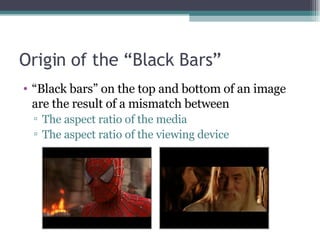
Origin of the “Black Bars” “ Black bars” on the top and bottom of an image are the result of a mismatch between  The aspect ratio of the media The aspect ratio of the viewing device
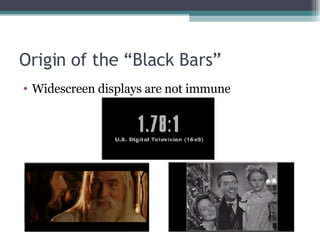
Origin of the “Black Bars” Widescreen displays are not immune
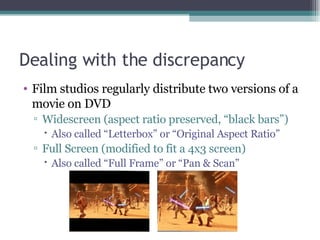
Dealing with the discrepancy Film studios regularly distribute two versions of a movie on DVD Widescreen (aspect ratio preserved, “black bars”) Also called “Letterbox” or “Original Aspect Ratio” Full Screen (modified to fit a 4x3 screen)  Also called “Full Frame” or “Pan & Scan”
How to Tell the Difference
Summary “ Aspect ratio” defined 1.33:1 1.85:1 2.35:1 “ Black bars” described Widescreen versus Full Screen

Mba 509 Understanding Aspect Ratios

  • 1.
  • 2.
    History Aspect ratio:the relationship between the width and height of a film image Late 1890s—Early 1950s
  • 3.
    History As televisionbecame more popular, movie theater attendance began to decrease The film industry introduced wider (more “epic” aspect ratios
  • 4.
    Examples 1.85:1 (AcademyFlat) 2.35:1 (Scope/Panavision)
  • 5.
    Origin of the“Black Bars” “ Black bars” on the top and bottom of an image are the result of a mismatch between The aspect ratio of the media The aspect ratio of the viewing device
  • 6.
    Origin of the“Black Bars” Widescreen displays are not immune
  • 7.
    Dealing with thediscrepancy Film studios regularly distribute two versions of a movie on DVD Widescreen (aspect ratio preserved, “black bars”) Also called “Letterbox” or “Original Aspect Ratio” Full Screen (modified to fit a 4x3 screen) Also called “Full Frame” or “Pan & Scan”
  • 8.
    How to Tellthe Difference
  • 9.
    Summary “ Aspectratio” defined 1.33:1 1.85:1 2.35:1 “ Black bars” described Widescreen versus Full Screen