PGCE Art & Design
Moving Image Arts Module
Day 3 A.M. Session
Camera & Editing
Continuity Film-making
Robert Thompson
Who were the first film editors?
Video Study: Editing History
Note: Film history in MIA is about context (students
are tested on creative technique, not history)
Editing History
•Early film-makers pessimistic about future
•Edison’s assistant, Edwin Porter, experiments with cutting film
•DW Griffith establishes a grammar of film
•Initially a technical role, Editors now partner creatively with directors
The Hollywood Factory System
What is continuity style (classical Hollywood style) film-making?
What was classical hollywood?
Video Study: Classical Hollywood
What are the elements of Classical Hollywood or Continuity film-making
•Invisible storytelling: Camera and sound never draw attention to themselves
•Match-on-action
•Time is continuous (except for Flashback)
•OTS (Over-the-shoulder shots)
•Eyeline match
•Visual Storytelling
•Cross-cutting
•POV (point-of-view)
Short Video Studies:
Visual Storytelling (Rear Window)
Cross-cutting: 1 (Strangers on a Train)
Cross-cutting: 2 (Silence of the lambs)
POV (Silence of the lambs)
Camera
1. Framing
2. Position
3. Movement
Camera Framing: Key Terms
Shot Type (ELS, LS, MS, MCU, CU, ECU)
Establishing Shot
Silhouette
Camera Movement: Key Terms
Tracking (Dolly)
Trombone shot (Dolly Zoom)
SteadicamHand-held
Panning
Whip Cut: Uses whip motion as a transition
Subjective (Snorricam)
Camera Position – Key Terms
Low AngleOTS
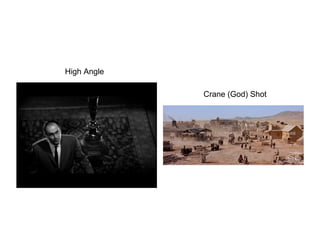
Crane (God) Shot
High Angle
POV
Dutch Angle
Video Study 1: Zooming and Handheld Camera
•Barry Lyndon – Zoom
•Handheld 1 – Blair witch hunt
•Golden Rule – Camera should be on a tripod unless there is a reason
for it not to be
•Editing – Great Expectations
Video Study 2: Goodfellas in production
Slomo
Freezeframe
Handheld camera
Some improvisation around script
Epic steadicam tracking shot (Entrance to nightclub)
Slow motion tracking shot (Jimmy Conway decides to murder)
Jump-cutting at wedding
Panning at wedding
Creating drug-induced confusion
Video Study 3: The Trombone Shot (dolly zoom)
•Zooming in from a distance will ‘flatten’ the field of view
•Zooming while tracking will keep the foreground subject a uniform size
while the background subject will appear to grow
Video Study 4:
Camera Framing
Camera Movement
Tracking
Crane Shot
Camera framing in The Third Man
Camera Movement in The Untouchables (Panning|Crane)
Tracking Shot (Klute)
Crane Shot/God Shot (Citizen Kane|Halloween|Raising Arizona|Highlander|
Origins)
Video Study 5: The Steadicam
Summary: The most important camera & editing
Techniques
Freezeframe
Timelapse
Reverse shot
Fast/slow motion
Jump-cutting
Ken Burns effect
Video Scratch
Tracking
Jump-cut
Trombone shot
Panning/Tilting
POV
OTS
Steadicam
Crane Shot
Low Angle/High Angle

Day 3 am cam_edit_continuity

  • 1.
    PGCE Art &Design Moving Image Arts Module Day 3 A.M. Session Camera & Editing Continuity Film-making Robert Thompson
  • 2.
    Who were thefirst film editors? Video Study: Editing History Note: Film history in MIA is about context (students are tested on creative technique, not history)
  • 3.
    Editing History •Early film-makerspessimistic about future •Edison’s assistant, Edwin Porter, experiments with cutting film •DW Griffith establishes a grammar of film •Initially a technical role, Editors now partner creatively with directors
  • 4.
    The Hollywood FactorySystem What is continuity style (classical Hollywood style) film-making? What was classical hollywood? Video Study: Classical Hollywood
  • 5.
    What are theelements of Classical Hollywood or Continuity film-making •Invisible storytelling: Camera and sound never draw attention to themselves •Match-on-action •Time is continuous (except for Flashback) •OTS (Over-the-shoulder shots) •Eyeline match •Visual Storytelling •Cross-cutting •POV (point-of-view)
  • 6.
    Short Video Studies: VisualStorytelling (Rear Window) Cross-cutting: 1 (Strangers on a Train) Cross-cutting: 2 (Silence of the lambs) POV (Silence of the lambs)
  • 7.
  • 8.
  • 9.
    Shot Type (ELS,LS, MS, MCU, CU, ECU)
  • 10.
  • 14.
  • 15.
  • 16.
  • 18.
  • 19.
  • 20.
  • 21.
    Whip Cut: Useswhip motion as a transition
  • 22.
  • 23.
  • 24.
  • 25.
  • 28.
  • 31.
  • 32.
    Video Study 1:Zooming and Handheld Camera •Barry Lyndon – Zoom •Handheld 1 – Blair witch hunt •Golden Rule – Camera should be on a tripod unless there is a reason for it not to be •Editing – Great Expectations
  • 33.
    Video Study 2:Goodfellas in production Slomo Freezeframe Handheld camera Some improvisation around script Epic steadicam tracking shot (Entrance to nightclub) Slow motion tracking shot (Jimmy Conway decides to murder) Jump-cutting at wedding Panning at wedding Creating drug-induced confusion
  • 34.
    Video Study 3:The Trombone Shot (dolly zoom) •Zooming in from a distance will ‘flatten’ the field of view •Zooming while tracking will keep the foreground subject a uniform size while the background subject will appear to grow
  • 35.
    Video Study 4: CameraFraming Camera Movement Tracking Crane Shot Camera framing in The Third Man Camera Movement in The Untouchables (Panning|Crane) Tracking Shot (Klute) Crane Shot/God Shot (Citizen Kane|Halloween|Raising Arizona|Highlander| Origins)
  • 36.
    Video Study 5:The Steadicam
  • 37.
    Summary: The mostimportant camera & editing Techniques Freezeframe Timelapse Reverse shot Fast/slow motion Jump-cutting Ken Burns effect Video Scratch Tracking Jump-cut Trombone shot Panning/Tilting POV OTS Steadicam Crane Shot Low Angle/High Angle