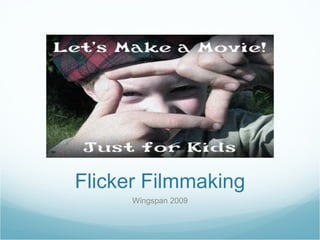
Flicker Filmmaking Wingspan 2009
What are we going to do in this Class? Learning how to make films- the entire process What Filmmaking is “storytelling through pictures and sound” Why we like the movies we like  What makes a movie good Watch awesome movies To learn what makes one movie good and another one forgettable. Find cool movies we haven’t seen before. Give you great ideas for movies you want to make Act out some of our favorite scenes from films Learn how to produce our own film Film Technology Three stages of production Storytelling
What are we going to do in this Class? Make our own Awesome Film!!
How Are we Going to do this? In order to get the most out of this class we have to follow the  TWO RULES RESPECT &  RESPONSIBILITY
The Two Rules Respect-
The Two Rules If you don’t follow the two rules you will be:  Warned. Then you will be sent on a time out Then you will be banned from the class and marked in the orange book.
The Spiderwick Chronicals We are watching this movie to better understand storytelling through film
What is filmmaking?
Great Stories = Great Films
A Story Has
ACT I The Beginning- Introduce Characters Introduces Plot, Setting, Location Introduces Conflict “ Who wants but so”
ACT II The Middle The plot Thickens Rising Action- What interesting things happen as they try to get around the conflict? Think of examples in movies you like?
ACT III Climax   The most intense moment of the conflict (final show down or moment of decision Resolution Tie up loose ends Do they get what they want or not? Do they change is the conflict solved?
Can you Identify:  Character introductions? The setting? Which Act We’re in? What the conflict (s) is/are? Anything visuals or situations that stick out in your mind? Is the story interesting or boring? Why?
How do you speak “movie?” As a filmmaker you have to convey as much information as possible with the images on the screen.  Introduce characters, convey emotion, set up conflicts Reveal information about character or locations or relationships.  how do you show how characters feel about each other without being boring or obvious?
Visual Storytelling What were some of the techniques the director used to tell the story Camera angles? Movement and position Placing the actors in the right place Colors, sets, lights Acting style, dialogue Costumes-
Composition Composition means where you place the subject in the frame The way you move the camera affects the viewer and your story. How you Frame the shot effects the Viewer Rule of Thirds Wide ,Medium, Close-Up,  Extreme Close-up
Position or  Camera Angle Where you place the camera affects the viewer’s perception  and the subject of your photograph  High Angle Low Angle
Camera Position How you angle or orient the camera can help you establish a point of view High angles Low angles  Eye Level Over the shoulder
Over the Shoulder
Establishing shot
Wide Angle
Full Length
Medium or Waist Shot
Bust Shot
Close Up
Extreme close ups
Composition, Position, Movement MOVEMENT The way you move the camera affects the viewer and your story. Common Camera Movements Pan/Tilt Dolly/Truck Arc Zoom
Lighting How much light and shadow you use can affect the tone of the photo The color temperature of the light can affect the feel of the picture or how the subject appears Warm colors- red, orange, yellow Cool colors- blue, purple, green Different colors have certain associations
Lighting and Position
Storyboarding To help plan their shots- filmmakers use story boards Like a visual script or comic strip that shows how each shot in the movie will go together.
Storyboarding Activity

Flickerfilms40

  • 1.
  • 2.
    What are wegoing to do in this Class? Learning how to make films- the entire process What Filmmaking is “storytelling through pictures and sound” Why we like the movies we like What makes a movie good Watch awesome movies To learn what makes one movie good and another one forgettable. Find cool movies we haven’t seen before. Give you great ideas for movies you want to make Act out some of our favorite scenes from films Learn how to produce our own film Film Technology Three stages of production Storytelling
  • 3.
    What are wegoing to do in this Class? Make our own Awesome Film!!
  • 4.
    How Are weGoing to do this? In order to get the most out of this class we have to follow the TWO RULES RESPECT & RESPONSIBILITY
  • 5.
    The Two RulesRespect-
  • 6.
    The Two RulesIf you don’t follow the two rules you will be: Warned. Then you will be sent on a time out Then you will be banned from the class and marked in the orange book.
  • 7.
    The Spiderwick ChronicalsWe are watching this movie to better understand storytelling through film
  • 8.
  • 9.
    Great Stories =Great Films
  • 10.
  • 11.
    ACT I TheBeginning- Introduce Characters Introduces Plot, Setting, Location Introduces Conflict “ Who wants but so”
  • 12.
    ACT II TheMiddle The plot Thickens Rising Action- What interesting things happen as they try to get around the conflict? Think of examples in movies you like?
  • 13.
    ACT III Climax The most intense moment of the conflict (final show down or moment of decision Resolution Tie up loose ends Do they get what they want or not? Do they change is the conflict solved?
  • 14.
    Can you Identify: Character introductions? The setting? Which Act We’re in? What the conflict (s) is/are? Anything visuals or situations that stick out in your mind? Is the story interesting or boring? Why?
  • 15.
    How do youspeak “movie?” As a filmmaker you have to convey as much information as possible with the images on the screen. Introduce characters, convey emotion, set up conflicts Reveal information about character or locations or relationships. how do you show how characters feel about each other without being boring or obvious?
  • 16.
    Visual Storytelling Whatwere some of the techniques the director used to tell the story Camera angles? Movement and position Placing the actors in the right place Colors, sets, lights Acting style, dialogue Costumes-
  • 17.
    Composition Composition meanswhere you place the subject in the frame The way you move the camera affects the viewer and your story. How you Frame the shot effects the Viewer Rule of Thirds Wide ,Medium, Close-Up, Extreme Close-up
  • 18.
    Position or Camera Angle Where you place the camera affects the viewer’s perception and the subject of your photograph High Angle Low Angle
  • 19.
    Camera Position Howyou angle or orient the camera can help you establish a point of view High angles Low angles Eye Level Over the shoulder
  • 20.
  • 21.
  • 22.
  • 23.
  • 24.
  • 25.
  • 26.
  • 27.
  • 28.
    Composition, Position, MovementMOVEMENT The way you move the camera affects the viewer and your story. Common Camera Movements Pan/Tilt Dolly/Truck Arc Zoom
  • 29.
    Lighting How muchlight and shadow you use can affect the tone of the photo The color temperature of the light can affect the feel of the picture or how the subject appears Warm colors- red, orange, yellow Cool colors- blue, purple, green Different colors have certain associations
  • 30.
  • 31.
    Storyboarding To helpplan their shots- filmmakers use story boards Like a visual script or comic strip that shows how each shot in the movie will go together.
  • 32.