LOMOGRAPHY
WHAT IS
?
Cameras today produce beautiful, high-
resolution images, automatic settings.
Everyone can now be a photographer.
But Where is the challenge in that?
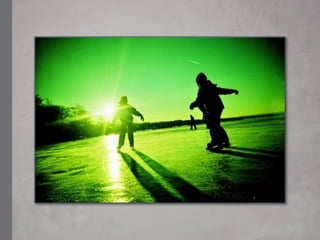
Lomographers use ‘wrong’ settings to their
advantage, creating one of a kind photos.
Lomography is a pretty recent type of
photography. The founders first experimented
with Lomo LC-A, a cheap Russian toy camera.
Lomography rules
1. Take your camera everywhere you go.
2. Use it any time – day and night.
3. Lomography is not an interference in your life, but a part of it.
4. Try to shoot from the hip.
5. Approach the objects of your Lomographic desire as close as possible.
6. Don’t think.
7. Be fast.
8. You don’t have to know beforehand what you captured on film.
9. Afterwards either.
10. Don’t worry about any rules!
Pros and Cons
Ironically, the disadvantages of lomography
can be used as an advantage, and vice versa.
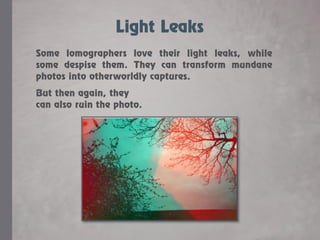
Light Leaks
Some lomographers love their light leaks, while
some despise them. They can transform mundane
photos into otherworldly captures.
But then again, they
can also ruin the photo.
Unpredictability
This is what makes lomography so fun and
so frustrating. Lomo cameras are highly
unpredictable– like it has a life of its own.
That’s why most of the beautiful lomo
photos are ‘happy accidents’.
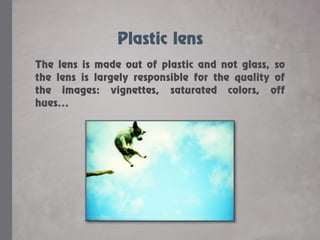
Plastic lens
The lens is made out of plastic and not glass, so
the lens is largely responsible for the quality of
the images: vignettes, saturated colors, off
hues...
How to Get Started?
1. Choose your weapon
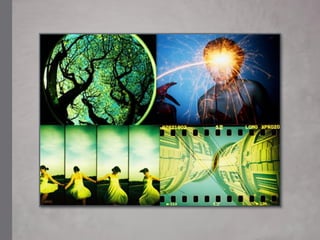
Different cameras have different uses, features and
effects. For example, the Fisheye takes a 170-degree
view around you, creating an almost circular image and
Colorsplash has some really colorful flashes.
Do your research and determine the
type of photos you want to achieve.
Also note that some lomo cameras use different kinds
of film. Buy cheap rolls of film first to use as your test
roll. 400 iso film is great for most conditions.
2. Choose your film
3. Experiment with different effects!
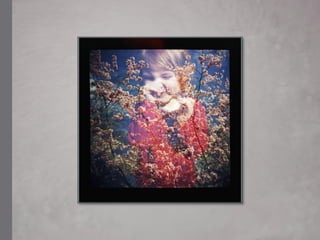
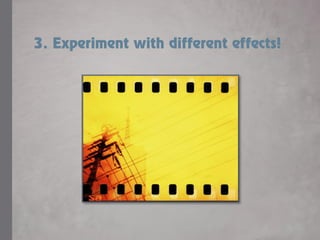
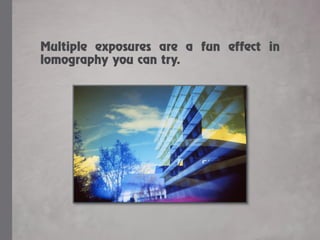
Multiple exposures are a fun effect in
lomography you can try.
4. Meet and share with fellow
lomographers
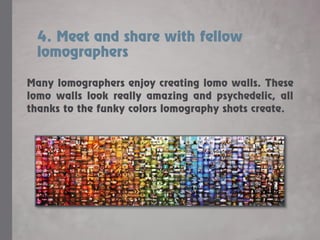
Many lomographers enjoy creating lomo walls. These
lomo walls look really amazing and psychedelic, all
thanks to the funky colors lomography shots create.
Wanna Learn more?
Check out our webinar!

What is Lomography?

  • 1.
  • 2.
    Cameras today producebeautiful, high- resolution images, automatic settings. Everyone can now be a photographer. But Where is the challenge in that?
  • 3.
    Lomographers use ‘wrong’settings to their advantage, creating one of a kind photos. Lomography is a pretty recent type of photography. The founders first experimented with Lomo LC-A, a cheap Russian toy camera.
  • 5.
    Lomography rules 1. Takeyour camera everywhere you go. 2. Use it any time – day and night. 3. Lomography is not an interference in your life, but a part of it. 4. Try to shoot from the hip. 5. Approach the objects of your Lomographic desire as close as possible. 6. Don’t think. 7. Be fast. 8. You don’t have to know beforehand what you captured on film. 9. Afterwards either. 10. Don’t worry about any rules!
  • 6.
    Pros and Cons Ironically,the disadvantages of lomography can be used as an advantage, and vice versa.
  • 7.
    Light Leaks Some lomographerslove their light leaks, while some despise them. They can transform mundane photos into otherworldly captures. But then again, they can also ruin the photo.
  • 8.
    Unpredictability This is whatmakes lomography so fun and so frustrating. Lomo cameras are highly unpredictable– like it has a life of its own. That’s why most of the beautiful lomo photos are ‘happy accidents’.
  • 10.
    Plastic lens The lensis made out of plastic and not glass, so the lens is largely responsible for the quality of the images: vignettes, saturated colors, off hues...
  • 11.
    How to GetStarted? 1. Choose your weapon Different cameras have different uses, features and effects. For example, the Fisheye takes a 170-degree view around you, creating an almost circular image and Colorsplash has some really colorful flashes. Do your research and determine the type of photos you want to achieve.
  • 13.
    Also note thatsome lomo cameras use different kinds of film. Buy cheap rolls of film first to use as your test roll. 400 iso film is great for most conditions. 2. Choose your film
  • 14.
    3. Experiment withdifferent effects!
  • 15.
    Multiple exposures area fun effect in lomography you can try.
  • 16.
    4. Meet andshare with fellow lomographers Many lomographers enjoy creating lomo walls. These lomo walls look really amazing and psychedelic, all thanks to the funky colors lomography shots create.
  • 17.
    Wanna Learn more? Checkout our webinar!